Fake and low-quality eclipse glasses: how to sanity-check what you are about to trust
A pair of eclipse viewers can look convincing: dark film, scientific-looking text, an ISO number and perhaps a copied company address. None of those features, by itself, proves that the filter protects your eyes. Printing a standards claim is easy; manufacturing consistently safe filters and documenting credible laboratory testing is harder.
That makes this less like inspecting an ordinary consumer accessory and more like checking a chain of custody. Think of the task as fake and low-quality eclipse glasses: how to sanity-check what you are about to trust, not how to certify optics at a kitchen table. You can identify clear failures at home, but you cannot prove that a filter adequately blocks visible, ultraviolet and infrared radiation with a flashlight or visual inspection alone.
The strongest answer to how to tell fake solar eclipse glasses ISO 12312-2 is therefore a combination of traceable sourcing, meaningful labeling, physical inspection and correct use. If you need viewers for your family, school or community event, start with our ISO 12312-2 eclipse glasses rather than leaving the purchase until unfamiliar sellers flood the market.
The central rule: an ISO number is a claim, not proof
ISO 12312-2 is the international standard relevant to nonmagnifying filters intended for direct observation of the Sun. It addresses more than how dark a product appears. Its requirements concern transmission of visible, ultraviolet and infrared radiation, consistency across the filter, material quality, mounting, labeling and user instructions.
That distinction matters because your eyes cannot judge invisible ultraviolet and infrared transmission. Two filters may make the Sun look similarly dim while differing in properties that require calibrated laboratory equipment to measure. Safe-looking darkness is not a substitute for spectral testing.
The words iso 12312-2 glasses on a listing or package are consequently only a starting point. Anyone can print “ISO 12312-2” on cardboard. ISO does not inspect each product, issue a retail seal of approval or authorize NASA to certify individual brands. NASA explicitly says that it does not approve particular solar-viewer brands.
There is also no official category of aas approved eclipse glasses. The American Astronomical Society maintains a list of suppliers whose supporting evidence it has vetted, but that is different from placing an AAS approval mark on every pair. The useful question is whether you can trace the exact product to a known manufacturer or to a reseller publicly identified by that manufacturer.
For a deeper explanation of the standard’s role and limits, read our guide to ISO 12312-2 and eclipse viewers.
A five-part sanity check before you trust a viewer
No consumer checklist can replace laboratory testing. It can, however, expose missing information, suspicious provenance and physical defects before anyone looks toward the Sun.
1. Trace the seller back to the manufacturer
Record where you bought the viewers, the seller’s identity, the manufacturer named on the product and any order or batch information. Then verify the relationship using the manufacturer’s own website—not merely a marketplace description repeating the same claim.
A familiar manufacturer name on the frame is not enough. Counterfeiters can copy names, addresses and artwork. What matters is whether the product came directly from the manufacturer or through a seller that the manufacturer publicly recognizes as authorized.
Be cautious when a listing changes seller, fulfillment source or product details after you order. A large marketplace may host both legitimate and untraceable stock under similar-looking listings. A low price, fast shipping and thousands of generic reviews do not establish the origin of the filter in your hand.
2. Read the complete labeling
Look for a specific reference to ISO 12312-2, a responsible manufacturer or supplier name and address, instructions for direct solar viewing, warnings about damaged filters, and guidance appropriate to the market where the product is sold. Instructions should be readable and coherent rather than machine-generated fragments.
Missing contact details, contradictory directions, obvious spelling errors or claims such as “NASA certified” deserve scrutiny. Labels are evidence to investigate, not trust badges that settle the question. A polished hologram is no more meaningful than plain ink unless a credible organization explains who issued it and what it verifies.
3. Inspect every filter in bright ambient light
Hold the viewer away from your face and examine both sides. Discard it if the filter is scratched, torn, punctured, creased, peeling or separating from its frame. Check around the edges and nose opening, where handling damage can be easy to miss. Do not repair a questionable filter with tape.
For a group event, inspect individual pairs rather than assuming an unopened carton is uniform. Keep unused viewers dry and protected from sharp objects. If cardboard gets wet or warped, the filter may loosen from its mounting.
4. Use indoor and outdoor rejection checks correctly
The AAS suggests putting the viewers on indoors first. You should see essentially nothing through them, except perhaps an exceptionally bright lamp appearing very faint. If you can see furniture, walls or ordinary room details, the viewer is not dark enough and must not be used for solar observation.
Outside, while looking away from the Sun, the surroundings should remain invisible; an intense reflection may be barely visible. A viewer that fails either check is clearly unsuitable.
Passing does not prove safety. These checks can reveal some obviously bad filters, but they cannot measure the filter’s complete spectral transmission or establish that a laboratory report belongs to that product. A phone camera, flashlight, brightness app or comparison with another dark material cannot fill that gap.
5. Stop when the evidence does not add up
If the seller cannot identify the manufacturer, the manufacturer does not recognize the seller, the report refers to another product, or the filter is damaged, do not negotiate with your uncertainty. Return or discard the viewers and replace them through a traceable source.
This is the practical core of how to know if eclipse glasses are safe: confidence should come from the documented supply chain and accredited testing, supported by intact construction and proper instructions. It should not come from a home experiment that merely failed to reveal a defect.
What a laboratory report can—and cannot—tell you
The question how can i check an iso certificate online? assumes there is one universal ISO database where a buyer can enter a product number. In practice, ISO writes standards; it does not maintain a consumer registry certifying every item that claims conformity.
A manufacturer may instead hold a quantitative test report from an independent laboratory. According to the AAS supplier-vetting process, meaningful evidence for direct solar viewers includes measurements of visible, UVA, UVB and infrared transmission, as well as transmission uniformity. The laboratory should be properly accredited, commonly to ISO/IEC 17025 for the relevant testing scope, by a recognized accreditation body. A one-page graphic saying “pass” without identifying the product, methods, results and competent laboratory is weak evidence.
When reviewing a report, compare its details with the item you are buying:
- Does the manufacturer’s legal identity match?
- Is the tested model or product construction clearly identified?
- Does the report explicitly address ISO 12312-2 rather than an unrelated eyewear standard?
- Is the laboratory named, and can its accreditation and relevant scope be confirmed through the accrediting body?
- Are the report date, sample details and quantitative measurements present?
- Can the manufacturer confirm that the report is genuine and applies to current production?
Even a real report can be misused. A seller might display a report belonging to another factory, another filter material or an older model. Consumers should not have to conduct a forensic investigation for every pair, which is why buying through a documented, accountable channel is so important.
Why the full ISO document may sit behind a paywall
The question why are iso standards not free? has a mundane but important answer: standards organizations fund technical development, editing, translation, administration and distribution partly by selling standards. National standards bodies may also license or sell their versions. A paywall does not make the safety requirements secret, but it can make the full normative text less accessible to an ordinary buyer.
You do not need to purchase the standard to view an eclipse. Public guidance from the AAS, NASA and established astronomy organizations explains the consumer-facing principles. Manufacturers, laboratories and procurement teams need more detailed access because they must work with exact test methods, limits and documentation.
This also explains why a product page merely linking to ISO’s general website proves little. The relevant evidence is not that ISO 12312-2 exists; it is that the particular viewer was tested appropriately and can be traced to accountable production and distribution.
The home tests that people overtrust
A flashlight test is useful only in one direction: if ordinary detail is plainly visible, reject the filter. It cannot establish safe ultraviolet or infrared performance. The same limitation applies to shining a phone torch through the film, taking a photograph through it or holding two suspect viewers together.
Nor can you judge quality by the apparent color of the Sun. Depending on the filter material, a legitimate viewer may present the Sun as white, bluish white, yellow or orange. Color is not a pass/fail test.
The wording how do i know if my glasses are fake? also hides two separate problems. A counterfeit may copy another company’s identity, while a poorly documented viewer may be unsafe without imitating a recognizable product. Conversely, a counterfeit product might happen to attenuate sunlight adequately but still be fraudulently labeled. You should reject dubious provenance either way because you cannot responsibly infer consistent performance from one sample.
“How to check eclipse glasses” should therefore never collapse into “look through them and see whether the Sun feels comfortable.” Retinal injury is not a reliable real-time warning system, and apparent comfort does not validate invisible-wavelength protection.
How to use eclipse glasses once you trust the source
Correct sourcing does not cancel the need for correct handling. Before every session, inspect the filters again. If you wear prescription glasses, leave them on and place the eclipse viewers over them, or hold a solar viewer in front.
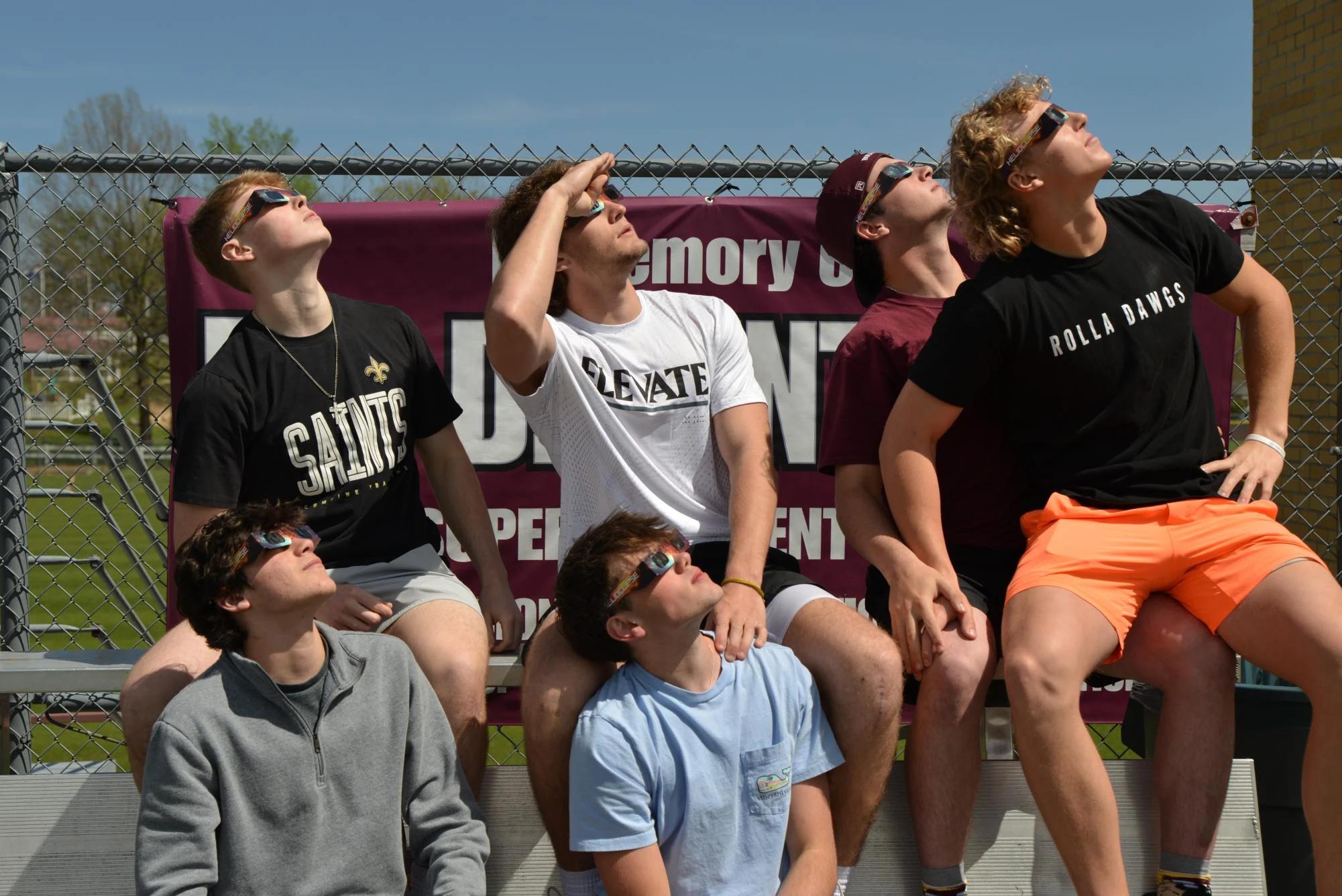
The safe sequence for how to use eclipse glasses is simple: stand still, cover your eyes before turning toward the Sun, take your look, then turn away before removing the viewer. Supervise children closely and check that the filter covers both eyes without gaps.
Never look through an unfiltered camera, telescope or binoculars while wearing solar eclipse glasses. Magnifying optics concentrate sunlight and require a purpose-built solar filter secured over the front aperture. An eyepiece-end filter is not a safe substitute, and ordinary eclipse viewers placed at your eyes cannot protect against concentrated rays from unfiltered optics.
During a partial or annular eclipse, certified viewers remain on whenever you look directly at the Sun. During a total eclipse, viewers may come off only when you are inside the path of totality and the Moon has completely covered the Sun’s bright face. Put them back on as soon as any bright photosphere reappears. Our phase-by-phase guide explains exactly when glasses stay on and when they can come off.
Proper, intact viewers that conform to the standard do not generally impose an arbitrary three-minute lifetime for a viewing session, although staring continuously adds little: the Moon’s movement becomes much clearer when you look briefly every few minutes. Follow the manufacturer’s current instructions and replace any viewer that becomes damaged.
No trusted glasses? Use projection, not improvisation
The phrase how to check solar eclipse without glasses? mixes up inspection and observation. If you do not have trusted viewers, you can still observe the partial phases indirectly with pinhole projection—but you must not test the eclipse by glancing at the Sun.
Stand with your back to the Sun and project its image onto the ground or a pale surface. Cross the slightly spread fingers of one hand over the other, use a card with a small hole, or watch the patterned shadow beneath a leafy tree. During the partial phases, each tiny opening projects a crescent image of the Sun.
Look at the projection, never through the hole. Ordinary sunglasses, smoked glass, exposed film, food wrappers and stacked photographic filters are not substitutes for purpose-made solar viewers.
If you accidentally view the Sun without suitable protection and later notice distorted vision, a central blind spot, unusual color perception or persistent visual discomfort, contact a qualified eye-care professional. Our explainer on why solar eye injury happens covers the risk without sensationalism.
Buying for a family, school or public event
Group procurement deserves more diligence than placing a large last-minute marketplace order. Our checklist follows aas/consumer-safety patterns: labeling red flags, vendor diligence, eclipse plan. In practice, that means establishing provenance first, inspecting stock when it arrives and building safe use into the event itself.
Ask the supplier for written confirmation of the manufacturer, product model, applicable testing and authorization to sell. Keep invoices, correspondence, packaging and batch details. Order early enough to inspect the delivery and replace it if the documentation or construction is unsatisfactory.
Search-style product claims such as approved solar eclipse glasses, eclipse glasses nasa approved and solar eclipse glasses iso 12312-2 certified often blur important distinctions. NASA does not certify retail brands, and ISO does not personally approve each pair. Favor precise claims backed by traceable evidence over impressive institutional names.
For schools, libraries and festivals, add these controls:
- Assign trained volunteers to distribute viewers and demonstrate their use.
- Inspect samples from every carton, then ask users to check their own pair for damage.
- Give children correctly fitting viewers and supervise them continuously.
- Keep spare viewers in protective packaging rather than loose on a table.
- Separate any telescope or camera area from naked-eye viewing and place an experienced operator in charge.
- Prepare pinhole projection as a safe backup and a useful group activity.
- Announce phase-specific rules before the event, not while everyone is already looking up.
A short briefing can prevent the most predictable mistakes. Show people how to cover their eyes before facing the Sun, explain why binoculars are a separate hazard, and make one person responsible for calling the end of totality if your site lies inside the total path.
Red flags worth remembering
When someone asks how to tell fake solar eclipse glasses ISO 12312-2, we use this compact rule: trace, read, inspect, reject.
Trace the product through an accountable manufacturer and authorized sales channel. Read the label and instructions instead of trusting a logo. Inspect every filter for scratches, punctures, tears and loose mounting. Reject anything with inconsistent provenance, damaged film or implausible certification claims.
The most important red flags are:
- no identifiable manufacturer or responsible supplier;
- an ISO number presented as if ISO itself endorsed the product;
- unsupported NASA, AAS or government “approval” claims;
- copied company information that cannot be tied to the seller;
- a generic certificate that does not identify the tested product;
- a laboratory with no verifiable accreditation for the relevant scope;
- ordinary indoor objects visible through the filter;
- scratches, pinholes, tears, creases or film separating from the frame;
- instructions suggesting use with unfiltered binoculars, cameras or telescopes;
- pressure to ignore questions because the eclipse date is close.
No trust badge should exist only as an image. The underlying manufacturer identity, test basis, instructions and contact details should also be available as selectable text or accessible documentation that buyers and event organizers can retain.
Frequently asked questions
How can I verify an ISO 12312-2 claim online before buying eclipse viewers?
Check whether the exact product can be traced to a known manufacturer or to a reseller publicly identified by that manufacturer. An ISO 12312-2 statement on a listing or package is only a claim, not proof of testing or product safety.
Why might access to ISO standards involve a cost?
The excerpt does not explain how ISO standards are priced or distributed. It does explain that ISO 12312-2 is a technical standard covering transmission, filter consistency, material quality, mounting, labeling, and user instructions.
What does the abbreviation ISO mean?
The excerpt does not define what the letters “ISO” stand for. It identifies ISO 12312-2 as the international standard relevant to nonmagnifying filters for direct observation of the Sun.
How does ISO 14001 differ from the ISO 14000 family of standards?
The excerpt does not discuss ISO 14000 or ISO 14001. Its focus is ISO 12312-2 and why a printed standards claim alone cannot verify an eclipse filter’s performance.
Can I observe a solar eclipse without eclipse glasses?
The excerpt does not provide alternative methods for viewing an eclipse without viewers. It states that filters intended for direct solar observation must be assessed for visible, ultraviolet, and infrared transmission, which cannot be verified by visual inspection or a flashlight test alone.
On-site next steps
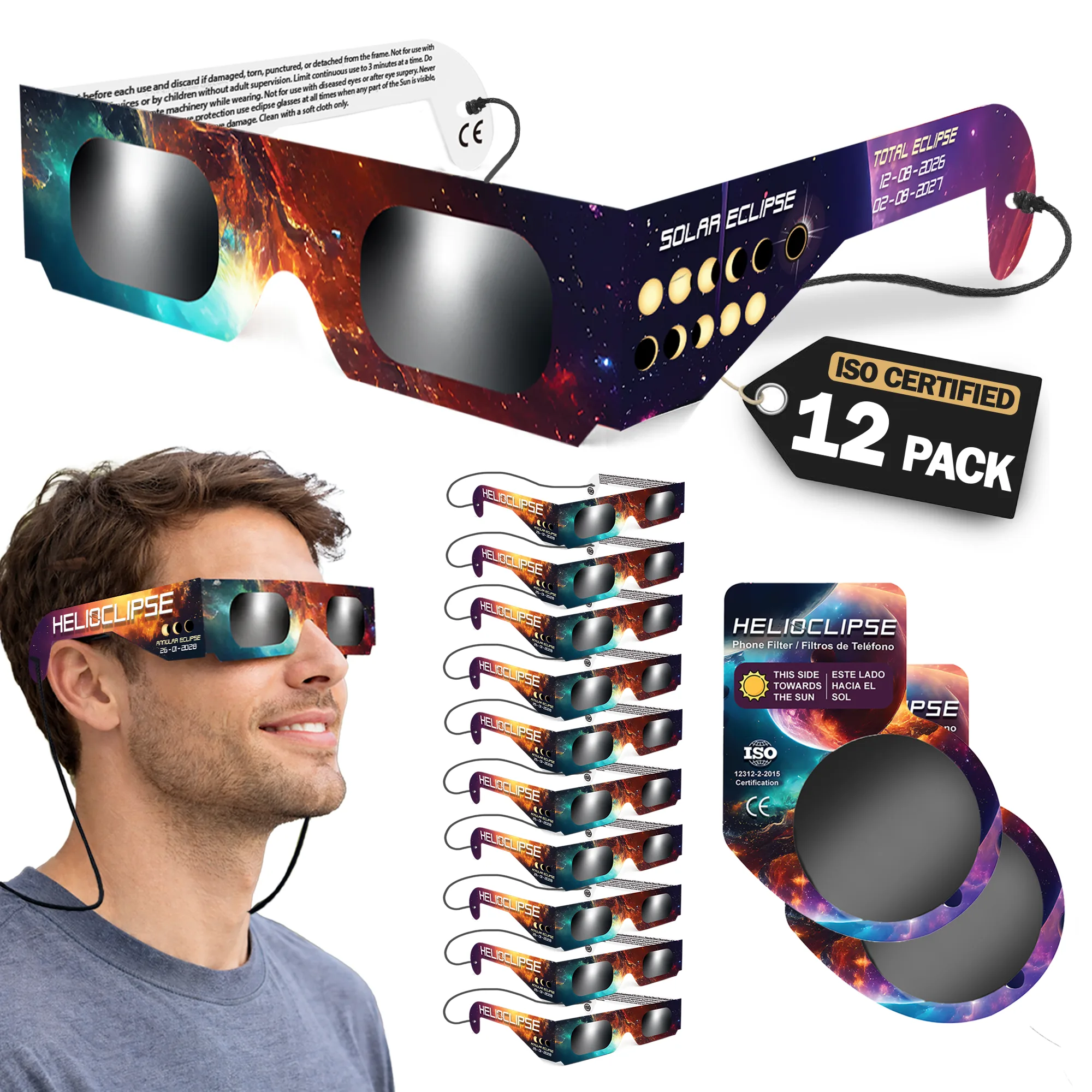
- Choose traceable Helioclipse solar eclipse glasses early enough to inspect them and brief your group before eclipse day.
- Use the Helioclipse Eclipse Explorer to confirm whether your location will experience totality or only partial phases; that determines whether there is ever a glasses-off interval.
- Keep learning through our eclipse safety and planning guides, especially if you are organizing a school, family or public viewing event.
Sources & further reading
- American Astronomical Society: How Can You Tell If Your Eclipse Glasses or Handheld Solar Viewers Are Safe?
- American Astronomical Society: About the ISO 12312-2 Standard for Solar Viewers
- American Astronomical Society: Suppliers of Safe Solar Viewers & Filters
- Space.com: Fake solar eclipse glasses are everywhere ahead of the total solar eclipse. Here's how to check yours are safe
- Astronomy Magazine: How to observe the Sun safely during a solar eclipse
- American Astronomical Society: How to View a Solar Eclipse Safely
- American Astronomical Society: How to Get Onto Our List of Manufacturers of Safe Solar Viewers & Filters
- NASA Science: Eclipse Viewing Safety
- NASA Science: Eclipses Frequently Asked Questions
- NASA Science: Host a Sun Party