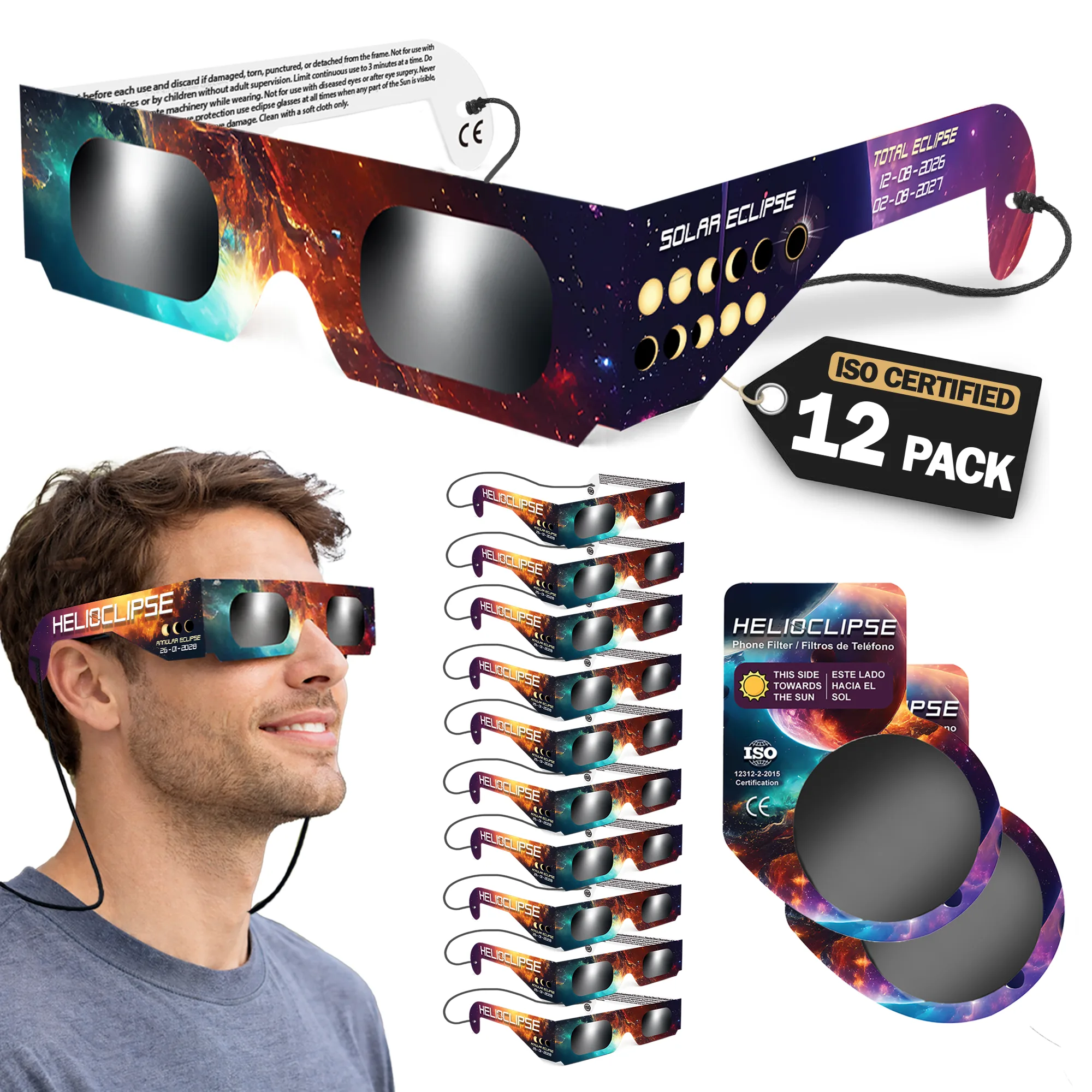
ISO 12312-2 and eclipse viewers: what the standard means for your family
A solar eclipse turns an ordinary patch of daylight into a shared countdown. Children compare crescent shapes, adults try to photograph the changing light, and everyone wants a turn looking up. The small piece of filter material between your eyes and the Sun therefore has a serious job.
That is where ISO 12312-2 comes in. It is the international standard relevant to wearable and handheld filters made for direct, unmagnified observation of the Sun. Proper solar viewers do much more than make the Sun look dim: they must control visible light and potentially harmful ultraviolet and infrared radiation while providing a usable, consistent view.
But there is an important catch. The text “ISO 12312-2” printed on cardboard is a claim, not self-authenticating proof that the finished product passed appropriate testing. Families need to consider the seller, traceability, instructions, construction and condition of the viewer as well as its label. If you are preparing for an eclipse, you can start with our solar eclipse glasses shop and review the product information before ordering.
What ISO 12312-2 actually is
ISO is the International Organization for Standardization, a global nongovernmental standards body whose members are national standards organizations. ISO 12312-2:2015 is titled “Eye and face protection — Sunglasses and related eyewear — Part 2: Filters for direct observation of the Sun.” It was adopted in 2015 and, according to the American Astronomical Society, affirmed in 2020.
The standard applies to non-magnifying, non-focusing viewers used directly in front of the eyes. Familiar examples are cardboard eclipse glasses and handheld solar viewers. Corrective eyeglasses or contact lenses do not change that scope: if you wear ordinary glasses, the solar viewer goes over them or is held in front of them.
Among other things, ISO 12312-2 addresses:
- how much ultraviolet, visible and infrared radiation a filter may transmit;
- the consistency of transmission across the filter;
- defects such as scratches, bubbles, pinholes or other flaws that could impair the view;
- whether a mounted filter is held securely during normal use;
- physical qualities such as rough edges or projections that could injure the wearer;
- labeling, manufacturer information and instructions for use.
This is why iso 12312-2 solar eclipse glasses are fundamentally different from ordinary sunglasses. Even very dark sunglasses transmit far too much sunlight for direct solar observation. Doubling up sunglasses, adding tinted plastic or using photographic film does not turn those materials into a tested solar viewer.
The number on the frame is not enough
A conformity statement matters, but anyone can print a standards code. The AAS warns that consumers cannot confirm ultraviolet and infrared performance merely by holding a viewer up to a lamp or examining its color. Reliable verification requires suitable measurements by a properly accredited laboratory.
That distinction helps untangle phrases such as iso 12312 2 certified solar eclipse glasses and iso 12312 2 compliant solar eclipse glasses. People often use “certified” and “compliant” interchangeably, but they can describe different forms of evidence. A manufacturer might make a declaration of conformity, while a laboratory report may show how a particular product or production sample performed. The useful questions are concrete: Who made or supplied the finished viewer? Can the product be traced to that source? What exact product did the report cover? Was the testing performed by a suitably accredited laboratory?
ISO itself does not personally approve each packet of viewers, and NASA explicitly says that it does not approve particular brands. Marketing language such as approved solar eclipse glasses or eclipse glasses nasa approved should therefore make you pause rather than reassure you. Likewise, the phrase solar eclipse glasses iso 12312-2 certified needs supporting product documentation; the words alone do not establish who conducted testing or what was tested.
Buy from a known, accountable source rather than an anonymous marketplace listing that could change sellers or inventory without warning. Keep your order confirmation and original packaging, especially when buying for a school, club or extended family. Traceability is far more valuable than a product page covered in badges.
For a deeper examination of misleading labels and questionable listings, read our guide to spotting fake and low-quality eclipse glasses.
What the standard does not cover
The “2” in ISO 12312-2 matters. ISO 12312-1 concerns sunglasses for general use, not filters intended for direct observation of the Sun. The wording iso 12312 1 solar eclipse glasses mixes those two purposes and should not be treated as an alternative safety specification. Ordinary sunglasses conforming to a sunglasses standard are still unsuitable for staring at the Sun.
ISO 12312-2 also is not the product standard for a filter mounted on a camera lens, binoculars or a telescope. Magnifying optics collect and concentrate sunlight. Eclipse glasses worn over your eyes cannot make an otherwise unfiltered telescope or pair of binoculars safe, and holding a loose viewer behind an eyepiece is dangerous.
Optical equipment needs a purpose-designed solar filter fitted securely over the Sun-facing aperture—the large front end—before sunlight enters the instrument. Finder scopes must also be covered or filtered appropriately. Because equipment and mounting arrangements differ, seek advice from an experienced solar observer or astronomer before using magnifying optics.
That boundary is easy to remember:
- Eyes only, without magnification: use a suitable wearable or handheld solar viewer.
- Camera, binoculars or telescope: use the correct securely mounted front-aperture solar filter and follow expert instructions.
- No trusted viewer available: use indirect projection with the Sun behind you.
Decoding the language families encounter online
Standards codes are frequently reformatted in shop titles and marketplace listings. Phrases such as iso 12312-2 glasses, iso 12312.2 eclipse glasses and iso 12312 2 eclipse glasses usually intend to refer to ISO 12312-2, but only the hyphenated designation matches the standard’s conventional name. Punctuation errors do not automatically reveal whether a filter is safe; they do show why you should look beyond a headline and examine the actual labeling, instructions and documentation.
Other wording can imply a status that the standard does not define. There is no special consumer category called iso 12312 2 grade solar eclipse glasses, and iso 12312 2 standard solar eclipse glasses is marketing shorthand rather than evidence. A long description such as iso 12312 2 eclipse glasses solar viewers still tells you nothing about the identity of the manufacturer, an accredited test report or the condition of the item delivered to your home.
Location and retailer terms are equally limited. Results labeled iso 12312-2 solar eclipse glasses uk, iso 12312-2 solar eclipse glasses boots or iso 12312-2 solar eclipse glasses nearby may help someone find stock, but proximity and a familiar storefront do not replace product-level checks. Regulations and conformity markings can also vary by market, so buyers should review current national consumer-safety guidance as well as the solar-viewer standard.
When you are ready to buy iso 12312 2 solar eclipse glasses, prioritize a traceable supply chain and clear documentation over delivery speed, star ratings or a suspiciously low price. If a listing calls its products iso 12312 2 compliant solar eclipse glasses viewers, ask what evidence supports that exact statement. Order early enough to inspect every viewer and resolve questions before eclipse day.
A practical pre-eclipse inspection
Even a properly made viewer can become unusable after being folded into a pocket, scratched by keys or soaked during a previous outing. Standards conformity when manufactured cannot protect a filter that is now torn or separating from its frame.
Set up a family inspection a few days before the event rather than opening the packet while everyone is already looking for the Sun. Under normal indoor lighting, examine both sides of every filter. Discard a viewer if the filter is scratched, punctured, torn, creased through the viewing area, detached from its frame or otherwise damaged. Follow the manufacturer’s instructions and warnings.
The AAS also suggests a cautious sequence that can reveal viewers that are obviously too light, although it cannot prove full spectral safety. Indoors, you should ordinarily see nothing through a solar viewer except perhaps an exceptionally bright light, and even that should appear very faint. Outside, ordinary scenery should remain invisible. A brief first view of the Sun through a trusted, undamaged viewer should show a comfortably bright, sharply edged disk against a dark background.
Stop using the viewer if the Sun is painfully bright, if normal surroundings are visible, or if you feel uncertain about its origin. This sensory check can reject an obviously unsuitable product; it cannot confirm invisible ultraviolet and infrared performance. Traceable sourcing and credible testing evidence remain essential.
Storage matters too. Keep cardboard viewers dry and place them in their original sleeve, an envelope or a rigid container that prevents rubbing, bending and punctures. Do not clean cardboard frames or filters with wet wipes, water, glass cleaner or solvents. Reinspect them every time they come out of storage.
Teaching children a safe viewing routine
Children do best with a physical routine they can rehearse, not a warning shouted when the eclipse has already begun. Practise away from the Sun:
- Stand still.
- Put the viewer securely over both eyes.
- Look toward the Sun only after both eyes are covered.
- Turn your head away from the Sun.
- Remove the viewer only after looking away.
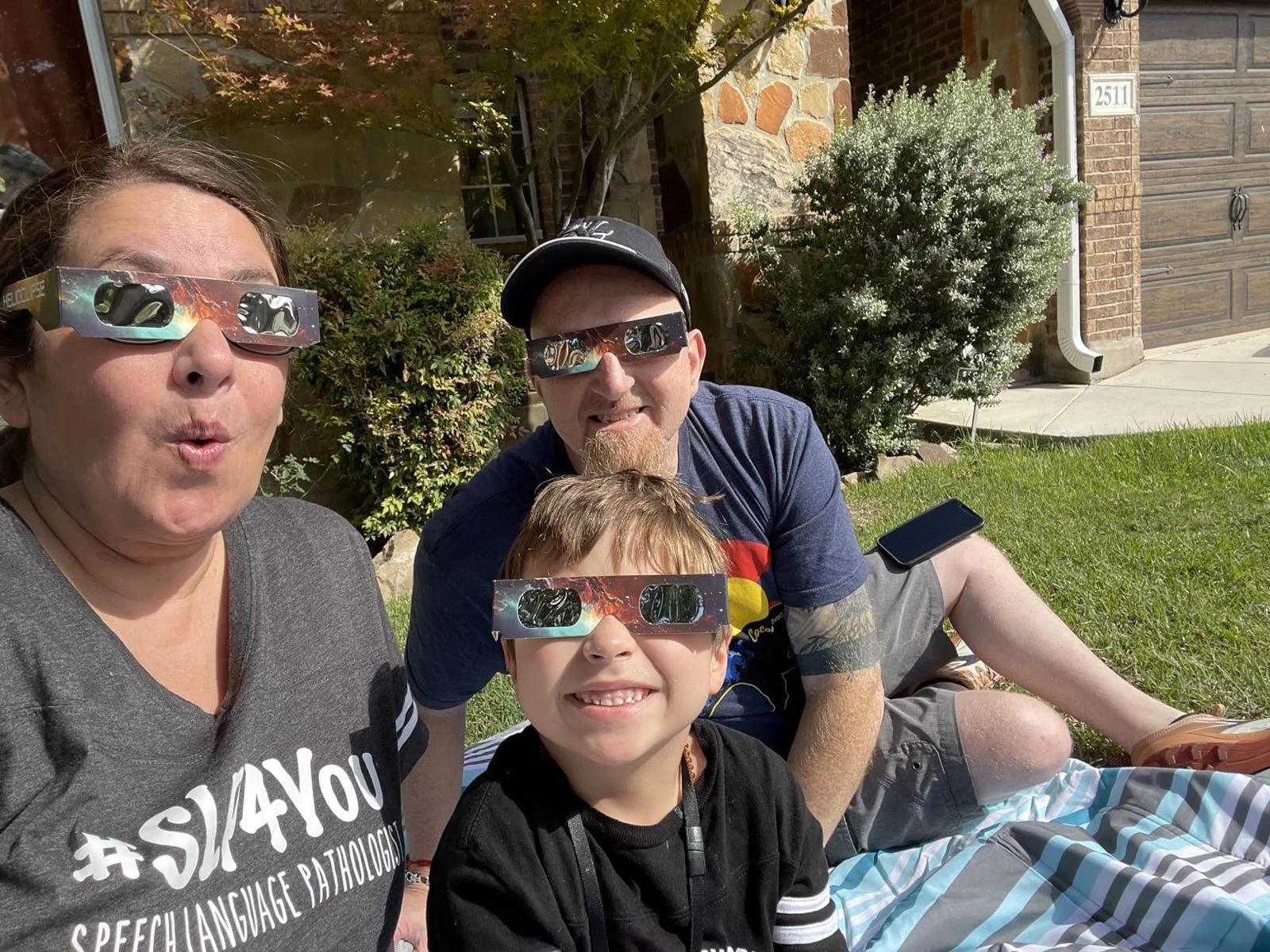
An adult should supervise children throughout direct viewing. Check that the filter covers both eyes and that sunlight cannot enter around a poor fit. If a child wears prescription glasses, keep those on and place the eclipse viewer over them. Handheld viewers can be easier for some children because an adult can help position them without bending cardboard arms.
There is no need to stare continuously. The partial phases unfold slowly, and brief looks every few minutes make the Moon’s progress easier to notice. Between looks, compare the changing temperature, shadows and ambient light. A colander or the gaps between crossed fingers can project multiple crescent Suns onto the ground, giving a group something to study without competing for eclipse viewing glasses.
For projection, face away from the Sun and look at the projected image—not through the hole. Tree leaves produce the same effect naturally, scattering dozens of bright crescents across the ground during a partial phase.
Glasses on, glasses off: the totality rule
ISO 12312-2 does not change with the percentage of the Sun covered. A 99% partial eclipse still leaves part of the brilliant solar surface exposed, so direct viewing still requires an appropriate solar viewer. Thin clouds, haze and sunset-like dimming do not make an exposed Sun safe to watch without protection.
The only naked-eye exception occurs during the brief total phase of a total solar eclipse, and only for observers inside the path of totality. Viewers may come off only when the Moon completely covers the Sun’s bright face and no direct photospheric light remains. They must go back on before the first bright point of sunlight reappears.
Outside the path of totality, there is no glasses-off moment. The same is true throughout every partial or annular eclipse. Your location therefore changes the rule, even when two groups are watching the same event only a short drive apart. Use our Eclipse Explorer and 3D map to check whether your exact site lies inside or outside totality, then review our phase-by-phase guide to when eclipse glasses stay on and when they may come off.
Do not guess the beginning or end of totality from crowd noise. Assign a prepared adult to follow verified local contact times and call the transitions. If anyone in the group is uncertain, keeping the viewer on is the safe choice.
Planning purchases for a family, class or event
Start with the number of people, the fit they need and how the viewers will be distributed. Families can share because partial phases change gradually, but one viewer per person reduces fumbling during a short group session. Schools and public events should add spares for damaged filters, unexpected guests and viewers dropped on damp ground.
Product labels such as certified solar eclipse glasses, iso certified eclipse glasses or eclipse glasses iso 12312-2 may sound reassuring in a shopping result. Treat them as prompts to inspect the detailed documentation, not as substitutes for it. Check the named manufacturer or responsible supplier, instructions, relevant conformity statement, condition on delivery and whether the seller can be traced as an authorized source.
Tell relatives, teachers and friends early. Last-minute scarcity encourages rushed decisions, while an early order leaves time to inspect the shipment, practise with children and replace anything questionable. Our 2026 total solar eclipse planning guide can help your group connect viewer safety with location, timing and the rest of the day’s logistics.
A five-point family rule
If you remember only one part of this guide, make it this:
- Right purpose: ISO 12312-2 concerns direct, unmagnified solar viewers—not ordinary sunglasses and not telescope filters.
- Right evidence: Printing the code is not proof; use a traceable source and review the product documentation.
- Right condition: Discard viewers with scratches, punctures, tears, loose filters or other damage.
- Right technique: Cover your eyes before looking up, look away before removing the viewer, and supervise children.
- Right phase: Keep viewers on whenever any part of the bright Sun is visible. Remove them only during confirmed totality from inside the totality path.
A good viewer should make the eclipse simple: cover, look, share the moment, then look away. The standard sits behind that experience, but careful purchasing and correct use complete the safety chain.
Frequently asked questions
Are eclipse viewers automatically certified just because they display ISO 12312-2?
No. Printing “ISO 12312-2” on a viewer is a claim, not proof that the finished product passed appropriate testing. Consider the seller, traceability, instructions, construction, and the viewer’s condition in addition to its label.
Will the 2026 solar eclipse be visible from North America?
The excerpt does not provide information about where the 2026 solar eclipse will be visible. Check a reliable eclipse timetable or local astronomy source for location-specific visibility details.
What does ISO 12312-2 cover for direct Sun viewing?
ISO 12312-2:2015 is the international standard for non-magnifying, non-focusing filters used for direct observation of the Sun. It addresses transmission of ultraviolet, visible, and infrared radiation, filter consistency, defects, secure mounting, physical safety, labeling, and instructions.
What safety requirements should a solar viewer meet?
A suitable viewer should be designed for direct, unmagnified solar observation and meet the relevant requirements for light transmission, filter quality, secure construction, labeling, and instructions. Ordinary sunglasses, even very dark ones, do not provide adequate protection for looking directly at the Sun.
Why are ISO 12312-2 viewers used to watch an eclipse?
They are intended to control visible light as well as potentially harmful ultraviolet and infrared radiation while providing a usable, consistent view of the Sun. If you wear corrective eyeglasses or contact lenses, place the solar viewer over them or hold it in front of them.
On-site next steps
- Review the specifications and purchasing information in the Helioclipse solar eclipse glasses shop, and order early enough to inspect every viewer before the event.
- Confirm whether your location is inside totality with the Helioclipse Eclipse Explorer. That determines whether a genuine glasses-off interval exists.
- Label each family member’s viewer, protect the filters in a dry container and practise the cover-look-away-remove routine together.
Sources & further reading
- American Astronomical Society: About the ISO 12312-2 Standard for Solar Viewers
- American Astronomical Society: How Can You Tell If Your Eclipse Glasses or Handheld Solar Viewers Are Safe?
- Ralph Chou and the American Astronomical Society: Solar Eclipse Eye Safety technical report
- Astronomy Magazine: How to Observe the Sun Safely During a Solar Eclipse
- Space.com: How to Observe the Sun Safely (and What to Look For)
- American Astronomical Society: How to View a Solar Eclipse Safely
- American Astronomical Society: Suppliers of Safe Solar Viewers & Filters
- NASA Science: Eclipse Viewing Safety
- American Astronomical Society: Eclipse Basics
- NASA Science: What to Expect: Total Solar Eclipse