Binoculars and telescopes during a solar eclipse: where filters belong (and where they do not)
A telescope can turn the partially eclipsed Sun into a crisp, unforgettable crescent. Binoculars can reveal its shape at a glance. But magnification also turns a simple mistake into an immediate eye hazard: unfiltered optics collect intense sunlight and concentrate it into a much smaller area.
The essential rule is wonderfully simple. A purpose-made solar filter must cover the front, Sun-facing aperture of the instrument before sunlight enters the optics. Eclipse glasses belong in front of your eyes for unmagnified viewing; they do not make unfiltered binoculars, telescopes, camera lenses, or finderscopes safe.
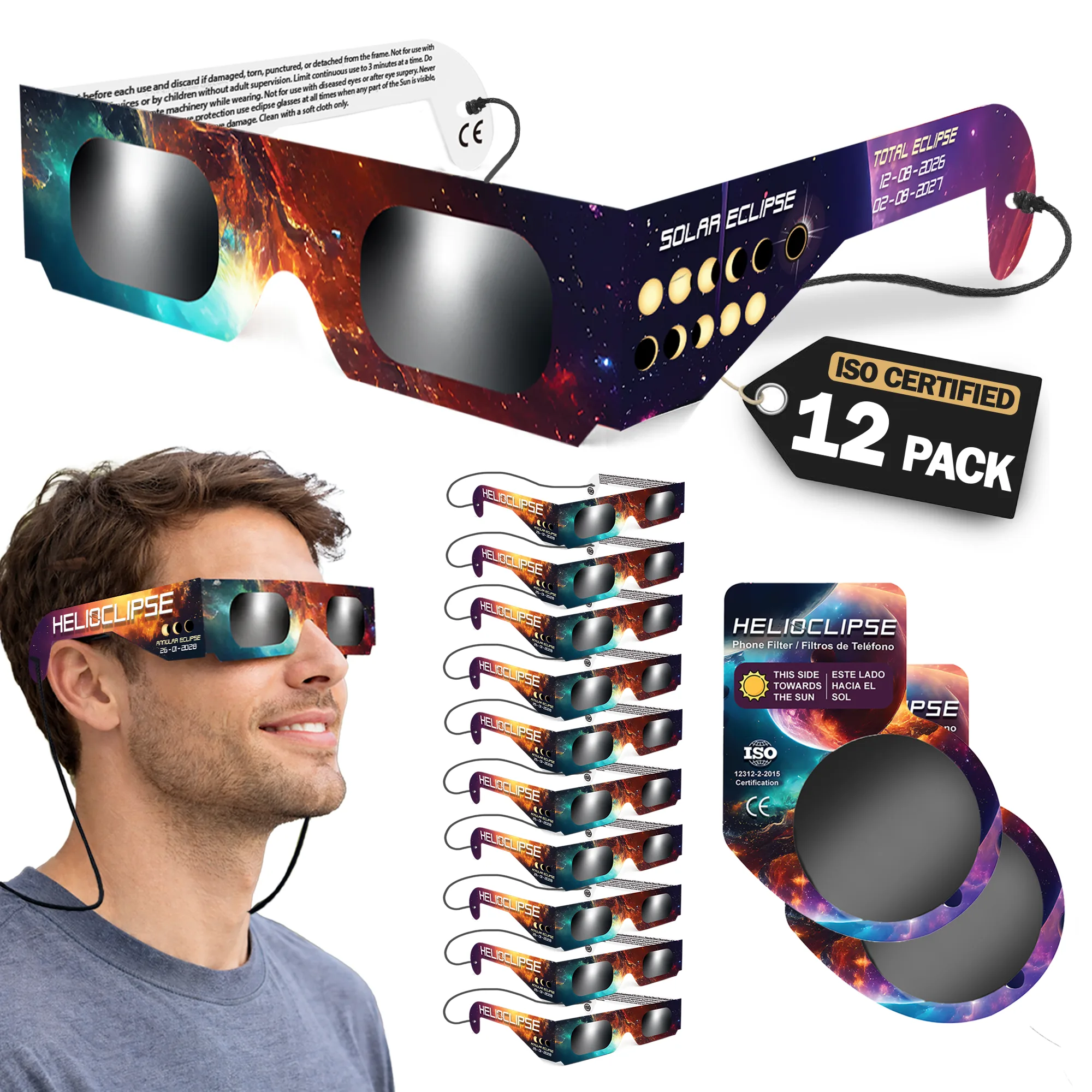
This binoculars telescope solar filter eclipse safety 2026 guide explains that distinction without sending first-time viewers into a maze of specialist equipment. For most families, the easiest plan is to use properly sourced ISO 12312-2 eclipse viewers from Helioclipse and leave magnified observing to a supervised astronomy group with correctly filtered equipment.
The one placement rule that prevents the worst mistake
Put the solar filter over the objective—the large lens or open end pointed at the Sun. On binoculars, that means filtering both objective lenses. On a telescope, the filter must cover the entire front aperture. On a camera, it belongs over the front of the lens. The filter cell must fit securely enough that a gust of wind, a curious child, or a bump against the tripod cannot dislodge it.
This is called front-aperture filtration. It intercepts the Sun’s visible light, ultraviolet radiation, infrared radiation, and heat before they travel through the instrument. A properly configured solar filter telescope arrangement therefore controls the energy at the entrance rather than trying to stop concentrated sunlight near your eye.
A filter at the eyepiece is in exactly the wrong place. By that point, the telescope has already gathered and focused solar energy. Small filters once supplied for threading into some eyepieces can overheat, crack, or fail. Do not use them, even if they came in an old telescope case or appear dark enough when held up to a lamp.
The same rule governs every binoculars eclipse filter setup: two objectives, two secure filters, no uncovered light path. A solar eclipse filter for binoculars is not a single sheet held loosely across the eyepieces, and a binocular filter solar eclipse arrangement is incomplete if only one front lens is covered while the other remains open.
Why eclipse glasses cannot protect you behind unfiltered optics
Eclipse glasses reduce sunlight to a level suitable for direct, unmagnified viewing. Binoculars and telescopes do something different: they gather light across an aperture much larger than your pupil and concentrate it toward the eyepiece. Placing eclipse glasses between that concentrated beam and your eye asks a thin viewer to withstand conditions it was not designed to handle.
That is why you must never look through unfiltered binoculars or a telescope while wearing eclipse glasses. The concentrated radiation can damage the viewer and your retina. Do not hold a handheld solar viewer over the eyepiece, either. The filter must stop sunlight at the front of the instrument.
Conversely, when you look through an instrument equipped with a correctly fitted front-aperture filter, you do not stack eclipse glasses underneath it. The instrument’s filter is already providing the required attenuation. Extra layers can make the image difficult to see and may encourage people to move or remove safety equipment unnecessarily.
The distinction is central to binoculars telescope solar filter eclipse safety: viewers made for your eyes and filters made for magnifying optics solve related but different problems. Our guide to ISO 12312-2 and eclipse viewers covers what the standard means for direct viewing.
ISO 12312-2 does not certify a telescope installation
ISO 12312-2 applies to handheld or wearable, nonmagnifying solar viewers used directly with the eyes. It does not certify an entire telescope, binocular, or camera-filter installation. Solar-filter material may have suitable optical transmission properties, but the safety of magnified observing also depends on complete aperture coverage, secure mounting, condition, instrument design, and correct supervision.
That nuance matters when shopping language becomes imprecise. Phrases such as approved solar eclipse glasses or eclipse glasses nasa approved can imply that a government agency endorses individual products. NASA explicitly says it does not approve particular brands. Look instead for clear manufacturer identification, usage instructions, credible conformity information, and an undamaged viewer represented as meeting ISO 12312-2.
Similarly, solar eclipse glasses iso 12312-2 certified and certified solar eclipse glasses describe products for unmagnified viewing—not material you should automatically tape over an instrument. Seek expert advice before using any filter with binoculars, a telescope, or a long camera lens. A printed standard number alone cannot tell you whether a filter cell fits securely or covers every opening.
How to inspect a filtered telescope or binocular setup
Do the inspection indoors or with the instrument pointed safely away from the Sun. Never test an uncertain arrangement by looking through it.
- Confirm full front coverage. No part of the main objective should remain exposed around the filter cell.
- Filter both binocular objectives. One safe barrel does not compensate for one unfiltered barrel.
- Secure the filter mechanically. It should not slide off when the instrument tilts or when the filter is touched lightly. Follow the filter maker’s instructions rather than inventing a last-minute mounting method.
- Check the filter surface and mounting. Do not use material that is torn, punctured, deeply scratched, delaminating, loose, or visibly damaged.
- Deal with the finder. Cap, remove, or correctly filter every optical finder, guide scope, or auxiliary aiming device. An uncovered finder can injure someone who instinctively looks through it and can also concentrate heat near its focal plane.
- Control access. At a family, school, or public event, one informed adult should remain beside the instrument. Do not leave a Sun-pointed telescope unattended.
- Rehearse before eclipse day. Learn how the mount moves, how the filter attaches, and how you will prevent anyone from touching it.
Telescope solar filter safety is not just a property of the filter material. It is a property of the complete, supervised setup. The same is true when a product description uses the wording solar eclipse telescope filter, binoculars solar eclipse filter, or solar filter telescope: compatibility and secure placement still require verification.
Never improvise a solar filter
Ordinary sunglasses, stacked sunglasses, smoked glass, exposed photographic film, CDs, food wrappers, neutral-density photography filters, and homemade tinted plastic are not safe substitutes. Apparent darkness tells you little about transmission outside visible wavelengths, and household materials are not manufactured or mounted for this job.
Do not salvage a filter from unknown equipment or use an old eyepiece filter because it happens to fit. Do not stretch filter film tight like a drum unless its instructions specifically require that treatment; some approved solar-filter films are meant to retain a slightly wrinkled appearance. Never judge safety by the color of the Sun through the material, because safe filters can render the disk white, yellow, orange, or another tint.
Compressed marketplace wording can also hide important distinctions. A listing framed as solar filter for telescope celestron does not establish that the filter fits a particular aperture, is intended for direct solar observation, or can resist accidental removal. That phrase is not a safety specification, and we do not recommend choosing optical filtration by brand compatibility alone.
Online discussion can help you identify questions to ask, but it cannot inspect your equipment. A binoculars telescope solar filter eclipse safety reddit thread may contain advice from experienced observers alongside guesses, outdated practices, or suggestions that omit crucial context. Verify claims against institutional guidance and, ideally, have the assembled instrument checked by an experienced solar observer before use.
Totality is a narrow exception, not a reason to relax
During every partial phase, front-aperture filters remain on binoculars, telescopes, and camera lenses. They also remain on throughout an annular eclipse because the bright solar surface is never completely covered. Clouds do not change the rule.
Inside the path of a total solar eclipse, the Sun’s bright face is fully hidden for a brief interval called totality. Direct, unaided viewing is safe only during that interval. The moment even a bright point of the photosphere reappears, eye protection is required again. Outside the path of totality, there is no filter-free phase at all.
Removing and replacing a filter on magnifying optics adds timing, handling, and supervision risks. A filter can be dropped, misaligned, or replaced too late. First-time viewers should not make a telescope filter change their main totality task. Step away from the instrument and experience totality with unaided eyes instead. If an experienced observer intends to use binoculars or a telescope during totality, the procedure should be rehearsed, based on precise local contact times, and designed so no one can look through the instrument before complete coverage or after the first return of direct sunlight.
Use the Helioclipse Eclipse Explorer to confirm whether your exact location lies inside totality and to check the local phase sequence. Being close to the path is not the same as being inside it. Our guide to when eclipse glasses go on and come off explains the phase boundaries in more detail.
Cameras and phones follow the same optical principle
A camera lens is an optical collector, so the filter belongs at its front aperture when the bright or partially eclipsed Sun is in frame. This protects the camera as well as the photographer, especially on interchangeable-lens cameras with telephoto optics. Never use an optical viewfinder to aim an unfiltered camera at the Sun.
The shorthand solar filter camera can refer to several products with very different transmission properties. A general photographic neutral-density filter is not automatically a solar-observation filter. Use only equipment specifically intended for solar imaging, matched to the lens and secured according to its instructions.
A solar eclipse filter for phone should likewise cover the phone camera lens rather than act as eye protection. A dedicated, securely positioned phone filter is preferable to trying to hold loose material in place while simultaneously aiming, focusing, and watching the sky. Keep your own eyes protected during setup, avoid prolonged Sun-pointing, and follow the phone manufacturer’s guidance.
Photography can consume the few seconds you most want to remember. Test your setup on the ordinary Sun well before eclipse day—with correct filtration throughout—and decide who in your group will take pictures. Everyone else can watch the changing crescent through handheld viewers or enjoy projected images.
A safer plan for families, schools, and first-time observers
Most people do not need magnification to enjoy an eclipse. Through a proper handheld viewer, the Sun is large enough to show the Moon’s progress clearly. Look briefly every few minutes and you will see the crescent change shape. Between glances, shadows sharpen, the light takes on an unfamiliar quality, and the temperature may begin to fall.
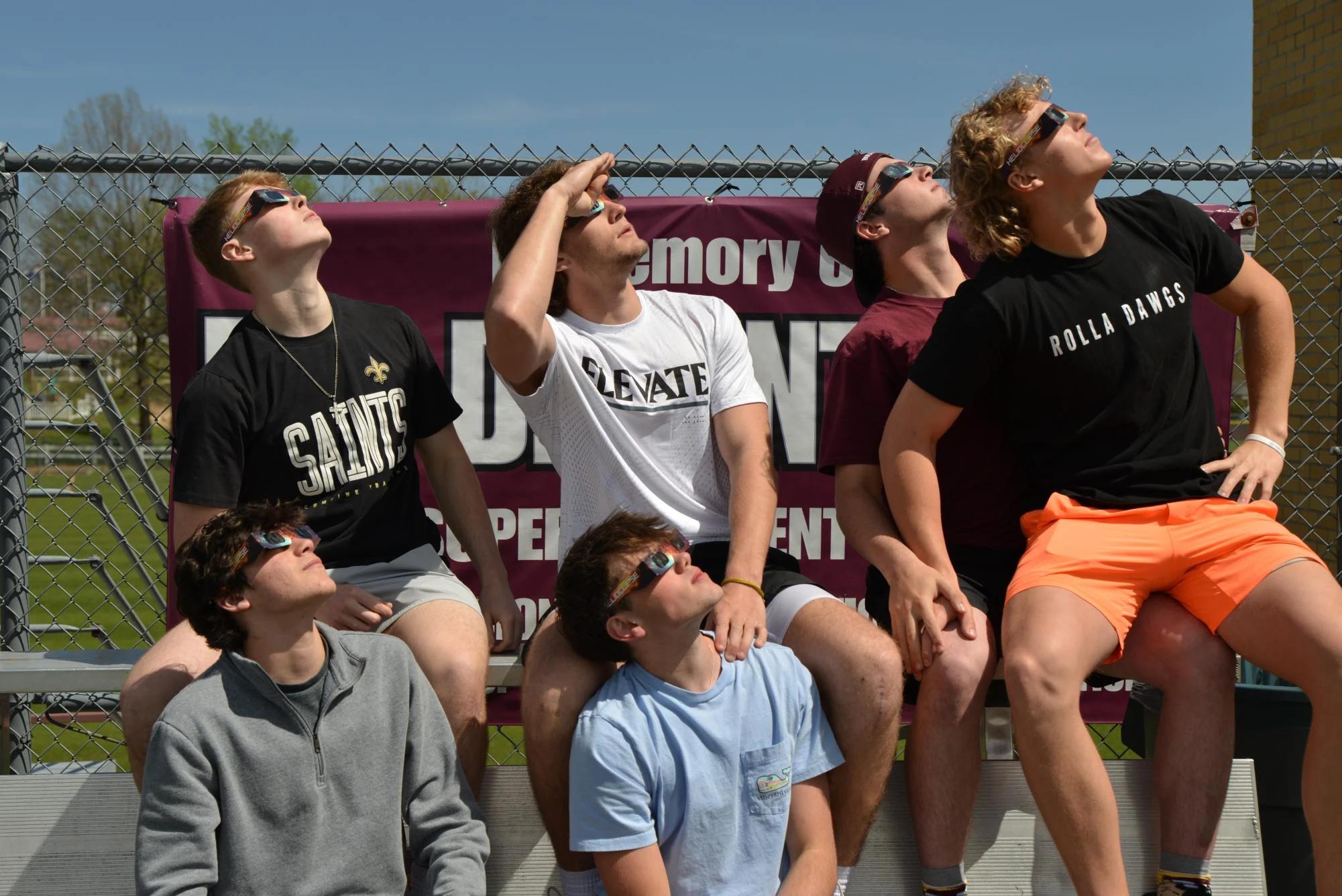
For groups, prepare viewers early, inspect each one, and explain the routine before anyone looks up: cover your eyes first, look toward the Sun, then turn away before removing the viewer. Supervise children directly. Damaged viewers should be discarded rather than repaired with tape.
If you want a larger shared image without putting anyone’s eye at an eyepiece, use a simple pinhole projector with the Sun behind you. Look at the projected image, never through the pinhole. Leaves, a colander, or crossed fingers can project dozens of small crescent Suns during the partial phases.
A professionally supervised, correctly filtered telescope can be a terrific addition to a school or community event. It may reveal a clean lunar edge crossing the photosphere and, when present, sunspots that appear much darker than their surroundings. The organizer should control the instrument continuously while everyone else uses handheld viewers for casual observing.
A practical eclipse-day checklist
Before the event, make the following decisions together:
- Choose the main viewing method. For most groups, use ISO 12312-2 handheld viewers as the default.
- Assign responsibility for optical equipment. One experienced adult should own the setup, inspection, and supervision process.
- Confirm the filter position. It must cover every Sun-facing aperture before the instrument is aimed.
- Cap or filter auxiliary optics. Include finderscopes and guide scopes in the inspection.
- Set a no-touch boundary. Children and visitors should not adjust the filter, focus, or mount.
- Know the eclipse type at your location. Partial and annular eclipses never have a safe filter-free interval.
- Prepare a simple fallback. If anything about the optical filter seems uncertain, stop using the instrument and switch to handheld viewers or projection.
That last step is not a disappointing compromise. An eclipse seen safely with your family is far better than a technically ambitious setup that leaves you worrying about every gust of wind.
Frequently asked questions
What basic precautions should I take to view a solar eclipse safely?
Use properly sourced eclipse viewers for direct, unmagnified viewing. If using binoculars, a telescope, a camera lens, or a finderscope, a purpose-made solar filter must be securely fitted over the full front, Sun-facing aperture before sunlight enters the instrument.
Can sunscreen protect my eyes while I watch an eclipse?
No. The excerpt identifies eclipse viewers for direct, unmagnified viewing and purpose-made front-aperture filters for magnified optics; it does not describe sunscreen as eye protection. Do not rely on anything other than the appropriate solar viewing protection for the way you are observing.
What eclipse-viewing mistakes should I avoid?
Do not look through unfiltered binoculars, telescopes, camera lenses, or finderscopes, even while wearing eclipse viewers. Also avoid eyepiece filters, loosely fitted filters, and any binocular setup with one objective lens left uncovered.
Why is it dangerous to view an eclipse without proper eye protection?
The Sun’s light is intense, and magnifying instruments collect and concentrate it into a much smaller area, creating an immediate eye hazard. Proper solar protection reduces or intercepts the light before it reaches your eyes or travels through the instrument.
Is it safe to view a solar eclipse through a telescope?
Yes, but only when a purpose-made solar filter securely covers the telescope’s entire front, Sun-facing aperture before sunlight enters the optics. Do not use a filter at the eyepiece, because the telescope has already gathered and focused solar energy by that point.
On-site next steps
- Get Helioclipse ISO 12312-2 eclipse glasses for direct, unmagnified viewing, and order early enough to inspect and distribute them before eclipse day.
- Use the Helioclipse Eclipse Explorer to check whether your location will experience a partial, annular, or total phase and when each phase occurs.
- If you plan to use magnifying optics, consult an experienced astronomer and rehearse the complete filtered setup before the event. If there is any doubt, do not point the instrument at the Sun.
Sources & further reading
- American Astronomical Society: Solar Filters for Optics: Telescopes, Binoculars & Cameras
- NASA Science: Eclipse Viewing Safety
- Sky & Telescope: How to Safely See a Solar Eclipse
- Space.com: How to observe the Sun safely (and what to look for)
- Astronomy Magazine: How to observe the Sun safely during a solar eclipse
- American Astronomical Society: How to View a Solar Eclipse Safely
- American Astronomical Society: About the ISO 12312-2 Standard for Solar Viewers
- NASA Science: Eclipses Frequently Asked Questions
- American Astronomical Society: Solar Eclipse Eye Safety technical report
- American Astronomical Society: Eclipse Basics