Why staring at the Sun without protection is never “just a quick look”
The Sun does not become safe because the Moon covers most of it. It does not become safe because clouds soften the glare. And your eyes do not provide a reliable countdown telling you when damage is about to begin.
That is the central fact behind solar retinopathy eclipse safety: direct sunlight can injure the light-sensitive tissue at the back of the eye without producing pain at the moment of exposure. A glance may feel uneventful, yet visual changes can emerge later. There is no universal number of safe, unprotected seconds that applies to every person and every circumstance.
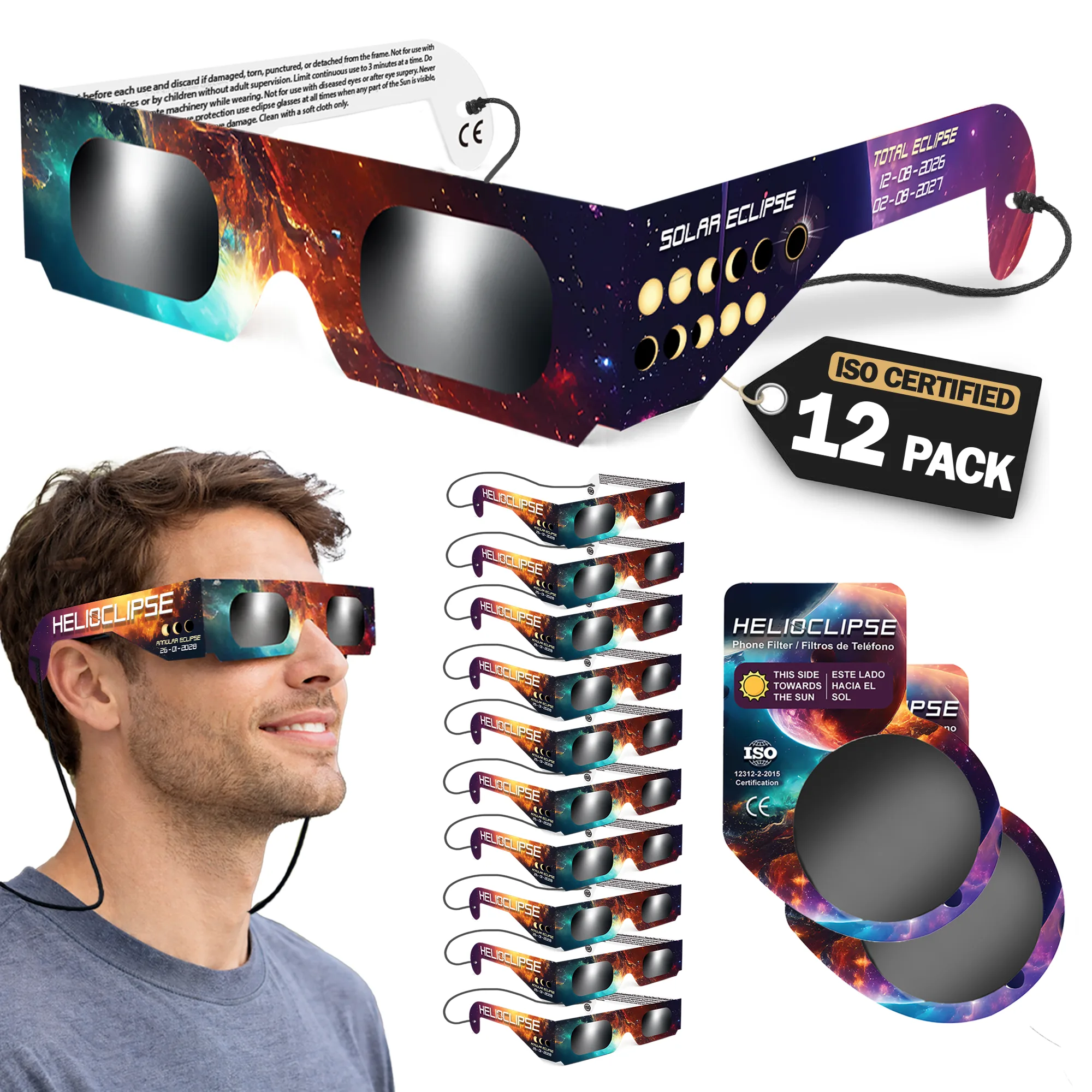
Fortunately, avoiding that risk is straightforward. Use purpose-made solar viewers for every partial phase, inspect them before use, and understand the narrow totality-only exception. You can prepare in advance with our ISO 12312-2 certified solar eclipse glasses and learn the viewing sequence before eclipse day.
This guide is educational, not a diagnosis. If you notice a new blind spot, distortion, unusual color changes, light sensitivity, or blurred central vision after looking at the Sun, stop solar viewing and contact a qualified eye-care professional promptly.
What solar retinopathy actually means
Solar retinopathy is an injury caused by looking directly at the Sun. It is also called photic retinopathy, and injury concentrated in the macula may be described as solar maculopathy or solar eclipse maculopathy. The terminology varies, but the essential problem is the same: intense solar radiation reaches the retina and damages tissue needed for detailed vision.
The retina is a thin layer of light-sensitive neural tissue lining the back of the eye. Incoming light is focused onto it by the cornea and lens. Near the center of the retina is the macula, which supports the sharp vision you use to read, recognize faces, drive, and inspect fine detail. At the macula’s center is the fovea, where visual acuity is greatest.
Looking at the Sun therefore does more than expose the eye to something bright. The eye’s optical system concentrates an image of the solar surface onto a small retinal area. The resulting injury is commonly explained as predominantly photochemical: absorbed light triggers molecular reactions that can damage retinal cells and supporting tissue. Heat may contribute under some conditions, especially when magnifying optics concentrate far more solar energy, but “the retina gets burned” is only a simplified description.
Good safety education needs medical mechanism at lay level from reputable eclipse planning and ophthalmology sources, not a frightening slogan. The practical conclusion is simple: the retina is delicate, sunlight is intensely concentrated by the eye, and discomfort is not a dependable warning signal.
Why your blink reflex cannot protect the retina
Ordinary bright light makes you squint, blink, turn away, and constrict your pupils. Those responses are useful, but they do not turn a deliberate look at the Sun into a controlled experiment.
Most importantly, the retina has no pain receptors that can warn you while light injury is developing. Your eyes may water and the Sun may feel unpleasantly bright, but the retinal tissue itself does not announce damage with an immediate burning sensation. By the time a visual disturbance is apparent, the exposure has already happened.
Pupil size, atmospheric clarity, medication use, individual susceptibility, where your gaze lands, and the duration and continuity of exposure can all affect risk. That variation is why statements such as “two seconds is fine” or “I looked last time and nothing happened” are not safety rules. NASA explicitly cautions that retinal injury can occur after a quick glance and that no one should assume they will look away soon enough.
A brief accidental glance does not prove that an injury occurred, but neither can an article calculate your personal outcome from a stopwatch. Do not look again to test your vision or compare eyes while staring at the Sun. Return to safe viewing and seek professional advice if you develop symptoms.
A crescent Sun is still the Sun
During a partial eclipse, the Moon blocks only part of the solar photosphere—the dazzling visible surface. The uncovered crescent may look smaller, but every visible piece retains the Sun’s normal surface brightness. Even when almost all of the disk is hidden, the remaining sliver can still deliver enough concentrated light to injure the retina.
This distinction matters because the environment can become dimmer as an eclipse deepens. Your surroundings may take on a strange metallic light, shadows may sharpen, and the temperature may fall. Those dramatic changes can create the false impression that the visible crescent itself has become gentle. It has not.
Cloud is not a solar filter either. Thin or broken cloud can reduce visible glare unevenly, then expose the Sun at full intensity as it moves. Haze, reflections, camera screens, smoked glass, photographic film, CDs, food wrappers, and ordinary sunglasses are not substitutes for a compliant solar viewer.
The same rule applies to an annular eclipse. The bright ring is exposed photosphere, so there is no glasses-off phase. During a partial eclipse—whether it is a standalone partial event or the long partial stage surrounding totality—certified viewers remain on whenever you look directly at the Sun.
The one exception: complete totality
There is one carefully defined exception. If you are inside the path of totality during a total solar eclipse, you may look without a solar viewer only while the Moon completely covers the Sun’s bright face. During those brief moments, the much fainter corona becomes visible around the black lunar silhouette.
This exception does not begin when the Sun becomes a thin crescent. It begins only when the bright photosphere is completely hidden. It ends as soon as the first brilliant point of direct sunlight reappears. At that instant, look away and put your viewers back on.
Outside the path of totality, there is no unfiltered viewing interval at all. A location with a 99% partial eclipse is still outside totality and still receives direct photospheric sunlight. Our guide to eclipse phases and when to use solar glasses explains the sequence families and first-time viewers should rehearse before the event.
The safest group plan is to appoint someone who understands the timing, but every adult should still know the rule independently: glasses on through the partial phases, off only after complete coverage is confirmed from within the totality path, and back on immediately when direct sunlight returns.
What symptoms can follow an unsafe look?
Possible solar eclipse retinopathy symptoms include a blurred or dim patch in central vision, a dark or yellowish spot, distorted lines, altered color perception, sensitivity to bright light, reduced contrast, or difficulty reading and recognizing faces. One eye may be affected more than the other.
Symptoms are not always immediate. Some people notice a persistent afterimage first; others recognize a central defect hours later. The phrase solar retinopathy after eclipse describes the timing of the discovery, not a special form of the condition. Similar injury can occur from looking at the uneclipsed Sun on an ordinary day.
Reports and public-education material may be organized under date labels such as solar retinopathy eclipse 2024, solar retinopathy 2024, or solar eclipse retinopathy oct. Those labels identify a period of public attention, not different diseases with different mechanisms. The underlying hazard does not change from one eclipse to the next.
Some retinal injuries improve over weeks or months, while others leave persistent visual defects. The course depends on the nature and severity of the injury, and no home observation can predict it reliably. There is also no proven household remedy that can “reverse” retinal injury. An eye-care professional can take a history, examine the retina, test vision, and decide whether imaging or follow-up is appropriate.
Seek prompt professional advice for new symptoms following direct solar viewing. Sudden or severe loss of vision, a curtain-like shadow, flashes with many new floaters, significant eye trauma, or other abrupt visual changes can have causes beyond solar exposure and warrant urgent assessment through local medical services.
Eclipse viewers work differently from sunglasses
Ordinary sunglasses are designed to make everyday surroundings comfortable. They still transmit vastly more light than is safe for direct solar observation. Stacking several pairs does not transform them into a solar filter.
Purpose-made solar eclipse glasses reduce visible sunlight to a tiny fraction of its original intensity while also controlling ultraviolet and infrared transmission. ISO 12312-2 addresses filters intended for direct, unmagnified observation of the Sun. It includes requirements concerning transmission, material quality, mounting, and labeling.
The relationship sometimes compressed into the phrase solar retinopathy eclipse glasses is straightforward: a trustworthy, undamaged viewer used correctly prevents the hazardous exposure that can cause retinal injury. The printed standard number alone, however, is not magical proof. Counterfeit or poorly documented products can copy markings, which is why traceability and a credible supplier matter. Our guide to ISO 12312-2 and eclipse viewers goes deeper into what the standard covers, while our guide to spotting fake or low-quality eclipse glasses explains practical checks.
Product language can also be misleading. Shoppers may encounter phrases such as approved solar eclipse glasses or solar eclipse glasses iso 12312-2 certified, but NASA does not approve or certify individual commercial brands. The useful questions are whether the viewer is documented as conforming to ISO 12312-2, whether it came through a traceable supply chain, and whether the filter is in good condition. Choose certified solar eclipse glasses from a source you can identify rather than trusting an unsupported marketplace claim.
Before use, inspect each filter for scratches, punctures, tears, loose material, or light leaks. Discard damaged viewers. Put the viewer over your eyes before looking up, keep it in place while observing, then turn away before removing it. Supervise children closely and make sure the viewer fits well enough that direct sunlight cannot enter around it.
Eclipse glasses and magnifying optics do not mix
Eclipse viewers protect the unaided eyes. They are not filters for binoculars, telescopes, telephoto lenses, or camera viewfinders.
Magnifying optics collect and concentrate sunlight. Looking through an unfiltered instrument while wearing eclipse glasses can direct enough energy at the viewer to damage the filter and your eye. A telescope, binocular, or camera requires a purpose-designed solar filter mounted securely over the front, or Sun-facing aperture, before light enters the instrument.
Never place a solar filter only at the eyepiece end of a telescope. Concentrated sunlight can overheat or destroy it. If you plan to observe or photograph through magnifying equipment, obtain advice from an experienced solar observer or astronomer and follow the equipment and filter manufacturer’s instructions exactly.
A smartphone also needs care. Do not use its screen as an excuse to point your face toward the Sun, and do not improvise a loose filter that can slip away from the camera lens. For a relaxed family experience, direct viewing through certified viewers and indirect pinhole projection are usually much simpler than trying to manage unfamiliar optical equipment in a crowd.
Safe alternatives still let you experience the eclipse
Direct viewing is not the only way to follow a partial phase. A pinhole projector forms an image of the Sun on a separate surface, allowing you to watch the Moon’s progress with your back to the Sun. The image—not the pinhole—is what you look at.
A kitchen colander, perforated card, or the gaps between crossed fingers can cast many tiny solar crescents. Leaves can do the same thing naturally: during a partial eclipse, the ground beneath a tree may fill with hundreds of bright crescent images. This is a wonderful option for children because it turns the eclipse into a visible experiment without asking them to aim their eyes at the sky.
A reputable solar eclipse live broadcast is another safe option when weather, location, disability, or age makes outdoor viewing difficult. A livestream cannot reproduce the temperature change, shifting light, or collective anticipation of being outside, but it can provide close-up views without direct solar exposure.
For groups, tell everyone the safety plan before the eclipse starts. Hand out viewers early, demonstrate how to use them, and keep spares sealed and protected. Children copy adults: if adults lift their viewers too soon or peer around the edge, younger observers may do the same.
Preparing for the August 12, 2026 eclipse
The next major total solar eclipse for Europe occurs on August 12, 2026. Totality crosses parts of Greenland, Iceland, and northern Spain, while a much larger surrounding region sees a partial eclipse. Whether you experience totality or only a partial phase depends on your exact location—not on the country name alone.
A solar retinopathy eclipse 2026 guide should therefore connect eye safety to geometry. Use the Helioclipse Eclipse Explorer to check whether your planned viewing site lies inside or outside the totality path and to review the local sequence. If your location is outside that narrow path, your viewers stay on for every direct look.
The question what time is the solar eclipse 2026 has no single global answer. Contact times vary by longitude and latitude, and local civil time depends on the time zone. The August 12 eclipse also occurs late in the day in Spain, making a clear western horizon part of the site-selection problem. Look up the first partial contact, the start and end of totality where applicable, maximum eclipse, and sunset for the exact coordinates where you will stand.
Do not rely on memory, a social-media countdown, or timing copied from another city. Save the local circumstances to more than one phone, agree on the glasses-on sequence with your family or group, and arrive with enough time to inspect every viewer. Our August 12, 2026 planning guide brings the path, timing, travel, and safety decisions together.
The rules worth remembering
- Never look directly at the uneclipsed or partially eclipsed Sun without a trustworthy solar viewer that conforms to ISO 12312-2.
- Ordinary sunglasses—even very dark ones—are not solar viewers.
- Clouds, haze, reflections, smoked glass, film, and improvised materials do not make direct viewing safe.
- During a partial or annular eclipse, there is no glasses-off phase.
- During a total eclipse, remove viewers only from inside the path of totality and only while the bright solar face is completely covered.
- Put viewers back on as soon as any direct sunlight reappears.
- Never use eclipse glasses with binoculars, telescopes, or camera lenses. Magnifying optics need securely mounted front-aperture solar filters.
- Inspect viewers before use and supervise children.
- If visual changes follow direct solar viewing, stop viewing and contact a qualified eye-care professional rather than trying to diagnose yourself.
The Sun rewards preparation. Once the safety routine is settled, you are free to notice the details that make an eclipse unforgettable: crescents beneath the trees, changing color in the landscape, the reaction of the people around you, and—if you are in the right place—the sudden arrival of totality.
Frequently asked questions
How can I tell whether eclipse viewing may have harmed my eyes?
New blind spots, distortion, unusual color changes, light sensitivity, or blurred central vision after looking at the Sun can be warning signs. Stop solar viewing and contact a qualified eye-care professional promptly, because damage may not cause pain at the time of exposure.
Where are the best places to watch the 2026 solar eclipse?
This excerpt does not identify viewing locations for the 2026 eclipse. Wherever you watch, direct solar viewing requires purpose-made solar viewers during every partial phase.
What time will the 2026 solar eclipse occur?
This excerpt does not provide the timing of the 2026 eclipse. Check a reliable local eclipse schedule before the event, and do not rely on changing light levels as a signal that unprotected viewing is safe.
What should I check before using eclipse-viewing glasses?
Use purpose-made solar viewers for every partial phase and inspect them before use. The excerpt points to viewers certified to the ISO 12312-2 standard and emphasizes that clouds or a mostly covered Sun do not make direct viewing safe.
What is the safest way to watch a solar eclipse?
Use purpose-made solar viewers throughout all partial phases, because the Sun remains unsafe even when the Moon covers most of it. The only exception mentioned is the narrow totality-only exception, so viewers should understand the viewing sequence before eclipse day.
On-site next steps
Prepare before eclipse demand peaks. Visit the Helioclipse shop for ISO 12312-2 certified eclipse glasses, choose enough viewers for your family, class, or group, and keep a few protected spares for eclipse day.
Then inspect them, practise the look-up and turn-away sequence, and use our 3D eclipse map to confirm whether your location will experience totality or a partial eclipse. The map decides the viewing rule; excitement never does.
Sources & further reading
- NASA Science — Total Solar Eclipse FAQ
- NASA Science — Eclipse Viewing Safety
- American Astronomical Society — How to View a Solar Eclipse Safely
- American Astronomical Society — Solar Eclipse Eye Safety: Technical Report
- Space.com — How to Observe the Sun Safely (and What to Look For)
- American Astronomical Society — About the ISO 12312-2 Standard for Solar Viewers
- American Astronomical Society — Suppliers of Safe Solar Viewers & Filters
- American Astronomical Society — Solar Filters for Optics: Telescopes, Binoculars & Cameras
- NASA Science — Eclipses Frequently Asked Questions
- NASA Science — Why Do Eclipses Happen?