When glasses on, when glasses off: eclipse phases explained for first-time viewers
A total solar eclipse builds slowly, then changes with astonishing speed. For much of the event, the Moon takes an apparently leisurely bite out of the Sun. Near totality, daylight thins, shadows sharpen, the horizon changes colour—and suddenly everyone needs to know whether their protective viewers stay on or come off.
Here is the rule to remember: if any part of the Sun’s bright face is visible, your viewers stay on. You may look without them only during the brief total phase of a total solar eclipse, when the Moon completely covers that bright surface. The moment direct sunlight returns, the viewers go back on.
That exception applies only if you are inside the path of totality. At a partial or annular eclipse—and outside the totality path—there is no safe glasses-off phase. Use our Eclipse Explorer and 3D map to confirm whether your exact observing site is inside or outside the path before relying on any totality plan.
This guide turns the solar eclipse eye safety phases into a sequence you can rehearse with your family, school group or friends. Get the rule clear now, and eclipse day becomes less about uncertainty and more about noticing what the sky is doing.
The one rule that prevents most confusion
Safe solar viewing depends on the Sun’s visible surface, not on how dark the surroundings feel. A heavily eclipsed Sun can look like a slim crescent and still be intensely bright. Ordinary sunglasses—regardless of their tint, price or number of stacked lenses—are not suitable for looking directly at it.
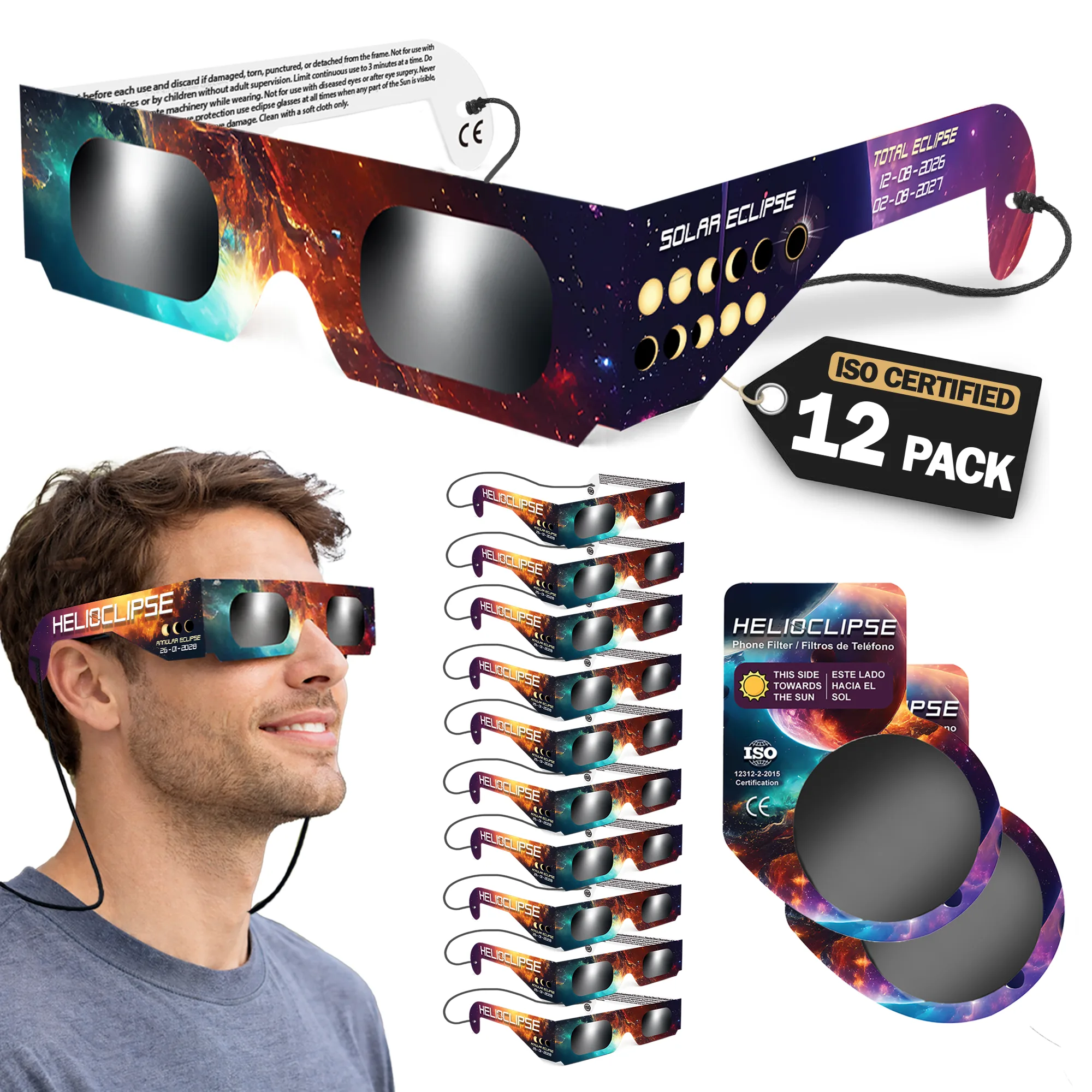
For direct, unmagnified viewing of an uneclipsed, partially eclipsed or annularly eclipsed Sun, use special-purpose solar viewers that comply with ISO 12312-2. You can explore Helioclipse solar eclipse glasses before the event and make sure every viewer is inspected and ready.
The rule behind when glasses on, when glasses off: eclipse phases explained for first-time observers can be reduced to three lines:
- Partial phase: viewers on.
- Complete totality, from inside the path of totality: viewers may come off.
- First returning point of direct sunlight: viewers on immediately.
This is the foundation of solar eye safety. Darkness, temperature changes, crowd reactions and a countdown can help you anticipate totality, but none of them overrides the physical test: the Sun’s bright face must be completely hidden before unaided viewing begins.
First contact: the partial eclipse begins
First contact is the moment the Moon’s edge first appears to touch the Sun’s disk. The initial notch can be subtle. You may not notice any change in the landscape, and people who are not looking through safe filters may have no idea the eclipse has started.
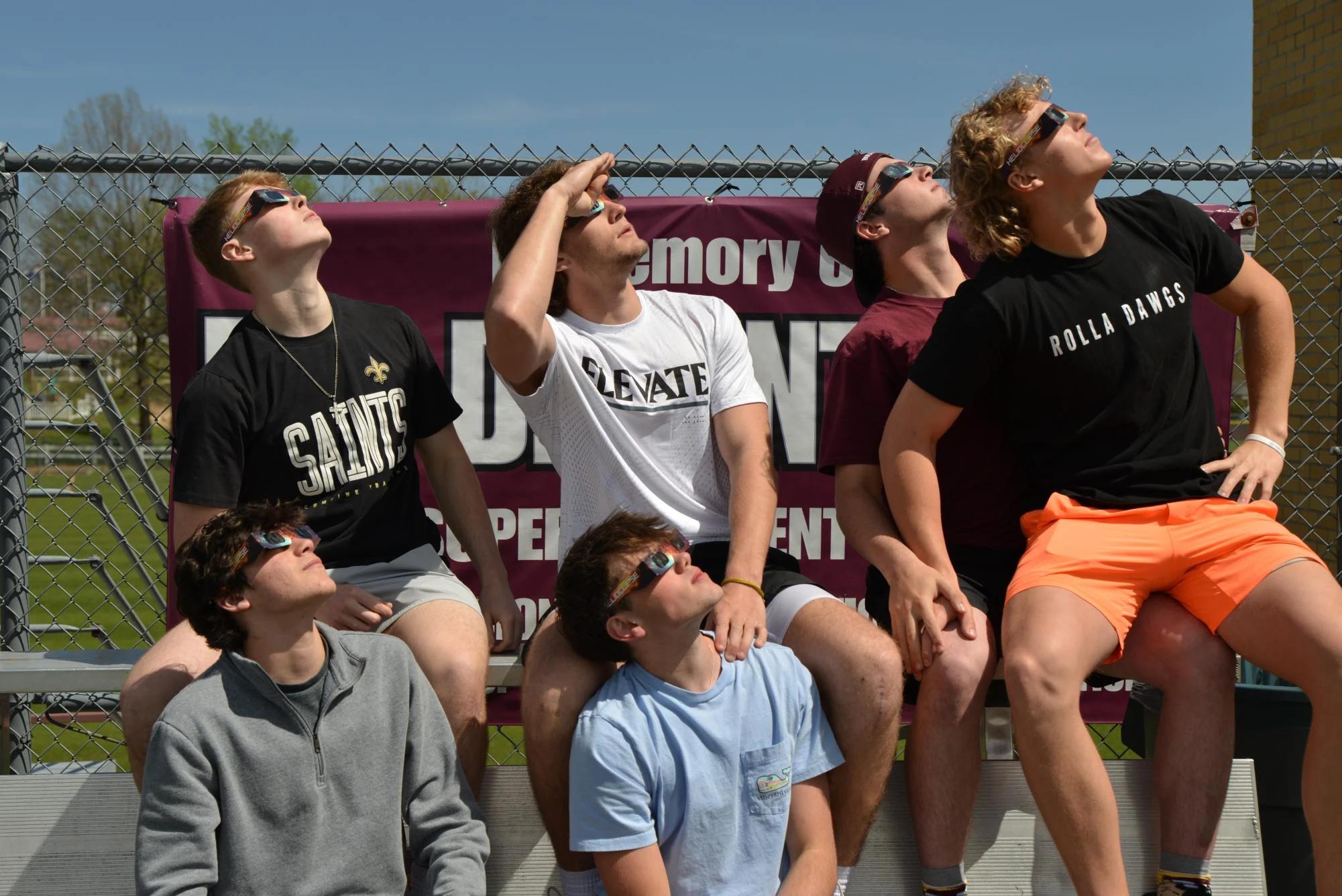
Your eclipse glasses must already be in place before you look towards the Sun. The American Academy of Ophthalmology recommends standing still, covering your eyes with the viewer before looking up, and turning away from the Sun before removing it. That simple sequence is especially helpful for children:
- Stand still and look down or away.
- Put the viewer securely over both eyes.
- Look up at the Sun.
- Turn away again before removing the viewer.
During the following partial phase, the Moon gradually covers more of the solar surface. NASA’s observer guidance notes that the partial phase can last roughly 70 to 80 minutes at many locations, although the actual duration varies by eclipse and site. Do not copy a generic duration into your day plan: check location-specific circumstances on the Helioclipse map and consult the event’s official tables.
You do not need to stare continuously. Take a short filtered look every few minutes and the Moon’s progress will be obvious. Between those looks, watch the ground beneath leafy trees or hold up a colander with the Sun behind you. The gaps act as pinhole projectors, scattering tiny crescent-shaped images of the Sun onto a pale surface.
Approaching totality: dramatic does not yet mean safe
As more of the Sun disappears, the quality of daylight changes. Colours can look muted, shadows become unusually crisp, the temperature may fall and animals may respond as if evening has arrived. Shortly before totality, faint shadow bands can sometimes ripple across pale walls or the ground.
The remaining solar crescent eventually breaks into Baily’s beads as sunlight shines through valleys along the Moon’s edge. A final brilliant point beside the emerging corona creates the diamond-ring effect. These are spectacular boundary phenomena—but for a first-time, unaided observer, the conservative and memorable instruction is still viewers on while direct sunlight remains visible.
Do not remove them merely because someone shouts “diamond ring,” because a predicted clock time has arrived or because the crowd starts cheering. Keep them on until the Sun’s bright face has completely disappeared and totality has actually begun at your location.
We use the phase sequence (partial, totality, etc.) from authoritative eclipse planning guidance published by NASA, the American Astronomical Society and medical eye specialists. That guidance matters more than an improvised countdown, particularly near the edge of the path where totality may be extremely short. Exact contact times change across surprisingly small distances.
For a group, appoint a calm adult as the safety caller and give that person verified local contact information. Add a note on eclipse safety to the family plan: nobody follows an unfamiliar voice in the crowd, and children wait for their designated adult’s instruction.
Second contact: the only glasses-off interval
Second contact marks the beginning of totality. The last direct point of the Sun’s brilliant photosphere disappears behind the Moon. If—and only if—you are inside the path of totality and the bright face is completely covered, you may remove your viewers and look at the eclipsed Sun with unaided eyes.
The sight is fundamentally different from a 99% partial eclipse. The black silhouette of the Moon hangs within the Sun’s pale corona, an atmosphere normally overwhelmed by the photosphere’s glare. A thin pink-red chromosphere or individual prominences may be visible near the lunar edge. Around you, the horizon can take on a 360-degree twilight glow, while bright planets or stars may appear overhead.
Safe solar viewers are intentionally so dark that they hide the corona during totality. Taking them off is therefore not just permitted during complete totality; it is necessary to see the defining spectacle. But totality is brief. At some locations it lasts only seconds, while other eclipses and sites offer a few minutes. Location-specific timing—not the event’s global maximum—must control your plan.
The August 12, 2026 total solar eclipse provides a useful example. Its path of totality crossed Greenland, Iceland and Spain, and the event’s maximum totality was approximately 2 minutes 18 seconds. Observers outside that narrow path saw a partial eclipse and had no glasses-off interval at all. Our 2026 total-eclipse planning guide explores that event in greater detail.
A solar eclipse eye safety phases 2026 guide cannot give one universal clock time for every town. The best places and timing for solar eclipse eye safety phases depend on path geometry and the observer’s exact coordinates: totality may last longer near the centre of the path and shrink towards either edge. Verify whether your pin lies inside the totality boundary, then record second and third contact in the local time zone.
Third contact: sunlight returns, viewers return first
Third contact ends totality. Before it arrives, stop scanning the corona and have your viewers ready. The side of the lunar silhouette opposite the disappearing Sun may begin to brighten, and red prominences or the chromosphere can signal that direct sunlight is about to return.
Put your viewers back on before the first bright point of the photosphere reappears. Once that flash emerges, totality is over. The diamond ring and Baily’s beads unfold in reverse, followed by an expanding solar crescent.
This transition can feel abrupt because your eyes have adapted to the darker sky. It is also the moment when excitement can disrupt a rehearsed plan: someone wants another photograph, a child drops a viewer, or the group begins celebrating. Make “viewers on before sunlight returns” part of your spoken countdown, not an afterthought.
After third contact, the eclipse remains worth watching. Crescent projections reappear, sharp shadows soften and daylight gradually returns. Every direct look at the partial Sun still requires proper protection until the Moon has completely moved away at fourth contact.
Fourth contact: the eclipse ends
Fourth contact is the moment the Moon’s trailing edge leaves the solar disk. The Sun is whole again, and the eclipse is finished at that location.
There is no special eye-safety transition here: viewing the ordinary Sun directly remains unsafe without a suitable solar filter. The eclipse did not make sunlight dangerous, nor does its end make direct viewing safe. The same protection rule applies whenever the bright Sun is visible.
By this point, many people will already be packing. Take a moment to collect every viewer, check that children are accounted for and let traffic disperse if conditions allow. If you plan to retain your viewers, store them flat, clean and dry where the filters cannot be scratched or punctured.
Partial, annular and total eclipses are not interchangeable
A solar eclipse can be total, partial, annular or hybrid. These labels describe the Sun–Moon geometry and determine whether a glasses-off interval exists.
Total solar eclipse
Inside the path of totality, the Moon completely covers the Sun’s bright face for a short interval. Viewers are required throughout both partial phases but may come off during complete totality. Outside the path, the same event is only partial and viewers remain on.
Even 99% coverage is not totality. The remaining sliver of the photosphere is bright enough to erase the delicate corona and requires eye protection. “Almost total” is still partial for both the visual experience and the safety rule.
Partial solar eclipse
Only part of the Sun is covered. There is no second-contact-to-third-contact total phase, so there is no glasses-off moment. Viewers stay on for every direct look.
Annular solar eclipse
The Moon appears slightly too small to cover the Sun completely, leaving a bright ring around it. The so-called ring of fire is direct sunlight. Viewers stay on throughout annularity and every partial phase.
Hybrid solar eclipse
A hybrid eclipse appears total along some portions of its path and annular along others because of the geometry of the shadow and Earth’s curved surface. Your local classification controls the rule. If the event is annular or partial at your site, the viewers never come off.
NASA also distinguishes three types of lunar eclipse: total, partial and penumbral. Lunar eclipses involve Earth’s shadow falling on the Moon and are safe to watch without solar filters. Do not transfer solar-eclipse rules to a lunar eclipse—or lunar-eclipse habits to the Sun.
Cameras, binoculars and telescopes need different protection
Solar eclipse eye safety glasses protect your eyes during direct, unmagnified viewing. They are not filters for cameras, binoculars or telescopes. Never look through an unfiltered optical instrument while wearing eclipse glasses: concentrated sunlight can damage the viewer and your eyes.
A camera lens, telescope or pair of binoculars used on the bright or partially eclipsed Sun needs a purpose-designed solar filter securely mounted over the front aperture, before sunlight enters the instrument. The requirements and setup differ from wearable viewers. Seek advice from an experienced solar observer or astronomer rather than improvising with loose filter material.
During totality, experienced observers may use unfiltered optics under a carefully planned procedure, but the filters must be replaced before direct sunlight returns. For a first eclipse, unaided viewing is simpler and leaves more attention for the event itself. No photograph is worth missing the moment—or rushing a safety-critical filter change.
If a school or family group uses a solar eclipse eye safety video for preparation, pause it at second and third contact and rehearse the hand movements. A video is useful for learning the sequence, but it cannot determine whether totality has begun at your actual location.
Choosing, inspecting and sharing viewers
ISO 12312-2 is the international standard relevant to wearable and handheld filters intended for direct observation of the Sun without magnification. It addresses properties including transmission of visible, ultraviolet and infrared radiation, material quality, mounting and labelling. Ordinary sunglasses fall under a different standard and transmit far too much sunlight for direct solar viewing.
A printed standards claim is not a magic guarantee by itself. Buy from a source you can identify, read the supplied instructions and inspect every filter in bright ambient light before eclipse day. Discard a viewer that is scratched, torn, punctured, separating from its frame or otherwise damaged. Supervise children and check that the viewer covers both eyes without gaps.
Product language such as eclipse viewing glasses, eclipse glasses iso 12312-2 or certified solar eclipse glasses should lead to a real verification step, not an assumption. NASA does not approve particular brands, so claims such as “NASA approved” or “NASA certified” should not be treated as an official product endorsement. For more context, read our guide to ISO 12312-2 and eclipse viewers and our guide to spotting fake or low-quality eclipse glasses.
Do eclipse viewing glasses degrade over time? Age alone is not the only issue. The AAS says some relatively recent viewers can be reused when their manufacturer has obtained appropriate accredited-laboratory testing, the product conforms to ISO 12312-2, and the filters remain in excellent condition. Follow the manufacturer’s current instructions, and never use a viewer whose history or condition you cannot trust.
A group does not necessarily need to stare continuously or have a viewer permanently assigned to every person. Partial phases move slowly enough for safe viewers to be shared for brief looks. Having enough for the group is still more comfortable, reduces fumbling and makes supervision easier—especially at the rapid transitions around totality.
Safe alternatives when you do not have viewers
You can experience the partial phases without looking directly at the Sun. A pinhole projector places an image of the solar crescent on another surface while your back remains towards the Sun. A cardboard box projector, colander, perforated spoon or the small gaps between crossed fingers can all create projected images.
The essential point is that you look at the projection, not through the hole at the Sun. Tree leaves produce the same effect naturally, often covering the ground with dozens of tiny crescents.
These indirect methods answer how to watch a solar eclipse safely without glasses during the partial phases. They do not turn ordinary materials into direct-viewing filters. Smoked glass, exposed film, CDs, food wrappers and homemade tinted sheets are not safe substitutes.
Our most useful solar eclipse eye safety tips are therefore practical: prepare before the event, inspect every viewer, supervise children, rehearse the phase changes, and keep a projection method available as a backup. For medically grounded background, start with solar eclipse eye safety NASA guidance and the AAS viewing rules rather than social-media shortcuts.
A family-ready phase script
The solar eclipse eye safety phases are easier to remember when someone says them aloud. Give your group this short script before eclipse day:
- Before first contact: “Viewers on before looking up.”
- During the first partial phase: “Any bright Sun means viewers on.”
- At the diamond ring before totality: “Keep them on; direct sunlight remains.”
- Once complete totality is confirmed: “Bright face fully covered; viewers may come off.”
- Before third contact: “Viewers ready and back on before sunlight returns.”
- During the final partial phase: “Viewers stay on for every direct look.”
Practise once with no Sun involved. Decide who calls the transitions, where spare viewers will be kept and how adults will help younger children. If your location is outside totality, simplify the script further: viewers stay on for the entire eclipse.
That is the central takeaway from this solar eclipse eye safety phases 2026 guide and from the broader guidance for every year. The sky can become strange, beautiful and deeply moving, but the safety decision remains wonderfully simple: visible photosphere means protection.
Frequently asked questions
What viewing stages should I expect during a total solar eclipse?
The eclipse begins with a partial phase, when the Moon first appears to cover part of the Sun and protective viewers are required. The brief middle phase is complete totality, when viewers may be removed only from inside the path of totality; they must go back on as soon as direct sunlight returns.
What is the simple three-part rule for using eclipse viewers?
During the partial phase, keep compliant solar viewers on. During complete totality, viewers may come off only if you are within the path of totality, and they must be put on immediately at the first returning point of direct sunlight.
Which kinds of solar eclipses allow a glasses-off moment?
Only a total solar eclipse has a brief glasses-off phase, and only for observers inside the path of totality when the Sun’s bright face is completely covered. Partial and annular eclipses, as well as locations outside the totality path, never have a safe glasses-off phase.
What could happen if I remove my eclipse viewers too early?
If any part of the Sun’s bright face is visible, you should not look at it without proper solar viewers because even a thin crescent remains intensely bright. Put the viewers on before looking toward the Sun and keep them on until complete totality begins.
Why might the eclipse feel strange or dramatic even when I still need viewers?
Near totality, daylight can thin, shadows may sharpen, and the horizon can change colour, which can make the experience feel unusual. These changes do not indicate that it is safe to remove viewers; the Sun’s bright face must be completely hidden first.
On-site next steps
- Choose Helioclipse solar eclipse glasses early enough to inspect them and practise with your group.
- Check your exact site in the Helioclipse Eclipse Explorer before making any glasses-off plan.
- Read why unprotected exposure can harm the retina in our guide to solar eye injury.
- Explore more family, safety and planning resources in the Helioclipse blog.
Sources & further reading
- NASA Science: What to Expect
- NASA Science: Eclipse Viewing Safety
- American Academy of Ophthalmology: Solar Eclipse Eye Safety
- Space.com: Here’s what to expect from 5 stages of the total solar eclipse 2026
- Astronomy Magazine: Our ultimate guide to the eclipse
- American Astronomical Society: How to View a Solar Eclipse Safely
- American Astronomical Society: About the ISO 12312-2 Standard for Solar Viewers
- American Astronomical Society: Phenomena You’ll Experience at a Total or Annular Eclipse
- NASA Science: Eclipses
- NASA Science: Why Do Eclipses Happen?