One certified viewer, many curious eyes: rotation tactics that stay safe (and sane)
If your group has one good eclipse viewer and five, ten, or thirty people who want a look, you do not need to panic and you do not need to improvise with unsafe substitutes. A calm, supervised rotation can work very well. In fact, a strong share one solar eclipse glasses family 2026 guide starts with one simple truth: during the partial phases, there is no prize for staring continuously.
The Moon moves across the Sun slowly enough that brief turns are enough to notice real change. That is why families, classrooms, scout groups, and neighbors can shop eclipse glasses early if they can, but still make a single compliant viewer useful if budgets are tight. The key is structure: one person looks at a time, the viewer is inspected before use, adults control the handoff, and everyone understands the difference between direct viewing and projection.
This is our practical guide to share one solar eclipse glasses family style viewing without turning eclipse day into a scramble.
The short answer: yes, but only with one-at-a-time rules
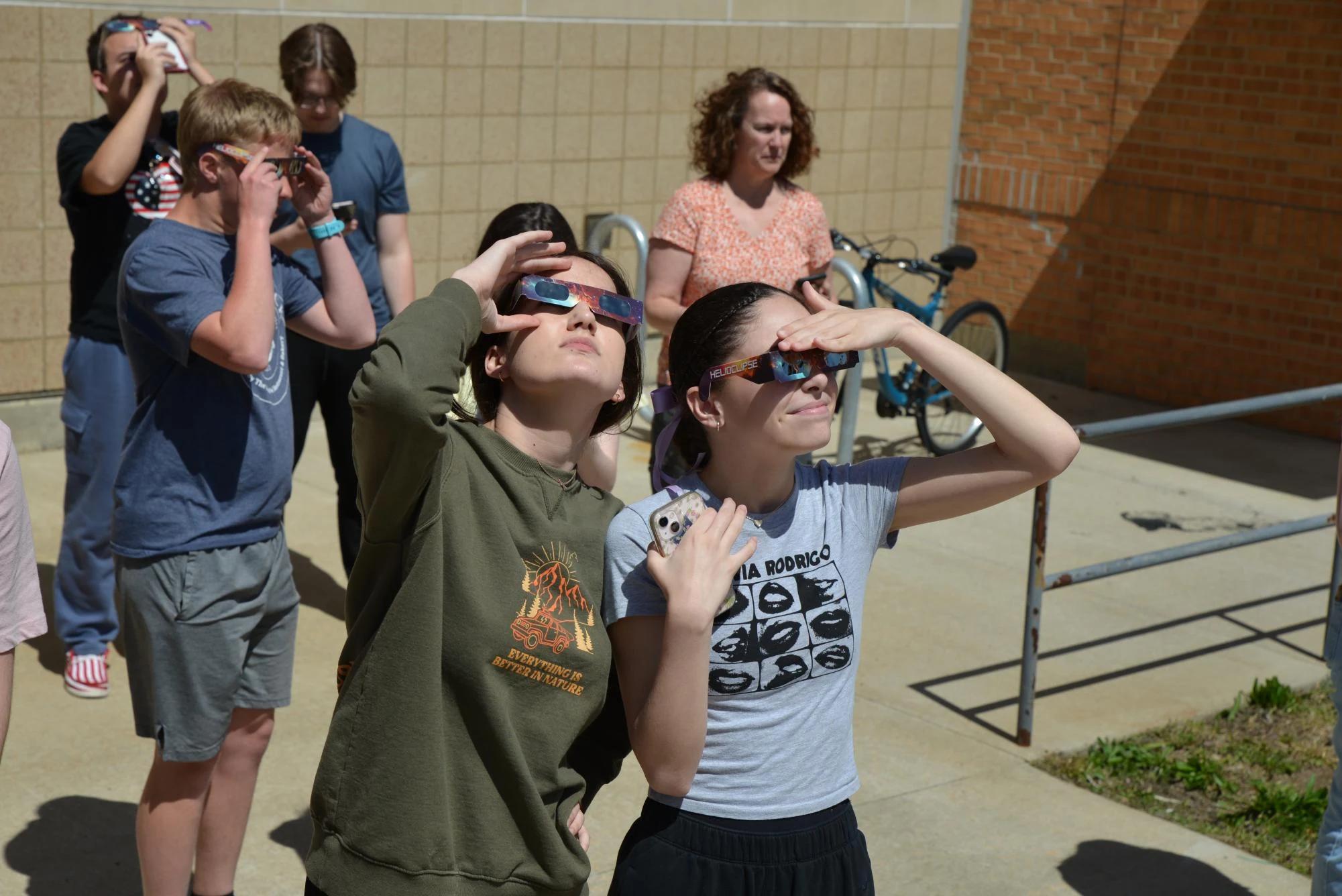
A lot of parents ask, can we share solar eclipse glasses? Yes—if what you mean is one certified viewer being passed from person to person, with each person taking a short turn while everyone else looks away from the Sun.
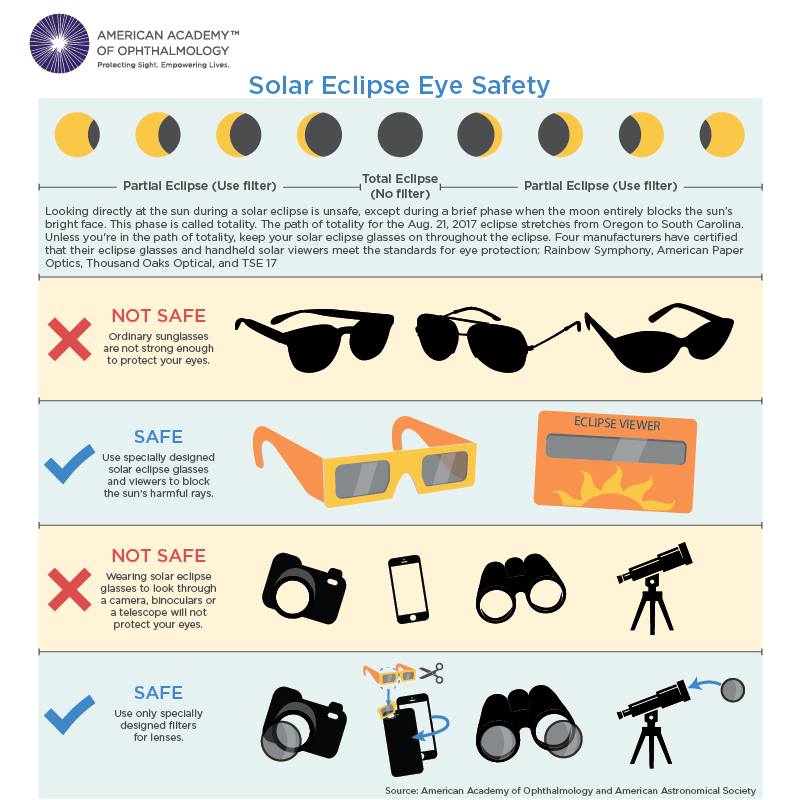
That is very different from two unsafe ideas that sometimes get mixed in with the question. First, you cannot have two people trying to peek through one pair at once. Second, you cannot make one viewer “go further” by stacking sunglasses, smoked plastic, exposed film, CDs, phone screens, or any other improvised material. The American Astronomical Society is explicit: direct viewing of the partial Sun is only safe through special-purpose solar filters that conform to ISO 12312-2.
So yes, you can share eclipse glasses. No, you cannot dilute the safety rules just because the group is sharing.
What sharing safely actually looks like
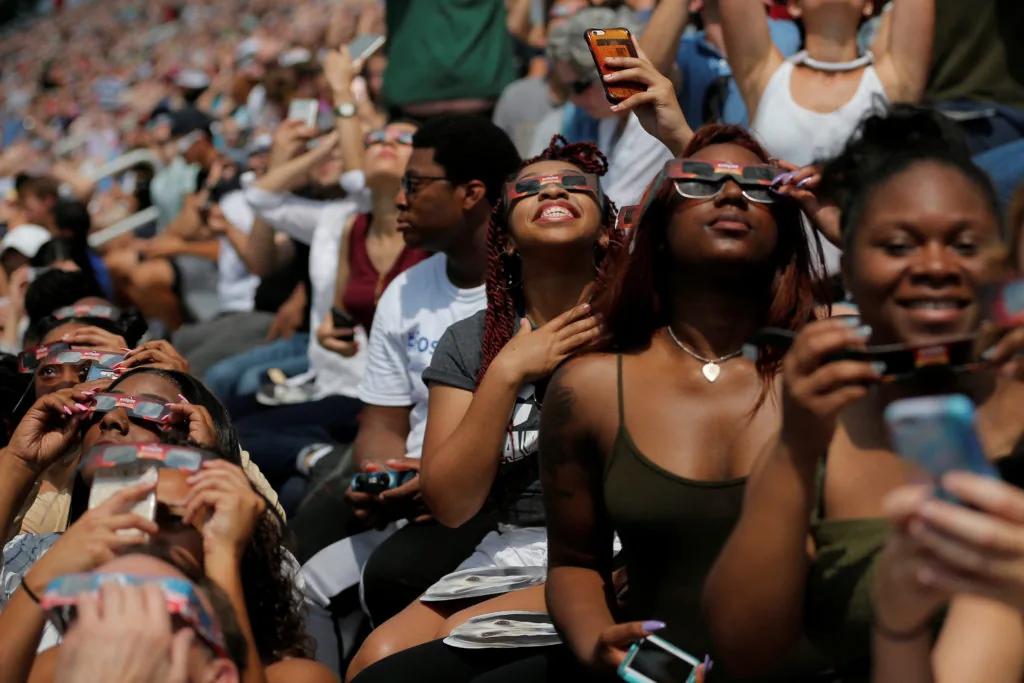
The safest version is boring in the best possible way. One adult or responsible older student becomes the “viewer manager.” That person checks the viewer before the eclipse starts, keeps it clean and dry, and controls every handoff.
The routine should be simple:
- Everyone faces away from the Sun while waiting.
- The next viewer puts the glasses on properly, or positions the handheld viewer correctly, before looking up.
- They take a short look.
- They look back down and away.
- Only then do they remove the viewer and pass it back.
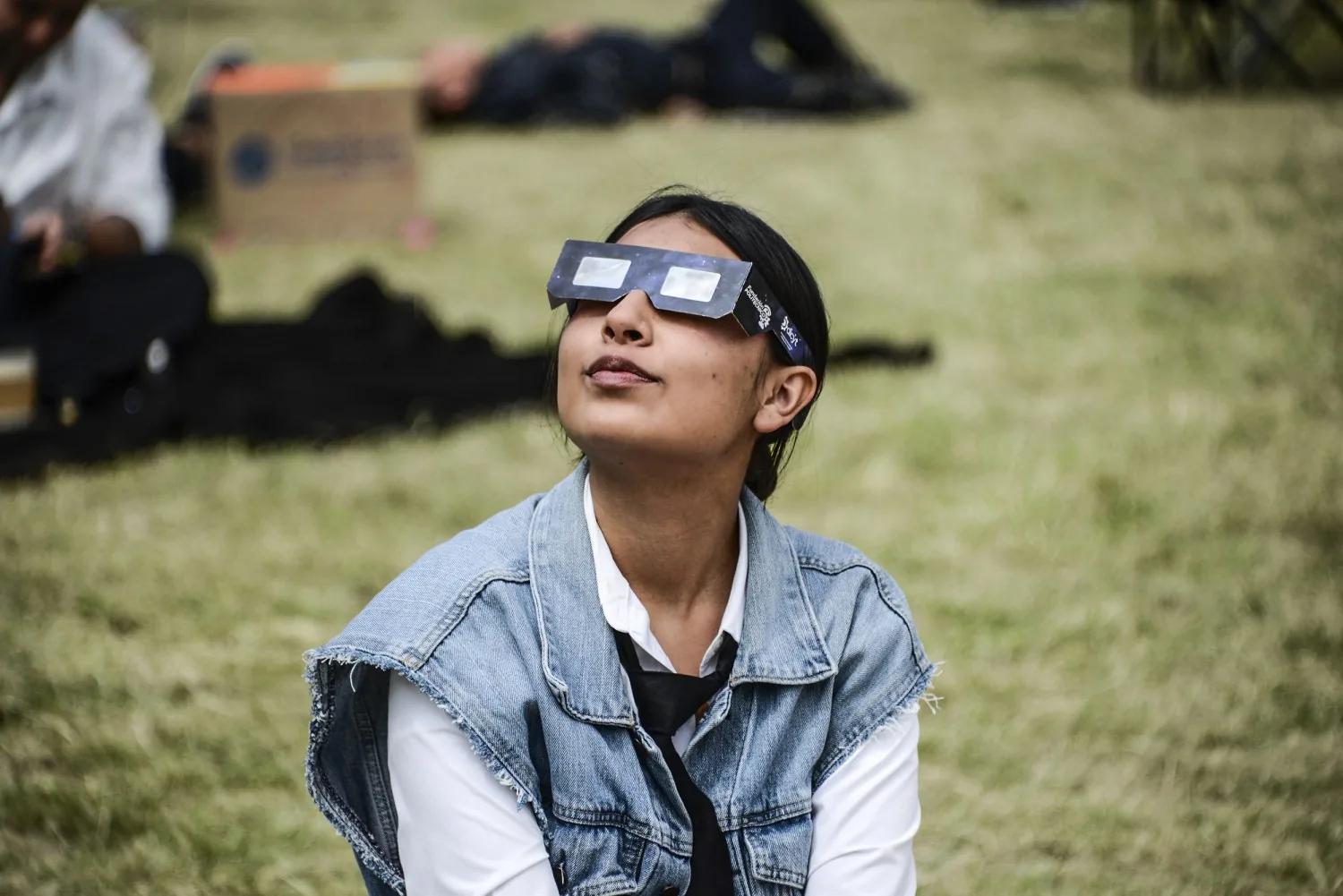
That sequence matters. AAS guidance specifically recommends putting the filter on before looking up and turning away before removing it. For children, we would not leave that to chance or memory. We would narrate it out loud every time: “Glasses on. Look up. Look down. Glasses off.”
If you want the cleanest possible rule for a mixed-age group, use this: the viewer never changes hands while anyone is looking at the Sun.
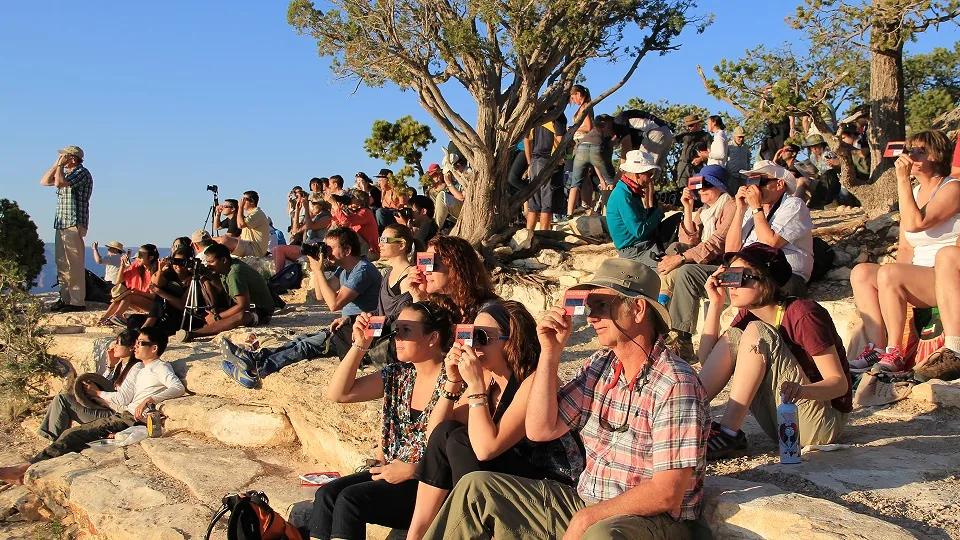
Why rotation works better than many first-time viewers expect
Families often assume eclipse viewing is like fireworks: if you miss ten seconds, you miss the event. That is not how the partial phases behave. The Moon takes roughly an hour or more to cover the Sun significantly, and then another long stretch to move away. If you glance every few minutes, the bite-shaped change is obvious.
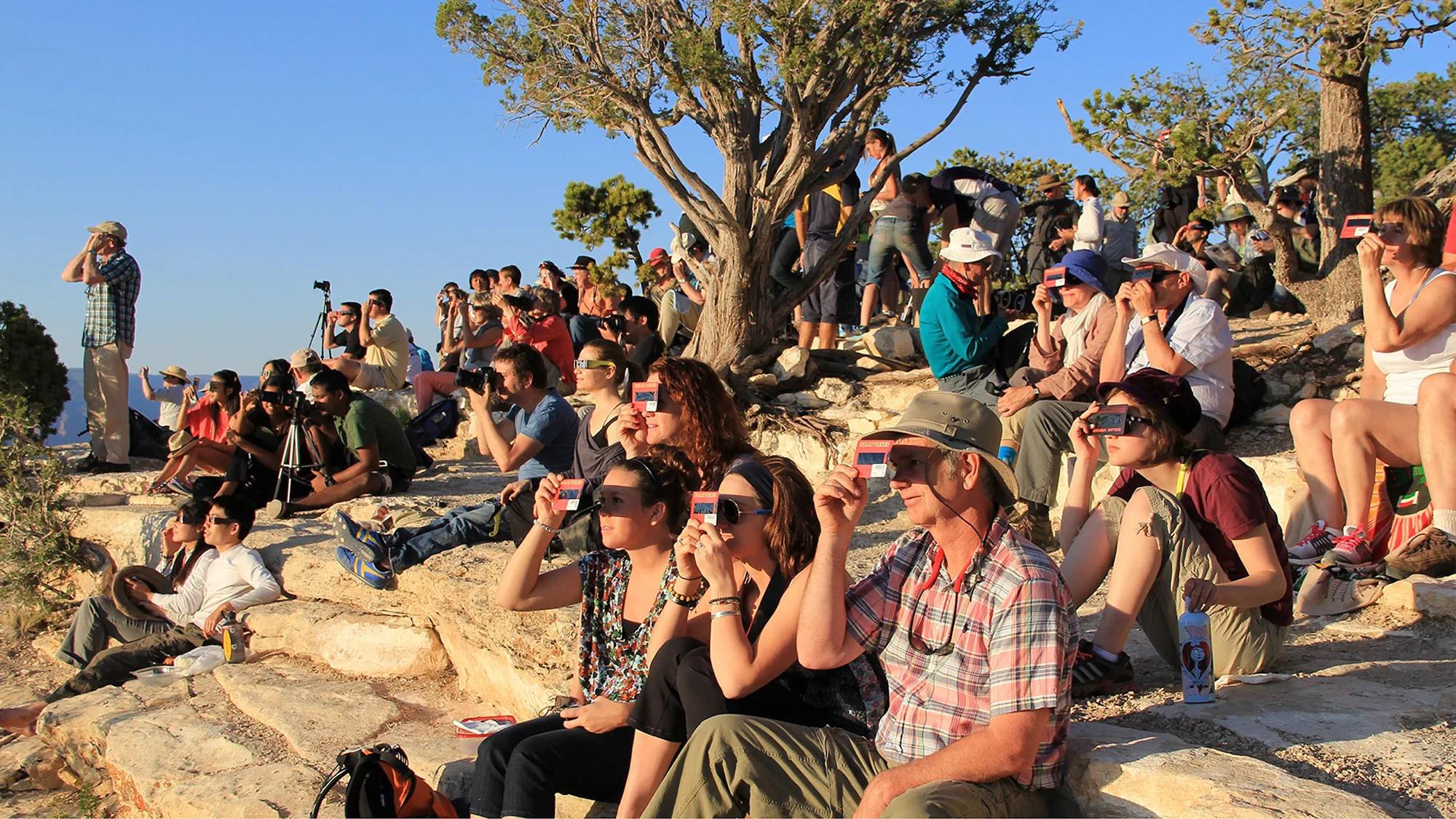
That is why the AAS says there is plenty of time to share a small number of solar viewers among a large group. This is especially true for a partial eclipse, and for the partial phases before and after totality in a total eclipse. You are not meant to lock in and stare for the whole event.
In practical terms, a family of six can rotate one viewer every two to five minutes and still feel the eclipse progressing. A classroom can do short stations. A schoolyard can combine one direct-view line with several projection activities so the waiting time still feels like part of the event, not dead air.
That is the heart of supervision-heavy guidance for families and schools—only one eclipse planning approach: make the line orderly, make the turns short, and make the non-viewing moments interesting.
The rule that never changes: only one person looks directly at the Sun at a time
This is where people get tempted to get clever. Don’t.
If you share solar eclipse glasses, the glasses are still doing one job for one set of eyes at one moment. They are not a group device. They are not a toy to wave around. They are not something children should swap freely while excited and looking upward.
For schools, we recommend saying it this way: one viewer, one face, one turn, one adult-controlled handoff.
For families with very young children, it is often easier if the adult physically places the viewer, keeps a hand near the child’s shoulder, and ends the turn after one or two seconds. Young kids do not need a long look to be thrilled. In fact, shorter turns are often safer and calmer because they reduce fidgeting.
If a child cannot reliably follow “look down before taking it off,” use indirect viewing instead of direct viewing. That is not a lesser experience. It is the right experience for that child on that day.
What not to do when you only have one viewer
Short budgets can push people toward bad workarounds. Let’s make the unsafe list plain.
Do not use ordinary sunglasses. Do not layer multiple sunglasses. Do not use exposed film, X-ray film, tinted plastic, emergency blankets, phone screens, or dark fabric. Do not cut up one pair of eclipse glasses to make several smaller pieces. Do not tape eclipse-glasses material over binoculars or a camera eyepiece. NASA warns that concentrated sunlight through optics can burn through an inadequate setup and cause severe eye injury.
And do not confuse “brief” with “safe.” A quick naked-eye glance at the partial Sun is still unsafe. If you want the science behind that risk, our guide to why staring at the Sun without protection is never “just a quick look” is worth reading before eclipse day.
This is also where search terms can mislead people. Phrases like nasa solar eclipse glasses or eclipse glasses nasa approved sound authoritative, but NASA does not approve a particular brand. NASA and the AAS instead point people toward proper solar-viewing safety rules and ISO 12312-2-compliant viewers. So when people ask what are the best glasses for viewing a solar eclipse?, the useful answer is not a celebrity brand name. It is: a compliant, undamaged viewer from a trustworthy source, used correctly.
For a deeper standards explainer, see our post on ISO 12312-2 and eclipse viewers.
If you only have one pair, build the day around direct plus indirect viewing
This is the move that makes everything easier.
When people ask how to view the solar eclipse without glasses or how to watch solar eclipse safely without glasses, the safe answer is not “just be careful.” The safe answer is indirect viewing. That means you are not looking at the Sun itself. You are looking at an image or shadow pattern produced by sunlight.
A pinhole projector is the classic option. A cardboard box version works well for schools because it gives one child at a time a clear little projected Sun inside the box. But you can also use crossed fingers, a colander, a straw hat, or the gaps between leaves in a tree canopy. During the partial phases, those tiny openings project little crescent Suns onto the ground.
That matters because it turns one scarce direct-view tool into a whole-group experience. One person gets a direct look through the certified viewer. Everyone else studies crescents on the pavement, compares shadow shapes, or watches the projected image change. Then the next person takes a turn.
If your group is large, indirect viewing is not the backup plan. It is the crowd-management plan.
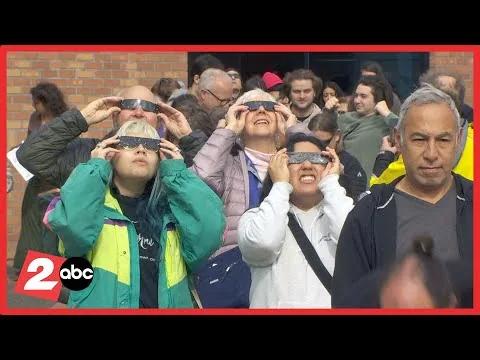
A rotation plan that works for families
Here is a simple home setup that keeps the mood fun instead of frantic.
For 2–4 people
Use 10- to 20-second turns every few minutes. Keep the viewer with one adult between turns. Call out what to notice: the shape of the Sun, how much of the disk is covered, whether the crescent is getting thinner.
For 5–8 people
Use a queue. One adult controls the handoff. Everyone gets a short look, then the group spends a minute doing something else: checking tree shadows, taking a photo of the crowd, or comparing how bright the daylight still feels.
For mixed ages
Let older kids go first only if they can model the routine well. Otherwise, lead with the youngest children while they are still patient. Give toddlers indirect viewing and narration instead of forcing a direct look they may not understand.
For a total eclipse trip
If you are traveling into totality, the sharing rules apply during the partial phases before and after totality. During totality itself, eye-protection rules change only if you are actually inside the path of totality and the Sun’s bright face is completely covered. If you are new to that distinction, read When glasses on, when glasses off, and use the Helioclipse Eclipse Explorer to confirm whether your exact location is in totality or only partial.
Outside totality, the glasses stay on for every direct look. No exceptions.
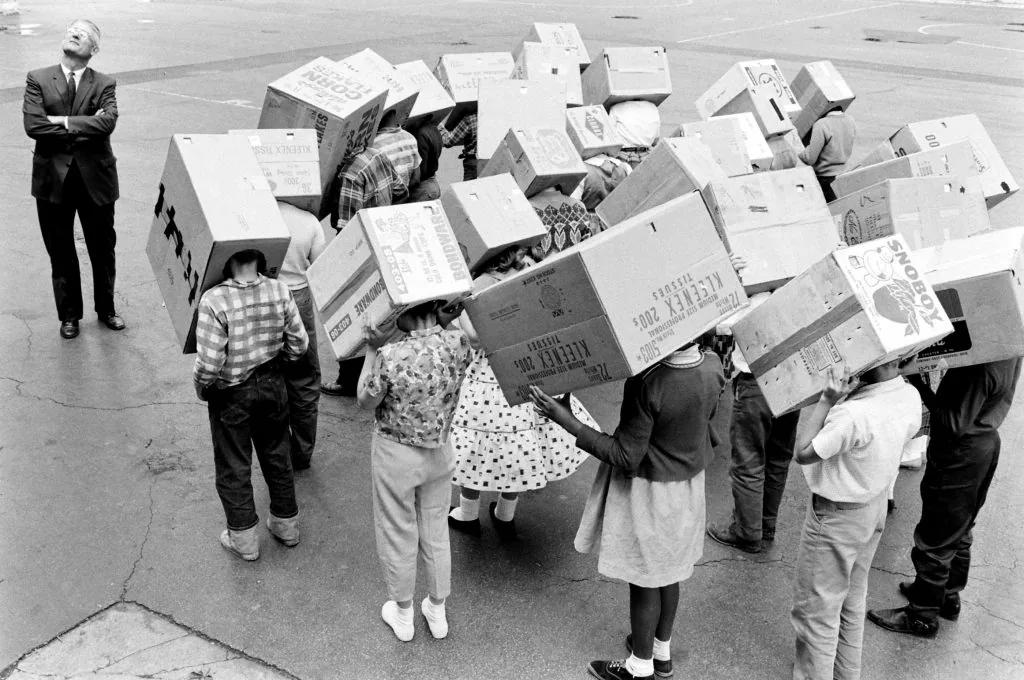
A rotation plan that works for schools and camps
Schools need more choreography, but the same physics.
Set up three stations:
- Direct-view station: one adult supervises the certified viewer.
- Projection station: pinhole box, colander shadows, or tree-shadow observation.
- Observation station: students record changes in light, temperature, shadows, and animal behavior.
Then rotate groups every few minutes.
This structure solves two problems at once. It reduces the temptation for children to grab the viewer out of turn, and it teaches that eclipse watching is not only about staring upward. NASA’s eclipse guides emphasize that the environment changes too: the light can look strange, shadows sharpen, and the whole scene becomes more memorable when people know what to notice.
For teachers, the most important sentence to repeat is this: protective glasses for solar eclipse use are for direct viewing only, and only one student should be using the viewer at a time. If a child is waiting, that child should be facing away from the Sun or focused on the projection station.
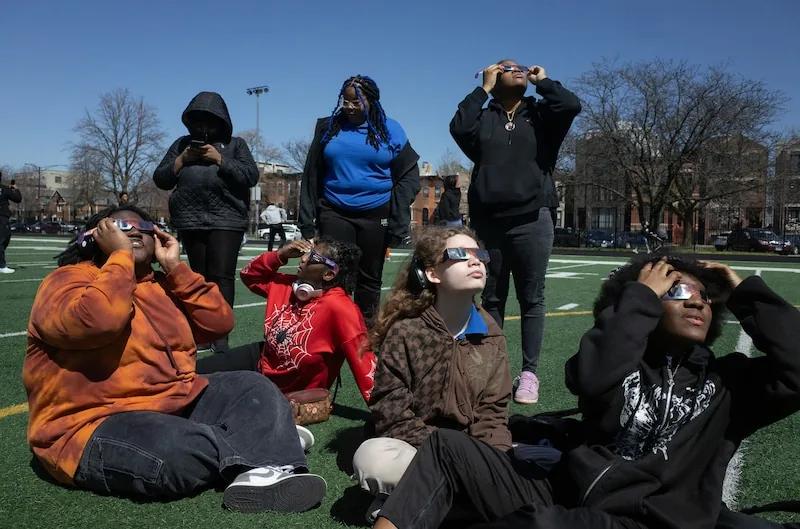
How to inspect the viewer before anyone uses it
Before the event, check the filter carefully. If it is scratched, punctured, torn, detached from the frame, or otherwise damaged, do not use it. Keep cardboard viewers dry. Do not clean them with water or wet wipes. A soft, dry, nonabrasive cloth is the safer choice for light cleaning.
This is also the moment to be honest about shopping language. People search for best glasses for solar eclipse, approved solar eclipse glasses, solar eclipse glasses iso 12312-2 certified, or certified solar eclipse glasses because they want a shortcut to trust. The shortcut is not hype. It is verification: proper labeling, intact filters, and a seller you are willing to trust before you put the product in front of a child’s eyes.
If you are still buying, buy early. Sellouts happen before major eclipses, especially when schools and community groups start ordering in volume. If you need more than one viewer, this is the moment to solve the problem before eclipse week.
Tight budget? Here is the honest answer
We are not going to shame anyone for trying to make one viewer work. Sometimes one compliant viewer is what a family has, and used properly, one is far better than a pile of unsafe substitutes.
But we are also not going to pretend that one viewer is equally convenient for every situation. If you have a larger family, a school group, or children who are very young and impulsive, more viewers make the day easier. Not because sharing is forbidden, but because supervision gets simpler and the chance of a sloppy handoff drops.
That is why the practical answer to share one solar eclipse glasses family planning is two-part:
- If one certified viewer is what you have, you can still do this safely with strict one-at-a-time rotation and indirect viewing for everyone else.
- If you can afford to add more, do it early and reduce the stress.
This is also where regional shopping searches can muddy the waters. For example, solar eclipse glasses uk for sale is a real need before a widely visible event, but the same rules apply everywhere: do not chase vague claims, do not rely on “NASA approved” wording alone, and do not wait until the last minute if your group size is already telling you one pair will be a headache.
The difference between direct viewing and projection is worth teaching out loud
A lot of confusion disappears once you say this clearly to children and adults alike:
- Direct viewing means your eyes are aimed at the Sun, so you need a proper solar filter.
- Indirect viewing means you are looking at a projected image or shadow pattern, not at the Sun itself.
That distinction is why the answer to how to watch solar eclipse safely without glasses is “use projection,” not “borrow someone’s sunglasses for a second.” It is also why a pinhole projector can serve a whole class at once while one pair of glasses cannot.
If you want a memorable line for kids, try this: glasses are for eyes; pinholes are for pictures.
What about totality?
Because this article is about sharing one viewer, we need one more safety line in bold mental ink: the rules change only during the brief total phase of a total solar eclipse, and only for people actually inside the path of totality.
During the partial phases before and after totality, you still need the viewer for any direct look. During totality itself, once the Sun’s bright face is completely covered, people in the path may remove their viewers and look with the naked eye. Then, the instant bright sunlight reappears, viewers go back on.
That sounds simple, but first-time groups often get it wrong because they are not sure whether they are truly in totality. If your plan depends on that distinction, verify your exact location with the Helioclipse 3D eclipse map and do not rely on a city name alone. A place can be close to totality and still not be in it.
A calm checklist for eclipse day
Use this as your family or school script.
- Inspect the viewer before leaving home.
- Assign one adult as the handoff manager.
- Explain the sequence: on before looking up, off after looking down.
- Keep waiting viewers facing away from the Sun.
- Set up at least one indirect-viewing activity.
- Give short turns, not long stares.
- Never use the viewer with binoculars, telescopes, or cameras.
- If you are in totality, know exactly when your location reaches it and when it ends.
- If you are not in totality, keep the viewer on for every direct look.
That is really the whole philosophy behind one certified viewer, many curious eyes: rotation tactics that stay safe under pressure. Good eclipse planning is not about squeezing more risk out of less equipment. It is about making the safe method easy enough that everyone actually follows it.
BHS Action News
Frequently asked questions
Where can families find no-cost eclipse glasses for safe viewing?
The excerpt does not say where to get free viewers, but it does say families can look for certified eclipse glasses early if they can. If cost is a concern, the article’s main point is that one compliant viewer can still be used safely with a careful one-at-a-time rotation.
What should I look for when choosing glasses for a solar eclipse?
Choose only special-purpose solar filters that conform to ISO 12312-2 for direct viewing of the partial Sun. The article says unsafe substitutes like sunglasses, smoked plastic, exposed film, CDs, and phone screens should not be used.
Why do children need close supervision when sharing an eclipse viewer?
Children should be supervised because the handoff has to be controlled and the viewer needs to be put on before looking up, then removed only after looking back down. The article says adults should manage the rotation and narrate the steps clearly so no one improvises or looks at the Sun without protection.
What is the main idea behind a one-viewer, many-people eclipse plan?
The main idea is that one certified viewer can be shared safely if each person takes a short turn and everyone else looks away from the Sun. The article emphasizes structure: inspect the viewer first, keep it clean and dry, and use one-at-a-time rules instead of trying to stretch the filter or share it simultaneously.
What should people know before using protective glasses during a solar eclipse?
Protective glasses are only safe for direct viewing if they are special-purpose solar filters that meet the proper standard. The article also says you should put the filter on before looking up and turn away before removing it, because stacking other materials or improvising with substitutes is not safe.
On-site next steps
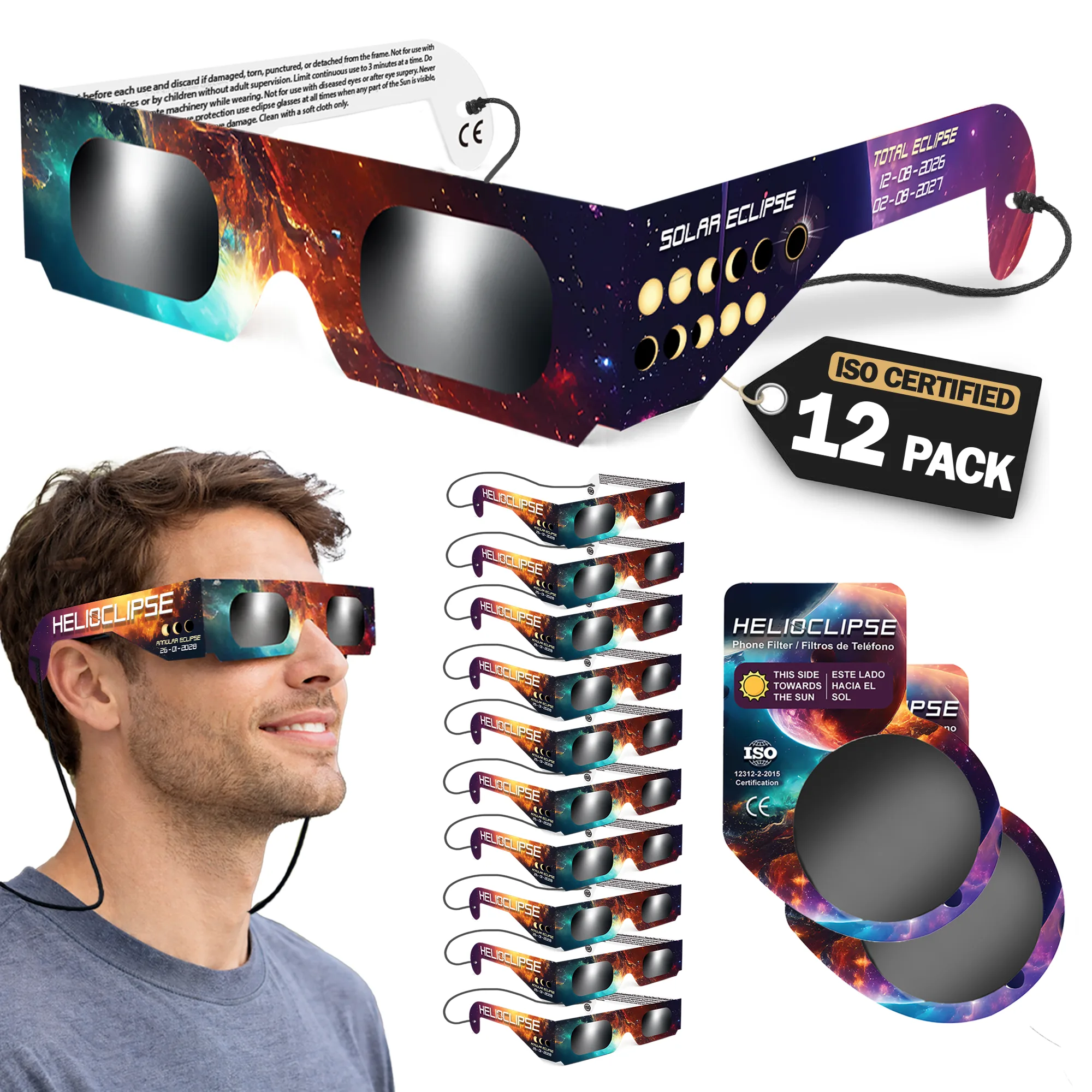
- If you want enough viewers to make family handoffs easier, shop Helioclipse eclipse glasses.
- If your plan depends on whether you are in totality or only seeing a partial eclipse, check your exact location in the Helioclipse Eclipse Explorer / 3D map.
- For more first-timer help, browse the Helioclipse blog and our planning guides, including August 12, 2026 total solar eclipse: what to expect and how to plan ahead.
Sources & further reading
- How to View a Solar Eclipse Safely — American Astronomical Society
- What to Expect: A Solar Eclipse Guide — NASA Science
- How to Safely See a Solar Eclipse — Sky & Telescope
- How to make a pinhole camera to see the eclipse — Astronomy Magazine
- How to view a solar eclipse with items from around the home — Space.com
- Eclipses — NASA Science
- Eclipses Frequently Asked Questions — NASA Science
- How to View a Solar Eclipse Safely | Solar Eclipse Across America — AAS
- Total Solar Eclipse Safety — NASA Science
- How to Safely View the Solar Eclipse Flyer — NASA Science PDF