CE marking, ISO 12312-2, and eclipse viewers: what European shoppers should understand
A few reassuring symbols can make a packet of eclipse viewers look thoroughly vetted. But CE marking and ISO 12312-2 answer different questions, and neither should be treated as decorative shorthand for “safe enough.” For direct solar viewing, the crucial product standard is ISO 12312-2; in Europe, CE marking belongs to the wider conformity framework that may apply to the product.
That distinction matters ahead of the total solar eclipse on 12 August 2026. Across most of Europe, viewers will experience a partial eclipse and must keep proper solar protection on whenever they look directly at the Sun. Only observers inside the narrow path of totality may remove their viewers during the brief interval when the Sun’s bright face is completely covered. Our guide to eclipse phases and when to use solar glasses explains that sequence in detail.
If you are buying for a family, school or viewing party, start early enough to inspect the product and ask questions. You can see our ISO 12312-2 eclipse viewers and read the product information before eclipse-day urgency takes over.
This ce mark vs iso 12312-2 eclipse glasses europe 2026 guide provides general consumer information, not legal advice or a conformity assessment. Its purpose is practical: help you understand what the markings communicate, what they do not prove by themselves, and what evidence a reputable seller should be able to provide.
The short version: CE and ISO are not interchangeable
The phrase ce mark vs iso 12312-2 eclipse glasses europe compresses two separate layers of product information into one shopping question.
CE marking is a European conformity marking. At a high level, the manufacturer uses it to declare that a product covered by relevant European Union harmonisation legislation meets the applicable legal requirements. The European Commission explicitly cautions that CE marking does not mean an EU institution has individually approved the product, and it does not identify where the product was made.
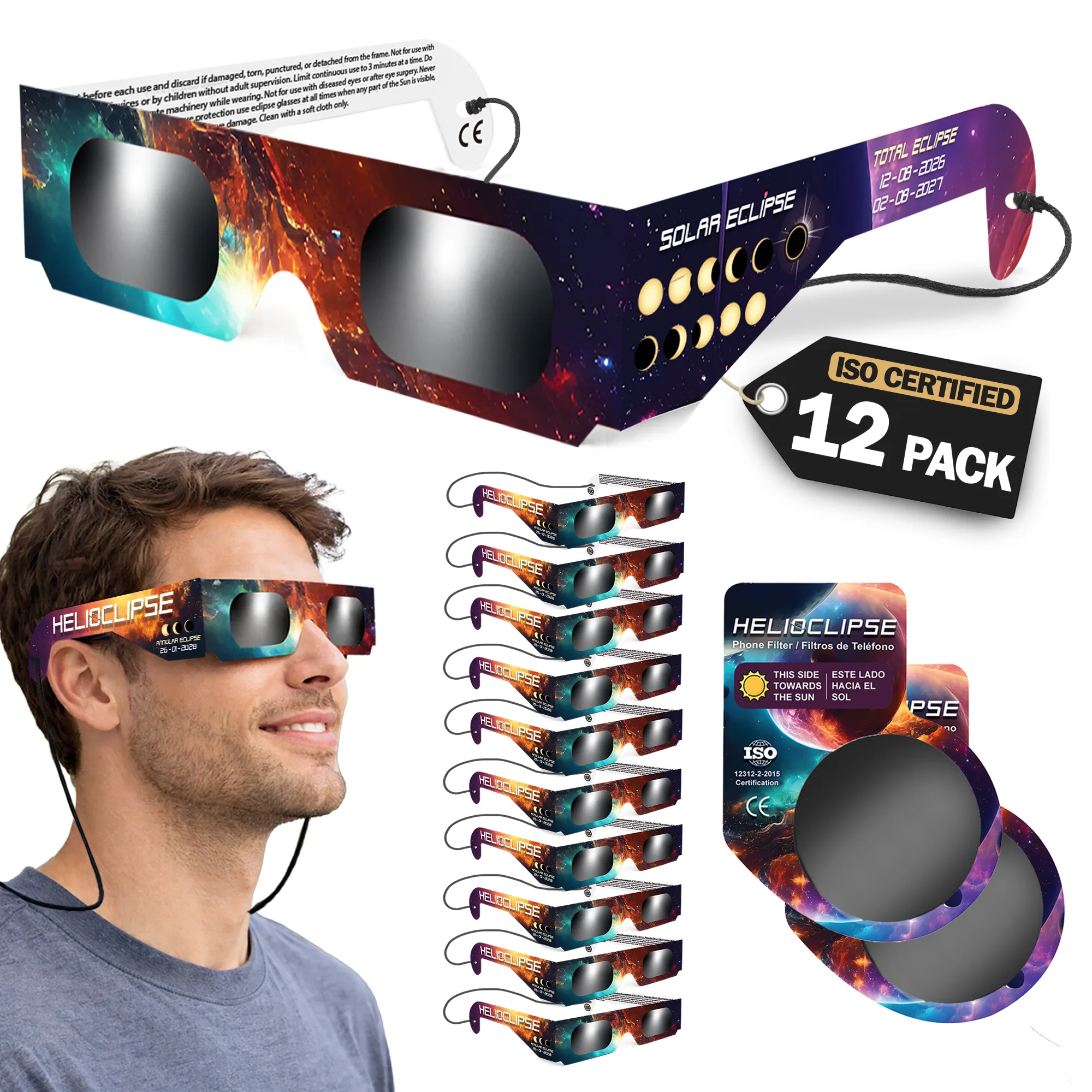
ISO 12312-2 is an international product standard for filters intended for direct observation of the Sun. It covers nonmagnifying viewers held in the hand or worn in front of the eyes, including familiar cardboard eclipse glasses. Its technical requirements concern much more than whether the Sun merely looks dim: they address transmission of ultraviolet, visible and infrared radiation, as well as filter uniformity, material quality, mounting and labelling.
A useful text-first comparison is:
| Question | CE marking | ISO 12312-2 | |---|---|---| | What is it? | A conformity marking used within the European regulatory framework | An international standard for direct solar viewers | | Does it specifically define safe optical performance for looking at the Sun? | Not by itself | Yes, within the standard’s scope | | Is it an EU safety approval stamped after officials test every item? | No | No; ISO publishes standards rather than approving retail products | | Can the symbol or claim be copied onto a poor product? | A printed mark can be misused | An unsupported ISO claim can also be printed | | What should a shopper do next? | Identify the responsible business and review the product information | Seek a credible conformity claim supported by appropriate testing and documentation |
The practical conclusion is not “choose one logo.” Look for a traceable product, an identifiable responsible business, clear instructions and credible evidence that the viewer conforms to ISO 12312-2. Where CE marking applies, it should be presented properly and supported within the relevant conformity process.
What ISO 12312-2 actually covers
The full designation is ISO 12312-2:2015, Eye and face protection — Sunglasses and related eyewear — Part 2: Filters for direct observation of the Sun. That is why listings sometimes use compact wording such as iso 12312 2 2015 eclipse glasses. The punctuation may vary in casual retail text, but a standards reference is not a substitute for evidence.
An ISO 12312-2 filter must reduce solar radiation to an appropriate level across relevant wavelengths. The American Astronomical Society’s technical explanation notes that a typical transmission of 0.001% means only about one part in 100,000 of the incident light passes through. Optical performance must also be acceptably uniform, and the filter should be free of defects such as scratches, bubbles or problematic pinholes that could impair its use.
The standard also addresses the physical viewer. The filter needs to remain secure during normal handling, while the mounting should not introduce sharp edges or other defects likely to cause injury or discomfort. Labelling provisions cover matters such as manufacturer identification and instructions for use.
This scope is narrower than many shoppers assume. ISO 12312-2 glasses are nonmagnifying direct viewers. The standard is not a blanket certification for cameras, binoculars or telescopes, and holding eclipse glasses behind or in front of magnifying optics is unsafe. Concentrated sunlight can damage the viewer and your eyes. Optical instruments require a purpose-designed solar filter secured over the front aperture, with expert instructions appropriate to that equipment.
ISO 12312-1 is also not interchangeable with Part 2. Part 1 concerns sunglasses for general use. Ordinary sunglasses—even very dark pairs—transmit far more sunlight than is safe for direct observation of the Sun.
A standard reference is a starting point, not the whole trust test
A genuine product that conforms to ISO 12312-2 should have appropriate technical support behind the claim. A seller merely printing “ISO 12312-2” does not make the filter conform, just as typing certified iso 12312 2 international standard eclipse glasses into a listing title does not create a laboratory result.
This is why the wording ce & iso certified eclipse glasses needs careful reading. ISO develops and publishes standards; it does not personally inspect and certify each packet in a shop. Depending on the conformity route and applicable rules, testing may be performed by competent laboratories and documentation should connect the tested product to the one being sold. Ask who manufactured or placed the finished viewer on the market, whether that business can be contacted, and whether the seller can substantiate its claims.
Likewise, a listing for iso 12312 2 compliant and ce certified eclipse glasses may sound comprehensive while leaving basic questions unanswered. Which finished product was tested? Which laboratory performed the work? Does the report identify the same model, filter material and responsible business? Is the documentation current and internally consistent? A reputable seller should not become evasive when asked for this information.
The aim is to explain product-safety labeling at a general level eclipse planning can put into action: treat the label, seller, documentation and physical product as connected evidence. No single printed element should carry the entire decision.
How to read the package and product information
Before buying, look for enough information to identify both the product and the business behind it. Exact requirements depend on the product and applicable European rules, so this is a consumer checklist rather than legal interpretation.
Useful signs include:
- a clear reference to ISO 12312-2 or ISO 12312-2:2015;
- the manufacturer’s or responsible economic operator’s identifiable name and contact details;
- instructions in a language suitable for the market where the product is sold;
- directions for putting the viewer on before looking toward the Sun and turning away before removing it;
- warnings against use with cameras, binoculars or telescopes;
- storage, inspection and disposal guidance;
- product or batch information that can be connected with supporting documentation;
- a seller with a real identity, customer-service channel and coherent product history.
Be cautious if the business name changes between the product, package, listing and documents. Also pause when a marketplace seller combines unrelated certificates, unexplained laboratory logos and vague phrases such as “approved by space agencies.” NASA does not approve or certify commercial eclipse glasses.
The ungainly phrase ce marking, iso 12312-2, and eclipse viewers: what european shoppers often need most is a hierarchy of evidence. A polished packet is less important than traceability. Clear typography is welcome, but technical claims should lead back to a real product, a real responsible business and credible testing—not to a collection of badges copied from elsewhere.
For a deeper buyer check, use our guide to spotting fake and low-quality eclipse glasses.
Shopping language that can mislead you
Retail listings often mix technical terms with popular phrases. Understanding that language helps you reject both false reassurance and false precision.
The question what is the iso certification for solar eclipse glasses? is best answered carefully: ISO 12312-2 is the relevant international standard for eligible direct solar viewers, but ISO itself does not award a retail product an approval badge. Look for a substantiated statement of conformity and credible supporting information from the responsible supplier.
Similarly, approved solar eclipse glasses and eclipse glasses nasa approved are not equivalent technical categories. NASA publishes safety guidance but does not certify commercial viewers. A seller using that language should not receive extra trust merely because the claim sounds official. More meaningful product wording includes solar eclipse glasses iso 12312-2 certified or eclipse glasses iso 12312-2—but even those phrases must be checked against the seller’s identity and evidence.
A search result or listing labelled baader solar eclipse glasses is a brand-specific commercial phrase, not an independent safety finding. We do not recommend choosing any viewer because a manufacturer’s name appears in a title, and we do not treat competitor branding as evidence of conformity. Apply the same documentation and condition checks to every product.
Price is also a poor safety shortcut. An iso 12312-2 glasses price that seems high does not prove conformity, while a multipack can legitimately reduce the cost per viewer. Very low pricing becomes concerning when it arrives alongside an anonymous seller, inconsistent packaging, copied images or unsupported claims. Judge the whole chain, not one number.
The same principle applies when looking for iso 12312-2 glasses near me. A museum, planetarium, astronomy organisation or established specialist retailer may offer useful accountability, but the shop’s reputation does not remove the need to inspect the actual item. If buying online, leave time for delivery, document review and replacement rather than opening the packet on 12 August.
Inspect every viewer before it reaches someone’s face
Documentation matters at purchase; condition matters at every use. Hold the viewer away from the Sun and inspect the filter for scratches, punctures, tears, separation from the frame or other damage. Discard a damaged viewer. Do not patch it with tape and assume the repair restores its optical properties.
Store cardboard viewers flat, clean and dry, preferably in their original sleeve or another protective envelope. Do not clean cardboard viewers with water, wet wipes, glass cleaner or solvents. Moisture can distort the mount or loosen the filter. Follow the manufacturer’s care instructions for the specific product.
When trying a viewer, ordinary indoor surroundings should not be visible through the filter. The Sun should appear comfortably bright and sharply defined, not painfully intense. However, a home brightness check cannot measure ultraviolet and infrared transmission and cannot prove compliance. It is only a final sanity check after you have established a trustworthy source and credible documentation.
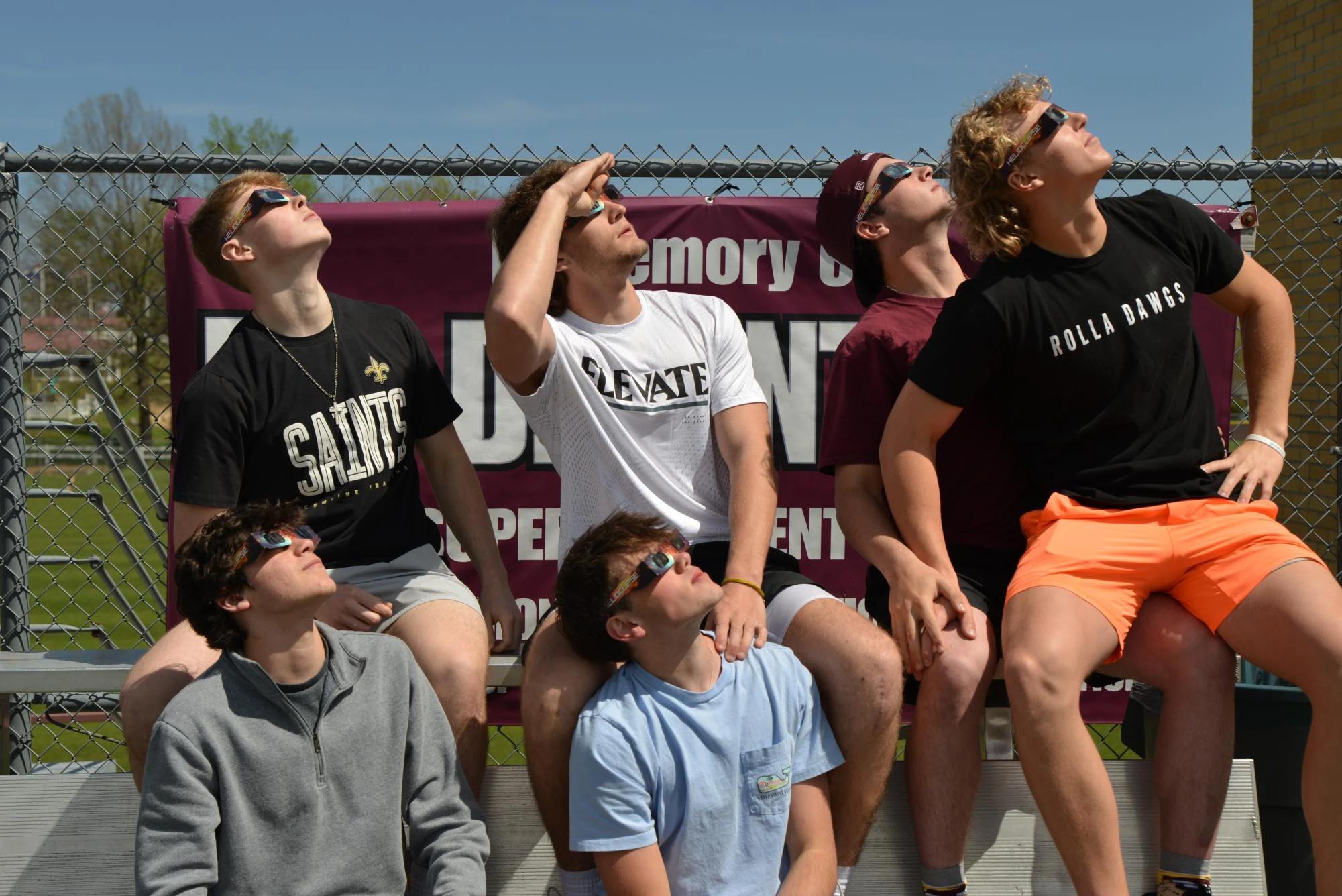
Families should practise before eclipse day. Put the viewer over your eyes while facing away from the Sun, turn toward the Sun to look, then turn away again before removing it. Supervise children closely. If someone normally wears prescription glasses, the eclipse viewer goes over them, or a handheld viewer is held in front.
Glasses are for eyes, not optical equipment
An iso 12312-2 filter in a wearable viewer is designed for unmagnified observation. It must never be placed between your eye and an unfiltered telescope, binocular or camera lens. Magnifying optics collect and concentrate solar energy, potentially damaging the filter almost instantly.
The safe arrangement for suitable optical equipment uses a purpose-built solar filter secured over the front aperture, before sunlight enters the instrument. Because equipment designs and filters vary, consult an experienced solar observer or the instrument and filter manufacturers rather than improvising.
Phone photography needs restraint too. Do not stare at the Sun while framing a photograph, and do not assume eclipse glasses are a camera filter. If you want a record without specialist equipment, photograph your group, the changing light or crescent projections beneath trees. Those images often tell the human story better than a tiny overexposed Sun.
The totality exception—and why most Europeans will not have one
During every partial or annular solar eclipse, proper viewers remain on whenever you look directly at the Sun. The same rule applies throughout the partial phases before and after totality.
There is one tightly defined exception. If you are inside the path of a total solar eclipse, you may view totality without eclipse glasses only after the Moon has completely covered the Sun’s bright face. As soon as direct sunlight begins to return, the viewers go back on. Outside the path of totality, there is no glasses-off interval at all.
That geographic distinction will be especially important on 12 August 2026. Totality crosses a narrow path that includes parts of northern Spain, while Madrid and many other European locations remain outside it and see a deep partial eclipse. Use the Helioclipse Eclipse Explorer to check whether your exact observing point is inside or outside the path and to review local circumstances. Being “close” to the path is not the same as being inside it.
Cloud does not cancel the safety rule. Thin cloud can reduce visible brightness while still allowing hazardous solar radiation through, and a gap may expose the Sun suddenly. Keep the viewer ready and use it whenever any part of the bright solar surface is visible.
A calm buying checklist for families, schools and groups
Buying early is less about panic and more about preserving choices. A family can inspect several viewers at the kitchen table. A teacher can confirm quantities, practise the viewing routine and set aside spares. An event organiser can record where the batch came from and brief volunteers before hundreds of people look upward at once.
Before placing an order, check:
- Purpose: Is the product explicitly intended for direct, unmagnified solar viewing?
- Standard: Does it claim conformity with ISO 12312-2?
- Identity: Can you identify and contact the manufacturer, importer or responsible seller?
- Evidence: Can the supplier provide credible documentation tied to the finished product?
- Instructions: Are safe-use directions clear, legible and suitable for your market?
- Condition: Can every viewer be inspected before distribution?
- Quantity: Do you have enough for supervised use, plus replacements for damaged items?
- Plan: Does everyone understand when viewers stay on and, if relevant, the exact condition under which they may come off?
There is no need to collect a wall of logos. The strongest purchase has a short, coherent story: the product has a defined purpose, the responsible business is identifiable, the ISO 12312-2 claim is supported, the instructions make sense, and the viewer arrives undamaged.
Common questions, answered precisely
Does a CE mark alone mean eclipse glasses are safe for the Sun?
No. CE marking does not, by itself, communicate the optical performance required for direct solar viewing. Look for an appropriately supported ISO 12312-2 conformity claim as part of the product’s complete information.
Are 3D cinema glasses or dark sunglasses suitable?
No. They are not solar viewers. Ordinary sunglasses fall under a different use case and can pass hundreds or thousands of times more light than is acceptable for direct solar observation. Smoked glass, photographic film and improvised plastic are also unsuitable.
Is “CE & ISO 12312 2 certified” enough wording?
No wording alone is enough. Even a polished claim such as ce & iso 12312 2 certified must be connected to an identifiable product, a responsible supplier and credible documentation. That is also why certified iso 12312 2 international standard eclipse glasses should describe a substantiated product rather than function as ornamental marketplace text.
Do eclipse viewers expire after three years?
Not automatically. The AAS says relatively recent viewers supported by appropriate testing may be reusable if their filters remain undamaged and the manufacturer’s instructions permit it. Always follow the instructions supplied with your product and discard anything scratched, punctured, torn, warped or separating from its mount.
Can several people share one pair?
Yes, if sharing can be managed safely and hygienically. Partial phases develop over a long period, so nobody needs to stare continuously. For children’s groups and public events, providing more viewers than the bare minimum makes supervision easier and gives you replacements when one is dropped or damaged.
Frequently asked questions
What do the labels on eclipse viewers actually tell me?
CE marking and ISO 12312-2 communicate different things. CE marking is part of the European conformity framework, while ISO 12312-2 is the product standard specifically for non-magnifying filters used to observe the Sun directly.
Which ISO standard should solar eclipse viewers meet?
For direct solar viewing, the relevant standard is ISO 12312-2. It addresses ultraviolet, visible and infrared transmission, as well as filter uniformity, material quality, mounting and labelling.
Can ordinary 3D cinema glasses be used to watch a solar eclipse?
No evidence in the excerpt supports using 3D glasses for direct solar viewing. Use viewers designed for direct observation of the Sun and covered by ISO 12312-2 instead.
What protection should I use when looking directly at a solar eclipse?
Use proper solar protection whenever you look directly at the Sun during a partial eclipse. Viewers may be removed only by observers inside the narrow path of totality, and only during the brief interval when the Sun’s bright face is completely covered.
What is the main point of the CE mark versus ISO 12312-2 guide for European buyers?
The guide explains that CE marking and ISO 12312-2 are not interchangeable and should not be treated as decorative proof that a viewer is safe. It also notes that CE marking is not individual approval by an EU institution and does not indicate where a product was made.
On-site next steps
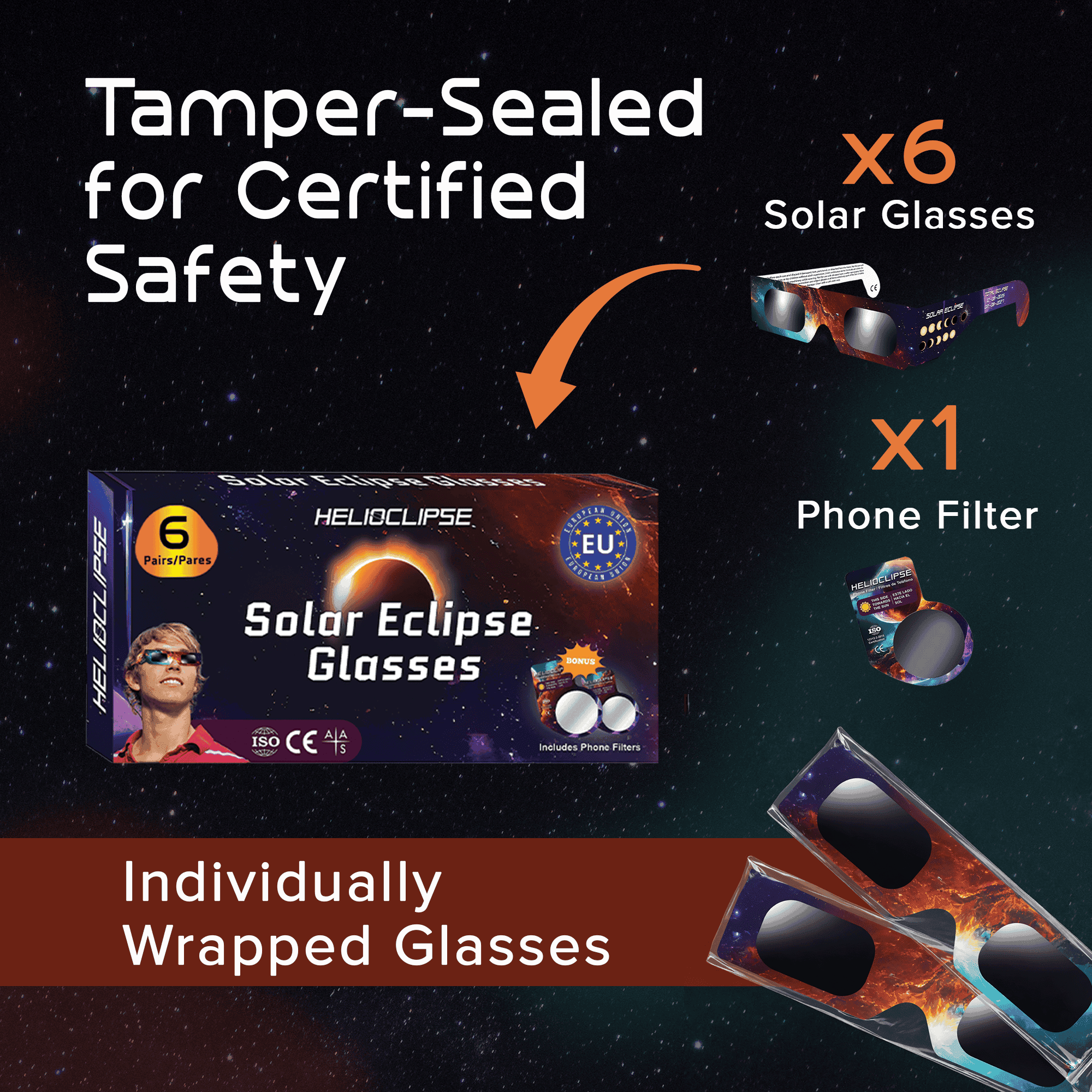
- Review Helioclipse solar eclipse glasses and order early enough to inspect every viewer before the event.
- Read our family-focused guide to ISO 12312-2 and eclipse viewers for a closer look at what the standard means in use.
- Check your exact location in the Eclipse Explorer so your group knows whether it will experience a partial eclipse or the brief total phase when the glasses-off rule can apply.
Sources & further reading
- American Astronomical Society: About the ISO 12312-2 Standard for Solar Viewers
- International Organization for Standardization: How to enjoy a solar eclipse in total safety
- Astronomy: How to observe the Sun safely during a solar eclipse
- Phys.org / Associated Press: Looking at a solar eclipse can be dangerous without eclipse glasses. Here's what to know
- NASA Science: Host a Sun Party
- American Astronomical Society: How to View a Solar Eclipse Safely
- American Astronomical Society: Reputable Vendors of Solar Filters & Viewers
- NASA Science: Eclipses
- European Commission: CE marking
- American Astronomical Society: Technical Report on Solar Eclipse Eye Safety