Eclipse glasses vs handheld viewers: choosing what fits your trip
The best solar viewer is the one you can use correctly when the sky begins to change. Eclipse glasses leave both hands free. A handheld viewer is easier to position over ordinary eyeglasses and can be passed around a group. Both can provide a clear, unmagnified view of the eclipsed Sun—and both depend on trustworthy solar-filter material, sound construction, and careful handling.
That makes eclipse glasses vs solar viewers less a contest than a question of fit. Are you traveling light, supervising children, standing on a windy coast, photographing your companions, or sharing equipment at a school event? Those details matter more than whether the filter is mounted in a spectacles-shaped frame or a handheld card.
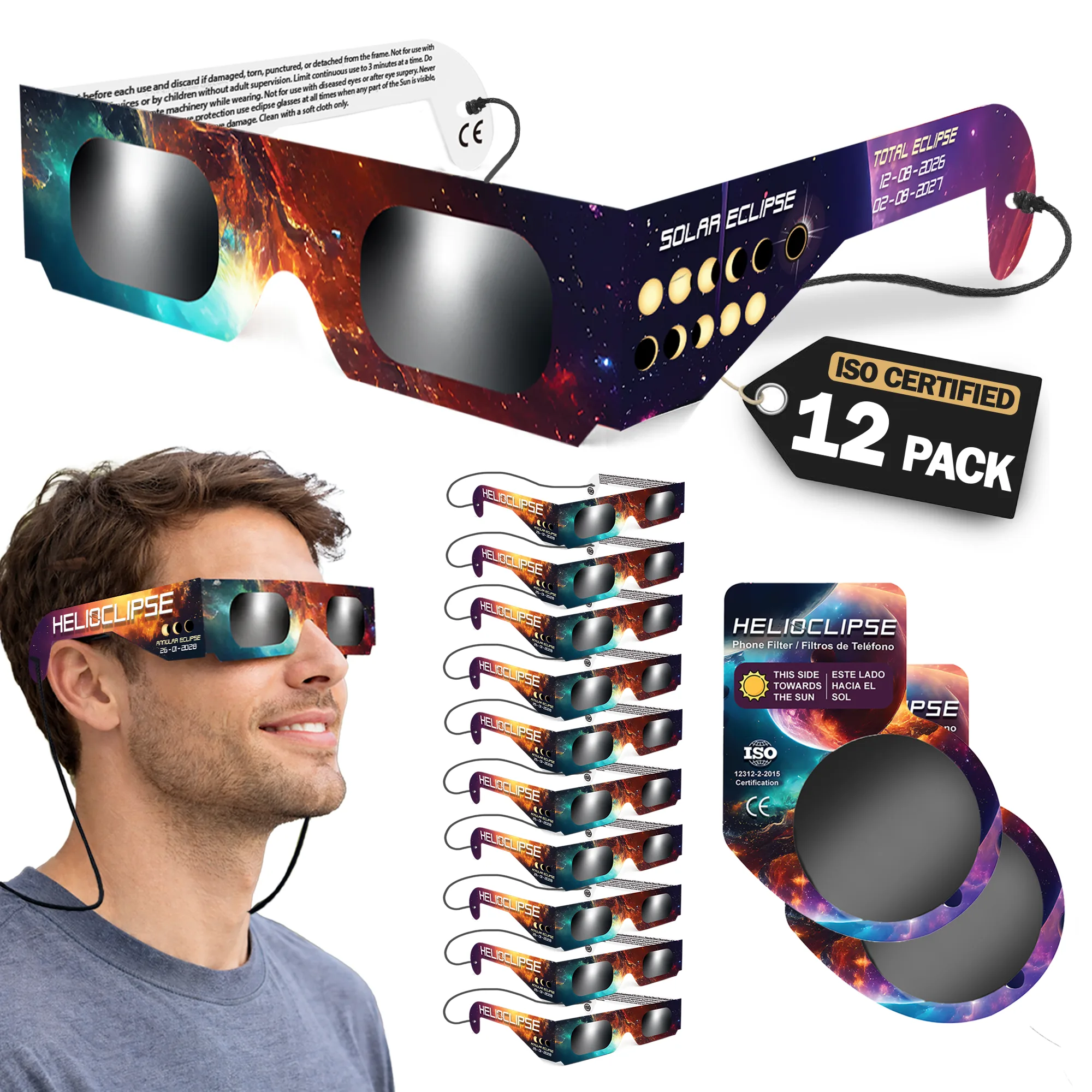
You can compare Helioclipse options in our eclipse-glasses shop. Before buying, decide how each person in your group will actually observe. A mixed kit is often more useful than choosing one format for everyone.
The filter can be similar while the experience is different
The phrase solar viewers vs glasses can suggest two different technologies. In their basic forms, however, both are nonmagnifying direct-viewing devices: eclipse glasses sit over your eyes, while a handheld viewer is raised in front of them. Neither format makes the Sun larger. The visible solar disk should look comfortably bright and sharply defined against a dark background.
The same principle resolves most comparisons of eclipse glasses vs viewers, eclipse viewers vs glasses, and solar eclipse glasses vs viewers. The protective performance comes from the filter and its secure mounting; the practical difference comes from how you hold or wear it.
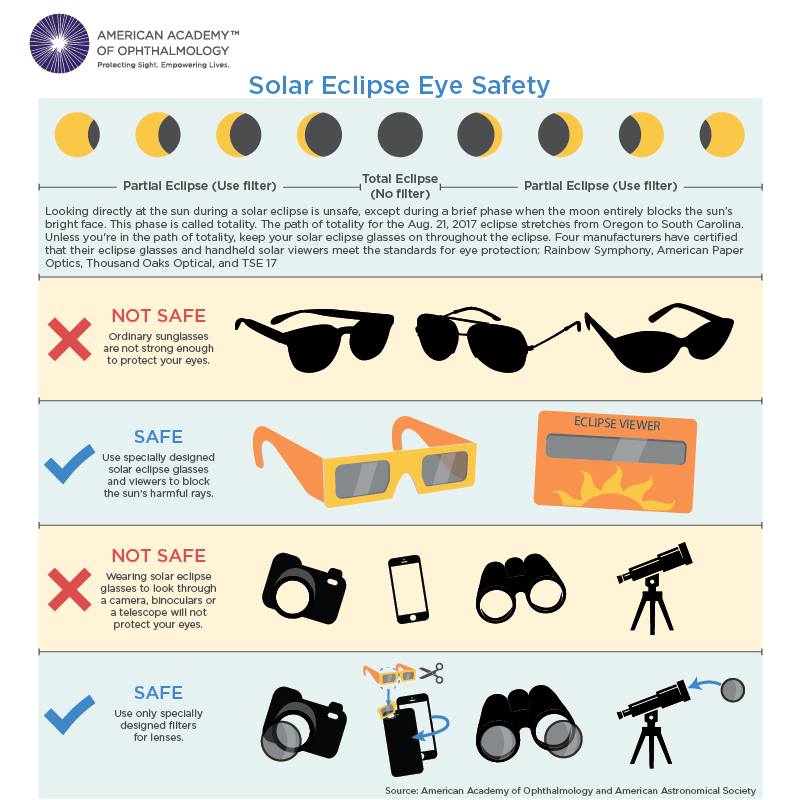
The solar eclipse glasses name is informal. These are special-purpose solar viewers, not sunglasses with unusually dark lenses. Products for direct, unmagnified solar observation should conform to ISO 12312-2, which addresses transmission of visible, ultraviolet, and infrared radiation as well as material quality, mounting, and labeling. Ordinary sunglasses—even several pairs stacked together—do not perform that job.
Glasses and handheld viewers at a glance
| Consideration | Eclipse glasses | Handheld solar viewer | |---|---|---| | Hands | Hands-free once fitted, though you may steady the frame | Requires one hand throughout each look | | Ordinary eyeglasses | Worn over prescription glasses | Held in front of prescription glasses | | Sharing | Possible, but repeated fitting can be awkward | Quick to pass between people | | Children | Convenient if the frame fits and an adult supervises | An adult can help position it and block stray direct light | | Wind | Can shift if the frame fits loosely | Must be held securely; a suitable lanyard may help if supplied and used as directed | | Photography of your group | Leaves hands available for a phone used normally—not aimed unfiltered at the Sun | One hand remains occupied | | Packing | Flat and very light | Flat, though usually a little larger | | Solar image | Unmagnified | Unmagnified; a larger physical window may make alignment easier | | Best fit | Independent observers who want hands free | Sharing, use over glasses, or people who prefer deliberate positioning |
Neither column is universally better. If everyone in a family wants to follow the changing crescent at the same moment, individual glasses reduce swapping. If grandparents wear prescription spectacles and only plan to check the Sun every few minutes, a handheld viewer may feel more natural. For a school group, several viewers can be shared in a supervised rotation because the partial phases progress slowly.
A child-size face also deserves more thought than a product label can provide. The filter must fully cover the eyes without gaps that invite a direct glance around its edge. An adult should supervise every child, inspect the viewer first, and demonstrate the sequence before anyone looks up.
Match the format to the trip, not the marketing
For a lightweight rail or air trip, glasses occupy almost no room. Pack them flat in a rigid envelope or case so keys, zips, and chargers cannot scratch or puncture the filters. Do not fold the filter area. Carry more than the exact number your party needs: one damaged viewer should not force someone to miss the partial phases.
A handheld viewer becomes attractive when people will share, when several travelers wear prescription glasses, or when careful positioning is more important than keeping both hands free. On a windy beach, ferry deck, or exposed hillside, either format needs attention. A loose pair of glasses can shift; an unsecured handheld viewer can blow away. If a viewer includes a lanyard, follow its instructions and supervise children because cords introduce their own hazards.
For families, the strongest answer to eclipse glasses or handheld solar viewers may be both. Give independent adults and older children glasses, keep a handheld viewer available for anyone struggling with fit, and carry a spare in sealed protective storage. Tell your group where the backup is before eclipse day rather than searching through luggage while the solar crescent narrows.
Comfort also matters. If someone cannot position a viewer without direct sunlight entering from an edge, change the format. A slightly larger mounting can be easier to align, but physical size does not establish filter quality or compliance.
ISO 12312-2 is essential—but printing the code is not proof
A useful eclipse glasses vs solar viewers 2026 guide must separate format from provenance. ISO 12312-2 applies to nonmagnifying products held in the hand or worn over the eyes for direct observation of the Sun. It does not make glasses inherently safer than handheld viewers, or vice versa.
A printed ISO statement alone is not enough. Packaging can be copied, and consumers cannot verify ultraviolet and infrared transmission by looking at a filter. Check for the manufacturer’s identity and address, understandable instructions, and traceability to a credible manufacturer or publicly identified authorized seller. Our detailed guide to ISO 12312-2 and eclipse viewers explains what the standard covers, while our guide to spotting fake or low-quality viewers provides a practical pre-use check.
Readers comparing eclipse viewing glasses often encounter product descriptions such as certified solar eclipse glasses or solar eclipse glasses iso 12312-2 certified. Those phrases point toward the right standard, but a claim is meaningful only when it is backed by credible sourcing and appropriate testing. NASA provides safety guidance but does not approve particular brands of solar viewers.
Inspect every viewer again on eclipse day. Discard it if the filter is scratched, punctured, torn, detached from its mounting, creased through the viewing area, or otherwise damaged. Cardboard viewers should be kept dry and cleaned only according to their instructions; liquids can weaken the frame or loosen the filter.
How to use either format safely
The basic sequence for how to use solar eclipse glasses also applies to handheld viewers:
- Inspect the filter and frame before use.
- Stand still and face away from the Sun.
- Put the glasses over your eyes—or cover both eyes completely with the handheld viewer—before turning toward the Sun.
- Look briefly, then turn away from the Sun before removing the viewer.
- Supervise children throughout.
If you wear prescription glasses, leave them on. Put eclipse glasses over them or hold the handheld viewer in front of them. Do not take ordinary glasses off if doing so makes it harder to stand, orient yourself, or follow instructions.
During a partial or annular eclipse, certified viewers stay in use for every direct look from beginning to end. During a total solar eclipse, you may remove them only when you are inside the path of totality and the Moon has completely covered the Sun’s bright face. Replace them immediately when any bright portion of the Sun returns. Our guide to eclipse phases and when to use solar glasses walks through that transition in detail.
If your location receives only a partial eclipse, there is no glasses-off moment. Even a very thin solar crescent remains intensely bright.
A viewer for your eyes is not a filter for a camera
The comparison eclipse glasses vs solar filter involves two product categories that must not be confused. Eclipse glasses and handheld viewers are for direct, unmagnified observation with your eyes. Cameras, binoculars, and telescopes concentrate sunlight and require a correctly fitted solar filter secured over the front aperture—the end where sunlight enters.
Never look through unfiltered binoculars, a telescope, a camera viewfinder, or another magnifying optical device while wearing eclipse glasses or holding a viewer in front of your eyes. Concentrated sunlight can damage the small viewer and reach your eye. A filter positioned only at a telescope eyepiece is also unsafe.
The same boundary applies to phones. Eclipse glasses held loosely over a phone camera are not automatically a secure or suitable photographic filter. Reflections, multiple lenses, shifting alignment, and heat can complicate the setup. Use a purpose-designed, securely mounted phone-camera solar filter according to its instructions, or leave the phone pointed away from the Sun and photograph the people, shadows, and changing light instead.
Safe alternatives when direct viewers are unavailable
The question what to use instead of solar eclipse glasses? has a dependable low-tech answer: indirect projection. A pinhole projector lets sunlight form an image on another surface while you keep your back to the Sun. You look at the projected image, never through the pinhole.
A colander, perforated spoon, or crossed fingers can project many tiny crescents during the partial phases. Gaps between tree leaves do the same thing across the ground. These methods are especially memorable for children because an ordinary shadow suddenly becomes a field of miniature Suns.
That makes pinhole projection a genuine solar eclipse glasses alternative, but only for indirect viewing. It does not turn household materials into eye filters. Do not improvise with smoked glass, exposed film, food wrappers, CDs, neutral-density photography filters, or ordinary sunglasses.
A livestream is another sensible backup for clouds, limited mobility, or anyone unable to use a direct viewer comfortably. It cannot recreate the temperature drop, strange light, and shared reaction outdoors, but it can preserve access to the event without taking risks.
Planning for August 12, 2026
On August 12, 2026, totality crosses parts of eastern Greenland, western Iceland, and northern Spain, while a partial eclipse reaches a much broader area including much of Europe and parts of northeastern North America. The correct viewing rule depends on your exact position, not merely the country written on your ticket.
A traveler inside the path in northern Spain may experience totality; someone in Madrid remains outside totality and sees a deep partial eclipse. Likewise, western Iceland lies in the totality corridor while places beyond its boundaries remain partial. Exact local contact times and the duration of totality change with position, so check your chosen coordinates in the Helioclipse Eclipse Explorer rather than relying on a city name alone.
This geography changes when viewers come off, but not whether you need them. Even travelers in the path use glasses or handheld viewers throughout the long partial phases before and after totality. People outside the path keep protection on for every direct look. Confirm the path, timing, and phase sequence with your group before the day; totality is too brief for a debate about whether the Sun is fully covered.
Good solar eclipse glasses information should support that plan rather than bury it under equipment choices. Order early enough to verify what arrived, inspect every unit, practice with children, and replace questionable items. Share the plan in the group chat along with who is carrying the spares.
A practical packing plan
For a couple traveling independently, two wearable pairs plus at least one protected spare keep the kit simple. A family may prefer one pair per confident user, a handheld viewer for anyone wearing prescription glasses or needing help with alignment, and additional spares. A group leader should carry backups separately so one wet or lost bag does not remove every viewer at once.
Before departure:
- Confirm that each viewer is traceable to a credible source and is intended for direct solar observation.
- Read the supplied instructions rather than assuming every mounting is handled identically.
- Inspect the filters under good indoor light for tears, punctures, scratches, or separation from the frame.
- Store them flat, dry, and protected from abrasion.
- Label family sets if that will prevent confusion over fit.
- Rehearse covering the eyes before turning toward the Sun.
- Pack a pinhole-projection activity as a shared second way to experience the partial phases.
- Use the map to save the exact observing location and local eclipse circumstances.
Ultimately, eclipse glasses vs handheld viewers is an ergonomic decision made inside a safety framework. Choose the format people can position reliably, source it carefully, protect it in transit, and bring enough redundancy that a single damaged filter does not become a crisis.
Frequently asked questions
What can I use if I do not have eclipse glasses?
A handheld solar viewer is an alternative for direct, unmagnified viewing of the eclipsed Sun. It should use trustworthy solar-filter material, be securely mounted, and conform to ISO 12312-2.
Do I need a proper solar viewer to look at an eclipse?
Yes, direct viewing requires a special-purpose solar viewer designed for unmagnified solar observation. Ordinary sunglasses, including multiple pairs worn together, do not provide the required protection.
What kind of eyewear is appropriate for watching an eclipse?
Use special-purpose eclipse glasses that conform to ISO 12312-2. They are solar viewers, not unusually dark sunglasses, and their filter and secure mounting are essential.
Can I safely watch the eclipse through my phone camera?
The excerpt only states that eclipse glasses leave your hands available for a phone used normally, not aimed at the Sun without appropriate filtering. For direct viewing of the Sun, use a suitable solar viewer rather than relying on a phone camera.
Are handheld viewers a practical substitute for eclipse glasses?
Yes, a handheld solar viewer can be a practical choice, especially for people wearing ordinary eyeglasses or for sharing among a group. It must be held in front of the eyes for each look, while eclipse glasses are hands-free once properly fitted.
On-site next steps
- Compare Helioclipse formats and plan quantities for your family or group in our solar eclipse glasses shop.
- Open the 3D Eclipse Explorer to confirm whether your location is inside totality and find the phase timing you need.
- Browse our eclipse planning and safety guides before briefing children, friends, or event volunteers.
Sources & further reading
- Which solar eclipse viewing method is right for you? — Live Science
- How Can You Tell If Your Eclipse Glasses or Handheld Solar Viewers Are Safe? — American Astronomical Society
- How to View a Solar Eclipse Safely — American Astronomical Society
- How to observe the Sun safely during a solar eclipse — Astronomy
- Solar Filters for Safe Sun Observing — Sky & Telescope
- Eclipse Viewing Safety — NASA Science
- About the ISO 12312-2 Standard for Solar Viewers — American Astronomical Society
- Suppliers of Safe Solar Viewers & Filters — American Astronomical Society
- Telescopes & Binoculars — American Astronomical Society
- Eclipses Frequently Asked Questions — NASA Science