Faro in 2026: one city, one eclipse—Algarve light, ocean air, and confirming you are really in totality
Faro has the ingredients for a memorable eclipse evening: hard Algarve light, salt in the air, white roofs, lagoon water and a Sun descending toward the western horizon. But it does not have totality on August 12, 2026.
That correction matters more than any postcard view. Faro lies far outside the Moon’s narrow umbral shadow, so observers there will experience a substantial partial solar eclipse. The Sun will never be completely covered, the corona will not appear, and there will be no safe glasses-off interval. You must use proper solar viewers whenever looking directly at the Sun.
Several labels circulating around the event blur that distinction. The wording total solar eclipse 2026 faro portugal identifies the right global eclipse and city but the wrong local eclipse type. Likewise, a total solar eclipse 2026 faro portugal 2026 guide must begin by saying plainly that Faro remains outside totality. Before booking a rooftop, beach transfer or dinner around the event, check your exact location with our Eclipse Explorer and 3D map.
Faro in 2026: one city, one eclipse—Algarve light, ocean air, and careful geometry. The experience can still be striking, but only if you plan for what the sky will actually do.

The essential correction: Faro is not in the path of totality
A solar eclipse creates two relevant shadow regions. Inside the Moon’s dark inner shadow, or umbra, the bright solar surface is completely hidden and observers see totality. Inside the much broader penumbra, only part of the Sun is covered. Faro is in that second region.
NASA’s event overview says the path of totality reaches Spain and only a very small corner of Portugal. More detailed regional mapping places that Portuguese totality zone in the country’s extreme northeast, around the Rio de Onor–Guadramil area near the Spanish border. Faro is roughly 500 kilometres to the south as the crow flies, in the Algarve—not a borderline case and not a location where moving between two nearby Faro neighbourhoods could turn a partial eclipse into a total one.
This is why 2026 portugal total eclipse can be a technically valid description of the event at national scale while being dangerously imprecise for a Faro itinerary. The corresponding phrase 2026 portugal solar eclipse is broader and more accurate: Portugal spans both a tiny total-eclipse zone and a much larger partial-eclipse region. The more specific wording total solar eclipse portugal 2026 needs a location attached to it before it tells you what anyone will see.
For scale, the full global path runs for about 8,260 kilometres, and Space.com reports a maximum shadow width of about 293 kilometres. Yet only a sliver of that moving umbra clips Portugal. Most of the country—including Lisbon and the entire Algarve—stays in the penumbra.
What Faro will actually experience on August 12
The eclipse reaches mainland Europe in the evening. NASA lists Lisbon’s partial eclipse as beginning at about 6:39 p.m. local time, reaching maximum at 7:36 p.m. with approximately 95% of the Sun’s area covered, and ending at about 8:29 p.m. Faro’s circumstances are different because it lies farther south, and the supplied institutional tables do not give a verified Faro-specific percentage or contact time. We will not manufacture one.
Use the Helioclipse map to place a pin on your intended observing site and record four values: first contact, maximum eclipse, obscuration or magnitude, and the Sun’s altitude and direction at maximum. A useful total solar eclipse 2026 map time display must identify both the time zone and the measurement being shown. NASA’s global visualizations commonly label times in UTC; Faro observes WEST, UTC+1, in August, so check whether your chosen tool has already converted the result to local time.
Be equally careful with percentages. Obscuration is the fraction of the Sun’s area hidden by the Moon. Magnitude describes how much of the Sun’s diameter is covered. They are related but not interchangeable. A map showing one can produce a different percentage from a table showing the other without either source being wrong.
The practical total solar eclipse 2026 time question in Faro is therefore not simply “When is maximum?” It is “At maximum, how high is the Sun from this exact pin, and what blocks that direction?” The event unfolds during the local evening, with the Sun dropping lower as the partial phase progresses. Buildings, trees, rooftop walls and distant terrain can end your view before the astronomical eclipse itself ends.
A deep partial eclipse is impressive—but it is not miniature totality
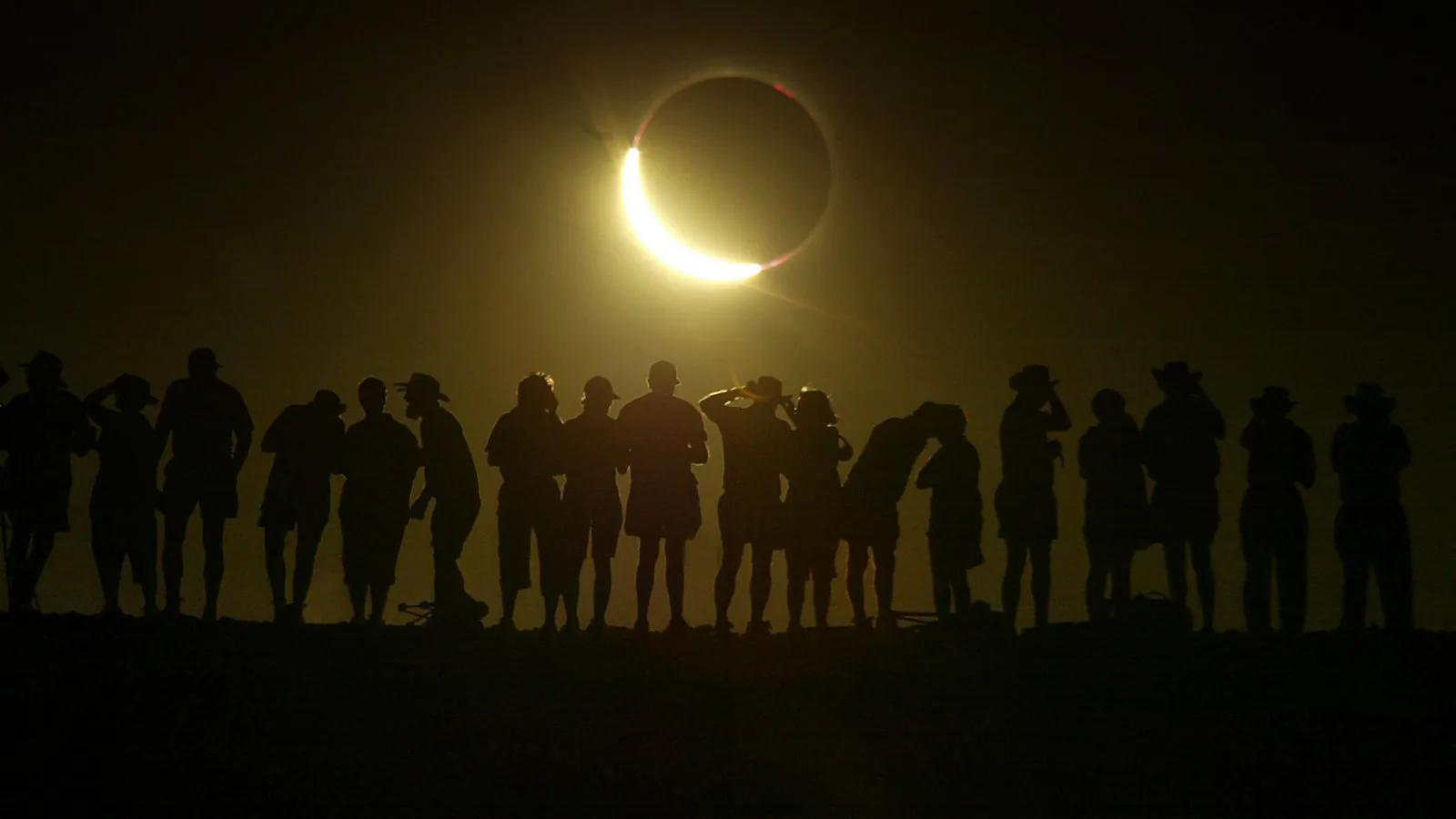
As the Moon covers more of the Sun, the remaining bright surface becomes a narrowing crescent. Through certified viewers, you can watch that crescent change noticeably between checks made several minutes apart. Gaps between leaves, the holes in a colander or crossed fingers can project small crescent Suns onto a pale wall or the ground.
The surrounding light may also become unusual. Shadows can sharpen in one direction, and the landscape may take on a flatter, less familiar tone. If most of the solar disk is hidden, the air can cool modestly and people may notice the change before they can explain it. Those are real partial-eclipse effects worth sharing with family and friends.
What Faro will not receive is the abrupt transition into the Moon’s umbra. Even a hairline of exposed photosphere is bright enough to dominate the sky. There will be no naked-eye corona, no completely black solar disk and no moment when direct viewing without a solar filter becomes safe. Our guide to eclipse phases and when glasses stay on explains why “almost covered” and “completely covered” are physically different experiences.
That distinction is the heart of any honest discussion of a total solar eclipse portugal itinerary. In Faro, keep the viewers on for every direct look, from the first visible bite until the Sun leaves view.
Map the pin, not the destination name
For Faro itself, map checking is less about deciding whether one side of town gets totality—it does not—and more about protecting your view of a low evening Sun. Put separate pins on the actual places your group might use rather than trusting a hotel description or a municipality-wide marker.
In the old town, walls, church towers, palms and closely spaced roofs can interrupt the western sightline. A rooftop may sound promising but still have a solid parapet at eye level. From a seated position, that wall can hide a low Sun much earlier than it would for someone standing.
Around Montenegro, the airport approaches and the developed edges of the city, an apparently open area may have restricted access or a poor pedestrian route. Praia de Faro offers a broader sense of sky, but its long, narrow setting, access road and seasonal traffic introduce practical constraints. Scout legally accessible ground, note where the Sun disappears on a normal evening, and do not assume that “oceanfront” automatically means an unobstructed eclipse direction.
A solar eclipse 2026 interactive map should be paired with an in-person horizon check. Visit at roughly the same evening hour several days beforehand if possible. Stand where children, wheelchair users and seated relatives will actually be. Then look for permanent obstructions and temporary ones: beach structures, parked vehicles, event fencing and crowds holding phones above their heads.
Save the coordinates and screenshots offline. Mobile data can become sluggish when thousands of people gather in one area, and a dropped pin is more useful than a venue name if your group becomes separated.
Algarve air: clear-looking is not always optically clear
August in Faro is often associated with strong sunshine, but eclipse planning is not the same as planning a beach afternoon. A low Sun sends its light through a much longer atmospheric path than a high midday Sun. Thin cloud, marine humidity, dust and sea haze that seem harmless overhead can soften or erase the solar crescent near the horizon.
The Ria Formosa and nearby Atlantic influence add another local variable: the sky may look blue above you while a pale band sits exactly where the Sun is descending. That band is the one that matters. Begin comparing forecasts a few days out, then use satellite imagery, cloud layers, humidity and visibility—not a single cheerful weather icon—on August 12.
Mobility within Faro can help with a local cloud bank or blocked horizon, but it cannot move the city into totality. Decide in advance how far your group is genuinely willing to move and set a decision time. A last-minute drive through summer traffic can trade one uncertain sky for a missed maximum. Our guide to cloud cover and eclipse-day mobility offers a framework for making that decision without chasing every patch of blue.
Bring water, sun protection and a simple ground marker for your group. The partial phase lasts long enough that nobody needs to stare continuously. Look briefly through a safe viewer, turn away, compare notes and check again after several minutes.
Eye safety in Faro: there is no glasses-off moment
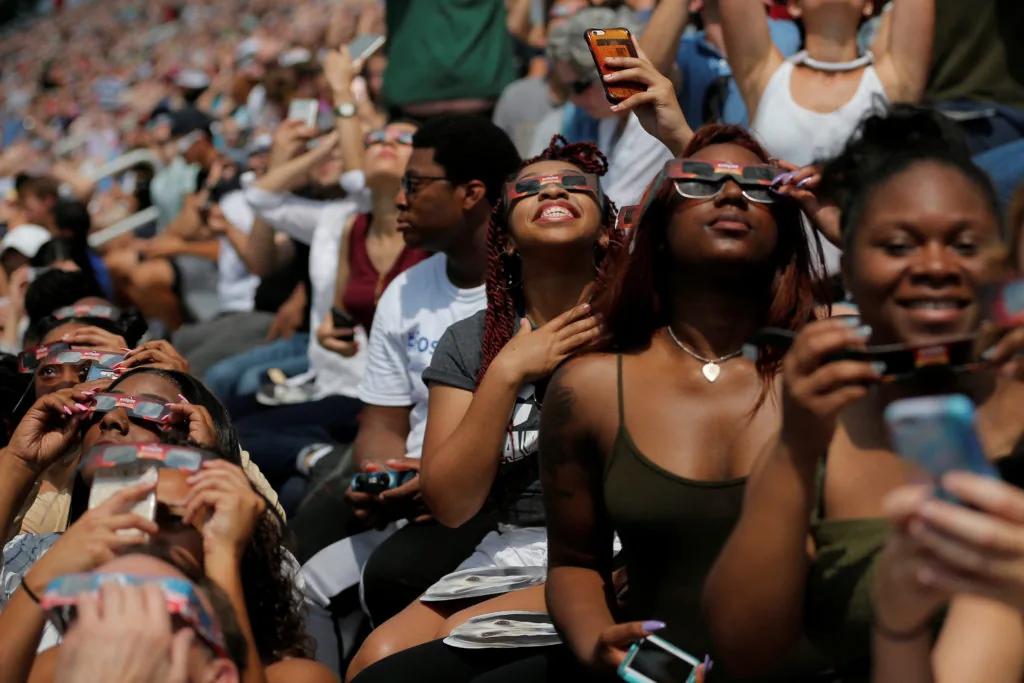
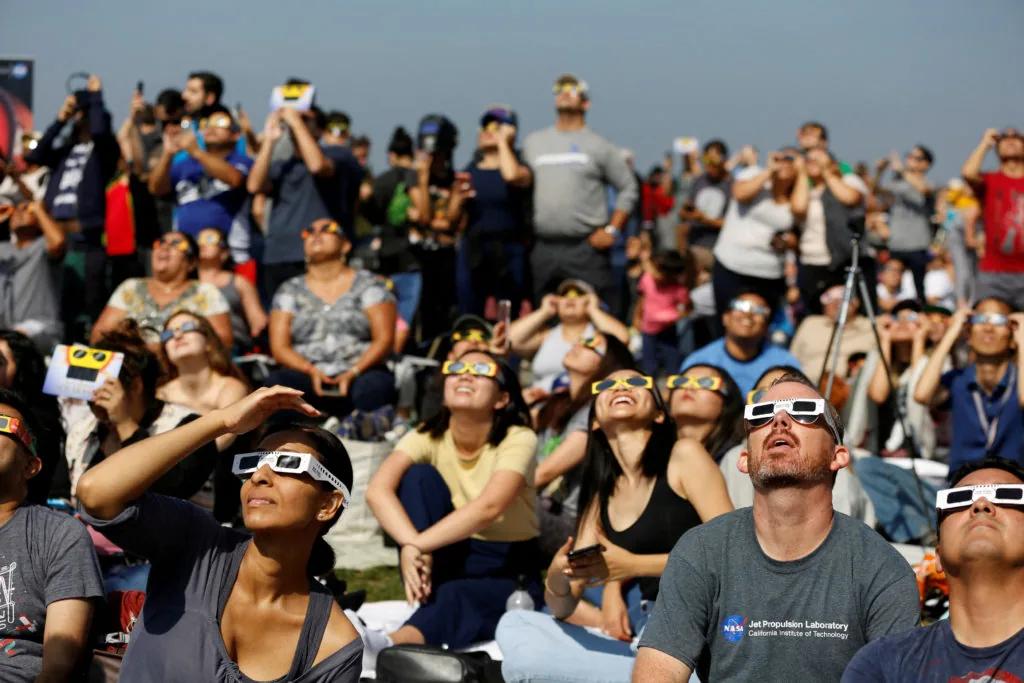
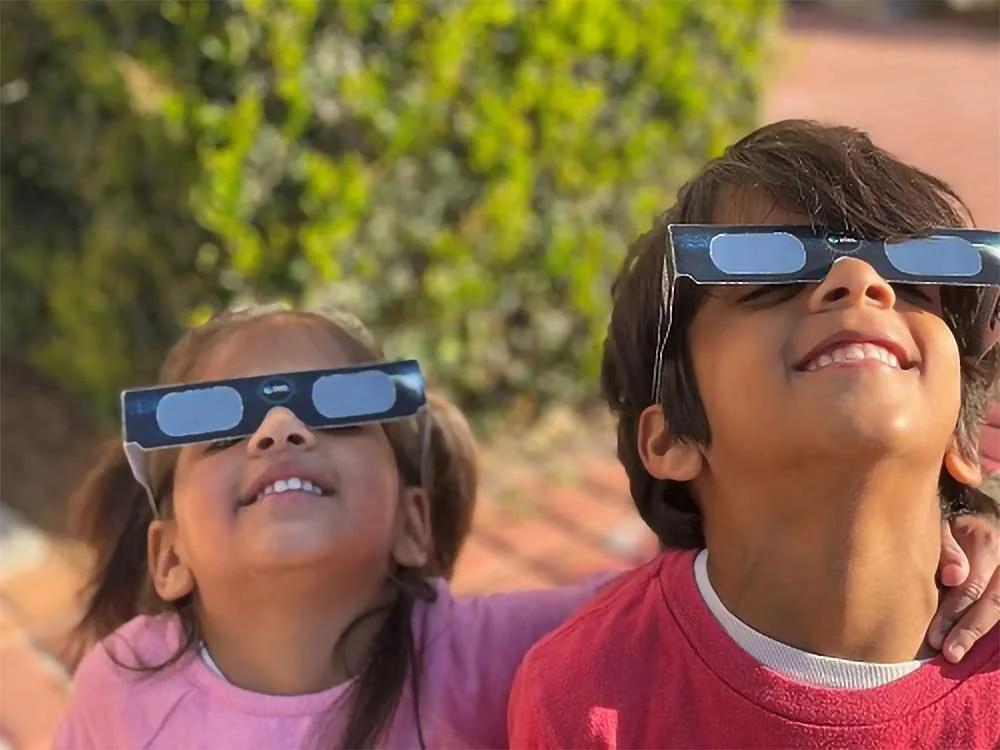
Because Faro remains outside the umbra, every direct view of the Sun requires a purpose-made solar viewer conforming to ISO 12312-2. Ordinary sunglasses are not sufficient, no matter how dark they appear. The low altitude of the Sun does not make unfiltered viewing safe, and cloud or haze is not a solar filter.
Inspect each viewer before eclipse day and again before use. Discard it if the filter is scratched, punctured, torn or separating from its frame. Put the viewer over your eyes before looking up; after looking, turn away from the Sun before removing it. Children should be supervised and should practise this sequence in advance.
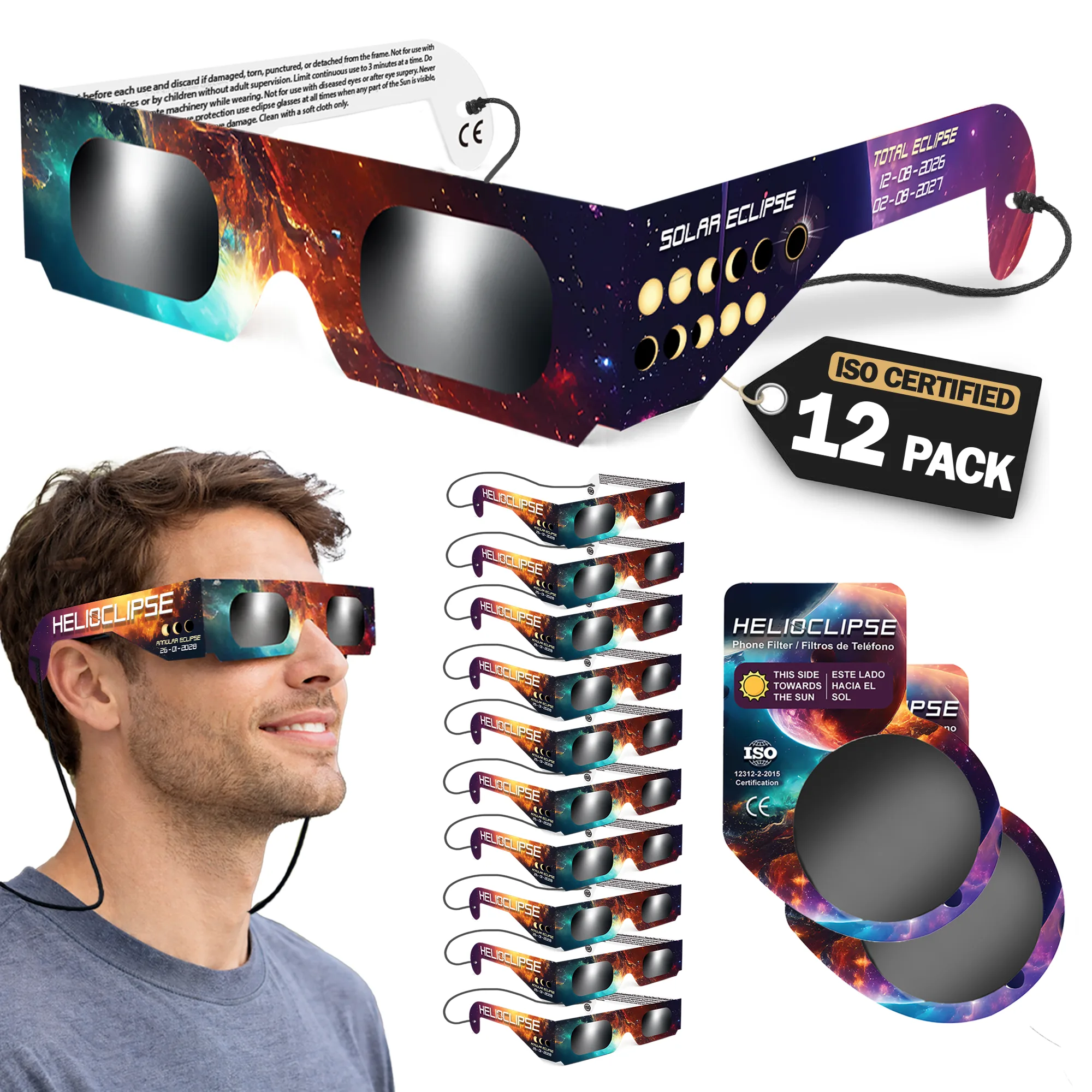
When shopping for eclipse viewing glasses, ignore vague promotional language and verify the product, instructions and supplier. The phrase solar eclipse glasses iso 12312-2 certified should refer to purpose-made, nonmagnifying viewers that meet the relevant standard—not ordinary sunglasses carrying solar-themed packaging. You can review our ISO 12312-2 solar-viewer explainer and order Helioclipse solar eclipse glasses early enough to inspect them and practise as a family.
Never look through binoculars, a telescope or a camera lens while wearing eclipse glasses. Magnifying optics concentrate sunlight and require a correctly fitted solar filter secured over the front aperture of the instrument. If you do not have the right equipment and expertise, keep optics packed away and use unmagnified viewers or pinhole projection instead.
Phones also deserve restraint. Do not let lining up a photograph tempt you to glance around a viewer. A wide scene showing your group, the lagoon and the changing light may preserve the evening better than a tiny, overexposed Sun.
Faro logistics: build the evening around people, not equipment
Tell your group now that Faro gets a partial eclipse. That prevents someone from removing their viewers because they expected a glasses-off announcement. Give one adult responsibility for timekeeping and another for helping children use viewers correctly. Agree on a meeting point that does not depend on finding one another in a crowded line of people facing the horizon.
Arrive early enough to test the view, but do not occupy private land, dunes under protection or access routes. Faro’s lagoon and coastal environments are lived-in and ecologically sensitive places, not empty stages. Follow local restrictions, carry out everything you bring and keep paths clear for residents and emergency access.
A total solar eclipse 2026 cruise may intercept the umbra elsewhere along the Atlantic or Mediterranean route, but that is a different observing plan from staying in Faro. A ship itinerary needs its own verified coordinates, weather strategy and safety procedures; the words “eclipse cruise” do not guarantee totality any more than “Portugal eclipse hotel” does.
For calendar clarity, total solar eclipse 2025 portugal cannot describe an actual Portuguese total eclipse in 2025. The Faro event discussed here is the partial view of the August 12, 2026 total eclipse. The February 17 eclipse in 2026 is also a separate annular event and should not be mixed into the Faro evening timeline.
If totality is your non-negotiable goal
Faro is a good base for an Algarve holiday and a meaningful place to watch the partial eclipse, but it is not a practical base for a same-evening dash into the 2026 path of totality. The tiny Portuguese totality zone lies in the extreme northeast, while the broad Spanish path crosses northern and eastern parts of Spain. Reaching it requires a deliberate trip, accommodation and a site with a clear western horizon—not an improvised drive after lunch.
NASA gives useful examples of the contrast. León, Spain, is listed with totality beginning around 8:28 p.m. local time and ending around 8:30 p.m. Valencia receives roughly a minute of totality around 8:32 p.m., shortly before sunset. Madrid and Barcelona sit outside the umbra despite approximately 99% obscuration in NASA’s table. Those cities demonstrate why a percentage that looks almost complete still does not equal totality.
In Portugal’s far northeastern totality sliver, published reporting indicates that totality may last no more than about 27 seconds, depending on the exact pin. That is enough for a true total eclipse but leaves almost no tolerance for standing outside the boundary or losing the Sun behind terrain. In Faro, by contrast, the duration of totality is exactly zero seconds.
Readers comparing future events should also keep 2027 separate. The solar eclipse 2027 path of totality belongs to the August 2, 2027 eclipse, not the 2026 shadow track. For anyone asking about the next total solar eclipse in europe after 2026, that 2027 event crosses part of southern Europe, including southern Spain, but it requires an entirely new map and plan. Never reuse a 2026 pin for a different eclipse.
A simple Faro eclipse-day plan
- Confirm the date and event: Wednesday, August 12, 2026; partial solar eclipse from Faro.
- Pin the exact site: Check local contact times, maximum, obscuration or magnitude, solar altitude and azimuth.
- Scout the western horizon: Test the view from the height at which each member of your group will observe.
- Choose a backup nearby: It should solve a realistic access or cloud problem, not pretend to create totality.
- Inspect viewers: Check every filter for damage and rehearse safe use with children.
- Monitor the low-horizon sky: Watch for thin cloud and marine haze, not merely the overhead forecast.
- Keep glasses on: Faro has no total phase and therefore no safe unfiltered interval.
- Share the moment: Compare the changing crescent every few minutes, look for projected crescents and notice how the lagoon light changes.
The best places and timing for total solar eclipse 2026 faro portugal plans are therefore the places that honestly support a partial-eclipse view: legal access, a verified western sightline, safe viewers and enough space for your people. Faro cannot offer the corona in 2026. It can offer a carefully watched celestial alignment over a landscape built from sunlight and water—and that is worth planning well.
Faro Travel Guide 2026 | Algarve's Hidden Gem ~ Portugal Vlog
The Kruns
Frequently asked questions
Where in Portugal can people see totality during the 2026 solar eclipse?
Only a very small area in Portugal’s extreme northeast is in the path of totality, around the Rio de Onor–Guadramil area near the Spanish border. Most of the country, including Lisbon and the Algarve, will see a partial eclipse instead.
Does the article say that any eclipse occurs only once every 300 years?
No. The excerpt does not provide a 300-year recurrence interval for any type of eclipse. It discusses the August 12, 2026 event and distinguishes totality from a partial eclipse in Portugal.
Will Faro experience a total solar eclipse in 2026?
No. Faro is far outside the Moon’s umbral shadow and will experience a substantial partial solar eclipse on August 12, 2026. The Sun will not be completely covered, the corona will not appear, and there will be no safe interval for viewing without proper solar viewers.
What is the most important point to include in a 2026 eclipse guide for Faro?
State clearly that Faro is not in the path of totality. Confirm your exact observing location with an eclipse map before making plans, because changing locations within Faro cannot turn the partial eclipse into totality.
What can eclipse viewers in Faro realistically expect from the event?
Faro can offer an atmospheric setting, with Algarve light, ocean air, lagoon water, and the Sun descending toward the western horizon. However, the local event remains a partial solar eclipse, so direct solar viewing requires proper solar viewers throughout.
On-site next steps
- Place your hotel, rooftop, beach access point or public space on the Helioclipse Eclipse Explorer and verify that Faro is outside totality. Record the local maximum, eclipse percentage, Sun altitude and viewing direction shown for that exact pin.
- Choose and order ISO 12312-2 eclipse glasses from Helioclipse before demand peaks, then inspect and practise with them.
- Read our broader August 12, 2026 eclipse planning guide before coordinating travel, weather decisions or a larger family group.
Sources & further reading
- Total Solar Eclipse on August 12, 2026 — NASA Science
- August 12, 2026 Solar Eclipse Map — National Solar Observatory
- Map of the August 12, 2026, Total Solar Eclipse — NASA Scientific Visualization Studio
- Where can I see the total solar eclipse on Aug. 12, 2026? — Space.com
- Partial: The Solar Eclipse for the Rest of Us — Sky & Telescope
- How to View a Solar Eclipse Safely — American Astronomical Society
- About the ISO 12312-2 Standard for Solar Viewers — American Astronomical Society
- Eclipse Basics — American Astronomical Society
- Why Do Eclipses Happen? — NASA Science
- Types of Solar Eclipses — NASA Science