A Coruña in 2026: one city, one eclipse—Atlantic coast, marine layer risk, and real horizons
A Coruña will meet the Moon’s shadow at the edge of the Atlantic evening on August 12, 2026. At approximately 20:27 CEST, the city is expected to receive about 75–76 seconds of totality, with the eclipsed Sun only around 12.1° above the west-northwestern horizon. That combination—real totality, a low Sun, and an ocean climate—makes this a thrilling city eclipse and a demanding one to plan well.
The reward is substantial. If the sky is clear, the remaining solar crescent will collapse, daylight will drain from the waterfront, and the corona will appear around the black silhouette of the Moon. But a building, headland, bank of marine cloud, or badly chosen line of sight could conceal a Sun sitting only a little more than one fist-width above the horizon.
Use our Eclipse Explorer and 3D map early in your planning. Check the total solar eclipse 2026 a coruna spain map for the exact point where you intend to stand—not merely the city name—and revisit it when your plans become more specific. This is deliberately a single-city guide: no tour of Galicia, no list of distant alternatives, and no assumption that every waterfront within A Coruña offers the same sky.
The essential A Coruña eclipse facts
Is there a solar eclipse in 2026? Yes. On Wednesday, August 12, 2026, the Moon’s umbra will cross parts of northern Russia, Greenland, Iceland, northern Spain, and a small part of Portugal. A much larger surrounding region will see only a partial eclipse. NASA describes the total solar eclipse 2026 path as arriving in northern Spain from the North Atlantic shortly before sunset, then continuing east-southeast across the country.
A Coruña lies inside that narrow path. Published city-level calculations place totality at about 20:27 CEST, equivalent to roughly 18:27 UTC, and give a duration of approximately 1 minute 15 seconds to 1 minute 16 seconds. The one-second difference between reputable summaries is not meaningful for choosing a viewing site; coordinates, rounding, and the ephemeris implementation can all affect a city-level display. Use the map readout for your exact position and check it again against an authoritative ephemeris closer to the event.
The most important numbers are:
- Date: August 12, 2026
- Approximate start of totality in A Coruña: 20:27 CEST, or 18:27 UTC
- Approximate duration: 75–76 seconds
- Sun’s altitude during totality: about 12.1°
- Direction: low in the west-northwest
- Historical cloud indicator: one published analysis reports about a 53% chance of cloud based on observations since 2000
That last percentage is climatology, not a prediction for eclipse evening. It tells us cloud deserves first-class status in the plan; it does not tell us whether August 12, 2026 will be clear.
Readers looking for the total solar eclipse 2026 a coruna spain time should also distinguish the start of totality from the much longer partial phase. The eclipse begins well before 20:27, but the supplied sources do not provide a verified first-contact time for a specific point within the municipality. Consult the map for first contact, maximum eclipse, the end of totality, and final contact at your chosen coordinates rather than transferring a timetable from another Spanish city.
For wider national context, our guide to Spain’s 2026 path of totality explains why being inside the umbra matters. A 99.9% partial eclipse is still not totality: the remaining photosphere is bright enough to suppress the corona and requires continuous eye protection.
Why 12 degrees changes the whole plan
At 12.1° altitude, the eclipsed Sun will not be grazing the geometric horizon, but it will be low enough for ordinary city features to matter. A closed fist held at arm’s length spans roughly 10°. Imagine placing that fist on the west-northwestern horizon; the Sun during totality would sit only a little above its top.
That makes a total solar eclipse 2026 map time display more than a countdown. It should help you answer three connected questions: where will the Sun be, how high will it stand, and what occupies that line of sight? The coordinates establish whether you are inside totality; the sky geometry tells you whether you can actually see it.
A Coruña’s ocean frontage is an advantage only when the relevant direction is genuinely open. Water in front of you does not automatically guarantee the correct horizon. The city’s curving shoreline, peninsulas, buildings, trees, lamps, railings, port infrastructure, and changes in elevation can all alter the view. From one position, a crane or apartment block may provide a dramatic silhouette beneath the eclipse; from another, it may conceal the last degrees of sky.
Scout at approximately the eclipse time on one or more evenings in the weeks beforehand. You will not see the Sun in precisely the same position on every date, so use the solar eclipse 2026 interactive map to establish the event-day direction and altitude. A physical visit then reveals the obstructions that a path map cannot: temporary stages, construction fencing, summer vegetation, locked gates, and the height of the skyline from eye level.
The phrase total solar eclipse 2026 a coruna spain location should therefore mean a set of exact coordinates, not “somewhere near the coast.” Moving a few hundred metres can change the foreground and practical capacity even when the eclipse duration barely changes.
Three city landscapes, three different trade-offs
A Coruña offers several kinds of urban horizon within the municipality. None is automatically “best”; each asks you to balance sightline, exposure, capacity, and cloud.
Riazor and Orzán: accessible, open, and likely busy
The crescent-shaped Riazor and Orzán waterfront is close to the city centre and gives large numbers of people access to an ocean-facing sky. Space.com specifically identifies these beaches as likely gathering points. Their accessibility is a strength for families and groups who do not want a difficult approach, but it also means crowd pressure may be intense.
Do not choose a position merely because it has a clear view straight out to sea. Confirm that the west-northwest sector is open from the exact part of the promenade or beach you intend to use. Check the tide, access route, steps, and a safe place to stand away from traffic and the waterline. A beach plan should include warmer layers and secure storage for viewers; wind-blown sand, spray, and damp cardboard do not mix well with solar-viewing equipment.
The Tower of Hercules peninsula: broad sky, maximum exposure
The headlands around the Tower of Hercules can offer a broad maritime horizon and fewer tall urban obstructions than the dense centre. They are also exposed to Atlantic wind and fast-changing low cloud. A headland may let you see beneath or around a broken cloud deck, but elevation does not place you above an extensive marine layer only a few hundred metres deep.
Capacity and controlled access may also change for a major public event. Verify municipal arrangements before relying on a specific lawn, path, car park, or overlook. The best astronomical sightline is not useful if the site closes, becomes unsafe in a crowd, or cannot be reached on foot at the required time.
Monte de San Pedro and the western high ground: elevation with a foreground
Elevated western viewpoints may help place nearby roofs or coastal features below the Sun, but higher is not synonymous with unobstructed. Trees, terrain, walls, and the local shape of the horizon still count. The low solar altitude makes an event-day sightline check essential.
These higher areas can also become bottlenecks. If you consider one, arrive with enough daylight to assess the site calmly and identify a second position reachable on foot. Do not build a plan that depends on driving between crowded viewpoints during the partial phase.
The port presents a different visual possibility: industrial silhouettes, masts, cranes, and waterfront structures. That may appeal to photographers, but it is a composition challenge rather than a guaranteed viewing advantage. Check public access and the actual west-northwestern line from street level. Working port areas, restricted quays, and vehicle routes are not eclipse-viewing spaces unless authorities explicitly designate them as such.
Marine stratus is part of the story
A Coruña’s defining uncertainty is not whether the Moon will arrive. Eclipse predictions are accurate; the cloud forecast is not. Moist Atlantic air can support low stratus or stratocumulus, and coastal cloud can change sharply over short distances and timescales. The city may be under a grey sheet while brighter breaks sit offshore, or the opposite may happen as low cloud moves inland.
The published historical cloud figure of about 53% is useful as a warning against complacency, but it is not a coin toss with fixed odds. “Cloud” can mean thin high cloud through which the shrinking Sun remains visible, scattered low cloud with moving gaps, or an opaque marine deck. Those situations produce very different eclipse experiences.
Start following forecasts several days ahead, but do not overreact to a single app icon. By 24–48 hours before the eclipse, compare hourly cloud cover at low, middle, and high levels; wind direction and speed; humidity; visibility; and satellite imagery. On the day itself, observations upstream over the Atlantic may be more revealing than a generic daily percentage.
Within a one-city plan, mobility is measured in pavements and neighbourhoods rather than motorways. A gap opening over Orzán may not help a viewpoint behind a stubborn bank farther west, while a headland can be cloudier than a sheltered section of waterfront only a short distance away. Our guide to cloud cover and eclipse-day decisions explains how to turn those observations into a calm go-or-stay choice.
Set a decision deadline. If your group is still debating positions as the Sun becomes a thin crescent, you are losing attention during the most interesting part of the partial phase. A practical city plan might include one primary site, one walkable fallback with a meaningfully different view of the sky, and a firm time after which everyone stays together.
What totality should feel like from the city
The partial phase will initially look subtle through certified viewers: a small notch appearing in the Sun, then growing as the Moon advances. As coverage deepens, the light can take on a hard, silvery quality and shadows may sharpen. Through gaps between leaves or crossed fingers, pinhole images of the Sun become crescents.
Near totality, changes accelerate. The west-northwestern sky will darken around the approaching shadow, the waterfront may cool, and the illuminated horizon beyond the umbra can take on sunset-like colours. Streetlights may respond. People who have been chatting through the slow partial phase often become very quiet in the final seconds.
When the photosphere is completely covered, the corona can appear as a pale structure around the black Moon. Bright planets or stars may become visible if the sky is sufficiently clear, but 75–76 seconds is short. Decide beforehand whether you want to take a photograph or simply look. Spending most of totality fighting a phone can turn an extraordinary minute into a technical problem.
A Coruña’s duration is substantial enough to reveal the transformation but shorter than the approximately 1 minute 44 seconds reported for cities such as Gijón and Burgos. That roughly 28–29 second difference reflects path geometry, not the quality of the experience. Inside A Coruña, your more important choice is likely to be a clear, comfortable horizon rather than chasing tiny duration differences between neighbourhood coordinates.
The shorthand a coruna eclipse 2026 and a coruna spain eclipse 2026 sometimes hides that central point: this is not simply a Spanish eclipse assigned to a city label. It is a precisely timed alignment arriving low over a complex Atlantic skyline.
Glasses on, glasses off, glasses on again
Wear safe solar viewers whenever any bright part of the Sun remains visible. In A Coruña, that means glasses on throughout the partial phase, glasses off only after totality has unmistakably begun, and glasses back on immediately when the first bright point of direct sunlight returns.
If cloud hides the critical transition, keep your viewers on until you can confirm totality. Never guess that the Sun is fully covered because the scene has become dark. Anyone outside the path, or anyone viewing a merely partial eclipse, must keep proper protection in place throughout.
The international standard relevant to nonmagnifying direct solar viewers is ISO 12312-2. Inspect every viewer before use and discard it if the filter is scratched, torn, punctured, loose, or water-damaged. Ordinary sunglasses are not a substitute, regardless of how dark they appear.
Marketplace language can be misleading. The phrase eclipse glasses nasa approved does not describe a real NASA endorsement program—NASA explicitly says it does not approve particular viewer brands. More useful wording, such as solar eclipse glasses ISO 12312-2 certified or eclipse glasses ISO 12312-2, still needs to be supported by a trustworthy supplier and credible testing rather than a standard number printed without evidence.
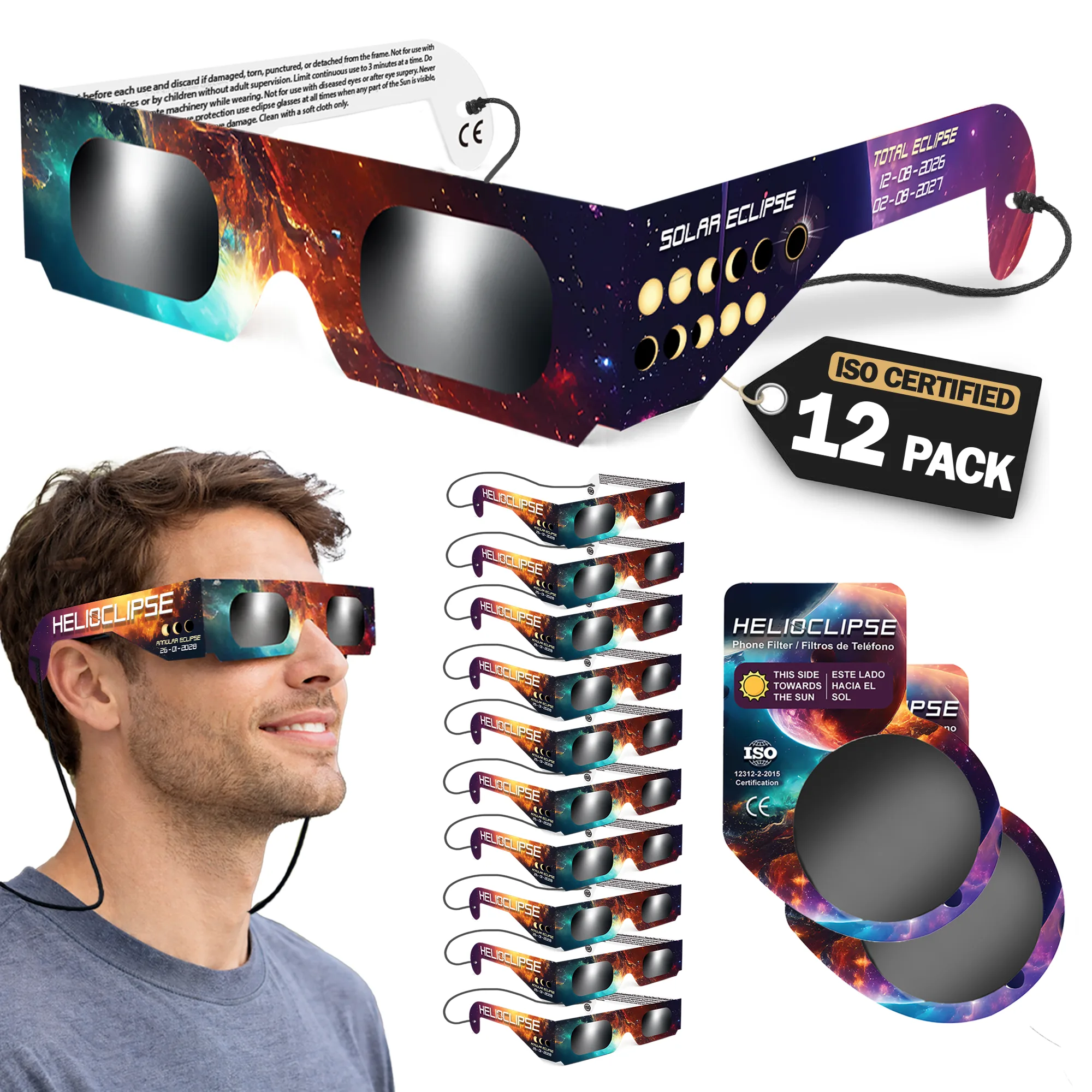
Choose your Helioclipse solar eclipse glasses early enough to inspect them and practise with the family. Eclipse viewing glasses should sit securely over the eyes; children need active supervision. Put them on before looking up, look away from the Sun before removing them, and keep cardboard viewers dry on the Atlantic coast.
Cameras, binoculars, and telescopes require purpose-made solar filters fitted securely over the front aperture. Eclipse glasses worn on your face do not make it safe to look through unfiltered magnifying optics: concentrated sunlight can damage the viewer and your eyes. If you have not prepared and tested a properly filtered optical setup, leave the equipment at home and experience the eclipse directly.
For a phase-by-phase rehearsal, read our guide to when eclipse glasses go on and off. Assign one adult to call the transitions clearly, especially if your group includes children or first-time observers.
A realistic plan for August 12
Treat this as an afternoon and evening event, not a 20:27 appointment. Eat early, bring water, and arrive with time to understand the site in ordinary daylight. Tell friends and relatives now; a group that agrees on its meeting point, safety rhythm, and fallback before eclipse day will make better decisions than one assembled through frantic messages during the partial phase.
A compact kit should include certified viewers, one or two spares, weather layers, water, any essential medication, and a printed or downloaded screenshot of the relevant map view. Mobile networks may be busy around popular waterfronts. If you are responsible for children, write a contact number on a card and agree on a reunion point away from the densest crowd.
Check municipal announcements for event zones, public transport changes, access restrictions, and organised viewing. There may be eclipse gatherings in Spain, but do not assume a rumoured party guarantees an open horizon, safe capacity, or protective equipment. The astronomy still depends on your exact line of sight and the cloud above it.
Some English references omit the accent or use the older Spanish form, producing labels such as la coruna spain eclipse 2026. The official Galician name is A Coruña. Similarly, a total solar eclipse 2026 a coruna spain map may recognise several spelling variants, but always confirm that its marker sits on your intended coordinates rather than a generic city centre.
This total solar eclipse 2026 a coruna spain 2026 guide has one central recommendation: make the horizon your first site test and the marine layer your first weather question. Everything else—photography, foregrounds, food, and atmosphere—comes after you know the Sun will be visible and everyone can observe safely.
Frequently asked questions
Where in A Coruña should I watch the 2026 total solar eclipse?
Choose a site in A Coruña with a clear, unobstructed view low toward the west-northwest. The Sun will be only about 12.1° above the horizon during totality, so buildings, headlands, or marine cloud could block it; check the exact viewing point on a detailed eclipse map rather than relying on the city name alone.
Will there be a total solar eclipse in 2026?
Yes. On August 12, 2026, totality will cross parts of northern Russia, Greenland, Iceland, northern Spain, and a small part of Portugal, while a wider surrounding area will see a partial eclipse. A Coruña lies within the narrow path of totality.
Will France be in the path of the 2026 solar eclipse?
The excerpt identifies the total-eclipse path as crossing northern Russia, Greenland, Iceland, northern Spain, and a small part of Portugal; it does not list France as being in the path of totality. A larger surrounding region will see a partial eclipse, but this excerpt does not provide viewing details for France.
Can I see the 2026 eclipse from Ireland?
The excerpt does not identify Ireland as being in the path of totality. It notes that a much larger surrounding region will experience a partial eclipse, but it does not give specific visibility information for Ireland.
Are there organized eclipse events in Spain for August 12, 2026?
The excerpt does not provide information about organized public events or gatherings. It confirms that northern Spain will be crossed by the total-eclipse path and that A Coruña is expected to experience about 75–76 seconds of totality around 20:27 CEST.
On-site next steps
- Open the Helioclipse Eclipse Explorer and place the marker on your exact A Coruña viewing position. Record totality status, local contact times, duration, solar altitude, and direction.
- Visit the site near 20:27 local summer time on a clear evening. Compare the real west-northwestern skyline with the total solar eclipse 2026 a coruna spain map readout and choose a walkable fallback.
- Order ISO 12312-2 solar viewers from Helioclipse early, inspect them on arrival, and practise the glasses-on/glasses-off sequence with your group.
- Recheck official access information, the detailed forecast, and your exact total solar eclipse 2026 a coruna spain time during eclipse week.
Sources & further reading
- 10 best Spanish cities to see the total solar eclipse 2026 — Space.com
- What time is the total solar eclipse on Aug. 12, 2026? — Space.com
- Stops Along the Path of Totality — NASA Earth Observatory
- What’s Up: August 2026 Skywatching Tips from NASA
- Solar and Lunar Eclipses in 2026 — Sky & Telescope
- How to View a Solar Eclipse Safely — American Astronomical Society
- About the ISO 12312-2 Standard for Solar Viewers — American Astronomical Society
- Eclipses and the Moon — NASA Science
- Types of Solar Eclipses — NASA Science
- Eclipses Frequently Asked Questions — NASA Science