Zaragoza in 2026: one city, one eclipse—inland heat, wide skies, and practical August truth
At about 8:29 p.m. on August 12, 2026, Zaragoza will briefly lose the Sun. The corona will emerge around the Moon, the evening light will collapse, and a city still carrying the heat of an August day will experience approximately 1 minute 23 seconds of totality.
That is the irresistible promise of the total solar eclipse 2026 Zaragoza Spain will experience. The practical catch is equally important: the eclipsed Sun will be only about 6° above the west-northwest horizon. A tree, apartment block, bridge feature, stadium structure, or distant rise that seems harmless at noon could erase the main event.
This is why a Zaragoza eclipse plan must begin with an exact viewing pin rather than the city name alone. Open the Helioclipse Eclipse Explorer, place the marker where you genuinely expect to stand, and check the path, local circumstances, and direction of the Sun. Treat this total solar eclipse 2026 Zaragoza Spain 2026 guide as the city-level briefing; use the map for the final site-level answer.
Zaragoza is inside the path—but that is only the first test
The August 12 eclipse is total across a corridor running through northern Spain. Zaragoza lies within the Moon’s umbra, the dark central shadow in which the bright solar disk can be covered completely. NASA’s published city table gives local circumstances of approximately 7:34 p.m. for the beginning of the partial eclipse, 8:29–8:30 p.m. for totality, and 9:07 p.m. for sunset while the partial phase is still in progress. Spain will be observing CEST, or UTC+2, so totality occurs at roughly 18:29 UTC.
Published city summaries put totality at about 1 minute 23 seconds, with the Sun roughly 6° above the west-northwest horizon. That duration is long enough to see the corona and notice the abrupt transformation of the sky, but short enough that fumbling with a phone or moving around after totality starts could consume a meaningful fraction of it.
The total solar eclipse 2026 path is not a line on which totality magically switches on. It is a band traced by the moving umbra, and duration varies across it. Zaragoza’s position is comfortably more useful than a near-edge location, but exact calculations can differ slightly with coordinates, elevation, the solar and lunar limb profiles, and the ephemeris used. Our broader guide to the 2026 path across Spain explains why “inside the band” and “on the centerline” are related but not identical ideas.
The important distinction is absolute: totality is not a percentage. A place with 99% or even 99.9% partial coverage still retains a dazzling sliver of photosphere and does not reveal the corona as a true total eclipse does. Zaragoza crosses into totality; nearby plans should still be checked by precise coordinates rather than inferred from an Aragón label or a hotel address.
The Zaragoza timetable: an evening event that ends at sunset
For anyone investigating the total solar eclipse 2026 Zaragoza Spain time, the best currently published city-scale sequence is:
- Partial eclipse begins: about 7:34 p.m. CEST
- Totality begins: about 8:29 p.m. CEST
- Totality ends: about 8:30 p.m. CEST
- Sunset: about 9:07 p.m. CEST, before the partial eclipse has geometrically finished
These are useful planning times, not permission to synchronize a camera or safety routine to the nearest second. Use your exact coordinates in the 3D eclipse map and check them again against an authoritative event table. Arrive early enough to settle in well before first contact; do not design a plan that depends on reaching a crowded riverfront at 8:20 p.m.
The sequence will begin subtly. Through safe solar viewers, the Moon will take an increasingly large bite from the Sun over roughly 55 minutes. As totality approaches, the remaining solar crescent will become extremely thin, shadows may sharpen, and the light can acquire an unfamiliar metallic quality. The scene then changes rapidly: the last bright photosphere disappears, the corona becomes visible, and the horizon may retain sunset-like color while the immediate sky darkens.
After about 83 seconds, direct sunlight returns. That first bright point means eye protection goes back on immediately. Zaragoza then gets an unusual coda: the Sun remains partially eclipsed as it descends toward the horizon and sets at about 9:07 p.m. The eclipse is therefore not finished in the astronomical sense when the landscape hides the Sun.
Six degrees is lower than it sounds
Hold a closed fist at arm’s length: it spans roughly 10°. Totality in Zaragoza occurs little more than half a fist-width above a level horizon. That simple comparison explains why the city’s broad sky does not automatically guarantee a view.
An open plaza may still be poor if its west-northwest edge is lined with mature trees. A shaded park that feels sensible during the afternoon may become a wall of leaves at 8:29 p.m. A rooftop may rise above nearby branches but remain blocked by a taller building, lift housing, parapet, or antenna. Even distant terrain matters when the Sun is this low.
The total solar eclipse 2026 Zaragoza Spain location question therefore has two layers. Zaragoza is geographically inside totality, but your standing position also needs a clean line of sight toward the low west-northwest. A famous landmark is not automatically better than an ordinary open space with the correct geometry.
Puente de Piedra and the San Lázaro riverfront have been identified as possible places from which the eclipsed Sun could appear near the silhouette of the Basilica del Pilar. That photographic alignment makes them obvious crowd magnets, and structures, trees, people, and access controls could complicate an already narrow view. A city-centred alternative is to inspect more open stretches along the Ebro toward the northwest—but only after checking pedestrian access, vegetation, barriers, and the actual azimuth from a specific pin.
Do a rehearsal from the intended spot on one or more evenings before August 12. Stand where your group will stand at approximately the eclipse time and inspect the correct horizon. The Sun’s position will not be exactly identical on another date, so use an augmented-reality or ephemeris tool to identify the eclipse direction rather than assuming the rehearsal sunset marks it perfectly.
Shade and sightline pull in opposite directions
Zaragoza’s August heat creates a planning contradiction. During the long wait, families need shade, water, breathable clothing, sunscreen, and a place to sit. During totality, a tree canopy can become the obstruction that ruins the view.
Solve those as two separate needs. Choose a shaded waiting area close to—but not occupying—the final observation line. About 20 to 30 minutes before totality, move calmly to a pre-checked open position. Make sure children, older relatives, and anyone with limited mobility can make that transition without crossing traffic, climbing barriers, or squeezing through a dense crowd.
A practical heat-and-shade kit includes:
- More drinking water than you expect to need during the event and the journey home
- A broad-brimmed hat, sunscreen, and light clothing
- A ground covering or compact seat if the site permits it
- A small first-aid kit and any necessary medication
- Fully charged phones and an offline screenshot of the meeting point
- Certified solar viewers stored flat and protected from scratches
- A simple pinhole projector for sharing the partial phases
- A planned shaded waiting position and a separate unobstructed viewing position
Do not count on the eclipse itself to provide meaningful relief from a hot afternoon. The light and temperature may fall noticeably near totality, but the effect is brief, and stored heat in paving and buildings does not disappear in 83 seconds.
Clear overhead is not the same as clear toward the Sun
Zaragoza’s inland setting and the broad Ebro basin can look encouraging on a climate chart, but an eclipse is decided by the weather that actually develops on August 12. For this event, the most relevant piece of sky is not directly overhead. It is the low west-northwestern horizon through which the sunlight must travel at a shallow angle.
High cloud can soften the view; a compact cloud bank in exactly the wrong direction can eliminate totality; haze can reduce contrast even when the sky appears technically clear. Dust or calima is another possibility to monitor, but the available sources do not support a confident Zaragoza-specific frequency or severity forecast for eclipse evening. We will not turn a plausible atmospheric risk into a made-up probability.
Afternoon convection deserves similar honesty. Heat can help clouds build, but whether storms or convective cloud affect Zaragoza on that particular evening will remain a short-range forecasting question. Begin watching forecast trends several days ahead, then compare current satellite imagery, cloud layers, visibility, dust information, and storm development during the final 24 to 72 hours. Our guide to cloud cover and eclipse-day mobility explains how to read forecasts without mistaking a long-range icon for a guarantee.
Look horizontally as well as vertically. A mostly clear forecast over the city does not rule out distant western cloud sitting across the six-degree sightline. If your backup requires moving across Zaragoza, decide on a trigger time in advance. Waiting until a cloud arrives at 8:20 p.m. invites a rushed drive into eclipse traffic, which is usually worse than staying with a well-scouted site.
One city needs more than one plan
A robust Zaragoza plan can remain entirely city-centred while still providing redundancy. Choose a primary site, a nearby pedestrian fallback with a slightly different horizon, and a weather fallback reachable without relying on one congested junction. Record exact coordinates for each rather than saving only place names.
For every candidate, answer five questions:
- Is the pin inside totality according to a current eclipse map?
- Is the west-northwest horizon genuinely open down to about 6°?
- Can the group wait safely in August heat?
- Are toilets, drinking water, and accessible routes realistically available?
- Can everyone leave without depending on a single bridge, car park exit, or last service?
The total solar eclipse 2026 Zaragoza Spain map should be used at street or site scale, not merely as proof that the word “Zaragoza” appears inside a national corridor. Share the selected pin with your group in advance. Agree on a physical meeting point and a time at which everyone stops moving and prepares for totality, even if mobile networks become slow.
The many labels attached to this event—Zaragoza eclipse 2026, Zaragoza 2026 eclipse, and Zaragoza Spain eclipse 2026 among them—all lead to the same practical truth: the city is the base, but the pin is the plan. The same applies when an itinerary calls it the Zaragoza Spain 2026 eclipse or the Zaragoza total eclipse 2026. Totality is citywide in the broad planning sense; an unobstructed view is not.
Crowds, events, tickets, and the route home
The eclipse itself does not require admission. Questions about total solar eclipse 2026 Zaragoza Spain tickets usually refer to an organized observation, rooftop, venue, tour, or transport package—not access to the Moon’s shadow. There is no universal total solar eclipse 2026 Zaragoza Spain tickets price, and inventing one before a named organizer publishes terms would be misleading.
If Zaragoza announces a public eclipse party, check the organizer, capacity, entrance conditions, accessibility, permitted equipment, water arrangements, and the exact horizon from the observation area. A ticket guarantees entry only to the activity described by its issuer; it cannot guarantee clear weather or an unobstructed solar view unless the physical layout genuinely provides one.
Book accommodation and transport using normal consumer safeguards. We do not have verified citywide room-rate or availability data, so treat dramatic claims about prices with caution. What can be said confidently is that a total eclipse concentrates departures into a narrow period. Thousands of groups may start moving soon after totality or sunset, increasing pressure around bridges, arterial roads, taxi ranks, and transit stops.
Plan to linger safely if conditions and venue rules permit. Bring food, water, and patience, and do not assume a journey that usually takes 20 minutes will do so after 9 p.m. Tell friends and family where you will be, especially if different households are meeting in the city.
A national comparison sometimes framed as solar eclipse 2026 Spain Bilbao versus Zaragoza illustrates why city names alone are insufficient: published estimates give Bilbao only about 26 seconds of totality near the path edge, compared with approximately 83 seconds in Zaragoza. Zaragoza’s longer totality comes with its own six-degree horizon constraint. The useful lesson is not to leave the city frame; it is that duration and sightline must be evaluated together.
Eye safety before, during, and after totality
From first contact at about 7:34 p.m. until the Sun is completely covered, use proper solar viewers for every direct look. Only during complete totality—when no part of the bright photosphere remains visible—may unaided observers remove them. As soon as the first bright point returns, put them back on. Because Zaragoza’s post-totality partial phase continues until sunset, protection remains necessary for every later direct look.
Ordinary sunglasses are not safe, however dark they appear. Choose viewers that conform to ISO 12312-2, inspect the filters for scratches, punctures, tears, or separation from the frame, and supervise children. Our phase-by-phase safety guide is worth rehearsing with the whole group before eclipse day.
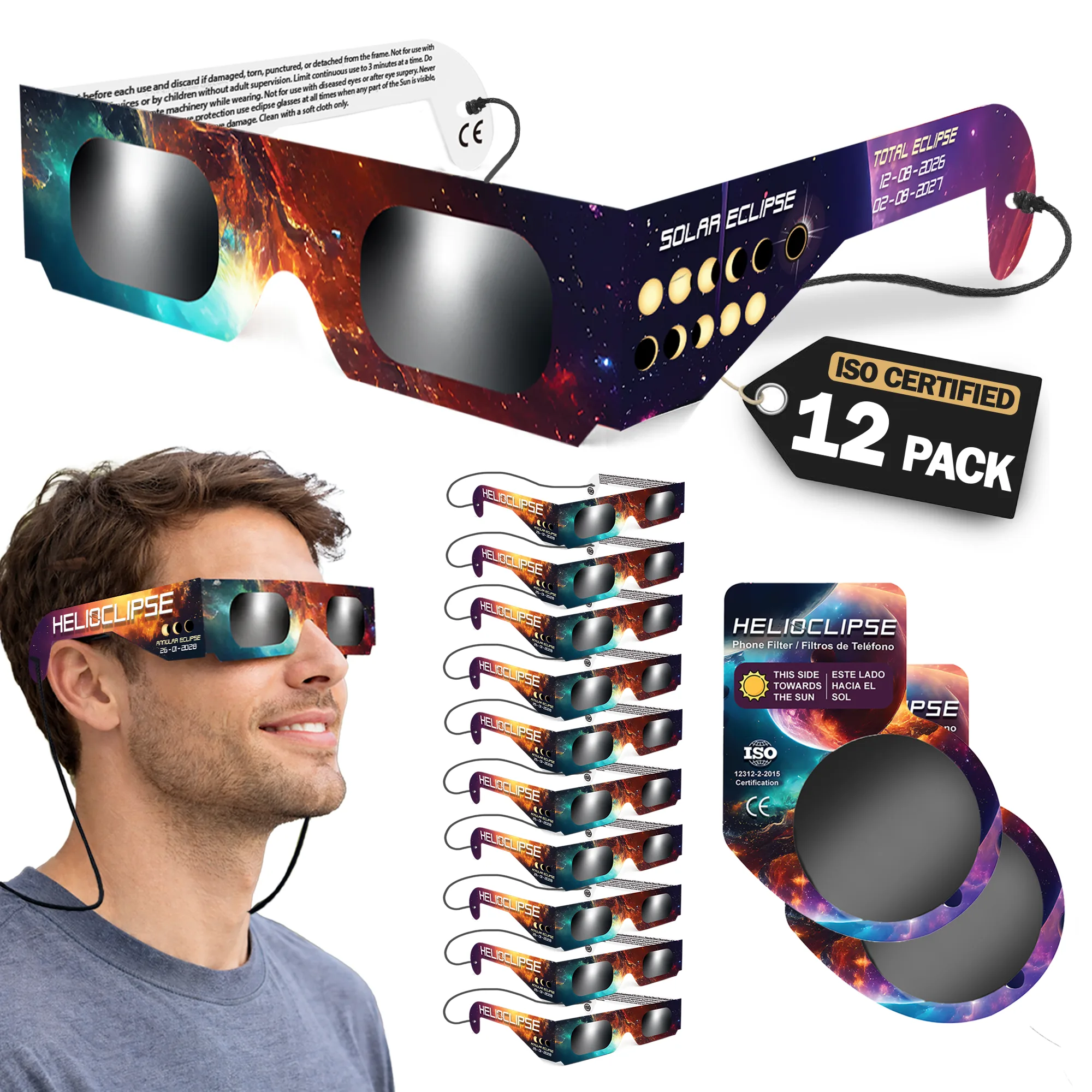
Shopping language can be confusing. Phrases such as approved solar eclipse glasses or eclipse glasses nasa approved do not establish a meaningful NASA endorsement; NASA explicitly says it does not approve individual viewer brands. A claim like solar eclipse glasses iso 12312-2 certified should be supported by credible manufacturer and testing information, not merely printed on an anonymous marketplace listing. You can review Helioclipse’s ISO 12312-2 certified solar eclipse glasses and order early enough to inspect and distribute them before your group reaches Zaragoza.
Never look at the Sun through binoculars, a telescope, or a camera lens while wearing eclipse glasses. Magnifying optics concentrate sunlight and need a correctly designed solar filter secured over the front aperture. If you intend to photograph through a telephoto lens or use a telescope, seek expert equipment guidance and practise the complete filtered setup before eclipse day.
For families, pinhole projection is an excellent way to follow the slow partial phase without staring upward continuously. Stand with the Sun behind you and project its image through a small opening onto a shaded surface. Never look through the pinhole at the Sun.
What the 83 seconds may feel like
The final minute before totality is where preparation pays for itself. Stop changing settings. Stop debating positions. Make sure everyone has a clear sightline and knows the glasses-off cue. If one adult is supervising children, agree beforehand who will call the transitions.
As the solar crescent narrows, the ordinary evening can become visually strange. The remaining sunlight comes from an increasingly thin arc, so shadows may look unusually crisp. The western sky is already carrying the warm geometry of sunset, yet the illumination can fade faster and more deeply than a normal dusk.
When the photosphere disappears, the black Moon will sit inside the Sun’s pale corona. Bright planets or stars may become visible, although haze and the low altitude will affect contrast. Do not promise yourself a photograph of every feature. Look directly at totality with unaided eyes, take in the horizon, and listen to how the crowd reacts. Eighty-three seconds is enough to remember for life and short enough to vanish almost immediately.
Then comes the returning bead of sunlight. Glasses on. The city brightens, the corona disappears, and the partially eclipsed Sun continues toward the horizon. That abrupt return is part of totality, not an anticlimax—and it is the moment at which a rehearsed safety cue matters most.
A final Zaragoza checklist
Several weeks before August 12:
- Confirm your accommodation and transport terms without relying on unverified scarcity claims.
- Order and inspect enough certified viewers for your household or group.
- Select a primary Zaragoza pin and at least two practical alternatives.
- Share coordinates, meeting times, and accessibility needs.
Two or three evenings before:
- Inspect the west-northwest horizon from each candidate site.
- Check trees, buildings, temporary structures, barriers, and distant terrain.
- Identify shade, water, toilets, and safe walking routes.
- Download maps and save contact details offline.
On eclipse day:
- Review satellite imagery and short-range forecasts, including low western cloud and visibility.
- Arrive before the site becomes crowded.
- Keep viewers protected until use and inspect them again.
- Be in the final observation position well before 8:29 p.m. CEST.
- Use eye protection throughout both partial phases and remove it only during complete totality.
Frequently asked questions
Where in Spain can I watch the 2026 total solar eclipse?
The total eclipse will cross a corridor through northern Spain, and Zaragoza lies inside the path of totality. For any chosen viewing location, verify the exact coordinates and local circumstances because totality duration varies across the path.
What time will the solar eclipse occur on February 17?
The provided information covers the eclipse on August 12, 2026, not February 17. In Zaragoza, the partial phase is expected to begin at about 7:34 p.m., with totality around 8:29–8:30 p.m. CEST.
Will there be an organized eclipse viewing event in Spain in 2026?
The excerpt does not confirm any organized public viewing events. It recommends choosing an exact viewing point and checking the path, local timing, and Sun direction before making plans.
What are the key facts for seeing the 2026 total solar eclipse from Zaragoza?
Zaragoza is within the path of totality and is expected to have about 1 minute 23 seconds of totality around 8:29 p.m. on August 12, 2026. The Sun will be only about 6° above the west-northwest horizon, so an unobstructed low horizon is essential.
How should I use a Zaragoza eclipse guide to choose a viewing site?
Use city-level information as a starting point, then check the exact place where you expect to stand for its eclipse circumstances and the Sun’s direction. Nearby trees, buildings, bridge features, stadium structures, or distant rises can block the low Sun during totality.
On-site next steps
- Place your actual hotel, park, riverfront, or meeting-point pin in the Helioclipse Eclipse Explorer and record the local contact times, path position, and west-northwest direction.
- Compare the primary pin with two Zaragoza backups; prioritize a clear six-degree horizon over a famous backdrop.
- Get certified eclipse viewers for your group early, inspect them before travel, and rehearse the glasses-on/glasses-off sequence together.
Sources & further reading
- NASA — Total Solar Eclipse on August 12, 2026
- Space.com — Spain's total solar eclipse 2026 comes with a catch—here's how to avoid ruining your view
- Space.com — Millions could see a rare sunset during the total solar eclipse on Aug. 12, 2026
- Space.com — 10 best Spanish cities to see the total solar eclipse 2026
- European Space Agency — Total solar eclipse 12 August 2026: map of totality in Spain
- American Astronomical Society — How to View a Solar Eclipse Safely
- American Astronomical Society — About the ISO 12312-2 Standard for Solar Viewers
- NASA — Eclipse Viewing Safety
- NASA — Why Do Eclipses Happen?
- NASA — Eclipses and the Moon