Santander in 2026: one city, one eclipse—bay sightlines, cliffs, and Cantabrian weather moods
Santander gets the real thing on August 12, 2026: a total solar eclipse, not merely an almost-total partial eclipse. At roughly 8:26 p.m. CEST—18:26 UTC—the Moon is expected to cover the Sun completely for about 58 seconds, with the eclipsed Sun only around 9° above the west-northwestern horizon. Those three numbers define the local experience: late, brief, and low.
That low altitude turns ordinary city geography into eclipse geography. A lighthouse headland may open the horizon but expose you to wind and fast-moving cloud. A sheltered bay promenade may be comfortable but face the wrong way or leave buildings and rising ground between you and the Sun. A hill helps only if it clears the correct horizon.
Use our Eclipse Explorer and 3D map to check whether your exact pin is inside totality and where the Sun will sit. Do not stop at the city name: for the Santander eclipse 2026, a difference of a few streets can change the final sightline even though it does not change the underlying eclipse type.
Santander’s place inside the Moon’s shadow
The total solar eclipse Spain 2026 path crosses northern Spain during the evening of August 12. NASA describes a wider track running from northern Russia through Greenland, Iceland, the Atlantic, Spain, and a small corner of Portugal. Santander lies inside the umbra’s route, so observers with a clear sky and an unobstructed view can see the corona during totality.
Published Santander figures indicate totality at approximately 8:26 p.m. CEST, lasting about 58 seconds, with the Sun near 9° altitude toward the west-northwest. Treat those as city-level planning figures rather than a second-by-second promise for every pavement. Your exact contacts and duration depend on your coordinates, and editors should verify them against current ephemerides before publication.
Nine degrees is low enough to visualize. A closed fist held at arm’s length spans roughly 10°, so the totally eclipsed Sun will be about one fist above a level horizon. At that altitude, a 16-metre obstruction only 100 metres away can hide the critical part of the sky. At a distance of one kilometre, terrain approximately 158 metres above your observing level subtends a similar angle. Trees, apartment blocks, a headland, or a ridge can therefore matter more than whether a viewpoint sounds scenic.
This is the distinction at the heart of our guide to Spain’s 2026 path: being inside the path makes totality possible, but it does not guarantee that local terrain, cloud, or access will cooperate. Lists of total solar eclipse 2026 Spain cities are useful beginnings; they are not substitutes for checking an exact observing point.
What 58 seconds in Santander may feel like
The partial phase develops gradually while the evening still looks recognizably bright. Through safe solar viewers, the Moon’s silhouette advances across the Sun. The light eventually begins to feel thinner and less like an ordinary summer evening. Shadows can sharpen, the surrounding colour balance may shift, and the horizon can take on the appearance of a rapid, strangely timed twilight.
Then the remaining bright photosphere disappears. During Santander’s roughly 58 seconds of totality, the black lunar disk can be surrounded by the Sun’s pale corona. Bright planets or stars may become visible if the sky is sufficiently clear, while the horizon beyond the Moon’s central shadow can retain warmer light. The event is short enough that elaborate last-minute adjustments are a poor bargain: if you spend 20 seconds changing camera settings, you have surrendered roughly a third of totality.
The abrupt return of direct sunlight ends naked-eye viewing immediately. A total eclipse is not over when totality ends; a long partial phase follows, although sunset may intervene before every astronomical contact is visible from western parts of Europe. NASA specifically notes that the Sun sets while still partially eclipsed in parts of this side of the track.
The phrase totality 2026 Spain covers locations with very different durations and solar altitudes. Santander’s approximately 58 seconds is shorter than the roughly 1 minute 44 seconds reported for León, while the Sun in Santander remains around 9° high at totality. That is why a national overview cannot answer the most important local question: what occupies the west-northwestern horizon from where you intend to stand?
Bay sightlines: water is not automatically an open horizon
Santander Bay gives the city its broad visual scale, but water in front of you does not by itself guarantee a clear eclipse view. The Sun is expected in the west-northwest, so the useful direction must be checked from the precise stretch of waterfront, beach, park, or open space you choose. A beautiful view across another part of the bay can still place the eclipsed Sun behind urban fabric or elevated land.
Promenades and established public spaces can offer practical advantages for families: simpler walking surfaces, nearby services, and easier regrouping than an exposed cliff path. They may also attract dense crowds. A person standing several rows ahead is not normally a serious horizon obstruction, but trees, lamp posts, shelters, temporary event structures, and buildings can be. Arrive early enough to inspect the complete sightline while there is still room to move.
The Magdalena Peninsula and the waterfront around it illustrate why orientation matters. Some outlooks open toward sea or bay, while others include headlands, mature vegetation, architecture, or rising ground in the relevant direction. Do not select a position from a daytime photograph alone. Drop a pin on the map, identify west-northwest, and visit at approximately the eclipse time on a preceding evening if possible.
For a santander Spain eclipse 2026 plan, the strongest bay option is therefore not a universally named bench or promenade. It is the accessible place whose exact west-northwestern horizon you have checked, with enough room for your group and a nearby fallback that does not require crossing the city at the last minute.
Cabo Mayor and the exposed coast
Cabo Mayor, within Santander’s municipality and roughly 5 kilometres from the central city, is the obvious coastal counterpoint. The lighthouse and surrounding cliff-top landscape offer expansive maritime views, and published eclipse coverage identifies this area as a potentially dramatic setting if the sky is clear. Its appeal is geometric: fewer urban structures may interrupt a low Sun over the relevant sector.
But exposed does not mean foolproof. A projecting headland can block one azimuth while leaving another completely open. Clifftop paths may be uneven, edges require ordinary coastal caution, and wind can make cardboard viewers, hats, tripods, and loose equipment difficult to manage. Sea mist or a low cloud bank can erase the Sun even when blue patches remain overhead.
Nearby coastal zones such as Mataleñas and the approaches toward Cabo Mayor deserve the same pin-by-pin test rather than a blanket recommendation. Check whether the Sun’s west-northwestern bearing crosses open water, a slope, vegetation, or the headland itself. Also identify a safe place to wait without blocking paths or gathering close to an edge.
A high point is useful when it lifts your line of sight above nearby obstructions. It hurts when reaching it commits you to a narrow, crowded access route or when another ridge still occupies the eclipse bearing. Elevation is not the objective; a clean horizon is.
Cantabrian weather: prepare for moods, not a single forecast
Historical summaries cited for Santander give a cloud chance of about 54% around the event context. That is not a forecast for August 12, 2026, and it does not mean the sky will be cloudy for 54% of the eclipse. It is a warning that Cantabrian weather cannot be treated as a footnote.
Coastal cloud can vary over short distances and short periods. One sector may be bright while a bank of low cloud sits over the sea; higher cloud can also make the Sun visible through safe viewers before thickening at the crucial moment. The only forecast that matters operationally will be the current one, updated repeatedly as eclipse day approaches.
Within a single-city plan, mobility should remain modest and realistic. Choose a primary Santander location and one or two backups with genuinely different exposure—for example, a bay-side option and an exposed coastal option—then define a decision time. Moving after the partial phase has drawn a crowd can cost more than it gains. Our guide to cloud cover and eclipse-day decisions explains how to compare cloud layers, satellite trends, and the practical cost of moving.
Wind deserves attention too. A breezy headland may have a clearer horizon but be uncomfortable for children or anyone holding a lightweight viewer. Bring a layer even if the afternoon is warm, secure loose items, and avoid relying on umbrellas or improvised shelters that can obstruct other observers.
August crowds, parking, and the value of walking the final stretch
Santander is already a summer destination in August. Add a citywide astronomical event near sunset and familiar coastal spaces can become crowded well before totality. Accommodation, dinner reservations, buses, taxis, car parks, and pedestrian routes all face demand at the same time.
Do not build the plan around finding a last available parking space beside Cabo Mayor or another famous viewpoint. Municipal traffic controls, temporary closures, event zones, and parking arrangements may change, and the supplied sources do not establish a final eclipse-day access plan. Check Santander’s official notices close to the date rather than treating an ordinary map pin as a promise of vehicle access.
A more resilient approach is to park legally well away from the viewing edge or arrive by public transport, then walk the final section with enough daylight to inspect the ground and horizon. Keep the equipment light. For most families, certified viewers, water, a warm layer, a small ground cover, medication, and a charged phone are more valuable than a complicated optical setup.
Agree on a meeting point before entering a crowd, especially if children or several households are involved. Mobile networks may be busy. Tell your group the no-move time—the point after which everyone stays at the selected location—and share the safety rule before attention turns skyward.
This total solar eclipse 2026 Santander Spain 2026 guide remains deliberately confined to one municipality. It is not a multi-day tour of northern Spain, nor a ranking of distant alternatives. The practical goal is to make one city work by understanding its bay, cliffs, hills, access routes, and changeable coastal sky.
Eye safety through every phase
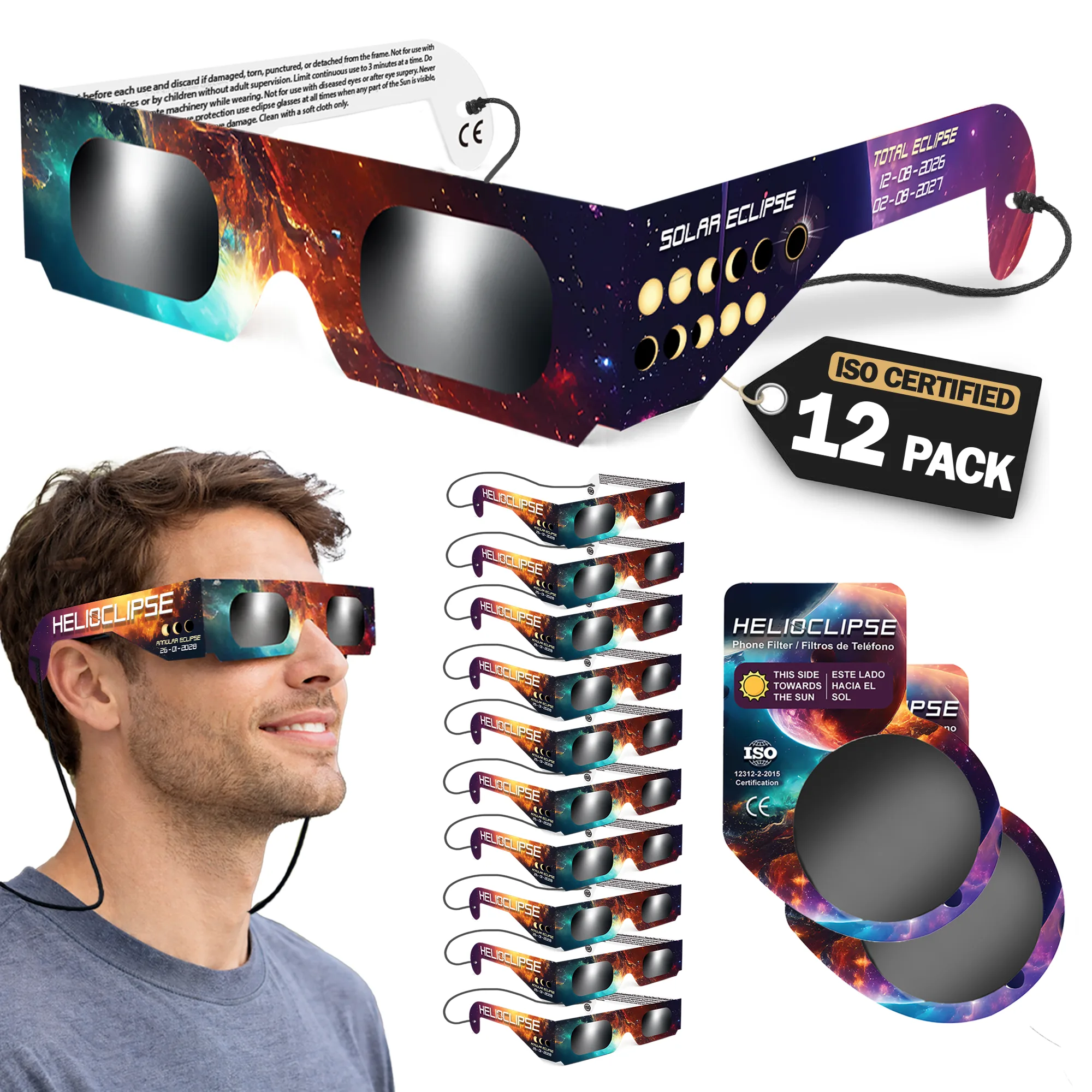
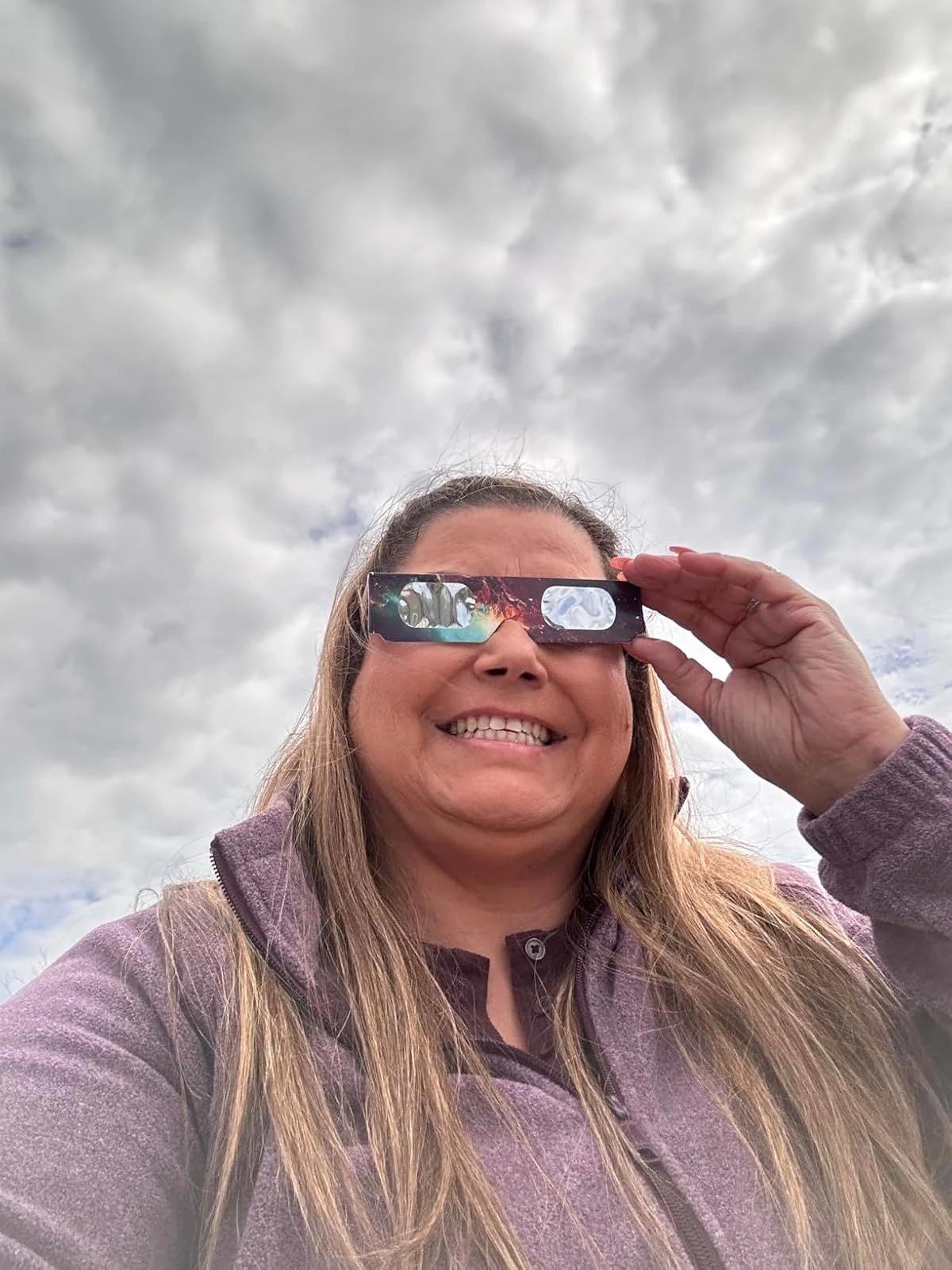
Use special-purpose solar viewers that conform to ISO 12312-2 whenever any part of the Sun’s bright face remains visible. Ordinary sunglasses are not sufficient, however dark they appear. Inspect every viewer before use and discard it if the filter is scratched, punctured, torn, loose, or otherwise damaged. Children should be supervised.
In Santander, viewers may come off only after the Sun’s bright face is completely covered and totality has actually begun. Replace them immediately when the first bright point of photosphere returns. If cloud prevents you from confirming the transition, err on the side of keeping protection on. Our first-timer’s guide to when eclipse glasses go on and come off walks through that sequence in detail.
Cameras, binoculars, and telescopes need correctly fitted solar filters secured over the front aperture. Never look through unfiltered magnifying optics while wearing eclipse glasses; concentrated sunlight can damage the viewer and your eyes. If you are not experienced with solar optics, enjoy the eclipse without magnification or use pinhole projection during the partial phases.
When shopping, eclipse viewing glasses should come from a trustworthy source and carry meaningful manufacturer, use, and standards information. Marketplace wording such as solar eclipse glasses ISO 12312-2 certified should prompt you to verify the actual product and supplier rather than trusting a phrase by itself. You can order Helioclipse solar eclipse glasses early enough to inspect them and practise with the family before eclipse day.
A Santander-specific checklist
Several similar phrases circulate around this event, including total solar eclipse 2026 Santander Spain and Santander Spain eclipse 2026, but the useful plan comes down to concrete checks:
- Confirm your exact point inside the total eclipse Spain 2026 path of totality, rather than relying only on the municipal boundary.
- Verify the latest location-specific contact times, totality duration, solar altitude, and west-northwestern bearing.
- Inspect the horizon from the precise standing position, ideally near 8:26 p.m. CEST on a preceding evening.
- Compare one bay-side location with one exposed-coast fallback without assuming either is automatically superior.
- Check current cloud, wind, access, public-transport, and municipal-event information.
- Arrive early, expect August foot traffic, and avoid depending on parking beside a headline viewpoint.
- Distribute and inspect ISO 12312-2 viewers before the partial phase begins.
- Settle camera choices in advance; Santander’s roughly 58 seconds of totality is too short for troubleshooting.
The broad total solar eclipse Spain 2026 path tells you why Santander experiences totality. The local horizon tells you whether you will actually see it. That is the essential difference between a national path map and a city monograph.
Frequently asked questions
Will Santander experience totality during the August 2026 solar eclipse?
Yes. Santander lies within the Moon’s umbral path on August 12, 2026, with totality expected at about 8:26 p.m. CEST and lasting roughly 58 seconds. The Sun will be only about 9° above the west-northwestern horizon, so an unobstructed view is essential.
How should I plan an observing spot for the 2026 eclipse in Santander?
Check your exact location rather than relying on the city name alone, because a few streets can change the final low-horizon sightline. Confirm that the west-northwestern horizon is clear of buildings, trees, headlands, and rising ground, and verify that your point is inside totality.
Are the bay and cliff viewpoints automatically good places to watch the eclipse?
No. Headlands may provide an open horizon but can be exposed to wind and fast-moving cloud, while bay promenades may be sheltered but face the wrong direction or be blocked by buildings or terrain. A viewpoint is suitable only if it has a clear view toward the low west-northwestern Sun.
Why does the Sun’s low altitude matter for eclipse viewing in Santander?
At totality, the Sun is expected to be near 9° above the horizon—about the height of a closed fist held at arm’s length. At that angle, even a 16-metre obstruction 100 metres away can block the view, as can more distant high terrain.
What time and duration should visitors expect for the Santander eclipse?
City-level planning figures place totality at approximately 8:26 p.m. CEST, or 18:26 UTC, on August 12, 2026, for about 58 seconds. These figures can vary by exact coordinates, so check current ephemerides and your specific observing point before finalizing plans.
On-site next steps
- Open the Helioclipse 3D eclipse map, place a pin on your intended Santander location, and record totality status, timing, duration, Sun altitude, and bearing.
- Visit the location near the event’s clock time to check buildings, trees, slopes, and headlands along the west-northwestern horizon.
- Choose a realistic backup within Santander and decide in advance what weather signal would justify moving.
- Order ISO 12312-2 eclipse viewers from Helioclipse early, inspect them on arrival, and explain the glasses-on/glasses-off sequence to everyone in your group.
Sources & further reading
- NASA Science — Total Solar Eclipse on August 12, 2026
- Timeanddate — August 12, 2026 Total Solar Eclipse in Santander
- Space.com — 15 expert-checked places to see the 2026 total solar eclipse
- Space.com — 10 best Spanish cities to see the total solar eclipse 2026
- Sky & Telescope — Plan Now for the 2026 Total Solar Eclipse in Europe
- American Astronomical Society — How to View a Solar Eclipse Safely
- American Astronomical Society — Eclipse Basics
- American Astronomical Society — About the ISO 12312-2 Standard for Solar Viewers
- NASA Science — Eclipses
- Exploratorium — Guide to the 2026 Total Solar Eclipse