Perseids week in 2026: what else is happening in the sky around the eclipse (without distracting from eye safety)
August 12, 2026 brings an unusual astronomical doubleheader: a total solar eclipse crosses Greenland, Iceland and Spain, and the Perseid meteor shower reaches its peak that night into the morning of August 13. The Moon is new, so it will not wash out the meteors. For people beneath clear, dark skies, that creates one of the most promising Perseid nights of the decade.
But these are two separate observing sessions with radically different rules. The eclipse happens in daylight and demands proper solar protection whenever any bright part of the Sun is visible. The Perseids are a nighttime, naked-eye experience—no eclipse glasses, binoculars or telescope required.
Start by checking your location in our Eclipse Explorer and 3D map. Whether you are inside or outside the narrow path of totality determines what you will see and whether there is ever a brief period when solar viewers may come off.
One date, two very different sky events
The total solar eclipse occurs on August 12. Its path of totality crosses northern Russia, Greenland, Iceland, the North Atlantic, Spain and a small corner of Portugal. Much of Europe, parts of northwestern Africa and portions of North America see a partial eclipse instead.
The Perseids are active for weeks—roughly from mid-July into late August—but their strongest activity is expected around the night of August 12–13. They occur when Earth passes through debris left by Comet 109P/Swift-Tuttle. Tiny particles enter the upper atmosphere at high speed and produce momentary streaks of light, generally at altitudes of about 80 to 120 kilometres.
The phrase perseid meteor shower august 2026 eclipse can therefore be misleading if it suggests one simultaneous spectacle. The calendar coincidence is real, but the useful observing windows are mostly separated: watch the eclipse in daylight, take a break, eat, relocate if necessary, and begin meteor watching after the sky becomes properly dark.
A listing described as a perseid meteor shower august 2026 eclipse 2026 guide should make that distinction immediately. The eclipse lasts a few hours from first to last partial contact at a given site, while totality lasts less than two and a half minutes anywhere on the path. The meteor shower unfolds over the whole night, with generally better rates after midnight as the Perseid radiant climbs higher.
What happens during the August 12 eclipse
NASA’s published local circumstances illustrate how strongly the eclipse experience changes with location. In León, Spain, the partial phase begins at about 7:32 p.m. local time, with totality from roughly 8:28 to 8:30 p.m. In Valencia, totality is listed from approximately 8:32 to 8:33 p.m., followed quickly by sunset. Zaragoza has about a minute of totality around 8:29–8:30 p.m. These rounded times are useful for orientation, but use an interactive map for your exact observing point.
Near greatest eclipse over the North Atlantic, totality reaches about 2 minutes 18 seconds. Across Spain, the duration varies from roughly 30 seconds to nearly two minutes. That is a major practical difference: a site only marginally inside the path may receive a fleeting total phase, while a location nearer the centreline gets substantially more time to see the corona and the darkened horizon.
Outside the path, there is no totality. NASA’s sample figures put maximum solar coverage at about 99% in Madrid and Barcelona, 95% in Lisbon, 94% in Dublin, 92% in Paris and 91% in London. Those are deep partial eclipses, but even a 99% partial eclipse is not interchangeable with totality: a bright sliver of photosphere remains visible, the corona is overwhelmed, and certified solar viewers must stay on throughout.
Our August 12, 2026 total solar eclipse planning guide covers the broader event. If this will be your first eclipse, also learn the sequence of eclipse phases and exactly when viewers stay on before you travel.
Could a Perseid appear during totality?
It is physically possible, but it is not a spectacle anyone should promise. Totality creates an eerie twilight rather than a fully dark astronomical night. That sky is still bright enough to hide ordinary meteors, leaving only an exceptionally bright fireball with a realistic chance of being noticed.
There is also a severe timing problem. Totality lasts only seconds or a couple of minutes, while bright Perseid fireballs occur unpredictably. Space.com reported an estimate of roughly one Perseid fireball per three hours at night; asking one to cross a suitably dark part of the sky during a two-minute eclipse is asking chance to do almost all the work.
Keep your attention on the eclipse. Totality can reveal the solar corona, bright planets, the dark lunar silhouette and a 360-degree sunset-like glow near the horizon. A meteor would be a startling bonus, not part of the plan. There will be hours to watch for Perseids later.
This is also why perseid meteor shower august 2026 eclipse videos require careful interpretation. A genuine video can show an eclipse sequence, a meteor captured at another time that night, or a composite assembled to communicate the doubleheader. Check timestamps and captions before assuming two recorded phenomena occurred simultaneously.
The realistic Perseid forecast for August 12–13
The outlook is unusually favourable because August 12 is a new Moon. With no bright moonlight flooding the night sky, the limiting factors become clouds, artificial light, haze, horizon obstructions and how long you are willing to watch.
Published calendars give the Perseids a zenithal hourly rate near 100. That number is not a promise that every observer will count 100 meteors in an hour. It describes an idealised rate for an experienced observer under a very dark, unobstructed sky, with the radiant effectively overhead and full dark adaptation. Real counts are usually lower.
Astronomy Magazine estimates that observers under good rural conditions could see around 60–80 meteors per hour during favourable predawn hours, when the radiant is high. In a city, the visible rate may fall by more than half because skyglow erases fainter meteors. Clouds can reduce the count to zero regardless of the forecast.
The perseid meteor shower august 2026 eclipse time is therefore not a single universal clock time. The eclipse follows a precise local contact schedule during the day or evening; the meteor shower builds over many hours and is generally best from after midnight until the beginning of dawn. Local darkness and the altitude of Perseus matter more than matching one minute on a timetable.
Begin once the sky is fully dark if that suits children or an early schedule. Evening rates will usually be lower, but a low radiant can produce occasional long Earth-grazing meteors. If your group can stay up, conditions tend to improve toward the early morning of August 13.
How to watch the Perseids after the eclipse
Choose a dark, open location with a broad view of the sky. You do not need to stare directly at Perseus. Meteors appear to trace back to that constellation, but they can flash anywhere, and longer trails are often seen well away from the radiant. A reclining chair or ground mat makes sustained watching much more comfortable than standing with your neck tilted back.
Give your eyes about 30 minutes to adapt to darkness. Keep phone screens dim and red if possible, and avoid vehicle headlights. Eclipse glasses have no role here: they are designed to suppress intense sunlight and will make the night sky effectively invisible. Meteors are safest and easiest to watch with unaided eyes.
Binoculars and telescopes are poor tools for meteor watching because their fields of view are too narrow. Save them for planned targets and never point them toward the Sun unless a correctly fitted, purpose-made solar filter is secured over the front aperture and you know how to use the equipment safely.
A useful group plan is to divide the night into 20- or 30-minute sessions. Face different portions of the sky, call out each meteor and have one person keep a simple tally. Families can make it a friendly count rather than a competition; two people may report different totals because trees, eyesight and attention all matter.
The safety rule that does not change
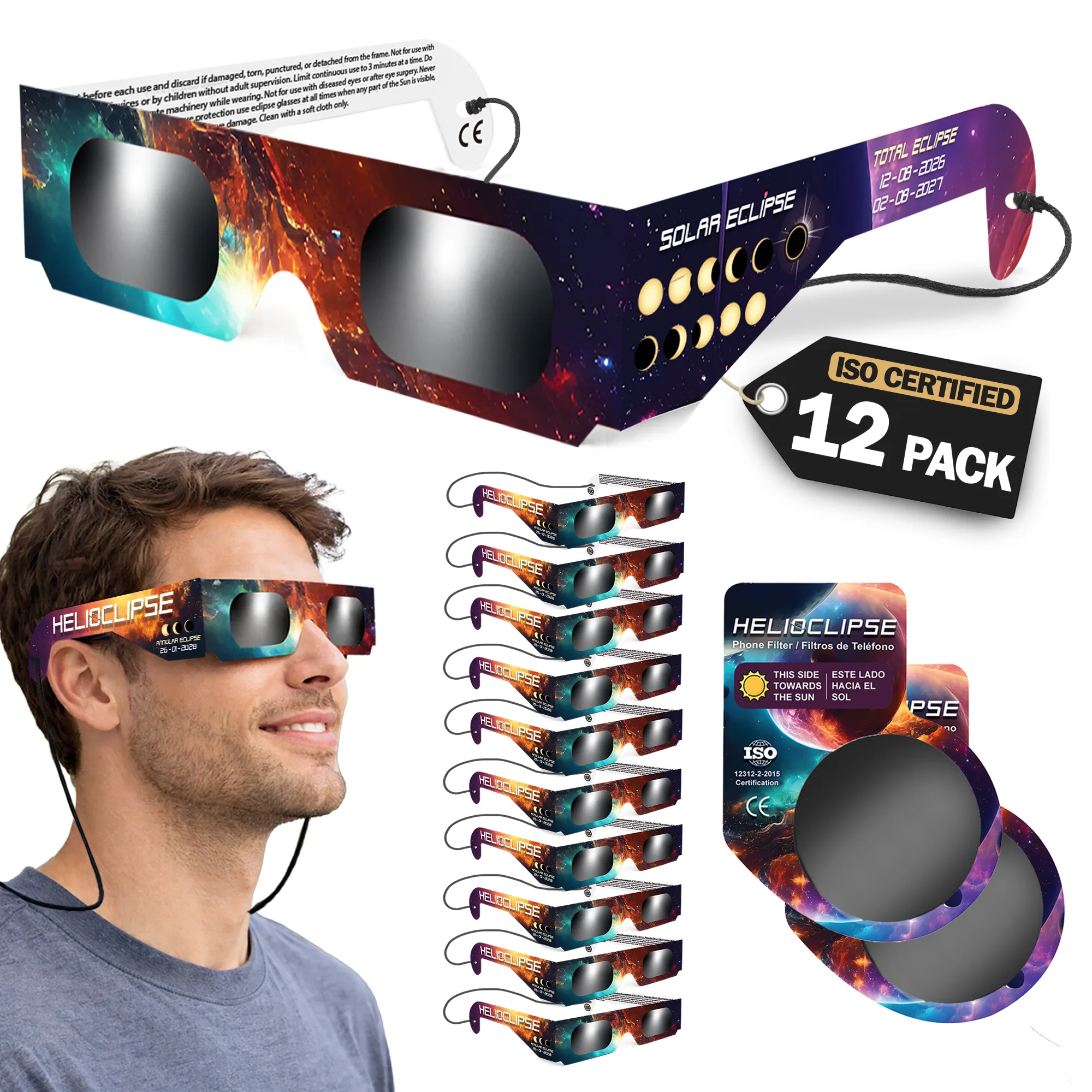
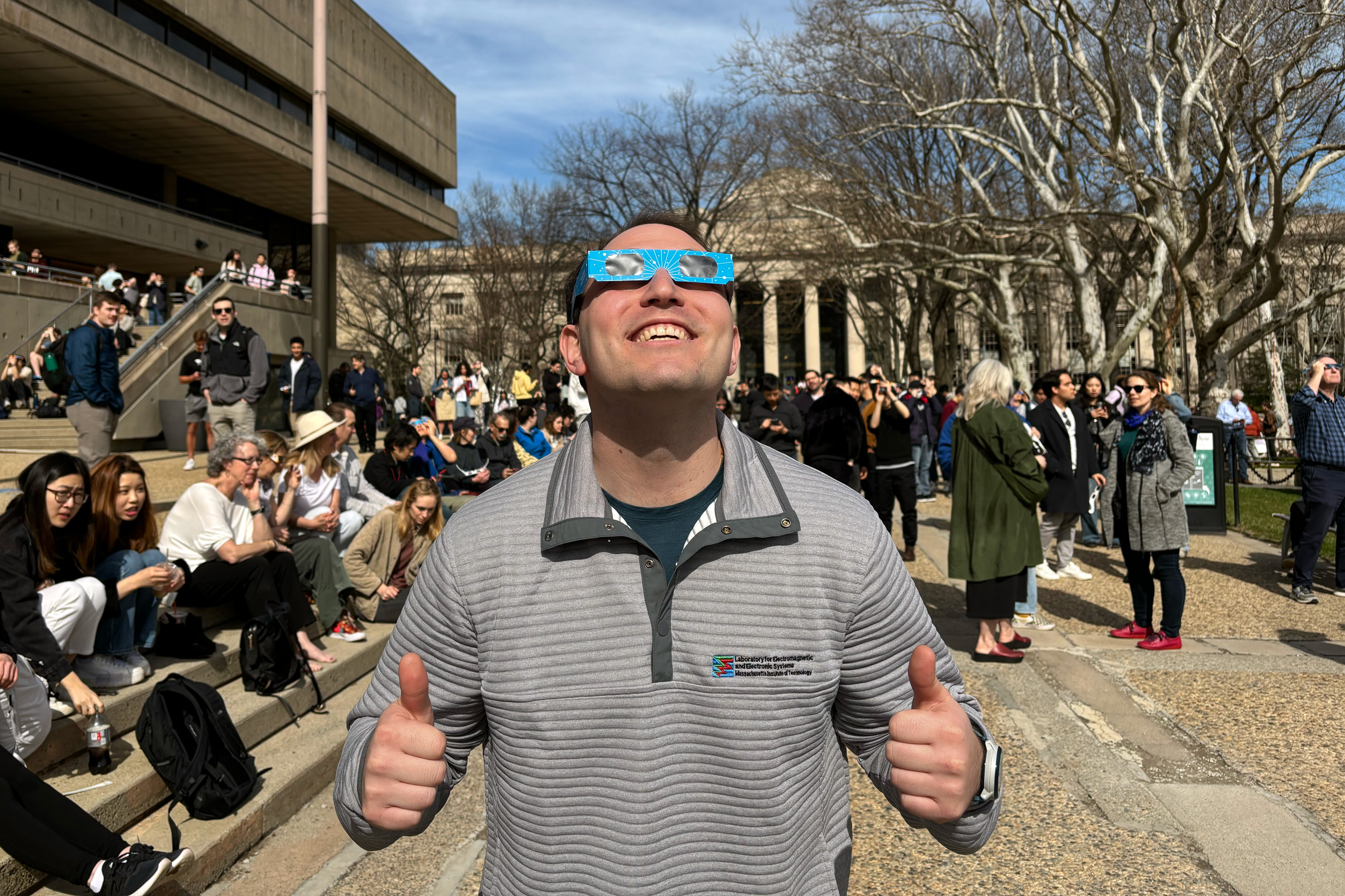
During every partial phase, use special-purpose solar viewers that conform to ISO 12312-2. Ordinary sunglasses are not sufficient, no matter how dark they appear. Inspect viewers before use and discard any with torn frames, punctures, scratches or filters coming loose. Supervise children and practise putting viewers on before looking toward the Sun.
Only observers inside the path of totality may look directly without solar viewers, and only while the Moon completely covers the Sun’s bright face. Viewers go back on as soon as any bright photosphere reappears. At a partial-only location—including Madrid, Barcelona, London, Dublin and Paris—there is no glasses-off moment.
Cameras, binoculars and telescopes need special solar filters attached securely to the front of the optics. Wearing eclipse glasses while looking through an unfiltered optical instrument is not safe: concentrated sunlight can damage the viewer and the eye. Our guide to ISO 12312-2 eclipse viewers explains what the standard covers and what it does not.
Product language can be confusing. Approved solar eclipse glasses is an incomplete claim unless the seller identifies the applicable standard and provides credible manufacturing and testing information. NASA does not certify or approve viewer brands, so claims such as “NASA approved” should not be treated as a safety credential. When choosing eclipse viewing glasses, look for undamaged viewers intended for direct, unmagnified solar observation and documented as meeting ISO 12312-2 requirements.
Tell your family, school group or travelling companions about these rules well before August. Leaving the safety briefing until the Sun is already disappearing is how confusion starts. If you need viewers for your group, arrange ISO 12312-2 certified solar eclipse glasses from Helioclipse early enough to inspect them and practise with children.
Why the Moon helps both events in different ways
The eclipse and dark Perseid night share the same underlying lunar phase: new Moon. During a solar eclipse, the Moon passes between Earth and the Sun closely enough to cast its shadow on Earth. Most new Moons do not cause eclipses because the Moon’s orbit is tilted by about 5 degrees relative to Earth’s orbital plane, so its shadow usually passes above or below our planet.
For the meteor shower, the new Moon matters because its night side faces Earth and it contributes essentially no moonlight to the observing sky. The Moon does not cause the Perseids or increase the number of incoming particles; it simply stays out of the way of faint meteor light.
The question what is the lunar calendar often arises when several events share a date. A lunar calendar tracks months primarily through lunar phases, while an astronomical almanac records calculated phenomena such as phases, eclipses, planetary positions and meteor-shower peaks. For planning, use the almanac to identify an event, then verify local circumstances with an eclipse map, current meteor guidance and a weather forecast.
Poorly maintained web indexes can attach irrelevant years to otherwise useful topics. For example, the machine-generated catalog string astronomical calendar context from reputable almanacs set eclipse planning 2021 does not establish anything about the 2026 sky. Trust the publication date, named astronomical authority and current ephemeris—not an accidental label inherited from an old index.
Other sights around eclipse week
The Perseids are the headline nighttime event, but the rest of August is not empty. Venus becomes a brilliant evening object low in the west after sunset around August 14–16, near its greatest apparent separation from the Sun for this evening appearance. On August 15, a young crescent Moon joins Venus in the evening sky.
Saturn and Neptune rise later and are best placed after midnight. Saturn is visible to the unaided eye under suitable conditions; Neptune requires optical aid and a finder chart. Mars rises in the early morning and passes near the open cluster M35 around August 14–15, although the view depends on latitude, horizon and twilight.
Later in the month, a deep partial lunar eclipse occurs on August 27–28 depending on timezone. NASA describes it as visible from much of the Americas and parts of Europe and Africa. Unlike a solar eclipse, a lunar eclipse is safe to watch directly, and binoculars can enhance the view.
These events are supporting acts, not obligations. If your group has travelled for totality, protect the eclipse plan first: know the route, horizon, cloud options, contact times and safety procedure. A tired driver chasing one more astronomical target is not a good trade.
Live coverage, recordings and claims beyond astronomy
NASA plans to begin its live eclipse broadcast at 1:15 p.m. EDT on August 12, equivalent to 17:15 UTC. A perseid meteor shower august 2026 eclipse live listing may combine eclipse coverage with later meteor commentary, but no livestream can guarantee meteors on cue. Unlike an eclipse contact, an individual meteor cannot be scheduled for the camera.
Recordings are useful for reviewing corona structure, shadow movement and observing techniques. However, perseid meteor shower august 2026 eclipse videos should clearly distinguish real-time footage from time-lapses, composites, simulations and clips recorded hours apart. That distinction does not make a composite illegitimate; it simply tells you what evidence the image provides.
Astronomy predicts the eclipse through orbital geometry and the Perseids through Earth’s recurring encounter with a meteoroid stream. The phrase perseid meteor shower august 2026 eclipse astrology refers to a different, symbolic tradition that does not provide a scientific method for predicting local contact times, totality duration, meteor rates or cloud cover. For practical planning, use ephemerides, maps and updated weather information.
A simple schedule for your August 12–13 group
A workable plan keeps the two events separate:
- Before eclipse day: confirm whether your exact site is inside totality, save local circumstances offline and inspect every solar viewer.
- Several hours before first contact: reach a location with a clear western horizon if you are observing from Spain or another sunset-sensitive site. Set up food, water and shade before the partial phase becomes distracting.
- During the partial phases: use certified viewers whenever looking directly at the Sun. Take short looks rather than staring continuously.
- During totality only: if you are inside the path and the bright solar surface is completely covered, follow the glasses-off procedure you rehearsed. Replace viewers immediately when the Sun begins to return.
- After sunset: pack optical equipment carefully, eat and move to the meteor site without rushing. Check clouds and local access conditions.
- After full darkness: let your eyes adapt and begin watching. Stay later if practical; the radiant climbs and meteor prospects generally improve toward dawn.
That schedule gives each event the attention it deserves. It also makes the week easier to share with people who have never watched an eclipse or meteor shower before: one afternoon-to-evening lesson in shadows and solar safety, followed by a relaxed night beneath comet dust.
Frequently asked questions
Can I watch the August 2026 eclipse and the Perseids as one event?
No. The solar eclipse is a daytime event on August 12, while the Perseid peak is expected during the night of August 12–13; plan them as separate observing sessions. Use proper solar protection whenever any bright part of the Sun is visible, then watch meteors after the sky is properly dark.
What should a practical August 2026 eclipse and Perseids guide make clear?
It should clearly distinguish the two events and their different safety rules. The eclipse lasts only a few hours from first to last partial contact at a location, with totality under two and a half minutes anywhere on the path, while Perseid watching can continue through the night and is generally better after midnight.
What else is happening in the sky during Perseids week in 2026?
A total solar eclipse crosses parts of northern Russia, Greenland, Iceland, the North Atlantic, Spain, and a small corner of Portugal on August 12. Much of Europe, parts of northwestern Africa, and portions of North America will see a partial eclipse instead.
Why is the date of the 2026 Perseid peak notable?
The Perseids are expected to peak on the night of August 12–13, the same date as the total solar eclipse. The Moon is new, so moonlight will not wash out the meteors for observers under clear, dark skies.
What is the safest way to observe the solar eclipse?
Use proper solar protection whenever any bright part of the Sun is visible. Only observers within the narrow path of totality may have a brief period when solar viewers can come off, so check your location and local eclipse circumstances in advance.
On-site next steps
- Explore your exact eclipse circumstances with the Helioclipse 3D eclipse map, paying attention to total versus partial visibility, local timing and sunset.
- Continue planning through our eclipse blog and learning hub for safety, weather and travel guidance.
- If your family or group still needs suitable solar viewers, visit the Helioclipse eclipse-glasses shop early rather than relying on last-minute availability.
Sources & further reading
- What’s Up: August 2026 Skywatching Tips from NASA
- NASA: Total Solar Eclipse on August 12, 2026
- Space.com: Will Perseid shooting stars be visible during the Aug. 12 total solar eclipse?
- Astronomy Magazine: August 2026—What’s in the sky this month?
- Sky & Telescope: The Best Meteor Showers in 2026
- American Astronomical Society: How to View a Solar Eclipse Safely
- American Astronomical Society: About the ISO 12312-2 Standard for Solar Viewers
- NASA: Eclipse Viewing Safety
- American Astronomical Society: Eclipse Basics
- NASA: Eclipses and the Moon