Partial phases before totality: what you’re looking at in the sky
The first sign can be almost comically small: one edge of the Sun no longer looks perfectly round. Through a safe solar viewer, the Moon appears to have taken a neat bite from the solar disk. Over the next hour or more, that bite grows into a deep curve and then, for observers approaching totality, a brilliant narrowing crescent.
That slow transformation is not merely a warm-up. The partial phase lets you watch orbital motion unfold in real time, while changing sunlight alters shadows, colours and sometimes the behaviour of the world around you. During a partial solar eclipse what you see depends on how much of the Sun is covered, where you stand and whether the eclipse will become total at your location.
Use our Eclipse Explorer and 3D map to check the geometry for your exact observing site. Being just outside the path of totality is fundamentally different from being just inside it, even when the uncovered portion of the Sun looks extraordinarily thin.
What is happening above you?
Start with the basic question: what is a solar eclipse? It occurs when the new Moon passes between Earth and the Sun and its shadow falls on part of our planet. The Moon’s orbit is tilted by about 5 degrees relative to Earth’s orbital plane, so most new moons pass above or below the Sun from our perspective. An eclipse happens only when the alignment is close enough during an eclipse season.
The Sun is about 400 times wider than the Moon but also roughly 400 times farther away. That coincidence makes the two disks appear close to the same angular size—about half a degree across. When the Moon’s apparent disk completely covers the bright solar surface, observers within the narrow umbral shadow experience totality. If only part of that surface is hidden, the view is partial.
So, what is a partial solar eclipse in practical terms? It can be a standalone event in which the Moon’s central shadow misses Earth, or it can be the broad partial region surrounding the narrow path of a total or annular eclipse. It is also the long opening and closing act seen from inside the path of totality.
The important distinction is local. Two people watching the same alignment from different places may experience different eclipse types. One can see the corona during totality while another, perhaps only tens of kilometres beyond the path boundary, sees a thin solar crescent and never enters totality at all.
What do you see during a partial eclipse?
At first contact, the Moon’s silhouette touches the apparent edge of the Sun. The first indentation can be subtle through unaided-eye eclipse viewers, although properly filtered, magnified equipment may reveal it sooner. As the Moon continues eastward across the Sun’s face, the missing arc deepens and the visible Sun takes on a crescent shape.
The Moon itself does not become a visible black ball with surface detail. You are seeing its unilluminated silhouette against the much brighter Sun. Through many safe viewers the Sun may appear orange, yellow or white, depending on the filter, while the Moon’s portion appears completely dark.
The phrase partial solar eclipse what you see describes more than the shape overhead. Look down as well as up. Small gaps between overlapping leaves act as natural pinhole projectors, covering the ground with miniature images of the crescent Sun. A colander, perforated card or loosely crossed fingers can produce the same effect. Each bright patch is an image of the Sun, not a crescent-shaped shadow of the Moon.
If a large sunspot is present, it may be visible through suitable solar-observing equipment, but ordinary eclipse viewers do not magnify the image. Never add binoculars, a telescope or a camera in front of glasses worn on your face. Magnifying optics require their own securely fitted solar filter over the front aperture.
What can you see during a partial solar eclipse?
Early in the event, the landscape may look completely normal. Human vision automatically adjusts to gradual changes in brightness, and even a reduced solar surface can keep the day surprisingly bright. That is why visual brightness is not a reliable measure of either eclipse coverage or eye safety.
Once much of the Sun is hidden, the light can begin to feel thinner and less warm. Colours may lose some richness, while the sky around you takes on an unusual quality that is difficult to reproduce at ordinary dusk. The effect generally becomes much more conspicuous during the final 15 minutes before totality, but clouds, terrain and the depth of the eclipse all affect what you notice.
Shadows also change. The everyday Sun is an extended light source, so objects cast shadows with softened edges. A narrow solar crescent illuminates objects more strongly from one direction, producing sharper detail along one axis. Near totality, individual hairs on a person’s head or arm can cast remarkably crisp lines.
Temperature may fall as less solar energy reaches the ground, although wind, cloud and the local surface can strengthen or mask the change. Birds and insects sometimes alter their behaviour as the light fades, but this is not a guaranteed countdown clock. Treat it as something to notice, not as proof that totality has begun.
A simple observation plan works well: record the temperature every ten minutes, photograph the same landscape without pointing the camera at the Sun, and sketch the projected crescent. Friends, families and school groups can divide the jobs, then compare notes after the eclipse.
The last minutes before totality are different
A deep partial eclipse is not the same physical experience as totality. When the Sun becomes a very thin crescent, the light can fade rapidly, the western sky may darken and faint rippling shadow bands may appear on pale ground or a white sheet. Atmospheric turbulence distorts the remaining sliver of sunlight, somewhat as it makes stars twinkle.
In the final seconds before totality, sunlight shining through valleys along the Moon’s rugged edge can break into Baily’s beads. As those points disappear, one bright point may remain beside the emerging corona, creating the diamond-ring effect. Keep your eye protection on while any direct part of the bright solar surface remains visible.
Only after the Moon completely covers the Sun’s bright face—and only if you are confirmed to be inside the path of totality—may you look at totality directly without a solar viewer. The pearly corona then surrounds the black lunar disk, and the chromosphere or prominences may appear pink along its edge. As soon as the bright Sun begins to return, eye protection goes back on.
Outside the path, even a 99%-plus partial eclipse never becomes total. There is no glasses-off moment, and the corona remains overwhelmed by direct sunlight. Our detailed guide to when eclipse glasses stay on and when they can come off explains that boundary for first-time observers.
Why the remaining sliver is still the Sun
Covering most of the solar disk does not make its exposed surface safe to view. The remaining crescent is still photosphere—the same intensely bright visible surface you see on an ordinary day. It can damage the retina without causing an immediate pain response, and a quick unprotected glance is not a safe observing technique.
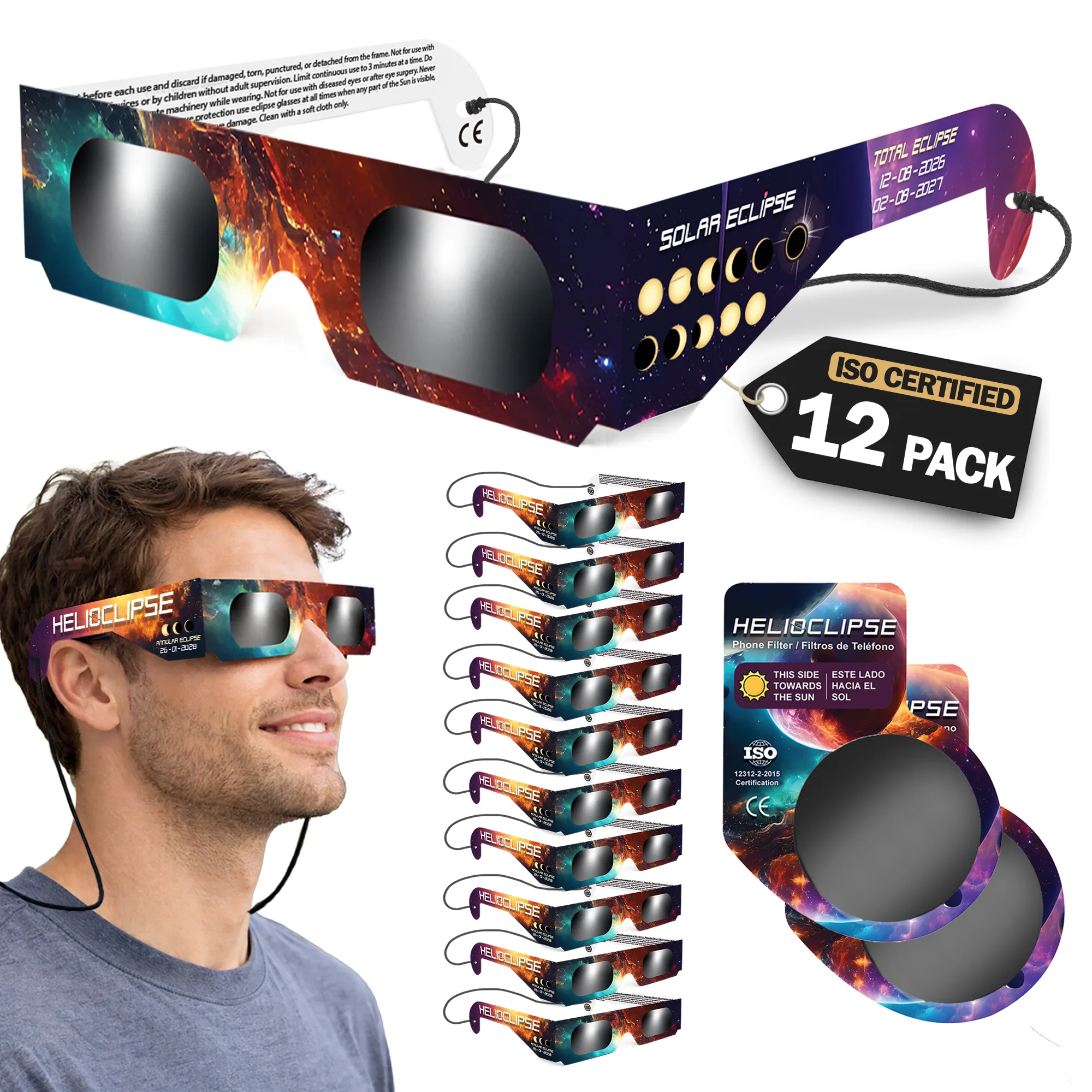
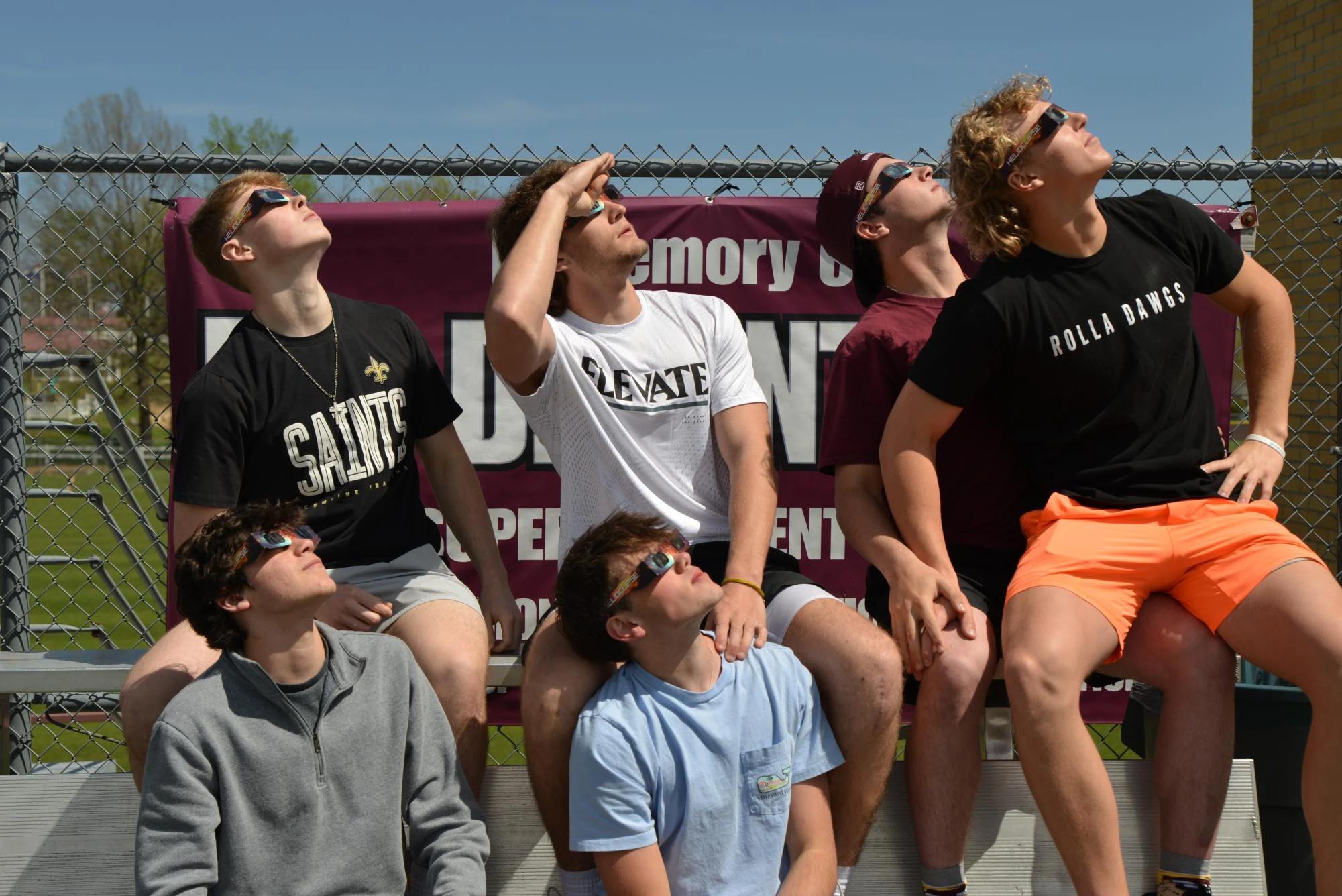
For every partial phase, use special-purpose solar eclipse glasses or a handheld viewer conforming to ISO 12312-2. Ordinary sunglasses are not sufficient, regardless of how dark they appear. Inspect every viewer before use and discard it if the filter is scratched, punctured, torn or separating from its frame. Supervise children and practise the routine before eclipse day: look away, position the viewer over your eyes, look at the Sun, then turn away before removing it.
Marketplace wording can be confusing. Phrases such as approved solar eclipse glasses, eclipse glasses nasa approved and solar eclipse glasses iso 12312-2 certified do not all provide the same evidence: NASA does not approve particular viewer brands, and a printed claim alone does not demonstrate conformity. Check the product information, manufacturer identity, usage instructions and condition of the filter; our guide to ISO 12312-2 and eclipse viewers goes deeper into what the standard does—and does not—tell you.
Cameras, binoculars and telescopes need purpose-made filters secured over the front of their optics. Do not look through an unfiltered instrument while wearing eclipse glasses: concentrated sunlight can damage the viewer and your eye. If you are uncertain about an optical setup, consult an experienced solar observer rather than improvising.
Projection turns the crescent into a group experiment
Indirect projection is one of the best ways to follow the entire partial phase with children or a crowd. Put the Sun behind you and let its light pass through a small opening onto a shaded white surface. You watch the projected image, never the Sun through the hole.
For families learning how to see solar eclipse safely at home, a cereal-box projector can produce a protected image inside the box. A card with several clean pinholes makes a row of crescents, while a colander can fill the ground with dozens. Move the projection surface farther from the opening and the image becomes larger but dimmer; move it closer and it becomes smaller and brighter.
Leaf shadows provide the most effortless demonstration. Before the eclipse, the patches of sunlight under a tree generally look round because they are images of the round Sun. During the partial phase, those same gaps project crescents. When the Moon moves away after maximum eclipse, the crescents reverse orientation before gradually becoming round again.
Never substitute homemade dark material for a direct-viewing filter. Smoked glass, exposed film, CDs, food wrappers and stacked sunglasses can transmit harmful radiation even if the Sun looks comfortably dim through them. Projection works because you face away from the Sun and observe an image on another surface—not because an improvised material filters your direct view.
How much changes from one location to another?
On August 12, 2026, the path of totality crossed Greenland, Iceland and Spain in a corridor reported at roughly 182 miles, or 293 kilometres, wide. Maximum totality anywhere along the path was about 2 minutes 18 seconds. Observers inside that corridor could progress from a long partial phase into totality; people elsewhere across a much broader region saw only a partial eclipse.
That distinction mattered within Spain itself. Locations in the northern totality path experienced complete coverage, while Madrid remained outside totality and saw a deep partial eclipse. The event occurred late in the day for Spain, so an unobstructed western horizon was part of the observing geometry—not an optional scenic extra. Our August 12, 2026 planning guide preserves the event’s path and phase context.
The labels partial solar eclipse 2026 and partial eclipse 2026 therefore covered several different experiences: a standalone partial view far from the central path, a deep partial eclipse just outside it, or the partial phases surrounding totality. Think of this as a partial solar eclipse what you see 2026 guide built around the lesson that a date alone never defines your view; coordinates and path geometry do.
The same caution applies to the phrase partial solar eclipse 2027. An eclipse can be total or annular along one central track while appearing partial across a much larger surrounding area. Check your exact location, local contact times, maximum coverage and the Sun’s altitude rather than relying on a country-level headline.
Even the question “when was the last partial solar eclipse here?” requires a place. Eclipse visibility changes across Earth, so the most recent partial eclipse in one city may not have been visible at all from another. Comparisons of partial solar eclipses in the future should likewise begin with a map and site-specific circumstances.
A practical observing sequence
Arrive before first contact and choose a site where buildings, hills and trees will not block the Sun at the relevant time. Bring your viewers out before anyone becomes tempted to take an unprotected look. If you are observing with a group, tell everyone in advance whether the site is inside or outside the path of totality.
During the opening partial phase, take short filtered looks every few minutes instead of staring continuously. Follow the changing crescent, check the projection station and look for altered leaf shadows. Closer to maximum eclipse, pay attention to the landscape: shadow sharpness, temperature, wind and the colour of the light can be as memorable as the filtered view of the Sun.
If totality will occur at your confirmed location, designate one informed adult to call the transitions. The conservative rule is simple: filters remain in use until the bright solar surface is completely covered, and they return before the first bright point of photosphere reappears. If totality will not occur, filters stay on for every direct look from first contact through fourth contact.
Tell your group early and obtain trusted viewers before demand peaks. Our solar eclipse glasses are intended to make that preparation straightforward, whether you are equipping a family, classroom or gathering of friends. Store them flat and dry, and inspect each one again on eclipse day.
Frequently asked questions
What will the Sun look like during the partial phase before totality?
The Moon appears to take an increasingly deep bite from the Sun’s disk, leaving the visible Sun in a crescent shape. For observers approaching totality, that crescent becomes brilliantly narrow as more of the solar surface is covered.
How can I tell whether a partial eclipse will be visible from my location?
Visibility and eclipse type depend on your exact observing site and on the alignment of the Moon’s shadow with Earth. Locations in the broad region around a total or annular eclipse may see a partial eclipse, while places inside the narrow umbral shadow can experience totality.
Why does the Sun’s corona become visible during a solar eclipse?
The corona can be seen when the Moon’s apparent disk completely covers the bright solar surface during totality. This occurs only for observers within the narrow umbral shadow.
Will I see the Moon’s surface crossing in front of the Sun?
No. During a partial eclipse, the Moon is seen as a dark silhouette cutting across the Sun’s disk rather than as a detailed black ball with visible surface features. The visible part of the Sun gradually changes from a round disk to a crescent.
What changes in the environment can occur as totality approaches?
During the partial phase, changing sunlight can alter shadows and colours and may sometimes affect the behaviour of the world around you. These changes develop as the Moon covers more of the Sun on the approach to totality.
On-site next steps
- Open the Helioclipse Eclipse Explorer and enter your observing location. Check the eclipse type, maximum phase, local timing and Sun altitude—not just the nearest city name.
- Once you know who is joining you, order Helioclipse solar eclipse glasses early enough to inspect them and practise safe viewing together.
- Explore our eclipse guides for more help with weather, path geometry, eye safety and family planning.
Sources & further reading
- NASA Science: What to Expect—A Solar Eclipse Guide
- NASA Science: What to Expect
- American Astronomical Society: Phenomena You’ll Experience at a Total or Annular Eclipse
- NASA Science: Host a Sun Party
- Space.com: Here’s What to Expect From 5 Stages of the Total Solar Eclipse 2026
- NASA Science: Eclipse Viewing Safety
- American Astronomical Society: How to View a Solar Eclipse Safely
- American Astronomical Society: Eclipse Basics
- American Astronomical Society: Solar Filters for Optics—Telescopes, Binoculars & Cameras
- NASA Science: Eclipses Frequently Asked Questions