Same night, second act: what the sky offers after the eclipse winds down
Totality ends with a burst of returning sunlight. People cheer, put their solar viewers back on and start comparing what they saw. But on August 12, 2026, the sky will not be finished with you.
After the remaining partial phase and ordinary sunset, a nearly moonless night will coincide with the peak of the Perseid meteor shower. Venus will be the most credible planetary target in the evening twilight. The exact transition will depend sharply on where you watched the eclipse: Spain moves from low-altitude totality toward sunset in minutes, while Iceland and Greenland face much longer summer twilight.
This is our planets visible after total solar eclipse same night 2026 guide, but it is not a promise of a six-planet parade. Use the Helioclipse Eclipse Explorer to check the eclipse geometry for your site, then pair it with a location-specific sunset and planetary ephemeris. The best second act may be one bright planet followed by a patient meteor watch—and that is already an exceptional night.
First, let the eclipse actually finish
Totality is not the end of the solar eclipse. The instant a brilliant point of the Sun reappears at third contact, certified solar viewers go back over your eyes. The Moon then takes roughly another hour to move away from the solar disk, although sunset interrupts that sequence at several European locations.
NASA’s published local circumstances show how different the evening will feel across the path. In León, Spain, totality runs approximately from 8:28 to 8:30 p.m., with the partial eclipse ending around 9:22 p.m. In Valencia, totality is approximately 8:32 to 8:33 p.m., but sunset arrives around 9:01 p.m. while the partial eclipse is still in progress. Zaragoza follows a similar pattern: roughly one minute of totality beginning at 8:29 p.m., followed by a partially eclipsed sunset around 9:07 p.m.
Farther north, Reykjavík reaches totality at about 5:48 p.m. local time for roughly one minute, and the partial phase ends near 6:47 p.m. Snæfellsjökull, closer to a favorable part of the path, may receive about 2 minutes 10 seconds of totality. Yet an earlier clock time does not mean quick darkness: Iceland’s high latitude brings prolonged mid-August twilight.
That contrast is central to the August 12, 2026 planning guide. Spain offers a rapid emotional and visual progression from totality to sunset. Iceland offers more time to eat, reset equipment and wait as twilight slowly deepens. Neither setting guarantees clear skies, and neither has the same night-sky timetable.
Eclipse darkness and night are not the same thing
The darkness of totality is a brief, unusual twilight produced by the Moon’s umbral shadow. It can reveal the solar corona, bright planets and a few stars, but scattered light remains around the horizon because nearby regions outside the umbra are still illuminated. Ordinary night begins for a different reason: your observing site rotates away from the Sun and twilight gradually fades.
That distinction untangles several similar-looking expressions. The compressed phrase planets visible solar eclipse refers to planets that emerge against the temporary twilight of the eclipse. Planets visible during total eclipse and planets visible during total solar eclipse describe that same brief interval, not the hours after sunset. By contrast, planets visible after total solar eclipse same night are governed by the normal evening positions of the planets, local horizon obstructions and the depth of twilight.
During totality, Venus should be the easiest planet to identify. Jupiter and tiny Mercury will lie relatively close to the Sun, while Mars will be low and difficult. A list of planets visible at totality therefore describes possibilities under a transparent sky, not objects every observer will detect. Totality is also too precious to spend sweeping randomly for faint points: the corona is the rare sight, and the planetary sky will still be there after the Sun has gone down.
Venus is the realistic evening planet
On August 12, Venus will be east of the Sun and heading toward its greatest eastern elongation on August 14–16. That makes it an evening object. Once the Sun has fully set, look low toward the west for an exceptionally bright, steady point in the twilight.
Venus is the strongest answer to which planets visible after sunset are genuinely practical for a mixed group of first-time observers. It outshines every star, but a low planet can still disappear behind hills, buildings, haze or a bank of cloud. A site with an open western horizon matters more than bringing a powerful telescope.
Timing also varies by latitude and longitude. In Spain, the short gap between the eclipse and sunset makes Venus a natural continuation of the event, although the planet may remain low. In Iceland, the Sun sets more slowly into a long twilight, so patience becomes part of the plan. Greenland spans such a large area that a national-level statement is not useful; check the sunset, twilight and Venus altitude for the exact settlement or observing coordinates.
Do not assume Jupiter, Mercury or Mars will become easier merely because totality has ended. Jupiter and Mercury are positioned close enough to the Sun that they descend with it, and Mars is not a dependable naked-eye showpiece in the bright western twilight described by the event ephemeris. Confirm any additional target with a current planetarium chart rather than copying a generic “planet alignment” graphic.
Two malformed calendar-feed labels sometimes attached to this topic—planets visible after total solar eclipse same night the nasa and planets visible after total solar eclipse same night the tonight—do not identify separate events or authoritative astronomical categories. The useful interpretation is simpler: consult a dated institutional sky guide, then calculate what is above your own horizon that evening. NASA’s August guide supports Venus as the standout evening planet; it does not promise that every planet will be obvious.
The Moon helps by staying out of the way
The August 12 solar eclipse occurs at new Moon. That is required for a solar eclipse: the Moon must pass between Earth and the Sun. After sunset, the Moon will remain close to the Sun in the sky and will not flood the night with moonlight.
This matters because faint meteors and stars are much easier to see under a dark sky. It does not eliminate light pollution, wildfire haze, coastal mist or lingering twilight, but it removes one major source of natural sky glow. Once astronomical darkness arrives, rural observers—particularly those in Spain, where the night is longer than at high-latitude Icelandic and Greenlandic sites—should have the better opportunity to see faint Perseids.
The broad phrase solar and lunar eclipse august 2026 can cause date confusion. The solar eclipse in August 2026 occurs on August 12. The lunar eclipse August 2026 is a deep partial lunar eclipse on August 27–28, depending on time zone, when about 93% of the Moon’s diameter enters Earth’s dark umbral shadow at maximum. A listing labeled lunar eclipse august 4 2026 is not the date of that eclipse.
Unlike a solar eclipse, a lunar eclipse is safe to watch directly with your eyes or through ordinary binoculars. It is also a separate event more than two weeks later—not part of the same-night program on August 12.
The Perseids may steal the second act
The annual Perseid meteor shower peaks during the night of August 12 into the early hours of August 13. Earth will be crossing a stream of debris left by Comet Swift–Tuttle, and individual grains entering the atmosphere at high speed can produce bright streaks anywhere across the sky.
The new Moon gives the 2026 peak unusually favorable darkness. Under a rural, transparent sky, a practical expectation cited for eclipse travelers in Spain is roughly 20–40 visible meteors per hour around midnight and into the early morning. That is not a guaranteed personal count. Clouds, light pollution, blocked horizons, fatigue and the amount of sky you can see all reduce the number.
You do not need a telescope. Find a broad open view, move away from direct lights, let your eyes adapt for about 30 minutes and watch a large area of sky. The Perseids appear to radiate from Perseus in the northeast, but their trails can flash far from that point. A reclining chair or insulated ground mat is more useful than magnification.
Spain has a straightforward darkness advantage over Iceland and Greenland. Around midnight, much of rural Spain can reach a properly dark sky, while high northern latitudes retain more twilight and offer fewer hours of darkness. Iceland can still produce a rewarding meteor watch if the sky becomes sufficiently dark and transparent, but the same nominal shower does not look identical from every point along the eclipse path.
A realistic location-by-location evening plan
Northern Spain and Mallorca
In places such as Gijón, Burgos, León and Mallorca, totality occurs low in the evening sky. Published estimates range from about 1 minute 36 seconds in Mallorca to 1 minute 46 seconds in Gijón and Burgos, while individual sites nearer the path edge receive less. After totality, keep your solar viewers on for every direct look until the Sun is completely below the horizon or the partial phase has ended.
Once the Sun is down, look west for Venus, eat and hydrate, then decide whether your group has the energy to remain out for the Perseids. The meteor watch improves later as the sky darkens and Perseus climbs. A safe campsite or accommodation within walking distance is better than an exhausted midnight drive.
Iceland
Reykjavík receives roughly one minute of totality, while the Snæfellsnes area can approach two minutes. The post-eclipse interval is less compressed than in Spain, but darkness develops slowly. Treat the wait as a reset: pack solar equipment carefully, add warm layers, check cloud movement and have a proper meal.
Venus may be visible in the western twilight if the horizon and weather cooperate. Meteors become a later and more patience-dependent target. An aurora is possible only if space weather and darkness align; it should be considered a bonus, not part of the core promise.
Greenland
Some centerline locations in Greenland and the North Atlantic approach, but remain below, two and a half minutes of totality. Conditions vary enormously across the island, and remote logistics dominate the evening plan. Local twilight, terrain and transport arrangements matter more than a generalized list of planets.
If you are part of an organized expedition, follow its schedule rather than wandering away from camp in pursuit of a darker horizon. Cold, uneven ground and limited communications remain real after the headline event ends.
The United States and other partial-eclipse locations
The phrase solar eclipse 2026 visible in usa needs an important qualifier: the August 12 event is partial from parts of the United States, not total. NASA’s sample circumstances range from about 37% solar-disk coverage in Fairbanks and 28% in Anchorage to 16% in Boston, 9% in New York and only a few percent around Detroit and Washington, D.C.
Because the eclipse occurs during the morning or early afternoon in those locations, it is not a direct transition into the same evening’s twilight. You can still watch the Perseids that night under a new Moon, but the solar event and meteor session will be separated by many hours. There is no glasses-off totality interval anywhere in the United States for this eclipse.
Pack for two different kinds of observing
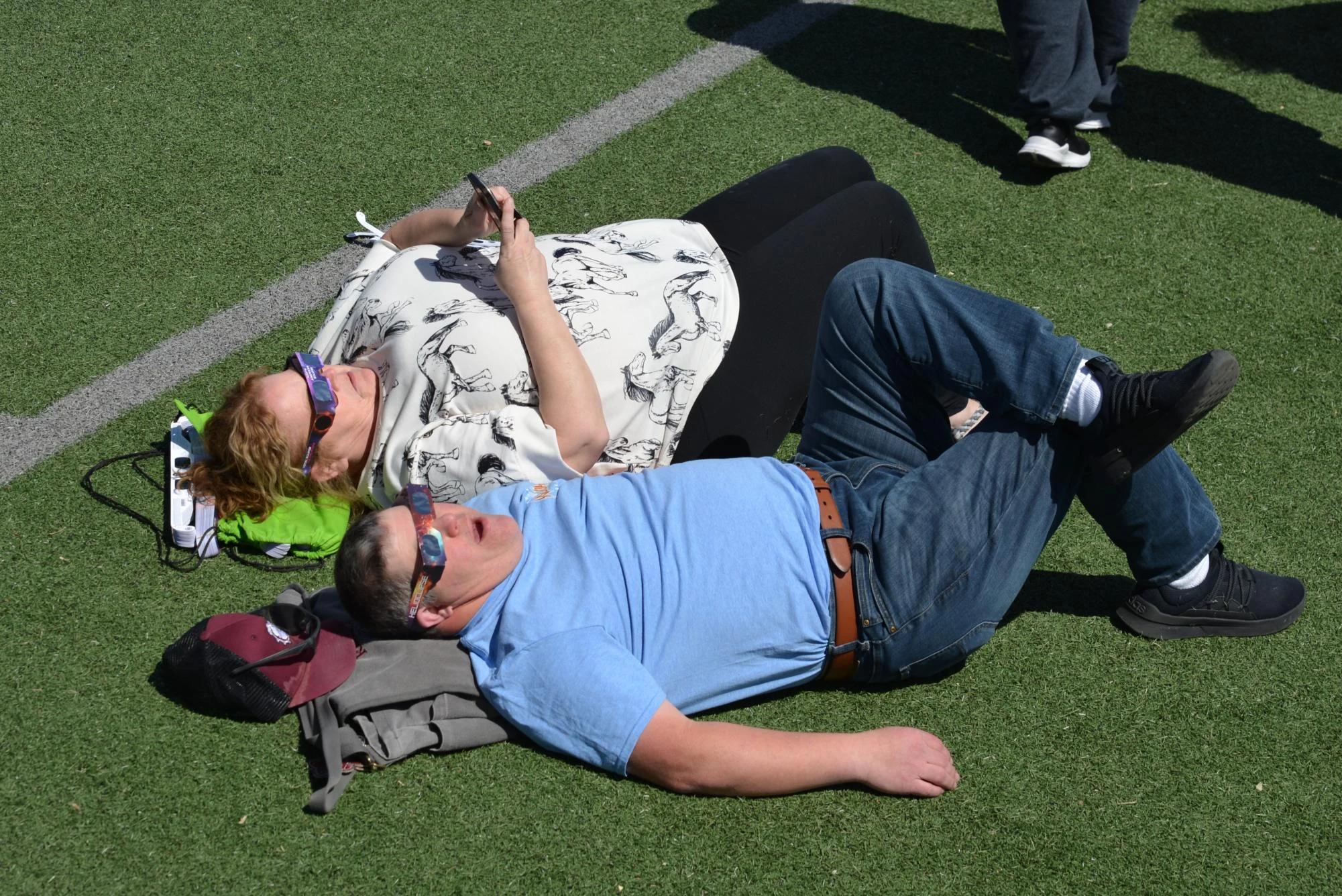
Solar observing and night-sky observing require different habits. During every partial phase, use special-purpose viewers that conform to ISO 12312-2. At the end of totality, viewers go back on as soon as the bright solar surface reappears. If the Sun sets while still partially eclipsed, keep using them for every direct look until the entire solar disk is below the horizon.
Binoculars, telescopes and cameras need securely mounted solar filters over the front of their optics whenever they are aimed at the visible Sun. Wearing eclipse glasses while looking through an unfiltered optical instrument is not safe: concentrated sunlight can damage the filter and your eyes. Read our guide to when eclipse glasses go on and come off before the event, not while totality is approaching.
Once the Sun has fully set, ordinary night-sky rules take over. Remove solar filters before trying to observe stars or planets with equipment that is designed for normal nighttime use; a proper solar filter blocks so much light that the night sky will appear black. Use a dim red light, lower phone brightness and avoid shining car headlights across other observers.
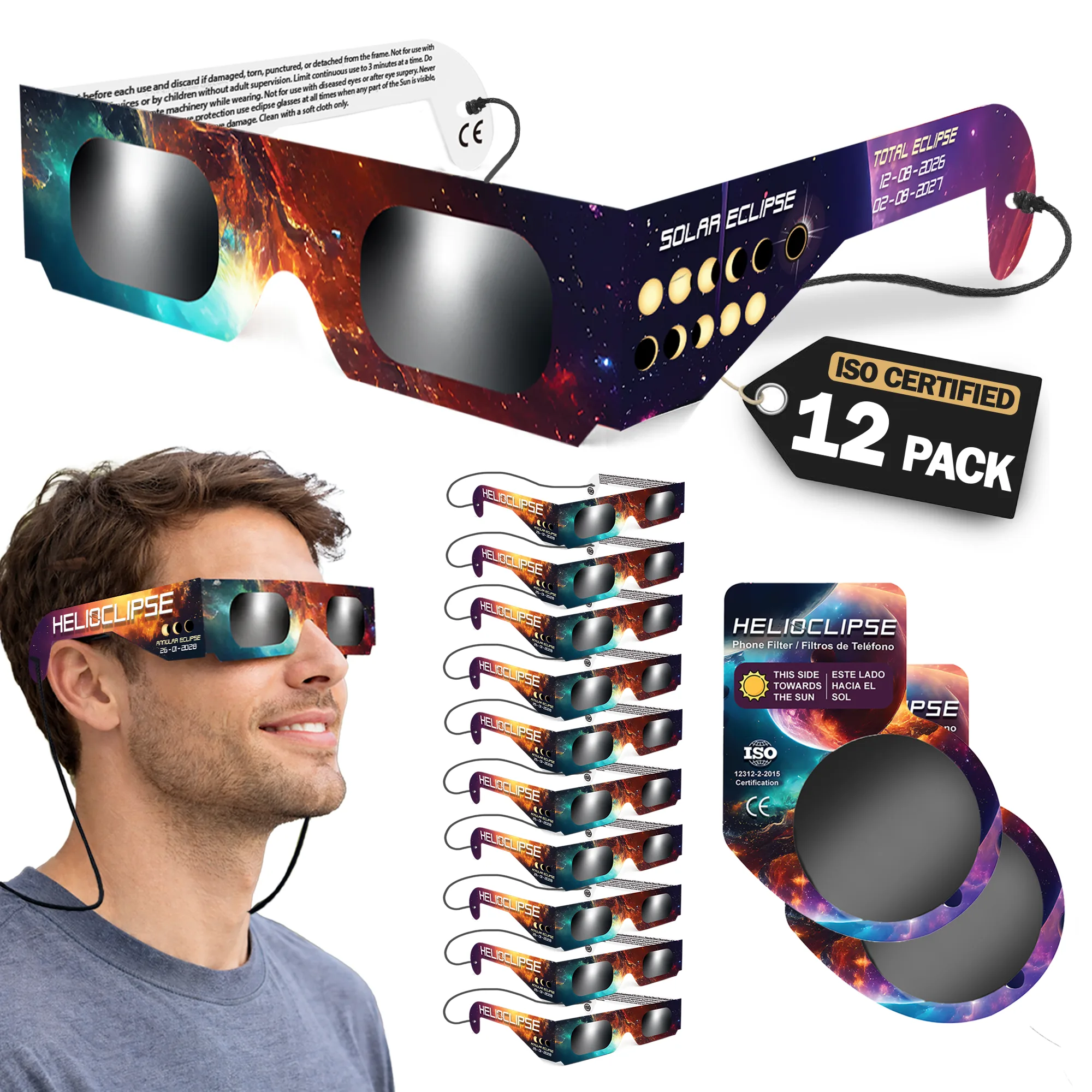
Shopping language can be confusing. Phrases such as approved solar eclipse glasses and eclipse glasses nasa approved do not describe a NASA retail certification program; NASA does not approve individual consumer products. What matters is credible conformity information for ISO 12312-2, clear instructions and an undamaged filter. If you need solar eclipse glasses iso 12312-2 certified for your family or group, review the details on the Helioclipse solar eclipse glasses page and order early enough to inspect and distribute them before eclipse day.
For the later meteor session, pack warm clothing, water, food, a reclining chair or mat, a red light and a charged phone or power bank. Tell someone where your group will be, especially if you move to a rural site. No planet or meteor is worth driving while exhausted after a long, emotional day.
Protect the memory by leaving room to rest
An eclipse day can begin before breakfast and involve hours of weather checks, travel, setup and intense concentration. After totality, adrenaline can disguise fatigue. Build a quiet interval into the schedule rather than treating sunset, Venus and the Perseids as compulsory checkpoints.
Families may get more from ten calm minutes watching Venus than from keeping tired children awake until 2 a.m. Drivers should sleep or hand over the keys. Photographers should back up irreplaceable files before carrying equipment into a dark field. If your observing site becomes congested, let the first traffic surge clear before moving.
Make a shared priority list in advance: totality first, safe completion of the partial phase second, food and rest third, then Venus or meteors if conditions allow. The night is richer when nobody feels they have failed because clouds hid one object.
Frequently asked questions
Where will the August 12, 2026 total solar eclipse be visible?
The excerpt highlights viewing locations in Spain, Iceland, and Greenland. It gives local timing examples for León, Valencia, Zaragoza, Reykjavík, and the Snæfellsjökull area, showing that the experience will vary substantially by location.
Which planets can I realistically look for after the eclipse on the same evening?
Venus is identified as the most credible planetary target in the evening twilight. The article does not promise several visible planets, so use a location-specific sunset time and planetary ephemeris to assess your viewing site.
Will planets be visible tonight once the eclipse is over?
That depends on your location, the timing of sunset, and how quickly twilight deepens. For August 12, 2026, Venus is the most credible evening-twilight target, while a nearly moonless night may also support Perseid meteor watching.
What do published local eclipse timings show about the evening after totality?
Published local circumstances illustrate that Spain may move from totality toward sunset within minutes, while Iceland has much longer summer twilight. In some Spanish locations, sunset occurs before the partial eclipse has ended, so observers should keep using certified solar viewers until the Sun is fully safe to view without them.
Is there both a solar and lunar eclipse in August 2026?
The excerpt discusses the total solar eclipse on August 12, 2026, but it does not provide information about a lunar eclipse that month. It notes that the night after the solar eclipse will be nearly moonless and coincide with the Perseid meteor shower peak.
On-site next steps
- Explore your exact path position, horizon direction and eclipse timing with the Helioclipse Eclipse Explorer.
- Visit the Helioclipse blog and guide hub for more on eclipse phenomena, weather decisions and what planets may appear during totality.
- If your group still needs viewers for the partial phases, check our ISO 12312-2 certified eclipse glasses early and inspect every viewer before use.
- Save a location-specific sunset, twilight and planetary chart offline. Mobile coverage may be unreliable at crowded or remote observing sites.
Sources & further reading
- What’s Up: August 2026 Skywatching Tips from NASA
- Total Solar Eclipse on August 12, 2026 — NASA Science
- What time is the total solar eclipse on Aug. 12, 2026? — Space.com
- 13 amazing things to see during the total solar eclipse on Aug. 12 — Space.com
- Night sky highlights — August 2026 — Royal Museums Greenwich
- How to View a Solar Eclipse Safely — American Astronomical Society
- Phenomena You’ll Experience at a Total or Annular Eclipse — American Astronomical Society
- Solar Filters for Optics: Telescopes, Binoculars & Cameras — American Astronomical Society
- Eclipses — NASA Science
- Suppliers of Safe Solar Viewers & Filters — American Astronomical Society