Corona, diamond ring, and Baily’s beads: what you’ll see in 2026 (and why it matters)
For a few seconds on August 12, 2026, the Sun appeared to wear jewelry. Points of intense sunlight broke apart along the Moon’s edge, one final point formed a brilliant diamond, and then the light vanished. In its place was the solar corona: a pale, structured atmosphere surrounding a black lunar silhouette.
Observers inside the path of totality across Greenland, Iceland, northern Spain, and parts of the Balearic Islands witnessed that sequence. Most people elsewhere saw a partial eclipse—and no corona or true diamond-ring transition. That distinction is the heart of any useful total solar eclipse corona diamond ring 2026 guide: 99% coverage is still not totality.
Although the August 12 event has now passed, understanding the sequence makes photographs and recordings far more meaningful—and prepares you for the next total eclipse. You can use our Eclipse Explorer to compare locations, see which ones entered the Moon’s umbra, and understand why the experience changed sharply across the path boundary.
The shorthand diamond ring eclipse 2026 may focus attention on one spectacular instant, but the ring was only the threshold. The corona during totality was the deeper prize.
What makes an eclipse total?
What is a total solar eclipse in physical terms? It happens when the new Moon passes directly between Earth and the Sun and appears large enough to cover the Sun’s visible surface, or photosphere. The Sun is roughly 400 times wider than the Moon but also roughly 400 times farther from Earth, so the two disks can appear nearly equal in size.
That apparent match is close, not exact. The Moon’s orbit is elliptical, as is Earth’s orbit around the Sun, so the apparent sizes of both bodies vary. On August 12, 2026, the Moon was large enough in our sky to hide the photosphere completely along a narrow moving track. NASA reported that the longest totality available from the ground was about 2 minutes 18 seconds.
Inside that track, an observer entered the Moon’s dark central shadow—the umbra—and could see totality. Outside it, the lighter penumbra covered only part of the Sun. That produced a partial solar eclipse 2026 experience, even where the remaining solar crescent became extremely thin.
This is not a minor technical distinction. A tiny exposed piece of photosphere remains dazzlingly bright. It keeps the corona hidden, prevents true totality, and means certified solar viewers must stay on. Our 2026 planning guide explains how path position, timing, horizon clearance, and weather combined on eclipse day.
Baily’s beads: sunlight through lunar valleys
The Moon looks like a clean circle from Earth, but its edge is made of mountains, crater rims, and valleys. In the final seconds before totality, the broad solar crescent narrowed until direct sunlight could reach observers only through some of those lunar valleys. The result was a broken chain of brilliant points called Baily’s beads.
Each bead was real photospheric sunlight passing through a different gap along the Moon’s rugged limb. As the alignment changed, valleys were covered one by one and the beads disappeared. Immediately after totality, the process ran in reverse on the opposite edge: the first sunlight returned through lunar valleys, followed by additional beads and then an expanding crescent.
The effect is named for English astronomer Francis Baily, who gave a prominent description of it after an annular eclipse in 1836, although observers had recorded comparable effects earlier. Today, detailed lunar topography lets astronomers predict the locations and approximate timing of individual beads much more accurately.
The compressed phrase corona beads eclipse can blur two different phenomena. The beads are direct sunlight from the photosphere. The corona is the Sun’s much fainter outer atmosphere. They can appear close together in time and in photographs, but they have different physical origins. The informal wording corona beads should not be mistaken for a separate solar structure.
The diamond ring is the final bead plus the corona
As the beads dwindled, one particularly bright point of photospheric light could remain beside the emerging inner corona. Together they resembled a gemstone set on a pale circular band: the diamond ring eclipse effect.
There was no physical ring surrounding the Moon. The “diamond” was direct sunlight shining through or past a low section of the lunar limb. The “ring” was primarily the inner solar corona becoming visible around the Moon’s silhouette. It was therefore a product of extreme contrast, precise alignment, and the Moon’s uneven terrain—not a permanent object in the solar atmosphere.
A true total solar eclipse corona diamond ring transition occurs twice. The first diamond ring announces the beginning of totality as the last photospheric light disappears at second contact. The second erupts at third contact when direct sunlight returns and totality ends. In ordinary language, corona diamond ring eclipse, diamond corona eclipse, and corona diamond ring solar eclipse all point toward this same boundary phenomenon, but “diamond-ring effect” is the clearest astronomical term.
Photographs can make the ring look stable because an exposure freezes an instant. To an unaided observer, it is startlingly brief. The second diamond ring can feel especially abrupt: one moment the corona hangs in a deep twilight sky; the next, a concentrated point of sunlight breaks through and daylight begins returning.
Why the corona is the real revelation
The Sun’s photosphere is the bright layer we normally call its surface. It is so luminous that scattered light in Earth’s atmosphere overwhelms the much fainter corona. Blocking 90%, 99%, or even 99.9% of the photosphere does not reproduce the visual conditions of totality. The final exposed sliver still dominates.
During totality, the Moon acts like a natural occulting disk and removes that glare. The corona then appears as a pearly halo with streamers, plumes, loops, and fine radial structure shaped by the Sun’s magnetic field. Its form changes with solar activity, which is why every total eclipse presents a different corona.
The temperature contrast is one of solar physics’ enduring puzzles. The photosphere is roughly 5,500°C, while parts of the corona reach temperatures of around a million degrees or more. Researchers investigate how magnetic fields and waves transfer energy into this sparse outer atmosphere. Eclipses provide a rare view of the low and middle corona, including regions that can be difficult to observe from either ground-based coronagraphs or spacecraft.
NASA used the 2026 eclipse for observations from a WB-57 aircraft flying at about 50,000 feet. Its cameras were designed to capture at least 20 images per second in multiple visible and infrared wavelengths. Flying at approximately 460 mph along the shadow extended the aircraft’s coronal observing time to nearly three minutes, compared with the ground maximum of 2 minutes 18 seconds.
That scientific work is why a total solar eclipse corona diamond ring is more than a beautiful composition. The disappearing photosphere exposes magnetic structures connected to the solar wind, prominences, and eruptions that can eventually affect satellites, communications, power systems, and astronauts.
The full sequence around totality
The best way to understand the spectacle is as a rapid sequence rather than a collection of isolated effects.
In the final minutes before totality
The Sun became a narrowing crescent, still visible only through proper solar viewers. Ambient light took on a silvery, low-contrast character. Shadows sharpened because the thin solar crescent behaved more like a narrow light source than the usual broad disk.
Small gaps between leaves projected crescent Suns onto the ground. Close to totality, faint shadow bands could ripple across pale surfaces as atmospheric turbulence distorted light from the extremely thin crescent. They were not guaranteed, but Spain’s low solar altitude made them a particularly interesting target in 2026.
In the final seconds
Baily’s beads appeared and vanished along the Moon’s advancing edge. The remaining light concentrated into the first diamond ring. Once the final direct photospheric point disappeared completely, totality began.
During totality
The corona surrounded the Moon’s black disk. A thin crimson arc of chromosphere could briefly appear near the lunar edge, while prominences might look like pink or red loops extending outward. Bright planets could become visible, and the horizon could develop a sunset-like glow in several directions because locations beyond the umbra still received sunlight.
At the end
Red chromospheric light and prominences emerged on the opposite side. Then the first point of photospheric sunlight created the second diamond ring. Solar viewers had to go back on immediately. More Baily’s beads followed, merged into a crescent, and the long partial phase continued.
Our phase-by-phase guide explains when glasses stay on and when they can come off without asking a first-time observer to improvise during the fastest part of the event.
What observers experienced along the 2026 path
The path on August 12, 2026 crossed remote parts of Greenland, western Iceland, the Atlantic, northern Spain, and the western Mediterranean. The geometry and local setting changed dramatically along that route.
Near Reykjavík in Iceland, totality occurred in the late afternoon, with the Sun higher than it was later along the track in Spain. In northern Spain—including areas around A Coruña, Oviedo, and Zaragoza—the eclipse unfolded in the evening. Approximate totality varied by location, generally on the order of a minute to nearly two minutes in favorable parts of the path; exact duration depended on distance from the centerline.
Farther east, locations including Palma on Mallorca encountered totality with the Sun very low toward the western horizon. The low altitude created a visually striking prospect but also made a clear sightline essential: a ridge, building, tree line, or marine haze could hide the Sun even if the sky overhead was blue. City-specific circumstances should always be checked rather than inferred from a national path map.
Madrid remained outside the umbra and experienced a deep partial eclipse. That meant no total phase, no safe glasses-off interval, and no naked-eye corona. This contrast is why “almost total” is not an adequate substitute for standing inside the path. Even within the path, observers near an edge received less totality than those nearer its middle, though an edge position could change the appearance and duration of Baily’s beads.
There was no total solar eclipse 2025 anywhere on Earth; 2025 brought partial solar eclipses instead. After the 2026 event, the total solar eclipse 2027 on August 2 became the next major opportunity, with a much longer maximum totality across parts of North Africa and the Middle East. Different geometry means a different corona, different bead pattern, and a very different observing environment.
Safety at the threshold of totality
The diamond ring is beautiful precisely because direct photospheric sunlight is still present or has just returned. Treat that concentrated point as the Sun, not as a dim decorative feature.
For a simple, conservative rule, keep ISO 12312-2 solar viewers on throughout every partial phase. Remove them only if you are inside the path of totality and the last direct glimmer of photospheric sunlight has completely disappeared. As soon as the first bright point returns, put the viewers back on. If you are outside totality, if the eclipse is annular, or if you are uncertain whether totality has begun, the viewers stay on.
Ordinary sunglasses are not sufficient, regardless of how dark they appear. ISO 12312-2 concerns filters intended for direct, unmagnified observation of the Sun; it is not simply a marketing synonym for dark lenses. Inspect every viewer for tears, punctures, scratches, or loose filter material before use, and supervise children.
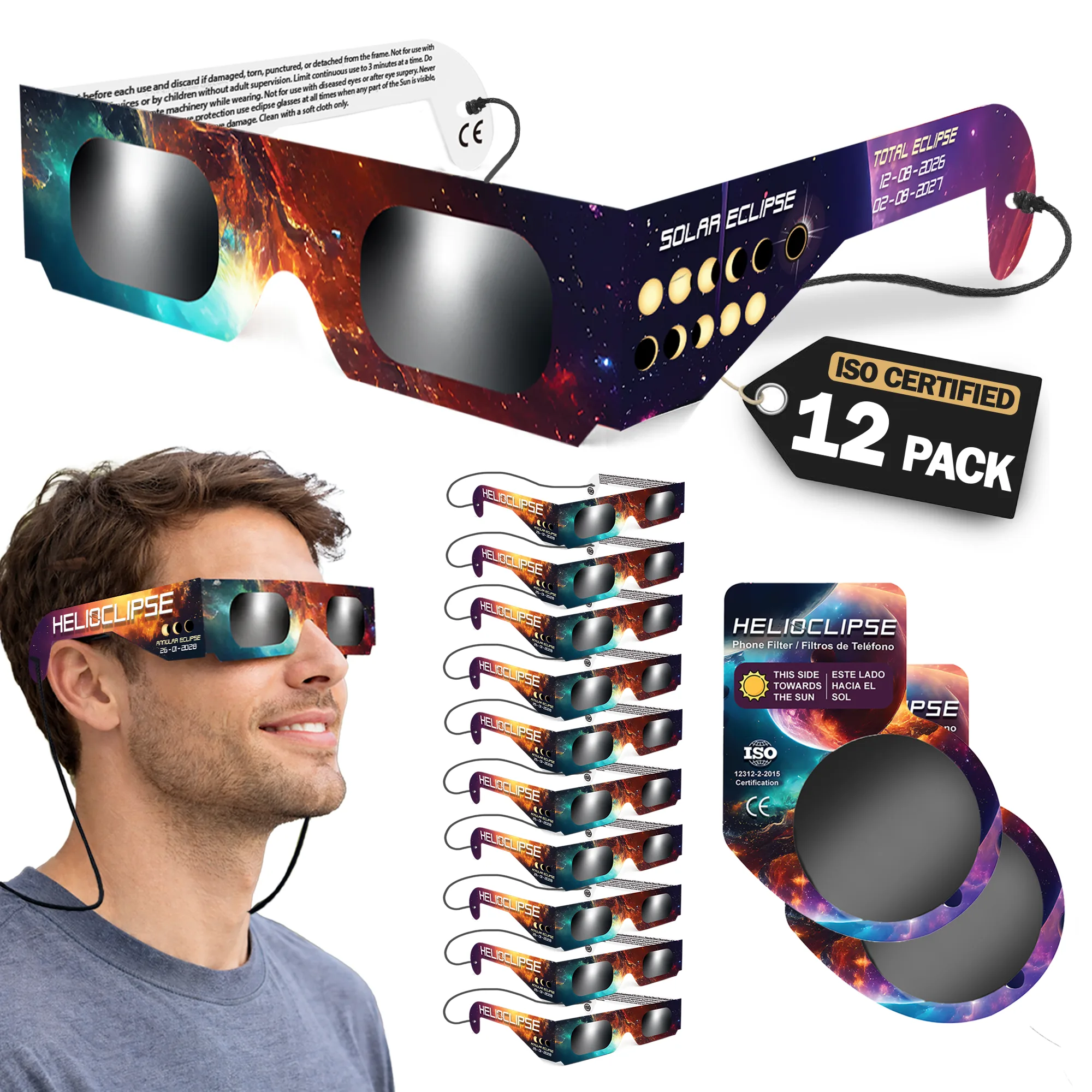
When product listings use phrases such as solar eclipse glasses iso 12312-2 certified, eclipse viewing glasses, or certified solar eclipse glasses, check the manufacturer information, instructions, condition, and credible evidence behind the standards claim rather than trusting the wording alone. NASA does not approve commercial eclipse glasses, so “NASA approved” language should be treated as a warning sign rather than an official endorsement. Helioclipse offers ISO 12312-2 certified solar viewers for direct, unmagnified viewing of the partial phases.
Cameras, binoculars, and telescopes require a different setup. A proper solar filter must be securely mounted over the front aperture of the instrument before it is aimed at the partially eclipsed or uneclipsed Sun. Eclipse glasses worn over your eyes do not make it safe to look through unfiltered magnifying optics; concentrated sunlight can damage the viewer and your eyes.
Looking at eclipse photographs without losing the physics
The total solar eclipse 2024 diamond ring images from North America are useful comparisons because they show the same basic sequence under a different solar and lunar geometry. The positions of the beads differ from one eclipse to another, and the corona evolves as the Sun’s magnetic field changes. A photograph is therefore both an artwork and a time-specific scientific record.
When reviewing solar eclipse photos 2026, look first at exposure. A short exposure may preserve the diamond and inner corona but hide faint outer streamers. A longer exposure can reveal an extensive corona while overexposing the bright bead into a large white flare. Composite images may combine several exposures to represent a wider brightness range than one camera frame can capture.
That is also why the phrase diamond ring eclipse can produce pictures that look unlike one another. Lens flare, diffraction spikes, sensor blooming, cloud, exposure length, and image processing all alter the apparent size and shape of the “diamond.” The underlying event remains a final or first patch of photosphere seen beside the corona.
A camera plan should never compete with the experience. For totality lasting around a minute, spending 20 seconds changing settings consumes a large fraction of the event. Set equipment in advance, automate a sequence if you can do so safely, and reserve time to look at the corona with your own eyes.
Why the distinction matters
Baily’s beads reveal that the Moon is a world with topography, not a flat cutout. The diamond ring marks the moment when one layer of the Sun stops dominating our vision and another becomes visible. The corona exposes a magnetic atmosphere whose extreme temperature and changing structure remain active fields of research.
Together, these effects turn an alignment diagram into something physical. You see mountains on the Moon indirectly through transmitted sunlight. You watch a million-degree atmosphere appear when the photosphere is hidden. You experience the edge of a shadow moving across Earth.
The common phrase diamond corona eclipse captures the spectacle but not the causal order: lunar valleys make the bead, the photosphere supplies its light, and the corona supplies the setting. Once you know that, the transition is no longer merely pretty. It becomes a compact demonstration of optics, topography, orbital geometry, and solar physics.
Frequently asked questions
What creates the diamond-ring appearance at the start or end of totality?
The diamond-ring appearance occurs when a final intense point of sunlight remains along the Moon’s edge just before the photosphere is fully covered, or reappears as totality ends. It marks the transition into or out of totality, when the corona becomes visible around the black lunar silhouette.
Why does the Sun briefly look like it has a bright jewel on its edge during an eclipse?
The effect comes from intense sunlight breaking into points along the uneven edge of the Moon, which includes mountains, crater rims, and valleys. One final bright point can form the apparent “diamond” immediately before the light vanishes at totality.
Was the 2026 event a Ring of Fire eclipse, and how often do those occur?
No. The excerpt describes August 12, 2026 as a total solar eclipse, in which the Moon completely covered the Sun’s visible surface along a narrow track. It does not provide information about how often Ring of Fire eclipses occur.
Where could observers see the full transition in 2026?
The full totality sequence, including the corona and the true diamond-ring transition, was visible only within the path of totality across Greenland, Iceland, northern Spain, and parts of the Balearic Islands. Observers outside the Moon’s umbra saw a partial eclipse and did not see the corona or a true diamond-ring transition.
Can a nearly total partial eclipse produce the same diamond-ring effect?
No. Even 99% coverage is not totality: a small exposed portion of the Sun’s photosphere remains bright enough to hide the corona and prevent the true transition. Certified solar viewers must remain on during a partial eclipse.
On-site next steps
- Explore the August 12, 2026 path—or start planning for a future event—with the Helioclipse 3D eclipse map. Check whether a site is inside totality, its distance from the centerline, the duration, local contact times, and the Sun’s altitude and direction.
- Prepare certified viewers for every observer, especially children and first-time viewers. Our eclipse glasses shop offers Helioclipse viewers for the partial phases before and after totality.
- Agree on the safety sequence with your group before eclipse day: viewers on for partial phases, off only after the photosphere has completely vanished during totality, and back on the instant direct sunlight returns.
Sources & further reading
- What to Expect: A Solar Eclipse Guide — NASA Science
- How to See the Diamond Ring Effect During a Total Solar Eclipse — Sky & Telescope
- 13 Amazing Things to See During the Total Solar Eclipse on Aug. 12 — Space.com
- NASA Science Soars During August Total Solar Eclipse — NASA Science
- Baily’s Beads — NASA Science
- Phenomena You’ll Experience at a Total or Annular Eclipse — American Astronomical Society
- A Solar Eclipse Glossary — American Astronomical Society
- How to View a Solar Eclipse Safely — American Astronomical Society
- About the ISO 12312-2 Standard for Solar Viewers — American Astronomical Society
- Why Do Eclipses Happen? — NASA Science