Wrong eclipse, right excitement: what lunar eclipses teach—and do not teach—about August 2026
Two eclipses arrive in August 2026, just over two weeks apart. On August 12, the Moon will pass in front of the Sun and create a total solar eclipse along a narrow path crossing Greenland, western Iceland, and northern Spain. On August 27–28, Earth’s shadow will cover about 96% of the Moon in a deep partial lunar eclipse visible from much of the Americas and parts of Europe and Africa.
That pairing makes the lunar eclipse and solar eclipse in 2026 a wonderfully clear lesson in celestial geometry—but also an easy source of confusion. Both events involve the Sun, Earth, and Moon lining up. They do not look alike, cover the same territory, happen at the same time of day, or follow the same eye-safety rules.
Think of this as our lunar eclipse vs solar eclipse difference 2026 guide: a beginner-friendly way to understand what each event can teach you before August 12. Once the distinction is clear, use the Helioclipse Eclipse Explorer to check whether your actual location is inside the path of totality or in the much larger partial-eclipse zone.
The shortest useful explanation
The lunar eclipse vs solar eclipse difference comes down to which world is in the middle and where the shadow lands.
- Solar eclipse: Sun → Moon → Earth. The Moon blocks some or all of the Sun, and the Moon’s shadow falls on Earth.
- Lunar eclipse: Sun → Earth → Moon. Earth blocks direct sunlight from reaching the Moon, and Earth’s shadow falls across the lunar surface.
A simple memory aid is to name the object that appears eclipsed. During a solar eclipse, the Sun appears partly or completely covered. During a lunar eclipse, the Moon darkens.
This solar eclipse vs lunar eclipse distinction also determines the lunar phase. A solar eclipse can happen only at new Moon, when the Moon lies in roughly the same direction as the Sun. A lunar eclipse can happen only at full Moon, when the Moon is opposite the Sun in our sky.
The alignment is not exact every month because the Moon’s orbit is tilted by about 5 degrees relative to Earth’s orbital plane. Most new Moons pass above or below the Sun from our perspective, while most full Moons pass above or below Earth’s shadow. Eclipses occur only when the Moon is near one of the crossing points of those two planes during an eclipse season.
Two August events, two completely different experiences
The August 12, 2026 solar eclipse is the headline event. Its path of totality will cross parts of Greenland, western Iceland, northern Spain, and a small area near Portugal. The maximum possible totality anywhere along the path is about 2 minutes 18 seconds. Outside that narrow moving shadow, observers across a broad part of Europe and neighboring regions will see a partial solar eclipse instead.
The experience changes sharply with location. Reykjavík is expected to receive roughly 1 minute 1 second of totality, while the Snæfellsnes area can approach 2 minutes 10 seconds. In Spain, published estimates include about 1 minute 46 seconds at Gijón and 1 minute 44 seconds at Burgos. Madrid, by contrast, remains outside totality even though approximately 99.96% of the Sun’s disk may be covered at maximum. That tiny remaining sliver means the event there is still a partial eclipse, with no safe naked-eye phase.
Spain also presents a practical horizon problem. Totality occurs in the evening, with the Sun only about 8–12 degrees high at several mainland locations and lower still in the Balearic Islands. Mallorca’s eclipsed Sun may be only about 2.7 degrees above the west-northwestern horizon, so a hill, building, or bank of low cloud could hide it. Our August 12, 2026 planning guide explains why exact position and a clear western sightline matter as much as the country name.
The lunar event comes later. From 01:23 to 07:01 UTC on August 28, the Moon will move through Earth’s penumbral and umbral shadows, reaching maximum eclipse at approximately 04:12 UTC. Around 96.2% of the lunar disk will enter the dark umbra. It is therefore an exceptionally deep partial lunar eclipse, but not a total one: a narrow portion of the Moon will remain outside the umbra.
For anyone checking a lunar eclipse 2026 date and time, the two-date notation matters. The eclipse begins on the evening of August 27 in some North American time zones but falls on August 28 in UTC and across Europe. The geometry occurs simultaneously worldwide; local clocks and whether the Moon is above the horizon create the apparent date difference.

What the Moon will actually look like on August 27–28
A lunar eclipse unfolds slowly enough to watch as a family without a frantic countdown. First, the Moon enters Earth’s penumbra, the pale outer shadow. The initial dimming is subtle and may be difficult to detect. Then the curved edge of the darker umbra begins to cross the Moon, making Earth’s round shadow visible on another world.
Near maximum, almost the entire Moon will be inside the umbra. The shadowed area may look coppery, orange, brown, or muted red because some sunlight passes through Earth’s atmosphere before reaching the Moon. Blue light scatters more readily, while longer red and orange wavelengths are bent into the shadow—roughly the same atmospheric filtering that colors sunrises and sunsets.
This eclipse should not be described as a total “blood moon.” Roughly 3.8% of the lunar disk remains outside the umbra at maximum. That bright edge will produce a striking contrast with the darkened majority of the Moon, but lunar totality never begins.
Visibility is broad rather than confined to a narrow ground track. North and South America receive especially strong circumstances, while observers in parts of Europe see the eclipse low in the west near dawn. Maximum occurs at about 12:12 a.m. EDT, 11:12 p.m. CDT, 10:12 p.m. MDT, and 9:12 p.m. PDT. In London it corresponds to about 5:12 a.m. BST; in Madrid and Paris, about 6:12 a.m. CEST, with the Moon descending toward the horizon as morning twilight brightens.
The lunar eclipse vs solar eclipse dates are therefore not interchangeable entries for one event. August 12 is the solar eclipse; August 27–28 is the lunar eclipse. If a calendar alert merely says “August eclipse,” open it and verify which object is being eclipsed before making plans.
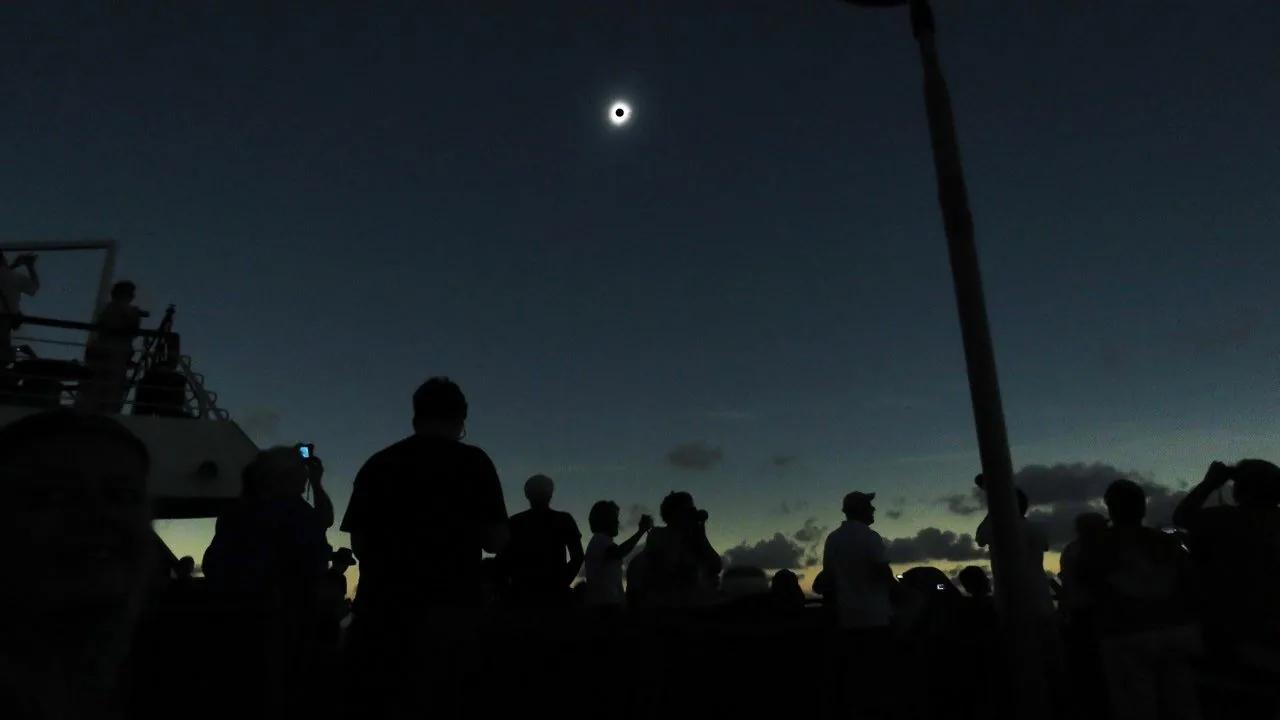
The safety rule that must not get lost
A lunar eclipse is safe to view directly throughout every phase. You can watch the Moon with your unaided eyes, ordinary binoculars, or a telescope. The Moon is reflecting sunlight as it normally does, and during the eclipse it becomes dimmer, not more hazardous. Children can look as long as they like, subject only to ordinary comfort and supervision around equipment or nighttime locations.
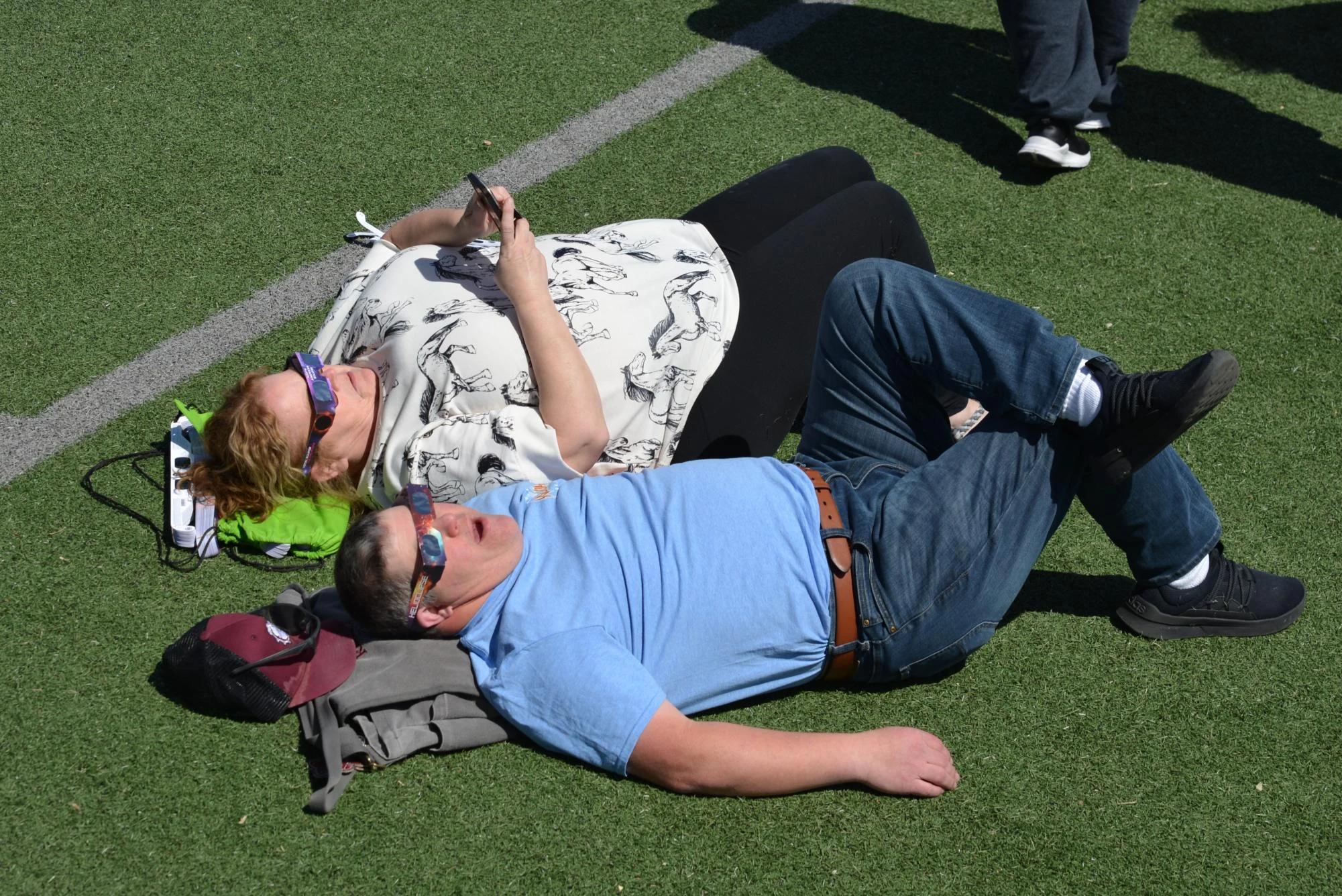
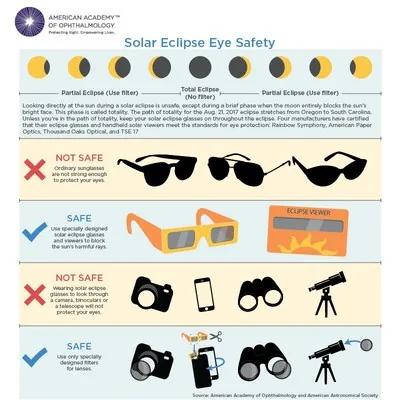
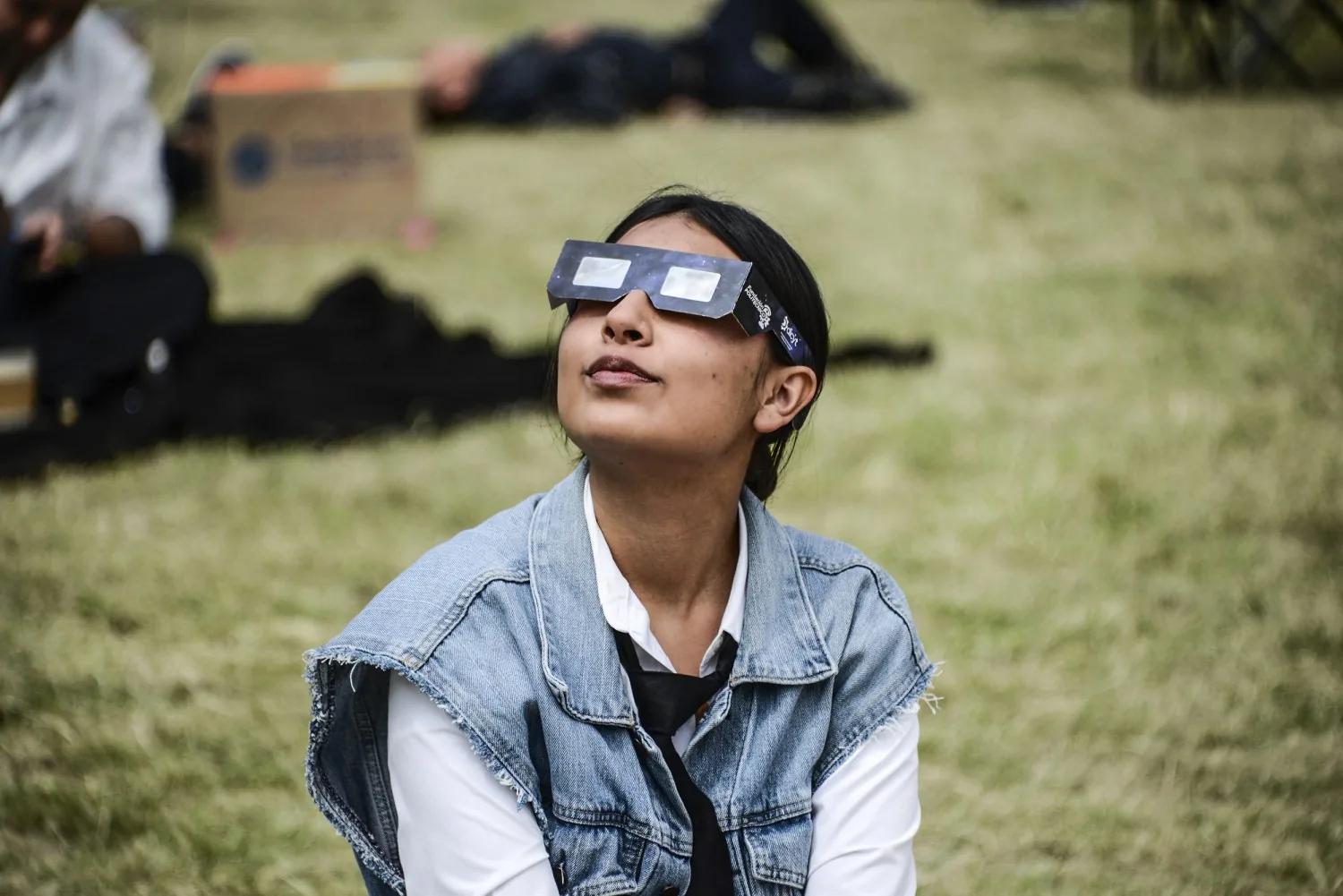
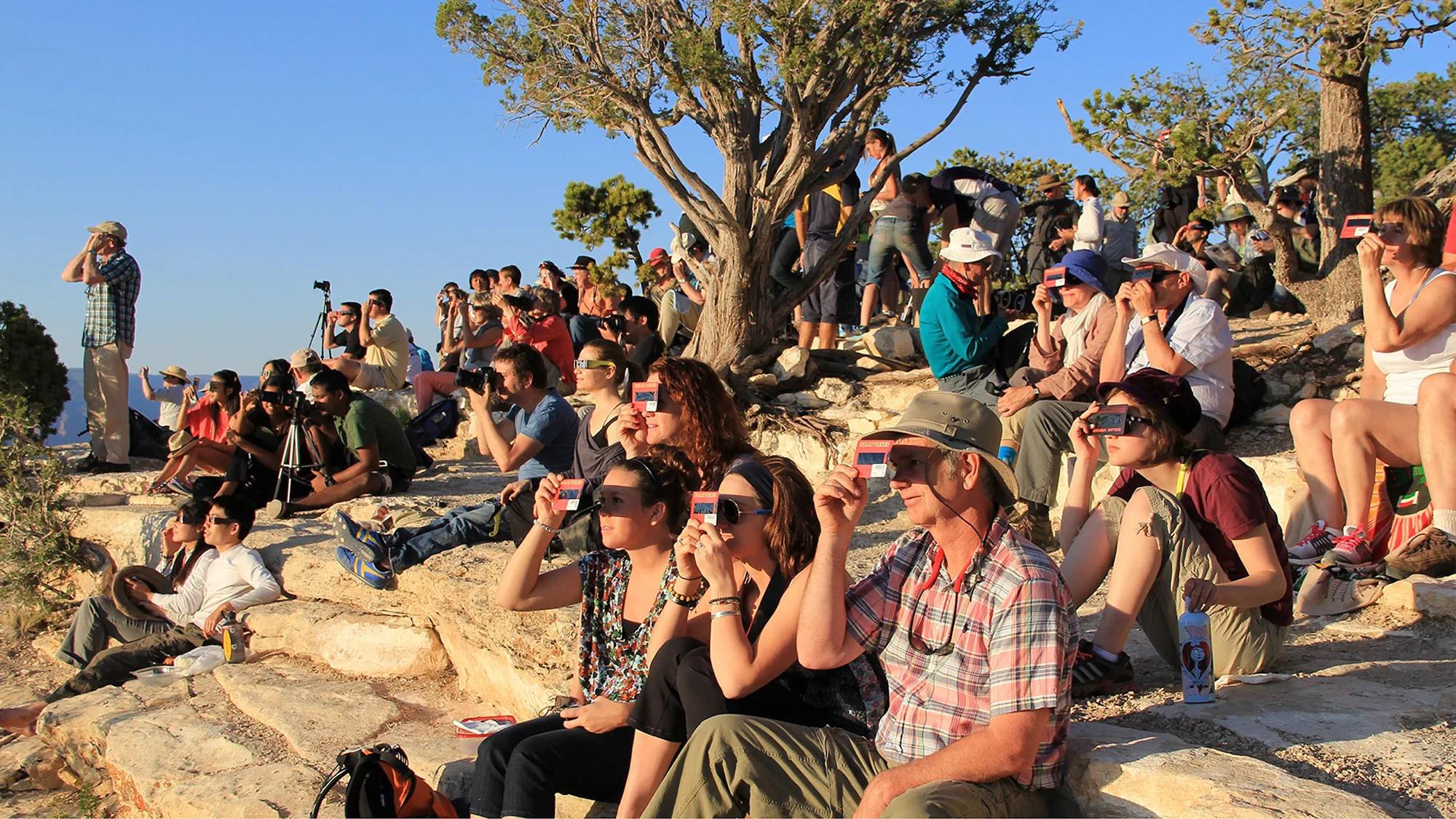
A solar eclipse requires the opposite default. During every partial phase, you must use special-purpose solar viewers that conform to ISO 12312-2, or use a safe indirect method such as pinhole projection. Ordinary sunglasses are not sufficient, regardless of how dark they appear.
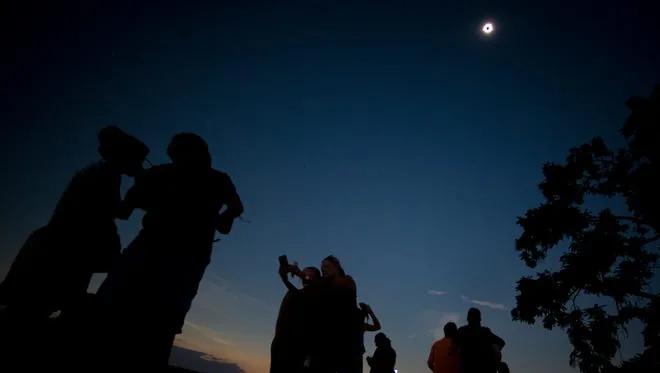
Only observers inside the path of totality may remove solar viewers, and only after the Moon has completely covered the Sun’s bright face. Viewers must go back on as soon as the first bright point of sunlight returns. Outside the path—including Madrid and other places with an extremely deep partial eclipse—there is no glasses-off moment. Our guide to eclipse phases and when to use solar glasses walks through that sequence carefully.
Cameras, binoculars, and telescopes introduce another risk: their lenses concentrate sunlight. Do not look through unfiltered optics while wearing eclipse glasses, and do not place ordinary eye-worn viewers over a camera or telescope eyepiece. Magnifying equipment needs a purpose-built solar filter secured over the front of the optics, with expert guidance if you are unsure.
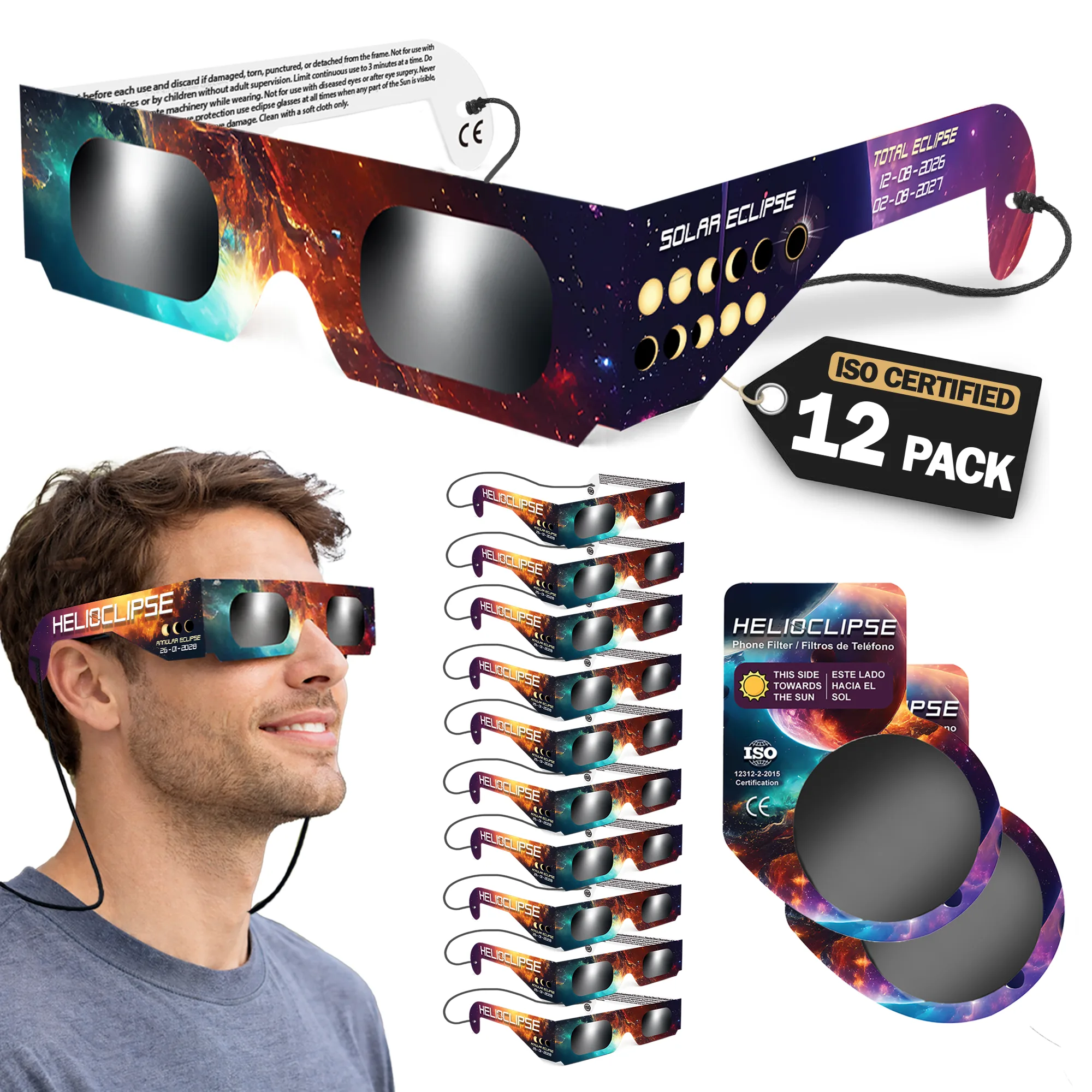
Product language can make this harder than it should be. Phrases such as approved solar eclipse glasses or eclipse viewing glasses do not, by themselves, identify who tested a viewer or what standard it meets. NASA does not approve commercial brands. When product wording says solar eclipse glasses iso 12312-2 certified, check the seller’s traceability, instructions, filter condition, and credible conformity information rather than treating a marketplace phrase as proof. You can review Helioclipse’s ISO 12312-2 eclipse viewers before your group’s solar observing day.
A diagram you can build with three people
A good solar eclipse vs lunar eclipse diagram needs only three labeled circles and two arrows showing the direction of sunlight. The order matters more than artistic detail.
For a solar eclipse, place the “Moon” person between the “Sun” and “Earth.” Use a flashlight as the Sun and a small ball as the Moon. When the ball’s compact shadow falls on a globe or wall, you can see why total solar eclipses are geographically selective: only a narrow region enters the darkest part of the Moon’s shadow.
For a lunar eclipse, put “Earth” in the middle. The flashlight shines past Earth, and the Moon moves into the larger shadow extending away from our planet. This lunar eclipse vs solar eclipse model immediately shows why many more people can share a lunar eclipse. Anyone on Earth’s nighttime side with the Moon above the horizon can potentially watch it, while solar totality belongs only to locations crossed by the Moon’s small umbral shadow.
There is one limitation. A tabletop model usually makes the Sun, Earth, Moon, distances, and shadows wildly out of scale. That is fine for teaching the order of the bodies, but not for predicting path width or duration. Real solar-eclipse circumstances depend on orbital distances, Earth’s curvature and rotation, and the observer’s exact coordinates.
A family and classroom explanation that stays accurate
For solar and lunar eclipse for kids activities, start with the shadow rather than a long vocabulary list. Ask two questions: Whose shadow is it? Where does that shadow land? If the Moon’s shadow lands on Earth, it is a solar eclipse. If Earth’s shadow lands on the Moon, it is a lunar eclipse.
A concise difference between solar eclipse and lunar eclipse for class 5 lesson can use three contrasts:
- Arrangement: the Moon is in the middle during a solar eclipse; Earth is in the middle during a lunar eclipse.
- Phase and visibility: solar eclipses happen at new Moon and totality follows a narrow path; lunar eclipses happen at full Moon and can be seen across much of Earth’s night side.
- Safety: the eclipsed Moon is safe to view directly, while the partially or annularly eclipsed Sun always requires proper solar protection.
One common misconception deserves special attention: a lunar eclipse is not the same thing as an ordinary new Moon. At new Moon, the illuminated half of the Moon faces mostly away from Earth; Earth’s shadow does not normally cause the darkness. During a lunar eclipse, the Moon is full and would ordinarily appear bright, but it passes into Earth’s shadow.
A second misconception is that a nearly total solar eclipse is visually or safely equivalent to totality. It is not. Even 99.96% coverage leaves direct sunlight visible. The corona does not emerge in the same way, the sky does not enter true totality, and certified solar viewers remain necessary.
What a lunar eclipse can teach you before August 12
The late-August lunar eclipse happens after the solar eclipse, so it cannot serve as a literal rehearsal for August 12. It can, however, reinforce the geometry you will use to understand future eclipse seasons: shadows have an umbra and penumbra, the Moon’s tilted orbit controls whether alignment occurs, and an observer’s horizon determines which phases are visible.
It also teaches patient observation. Rather than staring continuously, note the Moon every 10 or 15 minutes. Sketch the boundary of the shadow, photograph it at consistent exposure settings, or ask children when they first detect the penumbral dimming. Those habits—checking change over time and recording what you actually see—transfer well to safe solar observing.
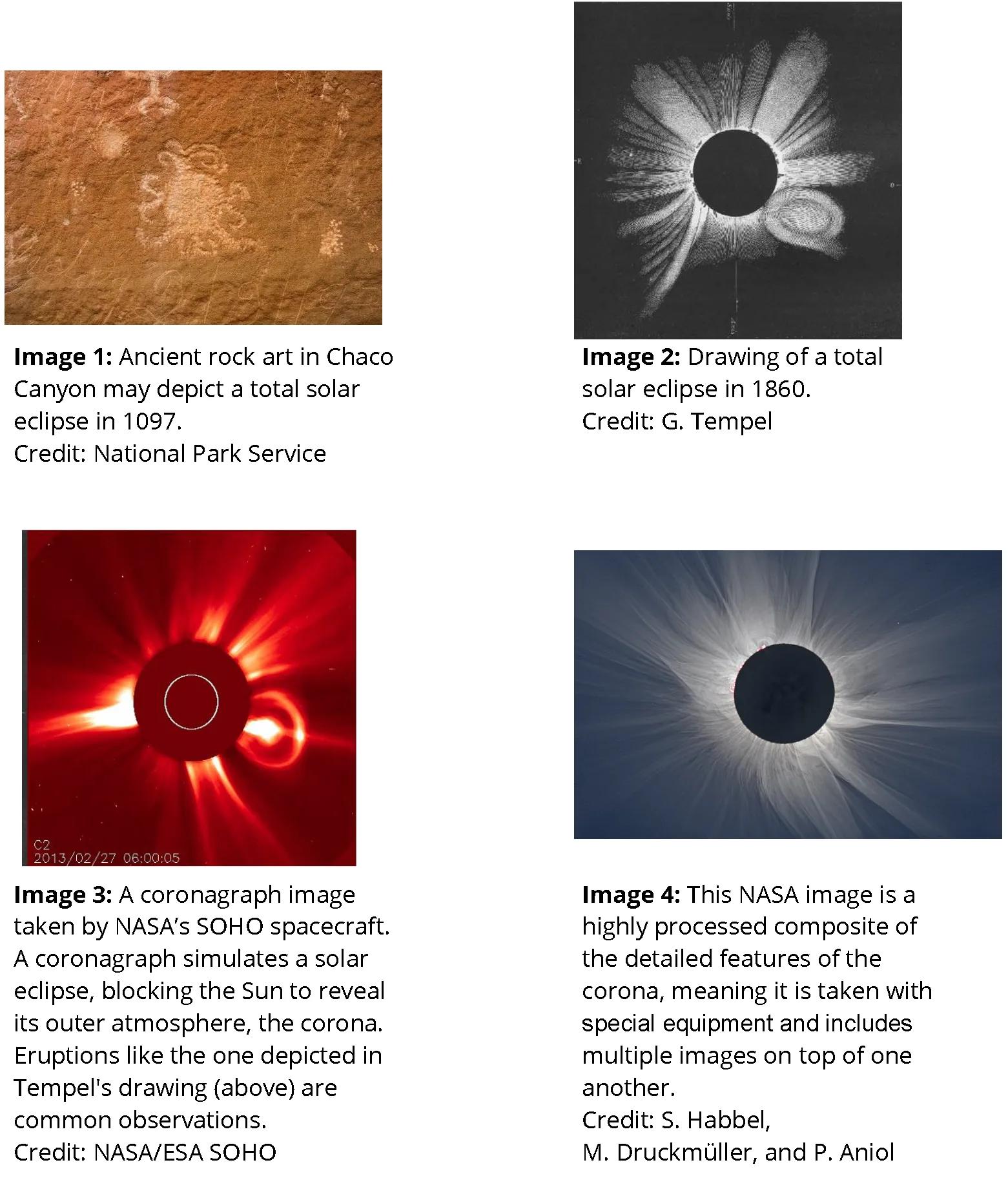
What it does not teach is how bright the Sun remains during a partial solar eclipse. Lunar practice cannot make an unfiltered glance at the Sun safe. It also cannot show you the environmental transformation of totality: the rapidly fading daylight, the dark silhouette of the Moon, and the solar corona becoming visible for a minute or two along the 2026 path.
A lunar eclipse vs solar eclipse comparison therefore should not ask which is “better.” A lunar eclipse is broad, slow, accessible, and safe to inspect directly. A total solar eclipse is geographically narrow, brief, and operationally demanding, but it reveals a part of the Sun that is normally hidden by the brilliant photosphere. They are different experiments performed by the same three worlds.
Why older eclipse labels can mislead
Dates attached to general explainers often outlive the event they were written for. A handout labeled lunar eclipse vs solar eclipse 2023 may still explain the geometry correctly, but its “next eclipse” details are obsolete. Keep durable science—the alignments, phases, and shadow terminology—separate from time-sensitive information such as contact times, visibility regions, weather, and local horizon height.
Likewise, a resource carrying the heading lunar eclipse solar eclipse difference may omit the most important practical distinction: safe lunar viewing does not imply safe solar viewing. Educational material should explicitly state the partial-solar rule rather than relying on a generic warning at the bottom of a page.
The same editorial test applies to any lunar eclipse vs solar eclipse difference table: does it distinguish total solar eclipse locations from partial ones, label times with a timezone, and say whether percentages refer to disk coverage or eclipse magnitude? If not, use it to understand the concept, not to make a travel or safety decision.
The most useful version of wrong eclipse, right excitement: what lunar eclipses teach—and do not is not a correction delivered with a scolding finger. Mixing up the names is normal. The goal is to turn that moment into better questions: What lines up? Which shadow reaches us? Is the event local or widespread? What protection does this particular observation require?
Lunar Eclipse 101 | National Geographic
National Geographic
Frequently asked questions
How should I prepare to watch the August 2026 lunar eclipse?
First, confirm whether the August 27–28 deep partial lunar eclipse is visible from your location; it will be visible from much of the Americas and parts of Europe and Africa. It will cover about 96% of the Moon, so plan to observe the darkening Moon rather than a daytime solar event.
Can children safely watch a lunar eclipse?
The excerpt distinguishes lunar and solar eclipses as events with different eye-safety rules, but it does not provide specific viewing guidance for children. A lunar eclipse is Earth’s shadow moving across the Moon, whereas a solar eclipse involves the Sun appearing partly or completely covered.
How can I explain the difference between a solar eclipse and a lunar eclipse to a child?
A solar eclipse happens when the Moon moves between the Sun and Earth, so the Sun appears partly or completely covered. A lunar eclipse happens when Earth moves between the Sun and Moon, so Earth’s shadow darkens the Moon.
What does a lunar-versus-solar eclipse guide help me understand before August 2026?
It helps you identify which object is being eclipsed, where the shadow falls, and why the two events look different. It also explains that solar eclipses occur at new Moon, while lunar eclipses occur at full Moon.
What are the two eclipses occurring in August 2026?
On August 12, a total solar eclipse will follow a narrow path across Greenland, western Iceland, and northern Spain, with partial views across a broader part of Europe and nearby regions. On August 27–28, a deep partial lunar eclipse will cover about 96% of the Moon and be visible from much of the Americas and parts of Europe and Africa.
On-site next steps
- Browse the Helioclipse blog and learning guides for clear explanations of eclipse phases, eye safety, weather, and 2026 planning.
- Explore your address in the Helioclipse Eclipse Explorer and check whether August 12 brings totality or only a partial eclipse. Look up the local maximum, Sun altitude, and western horizon direction rather than relying on a country-level map.
- If you will observe the solar eclipse, read our guide to ISO 12312-2 and eclipse viewers and organize safe viewers for your family, class, or friends ahead of time. No solar viewers are needed for the August 27–28 lunar eclipse.
Sources & further reading
- August 2026 lunar eclipse: Everything you need to know about the 96% “blood moon” — Space.com
- Total solar eclipse 2026 — Everything you need to know — Space.com
- What’s the difference between a solar eclipse and a lunar eclipse? — Space.com
- The next full Moon is a partial lunar eclipse, a supermoon, the Corn Moon, and the Harvest Moon — NASA Science
- Lunar Eclipses and Solar Eclipses — NASA Space Place
- Eclipses and the Moon — NASA Science
- Why Do Eclipses Happen? — NASA Science
- Eclipse Viewing Safety — NASA Science
- How to View a Solar Eclipse Safely — American Astronomical Society
- Eclipse Basics — American Astronomical Society