Low vision and blindness: heat, audio description, and what ‘experiencing’ an eclipse can mean
A solar eclipse changes more than the look of the sky. It can change temperature, wind, animal behavior, crowd energy, and the rhythm of a place for a few unforgettable minutes. That matters for everyone, including people who are blind or have low vision.
We want to start from a simple point: there is no single blind low vision solar eclipse experience. Some people want rich verbal description of the Sun, Moon, corona, and horizon colors. Some care more about the drop in heat on their skin, the hush or surge of a crowd, or the way birds and insects react. Some want tactile graphics, sonified data, or a radio-style play-by-play. Some do not want to be treated as a symbol for inspiration at all; they just want good access, good company, and accurate information.
If you are planning eclipse day with family, a school group, or friends, our Eclipse Explorer / 3D map can help you figure out whether your location is in totality or only a partial eclipse. That distinction shapes not just what the sky does, but what companions should describe, when sighted people need certified viewers, and how the whole event unfolds. For the safety basics, we also recommend our guide on when glasses are on and when glasses are off during eclipse phases.
An eclipse is not only something you look at
A lot of eclipse coverage still assumes that “the experience” means staring upward. That is too narrow. Astronomy itself is not purely visual: scientists routinely work with radio signals, sonified data, and tactile models. Inclusive astronomy outreach has been making this point for years, and eclipse projects have made it concrete.
NASA’s Eclipse Soundscapes project invited people to document multisensory observations during the 2024 eclipse, including changes in the environment that could be noticed without looking at the Sun at all. That framing matters. It says, correctly, that an eclipse can be experienced through your own senses, not only through a photograph or a sightline.
That is one reason the phrase blind low vision solar eclipse experience is worth treating seriously rather than as a curiosity. It is not about pretending vision does not matter in astronomy. It is about recognizing that a real celestial event also has tactile, thermal, acoustic, emotional, and social dimensions.
For some readers, this may sound obvious. For others, it may be a reset. Either way, respectful framing—some blind people engage eclipse culture eclipse planning in ways that are social, sensory, technical, and deeply informed. That is not a consolation prize. It is participation.
What companions and organizers often get wrong
The most common mistake is paternalism. It can show up as overhelping, talking around a blind person instead of to them, or saying something like, “You’re not missing much.” We should retire that immediately.
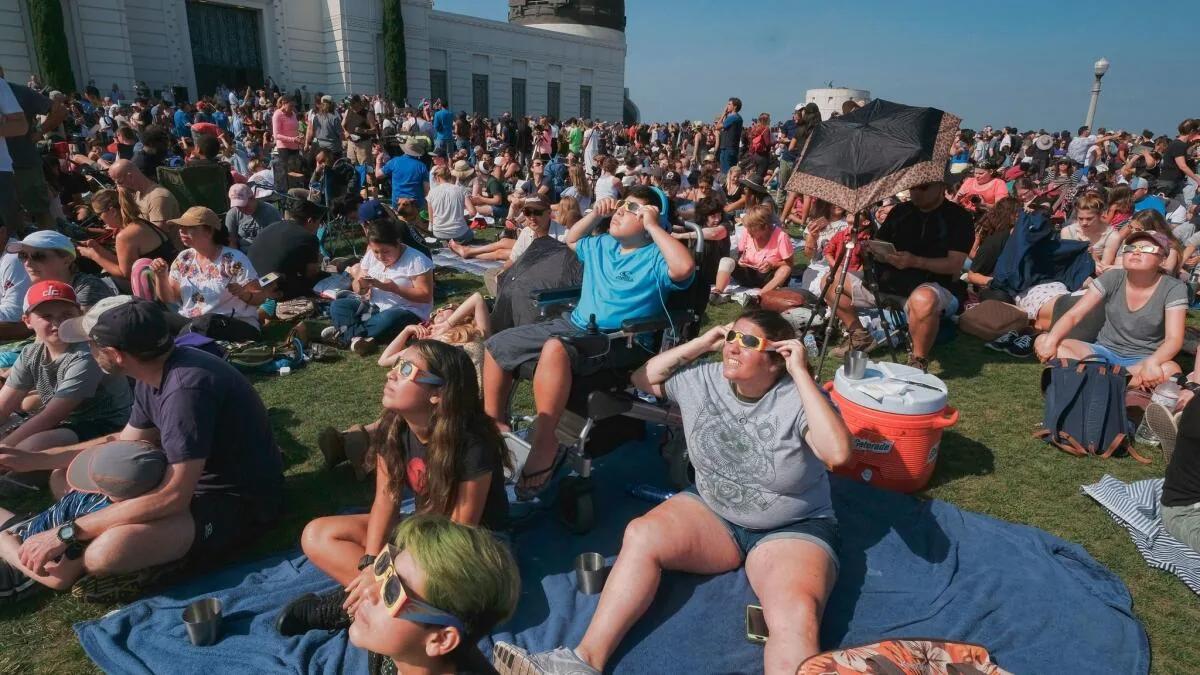
A total solar eclipse is a major environmental event. During totality, daylight can collapse into an eerie twilight. Temperature can drop noticeably. Wind may shift. Birds may quiet down; frogs or insects may start up. Crowds often move from chatter to countdown to a burst of emotion. Those are not trivial side effects. They are part of the event.
Another mistake is assuming one access method fits everyone. Some people want detailed, factual audio description: where the Moon is on the Sun, how much of the disk is covered, whether the corona looks like white streamers or a soft halo, whether planets are visible, whether the horizon glows orange in multiple directions. Others would rather have shorter cues and more room to listen.
A better question than “How can a blind person experience an eclipse?” is: “What kind of information would be useful to you, and when?” That is the difference between access and performance.
Audio description works best when it is specific, timed, and calm
If you are the sighted companion, your job is not to narrate every second in a dramatic voice. Your job is to help build a mental model.
Good eclipse description starts before first contact. Explain the setup: where you are, whether you are inside totality or outside it, what the weather is doing, where the Sun sits in the sky, and how long the key phases are expected to last. If you are in the path of totality, say roughly how long totality will last at your location. If you are outside it, say clearly that there will be no safe glasses-off moment because you are seeing only a partial eclipse.
Then describe change, not just objects. For example:
- “The Moon has taken a small bite from the Sun at the upper right.”
- “The light on the ground is getting stranger and less warm, but it is still bright.”
- “Shadows are sharpening.”
- “We are about one minute from totality; the sky still looks like day overhead, but the horizon is darkening.”
- “The last bright bead of sunlight is gone. The Sun is now a black disk with white streamers around it.”
This is also where the question what is audio description for blind people? deserves a practical answer. In this setting, audio description is not poetry pasted on top of science. It is accurate, well-timed verbal information that helps a listener understand what is changing, what matters, and what sighted people are reacting to.
The best descriptions usually follow a “facts first, interpretation second” rule. That approach echoes advice from blind accessibility consultants in astronomy outreach: give the observable details clearly, then add your emotional reaction if it helps. “The corona extends farther left and right than up and down” is more useful than “It looks magical,” though there is room for both.
Sound is not a gimmick here
Sonification can sound futuristic, but in astronomy it is already a real way of representing data. Sky & Telescope has reported on how astronomers render data in sound for accessibility, education, and sometimes even discovery. That matters because it moves sound out of the category of novelty.
For eclipses specifically, sound can work in at least three different ways.
First, there is the natural soundscape. During the 2024 total solar eclipse, researchers described birds quieting, frogs starting up, and the whole acoustic character of a landscape shifting as light and temperature changed. That is not guaranteed in the same way everywhere, but it is common enough to be worth listening for.
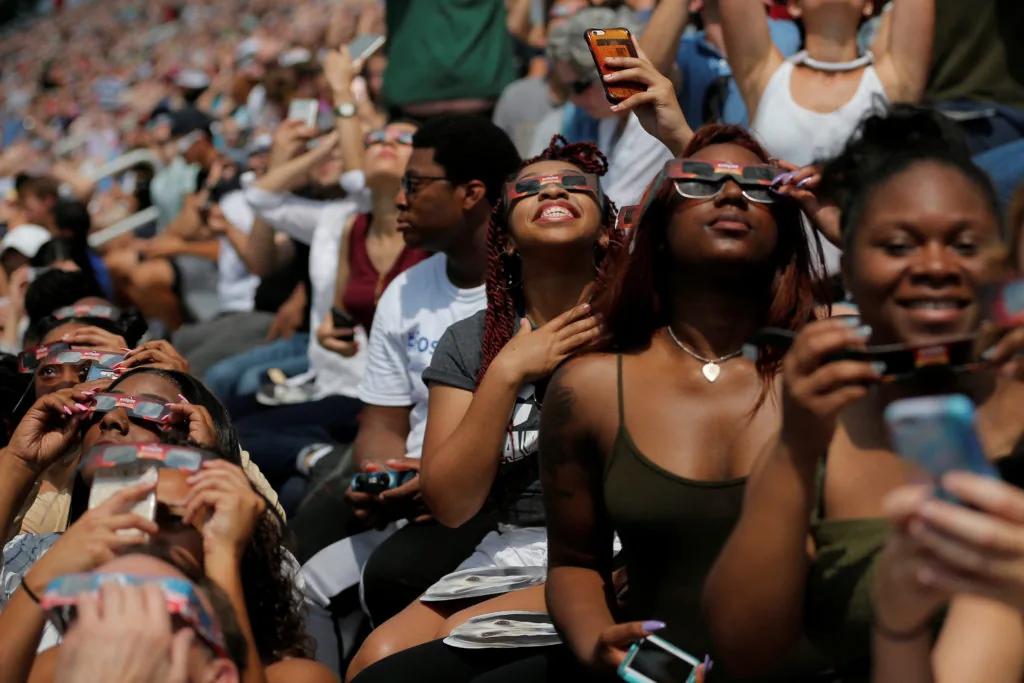
Second, there is social sound. A crowd countdown, a sudden silence, someone gasping when totality arrives, children asking what just happened, a neighborhood going still and then loud again: these are part of eclipse culture. They tell you when the event has crossed from gradual to dramatic.
Third, there is designed sound: apps, sonified images, tactile-plus-audio tools, and guided programs such as Eclipse Soundscapes. These can help users build a mental map of what sighted observers are seeing.
That is why blind solar eclipse and blind low vision solar eclipse experience should not be framed as contradictions. A solar eclipse is a sky event, but it is also an environmental event. Listening is one legitimate way into it.
Heat, wind, and the body’s sense of change
The title of this article includes heat for a reason. On eclipse day, especially if you are outside for hours, the body notices more than the eyes do.
During a deep partial eclipse or totality, sunlight weakens. In totality, the change can become startlingly physical: warmth fades, a breeze may feel different, and the atmosphere can take on that odd “late dusk at the wrong time” quality. Some people notice it first on their skin rather than in the sky.
That does not mean every eclipse produces a dramatic temperature plunge at every site. Local conditions matter: cloud cover, humidity, wind, ground surface, and how long the Sun is obscured all shape what you feel. But the possibility is real enough that it belongs in planning.
It also helps answer a related but different question that sometimes appears in search results: can heat exhaustion cause temporary blindness? Yes, heat illness can affect vision and overall neurological function, but that is not an eclipse phenomenon in itself. It is an outdoor-event risk. If your group will be in direct sun for hours before and after the main event, bring water, shade, hats, medication backups, and a plan for cooling down. Accessibility planning is not only about description; it is also about stamina, transport, seating, and recovery.
Safety: the eye-risk message is mostly for sighted companions
For blind readers, eclipse safety advice can feel oddly misdirected if it assumes everyone is trying to look at the Sun. So let’s be precise.
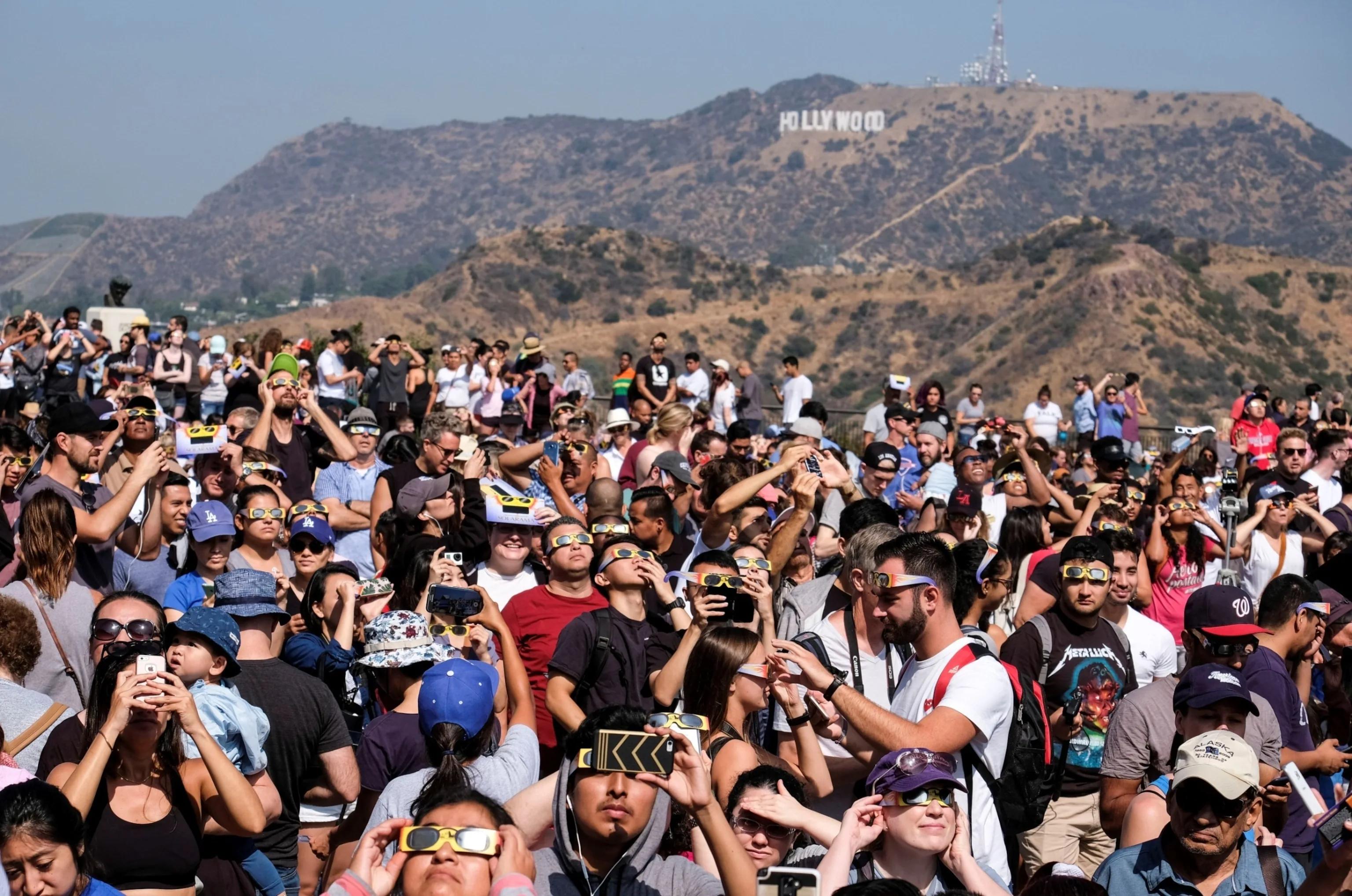
The risk is real for anyone who may look directly at the bright Sun during the partial phases without proper protection. NASA and the American Astronomical Society are clear: except during the brief total phase of a total solar eclipse, and only for people inside the path of totality, direct viewing requires special-purpose solar filters that meet ISO 12312-2. Outside totality, there is no safe unfiltered look.
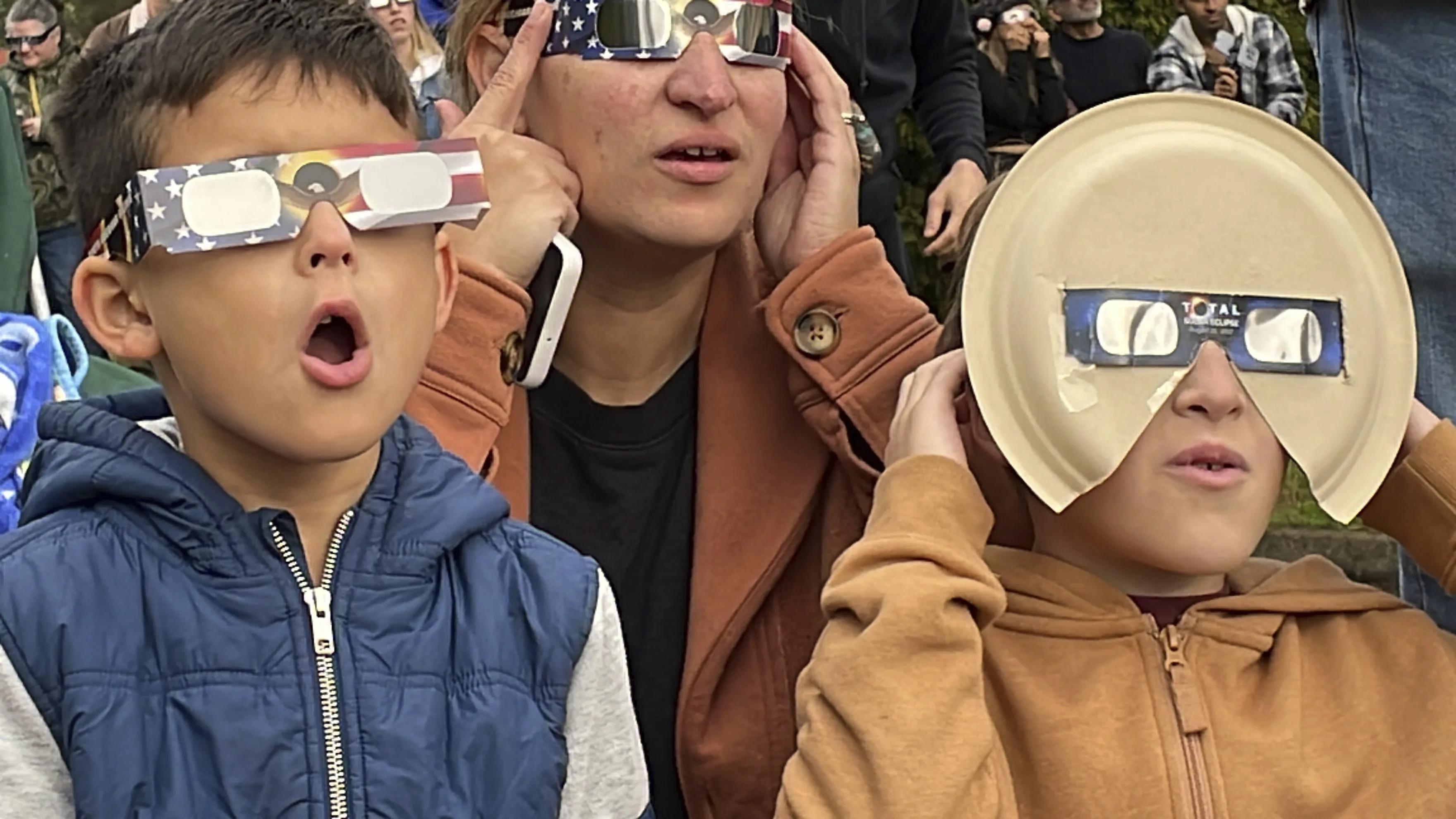
That means sighted companions, teachers, relatives, and group leaders need to know the rules cold. If you are sharing viewers in a family or school setting, inspect them first and supervise children. Never use ordinary sunglasses. Never look through binoculars, a telescope, or a camera with eclipse glasses alone; those optics need their own proper front-mounted solar filters.
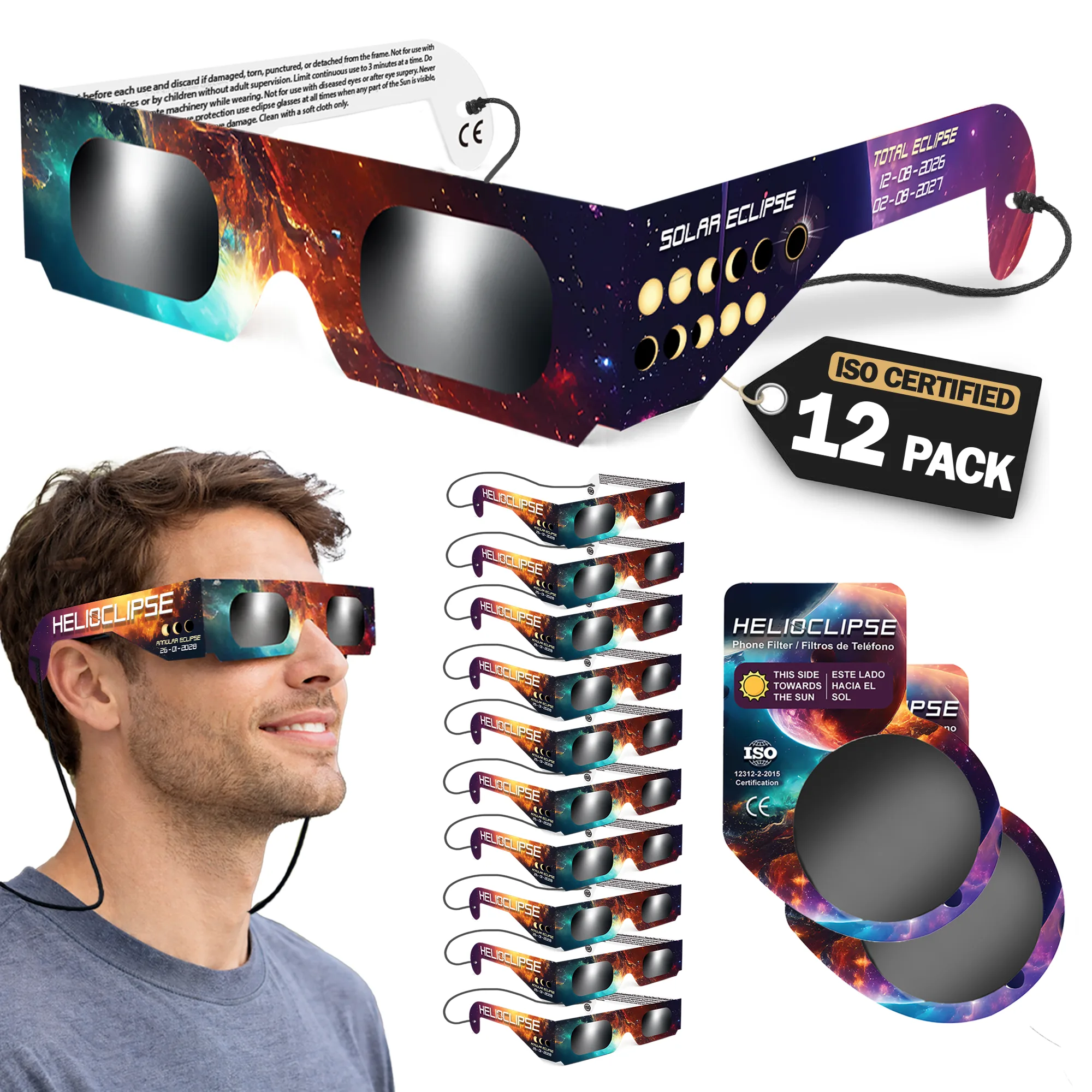
If you are shopping, the language people use can be messy. You will see phrases like approved solar eclipse glasses, eclipse glasses nasa approved, and solar eclipse glasses iso 12312-2 certified. The important correction is that NASA does not certify or approve a specific consumer brand; the meaningful standard is ISO 12312-2, and buyers should verify that the product is a safe solar viewer from a reputable source. If you need a straightforward starting point, our shop eclipse glasses focuses on certified viewers, and our explainer on ISO 12312-2 and eclipse viewers breaks down what the standard does and does not mean.
For families planning a total eclipse, our guide to why staring at the Sun without protection is never “just a quick look” is also worth sharing with the sighted people in the group.
“What is eclipse blindness?” is the wrong phrase for two different things
The search phrase what is eclipse blindness? mixes up two unrelated ideas.
One meaning is injury from looking at the Sun during an eclipse without proper protection. That is solar retinopathy: damage caused by intense sunlight focused on the retina. It may not hurt in the moment, which is part of what makes it dangerous.
The other meaning is simply blindness in the context of an eclipse, as in blind solar eclipse or blind eclipse 2024. That is not a medical condition created by the eclipse. It is a question about access, participation, and language.
Those should not be blurred together. If someone asks has anyone gone blind looking at an eclipse?, the careful answer is that serious eye injury from unsafe solar viewing is documented, which is why the safety guidance is so strict. But that is a different topic from how blind people participate in eclipse day.
The distinction matters because sloppy phrasing can turn blind people into a warning label instead of readers, participants, and experts in their own access needs.
Memory, community, and why older eclipses still matter
Search interest around blind solar eclipse 2017, blind solar eclipse 2024, and even blind solar eclipse reddit tells us something useful: people are trying to learn from lived experience, not only from official diagrams.
The 2017 and 2024 North American total eclipses pushed accessibility into wider public view. Projects involving tactile graphics, Braille materials, sonification, and multisensory observation gained attention because people could see that eclipse day was bigger than a single glance upward. NASA’s Braille book, Getting a Feel for Solar Eclipses, is a good example of how tactile explanation can support understanding before the event even begins.
Community discussion can be helpful, but it also has limits. A thread like blind solar eclipse reddit may contain useful first-person detail, yet it can also flatten very different experiences into one anecdotal answer. We would treat those conversations as prompts, not as final authority. The better model is to combine first-person access needs with reliable eclipse basics and a clear plan for the day.
That is especially important for 2026. A blind low vision solar eclipse experience 2026 guide should not assume that everyone wants the same script. It should help people prepare options: tactile materials ahead of time, a trusted describer, a quiet listening spot or a lively public event, safe transport, hydration, and a shared understanding of when the key moments happen.
Planning the day: what actually helps
The best places and timing for blind low vision solar eclipse experience are not only about maximum duration. They are also about logistics.
A centerline location with a longer totality can be wonderful, but only if the site is manageable. Ask practical questions:
- Is there accessible parking or drop-off?
- Are there restrooms nearby?
- Is there shade before and after totality?
- Will the crowd be energizing or overwhelming?
- Is there a describer you trust?
- Do you want a natural soundscape, a science-center program, or a family gathering?
For the August 12, 2026 total solar eclipse, NASA notes that totality crosses Greenland, Iceland, northern Russia, the Atlantic, Spain, and a small corner of Portugal, while many other places across Europe and beyond see a partial eclipse. If you are building plans early, our August 12, 2026 total solar eclipse planning guide is the broader starting point, and the Eclipse Explorer / 3D map is the fastest way to check whether a specific town is in totality or outside it.
For blind and low-vision participants, the key planning difference is this: if you are outside totality, the event may still be meaningful, but it will be more gradual and less dramatic in environmental change. If you are inside totality, the transition can become sudden enough that the crowd, the temperature, and the soundscape all shift in a way people remember for years.

A note on language: “blind spot solar eclipse” and other confusing phrases
Some search phrases are simply messy. blind spot solar eclipse, for example, may refer to a misunderstanding about eye damage, a metaphor, or a mistaken autocomplete phrase rather than a real eclipse concept.
When language gets muddy, we think it helps to return to plain terms. Are we talking about:
- blindness or low vision as an identity or disability?
- blind spots in vision caused by eye injury?
- safe viewing rules for sighted observers?
- or accessible ways to understand what is happening in the sky?
Keeping those separate makes the conversation more respectful and more useful.
One last misconception: not every dramatic eclipse headline is about your event
Another search phrase floating around is why will the sun disappear for 6 minutes in 2027? That refers to a different total solar eclipse, not a general rule and not the 2026 event. Totality duration varies from eclipse to eclipse and from one location to another within the path.
That is a good reminder for everyone, not only accessibility planners: eclipse details are local. The date, whether you are in totality, how long totality lasts, and what time the main phases happen all depend on where you stand. Use a map, not a headline.
Respect starts with asking, not assuming
If you are organizing an eclipse event that includes blind or low-vision participants, the most respectful move is also the simplest: ask what would make the event better.
Some people will want a detailed countdown and scientific description. Some will want to hold a tactile model beforehand and then mostly listen. Some will want to focus on the social atmosphere. Some will want very little mediation at all.
A good accessible eclipse plan is not built from pity, and it is not built from the idea that one sense must imitate another perfectly. It is built from accurate information, flexible tools, and the understanding that experiencing an eclipse can mean feeling the air cool, hearing frogs start up, noticing a crowd go silent, listening to a trusted voice say “totality,” and knowing exactly what that word means.
How Do Blind People Watch Movies and TV Shows | Audio ...
Josh Boykin
Frequently asked questions
What does “eclipse blindness” mean, and is it the same as being blind or having low vision?
No, it is not the same thing. In this article, the focus is on how a solar eclipse can be experienced by people who are blind or have low vision through heat, sound, tactile information, and social context—not on a medical condition called eclipse blindness.
Can someone really go blind from looking at a solar eclipse?
The excerpt does not discuss eye injury in detail, but it does stress that people need to know when glasses are on and when glasses are off during eclipse phases. It also notes that companions should know when sighted people need certified viewers, which reinforces that direct viewing of the Sun requires proper safety precautions.
What should a 2026 eclipse access guide include for blind and low-vision readers?
It should recognize that there is no single blind low vision solar eclipse experience. A useful guide would offer accurate phase information, clear safety guidance, and options such as verbal description, tactile graphics, sonified data, or a radio-style play-by-play, while also respecting that some people want sensory and social access rather than inspiration.
What stood out about the 2024 eclipse for blind and low-vision observers?
The excerpt says NASA’s Eclipse Soundscapes project invited people to document multisensory observations during the 2024 eclipse. That included changes in the environment that could be noticed without looking at the Sun, which shows that an eclipse can be experienced through heat, sound, and other senses.
How should people talk about a blind person’s eclipse experience in 2024?
They should avoid assuming that “the experience” only means seeing the sky. The article says blind and low-vision people may engage eclipse culture in social, sensory, technical, and informed ways, and that respectful access means good information, good company, and not treating someone as an inspiration symbol.
On-site next steps
- Use our Eclipse Explorer / 3D map to check whether your viewing site is in totality or only a partial eclipse, then note the timing you will want a companion to describe.
- Browse the Helioclipse blog hub for planning and safety guides you can share with family, schools, and group organizers.
- If sighted companions in your group need viewers, start with our explainer on ISO 12312-2 and eclipse viewers and then choose certified options from our solar eclipse glasses shop.
Sources & further reading
- With new technology, blind people can hear and feel April's total solar eclipse
- Solar eclipse accessibility resources: Assistive technology for blind and low vision
- Making astronomy accessible to the blind
- How Astronomers Are Rendering the Universe in Sound
- While millions watched the eclipse, these scientists listened
- Eclipse Viewing Safety — NASA
- Eclipses — NASA
- Eclipse Soundscapes — NASA
- NASA's Braille Book - Getting a Feel for Solar Eclipses
- How to View a Solar Eclipse Safely — American Astronomical Society