After August 2026: donating, storing, or retiring viewers without wishful thinking
The Sun returns, the crowd heads home, and a small pile of eclipse viewers lands on the kitchen table. After the total solar eclipse of August 12, 2026, millions of families, schools, tour groups, and community organizations will face the same deceptively simple question: what should happen to the viewers now?
This donate reuse recycle solar eclipse glasses after event 2026 guide starts with an unglamorous truth: donation is worthwhile only when somebody has agreed to receive a safe, useful product. A scratched viewer does not become useful because it crosses a border, and a school should not inherit the job of authenticating an anonymous box of used filters.
There are better choices. Known, undamaged viewers may be stored for future solar observing. Unopened surplus may suit a verified collection program. Damaged or untraceable viewers should be retired. Before making that decision, use our guide to ISO 12312-2 and eclipse viewers to understand what the standard does—and what a printed claim cannot prove.
The first decision is safety, not sentiment
A solar viewer is a piece of safety equipment, even if its cardboard frame looks as disposable as a party favor. Its filter must reduce visible sunlight to an appropriate level while also controlling ultraviolet and infrared transmission. Ordinary sunglasses do not do this, regardless of how dark they appear.
The current American Astronomical Society guidance says a viewer may be reused when it is less than 10 years old, came from a manufacturer whose product was tested by a properly accredited laboratory for conformity with ISO 12312-2, and remains clean and undamaged. Instructions supplied by the manufacturer still matter. If those instructions set a shorter life or stricter storage conditions, follow them rather than assuming that every modern filter lasts indefinitely.
This is an important correction to some older post-eclipse advice. Articles published after earlier eclipses sometimes said that modern compliant viewers do not expire. The more useful rule in 2026 is narrower: retain a viewer only when its age and origin are known, it falls within current expert guidance, and every part remains in excellent condition.
A printed ISO 12312-2 mark is not enough by itself. Anyone can print a standards claim. Provenance—the manufacturer, seller, packaging, and purchase trail—is what connects the product to accredited testing. Our guide to spotting fake or low-quality eclipse glasses explains why visual inspection can identify obvious failures but cannot authenticate an unknown filter.
Use a strict inspection checklist
Inspect every viewer individually in bright room light, without looking at the Sun. Donation boxes should not be treated as a single unit: one good pair does not vouch for the 49 beneath it.
Retire a viewer if any of these conditions applies:
- The filter has a scratch, puncture, tear, crease, peeling area, or suspicious light spot.
- The filter is separating from the cardboard or plastic frame.
- The frame is warped, crushed, water-damaged, or no longer stays securely over both eyes.
- The viewer has been modified, stapled, taped across the filter, or cut into an improvised shape.
- Its manufacturer, source, age, or compliance history cannot be established with reasonable confidence.
- The manufacturer’s stated retirement date or storage limit has passed.
- A receiving organization excludes used viewers or cannot verify this particular product.
Do not hold a questionable viewer up to the Sun to decide whether it is safe. The AAS notes that consumers cannot confirm full ultraviolet and infrared performance just by looking through a filter. An indoor check can reveal a viewer that is obviously too transparent, but passing that check is not laboratory verification and does not rescue unknown provenance.
Keep unopened viewers separate from used ones. Retain their original packaging, receipt, lot information, and instructions if available. That paperwork can make the difference between a useful transfer and a mystery item that a school or charity must reject.
Storing good viewers is often the best answer
There is nothing wasteful about keeping a sound viewer. Eclipse glasses are not useful only during eclipses: a legitimate, intact viewer can also be used for brief, unmagnified looks at the everyday Sun, including checks for sufficiently large sunspots. Never combine eclipse glasses with binoculars, a telescope, or a camera lens; magnifying optics need correctly mounted filters over their front apertures.
Store retained viewers flat at room temperature in their original sleeve, a clean envelope, or a rigid folder. The container should keep them dry and protect the filter from rubbing, punctures, staples, keys, toys, and the enthusiastic investigations of pets or small children. Do not leave them loose in a hot car, damp garage, crowded drawer, or travel bag.
Avoid liquids on cardboard viewers. The AAS advises using a soft, nonabrasive tissue or cloth when cleaning is appropriate, not water, glass cleaner, solvents, baby wipes, or other wet wipes. Moisture can swell cardboard and loosen the filter from its mounting.
Label the storage envelope with the purchase year, supplier, manufacturer, and the date of the next inspection. If you are keeping viewers for a school or astronomy club, add the invoice or a copy of the original product information. Inspect them again before every use; safe storage slows damage but does not eliminate the need to check.
Donation requires a real receiving chain
To donate means transferring something the recipient can actually use. For solar viewers, that requires more than good intentions: the receiving organization needs an active program, a defined eclipse or education use, inspection capacity, storage space, and local distribution partners.
Historic campaigns show what responsible redistribution involves. Following the 2017 eclipse in the United States, Astronomers Without Borders reportedly received about five million viewers. A later distribution included more than 40,000 sent to institutions and communities in Chile, Argentina, and Peru for the July 2019 eclipse. The work involved collection, verification, sorting, storage, repackaging, transport, and local partners—not simply forwarding miscellaneous envelopes overseas.
Programs created for earlier events must not be assumed active in 2026. A web page labelled donate solar eclipse glasses 2024 may document a valuable past campaign, but its collection deadline, warehouse, postal arrangement, or partner network may have ended years ago. The same caution applies to news stories listing temporary library and retail collection points.
Before sending anything, verify all of the following on a page updated for the current campaign or through direct written confirmation:
- The program is currently accepting viewers. Check both the update date and the closing date.
- Your country is eligible. International postage, customs rules, taxes, and import restrictions vary.
- The program accepts the product’s condition. Some take unopened stock only; others may accept gently used viewers for inspection.
- The make and age are eligible. A program may restrict accepted manufacturers, models, dates, or standards documentation.
- The quantity is useful. Ten viewers and ten thousand viewers create different handling problems.
- The destination is official. Confirm the address on the organization’s own current website, not an old article or copied social post.
- The recipient has requested shipment. Never send an unsolicited overseas parcel to a school, observatory, or community group.
Instructions reduced to donate solar eclipse glasses mail or donate solar eclipse glasses address are not adequate logistics. You need a named program, a current acceptance policy, a closing date, and an address confirmed by the recipient. Recheck immediately before posting; collection sites can stop accepting parcels when storage fills.
Unused stock is easier to place—but still needs verification
Organizations are more likely to accept unopened viewers because sealed stock is easier to inventory and has not been bent, worn, or exposed to moisture. That does not make every unopened viewer safe. Its source must still be traceable, its labeling must be credible, and its storage history must be suitable.
If you want to donate unused solar eclipse glasses, begin with the organization that supplied your event. A museum, university, astronomy club, municipal science program, or school district may have a planned use for intact surplus. Ask before arriving with boxes, and provide the exact quantity, purchase date, manufacturer information, packaging status, and photographs of the cartons—not photographs intended to substitute for inspection.
Schools have legitimate reasons to be cautious. Staff may not have the equipment or expertise to verify filter performance, and accepting used safety products can create administrative and liability questions. A polite refusal is not a lack of interest in astronomy. It may simply mean the school requires new, documented stock purchased through its approved procurement process.
For the same reason, do not leave anonymous viewers at a library desk or add them to a general charity bin alongside clothes and household goods. The recipient needs to know what they are, where they came from, and whether there is a controlled process for examining them.
Do not export the disposal problem
Donation can feel morally preferable to throwing something away, but an unwanted or damaged viewer remains waste wherever it arrives. Shipping mixed, unrequested material to another country can transfer sorting costs and disposal burdens to organizations with fewer resources.
A credible program should be able to explain, at least in broad terms, how it screens donations, which partners receive them, and what happens to rejected units. You do not need private details about every classroom, but there should be a plausible chain between collection and use.
Be especially cautious when an appeal has no closing date, acceptance criteria, legal organization name, or current contact information. Images from a previous eclipse are not evidence that a new campaign is operating. Likewise, a large social-media following does not prove that the group has warehouse capacity, trained inspectors, or permission to import safety equipment.
Postage has an environmental cost too. Mailing two used cardboard viewers thousands of kilometres may consume more packaging and transport than the items justify. A verified local education project—or careful storage at home—can be the more responsible outcome.
Recycling is local and usually incomplete
Eclipse viewers combine materials that many household recycling systems do not process together. A cardboard frame may be recyclable after the filter has been removed, but only if the card is clean, dry, uncoated, and accepted by your local service. Laminated frames, adhesive-heavy pieces, plastic viewers, and the solar-filter material itself may need to go into general waste.
Never place an intact viewer in paper recycling and assume machinery will separate it. Remove the filter without creating loose fragments, then consult your municipal waste authority. Rules differ among cities and countries, so a recycling symbol or a general online claim cannot settle what your local facility accepts.
If the filter is damaged or the viewer is untraceable, mark it unusable before disposal. Cutting through the frame and filter prevents somebody from retrieving it and trusting it later. Keep the fragments away from children and dispose of them according to local guidance.
The phrase donate reuse recycle solar eclipse glasses after event suggests three equally available routes. In reality, the hierarchy is conditional: reuse a known, sound viewer; donate only through a verified receiving program; recycle only the locally accepted components; and retire everything that fails the safety test.
Standards language can create false confidence
Product descriptions often contain phrases such as approved solar eclipse glasses, eclipse glasses nasa approved, or solar eclipse glasses iso 12312-2 certified. They are not interchangeable guarantees. NASA explicitly says it does not approve particular brands of solar viewers, while ISO 12312-2 conformity depends on appropriate testing and traceable supply—not merely those words appearing in a listing.
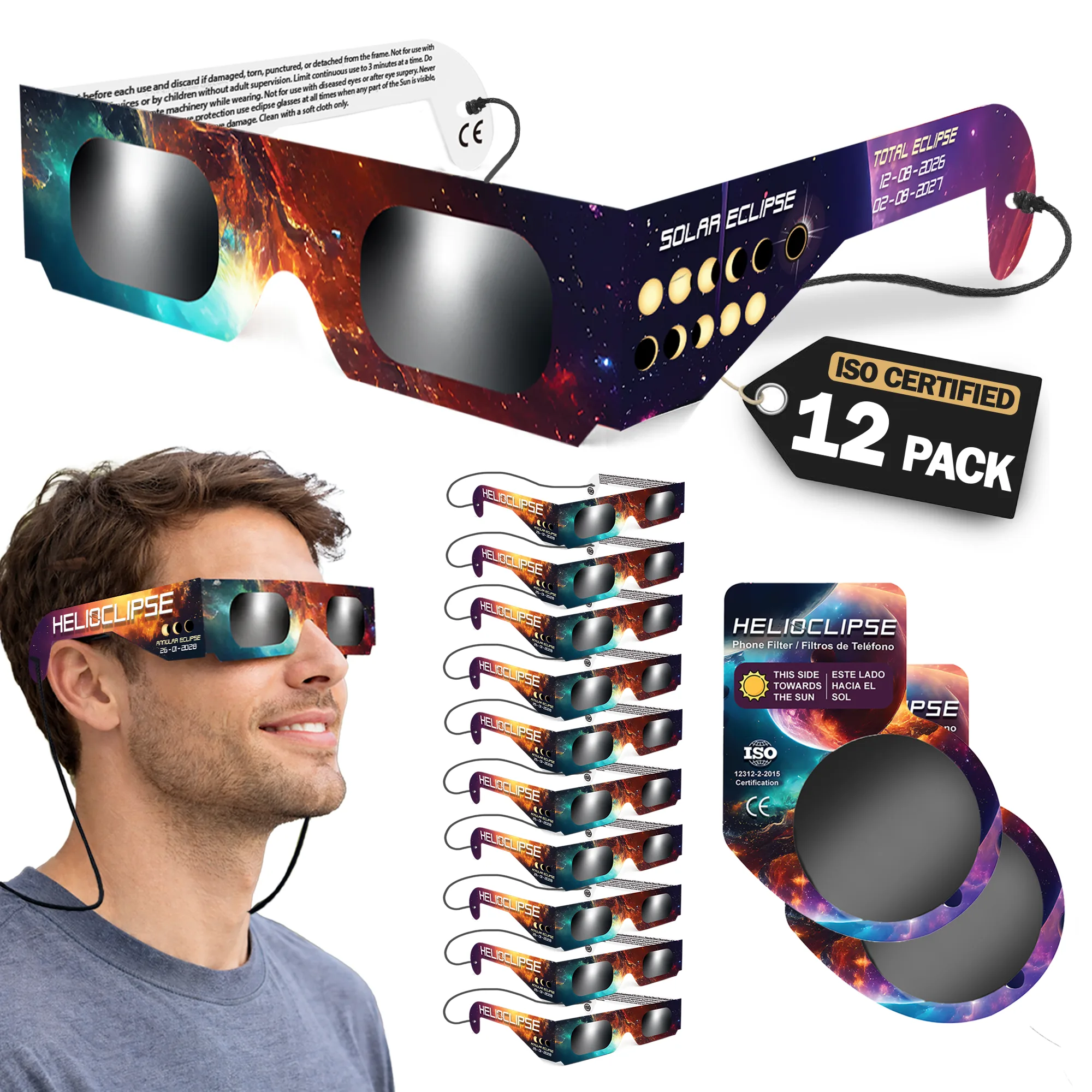
When replacing retired viewers, use a known source and retain the packaging and order record. Helioclipse offers ISO 12312-2 certified solar eclipse viewers for future events and family solar observing. Order early enough to inspect them calmly and explain their use to everyone in your group rather than conducting a last-minute handout.
Some automated topic systems also mix unrelated technical language into eclipse-glasses discussions. The terms plan normalization value eclipse and what is the eclipse treatment planning system? refer to healthcare treatment-planning software, not astronomical eclipses, solar-filter standards, reuse, or donation. They provide no evidence about whether a viewer is safe.
A five-minute post-event plan for families and groups
Do the first sort while the viewers’ history is still fresh. Waiting six months makes it harder to remember which packet stayed dry, which viewer was dropped, or where an unlabelled spare came from.
- Create a keep pile: traceable, within current age guidance, undamaged, clean, and suitable for protected storage.
- Create an unopened-surplus pile: still sealed, documented, and potentially useful to a verified recipient.
- Create a quarantine pile: questionable origin, uncertain age, or possible damage. Do not lend or donate these.
- Photograph the documentation: packaging, receipt, manufacturer details, and instructions.
- Store the keepers immediately: flat, dry, and protected at room temperature.
- Contact recipients before shipping: describe condition and quantity, then wait for confirmation.
- Retire failures: separate recyclable card only where local rules permit and dispose of the filter safely.
For a school, festival, or tour group, assign one person to this task before eclipse day. Keep unopened reserves in their cartons, provide a return box for used viewers, and prevent wet or bent units from being mixed back into clean stock. Tell participants whether viewers are theirs to keep or whether your organization is collecting them under a specific, verified plan.
This small amount of organization preserves options. It also prevents the familiar post-event outcome in which several hundred viewers are swept into one box with food wrappers, damp leaflets, and no record of where anything came from.
Frequently asked questions
What system should we use to decide whether eclipse viewers can be kept, donated, or retired?
Use a safety-first decision process based on each viewer’s age, known origin, condition, and the supplied instructions. Keep or donate only viewers that are known, undamaged, within current reuse guidance, and accepted by a verified recipient; retire damaged or untraceable items.
What is the main advice for handling eclipse viewers after the August 2026 event?
Do not donate viewers simply because they are no longer needed locally. Known, undamaged viewers may be stored for future solar observing, unopened surplus may be appropriate for a verified collection program, and damaged or untraceable viewers should be retired.
Can eclipse viewers left over from a previous eclipse still be donated or reused?
Possibly, but only if their age and origin are known, they remain clean and undamaged, and they meet current expert guidance. A printed standards mark alone does not authenticate a viewer, and the manufacturer’s instructions may set a shorter usable life or stricter storage requirements.
What is the safest way to use a solar viewer during an eclipse?
Use a viewer from a known source that was tested for conformity with the relevant solar-viewing standard and is clean and undamaged. Inspect each viewer individually in bright room light without looking at the Sun; ordinary sunglasses are not suitable for solar viewing.
Does this guidance explain how to plan for eclipse weather or visibility?
No. The excerpt focuses on evaluating, storing, donating, or retiring solar viewers after the event, not on weather forecasting or visibility planning. For post-event decisions, inspect each viewer individually rather than treating a box of viewers as a single safe unit.
On-site next steps
- Keep learning through the Helioclipse blog and planning hub, including our guides to viewer standards, counterfeit claims, and safe eclipse phases.
- Save the date and explore future visibility from your location with the Helioclipse Eclipse Explorer.
- If inspection removes too many viewers from your group’s supply, replace them through the Helioclipse eclipse-glasses shop rather than passing questionable filters to somebody else.
The responsible ending is not always donation. Sometimes it is a labelled envelope in a dry cupboard; sometimes it is a confirmed shipment to an organization prepared to inspect and distribute the contents; and sometimes it is the bin. What matters is that hope never outranks evidence when the item will eventually sit between someone’s eyes and the Sun.
Sources & further reading
- What to Do With Leftover Solar Eclipse Glasses — American Academy of Ophthalmology
- The solar eclipse is over! Here's what to do with your eclipse glasses — Space.com
- Is It Safe to Reuse Your Solar Eclipse Glasses? — Space.com
- OK, the eclipse was cool, but those glasses aren't. Now what? — Phys.org
- Astronomers Without Borders Giving Away Free Eclipse Glasses — Space.com
- How to View a Solar Eclipse Safely — American Astronomical Society
- How Can You Tell If Your Eclipse Glasses or Handheld Solar Viewers Are Safe? — American Astronomical Society
- About the ISO 12312-2 Standard for Solar Viewers — American Astronomical Society
- Suppliers of Safe Solar Viewers & Filters — American Astronomical Society
- Eclipse Viewing Safety — NASA Science
Donation campaigns, addresses, deadlines, and local recycling rules can change. Verify them directly before sending or discarding viewers; historical collection reports are evidence of what happened previously, not confirmation of an active 2026 program.