Welding glass, sunglasses stacks, and Mylar myths: why improvised filters fail modern safety tests
A solar filter has a deceptively simple job: make the Sun comfortable to see without allowing hazardous radiation to reach your eyes. The difficulty is that you cannot judge that performance by darkness, color, reflectiveness, or a clever experiment at home.
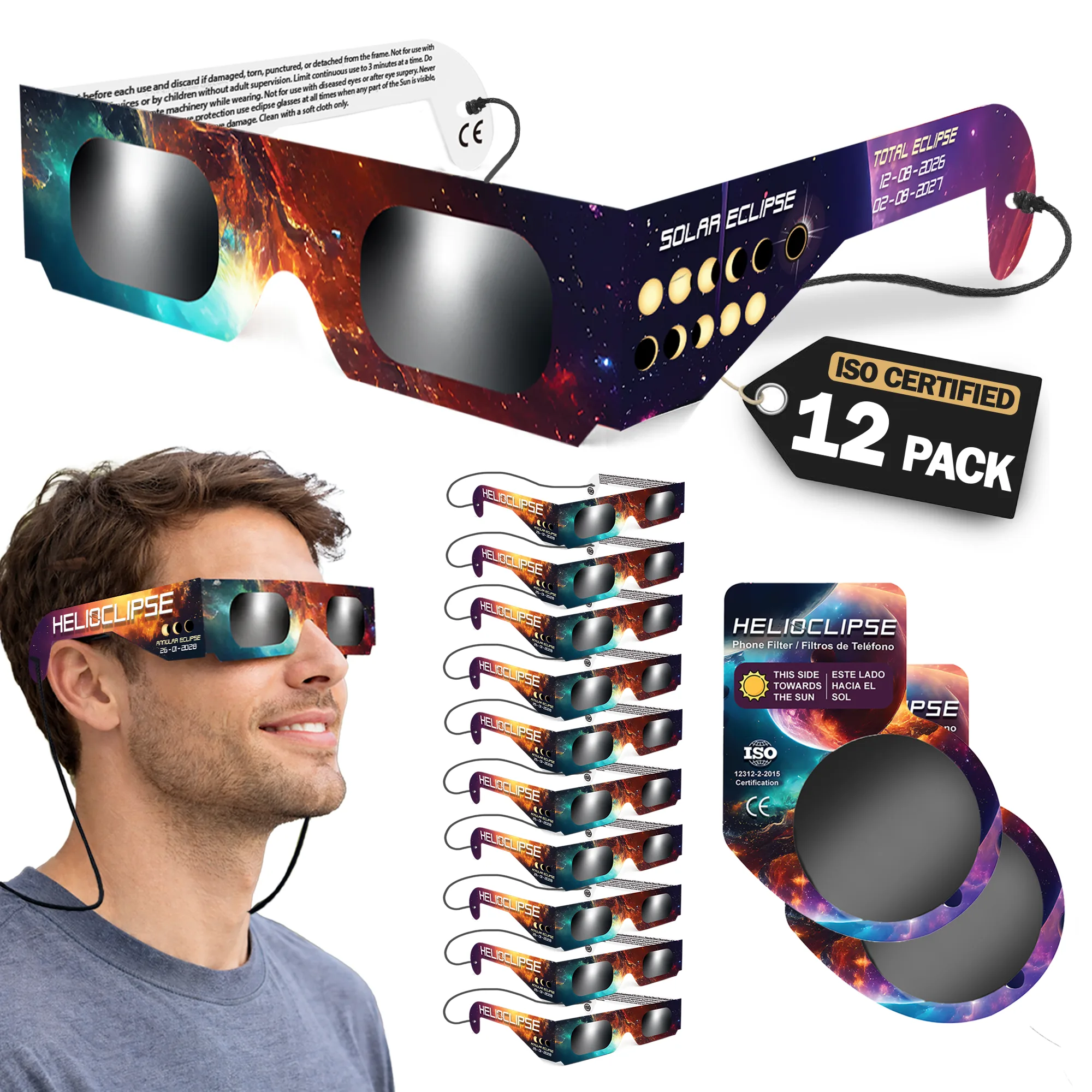
That is why a pile of sunglasses, a scrap of silvery film, and an unidentified welding lens do not become safe just because the Sun looks dim through them. For direct, unmagnified viewing, choose a viewer from a traceable supplier that conforms to ISO 12312-2—or keep your back to the Sun and use indirect projection. You can find Helioclipse ISO 12312-2 certified viewers here.
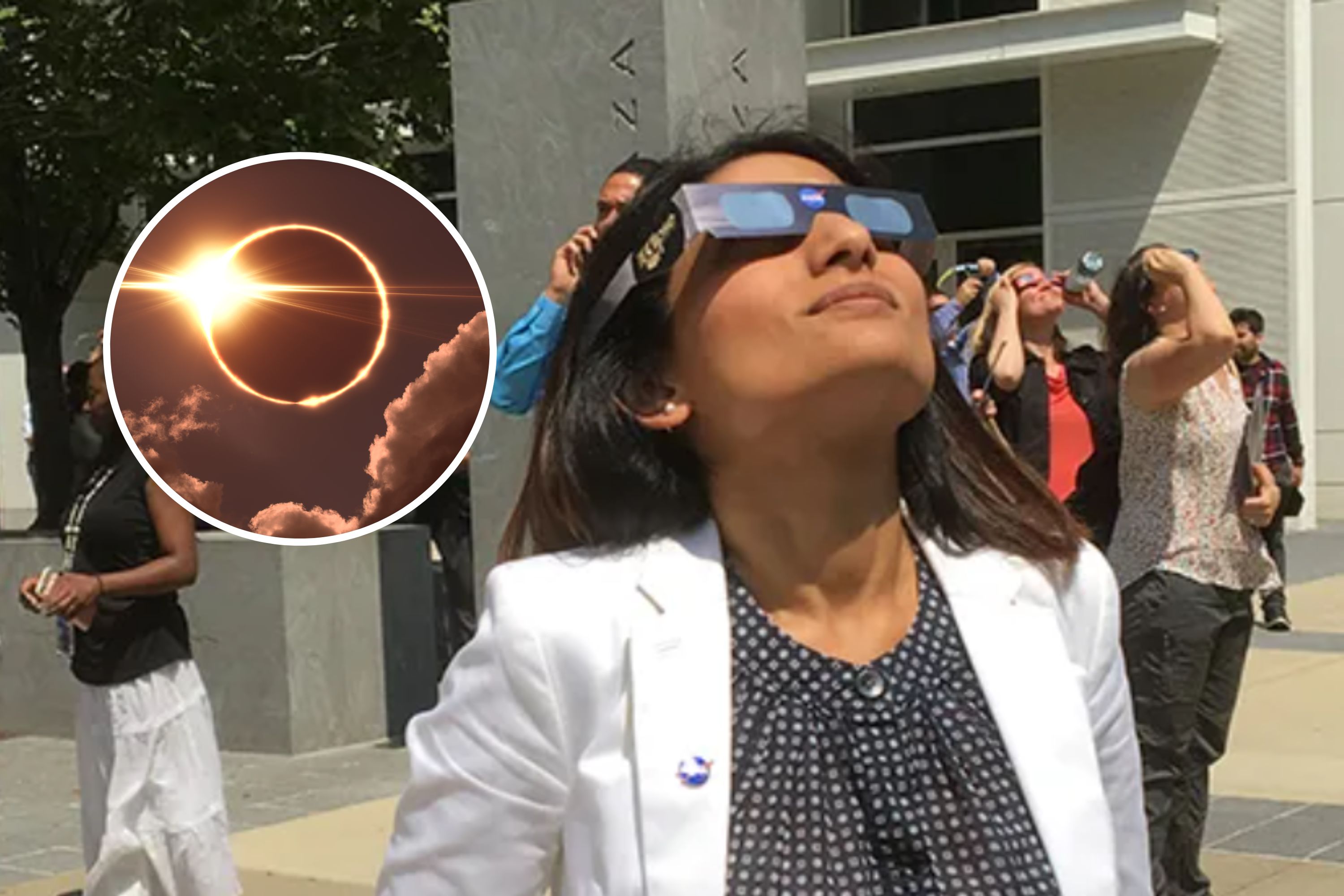
Treat this as our welding glass solar eclipse safe myth 2026 guide: the August 12, 2026 eclipse will include totality along a narrow path, but most observers will experience partial phases. During every partial phase—and throughout any partial or annular eclipse—some of the Sun’s brilliant surface remains visible, so proper protection is required.
Darkness is not a safety measurement
Human vision is a poor solar-filter laboratory. Our eyes respond mainly to visible light, automatically changing sensitivity as conditions become brighter or darker. A material that creates a tolerable-looking solar image may still transmit too much visible light or an unsuitable amount of radiation elsewhere in the spectrum.
Modern safety evaluation therefore measures transmission across relevant wavelengths. ISO 12312-2 also addresses transmission uniformity, material and surface quality, secure mounting, and labeling. A filter is not judged merely by whether it makes the Sun look orange, green, blue-white, or faint.
Ordinary sunglasses are designed for everyday glare, not direct observation of the solar photosphere. According to the American Astronomical Society (AAS), they transmit hundreds to thousands of times more light than a proper solar viewer. Stacking two, three, or six pairs does not create a tested system: it creates an unknown one, potentially with reflections, gaps, and no verified ultraviolet or infrared performance.
This distinction also explains why ISO 12312-1 is not interchangeable with ISO 12312-2. Part 1 concerns sunglasses for general use; Part 2 covers filters for direct observation of the Sun with unmagnified viewing. A reference to ISO 12312 3 is not a substitute for the relevant solar-viewer designation either. For eclipse glasses, the number you need to understand is ISO 12312-2.
The narrow truth about welding filters
The welding glass solar eclipse discussion contains a sliver of technical truth surrounded by plenty of dangerous ambiguity. The AAS says a fixed welding filter with a shade number of 12 or higher transmits a sufficiently small proportion of sunlight for unmagnified solar viewing. Shade 13 or 14 generally gives a more comfortable green solar image; shade 12 can look uncomfortably bright, while shade 15 or darker can be frustratingly dim.
That does not mean any dark welding lens is suitable. Shade numbers matter, and an unmarked plate cannot be identified reliably by holding it up to a lamp. Lower shades used for some welding tasks are inadequate. Adjustable and auto-darkening helmets introduce further risks: they may not reach an appropriate shade, may be set incorrectly, or may not darken as expected when first aimed at the Sun.
This is why the claim welding glass safe for solar eclipse is incomplete unless it identifies a fixed, genuine, undamaged filter and its verified shade. Likewise, welding glass safe for eclipse is not a property you can infer from green color or apparent darkness. The phrase welding glass solar eclipse safe myth captures the real problem: a limited technical exception gets shortened into permission to use whatever welding equipment happens to be nearby.
The longer question is welding glass safe to view solar eclipse, and the responsible answer is narrow: only certain fixed filters with verified shade numbers meet the AAS guidance, while uncertain, adjustable, auto-darkening, stacked, or lower-shade products should not be used. Purpose-made solar viewers from a traceable source are simpler for families and first-time observers.
A label or post combining welding glass eclipse NASA would not establish product approval. NASA does not approve particular solar-viewer brands, and its public guidance directs observers toward special-purpose solar protection that complies with ISO 12312-2. Claims using wording such as welding glasses safe to see solar eclipse or welding glasses safe to watch solar eclipse are not evidence of laboratory testing.
Why Mylar, wrappers, and reflective films cause confusion
Mylar has become an imprecise catch-all for shiny plastic. In solar observing, however, purpose-made aluminized polyester filter material is an engineered optical product. The AAS notes that this material is frequently—but inaccurately—called aluminized Mylar. Its controlled manufacture is what matters, not the casual name.
A metallic balloon, emergency blanket, food wrapper, photographic film, tinted plastic sheet, CD, or piece of smoked glass is not equivalent. Neither is an unknown film folded until the Sun seems dim enough. Multiple layers can shift, crease, develop microscopic damage, or transmit radiation in ways you cannot assess by eye.
The same rule applies to homemade viewers assembled from genuine filter material: the material must be intended for solar use, sourced reliably, undamaged, and mounted according to its instructions. Loose scraps and mystery offcuts are not a family craft project worth gambling on.
The practical lesson behind welding glass, sunglasses stacks, and Mylar myths: why improvised filters fail is not that every silvery polymer is inherently dangerous. It is that appearance and material nickname do not establish optical performance. Proven construction, traceable sourcing, and the correct application do.
What ISO 12312-2 tells you—and what a printed logo cannot
ISO 12312-2:2015 is formally titled Eye and face protection—Sunglasses and related eyewear—Part 2: Filters for direct observation of the Sun. It applies to nonmagnifying viewers used directly by the eyes, such as eclipse glasses and handheld solar viewers. It is not a general certification for camera, telescope, or binocular filters.
Among other requirements, the standard sets limits on visible, ultraviolet, and infrared transmission. It also addresses uniformity and defects such as scratches, bubbles, pitting, and pinholes. The viewer and mounting must work together so that ordinary handling does not expose an eye to direct sunlight.
However, the characters ISO 12312-2 on cardboard are not proof by themselves. Anyone can print a standards claim. Consumers generally cannot verify spectral transmission at home, so provenance matters: buy from a supplier that can trace its product and testing rather than from an anonymous listing using copied artwork or vague laboratory language. Our guide to ISO 12312-2 and eclipse viewers explains the standard in more detail, while our guide to fake and low-quality eclipse glasses covers practical buying checks.
The consensus astronomy-safety line: ISO 12312-2 viewers or eclipse planning built around indirect projection. That recommendation is more useful than trying to reverse-engineer a filter from household materials.
When shopping, descriptions such as ISO 12312-2 certified eclipse glasses and ISO 12312-2 glasses should be supported by a named manufacturer or responsible supplier, clear instructions, and credible testing—not just marketplace keywords. Product wording such as solar eclipse glasses ISO 12312-2 certified, certified solar eclipse glasses, eclipse viewing glasses, or ISO certified eclipse glasses still requires the same provenance check.
There is no home test that proves an unknown viewer safe
A phone camera, flashlight, television screen, flame, barcode, or glance through a window cannot measure a viewer’s transmission across the required wavelengths. Comparing an unknown filter with a trusted one is also not laboratory testing. Two products can look similarly dark to you while performing differently outside the range your eyes perceive.
You can identify some reasons to reject a viewer. Discard it if the filter is scratched, punctured, torn, creased through the viewing area, or separating from its frame. If ordinary room details are visible through it, that is an obvious red flag. But passing a darkness check does not prove compliance.
That asymmetry matters: you can sometimes tell that a viewer is unsafe, but you cannot establish that an unknown viewer is safe simply by looking through it. Verification should happen through the supply chain and appropriately accredited laboratory testing before the product reaches your family.
The retailer’s name cannot settle the issue either. The question are home depot solar eclipse glasses safe? has the same evidence-based answer as it would for any large shop, museum counter, marketplace, or local event: assess the specific product, responsible supplier, traceability, condition, and credible conformity claim. A familiar storefront is not itself an optical test.
Eclipse glasses do not belong behind binoculars
Eclipse glasses and handheld viewers are designed for unmagnified vision. Never look through binoculars, a telescope, a camera viewfinder, or another magnifying optical device while wearing them. Concentrated sunlight can damage the filter and your eye.
Optical equipment requires a purpose-made solar filter secured over the front aperture, before sunlight enters the instrument. Old eyepiece solar filters are dangerous because concentrated energy reaches them inside the optical system. Every finder scope must also be capped, removed, or filtered correctly.
If you want to photograph the eclipse or use magnification, obtain equipment-specific advice from an experienced solar observer. Do not adapt wearable viewers, welding plates, or loose film to a lens with tape and optimism.
Direct viewing and projection are two different safe routes
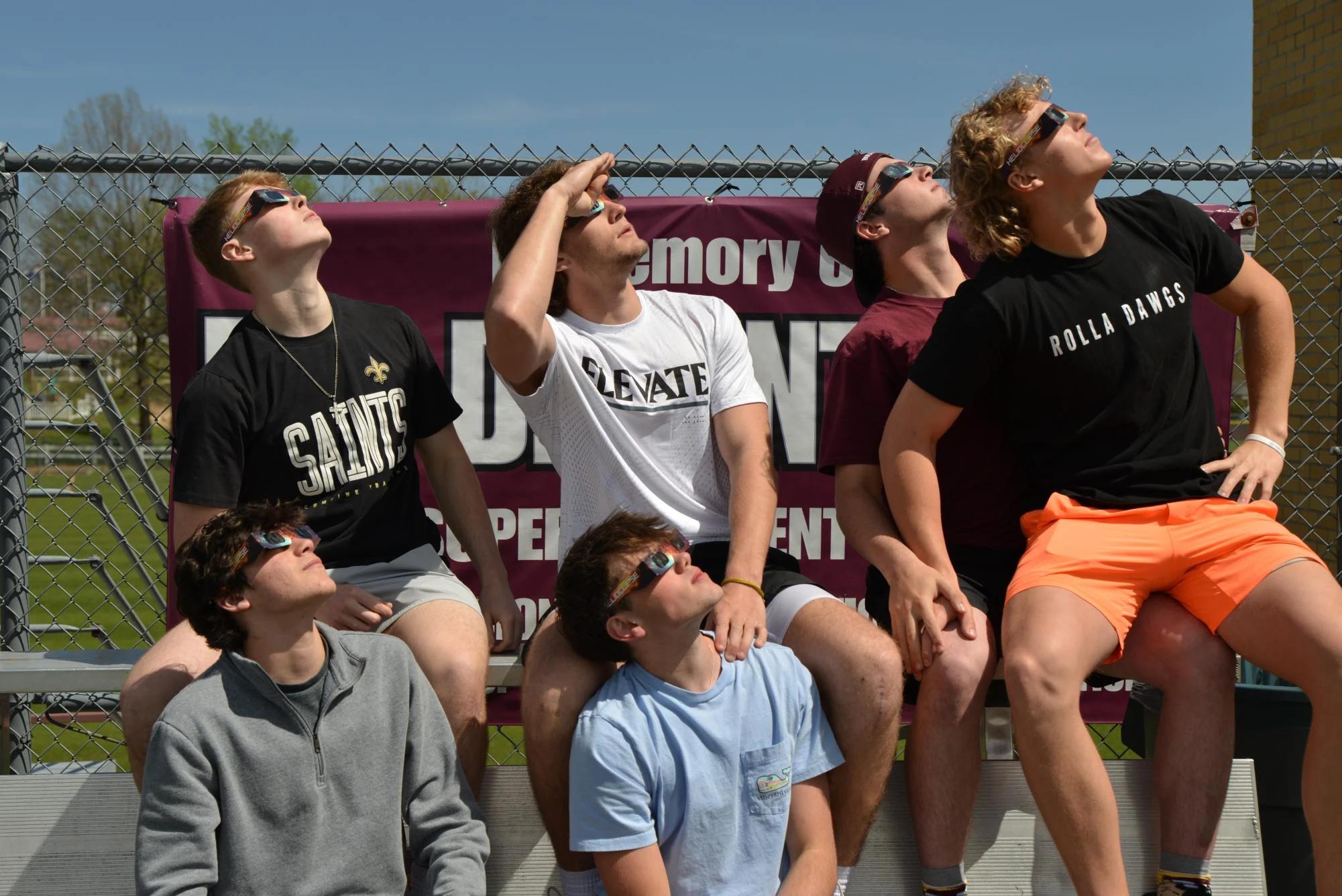
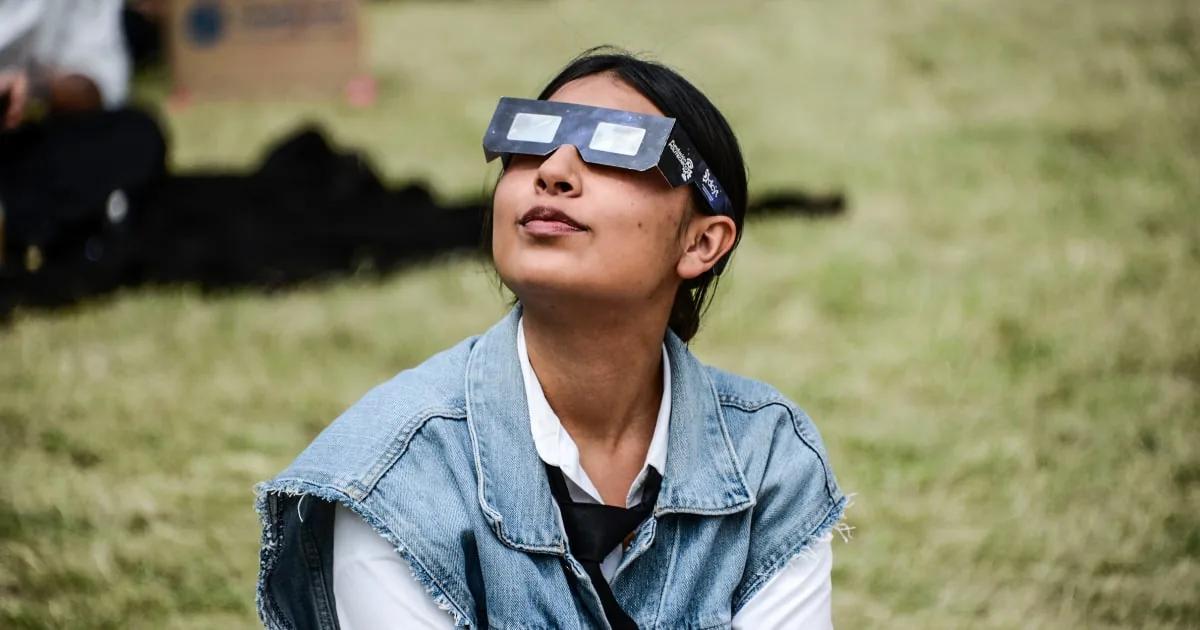
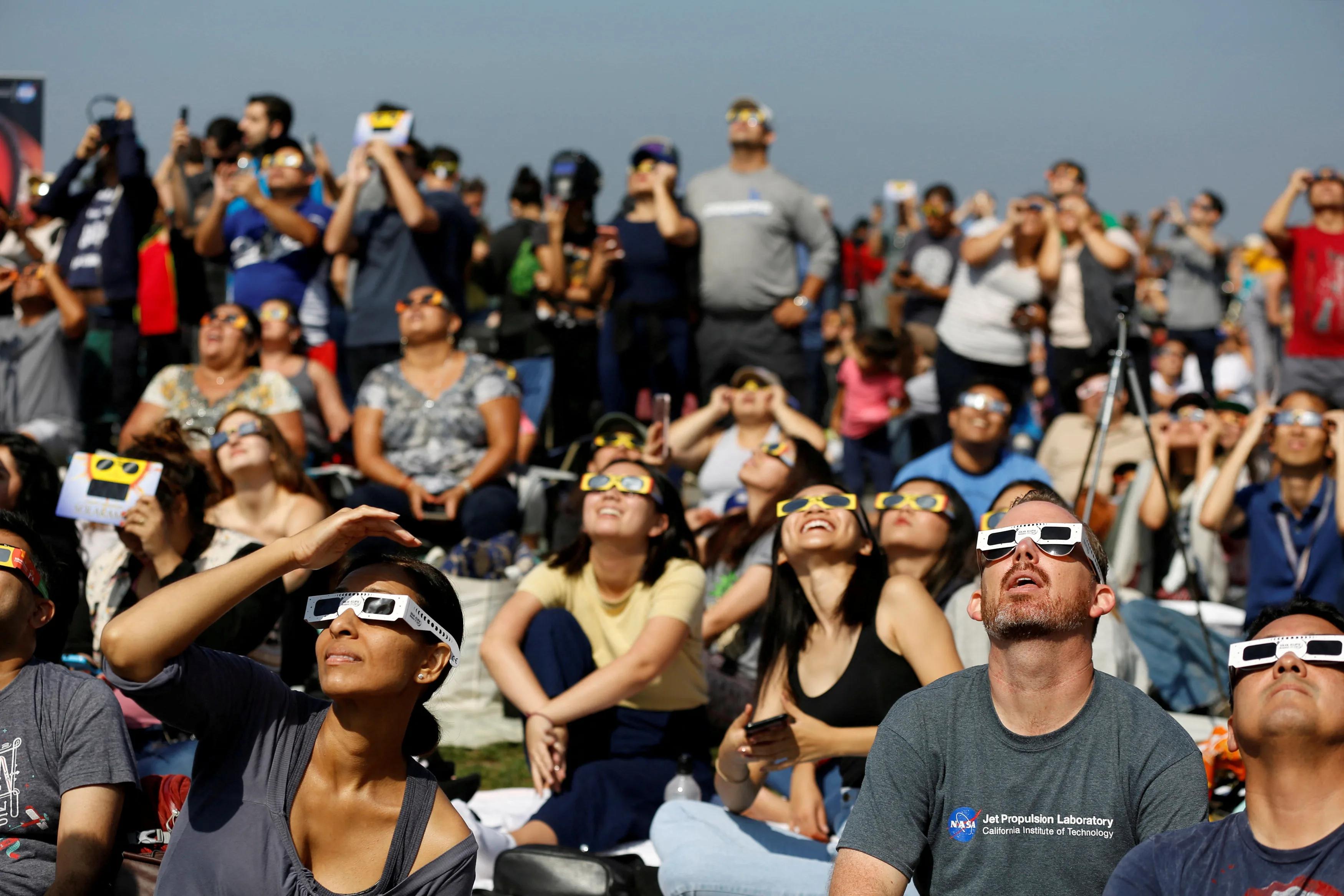
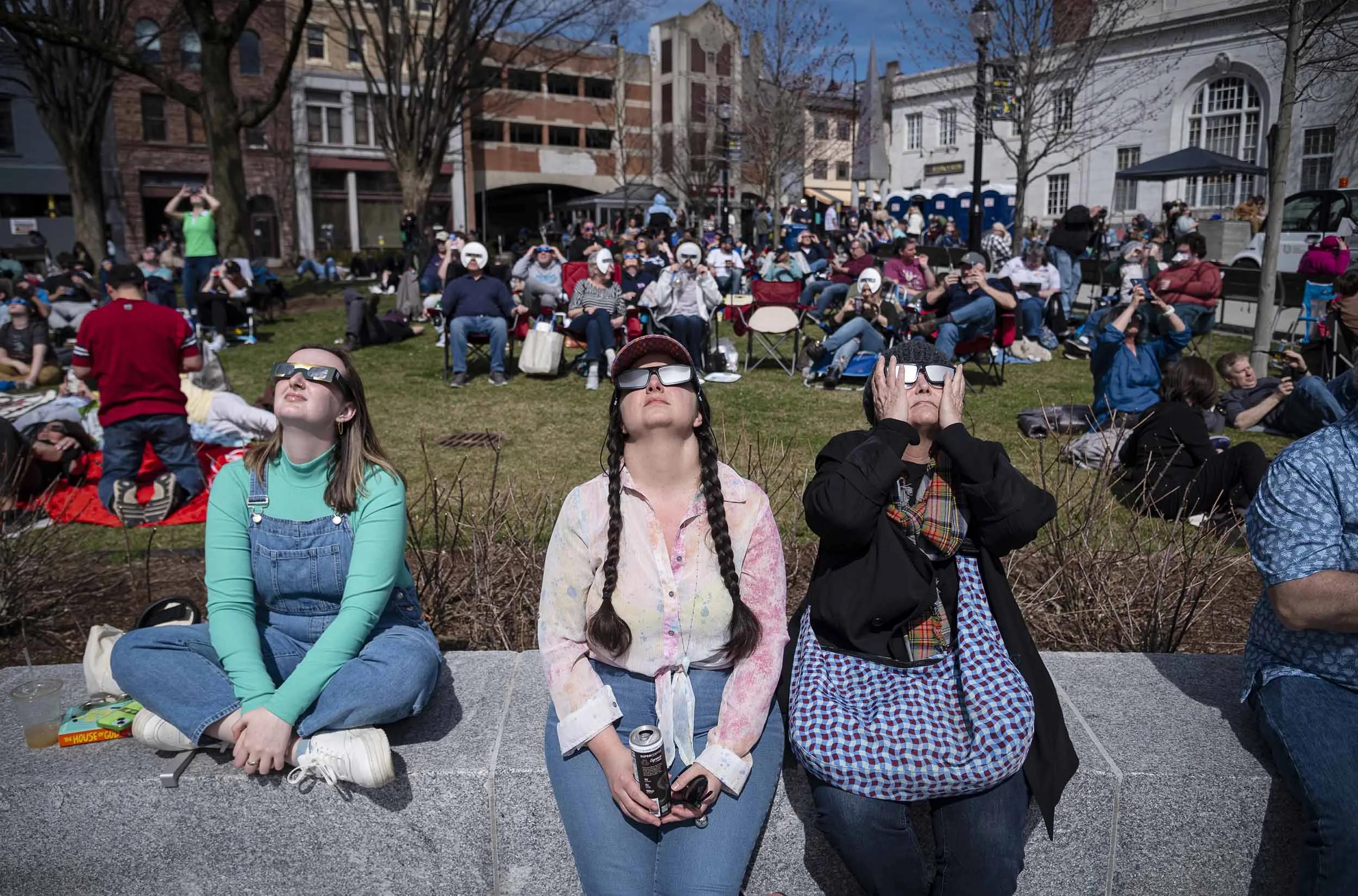
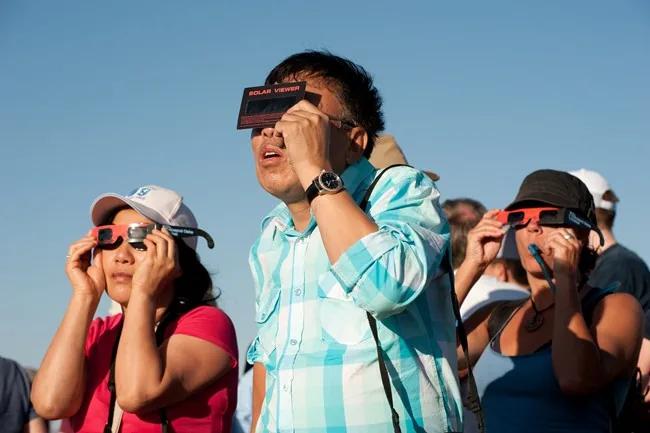
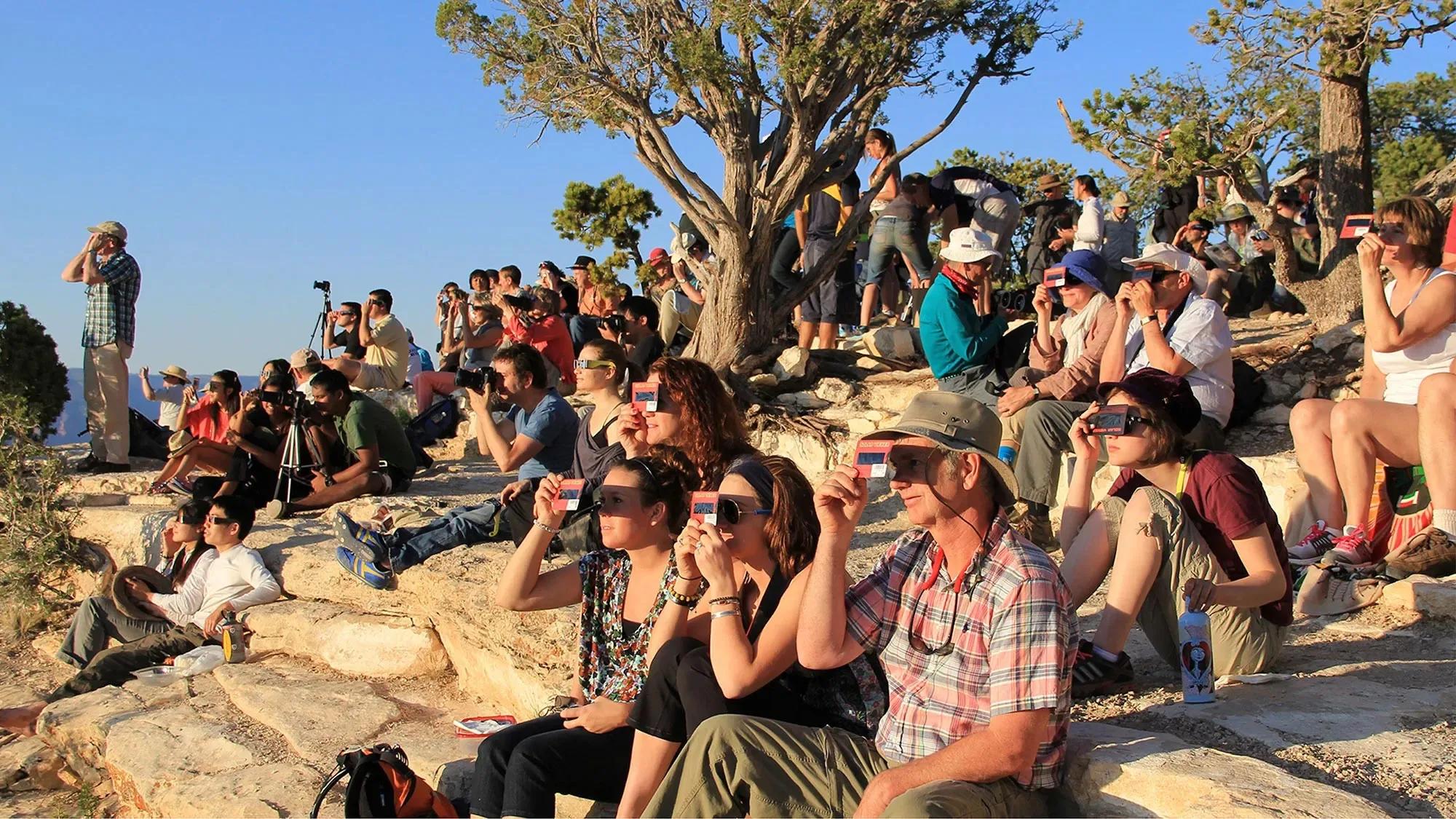
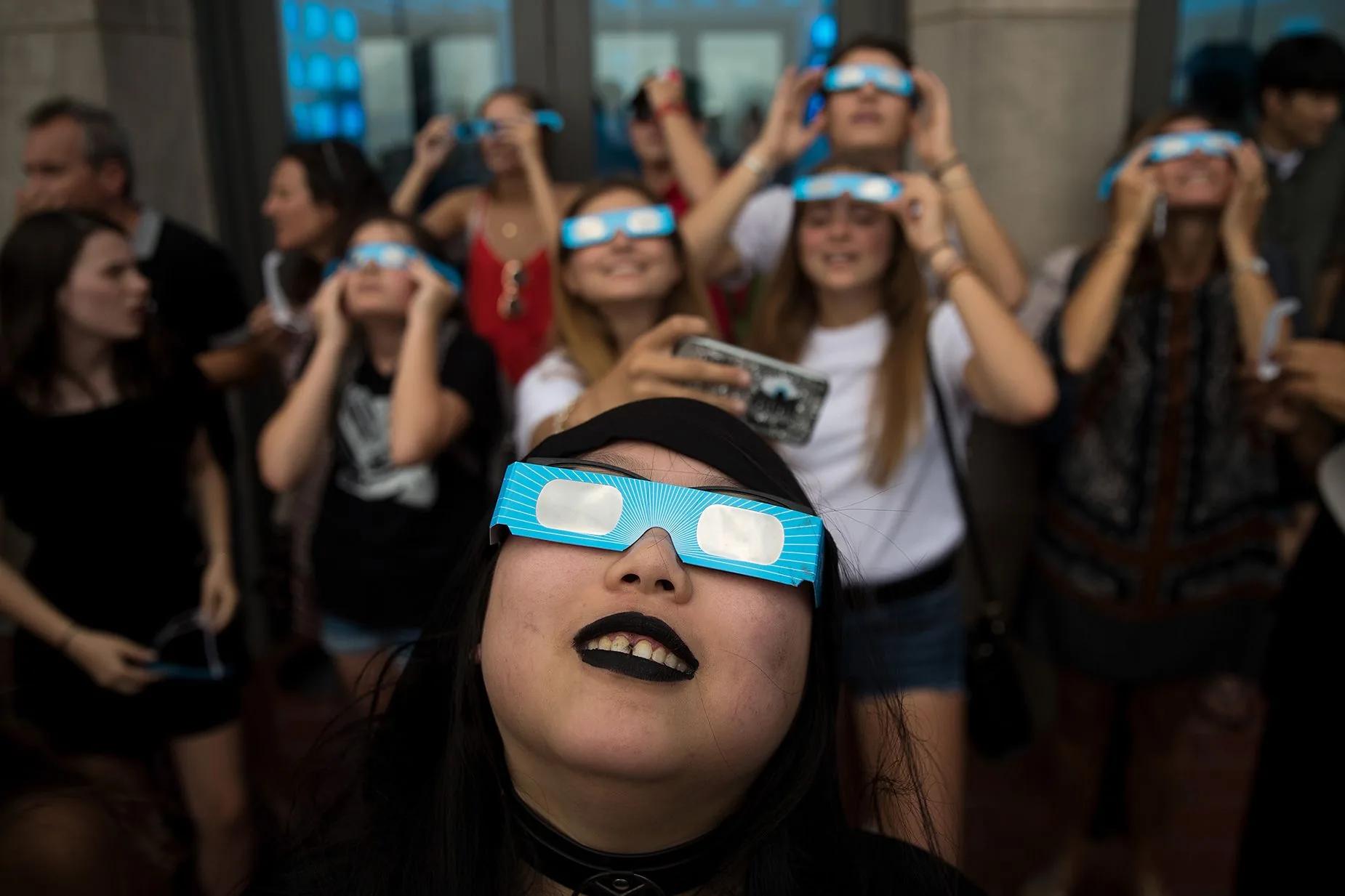
For direct, unmagnified observation of the uneclipsed, partially eclipsed, or annularly eclipsed Sun, use a genuine, undamaged solar viewer that meets the applicable safety requirements. Put the viewer over your eyes before turning toward the Sun. When you finish looking, turn away before removing it. Supervise children rather than assuming a cardboard frame will remain correctly positioned during the excitement.
Indirect projection removes the need to look toward the Sun. With your back to it, let a small opening project an image onto a shaded surface. A simple pinhole projector works; so can the gaps between crossed fingers, the holes in a colander, or spaces between leaves. Look at the projected image—not through the opening.
Projection is the best fallback when safe direct-viewing equipment is unavailable or its provenance is doubtful. It also turns the changing crescent into something a family, class, or crowd can examine together.
The totality exception must stay narrow
During the total solar eclipse of August 12, 2026, people inside the path of totality may remove solar viewers only after the Moon has completely covered the Sun’s bright face. Totality lasts only briefly and occurs nowhere outside that path. As soon as the first brilliant point of photosphere returns, viewers must go back on.
Everywhere outside totality—including locations experiencing a deep partial eclipse—certified viewers remain necessary for direct observation from beginning to end. An annular eclipse also has no glasses-off phase because the bright ring is exposed throughout maximum eclipse.
Use our Eclipse Explorer and 3D map to check whether your exact location is inside the path. Do not decide from a country name, a social-media graphic, or the fact that daylight has become strangely dim. Our phase-by-phase guide explains the visual cues and the strict boundary between partial phases and totality.
A simple plan for families, schools, and groups
Do not wait until eclipse morning to discover that half your viewers came from an untraceable giveaway or have been crushed in a drawer. Tell your group early, order from a reliable source, and inspect every viewer in good light before the event.
A practical checklist is short:
- Use purpose-made, traceable solar viewers conforming to ISO 12312-2 for direct, unmagnified viewing.
- Reject viewers that are torn, punctured, badly scratched, loose, or otherwise damaged.
- Do not substitute stacked sunglasses, smoked glass, exposed film, wrappers, CDs, balloons, or unknown reflective plastic.
- Do not rely on unidentified welding glass or adjustable and auto-darkening welding equipment.
- Keep eclipse glasses away from binoculars, telescopes, and camera viewfinders.
- Prepare a pinhole or other indirect projector as a shared backup.
- Confirm whether your site will experience totality or only partial phases.
- Supervise children and rehearse: cover eyes, look up, look away, then remove the viewer.
The welding glass solar eclipse safe myth is easiest to defeat before a crowd gathers. Give each person one clear rule and demonstrate projection in advance. That leaves eclipse day for watching the Moon take a clean, astonishing bite out of the Sun—not debating mystery materials in the car park.
TFS: Welding Glasses - Legit or S#!t?
The Fabrication Series
Frequently asked questions
What does ISO 12312-2 tell me about a solar viewer?
ISO 12312-2 covers filters intended for direct, unmagnified observation of the Sun. It addresses transmission across relevant wavelengths, uniformity, material and surface quality, secure mounting, and labeling.
Which type of eyewear should I use to watch an eclipse directly?
Use a solar viewer from a traceable supplier that conforms to ISO 12312-2 for direct, unmagnified viewing. Ordinary sunglasses, including stacked pairs, are not a tested solar-viewing system and transmit far more light than a proper solar viewer.
Are certified eclipse viewers safe during an eclipse?
Yes, a viewer that conforms to ISO 12312-2 is intended for direct, unmagnified solar viewing. Proper protection is required during every partial phase and throughout partial or annular eclipses because some of the Sun’s bright surface remains visible.
What should I consider if weather or visibility may affect my eclipse plans?
The excerpt does not provide specific guidance on weather forecasting or travel planning. It does stress that, whenever the Sun is directly visible during partial phases, proper solar protection is still required.
What are the most common mistakes new eclipse viewers should avoid?
Do not judge a filter by how dark, colored, reflective, or comfortable the Sun appears through it. Avoid improvised options such as stacked sunglasses, silvery film, or an unidentified welding filter; if using a fixed welding filter, the excerpt states that shade 12 or higher is suitable for unmagnified solar viewing.
On-site next steps
- Shop Helioclipse solar eclipse glasses and arrange enough traceable viewers for your family, class, or event.
- Inspect and store them flat, dry, and protected from scratches before eclipse day.
- Check your location with the Helioclipse Eclipse Explorer so everyone knows whether viewers stay on throughout or may come off briefly during true totality.
Sources & further reading
- American Astronomical Society: About the ISO 12312-2 Standard for Solar Viewers
- American Astronomical Society: How Can You Tell If Your Eclipse Glasses or Handheld Solar Viewers Are Safe?
- American Astronomical Society: Solar Filters for Optics: Telescopes, Binoculars & Cameras
- Ralph Chou / American Astronomical Society: Solar Eclipse Eye Safety
- Sky & Telescope: Safe Solar Observing
- American Astronomical Society: How to View a Solar Eclipse Safely
- NASA Science: Eclipse Viewing Safety
- American Astronomical Society: Eclipse Basics
- NASA Science: Eclipses
- International Organization for Standardization: ISO 12312-2:2015—Eye and Face Protection: Filters for Direct Observation of the Sun