Viral hacks and affiliate links: how eclipse misinformation travels faster than the Moon’s shadow
A video needs only seconds to demonstrate an eclipse “hack.” Testing whether that hack protects a human retina takes specialist equipment, an accredited laboratory and a chain of evidence that cannot be compressed into a dramatic before-and-after clip.
That imbalance matters ahead of the total solar eclipse on August 12, 2026. Families, schools and travel groups will be buying viewers, planning photographs and sharing advice. For the 2026 eclipse, tiktok instagram solar eclipse safety misinformation is not an abstract media-literacy problem: one confident post can influence what hundreds of people put between their eyes and the Sun.
A responsible tiktok instagram solar eclipse safety misinformation 2026 guide therefore begins with physics, not popularity. Outside the brief total phase of a total eclipse—and everywhere outside the path of totality—you need a proper solar viewer for direct observation. You can review the geometry for your exact location with our Eclipse Explorer and decide in advance whether your group will experience totality or only partial phases.
The goal is not to blame one platform or mock people who get something wrong. Misleading advice can circulate through short videos, photo carousels, group chats, forums and ordinary conversations. What protects you is learning to recognize claims that conflict with the stable safety consensus from the American Astronomical Society (AAS), NASA and eye-care organizations.
The algorithm cannot test a solar filter
Social feeds reward material that is quick, surprising and easy to repeat. Solar-viewing safety is almost the opposite: the important properties of a filter include how it transmits visible, ultraviolet and infrared radiation, whether that transmission is sufficiently uniform, and whether the filter is securely mounted and free from defects.
A viewer can look extremely dark while still lacking a trustworthy safety trail. Conversely, the Sun’s apparent color through a legitimate filter—white, orange or bluish white—does not by itself determine whether the viewer is safe. You cannot validate invisible-wavelength performance by holding a product up to a lamp, counting likes or trusting a creator’s reaction.
This is why a polished tiktok instagram solar eclipse safety misinformation video may be more persuasive than useful. The creator may sincerely believe the material is safe. They may also be repeating another post, showing an unrepresentative sample or earning commission through a product link. None of those circumstances supplies accredited test results or reliable provenance.
The same compression happens across formats. A claim discussed under a label such as tiktok instagram solar eclipse safety misinformation reddit does not become safer because commenters reach a consensus. Community discussion can uncover suspicious listings, but votes and anecdotes are not optical measurements.
The larger lesson behind viral hacks and affiliate links: how eclipse misinformation travels faster is simple: copying requires less work than verification. A false claim can move from one platform to another without carrying its original caveats, source or evidence.
Six warning signs that a solar-viewing claim is unsafe
You do not need to become an optical engineer before eclipse day. You do need a reliable pattern-recognition checklist.
- Ordinary materials are presented as direct-viewing filters. Sunglasses, smoked glass, exposed photographic film, CDs, snack wrappers and dark plastic are not substitutes for purpose-made solar viewers. Apparent darkness is not proof of safe transmission across the relevant wavelengths.
- The demonstration involves looking through a pinhole. A pinhole projector is an indirect method. You keep the Sun behind you and look at its projected image on another surface. You never look at the Sun through the hole.
- Eclipse glasses are placed behind binoculars, a telescope or a camera lens. Magnifying optics concentrate sunlight and heat. A handheld viewer at your eyes can be damaged by that concentrated beam. Optical instruments require a suitable solar filter secured over the front aperture, with expert guidance.
- A phone camera is treated as eye protection. A screen may let you compose a scene without looking directly at the Sun, but it does not make an unfiltered camera safe. NASA advises using a specialized solar filter between the camera and the Sun for eclipse photography.
- A printed ISO number is treated as complete proof. Anyone can print “ISO 12312-2” on a product page or frame. The claim needs credible manufacturing and testing provenance.
- Urgency replaces evidence. Countdown timers, “selling fast” banners and affiliate commissions tell you about a sales funnel, not filter performance. Stop and verify before buying.
One more warning sign is overconfidence about totality. Advice such as “take your glasses off when it gets dark” is dangerously incomplete. Thick cloud, a deep partial eclipse and the minutes immediately before totality can all make the landscape dimmer while some of the Sun’s bright photosphere remains visible.
Why a tiny solar crescent is still a serious light source
The question why is it not safe to view a solar eclipse? has a counterintuitive answer: an eclipse does not make the visible surface of the Sun intrinsically less intense. The Moon covers part of that surface, but any uncovered portion remains dazzlingly bright.
NASA notes that even when 99% of the photosphere is obscured during a partial phase, the remaining crescent can still injure the retina. The retina also has no pain receptors, so damage does not necessarily announce itself while exposure is happening. That is why “I will glance away if it hurts” is not a safety strategy.
Regular sunglasses are designed for ordinary daylight, not direct observation of the solar disk. Purpose-made eclipse glasses are thousands of times darker and must control more than visible brightness. Our deeper guide to ISO 12312-2 and eclipse viewers explains what the standard covers and why a printed code is only one part of the evidence.
There is one carefully defined exception. If you are inside the path of a total solar eclipse, you may view the totally eclipsed Sun without a handheld viewer only while the Moon completely covers the bright photosphere. Keep your protection on through the partial phase and the diamond-ring stage. Remove it only when no direct photospheric light remains, then replace it before the first bright point returns. Outside totality, and throughout every partial or annular eclipse, protection stays on for direct viewing. Our phase-by-phase guide is worth sharing with everyone in your group before the event.
That exception applies to unaided viewing. Cameras, telescopes and binoculars introduce separate filtration requirements; do not improvise their setup during the countdown to totality.
What ISO 12312-2 does—and does not—tell you
The useful product category is iso 12312-2 eclipse glasses: nonmagnifying viewers intended for direct observation of the Sun. The standard addresses properties including transmittance, material quality, mounting and labeling. It is not the standard for ordinary sunglasses, and it does not turn a handheld viewer into a filter for binoculars or a telescope.
Two bits of marketplace language deserve special caution. The phrase aas approved eclipse glasses is imprecise because the AAS does not operate as a product-approval agency. It maintains a list of suppliers whose products and documentation it has examined according to its stated criteria. NASA likewise says that it does not approve particular solar-viewer brands, so phrases such as “NASA approved” should not be treated as official endorsements.
The same caution applies to approved solar eclipse glasses in shopping copy. Ask: approved by whom, against what requirements, based on which test laboratory, and sold through which traceable channel? A logo or acronym without that context is a claim, not a chain of evidence.
Before trusting eclipse viewing glasses, look for:
- a clearly identified manufacturer or responsible supplier;
- instructions and warnings appropriate to the country of sale;
- a credible statement of conformity with ISO 12312-2;
- evidence that the product came directly from that supplier or an identified authorized channel;
- intact filters with no scratches, punctures, tears or separation from the frame;
- a fit that lets the viewer fully cover your eyes, including when worn over prescription glasses.
An indoor check can identify an obviously bad viewer: you should not see furnishings or normal room lighting through it, though an exceptionally bright source may appear faint. The AAS stresses an important limit, however: passing a home check does not prove ultraviolet and infrared performance. Provenance still matters.
Homemade projectors are safe; homemade direct-viewing filters are not
The wording how to make a homemade eclipse viewer? hides a crucial distinction. You can make a safe projector with simple materials, but you should not make a direct-viewing filter from household objects.
For pinhole projection, make a small hole in a card or a piece of foil and stand with your back to the Sun. Let sunlight pass through the hole onto a white card, the ground or the inside of a box. Watch the projected solar image—not the hole and not the Sun. During a partial phase, the projected disk becomes a crescent.
Nature provides the same effect. Gaps between overlapping leaves cast many tiny images of the eclipsed Sun onto the ground. A colander or perforated spoon can create a grid of crescents. These are excellent ways to involve children because several people can inspect the projection together without competing for a direct view.
Do not add lenses, binoculars or mirrors to a casual projector design. Concentrating sunlight changes the heat and injury risks. Use a design published by NASA, the AAS, a science museum or another established astronomy organization, and supervise children throughout the activity.
Cameras and binoculars are where plausible hacks become dangerous
A common clip shows eclipse glasses held over a phone, camera, binocular eyepiece or telescope eyepiece. The setup looks logical because the filter is “between” the observer and the Sun. Optically, its position is the problem.
Binoculars and telescopes collect much more sunlight than the naked eye and focus it. A filter placed at the eyepiece—or ordinary eclipse glasses worn behind unfiltered optics—can be heated or damaged by the concentrated beam. The correct instrument filter belongs securely over the front of the optics so intense sunlight and heat are blocked before entering the system.
Cameras require planning too. NASA recommends a specialized solar filter between the camera and the Sun during partial and annular phases. A long lens can concentrate substantial energy, while an optical viewfinder can create a direct path to the eye. Seek expert advice for the exact camera, lens or telescope you intend to use, and practise the sequence before eclipse day rather than inventing it while the sky is changing.
There is an easier photographic story available. Capture your family putting viewers on before looking up, crescent projections under trees, the changing landscape and people’s reactions. Those images often communicate the experience better than a tiny overexposed Sun—and they do not require you to spend the entire eclipse troubleshooting equipment.
Totality clips often lose the sentence that makes them safe
A creator standing inside the path of totality may correctly remove their viewer when the Sun is completely covered. When that clip is reposted without its location, timing and explanation, viewers elsewhere can receive the false message that glasses come off at maximum eclipse everywhere.
They do not. Totality occurs only within the Moon’s narrow central shadow. A person just outside that path sees a partial eclipse even if nearly the entire Sun is covered, and certified solar viewers remain necessary for every direct look. Annular eclipses also have no glasses-off phase because a bright ring of photosphere remains visible.
For August 12, 2026, do not rely on a creator’s city name alone. Check your precise observing point on the Helioclipse 3D map, because “near the path” is not the same as inside it. Save your location’s contact times, account for the displayed time zone and appoint someone in your group to call the transition into and out of totality. If there is any uncertainty about whether complete coverage has begun, keep the viewers on.
This is also why dramatic claims need a location. The question why will the sun disappear for 6 minutes in 2027? compresses a maximum-duration story into a universal promise. On August 2, 2027, totality duration will vary by position within the path, and people outside that path will never see the Sun completely covered. An eclipse map and location-specific contact times—not a rounded number in a caption—tell you what you can actually experience.
Health myths spread differently, but they still need evidence
Not every viral eclipse claim involves a filter. Posts may attribute headaches, fatigue, anxiety, pregnancy effects, changes in mood or unrelated symptoms to an eclipse. The anxious question why am i feeling weird after the solar eclipse? deserves a calm response rather than ridicule.
An eclipse can be an intense day. You may have travelled, slept poorly, stood in heat, skipped a meal, become dehydrated or felt a strong emotional reaction. Those ordinary factors are more useful starting points than unsupported claims about special eclipse radiation. During partial phases, the sunlight reaching you is the same kind of sunlight as usual—there is simply less of it because the Moon blocks part of the solar disk.
Eye symptoms are different because direct solar exposure is a known hazard. If you looked at the Sun without proper protection and later notice blurred central vision, a dark or yellow spot, distortion, unusual light sensitivity or loss of detail, contact a qualified eye-care professional promptly. Do not use comments under a post to diagnose or dismiss symptoms. This article provides safety education, not individual medical advice.
A 60-second verification routine before you share or buy
Pause before forwarding a safety claim to the family chat or school group. A minute of checking can stop weak advice from gaining another audience.
- Identify the viewing method. Is it direct viewing, indirect projection or magnified viewing through optics? Each has different rules.
- Find the original authority. Look for guidance from the AAS, NASA, a professional astronomical society, an observatory or a qualified eye-care organization—not a cropped screenshot claiming they said something.
- Check the exception language. Does “safe without glasses” explicitly say complete totality, inside the path of totality, and only until direct sunlight returns?
- Inspect commercial incentives. An affiliate link does not automatically make advice false, but it creates a reason to verify every safety claim independently.
- Trace the product. Confirm the manufacturer, conformity claim, condition and sales channel rather than relying on a marketplace title.
- Refuse improvised optics. Do not place handheld viewers behind unfiltered binoculars, telescopes or camera lenses.
- Share the correction with a source. A short, nonjudgmental note plus an AAS or NASA link is more useful than a pile-on.
When preparing a group, tell people early what you are buying and how it will be used. Order certified solar eclipse glasses with enough time to inspect every pair, practise fitting them over prescription glasses and replace damaged units. Last-minute scarcity is exactly when vague listings and recycled product photos become most persuasive.
Frequently asked questions
Why can looking at an eclipse without proper protection be dangerous?
Direct solar viewing requires a proper solar viewer outside the brief total phase of a total eclipse, and everywhere outside the path of totality. A safe filter must control visible, ultraviolet, and infrared transmission, be uniformly effective, securely mounted, and free from defects.
I feel strange after watching the eclipse—what does the article say?
The excerpt does not describe symptoms or explain how to assess them after an eclipse. It emphasizes preventing unsafe viewing by using a proper solar viewer when direct observation is required.
Can I make a safe eclipse viewer from household materials?
The excerpt does not support homemade solar viewers as a safe option. It explains that filter performance requires specialist equipment, accredited laboratory testing, and reliable evidence that cannot be confirmed in a short video or at home.
What should I watch for in viral eclipse-safety posts and affiliate-linked recommendations?
Treat popularity, confident presentation, and product links as insufficient evidence of safety. A creator may be sincere, repeating another post, showing an unrepresentative sample, or earning a commission, but none of these provides accredited test results or reliable provenance.
How can I tell whether eclipse glasses are suitable for direct solar viewing?
Do not judge a solar viewer by how dark it looks, the Sun’s color through it, a lamp test, likes, or a creator’s reaction. The excerpt says a trustworthy viewer needs appropriate transmission properties, uniform performance, secure mounting, and no defects, supported by a reliable safety trail.
On-site next steps
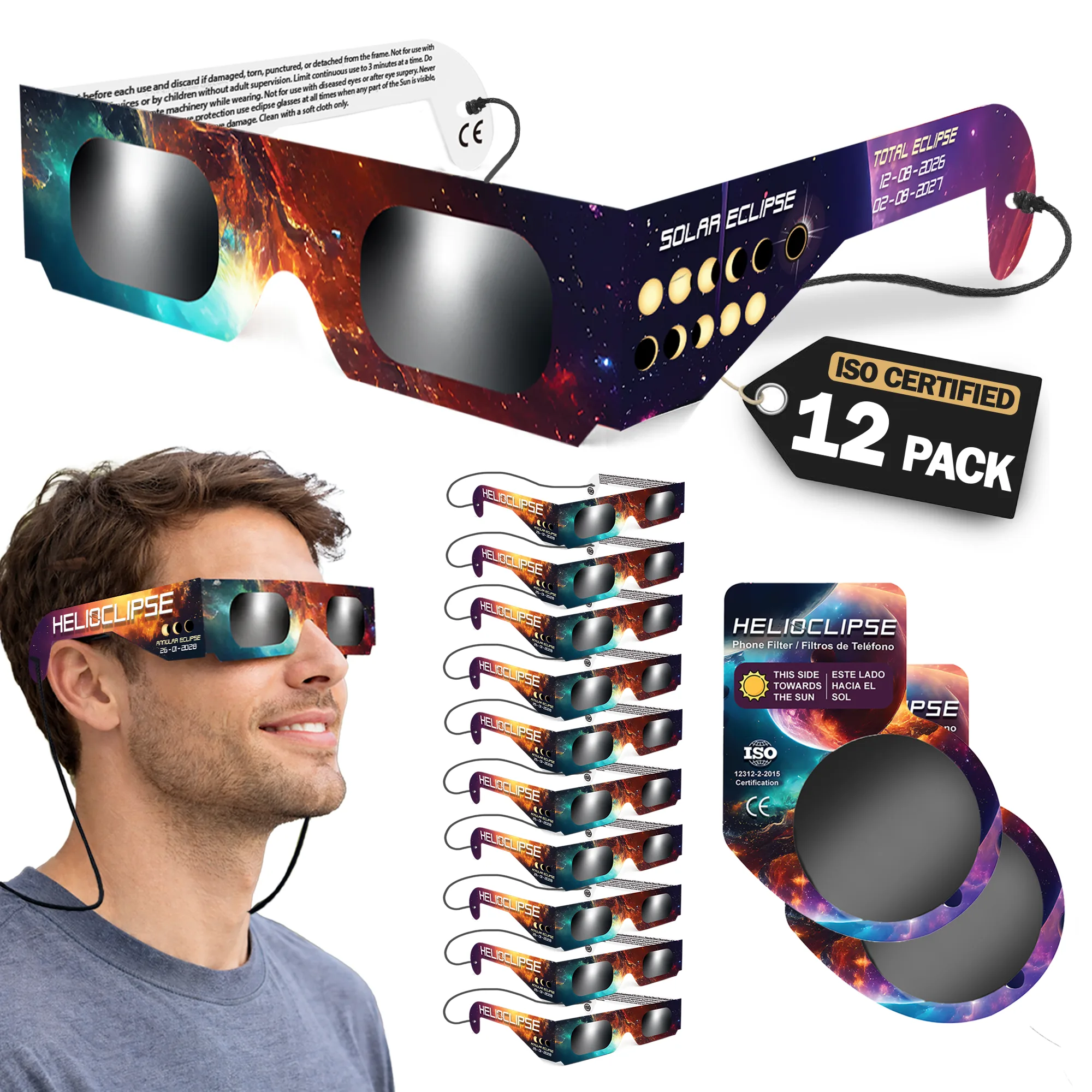
- Choose a traceable source rather than an anonymous viral link: shop Helioclipse solar eclipse glasses designed for direct solar viewing and certified to ISO 12312-2.
- Inspect each viewer before eclipse day, discard damaged filters and rehearse the “cover eyes, look up, turn away, then remove” sequence with children.
- Confirm whether your exact location reaches totality with the Eclipse Explorer. If it does not, viewers stay on for every direct look.
- Send your group one agreed safety reference now. It is much easier to establish the rules before the excitement, travel and countdown begin.
Sources & further reading
- Fake solar eclipse glasses are everywhere ahead of the total solar eclipse. Here's how to check yours are safe — Space.com
- AAS's Advice for Safe Solar-Eclipse Viewing — Sky & Telescope
- Five Tips for Photographing the Annular Solar Eclipse on Oct. 14 — NASA Science
- Total Solar Eclipse FAQ — NASA Science
- What to Expect — NASA Science
- How to View a Solar Eclipse Safely — American Astronomical Society
- How Can You Tell If Your Eclipse Glasses or Handheld Solar Viewers Are Safe? — American Astronomical Society
- About the ISO 12312-2 Standard for Solar Viewers — American Astronomical Society
- Solar Filters for Optics: Telescopes, Binoculars & Cameras — American Astronomical Society
- Eclipse Viewing Safety — NASA Science