Trains, transit, and the eclipse path: what rail can (and cannot) solve
A train can move hundreds of people efficiently across a country. It cannot move the path of totality, lower a mountain, hold a connecting bus, or open a hole in the clouds. That distinction is the foundation of sensible rail planning for the total solar eclipse on August 12, 2026.
Europe’s accessible rail network makes this eclipse unusual. The Moon’s central shadow crosses Greenland, western Iceland, a small part of Portugal, and Spain; the rest of Europe sees a partial eclipse of varying depth. In Spain, rail can take you close to numerous places inside the path. Yet the Sun will be low in the west or northwest, so the last few kilometres—and the shape of the horizon there—may matter more than the elegance of your long-distance itinerary.
Start by plotting candidate stations and viewing sites on our Eclipse Explorer and 3D map. Do that before buying a ticket. A station pin is not proof of totality, and a town inside the path is not proof that the Sun will be visible from the station square.
First solve the eclipse geometry
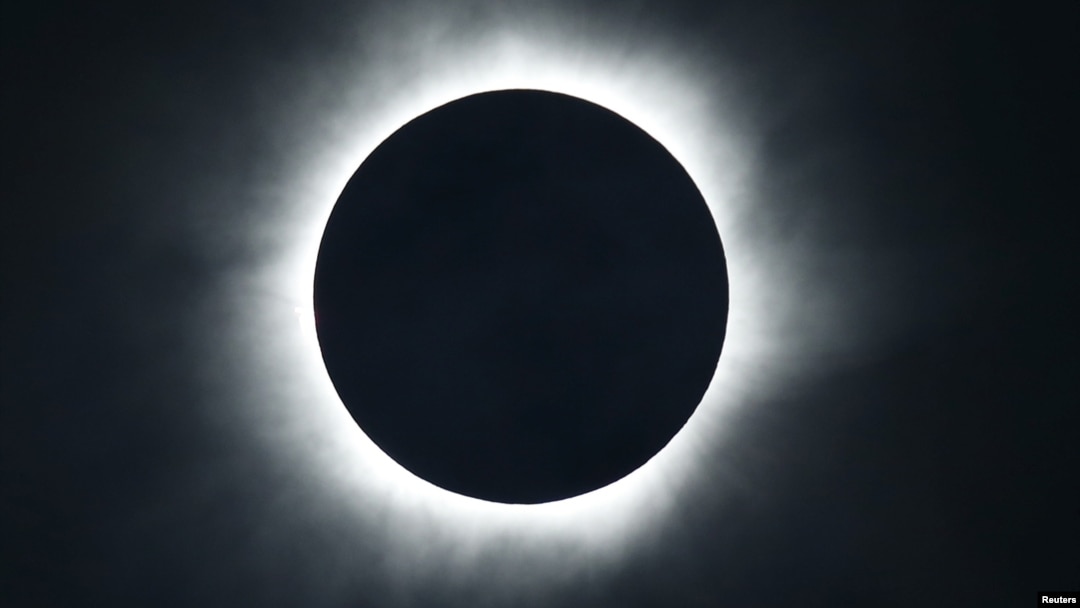
The total solar eclipse 2026 path is the narrow strip where the Moon completely covers the Sun. NASA’s map shows the umbra moving through the Arctic and North Atlantic, across western Iceland, and into Spain. Sky & Telescope gives the path as roughly 293 kilometres wide and about 8,260 kilometres long, with the greatest duration—about 2 minutes 18 seconds—off Iceland.
That width sounds generous until a transport plan treats “near the path” as equivalent to “inside it.” Madrid and Barcelona are both outside totality, despite being obvious rail and air gateways. They will experience deep partial eclipses, but even 99% coverage is not totality: a sliver of the bright photosphere remains, the corona does not emerge in the same way, and solar viewers must stay on throughout.
Our detailed guide to the 2026 totality path in Spain explains why the centreline is not the only reasonable target. Moving from just outside the boundary to just inside changes the event from partial to total. Moving farther toward the centre generally adds duration, but it may not justify a fragile connection or a poor western horizon. A reliable site with 60–90 seconds of totality can be a better plan than a theoretical maximum reached by a final train with no margin.
Any train travel solar eclipse europe 2026 map therefore needs two layers: eclipse geometry and the actual transport network. Add a third layer for terrain. In Spain, the eclipsed Sun will be low: sources describe an altitude of roughly 12° in parts of the peninsula, falling to only a few degrees toward the Balearic end of the track. A ridge, apartment block, tree line, or platform canopy can erase the view even when your coordinates are comfortably inside the path.
Where rail is genuinely useful
For train travel solar eclipse europe 2026, Spain offers the clearest case for using rail as the long-distance backbone. The path crosses the peninsula from the north and northwest toward the Mediterranean, putting a number of regional centres and smaller communities within reach of intercity or regional services. Valladolid, Burgos, Zaragoza, and parts of the Ebro corridor are the kinds of places worth testing on the map—not because every platform is automatically suitable, but because they can combine accommodation, food, onward transport, and access to more open terrain.
Spain’s total phase lasts up to about 1 minute 44 seconds, depending on location. The event occurs shortly before sunset, so reaching the right longitude is only part of the job. Around Valladolid or the northern plateau, open ground may offer a more forgiving western view than a valley or historic centre. Around Zaragoza and farther east, the Sun is lower, making exact terrain and sightline checks increasingly important. Barcelona remains outside the path, while Madrid is also outside it and should be treated as a gateway rather than a totality destination.
Rail is particularly good at solving three problems:
- moving a group between major cities without assigning someone a long drive;
- avoiding the need to park a car in a crowded town centre;
- providing a comfortable base journey that can be combined with a local bus, taxi, bicycle, or planned walk.
It is less useful for a rapid weather chase. Trains follow fixed tracks and published stopping patterns. On eclipse day, the clear patch may be west of your planned branch line or beyond the final bus stop. If mobility is central to your cloud strategy, choose a base with several realistic corridors rather than assuming one train can function like an on-demand chase vehicle.
Spain, Iceland, Ibiza, Madrid, and England are different plans
There is no single best train travel solar eclipse europe 2026 itinerary because the practical trade-offs change across the continent.
Mainland Spain
Mainland Spain combines the strongest rail possibilities with comparatively favourable August climate prospects, but it also has the most serious low-horizon problem. The path runs diagonally across northern Spain and toward the Mediterranean. The Sun’s altitude decreases along that route, so a station farther east may offer totality yet demand a much cleaner horizon than a site farther west.
The phrase solar eclipse madrid 2026 describes a major partial eclipse, not totality. Madrid can still work as an arrival point, but your onward journey must cross the path boundary if totality is the goal. Do not plan to return immediately after the eclipse unless your reservations and operator information support it; road and station congestion may peak when large numbers of people leave at once.
The Balearic Islands
A solar eclipse ibiza 2026 plan is not a train plan at all. It is an island itinerary involving flights or ferries, local roads, and a very low Sun. Parts of the Balearic region lie in the eclipse track, but exact island and site geometry must be checked on a detailed map. Near the path’s sunset end, atmospheric refraction, local terrain, haze, and a horizon measured in only a few degrees all become consequential. Do not infer totality from the island name alone.
Iceland
Western Iceland, including Reykjavík and the Reykjanes and Snæfellsnes areas, lies within the path. Iceland offers roughly 2 minutes 13.7 seconds of totality on land in favourable locations, with the Sun around 25° above the southwest horizon—a far less severe sightline challenge than eastern Spain.
But Iceland is not a rail destination. Buses, organised transport, rental vehicles, and carefully selected accommodation do the work. Roads can be constrained, and weather may vary sharply over short distances. A European rail pass does not create mobility once you land there.
England and the rest of the UK
The solar eclipse england 2026 experience is partial. Rail can be useful for reaching a coastal or open-horizon site, but no train within England crosses into totality. Anyone considering a Channel crossing should compare the cost and complexity with the actual difference in experience. Our guide to the 2026 partial eclipse from the UK helps make that comparison without pretending that a deep partial eclipse and totality are interchangeable.
Tickets are inventory, not an eclipse guarantee
Questions about train travel solar eclipse europe 2026 dates have one fixed astronomical answer—Wednesday, August 12, 2026—but transport sales windows, reservation rules, and seasonal schedules vary by operator and route. A timetable visible months in advance may be provisional, while some tickets may not be released until much later. Engineering work, strikes, special-event controls, or altered stopping patterns can also intervene.
Treat train travel solar eclipse europe 2026 tickets as a chain of contractual and operational details, not merely a confirmation email. Check whether you have one through-ticket or several separate tickets, whether a specific train is compulsory, what happens after a missed connection, and whether your local segment accepts bicycles or oversized luggage. Save the relevant operator apps and booking references, but also keep screenshots or offline copies in case mobile networks become congested.
EU passenger-rights rules provide important protections on many journeys, but exemptions and conditions apply. The European Commission says passengers should receive information about fares, connections, accessibility, disruptions, and their rights. For a cancellation or delay expected to put arrival more than 60 minutes late, refund or rerouting rights may apply. Those protections can help recover money or complete a journey; they cannot restore totality after the Moon’s shadow has passed.
That is why we prefer an arrival plan measured in hours or a full day, not minutes. If the eclipse is the purpose of the journey, sleep inside the path on August 11 where possible. The morning of August 12 can then be used for a controlled local move rather than a high-stakes cross-country transfer.
The final mile is where elegant plans break
A rail itinerary often ends at the point where eclipse planning becomes most specific. The viewing field may be six kilometres from the station. The connecting bus may run every two hours. A taxi company may stop taking advance reservations. A route that looks walkable may have no pavement, little shade, or an unsafe road crossing.
For every candidate site, write down the answers to five questions:
- Is it definitely inside totality? Check the exact coordinates, not only the town name.
- What blocks the west or northwest? Use terrain tools and, ideally, inspect the site in person or through recent street-level imagery.
- Can everyone in the group cover the final distance? Include children, older relatives, wheelchairs, luggage, and August heat.
- What happens if the local connection fails? Identify a walkable fallback rather than relying on an imaginary taxi supply.
- Can you remain there after the eclipse? Immediate departures concentrate demand and leave no room for delays.
For a family, a 20-minute walk on paper can become much longer with water, food, folding seats, and excited children. For a school or club, keeping the group together may matter more than reaching the centreline. Tell everyone the fallback meeting point before leaving the station, and assume that messages may arrive slowly when local networks are crowded.
A practical train travel solar eclipse europe 2026 2026 guide must therefore treat walking time, accessibility, heat, toilets, and the return journey as part of the astronomy. The eclipse is brief; the day around it is not.
Weather flexibility has limits on rails
The climate case for Spain is encouraging, not deterministic. Sky & Telescope cites an average cloud-cover estimate around 35% for Spain while also warning about late-day storms and mountainous terrain. Iceland has more variable cloud prospects but a higher Sun and potentially useful local forecast detail. Neither destination comes with a clear-sky warranty.
The strongest rail-based weather plan is not “go anywhere.” It is “retain two or three reachable options along useful lines.” Select a primary site and alternatives that are all inside totality, have acceptable horizons, and can be reached without a sequence of tight reservations. Compare forecasts on August 11, then commit early enough to avoid becoming trapped between connections.
Do not chase every model update. A forecast difference that looks dramatic on a coloured map may represent uncertain cloud timing rather than a dependable clear slot. Our guide to cloud cover and eclipse-day mobility explains when movement improves the odds and when it merely exchanges one uncertainty for another.
Rail can widen your choice of bases. It cannot provide the fine-grained, last-minute freedom of a private vehicle, and even a car can become useless in gridlock. The right backup is the one your group can actually execute.
Build a multimodal plan with failure margins
Many 2026 solar eclipse trips will be multimodal: flight or international train, intercity rail, regional service, and then a bus, taxi, bicycle, or walk. The plan should still work after one minor failure.
Use a simple hierarchy:
- Base: accommodation inside the path, preferably for the nights before and after the eclipse.
- Primary site: reachable without a critical same-day long-distance connection.
- Weather alternative: also inside totality and served by a genuinely usable route.
- Walkable fallback: less ambitious but safe, open, and within the path.
- Return plan: late enough to absorb crowds, with food and water available.
When comparing eclipse travel 2026 options, count vulnerable links rather than kilometres. A 500-kilometre direct train arriving the day before may be safer than a 70-kilometre journey involving three unprotected connections on eclipse afternoon. The same logic should guide 2026 solar eclipse travel for families: fewer handoffs usually mean fewer ways to miss the event.
Share the plan early. Give friends or relatives the exact coordinates, station name, intended walking route, and fallback. If someone joins late, do not rebuild the entire itinerary around an unavailable seat or distant hotel. Totality rewards coordination more than improvisation.
Astronomy, not astrology—and safety on every platform
The awkward phrase train travel solar eclipse europe 2026 astrology mixes two unrelated subjects. The path, contact times, Sun altitude, and duration come from astronomy: measured motions of Earth and the Moon, calculated with ephemerides. Astrology does not determine where the umbra falls or which train reaches it.
Safety also follows the physical geometry. During every partial phase, and throughout the entire event outside totality, look at the Sun only through suitable solar viewers conforming to ISO 12312-2. Ordinary sunglasses are not enough. Only observers inside the path may remove viewers, and only after the Sun’s bright face is completely covered; viewers must go back on as soon as direct sunlight reappears. Our phase-by-phase safety guide is worth sharing with every member of your group before travel day.
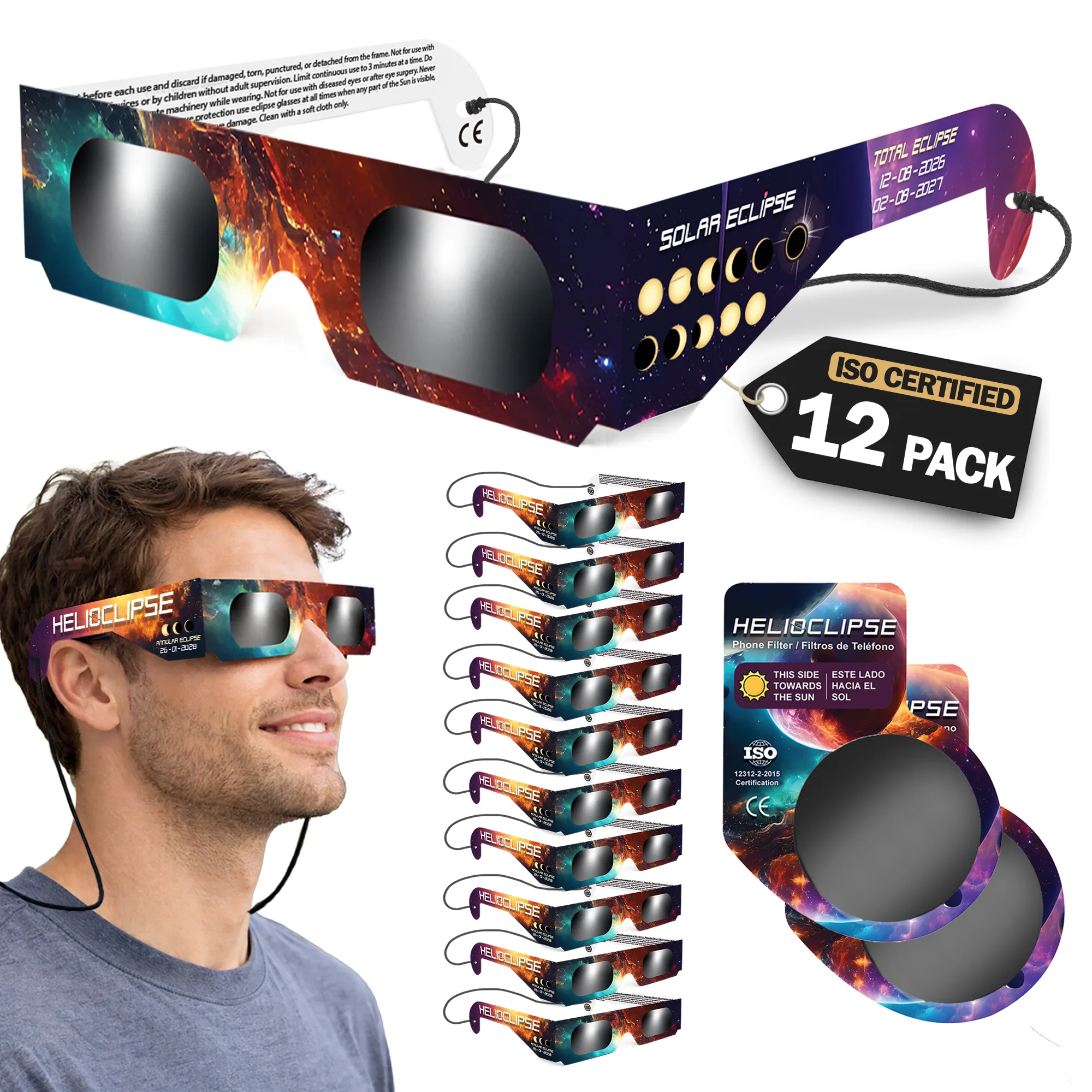
Buy and inspect viewers before departure rather than hoping to find them at a station kiosk. Product language can be confusing: eclipse glasses nasa approved is not a legitimate certification category because NASA does not commercially approve individual products. Instead, look for trustworthy seller information, clear instructions, undamaged filters, and solar eclipse glasses iso 12312-2 certified for direct, unmagnified viewing. You can order Helioclipse solar eclipse glasses early enough to inspect and pack them calmly.
Keep viewers flat and protected from scratches or punctures. Do not use them as filters in front of binoculars, telescopes, or camera lenses; concentrated sunlight can damage the filter and your eyes. Optical equipment requires a correctly fitted filter over its front aperture and expert guidance.
A realistic booking sequence
The planning order matters more than finding a supposedly perfect rail itinerary.
- Map the path. Identify several exact coordinates inside totality.
- Check the horizon. In Spain, prioritise an unobstructed west or northwest view.
- Choose a base inside the path. This removes the most dangerous same-day transfer.
- Research current operators and connections. Do not assume today’s timetable will be the August 2026 timetable.
- Book accommodation and major transport when appropriate. Read change and cancellation terms.
- Design the last mile. Confirm walking routes, accessibility, heat exposure, and a fallback site.
- Add weather options. Keep them few, realistic, and inside totality.
- Pack viewers, water, food, power banks, and offline records. Do not depend on event-day retail stock or mobile data.
A free train travel solar eclipse europe 2026 2026 guide map can show the broad relationship between tracks and shadow, but only current operator information can confirm service. Likewise, a train travel solar eclipse europe 2026 2026 guide time displayed by a journey planner is not a promise that the same service will run unchanged on eclipse day. Recheck every leg as August approaches.
The best plan is not the one with the most impressive centreline pin. It is the one that gets your group inside the path early, gives everyone a clear and safe place to stand, and survives a delayed train without turning two minutes of celestial drama into a platform sprint.
Frequently asked questions
Where in Europe can I see totality during the August 12, 2026 solar eclipse?
Totality crosses Greenland, western Iceland, a small part of Portugal, and Spain; elsewhere in Europe, the eclipse will be partial. In Spain, choose a viewing site that is genuinely inside the path and has a clear low western or northwestern horizon.
Can I book a rail-based eclipse tour for 2026?
The excerpt does not provide information about organised tours or bookings. It does show that rail can reach many areas near the Spanish section of the totality path, but travellers must independently verify the final viewing site, connections, and horizon.
Is train travel a practical way to reach the 2026 eclipse path in Europe?
Yes, rail can efficiently bring travellers close to many locations within the Spanish totality path, but a station is not automatically a suitable viewing location. Map the eclipse path, transport network, terrain, and the final kilometres to your chosen site before purchasing tickets.
What should a rail travel guide for the 2026 eclipse include?
A useful guide should combine the totality path with station locations, local transport options, and terrain rather than treating a nearby town or station as proof of a view. It should also account for the low Sun, which may be blocked by ridges, buildings, trees, or platform canopies.
What is the most important thing to plan for when travelling to the 2026 eclipse?
First confirm that your viewing site is inside the narrow path of totality, not merely near it. Then prioritise a reliable location with a clear horizon and enough connection time over chasing maximum duration through a fragile final journey.
On-site next steps
- Plot your station, accommodation, viewing site, and weather alternatives on the Helioclipse Eclipse Explorer. Check both the path boundary and the western horizon.
- Read our August 12, 2026 planning guide before committing to transport and accommodation.
- Order ISO 12312-2 certified Helioclipse viewers for your family or group in time to inspect and pack them before departure.
Sources & further reading
- August 12, 2026 Solar Eclipse Map — National Solar Observatory
- Map of the August 12, 2026, Total Solar Eclipse — NASA Scientific Visualization Studio
- Eclipse chasers share insider tips, travel advice and skywatching secrets for the 2026 total solar eclipse — Space.com
- Plan Now for the 2026 Total Solar Eclipse in Europe — Sky & Telescope
- Rail passenger rights — European Commission
- Eclipses and the Moon — NASA Science
- Why Do Eclipses Happen? — NASA Science
- Eclipse Basics — American Astronomical Society
- How to View a Solar Eclipse Safely — American Astronomical Society
- About the ISO 12312-2 Standard for Solar Viewers — American Astronomical Society