Oviedo in 2026: one city, one eclipse—Asturian clouds as a planning character, not a spoiler
Oviedo will be inside the path of totality on August 12, 2026. That single fact turns an ordinary Wednesday evening into a rare appointment with the Moon’s shadow—but it does not settle where you should stand, whether the western sky will be open, or what Asturian cloud will do.
The challenge is unusually visual. Totality reaches northern Spain late in the evening, when the Sun is already low in the west-northwest. In Asturias, the eclipsed Sun should be roughly 10–12 degrees above the horizon, with the precise altitude depending on your coordinates. A building, wooded slope, or stubborn strip of marine cloud can therefore matter more than a beautiful overhead forecast.
This total solar eclipse 2026 Oviedo Spain 2026 guide treats those constraints as planning information, not a verdict against the city. Start by placing your exact accommodation and candidate observing sites on our Eclipse Explorer and 3D map. Confirm that each coordinate is inside totality, note the local contact times, and inspect the direction and height of the Sun rather than relying on a generic Spain-wide timetable.
Oviedo is in totality—but your exact coordinates still matter
The total solar eclipse 2026 path crosses Greenland, western Iceland, the Atlantic, northern Spain, and a very small part of Portugal. Oviedo lies within the broad Spanish totality corridor, so an observer at a suitable site in the municipality can experience the Sun’s bright face becoming completely covered by the Moon.
That is categorically different from a 99% partial eclipse. Madrid and Barcelona, for example, remain outside totality despite seeing extremely deep partial phases. Even a narrow uncovered arc of the photosphere is bright enough to suppress the corona and requires solar viewers. In Oviedo, by contrast, the corona can become visible during the brief interval when the photosphere is fully hidden—if clouds and the local horizon cooperate.
The available source payload does not provide a verified coordinate-specific duration for central Oviedo, so we will not manufacture one. Two published regional benchmarks show the correct scale: Space.com lists totality in coastal Gijón at about 8:26 p.m. CEST for approximately 1 minute 46 seconds, while Burgos is listed at about 8:28 p.m. CEST for approximately 1 minute 44 seconds. NASA places totality in León between approximately 8:28 and 8:30 p.m. local time. These are useful checks, not substitutes for an Oviedo calculation.
For the total solar eclipse 2026 Oviedo Spain date and time, use an exact pin on the map and record at least four quantities: the start of the partial eclipse, the start and end of totality, the Sun’s altitude, and its azimuth. The expected order of magnitude is an evening partial phase followed by totality around 8:26–8:29 p.m. CEST, but your map result—not a nearby-city table—should run your countdown.
The low Sun changes what counts as a good city site
The central question for an Oviedo Spain solar eclipse plan is not merely whether a park or plaza has open sky overhead. You need a clean view low toward the west-northwest. Ten degrees above the horizon is only about the width of a fist held at arm’s length. Trees, apartment blocks, stadium structures, church towers, and nearby terrain can all enter that small vertical window.
Scout each candidate site at approximately the eclipse time on August 11, or as close to that date and time as practical. The Sun will then indicate almost the same sightline needed the following evening. Stand where you actually expect to observe—not at the edge of a car park or on a nearby street—and check whether the solar disk remains visible above the real horizon.
An elevated location can improve a sightline, but “higher” does not automatically mean “clearer.” A ridge may expose you to wind, restricted access, difficult parking, or a cloud layer that remains just as troublesome as it is below. Within Oviedo’s municipal scope, the slopes and elevated ground associated with Monte Naranco may look tempting on a map, but they should be evaluated as individual sites, not advertised as a meteorological escape hatch. Confirm public access, safe standing space, the west-northwest horizon, and your route home.
The total solar eclipse 2026 Oviedo Spain map is therefore a starting point rather than a final site recommendation. Combine eclipse geometry with an in-person horizon check. A less scenic open space with a reliable sightline may outperform a dramatic viewpoint where one wooded shoulder blocks the last ten degrees of sky.

Asturian cloud is a process, not a prophecy
Oviedo sits inland from the Bay of Biscay but remains strongly connected to Asturias’ marine environment. Moist Atlantic air, changing wind direction, coastal low cloud, and mountainous terrain can produce a sky that varies over surprisingly short distances and times. August climate statistics help describe the background risk; they cannot tell you whether a particular cloud bank will cover the Sun during a roughly two-minute window on August 12, 2026.
Orographic influence occurs when moving air is forced to rise over elevated terrain. Rising air expands and cools, and if it reaches saturation, cloud droplets can form. That is the basic physical feature needed for orographic cloud and precipitation: moist air crossing terrain that makes it ascend. Coastal regions can receive more cloud and rain when nearby water supplies moisture and the landscape provides that lift, although wind direction and atmospheric stability determine how the process unfolds on a given day.
For eclipse planning, this matters in two different ways. First, a cloud forecast for central Asturias should not be reduced to a single percentage icon. Low cloud, middle cloud, high cloud, cloud-base height, wind, and the position of breaks all affect the view differently. Thin high cloud may allow a filtered corona or at least a visible partial phase; an opaque low deck can hide the Sun completely.
Second, overhead blue sky is not enough. Because totality is low in the west-northwest, you care about the atmosphere along a long slanted sightline. A bank of cloud near the distant horizon can block the eclipse while the zenith remains blue. Conversely, a forecast labeled “partly cloudy” may still leave the required sector open at precisely the right moment.
That is why Asturian clouds belong in the story as a planning character. They create uncertainty, but uncertainty is not the same as failure. Even under an overcast sky, the rapid drop in illumination during totality can still be striking. The best outcome, of course, is a break in the correct direction—and your preparation should be designed to recognize and use that break.
Build a forecast routine instead of chasing every model run
Long-range forecasts issued weeks ahead cannot resolve an eclipse-minute cloud gap over Oviedo. Use them for broad patterns only. The useful decision window tightens substantially during the final several days, when forecast models, satellite images, radar where relevant, and local observations begin to describe the actual air mass.
A sensible routine looks like this:
- Seven to five days out: watch the large-scale pattern without committing to every forecast swing. Note whether Atlantic flow, a stable high-pressure pattern, or unsettled conditions are being suggested.
- Three to two days out: compare more than one model and distinguish low, middle, and high cloud. Pay particular attention to the western and west-northwestern sector, not just cloud cover directly over your pin.
- Twenty-four hours out: use satellite imagery to see how marine cloud behaves in the real atmosphere. Check local forecasts and official warnings, then settle on a primary site and a practical municipal backup.
- On eclipse day: observe the sky itself. Track the direction and speed of cloud movement. Set a firm decision deadline so that a late, emotional move does not leave your group in traffic or at an unscouted horizon.
Our broader guide to cloud cover and eclipse-day mobility explains how to turn forecasts into go-or-stay decisions. For an Oviedo-based plan, mobility should remain honest: moving across the municipality may improve a sightline or exploit a visible gap, but it cannot guarantee different regional weather.
Do not let your vehicle become the plan. If thousands of people react to the same cloud forecast, roads and parking areas can lose their usefulness quickly. A known site with a clear horizon and manageable access can be a better choice than a theoretically clearer destination you cannot reach.
What the evening should feel like if the sky opens
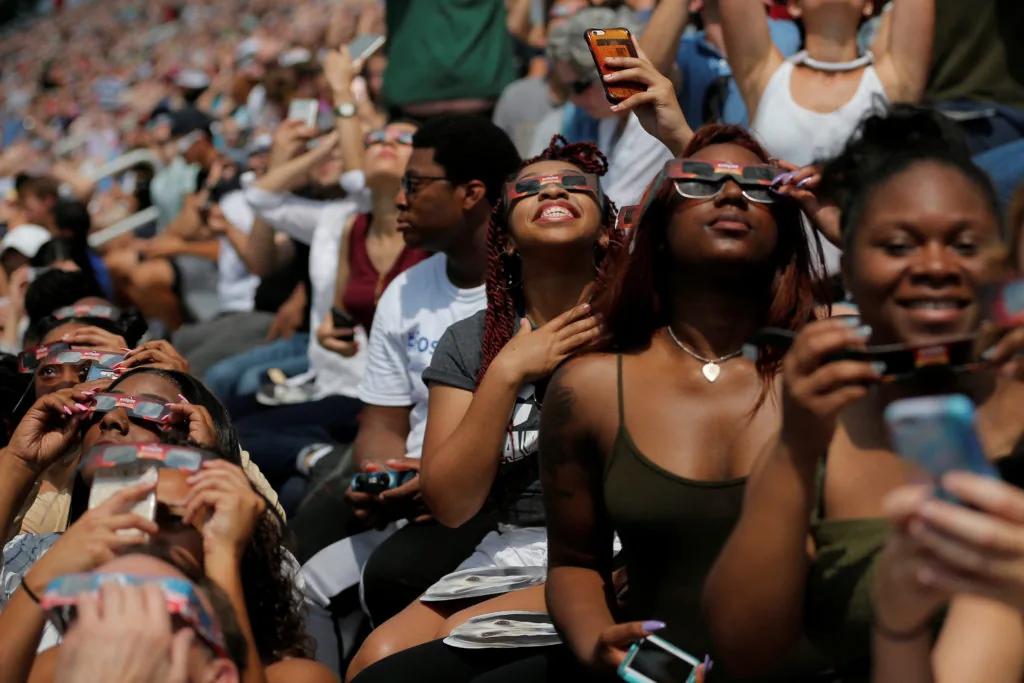
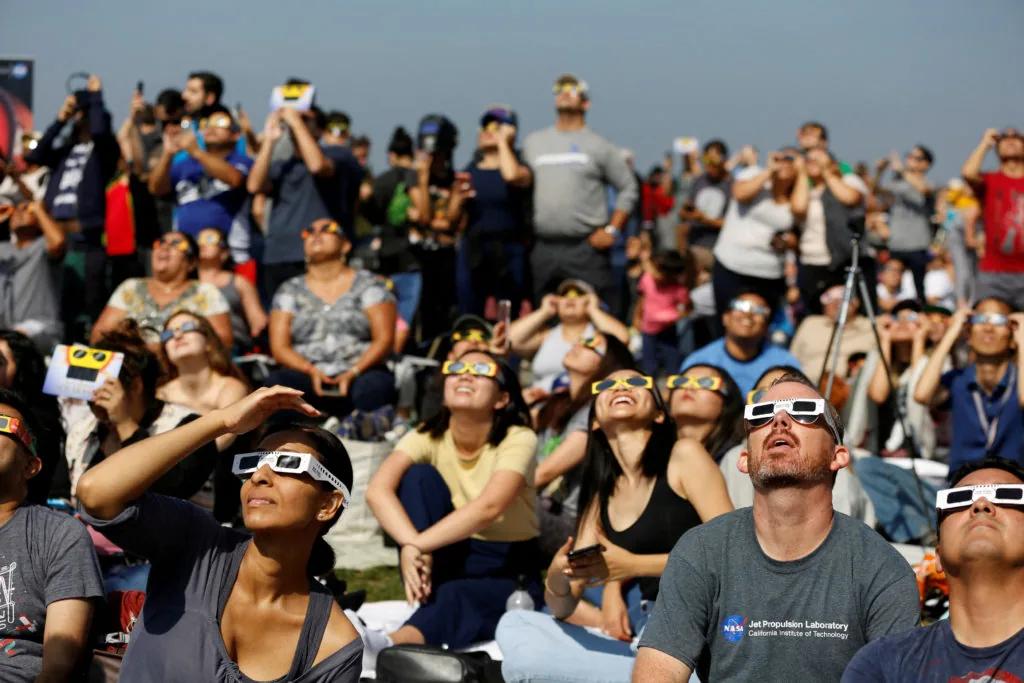
The partial phase unfolds gradually. Through proper solar viewers, the Moon appears to take an increasingly large bite from the Sun. Changes in ambient light become more noticeable near the end, and shadows may look unusually sharp as the exposed photosphere narrows to a crescent.
Then the pace seems to accelerate. The western sky darkens, the temperature may dip, and familiar streets or open ground take on a strange, muted appearance. When the last uncovered point of the photosphere disappears, totality begins. Only then may you remove your solar viewers and look directly at the black lunar silhouette surrounded by the corona.
For Oviedo, the low altitude adds a compressed, near-sunset quality to the scene. The corona will hang close to the west-northwestern landscape rather than high overhead. Any clear view will need to fit between the real horizon below and cloud above. That constraint is exactly why the site inspection matters so much.
Totality will last on the order of less than two minutes in this part of Spain, judging from the published Gijón, León, and Burgos benchmarks. It is enough time to see the corona and absorb the transformed city, but not enough time to troubleshoot a camera, distribute glasses, or explain the safety sequence. Agree beforehand that one person will call “glasses off” only after the bright photosphere has vanished and “glasses on” the instant it returns.
Safety rules for a low evening eclipse
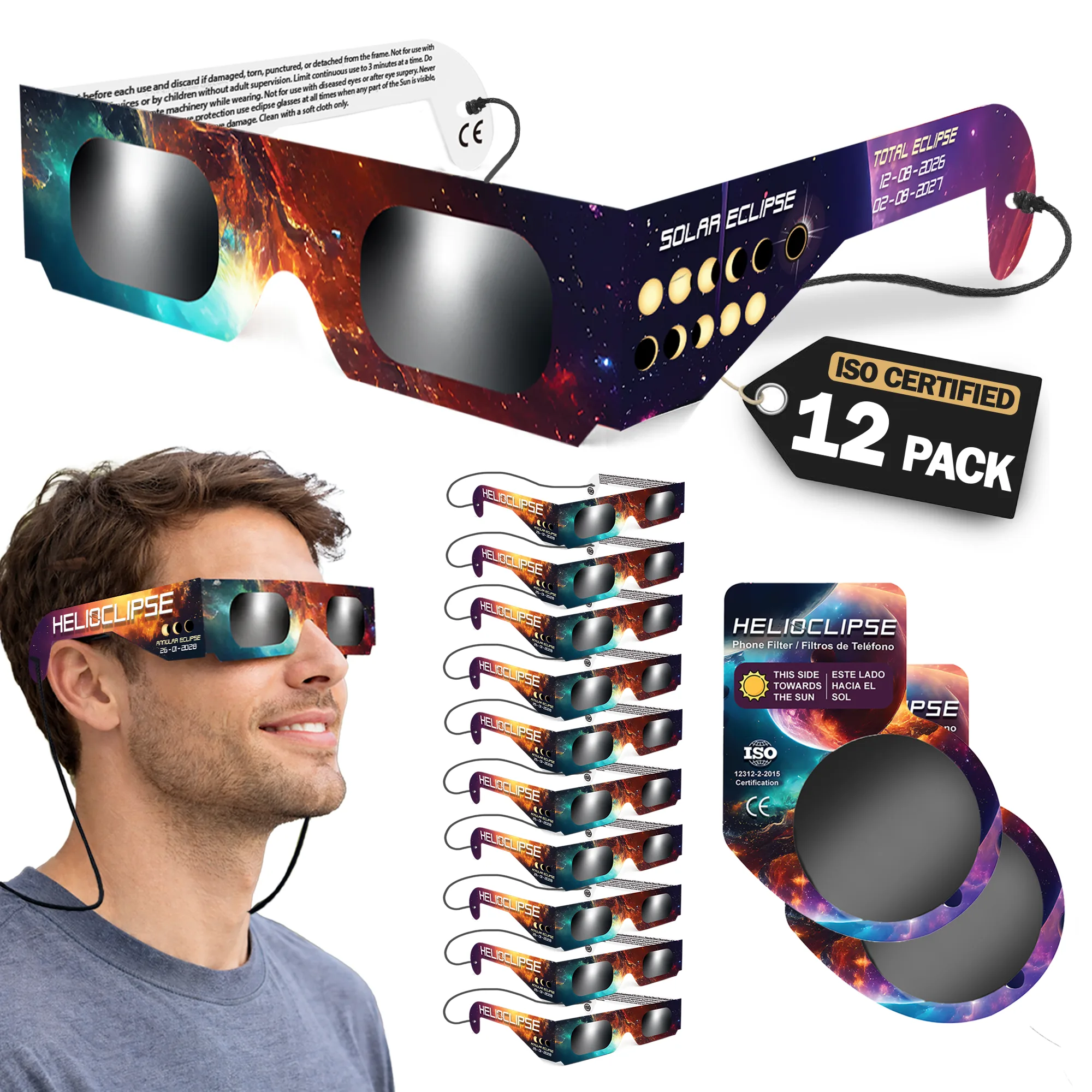
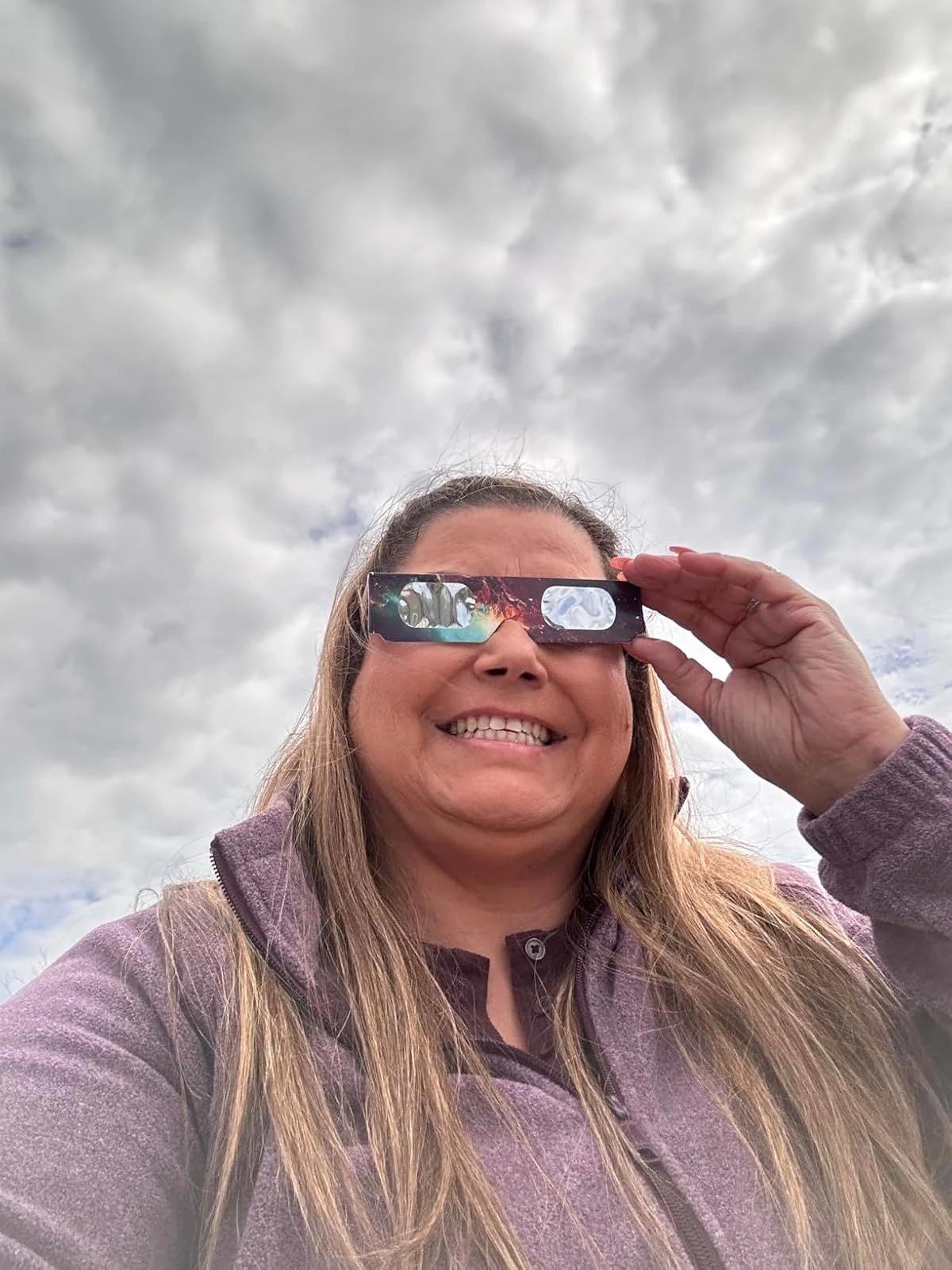
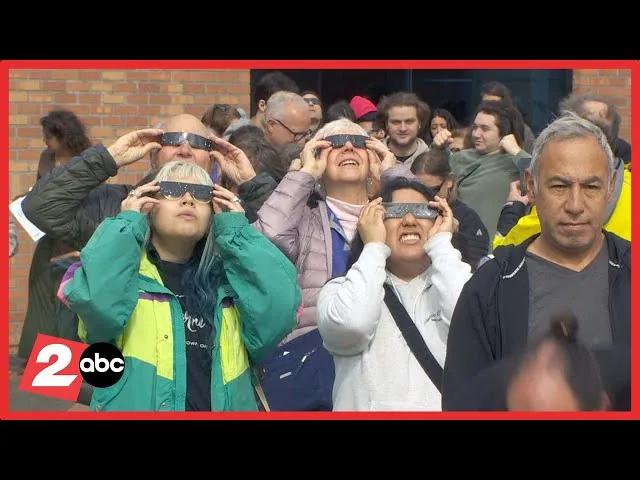
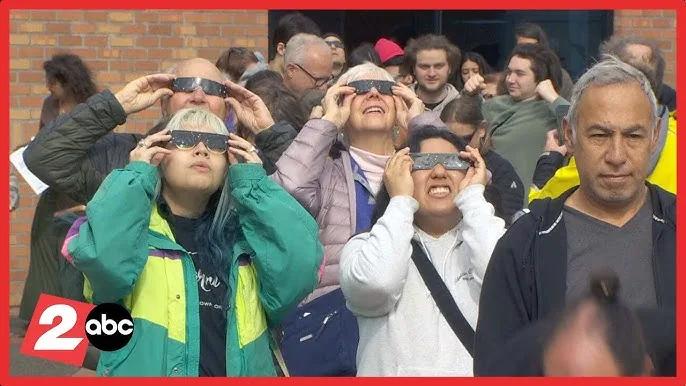
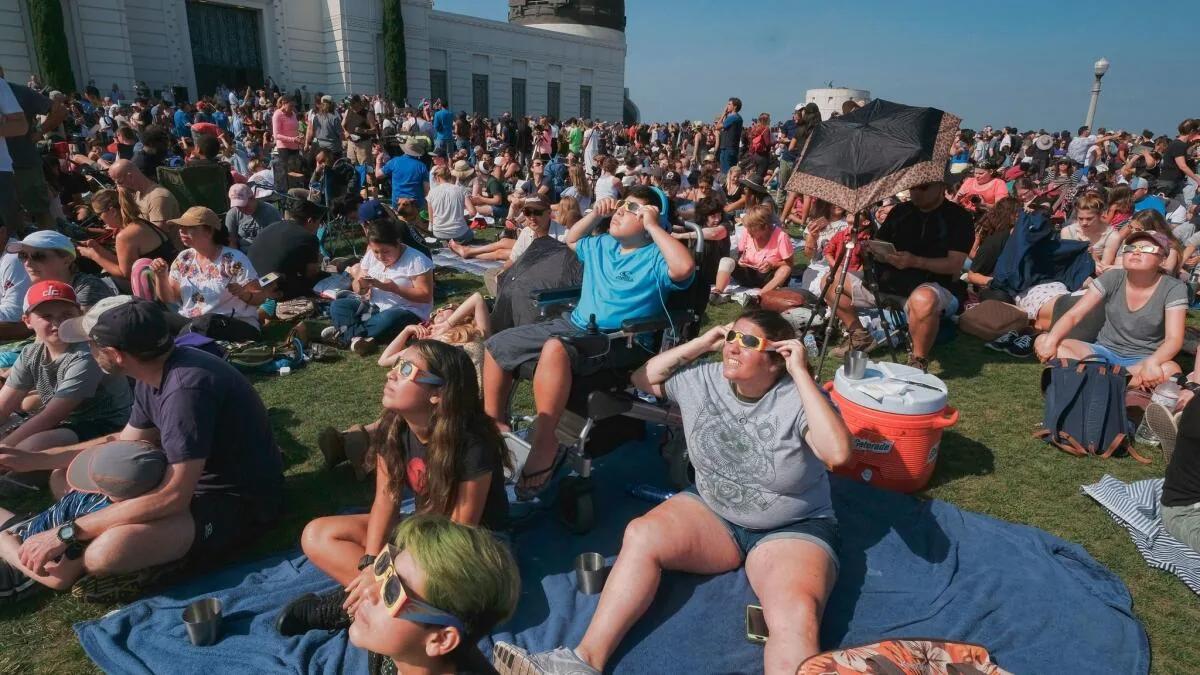
Certified solar viewers are required throughout every partial phase. Ordinary sunglasses are not safe, regardless of darkness or UV labeling. Use viewers that conform to ISO 12312-2, inspect them for tears, punctures, scratches, or loose filter material, and supervise children. Our guide to eclipse phases and when to use solar glasses is worth sharing with everyone in your group before eclipse day.
In Oviedo, viewers may come off only during true totality, when the Moon completely covers the Sun’s bright face. If cloud makes the contacts hard to judge, do not guess. Keep the viewers on until a reliable countdown and the complete disappearance of the photosphere confirm totality. Replace them immediately when any bright sunlight reappears.
Cameras, binoculars, and telescopes need properly designed solar filters secured over the front of their optics during the partial phases. Eclipse glasses worn by the observer do not make it safe to look through an unfiltered optical instrument; concentrated sunlight can damage the viewer and the eye. Anyone attempting magnified observation should obtain expert equipment guidance well before the event.
Marketplace language can be misleading. Phrases such as approved solar eclipse glasses or eclipse glasses nasa approved do not establish that a product is safe—NASA explicitly says it does not approve individual viewer brands. More meaningful wording includes solar eclipse glasses iso 12312-2 certified, but even that claim should be supported by trustworthy manufacturing, testing, labeling, and seller information rather than accepted as decorative print. Order Helioclipse solar eclipse glasses early enough to inspect them and practise fitting them over ordinary prescription glasses.
Tickets, events, accommodation, and the city-day plan
There is no admission fee for the Moon’s shadow. The phrase total solar eclipse 2026 Oviedo Spain tickets generally refers to organized events, reserved venues, transport, or accommodation—not a ticket required to see totality from an accessible public place. If a museum, university, hotel, or municipal organizer announces an event, check whether registration controls entry and whether the venue has a verified west-northwestern horizon.
If you are staying in Oviedo, keep the day simple. Avoid building a schedule that requires crossing the city shortly before the partial phase begins. Carry water, food, sun protection, a light extra layer, charged phones or batteries, your saved timings, and eclipse viewing glasses for the group. Download essential maps in case mobile networks become congested.
Tell friends and family early, especially if children or first-time observers are coming. Practise the viewer sequence before August 12: face away from the Sun, put the viewer securely over the eyes, turn toward the Sun, then turn away again before removing it. Decide where everyone will regroup if the crowd shifts or phone service fails.
After totality, resist the impulse to leave instantly. The returning partial phase still requires viewers, and roads may be busiest while everyone else departs. Remaining at the site for a while can turn a stressful exit into a calmer end to the evening.
How Oviedo fits into the wider Spanish eclipse story
Search results can blur together very different Spanish locations. The Burgos Spain eclipse 2026 circumstances—about 1 minute 44 seconds of totality near 8:28 p.m. CEST in the cited table—do not describe Oviedo’s horizon or weather. Burgos is an inland comparison that illustrates why some travelers are considering Castile and León, where August cloud climatology is often more favorable than on the northern coast. It is not proof of what the weather will do on eclipse day.
Likewise, the Oviedo 2026 eclipse should not be confused with the solar eclipse Spain 2027 event. Spain encounters another total eclipse on August 2, 2027, but its totality path follows a different geography across the far south of the country and North Africa. A location that is in totality in 2026 is not automatically in totality in 2027.
The Oviedo Spain 2026 eclipse choice is therefore a real trade-off rather than a ranking exercise. You gain the possibility of experiencing totality from a compact Asturian city without treating the day as a long-distance chase. In exchange, you accept marine cloud uncertainty and a low western Sun. A traveler whose only objective is maximizing climatological clear-sky probability may choose differently; someone who wants Oviedo itself to be part of the experience can plan intelligently around its constraints.
There is no universally “best” Spanish location. The best place for your group is inside totality, accessible under expected traffic conditions, safe to occupy, and open toward the eclipsed Sun. For the total solar eclipse 2026 Oviedo Spain time and final viewing position, coordinates beat city names every time.
A compact Oviedo checklist
Use this as a final readiness test for the Oviedo Spain eclipse 2026:
- Confirm August 12, 2026 and save coordinate-specific local times.
- Verify that the exact observing pin is inside totality.
- Inspect the west-northwest horizon at approximately 8:25–8:30 p.m. CEST.
- Record the Sun’s predicted altitude and azimuth for your pin.
- Choose a primary site and at least one realistic municipal backup.
- Monitor cloud layers and the western sightline, not just the overhead forecast.
- Obtain ISO 12312-2 solar viewers before supplies become pressured.
- Brief the group on glasses-on and glasses-off timing.
- Avoid unfiltered cameras, binoculars, and telescopes.
- Build in extra time for walking, parking, crowds, and the post-totality departure.
A phrase like total solar eclipse 2026 Oviedo Spain sounds as though the city name completes the plan. It does not. The decisive details are your pin, your horizon, the moving cloud field, and a group that already knows what to do when the light begins to collapse.
Oviedo, Spain — 2026 Total Solar Eclipse Simulation (Totality ...
Solar Eclipse 2026
Frequently asked questions
Is there one best place in Spain to watch the 2026 total solar eclipse?
No single location is identified as the best in the available information. Oviedo is inside the path of totality, but a suitable viewing site needs an unobstructed west-northwest horizon because the Sun will be low in the evening sky.
What time will totality occur in Oviedo on August 12, 2026?
Totality is expected around 8:26–8:29 p.m. CEST, but the exact time depends on your precise location in or around Oviedo. Check an exact map coordinate for the start and end of totality, rather than relying on times for nearby cities.
How long will totality last in Spain during the 2026 eclipse?
The duration will vary by location along the path. Published regional reference points list about 1 minute 46 seconds in coastal Gijón and about 1 minute 44 seconds in Burgos, while no verified duration is provided for central Oviedo.
What makes Oviedo a practical but challenging place to view the 2026 total solar eclipse?
Oviedo is within the path of totality, so observers at a suitable site can see the Sun’s bright face fully covered and the corona become visible. However, the Sun will be only about 10–12 degrees above the west-northwest horizon, making buildings, slopes, trees, and marine cloud especially important.
What should I check when planning an eclipse-viewing site in Oviedo?
Confirm that your exact accommodation or observing coordinate is inside the path of totality, then record the partial-eclipse times, the start and end of totality, and the Sun’s altitude and azimuth. Prioritize a clear low horizon toward the west-northwest, since an overhead cloud forecast may not show whether the low evening Sun will be visible.
On-site next steps
- Open the Helioclipse Eclipse Explorer, place a pin on each candidate Oviedo site, and compare totality timing, Sun altitude, and path position.
- Read our August 12, 2026 planning guide for the wider event sequence and travel checklist.
- Order ISO 12312-2 eclipse viewers from Helioclipse early, then inspect and practise with them before the event.
Sources & further reading
- Total Solar Eclipse on August 12, 2026 — NASA Science
- August 12, 2026 Solar Eclipse Map — National Solar Observatory
- Total solar eclipse 2026 — Everything you need to know — Space.com
- Spain's total solar eclipse 2026 comes with a catch — Space.com
- Plan Now for the 2026 Total Solar Eclipse in Europe — Sky & Telescope
- How to View a Solar Eclipse Safely — American Astronomical Society
- About the ISO 12312-2 Standard for Solar Viewers — American Astronomical Society
- Eclipse Viewing Safety — NASA Science
- What to Expect: A Solar Eclipse Guide — NASA Science
- Eclipses Frequently Asked Questions — NASA Science