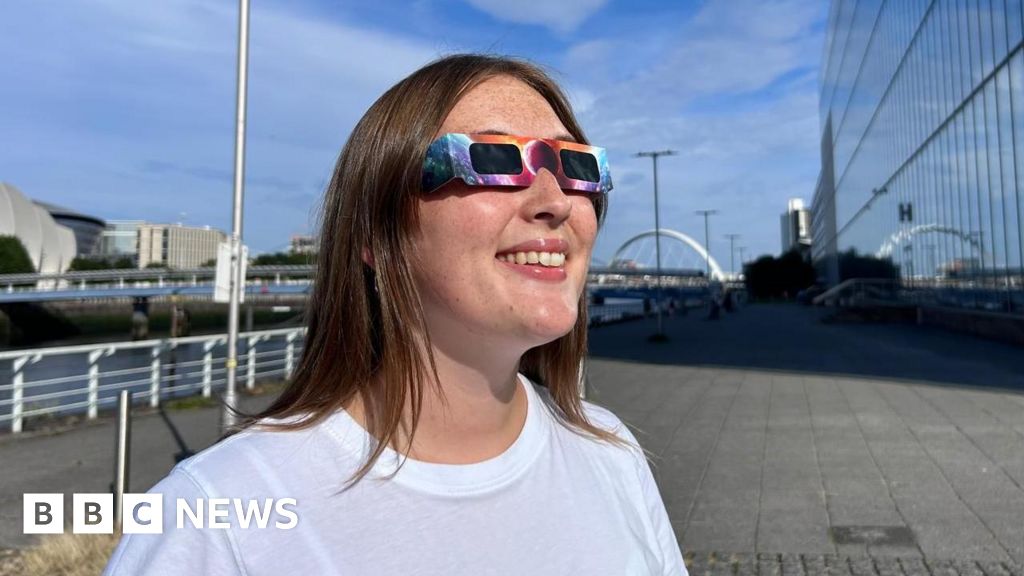
Before you pack them: storing, inspecting, and retiring eclipse viewers for 2027
The night you zip up your suitcase is a bad time to discover that your spare eclipse glasses have a scratch. Before the August 2, 2027 total solar eclipse, take a few minutes to store the pairs you can trust, inspect every filter you plan to use, and replace any eclipse glasses whose age, source, or condition you can’t verify. That includes the souvenir pair from 2017 and the still-wrapped pair that spent last summer in the glove box.
Start with the exact spot where you’ll watch. Our Eclipse Explorer map shows whether you’ll be inside the path of totality and when each phase happens at your site. On August 2, southern Spain gets totality along a narrow path, while northern Maine gets only a partial eclipse in parts of the state. A safe viewer matters in both places. What changes is whether there’s any moment when you can take it off while watching.
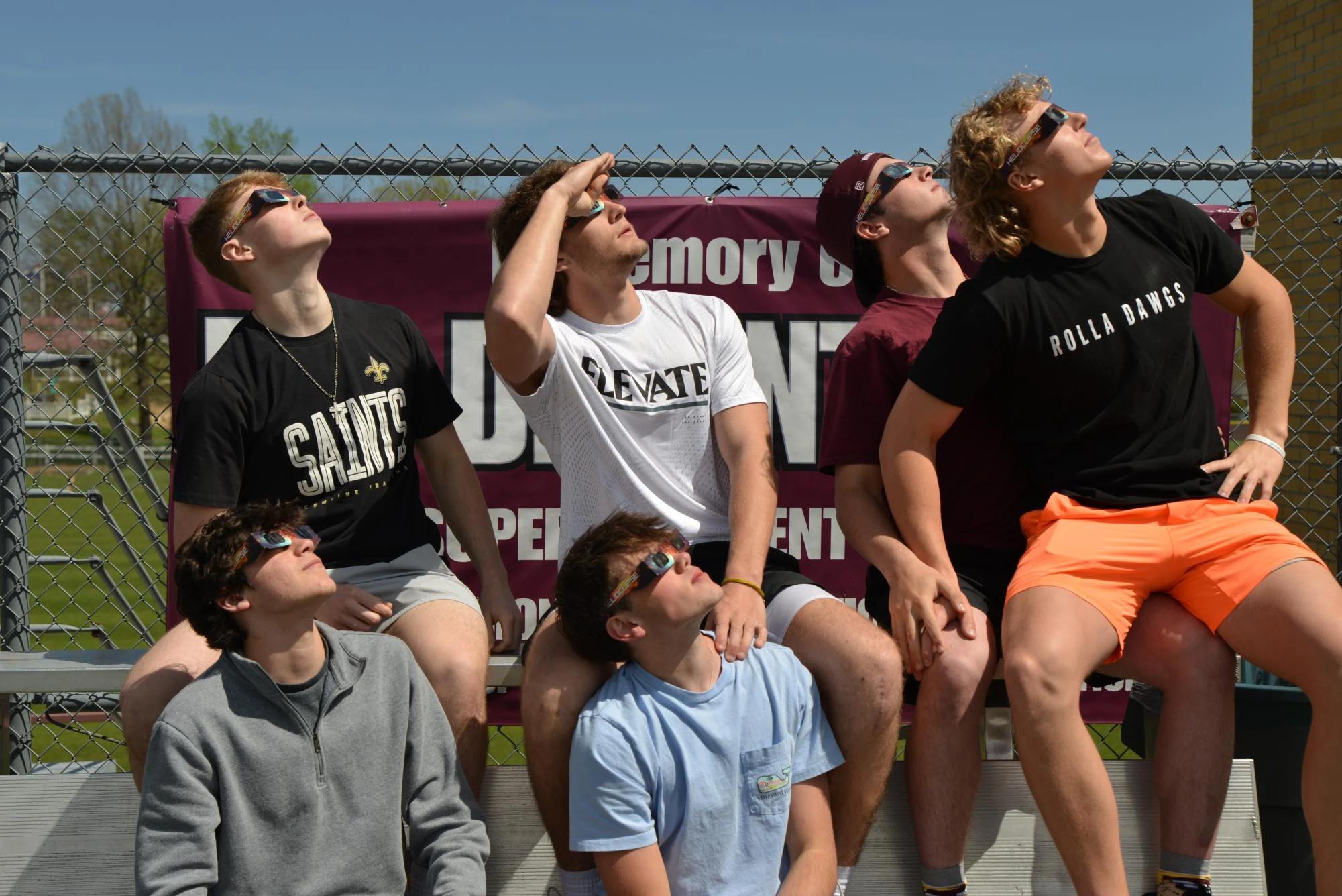
How to store eclipse glasses for 2027
Keep your solar eclipse glasses at room temperature, clean and dry. The American Astronomical Society (AAS) recommends keeping viewers in their original case or packaging, or in an envelope or other container that protects the filters from scratches and punctures. For a stack of cardboard viewers, individual sleeves inside a rigid box give you two kinds of protection: the sleeves keep the filter surfaces from rubbing, and the box keeps the frames from getting crushed.
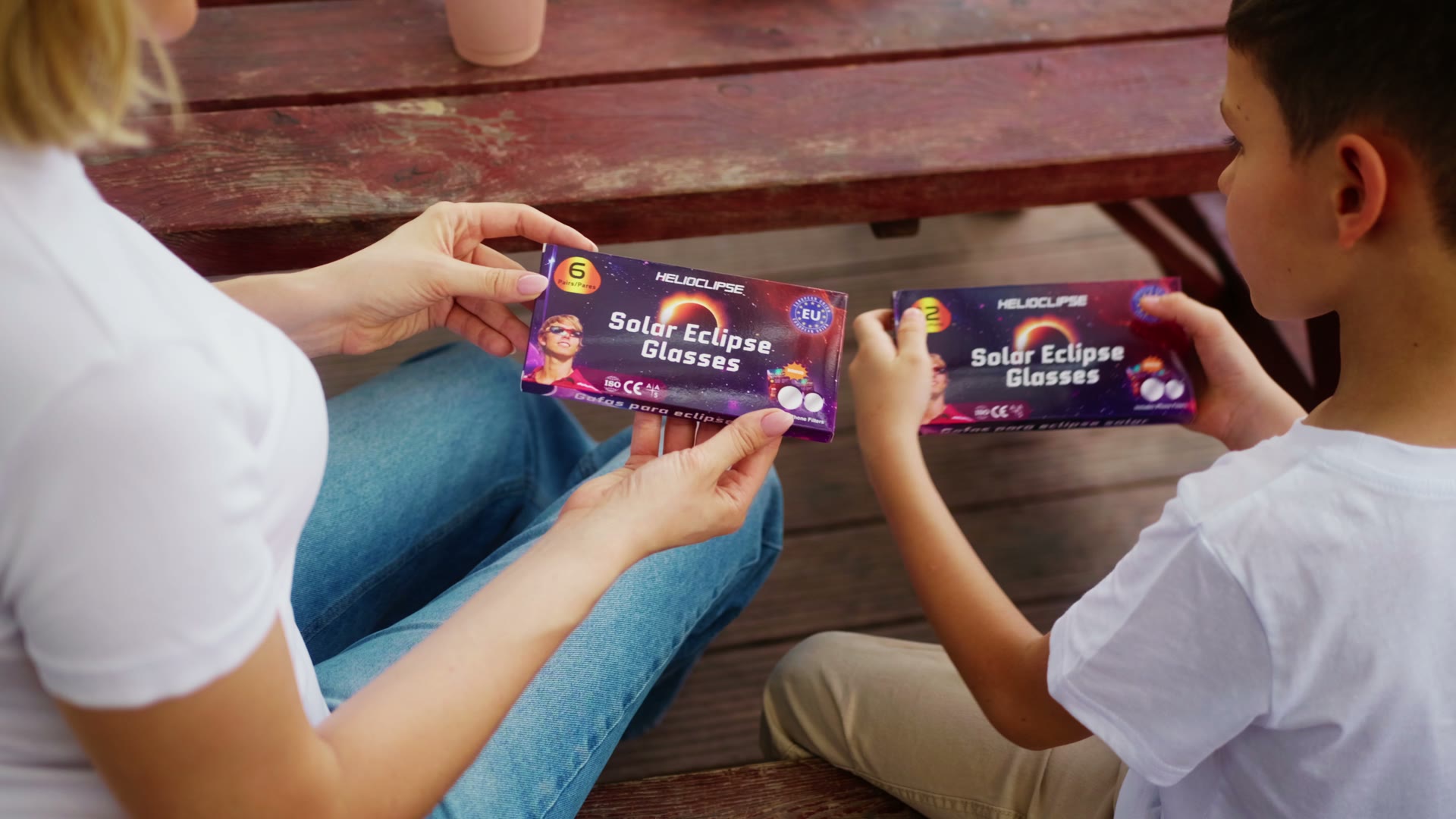
Save the packaging or order confirmation with the glasses. A dated receipt helps establish when you bought them, though it doesn’t necessarily tell you when they were made. Keeping the maker, seller, and product details together also means you won’t have to reconstruct their origin from a logo years later. If you’re packing for a group, put the viewers somewhere easy to reach, but not loose with keys, chargers, or a water bottle.
If there’s dust on a filter, follow the manufacturer’s instructions. The AAS recommends a soft, dry, nonabrasive cloth or tissue for cardboard viewers. Skip water, glass cleaner, and wet wipes: damp cardboard can swell and pull away from the filter. Cleaning can remove dust; it can’t fix a scratch or a loose edge.
Why a parked car is a poor place to keep viewers
On an August road trip, it’s easy to leave the eclipse kit in the glove box when you stop for lunch. In a study in Tempe, Arizona, reported by Live Science, cars parked in the sun on hot days averaged about 116°F (47°C) inside after an hour, and dashboards averaged about 157°F (69°C). Even cabins parked in the shade averaged about 100°F (38°C). Moving the glasses off the dashboard protects them from direct sunlight, but it doesn’t keep them at room temperature.
Those numbers describe cars, not filter failure temperatures. Excessive heat or moisture can cause layers to separate in some paper-and-adhesive viewers; there’s no universal time or temperature cutoff you can apply to a pair found in a hot car. Take the kit indoors when you stop. If a pair has spent extended time in a hot parked car and you can’t establish that it stayed within the manufacturer’s storage guidance, replace it rather than trusting its appearance. Retire any viewer with warped cardboard, bubbling, peeling, or a filter edge that’s starting to lift.

Inspect each viewer before it goes in the bag
Do the first check at home, while there’s still time to get replacements. Repeat it at the viewing site before anyone looks at the Sun. Use ordinary room light to examine the viewer itself; don’t use the Sun to test a questionable filter.
- Start with the source. Check that you can trace the viewer to a reputable supplier and that the manufacturer had the product tested by a properly accredited lab and found to conform to ISO 12312-2. An ISO number printed on a frame is not proof. Our guide to spotting fake and low-quality eclipse glasses explains what to check beyond the label.
- Check both sides of each filter. Look for scratches, pinholes, tears, creases in the filter itself, or any other damage. Handle the viewer by the frame so you don’t add a fingerprint or scratch while checking it.
- Follow the edges. Look where the filter meets the cardboard or plastic. A lens can look flawless in the middle while it’s peeling away at a corner. Check that the frame is sturdy and that the viewer covers both eyes securely when worn as directed. For children, check fit before eclipse day and supervise use.
- Remove rejects from the kit. Don’t tape a loose filter back in place or keep a scratched pair as an emergency spare. Discard damaged viewers so no one can grab them by mistake. If you want to keep a pair as a souvenir, mark it clearly as not for solar viewing and store it away from usable pairs.
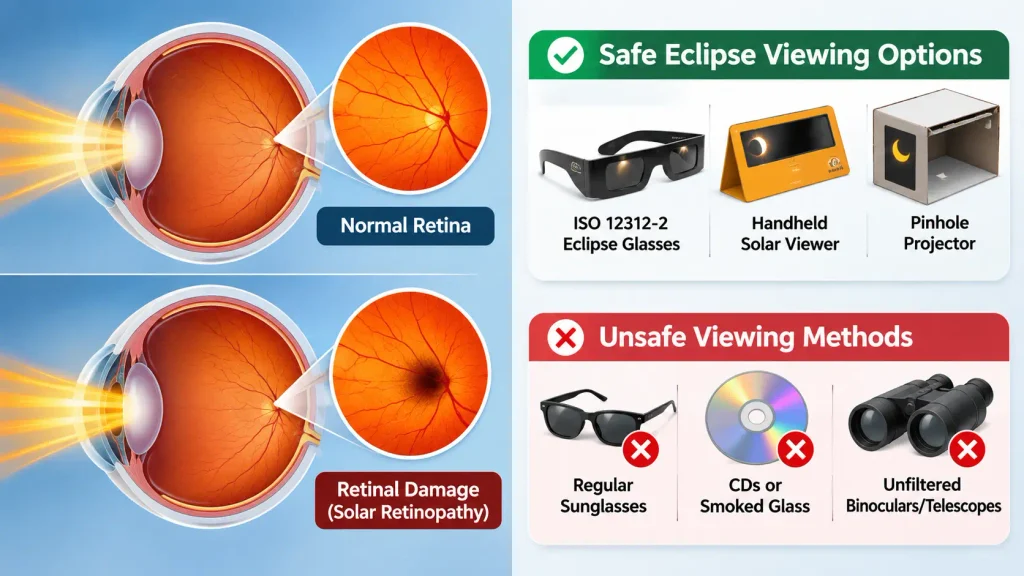
> An inspection can tell you when to stop, not when a filter is safe. Proper solar viewers work by limiting visible light as well as ultraviolet and infrared radiation. A filter can look dark indoors without meeting those limits. A clean surface doesn’t make up for an unverified source. See what ISO 12312-2 covers for the difference between checking condition at home and measuring filter performance in a lab.
Can eclipse glasses expire? What to do with a pair from 2017
The AAS says you may reuse a viewer if it is less than 10 years old, a properly accredited laboratory found it conforms to ISO 12312-2, and it is undamaged. All three conditions matter. Ten years isn’t a guaranteed service life: a new pair with a pinhole is already out, and an intact pair of unknown age is not one we’d pack. Read the manufacturer’s instructions, including any product-specific lifetime or storage limits.
Some glasses bought for the 2017 U.S. eclipse could still be suitable in April 2024 if they met the testing and condition criteria. That doesn’t settle whether the same pair belongs in your 2027 bag. A viewer made on or before August 2, 2017, won’t be less than 10 years old on eclipse day. The August 21, 2017 eclipse date printed on a frame tells you which event it commemorates, not when the pair was made. If that’s the only date you have, replace it for 2027.
Older coverage sometimes quotes advice about indefinite reuse or mentions a blanket three-year warning. The AAS says those generic three-year warnings are outdated for recently manufactured, compliant viewers in excellent condition. For this trip, use the AAS reuse criteria and the instructions for your specific product, not a rule remembered from a previous eclipse. And if you’re donating surplus glasses, check the program’s current requirements first. Don’t pass along pairs you’ve ruled out for your own family.
Replace questionable pairs while you still have time
If you’d rather buy in person in the U.S., check whether a local science museum or planetarium shop carries viewers and can tell you who supplied them. Call ahead to confirm stock. Whether the pair is on a shelf nearby or shipped to you, traceable sourcing matters more than convenience. NASA doesn’t approve individual brands, so a claim of NASA approval isn’t a reason to choose a pair.
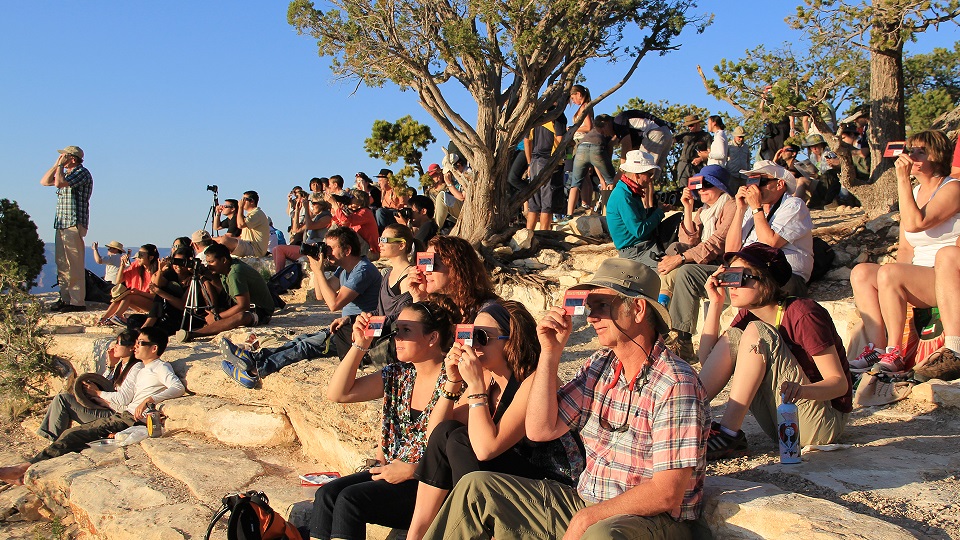
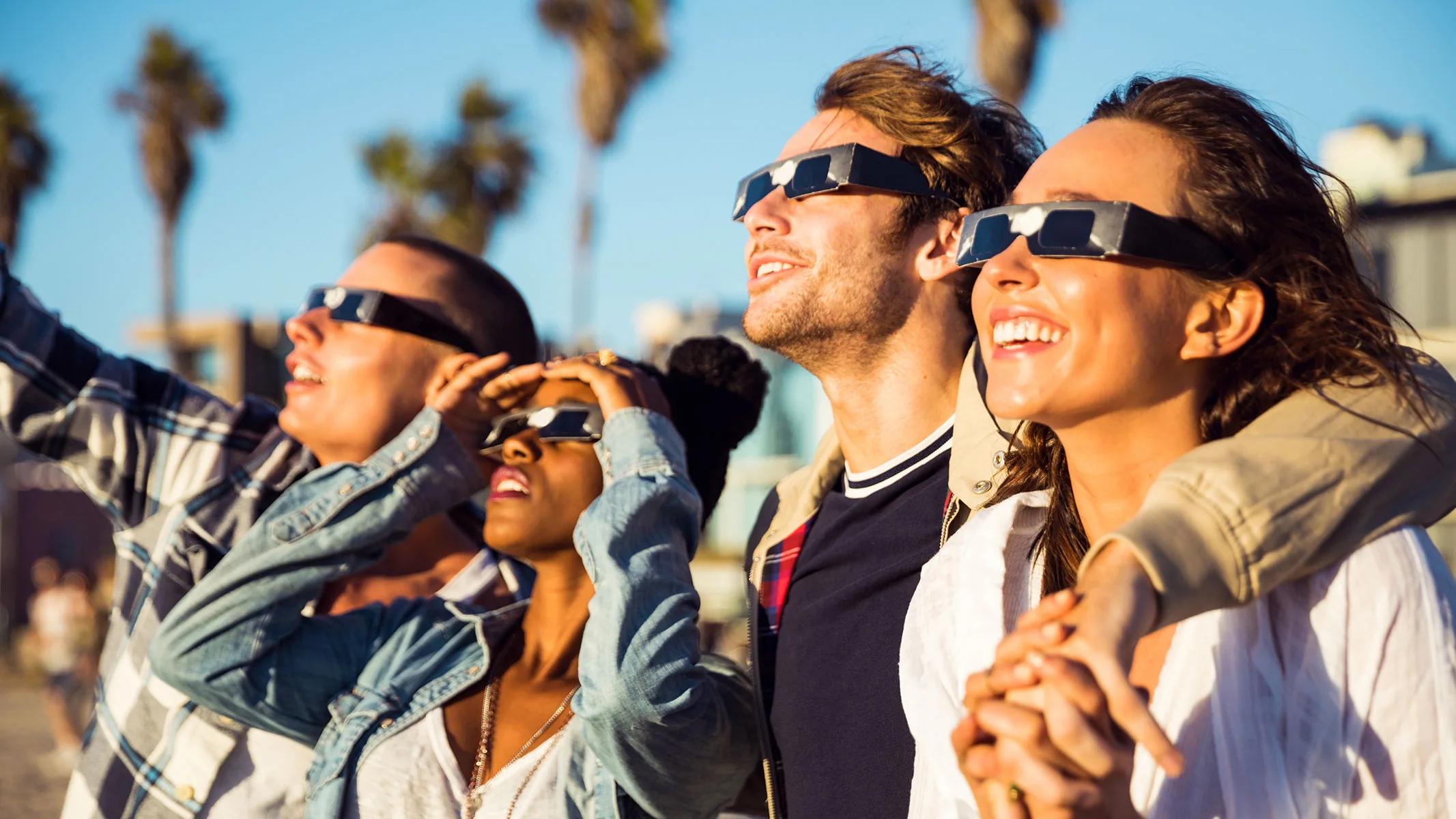
If you’re organizing a family outing or a school group, count your usable pairs now and set aside a checked spare in its own sleeve. Viewers can be shared during the slow partial phases, but having one ready for each child you’re supervising makes it easier to manage the moments when everyone wants to look up at once. At your site, put viewers on before looking at the Sun and turn away before taking them off. Outside the path of totality, keep them on whenever you look directly at the Sun. Inside the path, remove them only once the bright face is completely covered, and put them back on before it reappears. If you’re unsure about the timing, keep them on.
> No safe viewer? Watch indirectly. With the Sun behind you, let a colander project little crescent Suns onto the ground and look at the projections, not through the holes. Ordinary sunglasses aren’t a substitute. And eclipse glasses don’t make it safe to look through unfiltered binoculars, telescopes, or cameras: those require purpose-made solar filters secured over the front of the optics.

Frequently asked questions
What’s the best way to pack and store eclipse glasses for 2027?
Keep them clean and dry at room temperature, in their original packaging or in a sleeve that protects the filters from scratches and punctures. If you’re packing several cardboard pairs, put them in individual sleeves inside a rigid box and don’t leave the box in a parked car.
What should I check before looking at the 2027 solar eclipse?
Inspect every filter for scratches, punctures, and loose edges, and replace any pair whose age, source, or condition you can’t verify. Check the eclipse phases for your exact viewing spot, and keep your glasses on whenever you look at the Sun during a partial phase.
Are my old eclipse glasses still safe to use in 2027?
Don’t reuse a pair if you can’t verify its age, source, or condition. A dated receipt can show when you bought the glasses, but it doesn’t necessarily tell you when they were made.
Where can I buy eclipse glasses I can verify later?
The article doesn’t recommend a specific retailer. Wherever you buy your glasses, keep the packaging or order confirmation so you can verify the seller and identify the pair later.
What should I expect to pay for one pair of eclipse glasses?
The article doesn’t give a price or price range. If you buy a pair, save the dated receipt with the glasses so you have a record of when you bought them.
On-site next steps
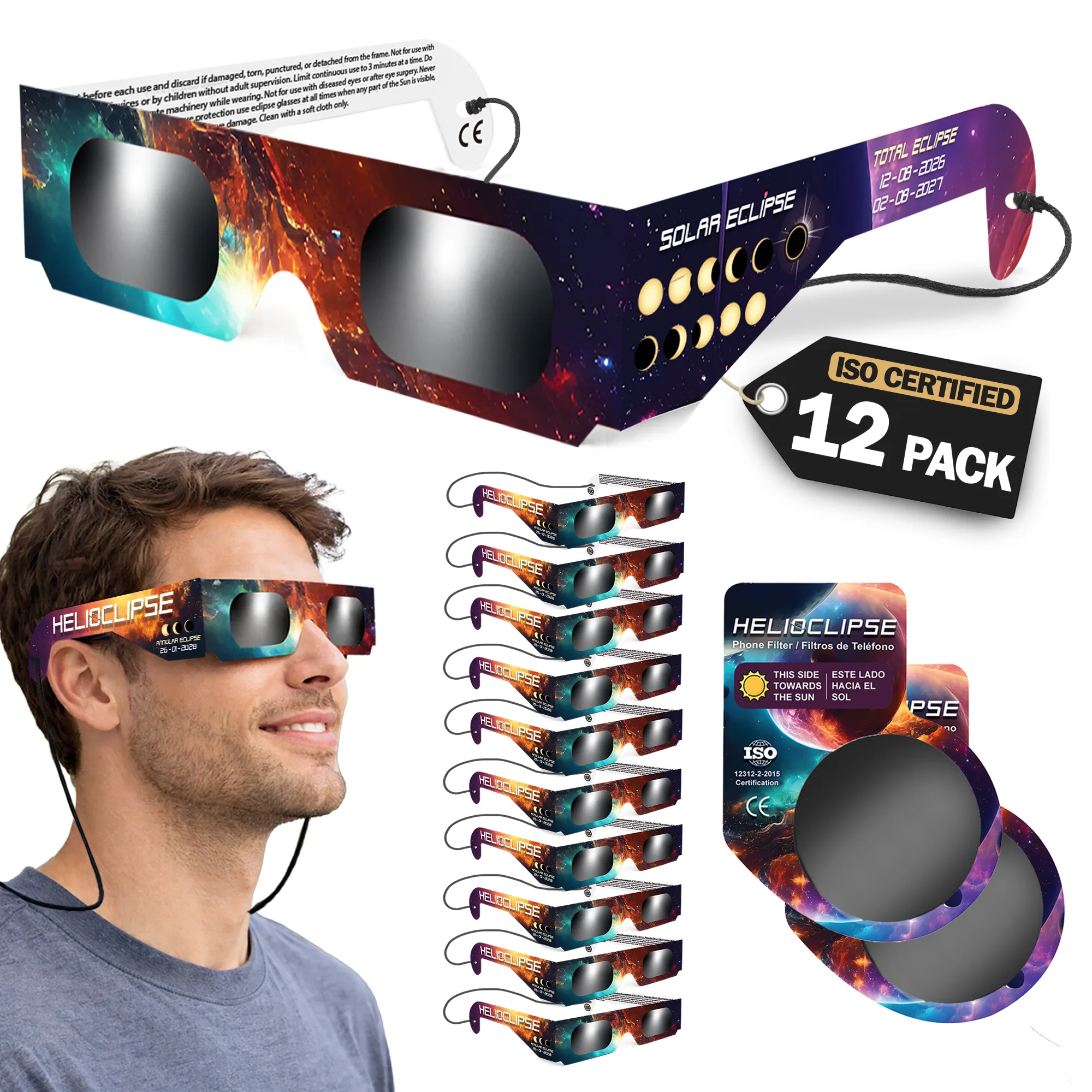
Once you’ve sorted the keepers from the rejects, shop Helioclipse’s ISO 12312-2 certified solar eclipse glasses for the pairs you need to replace. Order your eclipse viewing glasses early enough to inspect them when they arrive and pack them with a checked spare. Then send your group the viewing location and a reminder to bring their pair.
Sources & further reading
- How to View a Solar Eclipse Safely — American Astronomical Society — reuse, storage, cleaning, and phase-by-phase safety.
- How Can You Tell If Your Eclipse Glasses or Handheld Solar Viewers Are Safe? — American Astronomical Society — traceable sourcing and the limits of visual checks.
- About the ISO 12312-2 Standard for Solar Viewers — American Astronomical Society — filter performance, mounting, and labeling.
- Eclipse Viewing Safety — NASA Science — eye protection, optical equipment, and indirect viewing.
- Future Eclipses — NASA Science — dates and visibility for the 2027 eclipses.
- October 14, 2023 Eclipse Fact Sheet — NASA HEAT — viewer inspection and observing guidance.
- What to Do with Your Eclipse Glasses — Space.com — a practical storage example and historical reuse advice.
- Will Your Solar Eclipse Glasses Still Be Safe to Use in 2024? — Live Science — historical context for viewers saved from 2017.
- How to Watch the ‘Ring of Fire’ Solar Eclipse Live or Online — Live Science — reporting on heat and moisture damage in some paper viewers.
- How Long Does It Take a Parked Car to Reach Deadly Hot Temperatures? — Live Science — measured cabin and dashboard temperatures in Tempe, Arizona.