Fake and low-quality eclipse glasses: how to sanity-check what you trust in 2027
A convincing logo, a dark-looking filter, and “ISO 12312-2” printed on cardboard do not prove that eclipse glasses are safe. Counterfeiters can copy all three. The important question is whether you can trace the viewer through a credible seller to a manufacturer whose product has been tested by a properly accredited laboratory.
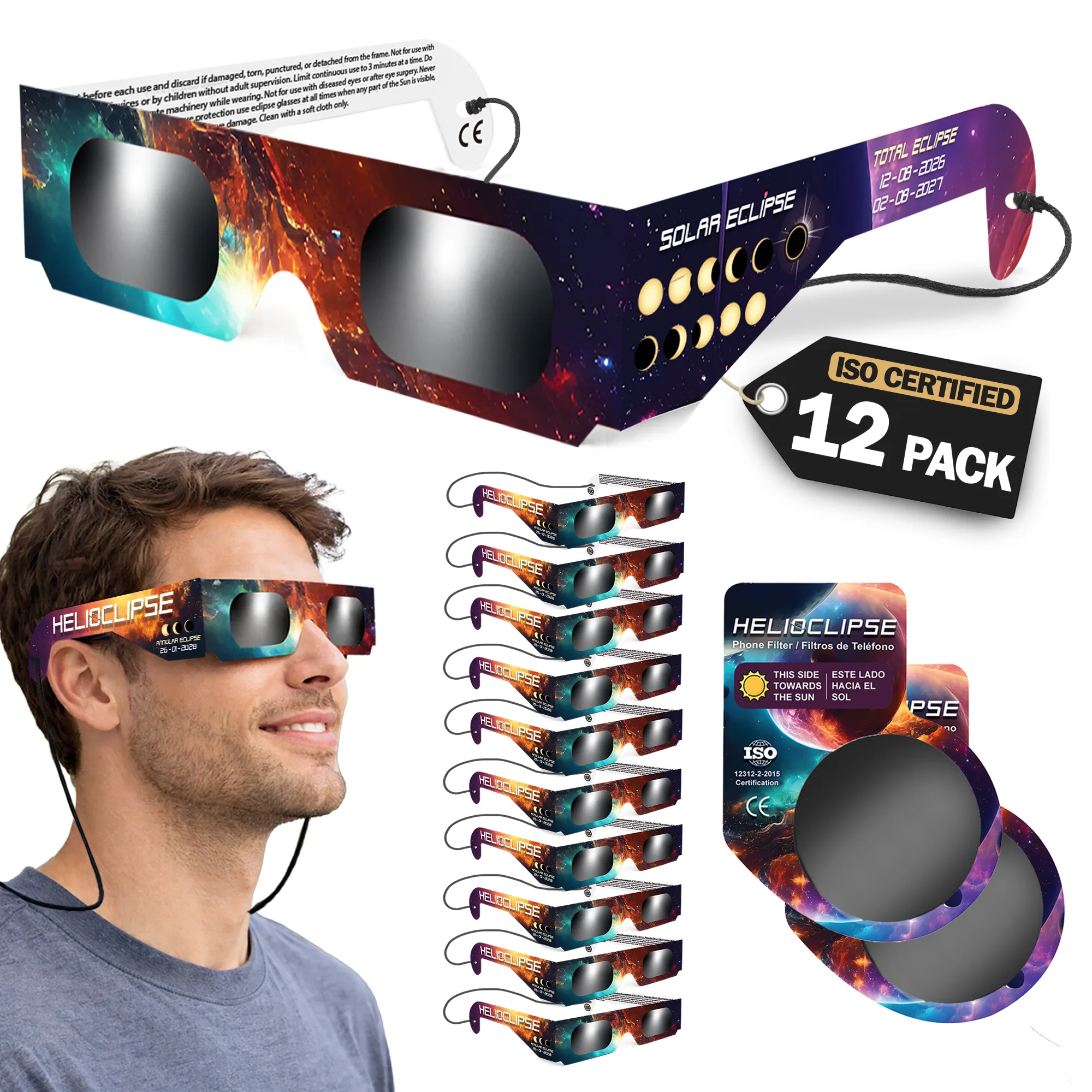
That distinction will matter on 2 August 2027. The total eclipse will cross southern Spain, Gibraltar, North Africa, and parts of the Middle East, with totality lasting about 6 minutes 23 seconds near Luxor. But the long partial phases before and after totality—and the entire eclipse for anyone outside the narrow path of totality—require proper solar protection. You can check your location with our Eclipse Explorer and 3D map and obtain ISO 12312-2 certified Helioclipse viewers well before last-minute demand peaks.
The short version of fake eclipse glasses how to check 2027 is this: verify the supply chain, inspect the physical viewer, read its instructions, and reject anything that creates doubt. A home brightness check can expose an obviously bad filter, but it cannot certify an unknown one.
The difficult truth: appearance cannot prove safety
The American Astronomical Society gives an unusually direct answer to the question of whether consumers can identify a safe viewer by sight: you cannot be certain just by looking. You can recognize reasons not to use a viewer, but visible darkness does not reveal how effectively its filter blocks ultraviolet and infrared radiation.
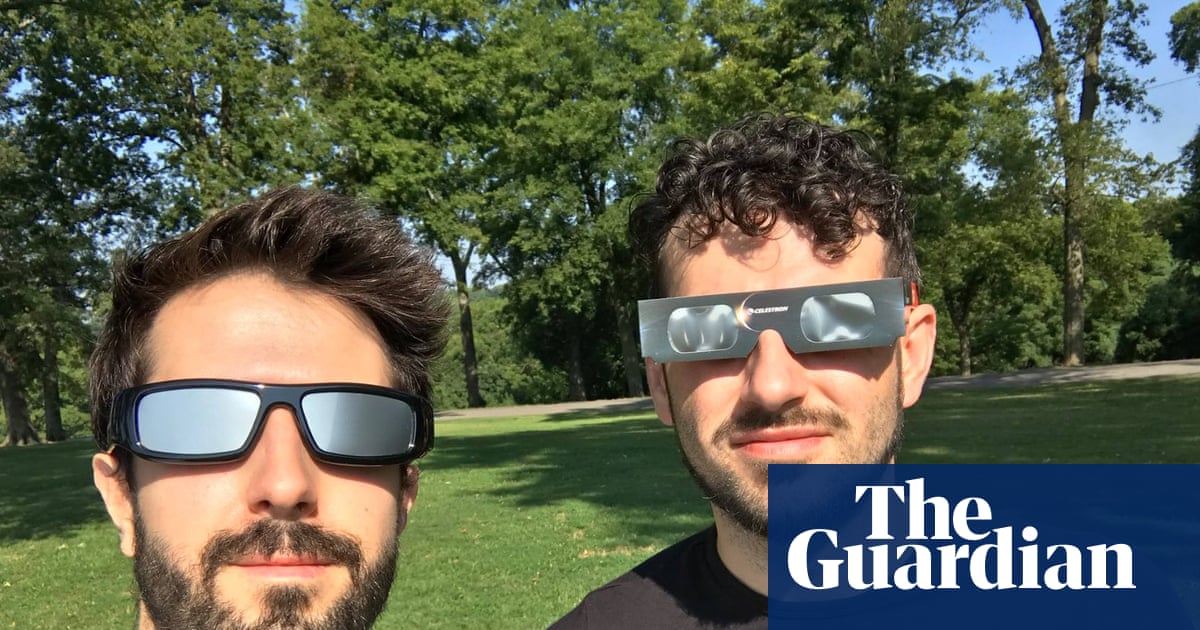
That is why collections of fake eclipse glasses examples can be misleading. A dangerous viewer may resemble cheap sunglasses, allowing you to see furniture and walls indoors. Another counterfeit may look professionally printed and become almost completely black when worn. Some counterfeits may even happen to use adequate filter material, but you cannot infer that from the artwork or color.
In other words, there is no single answer to what fake eclipse glasses look like. Warning signs can include blurred printing, missing contact details, loose filter panels, contradictory instructions, or a seller that cannot identify the manufacturer. Yet a neat, well-printed frame can still carry an unsupported standards claim.
The full question—fake and low-quality eclipse glasses: how to sanity-check what you trust—therefore starts with provenance rather than appearance. Who made the finished viewer? Who sold it? Is that relationship publicly verifiable? Can the supplier provide credible compliance information instead of repeating words printed on the frame?
What ISO 12312-2 does—and does not—tell you
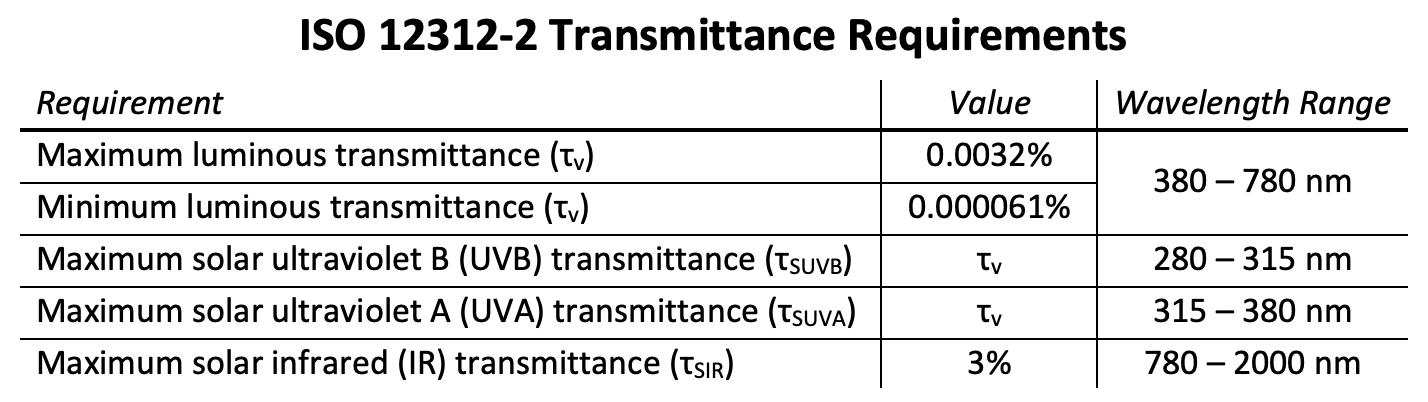
ISO 12312-2 is the international standard covering filters intended for direct, unmagnified observation of the Sun. It addresses visible-light transmission as well as ultraviolet and infrared transmission, uniformity, material quality, mounting, and labeling. Ordinary sunglasses fall under a different area of the ISO 12312 family; they transmit far too much sunlight for direct solar viewing, regardless of how dark their lenses appear.
You may encounter the fuller wording ISO 12312-2:2015 glasses because the applicable edition was published in 2015 and affirmed in 2020. You may also see the shorter phrases iso 12312-2 glasses or “ISO-compliant solar viewers.” Those words describe a relevant standard, not independent evidence that the particular item in your hand passed laboratory testing.
This is the essential difference between a claim and compliance:
- A claim is text that anyone can print on a viewer, package, or marketplace page.
- Compliance evidence connects an identifiable product and manufacturer to testing by a competent, properly accredited laboratory.
- A trustworthy purchase path connects you to that manufacturer directly or through an authorized seller the manufacturer publicly recognizes.
ISO 12312-1 is associated with sunglasses and related eyewear for general use. It is not a substitute for ISO 12312-2 when you intend to look directly at the Sun. Our deeper guide to ISO 12312-2 and eclipse viewers explains what the solar-viewer standard covers and why printed letters alone are insufficient.
A five-part trust check before you buy
The most useful fake eclipse glasses how to tell method is not a secret visual trick. It is a short investigation that should happen before the package reaches your eclipse bag.
1. Identify the actual manufacturer
Look for the name and address of the company responsible for the finished product. A vague marketplace storefront, newly created seller profile, or listing that never identifies a manufacturer weakens the trust chain. The name printed on the viewer is not enough by itself because counterfeiters can copy legitimate company details.
2. Verify the seller relationship
Buy directly from a known manufacturer or from a reseller that the manufacturer publicly identifies as authorized. Do not assume that a seller is authorized merely because its listing uses a familiar name, reproduces a certificate image, or says “genuine.”
The phrase aas approved eclipse glasses is common but imprecise. The AAS does not “approve” each retail transaction or guarantee every item bearing a listed company’s name. It maintains a resource identifying manufacturers that have demonstrated credible testing, while advising consumers to verify the seller and supply chain. Likewise, NASA explicitly says it does not approve particular solar-viewer brands, so wording such as eclipse glasses nasa approved should make you pause rather than reassure you.
3. Examine the standards claim in context
Look for ISO 12312-2, usable instructions, warnings, and manufacturer information in a language appropriate to the market. Then ask whether those details are consistent across the viewer, its packaging, the seller’s page, and the manufacturer’s own information.
A copied laboratory report is not automatically evidence for the item being sold. Product identifiers, model details, and the organization named in any documentation should match. If a seller cannot explain what was tested or offers an unrelated certificate, do not fill the gaps with optimism.
4. Inspect every viewer, not just one from the pack
Hold the filter away from the Sun and examine it under ordinary room lighting. Discard the viewer if the filter is scratched, punctured, torn, creased through the viewing area, detached from its frame, or visibly uneven. The mounting should keep the filter secure during normal handling and in a breeze.
For a family, classroom, or public event, check each pair individually. One intact sample does not prove that another pair escaped damage during transport or storage.
5. Read the instructions before eclipse day
The instructions should explain how to put the viewer on before looking toward the Sun, how to turn away before removing it, and how to supervise children. They should not suggest using the glasses with unfiltered binoculars, telescopes, or cameras.
Our method follows aas consumer-safety patterns: labeling, iso claim vs eclipse planning, but the practical lesson is simple: documentary checks and physical inspection perform different jobs. You need both.

What an at-home brightness check can reveal
A so-called fake eclipse glasses test is useful only as a rejection screen. It cannot measure invisible radiation or replace accredited laboratory testing.
Put the viewer on indoors. You should not see furniture, walls, pictures, or ordinary room lights through it. At most, an exceptionally bright source may appear very faint. If you can navigate the room normally or see household objects, the filter is not dark enough for direct solar observation: do not use it.
If it passes indoors, wear it outside while facing away from the Sun and look around. Again, the normal scene should be invisible. A strong reflection from a shiny surface may appear faint. Seeing the landscape clearly is a failure.
These checks can identify an obviously inadequate filter, but passing them does not prove that ultraviolet and infrared transmission is safe. A filter can appear dark in visible light without having documented performance across the required spectrum. Do not conduct repeated direct-Sun experiments to investigate an unknown product. Establish provenance first, follow the manufacturer’s instructions, and discard or return the viewer if confidence remains incomplete.
A downloadable fake eclipse glasses list would also become stale quickly and could be unfair or incomplete. Counterfeit listings change names, images, and storefronts. A current trust-chain check is more dependable than trying to match your viewer against old photographs.
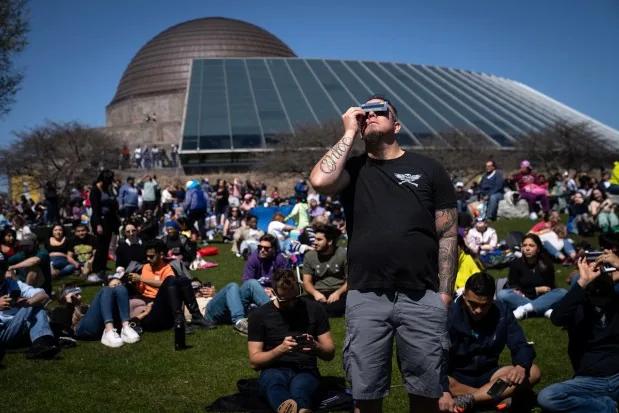
Can glasses from the 2017 eclipse be reused in 2027?
The fake eclipse glasses 2017 story created a lasting but oversimplified idea that all old cardboard viewers are unsafe. Age alone is not the deciding factor.
The AAS says viewers less than 10 years old may be reused when their manufacturer had the product tested by a properly accredited laboratory, the product conformed to ISO 12312-2, and the filters remain in excellent condition. Glasses used for the 21 August 2017 eclipse will be just under 10 years old on 2 August 2027—but that calendar fact does not establish their provenance or condition.
Reuse them only if you can still answer all of these questions:
- Do you know who manufactured them and where they were obtained?
- Can you establish that the product was credibly tested for ISO 12312-2 conformity?
- Were they stored clean, dry, and flat in a protective envelope or container?
- Are both filter panels free of scratches, punctures, tears, deep creases, or separation from the frame?
- Are the instructions still legible and appropriate?
Discard them if the history is unknown, the cardboard became wet, the filter is damaged, or the frame no longer holds it securely. A decade-old souvenir is not worth turning into safety equipment on the strength of nostalgia.
How to use a trusted viewer correctly
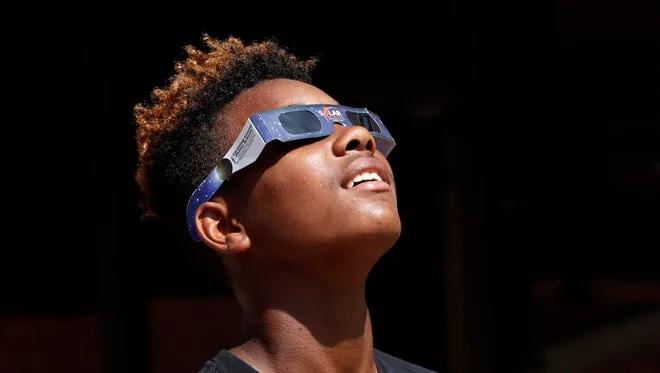
Even genuine, undamaged eclipse glasses must be used properly. The safe answer to “how to look at a solar eclipse?” depends on whether any part of the Sun’s bright face remains visible.
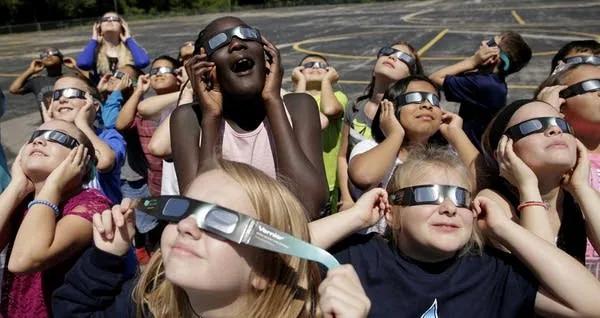
Before looking up, stand still and cover your eyes with the viewer. Look briefly at the Sun, then turn your face away before removing the glasses. Children need active adult supervision, especially when frames do not fit securely. If you wear prescription glasses, keep them on and place eclipse glasses over them, or use a handheld solar viewer in front of them.
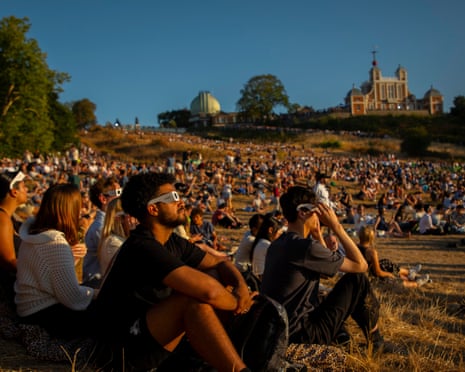
On 2 August 2027, viewers are required throughout the partial phases. They may come off only during true totality, when the Moon completely covers the Sun’s bright photosphere—and only if you are inside the path of totality. Put them back on as soon as the first bright point of photosphere reappears. Outside the path, the eclipse remains partial, so there is no glasses-off interval. See our phase-by-phase guide to when glasses go on and off in 2027 before briefing your group.
Never look through an unfiltered telescope, binoculars, or camera while wearing eclipse glasses. Magnifying optics concentrate sunlight and can damage the viewer and your eyes. Filters for optical equipment require a different setup and must be secured over the front aperture, not placed at the eyepiece. Seek advice from an experienced solar observer before using magnifying equipment.
What to do if you cannot verify your glasses
Uncertainty is a reason to stop, not a reason to improvise. Return the product if possible or discard it so someone else does not use it accidentally. Ordinary sunglasses, exposed photographic film, smoked glass, CDs, food wrappers, and homemade dark materials are not substitutes.
You can still follow the partial phases by projection. With your back to the Sun, allow sunlight to pass through a small hole onto a pale surface and watch the projected image. Gaps between crossed fingers, holes in a colander, or spaces between tree leaves can produce many tiny crescent Suns. Look at the projection—not through the hole at the Sun.
A phone screen is not eye protection. Pointing an unfiltered phone camera at the Sun may also damage the sensor, particularly with auxiliary lenses or magnification. Use a purpose-designed, securely mounted solar filter suitable for the camera system and follow its instructions; do not hold eclipse glasses loosely over a phone lens while staring toward the Sun.
For a school, club, tour, or extended family, make one person responsible for sourcing viewers early and another responsible for inspecting them before distribution. Share the 2 August 2027 planning guide with the group, label the storage envelope, and repeat the glasses-on/glasses-off rule aloud before first contact. That small rehearsal prevents confusion when the light begins to change.
Buying for 2027 without falling for authority language
Marketplace phrases such as approved solar eclipse glasses, solar eclipse glasses nasa approved, and nasa certified solar eclipse glasses imply an endorsement that NASA says it does not provide. More technical wording such as solar eclipse glasses iso 12312-2 certified is relevant only when the seller can support it with a credible manufacturer, traceable supply chain, and appropriate test documentation.
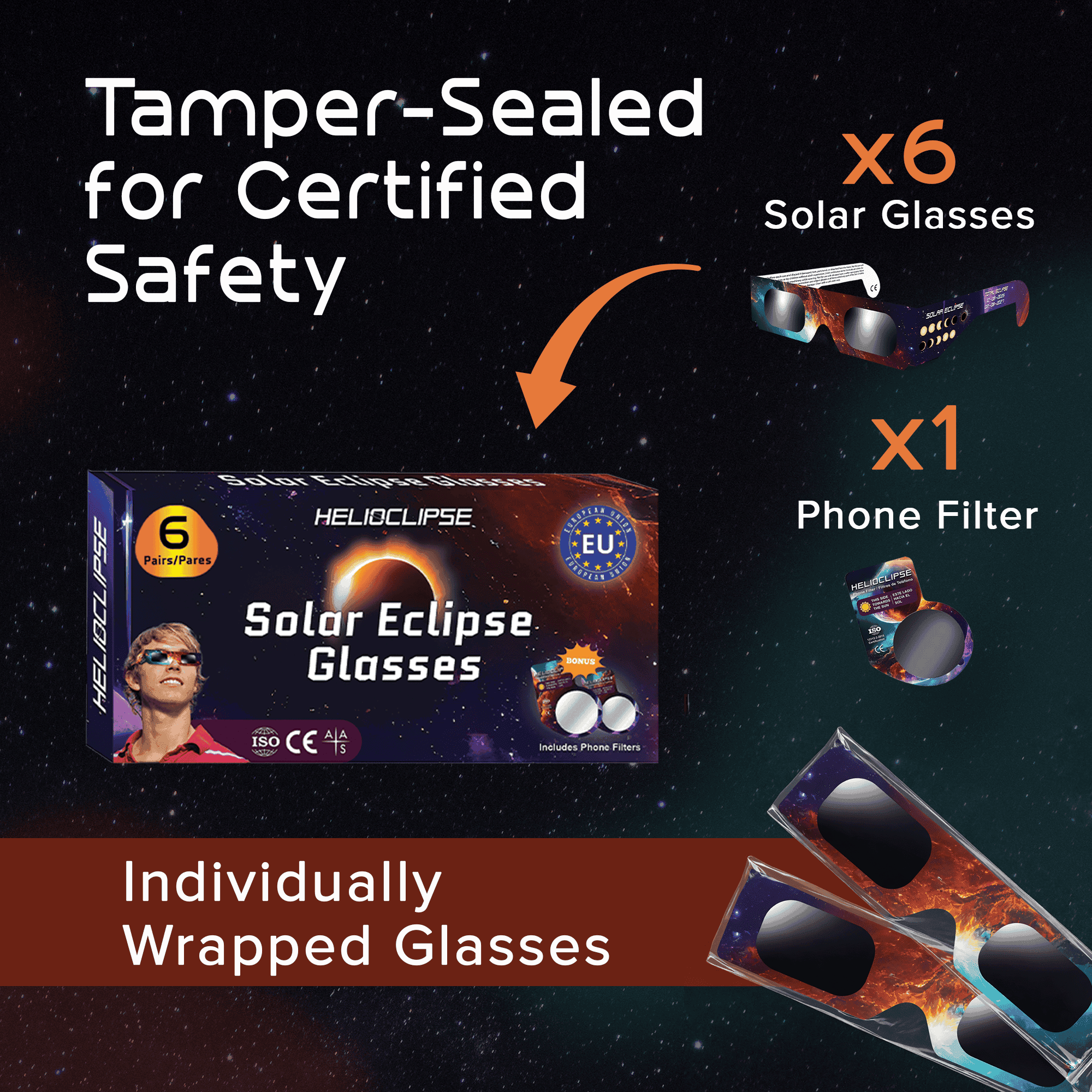
For our fake eclipse glasses how to check 2027 2027 guide, the buying rule is therefore deliberately conservative: shop early, use a known source, keep your receipt and packaging, and protect the viewers after delivery. Helioclipse offers certified eclipse viewing glasses for direct, unmagnified solar viewing. Order enough for your group, then store them flat, clean, and dry until inspection day.
The best time to discover a scratched filter is not in a crowded field with the partial eclipse already underway. Check every pair when it arrives, again while packing, and once more on eclipse day.
A two-minute inspection checklist
Use this checklist a few days before the eclipse and repeat the physical inspection on 2 August 2027:
- Source: Can you trace the viewer to an identifiable manufacturer and an authorized sales route?
- Standard: Does the product make a credible ISO 12312-2 claim supported by the manufacturer’s documentation?
- Labeling: Are manufacturer details, instructions, and warnings present and internally consistent?
- Filter: Are both viewing panels free from scratches, holes, tears, deep creases, and detached edges?
- Frame: Does it fit securely without letting direct sunlight enter around the filter?
- Indoor rejection check: Is the ordinary room invisible through the viewer?
- Storage: Has the viewer remained dry, clean, flat, and protected?
- Use: Does everyone know to put it on before looking up and turn away before removing it?
- Totality: Does the group understand that glasses come off only during complete totality from inside the path?
- Optics: Does everyone know that eclipse glasses cannot be combined with unfiltered binoculars, telescopes, or cameras?
If one answer exposes a serious gap, replace the viewer. The goal is not to prove that a questionable product is probably fine; it is to remove avoidable doubt before anyone looks at the Sun.
Safe Solar Eclipse Glasses? Three Ways To Spot A Dangerous ...
Astronomy Garage with Reflactor
Frequently asked questions
How should I safely watch the 2027 solar eclipse?
Use proper solar protection during the partial phases before and after totality, and throughout the event if you are outside the narrow path of totality. Choose a viewer that can be traced through a credible seller to a manufacturer with testing by a properly accredited laboratory.
Can I tell whether eclipse glasses are counterfeit just by inspecting them?
No. A convincing logo, dark filter, neat printing, or an ISO 12312-2 claim on the frame cannot prove that a viewer is safe. Look for reasons to reject it—such as loose filter panels, missing contact details, contradictory instructions, or an unidentified manufacturer—but verify the supply chain as well.
Is it safe to view a solar eclipse through my phone camera?
The excerpt does not provide guidance on using a phone camera to view an eclipse. It states that direct, unmagnified observation of the Sun requires filters intended for that purpose and that proper solar protection is needed during partial phases.
What could happen if I watch the Sun during an eclipse without appropriate protection?
The excerpt says that the partial phases require proper solar protection, including for observers outside the path of totality. It also explains that safe solar filters must address visible-light transmission as well as ultraviolet and infrared radiation, so ordinary appearance or darkness is not a reliable safety test.
What are the most important checks for avoiding fake or low-quality eclipse glasses in 2027?
Verify the supply chain, inspect the viewer and its instructions, and reject anything that creates doubt. Confirm who made the finished viewer, who sold it, whether that relationship is publicly verifiable, and whether credible compliance information is available rather than relying on wording printed on the frame.
On-site next steps
- Shop Helioclipse solar eclipse glasses early enough to inspect and store them properly before 2 August 2027.
- Use the Helioclipse Eclipse Explorer to confirm whether your exact observing site is inside the path of totality. That determines whether any safe glasses-off interval exists.
- Read our eclipse safety and planning guides and share the relevant phase instructions with your family, school, or travel group.
Sources & further reading
- American Astronomical Society: How Can You Tell If Your Eclipse Glasses or Handheld Solar Viewers Are Safe?
- American Astronomical Society: About the ISO 12312-2 Standard for Solar Viewers
- American Astronomical Society: Suppliers of Safe Solar Viewers & Filters
- Space.com: Fake solar eclipse glasses are everywhere ahead of the total solar eclipse. Here's how to check yours are safe
- American Astronomical Society: How to View a Solar Eclipse Safely
- NASA Science: Eclipse Viewing Safety
- American Astronomical Society: Eyewear & Handheld Viewers
- NASA Science: What to Expect: A Solar Eclipse Guide
- American Astronomical Society and Ralph Chou: Solar Eclipse Eye Safety technical report
- NASA Science: Eclipse Essentials: Safe and Stylish Solar Viewing Glasses