Eclipse selfies: front cameras, reflections, and the confidence trap beside the lens
A selfie can make an eclipse feel deceptively ordinary: face the screen, find the frame, tap the shutter. But the Sun is not an ordinary background light, and a phone screen is not eye protection. While you concentrate on your expression or the tiny preview, a slight turn of your head can put the bright Sun directly in your field of view.
That positioning problem matters during every partial phase of an eclipse, including the partial phases before and after totality. On August 12, 2026, only observers inside the path of totality will experience a brief interval when the Moon completely covers the Sun’s bright face. Everyone else will see a partial eclipse and must use proper eye protection throughout. Check your exact location and circumstances with our Eclipse Explorer and 3D map before building any photo plan around totality.
This solar eclipse selfie phone reflection eye safety 2026 guide focuses on the risk beside the lens: not just what the camera sees, but where your eyes, face, phone and reflected light are pointing while you compose the image.
Why selfie mode creates false confidence
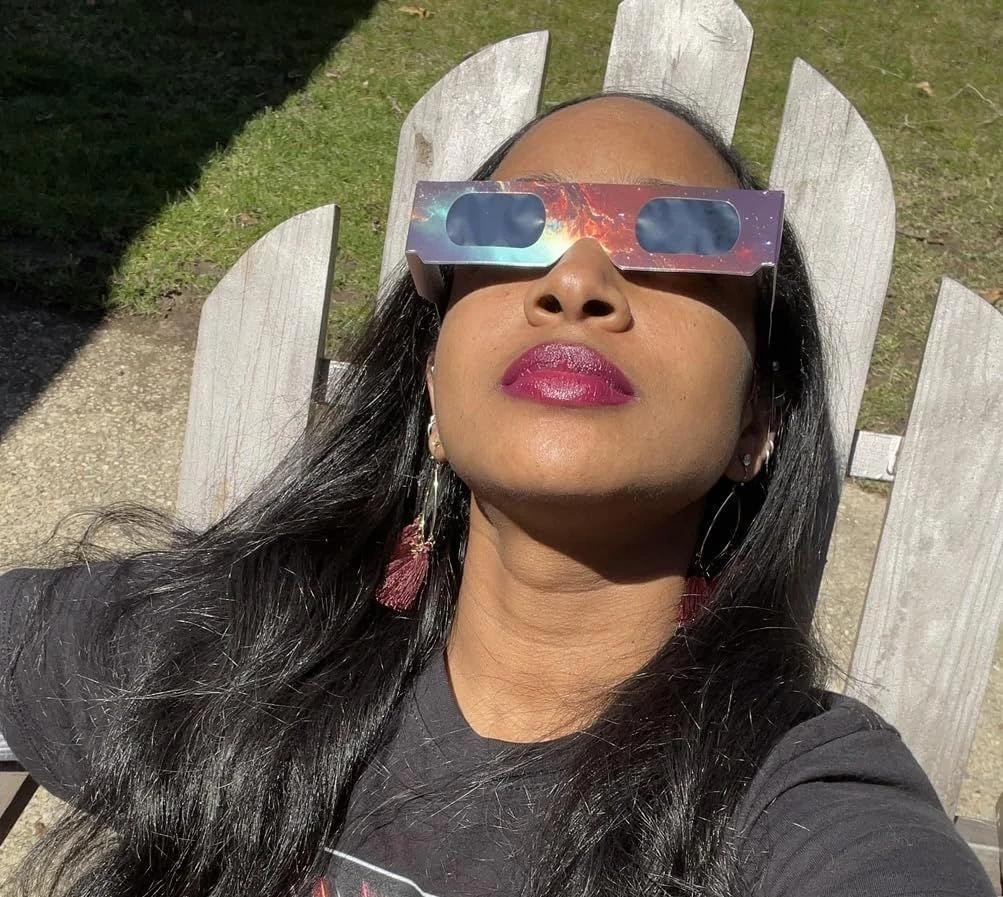
Watching a preview is not the same as looking safely at the Sun. The screen may show a small white disk, a flare or an overexposed patch, but it does not block direct sunlight arriving from above or beside the phone. If you look past the screen, glance over its edge or tilt your face to improve the composition, your eyes can become exposed before you notice the mistake.
That is the central problem with selfie mode eclipse viewing: the interface encourages you to treat the phone as an intermediary, even though the device does not control all the light reaching your eyes. A front camera changes the picture’s orientation; it does not turn the display into a solar eclipse viewer.
The danger is amplified by attention. You may be watching a countdown, changing exposure, reading comments or trying to keep friends inside the frame. Meanwhile, the Sun continues to occupy a real position in the sky. The safest composition begins with that position, not with the preview.
For the August 2026 event, make the eye-protection rules part of your group plan before anyone starts filming. Our guide to eclipse phases and when to use solar viewers explains the boundary between partial phases and genuine totality. A screen image, sudden dimming or automatic exposure change is not enough to establish that totality has begun.
The three light paths to think about
Most eclipse-selfie mistakes become easier to prevent when you separate three possible paths: sunlight entering your eyes directly, sunlight reflecting from a surface, and sunlight entering the phone’s camera optics.
1. Direct sunlight beside the phone
The simplest path is also the most important. Your phone may cover a small part of your view while the Sun remains visible immediately above, below or beside it. Looking toward that area without a proper viewer is unsafe during a partial or annular eclipse and during the partial phases of a total eclipse.
Small changes in eclipse angles matter. Raising the phone, leaning into a friend or rotating from portrait to landscape can move your face into a direct line with the Sun. Treat eclipse viewing angles as a physical setup problem: identify where the Sun is, decide where every person will face, and then place the phone.
Do not use the screen to hunt for the Sun by sweeping the phone around while looking over it. If the composition requires the eclipsed Sun itself, plan the alignment in advance and use equipment and filtering appropriate for solar photography.
2. Reflections from the screen, case or eyewear
Phone screens and glossy cases can produce bright glare or a more distinct, mirror-like reflection at particular angles. Prescription lenses and ordinary sunglasses can also catch reflections. A solar eclipse reflection on phone screen glass may therefore be uncomfortable or distracting, especially when you tilt the device toward the Sun.
Claims that a phone display necessarily reflects a uniquely dangerous dose of ultraviolet radiation during an eclipse should be treated cautiously. The stronger, well-established safety case concerns direct solar viewing, concentrated light through unfiltered optics, glare and the way a reflection can lure you into an unsafe position. An eclipse does not make the Sun emit a special new kind of radiation.
In practical terms, the eclipse reflection phone problem is geometric. If a bright solar image appears on the display, change the phone’s angle while keeping your face turned away from the Sun. Do not stare at the reflection to assess whether it seems dim enough. Apparent brightness is not a reliable safety test.
The same reasoning applies to the phone reflection solar eclipse setup sometimes used to place a glowing disk near a person’s face. A reflection is not a substitute for an indirect projection method, and a glossy screen should not be used as a solar-viewing surface.
3. Sunlight entering the camera
Your eyes and your camera need different protection. ISO 12312-2 applies to nonmagnifying viewers intended for direct observation with the eyes. It does not certify a filter for a phone camera, telephoto lens, binoculars or telescope.
During partial phases, a camera aimed at the Sun requires a suitable solar filter secured over the Sun-facing front of the lens or optical system. A filter placed behind magnifying optics can be exposed to concentrated light and is unsafe. Seek equipment-specific advice from an experienced solar observer or reputable astronomy authority before using magnifying accessories.
A smartphone’s wide lens usually renders the Sun very small, and an unfiltered partial Sun is likely to be badly overexposed. Prolonged direct exposure may also damage a camera sensor, particularly when magnifying optics are involved. Digital zoom does not reveal detail that the lens failed to capture, and it does nothing to improve safety.
A safer way to frame an eclipse selfie
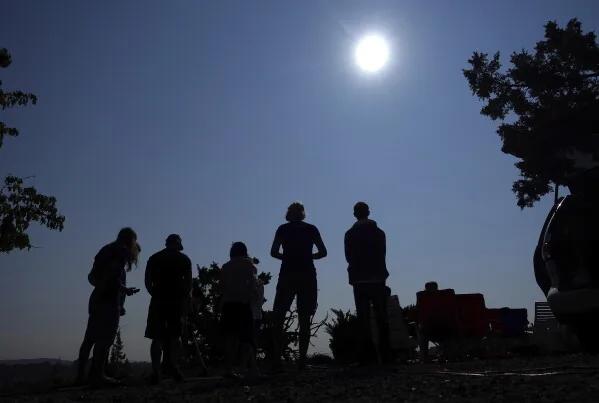
The most reliable approach is to make people and the changing environment the subject rather than trying to force the bright Sun into the frame. Photograph reactions, crescent projections beneath trees, unusual shadows, the gathering crowd or the changing color of the landscape. These images often tell the story better than a tiny blown-out disk.
Use this sequence during any partial phase:
- Locate the Sun while wearing proper eye protection. Do not search for it with unprotected eyes.
- Turn away before removing or adjusting your viewer. Keep the Sun outside your direct field of view while handling the phone.
- Choose a composition that does not require anyone to face the Sun. Tell friends exactly where it is so they do not turn toward it on instinct.
- Keep the Sun out of the phone’s frame unless the camera has an appropriate, securely fitted solar filter. Eye viewers and camera filters are not automatically interchangeable.
- Set a timer or start video before the key moment. This reduces last-second pointing, tapping and head movement.
- Take the photograph, then put the phone down. Recheck your eye protection before looking toward the sky.
A Sun-over-the-shoulder selfie may orient the subject’s eyes away from the Sun, but it aims the camera toward the Sun behind them. During a partial phase, that still creates a camera-filtering problem. It can also produce flare, silhouette the face and tempt the photographer to keep adjusting the angle. A safer and often better result is to keep the Sun outside the frame and photograph the human scene.
If you want a direct view of the partial Sun, use undamaged solar eclipse glasses or a handheld viewer that conforms to ISO 12312-2. Our deeper guide explains what ISO 12312-2 means for eclipse viewers, including why ordinary sunglasses are not an alternative.
How to use eclipse glasses around a phone
Knowing how to use eclipse glasses is less about wearing them continuously and more about controlling the transition between protected viewing and everything else you are doing.
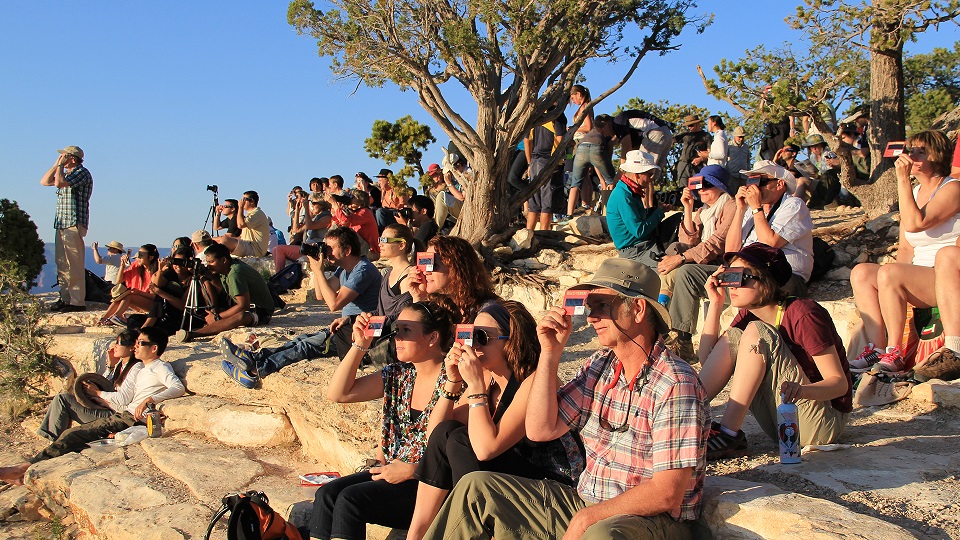
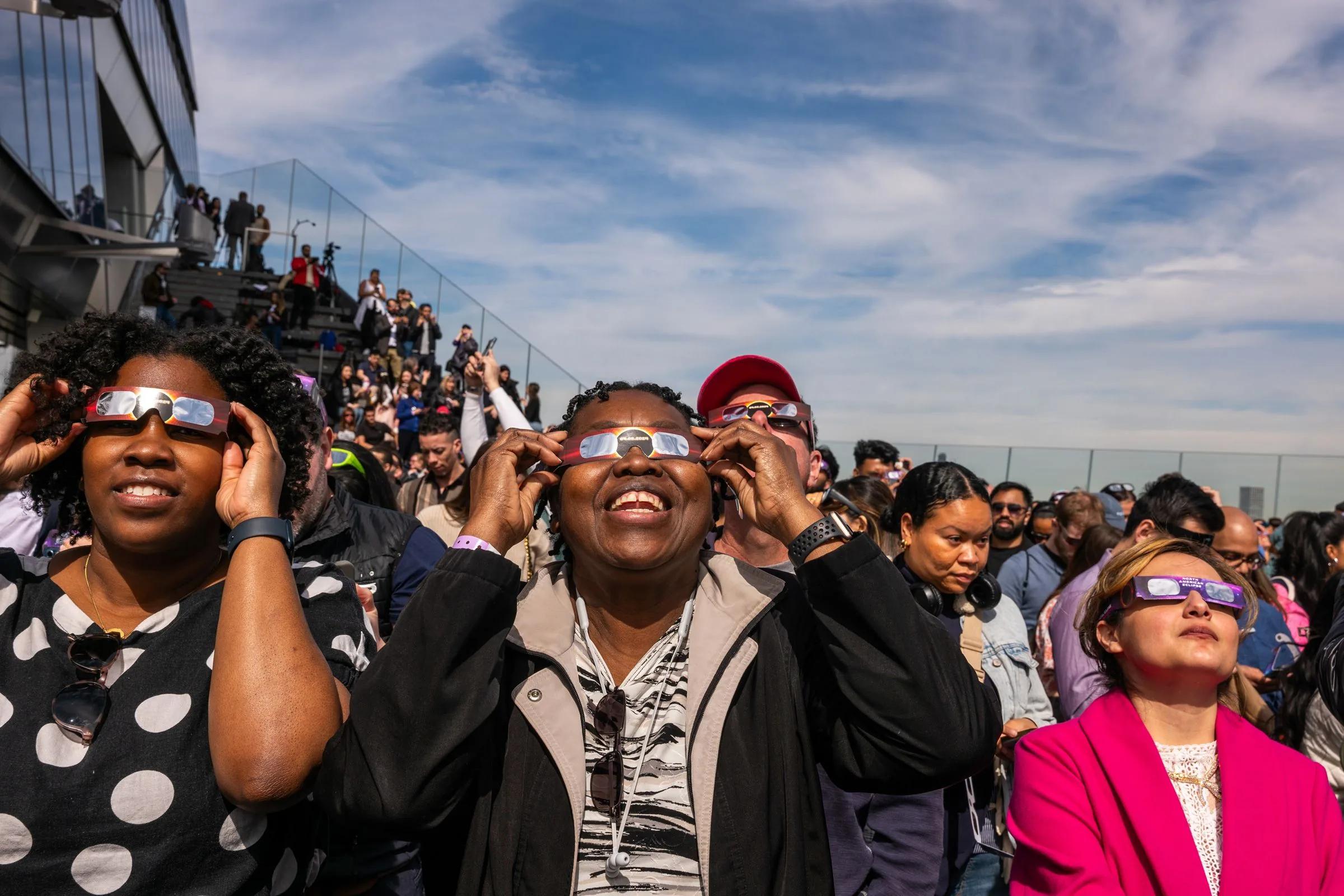
Stand still before looking up. Put the viewer over your eyes, then turn toward the Sun. When you have finished looking, turn your head away before removing the viewer. Inspect it before use and discard it if the filter is scratched, punctured, torn or separating from its frame. Children should be supervised closely because a viewer that slips while they are looking up can expose their eyes.
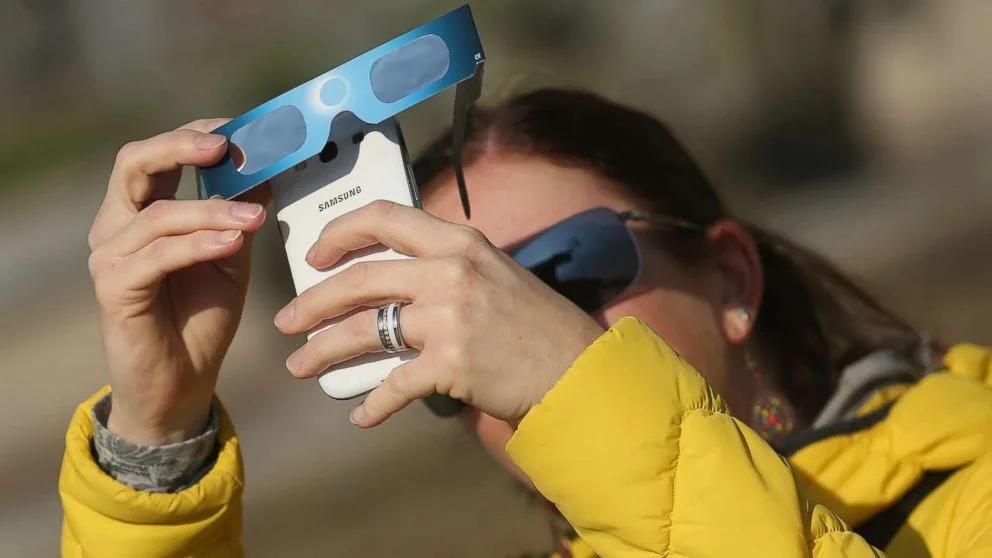
Do not look through an unfiltered camera lens, binoculars or telescope while wearing eclipse viewers. Magnifying optics can concentrate sunlight strongly enough to damage the viewer and injure the eye. A solar eclipse viewer designed for unaided eyes belongs in front of your eyes; a camera or telescope needs a suitable filter securely attached over the front aperture.
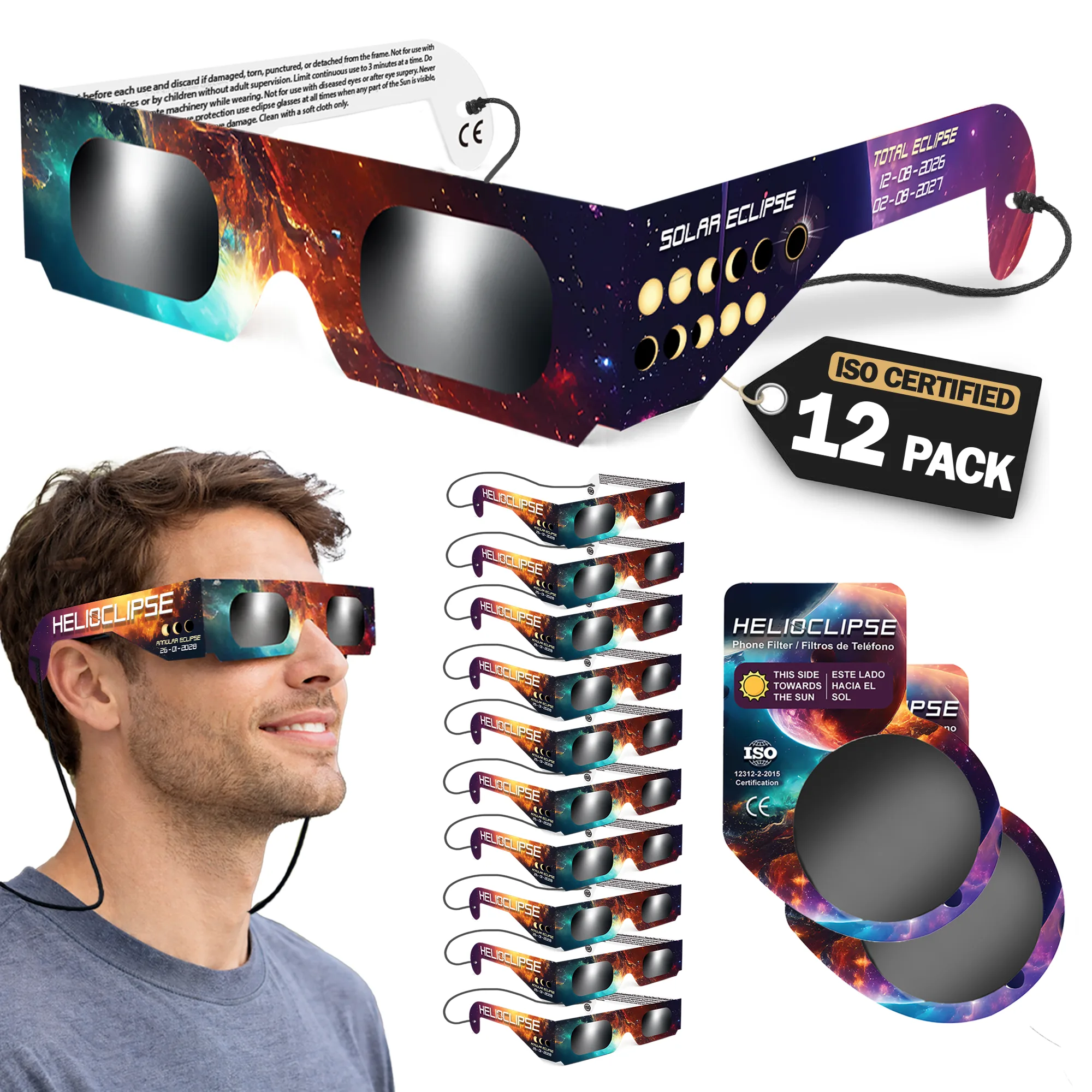
Marketplace language can muddy this distinction. Phrases such as eclipse glasses nasa approved are misleading because NASA does not approve particular brands. When evaluating certified solar eclipse glasses or eclipse viewing glasses, look for credible evidence that the product conforms to ISO 12312-2, clear manufacturer information and intact filters—not a vague space-agency claim. Helioclipse offers ISO 12312-2 certified solar eclipse glasses for direct, nonmagnified viewing.
Totality is a narrow exception, not a camera cue
During a total solar eclipse, viewers may remove their eye protection only when the Moon completely covers the Sun’s bright face. That exception exists only inside the path of totality and only for the brief total phase. As soon as any bright photosphere reappears, viewers must go back on.
A phone cannot make that decision for you. Automatic exposure can darken a bright scene, a cloud can cover the Sun, and a camera preview can clip highlights. None of those conditions is totality. If you are outside the path, there is no glasses-off interval at all.
For solar eclipse 2026 safety, verify your position and local contact times in advance, appoint someone in the group to follow a reliable countdown, and listen for the end-of-totality warning. If you are uncertain whether totality has started or ended, keep your viewers on.
During actual totality, a wide, fixed phone shot can capture something a close-up often misses: the darkened landscape, the horizon glow and your group’s reaction. Set it up beforehand, turn off the flash, start recording early and let it run. The moment is too short to spend navigating menus.
Common confidence traps
“I’m only looking at the screen”
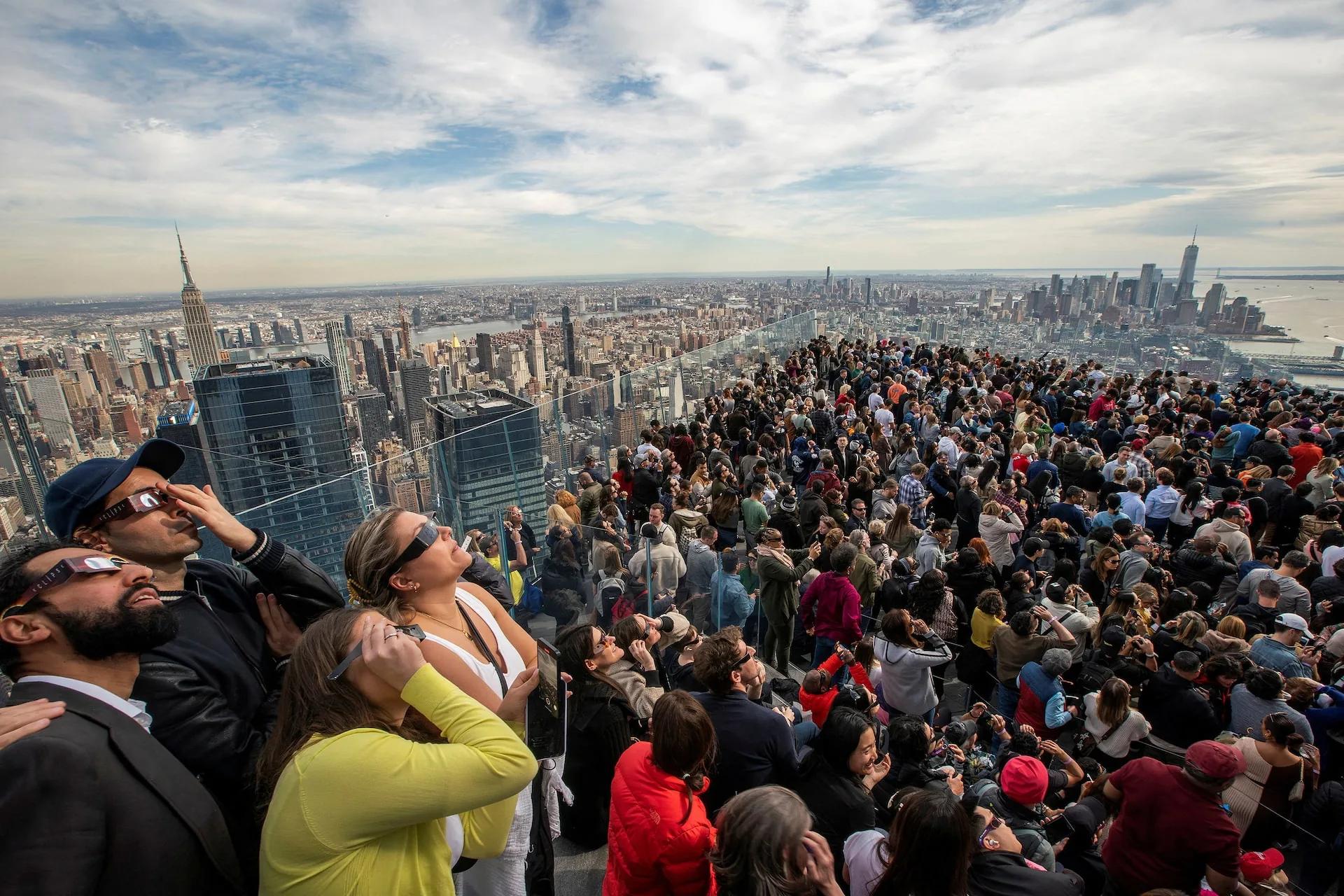
The screen does not shield your peripheral vision or stop you from glancing around its edge. Keep track of the real Sun, not merely its preview.
“The remaining crescent is tiny”
Even a narrow visible portion of the Sun is still intensely bright. During partial phases, the photosphere requires proper eye protection regardless of how much the Moon covers.
“My sunglasses are very dark”
Ordinary sunglasses are not solar viewers. Their visible darkness does not demonstrate the extreme attenuation and spectral performance required for direct solar observation.
“Clouds make it safe”
Cloud thickness changes from moment to moment, and bright sunlight can break through unexpectedly. Use the same protection rules when the Sun is visible through haze or cloud.
“The reflection does not hurt, so it must be safe”
Comfort is not a measuring instrument. Move the reflective surface rather than testing how long you can tolerate the glare.
“I can fix the shot during the countdown”
Rushing changes body position and divides attention. Practice the framing on an ordinary sunny day without looking at the Sun, then save the setup. The best safety precautions when viewing a solar eclipse are the ones that remove decisions from the most intense minute.
A short checklist for creators and influencers
If you are filming for an audience, your behavior becomes part of the lesson. People may copy your pose without seeing the preparation that happened before recording.
- State whether you are filming a partial phase or genuine totality.
- Keep certified viewers visible and explain when they are required.
- Never tell viewers that a phone screen makes direct solar viewing safe.
- Do not demonstrate damaged, improvised or ordinary tinted eyewear as eye protection.
- Avoid choreography that asks participants to look toward the Sun for the camera.
- Assign one person to monitor eclipse timing while another handles the recording.
- Prewrite captions so you are not editing while the Sun is reappearing.
- Say explicitly that a filter for human eyes is not automatically a camera filter.
Good solar eclipse selfie phone reflection eye safety advice should remain correct when a clip is separated from its caption. Show the safe sequence on camera: viewer on before turning toward the Sun, viewer off only after turning away, with the totality exception explained precisely.
Better photographs come from looking around
A phone is excellent at recording context. It can capture faces, sound, movement and the rapid change in ambient light—subjects for which a tiny wide-angle lens is much better suited than it is for detailed solar photography.
Look for crescent images projected through gaps between leaves. Record the crowd growing quieter as the light changes. Frame a friend checking a viewer for damage or a family comparing the Sun’s shape every few minutes. During totality, if you are inside the path, a fixed wide shot can record cheers, the dark sky and the returning light without anyone spending the whole event staring at a display.
This approach also reduces the pressure to solve complicated eclipse viewing angles in real time. You return attention to the experience itself while the phone records a scene worth remembering. The strongest eclipse image may not show the Sun at all; it may show what the Sun’s disappearance did to everyone around you.
Honest Review of Solar Eclipse Glass w Smartphone Filter
Courtney's Corner
Frequently asked questions
Can I safely watch a solar eclipse on my phone screen?
No. A phone screen is not eye protection and does not block sunlight that can reach your eyes from above, beside, or past the edge of the device. Watching the preview does not make direct viewing of the Sun safe.
Why is recording an eclipse with a phone risky in selfie mode?
Selfie mode can create false confidence because the screen acts as an image display, not a solar viewer. While framing the shot or adjusting settings, a small head movement can place the bright Sun directly in your field of view.
How should I protect my eyes while taking eclipse photos?
Use proper eye protection during every partial phase, including the partial phases before and after totality. Plan your position based on where the Sun is in the sky, rather than relying on the phone preview or automatic exposure.
Is taking an eclipse photo with a phone allowed?
A phone can capture an image, but the camera view does not protect your eyes while you compose it. Keep in mind that sunlight may reach your eyes directly beside the phone or when you glance beyond the screen.
When do I need eclipse glasses during an eclipse?
Proper solar viewers are required throughout a partial eclipse, including before and after totality. Only people inside the path of totality experience a brief period when the Moon completely covers the Sun’s bright face, and screen dimming or exposure changes do not confirm that this has happened.
On-site next steps
- Get Helioclipse ISO 12312-2 certified viewers early enough to inspect them and practise the correct viewing sequence.
- Use the Helioclipse Eclipse Explorer to confirm whether your location is inside totality and to check the phases and local timing.
- Share the safety plan with your family, school group or filming team before eclipse day—especially the rule that a phone screen never replaces eye protection.
Sources & further reading
- How to safely record today’s total solar eclipse with your phone — Live Science
- One Tech Tip: How to use apps to track and photograph the total solar eclipse — Phys.org
- Can you take eclipse photos with your phone? Yes, but … — Astronomy Magazine
- Use Your Smartphone to Photograph the Solar Eclipse — Sky & Telescope
- How to Shoot Solar-Eclipse Images & Videos — American Astronomical Society
- Eclipse Viewing Safety — NASA Science
- How to View a Solar Eclipse Safely — American Astronomical Society
- Solar Filters for Optics: Telescopes, Binoculars & Cameras — American Astronomical Society
- About the ISO 12312-2 Standard for Solar Viewers — American Astronomical Society
- What to Expect: A Solar Eclipse Guide — NASA Science