Noise, cheering, and PA systems: earmuffs, rhythm breaks, and still keeping glasses discipline
A public eclipse event can change character in seconds. One moment, families are chatting on picnic blankets; the next, a presenter counts down over a PA system, music starts, and hundreds of people cheer at once. For a child who is sensitive to sound—or simply tired, hot, and surrounded by strangers—that surge can turn wonder into overload.
That does not mean the child has to miss the eclipse. A pair of well-fitting earmuffs, predictable breaks, a quieter viewing position, and rehearsed visual cues can make the day much more manageable. The crucial distinction is simple: earmuffs manage sound, while solar viewers protect eyes. One never substitutes for the other.
For the August 12, 2026 eclipse, first use our Eclipse Explorer and 3D map to confirm whether your exact site is inside the path of totality or will see a partial eclipse. That geographic answer determines whether there is any brief glasses-off period at all.
This noise reducing earmuffs kids eclipse crowds 2026 guide focuses on what families can control: sound, communication, breaks, supervision, and a viewer routine that still works when the crowd gets loud.
Why an eclipse crowd may sound different from an ordinary day out
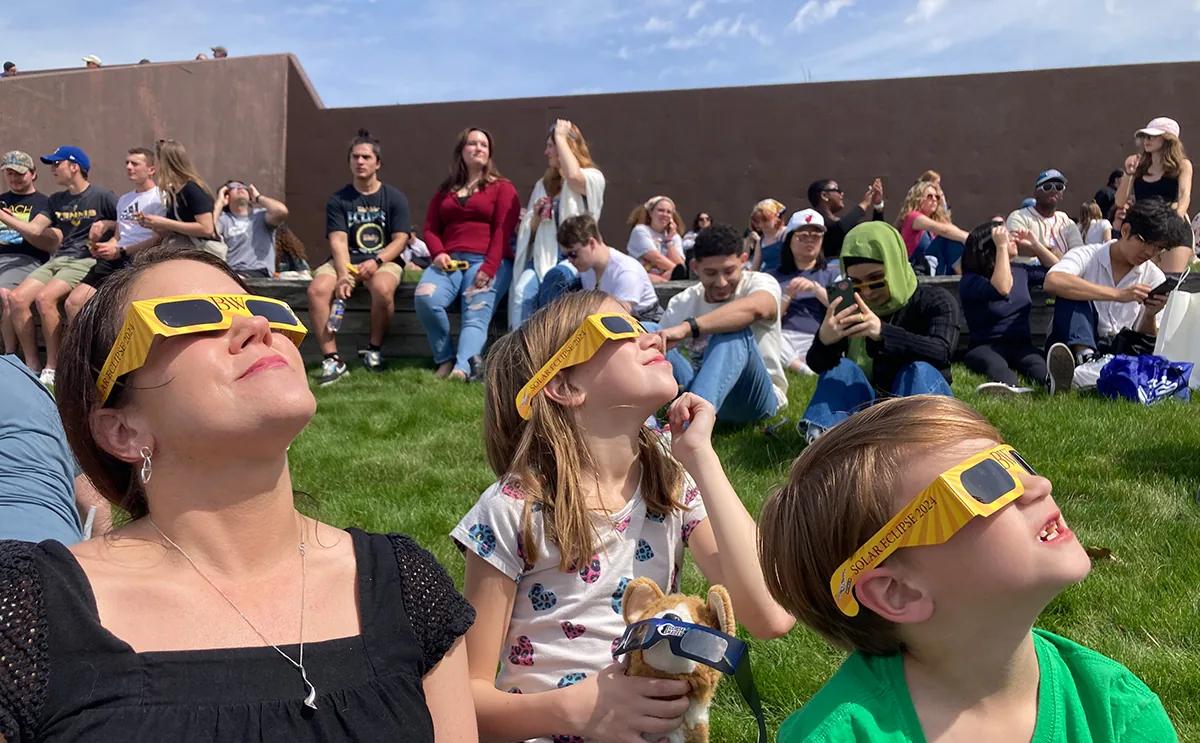
An eclipse gathering is not necessarily loud from beginning to end. The partial phases develop gradually, often over roughly an hour before totality and another hour afterward. During much of that time, the soundscape may resemble a festival, school field day, or busy park: conversations, children playing, generators, traffic, music, and periodic announcements.
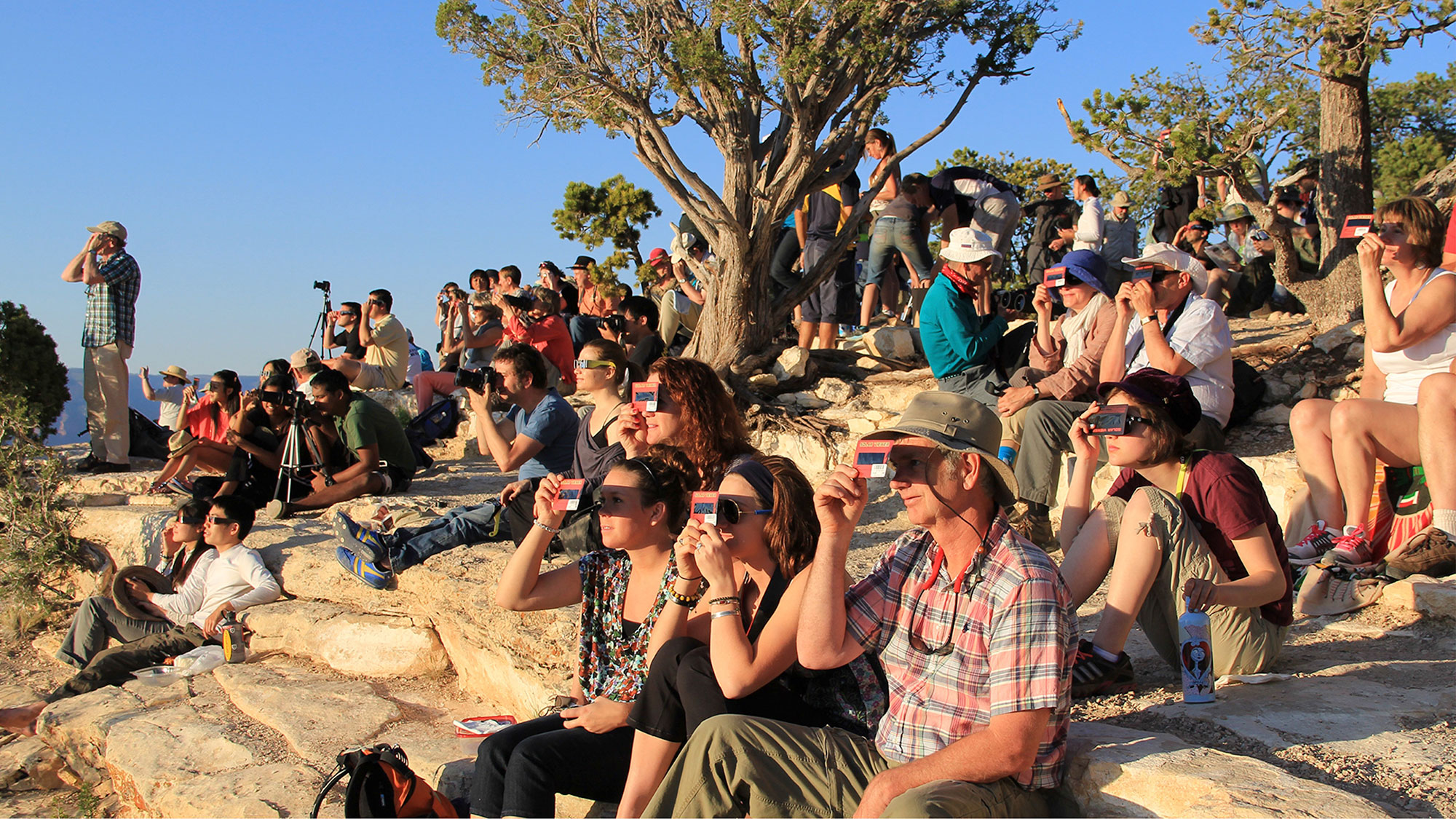
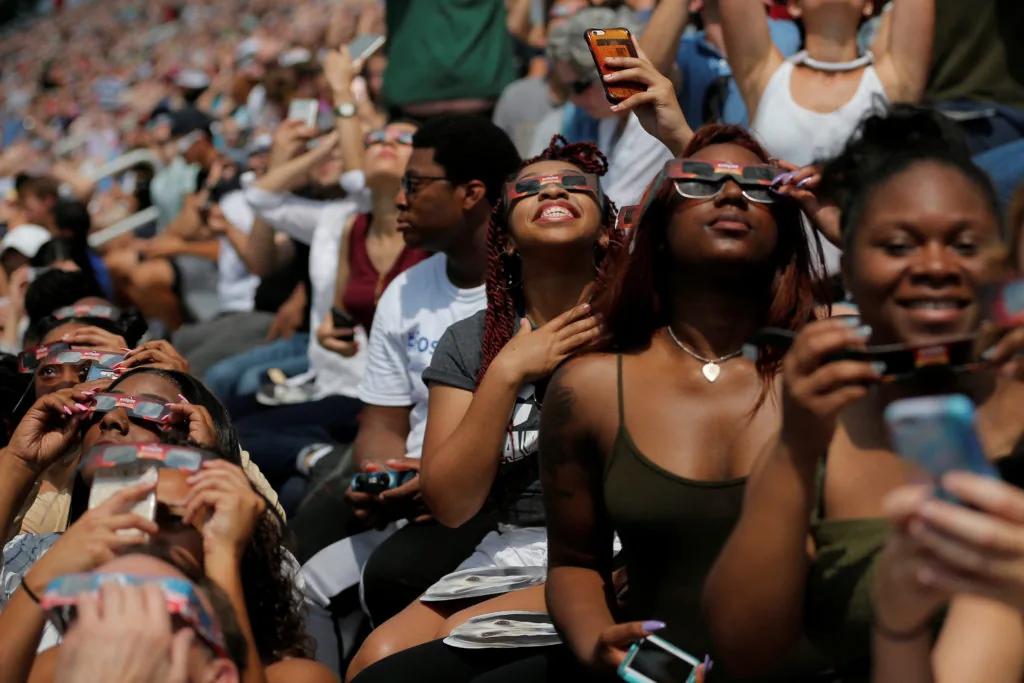
The sharpest sensory change may come near totality. NASA’s observing guidance notes that people often gasp, shout, cheer, and clap as the last bright sunlight disappears and again when it returns. An emcee may amplify that moment with a countdown. Automated streetlights can switch on, phones may sound alerts, and a child who was coping comfortably five minutes earlier may suddenly need distance.
The August 12, 2026 total eclipse crosses parts of Greenland, Iceland, northern Russia, Spain, and a small corner of Portugal. Much of Europe and other parts of the Northern Hemisphere will see a partial eclipse instead. The crowd around you may celebrate a local maximum even where totality does not occur—but crowd excitement does not change the solar geometry. In a partial-eclipse location such as Madrid or most of the UK, there is no safe naked-eye phase.
Before choosing a public event, ask the organizer concrete questions: Will there be amplified music? Is a countdown planned? Are air horns, fireworks, or rocket launches involved? Is there a quiet area, and can your family leave and return? A “family-friendly” label does not tell you the likely sound level.
What earmuffs can—and cannot—do
Passive noise-reducing earmuffs use cups, cushions, and sound-absorbing material to reduce the sound reaching the ears. They generally soften a broad range of noise without requiring batteries. Active noise cancelling headphones add electronics that work especially well against steady low-frequency sounds, such as an engine or ventilation system, but may be less effective against sudden cheering or a nearby shout.
Product packaging may state an NRR or SNR value in decibels, depending on the testing system and market. That laboratory rating is not a promise that every child will experience exactly that reduction. Hair, glasses arms, hats, cup position, cushion condition, and head size can all affect the seal. A larger number is not automatically better if the headband is painful, the cups slip, or the child cannot hear a caregiver’s safety cue.
The best noise reducing earmuffs kids eclipse crowds can use are therefore not simply the pair with the largest printed number. They are appropriately sized, comfortable enough to remain in place, tested by the child beforehand, and compatible with the family’s communication plan. Avoid making eclipse day the first trial.
Some children prefer reduced sound but still want to hear speech; others need stronger attenuation and a visual or tactile cue from a trusted adult. Let the child try the earmuffs during a noisy but familiar activity. Check for pressure, heat, slipping, and whether the child can remove them independently. Never force continued wear if the equipment is causing distress or pain.
Earplugs can help some older children and adults with sensory overload, but fit and insertion matter, and small plugs may be unsuitable for young children. If hearing protection is needed for genuinely hazardous sound rather than general crowd comfort, seek product guidance appropriate to the setting and advice from a qualified hearing professional.
The two-layer rule: sound comfort and solar safety
Our shorthand is earmuffs reduce audio overload, not solar risk—viewers eclipse planning must keep those two jobs separate. Earmuffs go over or around the ears. Eclipse glasses or a handheld solar viewer must fully cover the eyes whenever someone looks directly at the uneclipsed or partially eclipsed Sun.
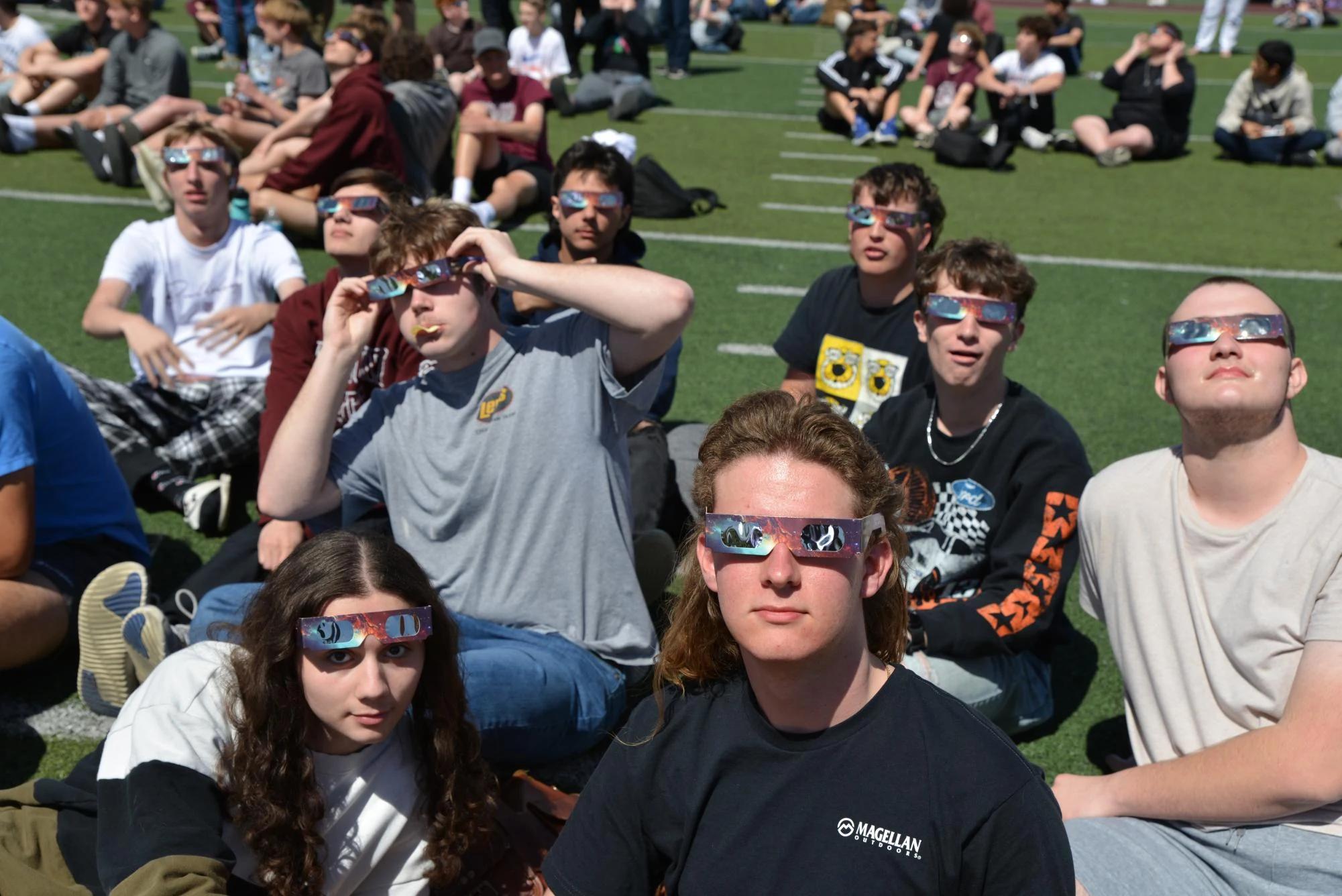
During every partial phase, put the solar viewer on before the child turns toward the Sun. After the look, have the child turn away before removing it. This sequence is easier to supervise than trying to correct a viewer after the child is already looking up:
- Stop and stand still.
- Viewer on and covering both eyes.
- Look toward the Sun briefly.
- Turn the whole body or head away.
- Viewer off only after facing away.
Practice that five-step rhythm indoors, using a wall sticker or lamp that is switched off as the pretend Sun. The goal is not obedience for its own sake; it is a familiar motor routine that survives excitement, noise, and changing plans.
Children need active supervision with solar viewers. Check the filters before the event and discard any viewer that is torn, punctured, scratched, detached from its frame, or otherwise damaged. Ordinary sunglasses—even very dark ones—are not suitable for direct solar viewing. For a fuller explanation, read our guides to eclipse phases and when viewers come off and what ISO 12312-2 means for families.
Cameras, binoculars, and telescopes introduce a separate hazard. Do not look through an unfiltered optical device while wearing eclipse glasses. Magnifying equipment needs an appropriate solar filter secured over the front aperture, with expert guidance where necessary.
Totality requires a location-specific plan
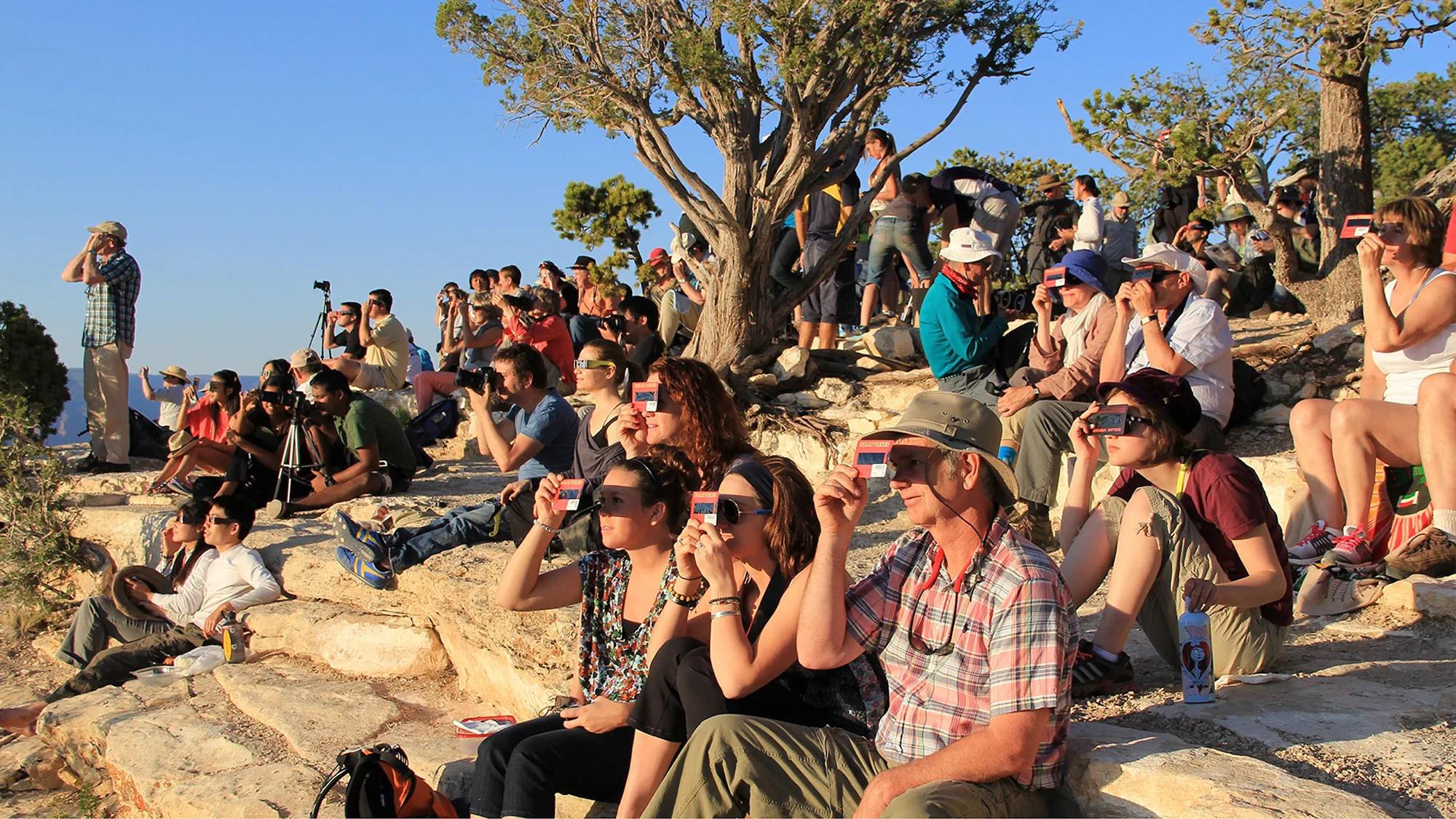
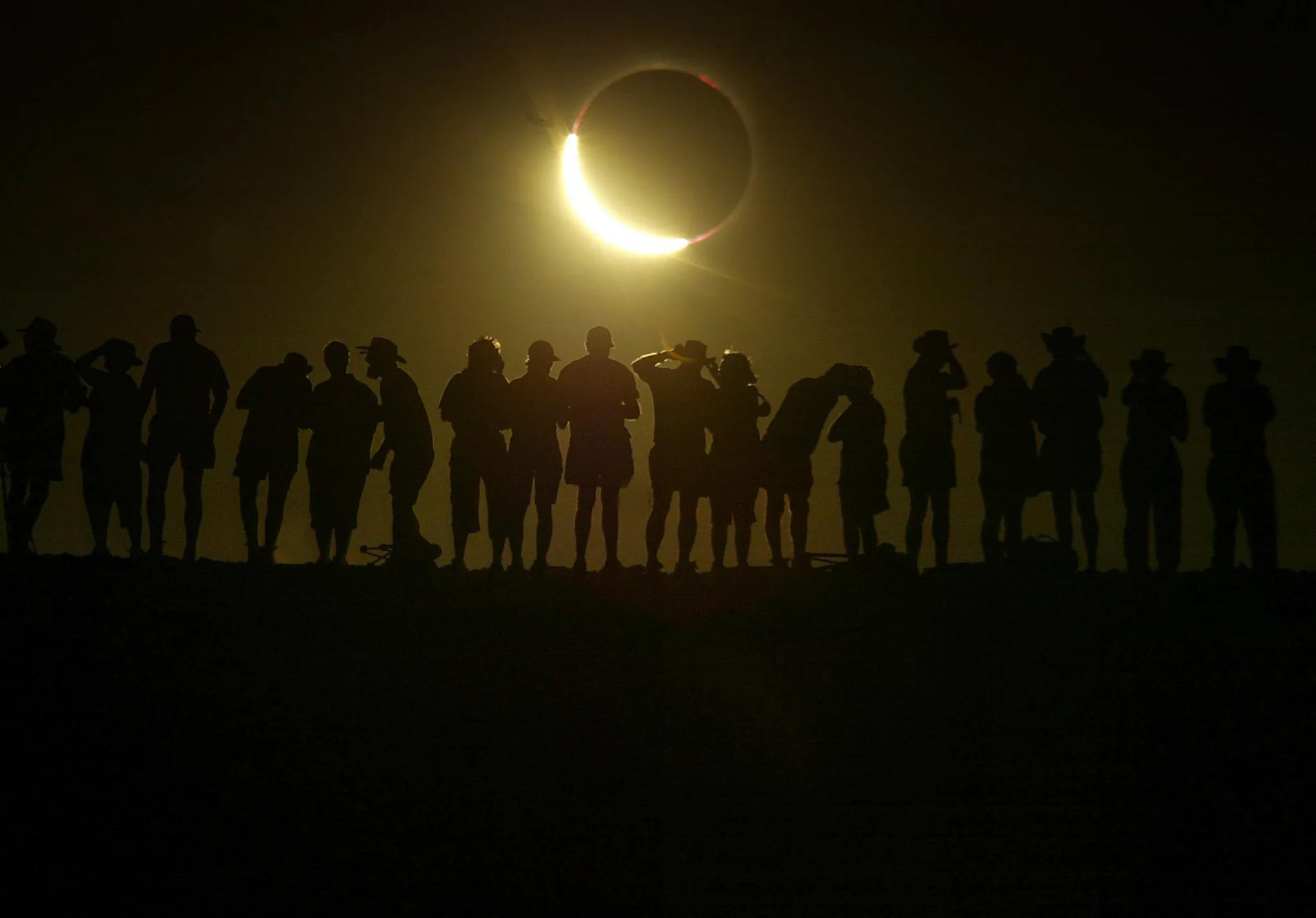
Only observers inside the path of totality may briefly view the totally eclipsed Sun without solar viewers—and only while the Moon completely covers the Sun’s bright face. Earmuffs do not help you determine when that interval begins or ends. Neither does a crowd countdown, which may be early, late, or intended for a different reference point.
Keep viewers on through the final partial moments. Totality has begun only when the bright solar surface is completely covered and nothing is visible through a proper solar viewer. As soon as any bright sunlight reappears, viewers must go back over the eyes before anyone looks toward the Sun again. Your precise contact times and duration depend on your exact coordinates, so check the Helioclipse map rather than relying on a city-wide estimate.
Outside the path of totality, there is no glasses-off moment. This remains true even if the Sun looks like an extremely thin crescent, the air cools, or the crowd cheers at maximum eclipse. Partial is not “almost safe”; a visible portion of the Sun is still intensely bright.
For a child wearing earmuffs, do not rely on a spoken countdown or PA announcement. Choose one supervising adult who understands the local eclipse circumstances and can deliver a rehearsed visual cue. For example:
- Two raised fingers: keep the solar viewer on.
- A flat hand facing the child: stop and look at the adult.
- A practiced gesture at confirmed totality: the adult helps with viewer removal, if the child wants it removed.
- Both hands returning to the eyes: viewer back on immediately.
If this sequence feels too complicated in the moment, leave the viewer on. A child can still experience the darkness, cooling air, crowd reaction, horizon colors, and changing animal sounds without looking directly at the Sun.
Build rhythm breaks into the day
A rhythm break is a planned pause before overload, not a punishment after it. Public eclipse events can last several hours, while direct looks through a solar viewer need only be brief and occasional. The Moon’s movement becomes apparent when you compare the Sun every few minutes; nobody needs to stare continuously.
Try a predictable cycle: one supervised look, one nonvisual observation, then a break. The child might mark the Sun’s changing shape on a card, look for crescent projections beneath leafy trees, notice whether the light feels flatter, drink water, and return to a quieter spot. During indirect projection, keep your back to the Sun and look at the projected image—never through the pinhole.
NASA-supported Eclipse Soundscapes work has emphasized that an eclipse can be experienced through sound, touch, temperature, and environmental change as well as sight. A child taking a visual break is not failing to participate. They may be the person who notices insects becoming more active, birds changing their calls, wind shifting, or the temperature falling.
Schedule breaks by time or event rather than waiting for visible distress. Useful anchors include arrival, the first supervised solar look, a snack, the final 15 minutes before totality or local maximum, and a quiet period after the main crowd reaction. NASA’s 2024 Wallops eclipse event offered a supervised sensory-friendly area with dimmer lighting, seating, space for reflection, and tactile items—a practical model for what families can request from schools, museums, and community organizers.
Choose a viewing position that preserves an exit
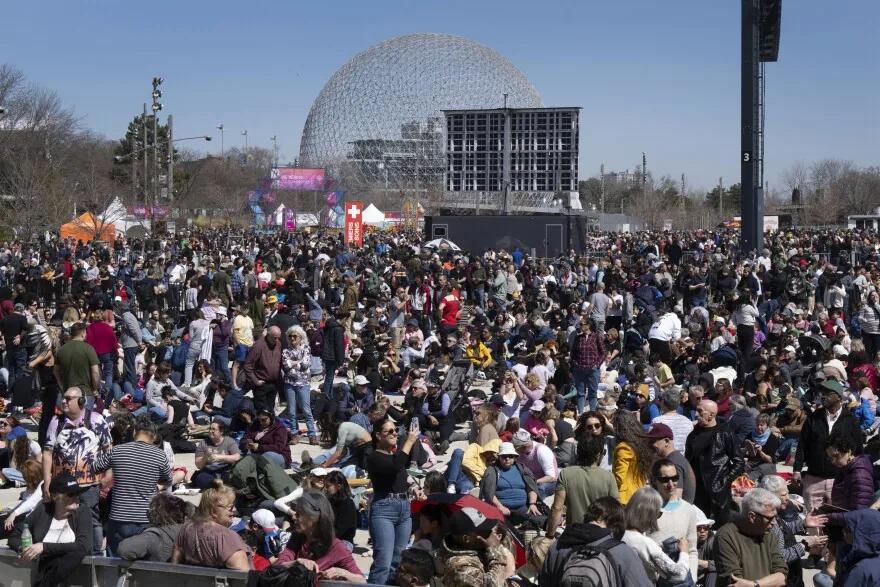
The middle of a festival lawn may provide a clear sky, but it also puts you near speakers, queues, and crowd compression. A position near the edge can offer almost the same celestial view with a faster route to a car, indoor room, shaded area, or quiet side street. The Sun does not become more eclipsed because you are standing beside the stage.
Arrive early enough to assess the site before the partial phase begins. Identify the loudspeakers, toilets, food queues, shade, first-aid station, and at least two retreat routes. If an organizer has designated a sensory area, confirm whether the Sun is visible from it and whether leaving the main area affects re-entry.
For the 2026 event, also distinguish between choosing a town and choosing a specific viewing site. The August 12, 2026 planning guide can help with the larger event, while the map lets you inspect whether a precise location is inside or outside totality. Once the geometry is settled, choose the least demanding workable environment—not necessarily the biggest official celebration.
Tell friends, relatives, teachers, or group leaders about the plan before eclipse day. A one-page social story can show arrival, the viewing area, earmuffs, eclipse viewers, the break location, expected darkness, possible cheering, and departure. Use literal language: “People may shout when the sky gets dark” is more useful than “It will be magical.”
A practical family checklist
Before leaving home
- Confirm the eclipse type at your exact location: total or partial.
- Save the local phase information and do not depend solely on mobile service.
- Inspect every solar viewer for damage and read its instructions.
- Practice the stand–viewer on–look–turn away–viewer off routine.
- Test earmuffs for fit, comfort, and compatibility with glasses arms or a hat.
- Agree on visual or gentle tactile cues that the child already accepts.
- Pack water, snacks, sunscreen, comfortable clothing, and a familiar calming item.
- Create a short social story or picture schedule if predictability helps.
- Tell the child that leaving early or watching indirectly is allowed.
At the site
- Locate speakers and move away from their direct line where possible.
- Find the quiet space and exit route before the crowd grows.
- Assign one adult to solar-viewer supervision and timing.
- Keep viewers accessible rather than buried in a bag.
- Offer earmuffs before the loudest period, not only after distress begins.
- Use short viewing turns and regular sensory breaks.
- Watch for overheating beneath earmuffs, hats, or hoods.
- Never let a PA countdown override the location-specific solar-safety plan.
When the crowd reacts
- Face the child so your visual cue is easy to see.
- Keep solar viewers in place during every partial phase.
- If you are not unquestionably inside totality, treat the event as partial.
- If totality occurs, help with viewer removal only after full coverage is confirmed.
- Replace viewers as soon as bright sunlight starts to return.
- Move to the quiet area whenever the child asks or shows their agreed signal.
How to shop without confusing the two products
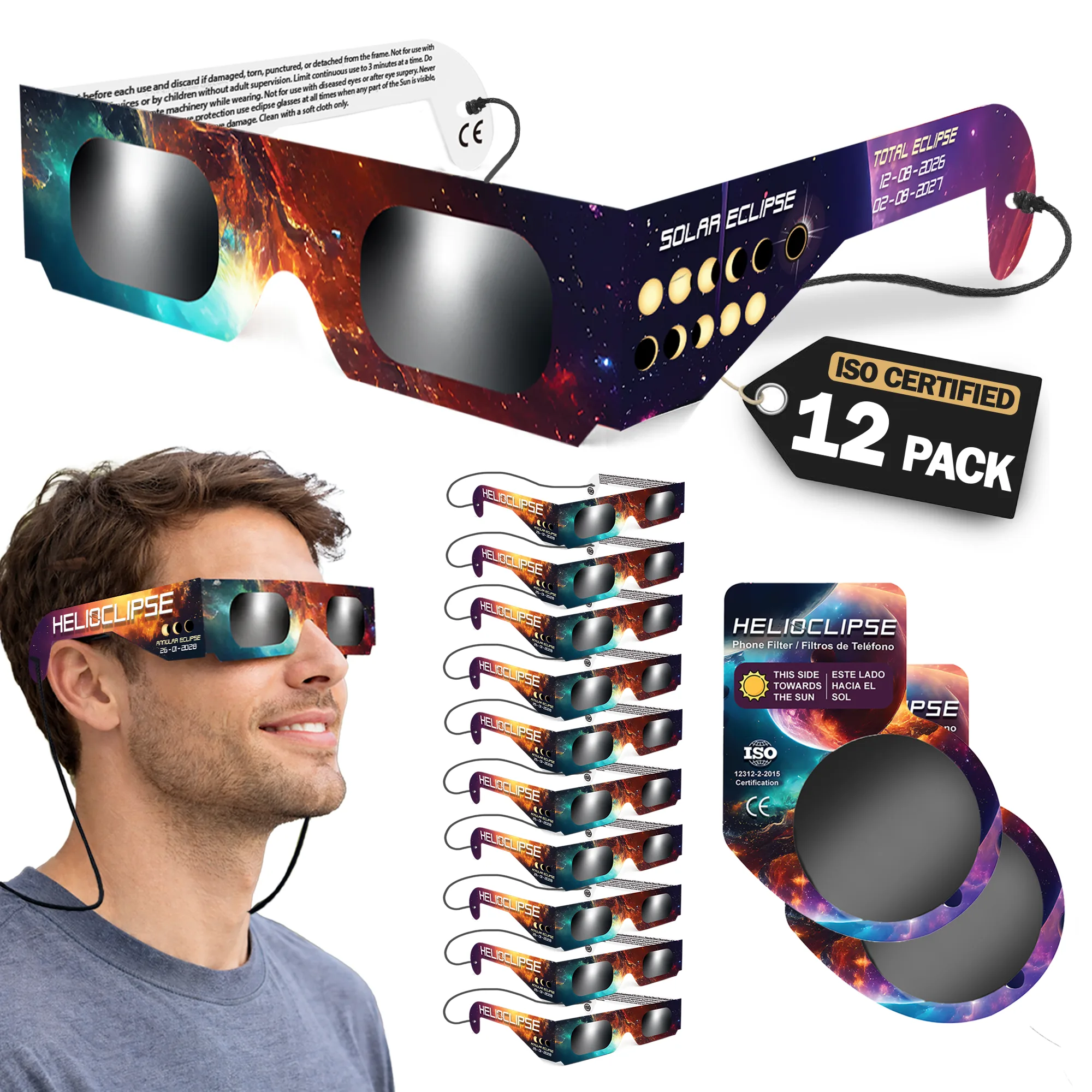
Families planning noise reducing earmuffs kids eclipse crowds should make two separate purchasing decisions. For earmuffs, consider fit, comfort, attenuation information, durability, and whether the child can still receive the planned cue. For solar viewers, look for a trustworthy seller, appropriate instructions, intact filters, manufacturer information, and documented conformity with ISO 12312-2.
Marketplace wording can blur authority. Phrases such as approved solar eclipse glasses or eclipse glasses nasa approved do not establish that NASA endorsed a product; NASA explicitly says it does not approve particular viewer brands. More useful product language includes solar eclipse glasses iso 12312-2 certified, but even that printed claim should be considered alongside seller credibility, traceability, labeling, and the physical condition of the viewer.
Order Helioclipse solar eclipse glasses early enough to inspect them and rehearse with the children who will use them. Do not let a last-minute search for the best noise reducing earmuffs kids eclipse crowds distract from the nonnegotiable solar-viewer check.
Give the child more than one valid way to participate
A successful eclipse day does not require a child to tolerate the loudest crowd, watch every phase, or remove their earmuffs. It also does not require a direct view of the Sun. Choice can be built into the plan without making safety optional.
Offer concrete alternatives: a brief filtered look, pinhole projection, watching crescent shadows, listening from a quiet edge, recording temperature changes, following a trusted livestream indoors, or returning outside only for the environmental change near maximum eclipse. The adult keeps the solar rule fixed while the child chooses how close, how long, and through which safe method to participate.
That balance matters. We can respect sensory needs without lowering the eye-safety standard, and we can supervise without turning a rare shared experience into a test of compliance. The sky will provide enough drama on its own.
How to Eliminate Hum on Your PA System
Networx Audio Video Inc
Frequently asked questions
How can I prepare a sound-sensitive child for a crowded eclipse event in 2026?
Plan for sudden noise near the peak of the eclipse, when countdowns, music, cheering, clapping, alerts, and announcements may occur. Well-fitting passive earmuffs, a quieter viewing position, predictable breaks, and rehearsed visual cues can help a child manage the environment.
What features matter most when choosing earmuffs for a child at an eclipse crowd?
Choose earmuffs that fit the child well and can be worn comfortably during a potentially busy public event. Also ask organizers whether amplified music, countdowns, air horns, fireworks, rocket launches, or a quiet area are planned, because a family-friendly label alone does not indicate sound level.
Can earmuffs replace solar viewers during an eclipse?
No. Earmuffs reduce sound, while solar viewers protect the eyes; one does not substitute for the other. Keep the eye-safety routine in place even when the crowd becomes loud or the child is wearing hearing protection.
How should we plan for weather and whether the eclipse will be visible from our site?
First confirm whether your exact viewing site is inside the path of totality or will see only a partial eclipse, because that determines whether any brief glasses-off period exists. Crowd excitement or local conditions do not change the solar geometry: at a partial-eclipse location, there is no safe naked-eye phase.
What common mistakes should first-time eclipse viewers avoid in a noisy public crowd?
Do not assume the event will remain quiet just because the early partial phases feel calm; noise can increase sharply near totality or the local maximum. Avoid treating cheering as a signal that eye protection rules have changed, and do not rely on earmuffs as eye protection.
On-site next steps
- Check your exact observing site in the Helioclipse Eclipse Explorer, including whether it is inside totality and what local phase times you need to supervise.
- Read the phase-by-phase viewer guide and rehearse its routine before the event.
- Get ISO 12312-2 eclipse viewers from Helioclipse early, inspect them, and keep a protected spare set with the supervising adult.
Sources & further reading
- How to safely watch a solar eclipse with children — child-focused preparation, supervision, social stories, and safe viewer use.
- NASA to launch three sounding rockets during solar eclipse — includes details of the sensory-friendly quiet area offered at NASA Wallops in 2024.
- What to Expect: A Solar Eclipse Guide — NASA’s account of eclipse phases, crowd reactions, travel preparation, and viewer replacement after totality.
- How to Safely See a Partial Solar Eclipse — an accessible guide to the continuous eye-protection requirement during partial eclipses.
- Sense the solar eclipse with NASA’s eclipse soundscapes project — multisensory eclipse observation and changes in animal behavior.
- How to View a Solar Eclipse Safely — American Astronomical Society instructions for solar viewers, children’s supervision, indirect viewing, and totality.
- About the ISO 12312-2 Standard for Solar Viewers — scope, performance requirements, mounting, and labeling context for direct solar viewers.
- Eclipse Viewing Safety — NASA’s safety rules for partial, annular, and total eclipses.
- Eclipses — NASA’s eclipse hub and overview of the August 12, 2026 event.
- Eclipse Basics — the geometry and terminology behind partial, annular, and total solar eclipses.