Marketplace listings that look official: patterns we watch for—and why price alone lies
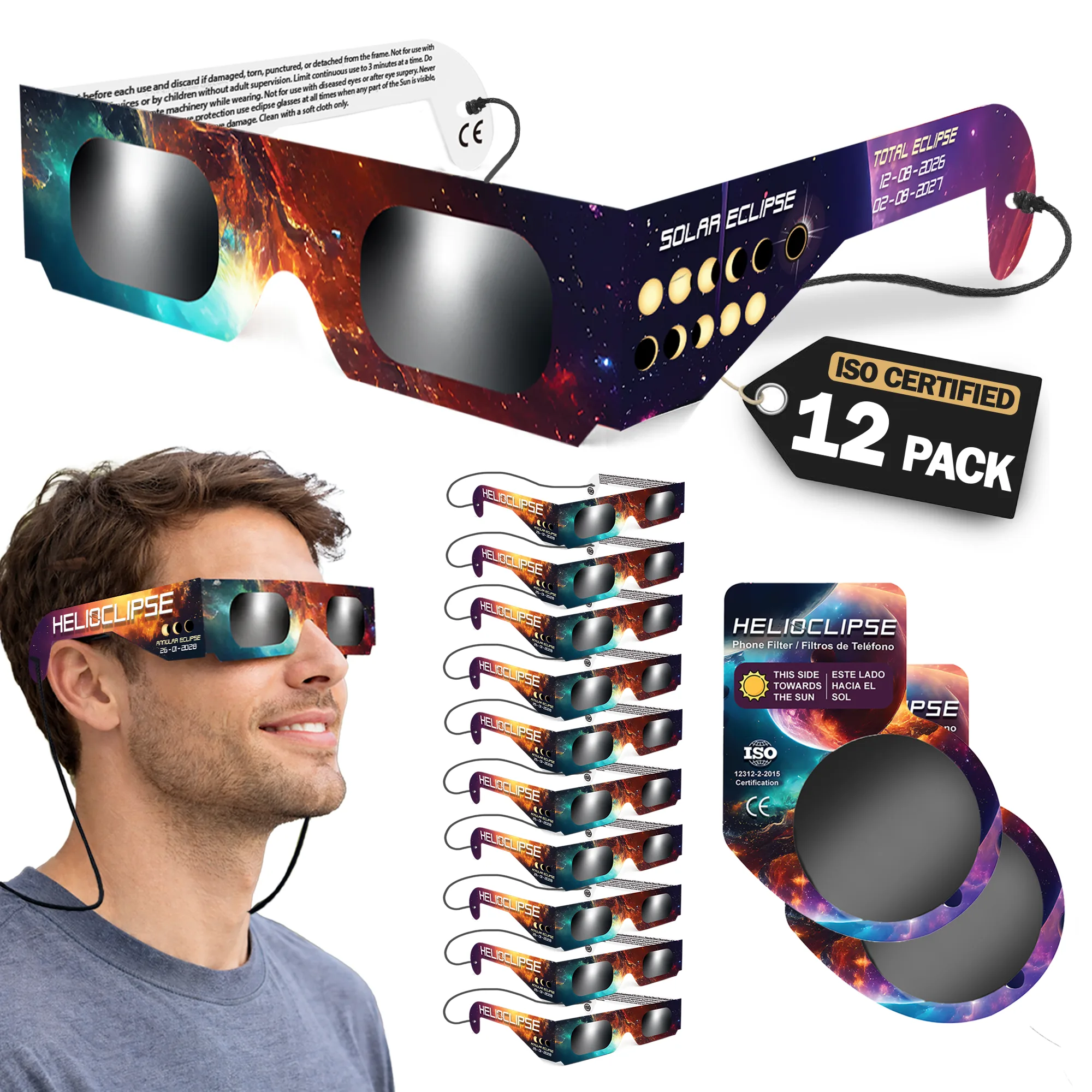
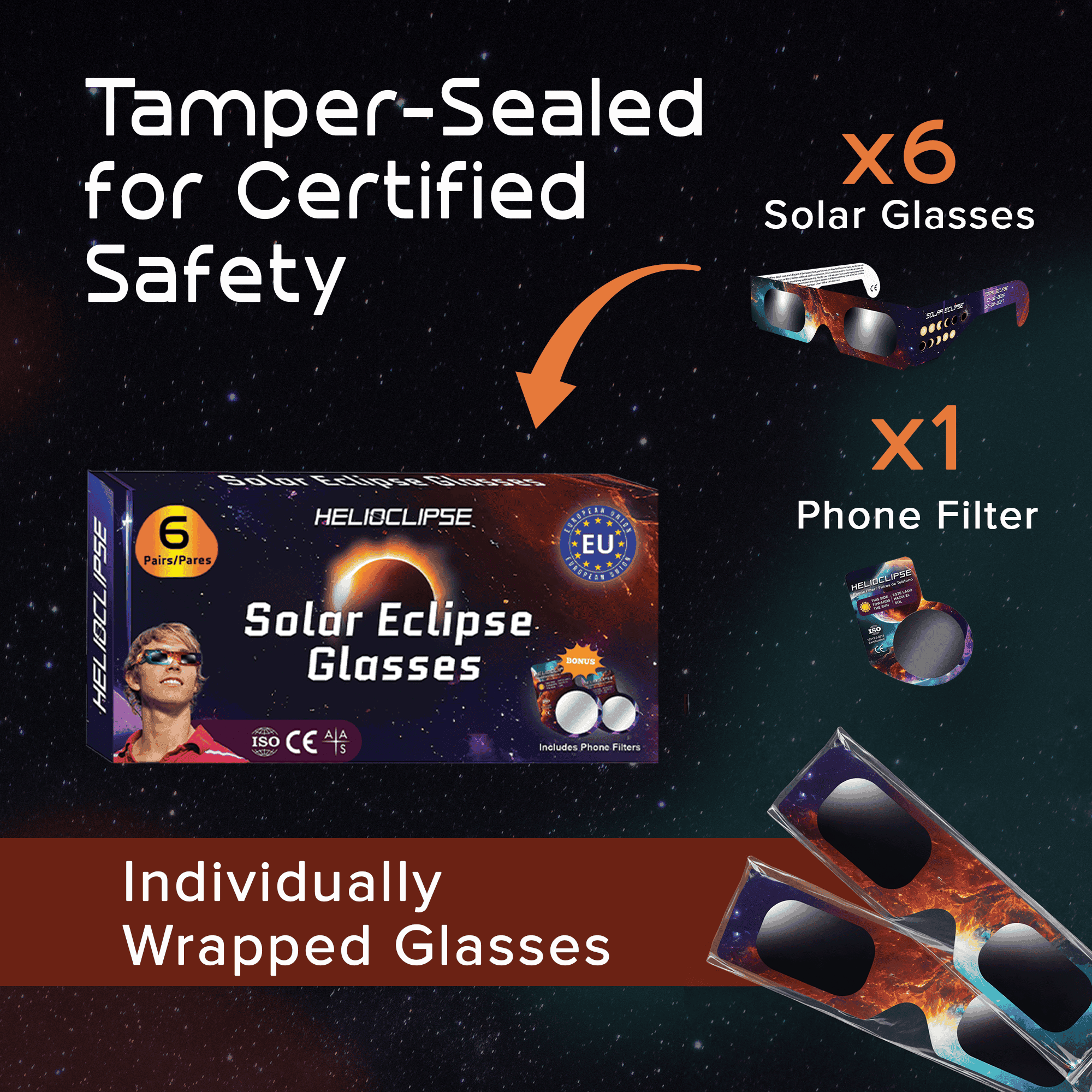
A marketplace listing can look reassuring in under a second: five stars, an ISO logo, a laboratory-style graphic, a crossed-out “original” price, and a delivery date comfortably before eclipse day. None of those elements, alone or together, proves that the glasses arriving at your door are the product described.
That matters because an eclipse viewer is not an ordinary novelty. Its filter must reduce ultraviolet, visible, and infrared radiation to appropriate levels while remaining uniform and free from dangerous defects. You cannot establish those properties from a photograph, a star rating, or the darkness of the film.
Our counterfeit eclipse glasses online marketplace red flags 2026 guide focuses on a better question than “Does this deal look cheap?” We ask whether the product has a traceable identity and a credible path from a known supplier to you. If you prefer to avoid that marketplace detective work, you can go directly to our ISO 12312-2 certified eclipse viewers.
We keep this counterfeit eclipse glasses online marketplace red flags 2026 guide free because families, schools, clubs, and event organizers need to make purchasing decisions before urgency narrows their options. The closer an eclipse gets, the easier it is for a polished listing and a fast shipping promise to feel like evidence. They are not.
Why a low price is a warning—but a high price proves nothing
An implausibly low price can signal poor materials, misrepresented stock, or a seller trying to move questionable inventory quickly. It deserves scrutiny, especially when the seller has no verifiable history and the listing gives no meaningful manufacturer details.
But price works badly as an authenticity test. A dishonest seller can charge more precisely because buyers associate a higher price with quality. Scarcity near eclipse day can also push both genuine and questionable products upward. Meanwhile, legitimate multipacks may have a low per-viewer cost because lightweight cardboard viewers are economical to manufacture and distribute in quantity.
So price is context, not proof. Treat it as one signal in a larger chain:
- Who made the viewer? A real manufacturer identity should be present and independently traceable.
- Who is selling it? The storefront name, legal seller, and company named on the product should make sense together.
- What evidence supports the safety claim? Printing ISO 12312-2 is not the same as demonstrating conformity through appropriate testing.
- Will you receive the pictured product? Marketplace catalog pages can combine offers from multiple sellers, and fulfillment arrangements may make provenance harder to follow.
- Can you inspect and return it before the event? Last-minute delivery removes the time needed to resolve a substitution or damaged shipment.
The counterfeit eclipse glasses online marketplace red flags worth remembering are usually inconsistencies across those five questions—not one magic typo or one suspicious price.
The anatomy of an official-looking listing
Counterfeit glasses for eclipse viewing do not have to look amateurish. A seller can copy photographs, technical language, instructions, company names, and certification-style graphics from somewhere else. The page may look more polished than the product itself.
Here is how we interpret common listing signals:
| What the listing shows | What it may tell you | What it does not prove | |---|---|---| | “ISO 12312-2” printed prominently | The seller knows the relevant standard’s name | That the delivered viewer was tested or conforms to the standard | | An ISO logo or certificate graphic | A document or logo has been uploaded | That ISO approved the product, or that the document belongs to this exact product | | Thousands of reviews | The catalog page has accumulated customer activity | That every seller or current batch shares the same provenance | | A marketplace fulfillment badge | The platform may handle storage or delivery | That the platform manufactured, tested, or authenticated the filter | | “Official,” “premium,” or “professional” | Marketing language chosen by the seller | A defined level of optical safety | | A laboratory name or report number | A lead that may be investigated | That the lab is appropriately accredited or tested this model and filter | | A very dark product photo | The film looks dark under photographic conditions | Safe ultraviolet, visible, and infrared transmittance | | Fast delivery before eclipse day | The inventory may be nearby | Authenticity or safe performance |
Trust badges belong in the evidence chain, not merely in an image. If crucial details appear only in a low-resolution promotional graphic—and not as readable product information tied to the seller and manufacturer—assume you still need verification.
This is also why a counterfeit eclipse glasses Reddit discussion can be useful for spotting a sudden pattern, such as buyers receiving different packaging from the listing, but it cannot authenticate your pair. Anonymous comments, photographs, and anecdotes are leads. They are not laboratory measurements or a documented chain of custody.
What ISO 12312-2 means—and what it does not
The phrase iso 12312-2 eclipse glasses refers to nonmagnifying viewers intended for direct observation of the Sun. The standard addresses properties including ultraviolet, visible, and infrared transmittance, transmission uniformity, material quality, mounting, and labeling. Ordinary sunglasses fall under a different standard and transmit far too much sunlight for direct solar viewing.
ISO develops standards; it does not inspect marketplace listings or approve individual brands. A manufacturer’s conformity claim should be supported by relevant testing. The American Astronomical Society explains that credible evaluation involves quantitative reports from laboratories with appropriate accreditation and a scope covering the required testing—not a generic document that simply says “pass.”
That distinction corrects two common pieces of shopping language. Aas approved eclipse glasses is an imprecise phrase: the AAS maintains a supplier resource and evaluates evidence, but it does not turn the letters “AAS” into a product certification mark. Likewise, NASA states that it does not approve particular solar-viewer brands. Claims such as “NASA approved” should therefore make you more cautious, not less.
The question how to tell if eclipse glasses are iso approved? starts from the wrong premise because ISO does not grant retail approval to an individual pair. Instead, establish whether the named product comes from a traceable source with credible evidence of conformity, then confirm that the delivered item matches that identity and is undamaged.
Our deeper guide to ISO 12312-2 and eclipse viewers explains what the standard is designed to control—and why a printed code is only a claim until provenance and evidence support it.
Follow the product, not the page design
A strong purchasing check moves from the marketplace page to independent sources. Do not rely solely on links, certificates, or contact details supplied inside the listing itself; copied information can lead you in a circle.
1. Identify the actual seller
Look beyond the product title. Marketplace pages may show a recognizable product name while a separate third party makes the offer. Record the storefront name, legal business details, dispatch location, return address, and the seller named on your order confirmation.
A recently created storefront with an unrelated product catalog is not automatic proof of fraud, but it increases uncertainty. So does a seller name that changes between the listing, checkout, and receipt.
2. Identify the claimed manufacturer
The viewer or packaging should provide meaningful manufacturer or responsible-supplier information and instructions for use. Search for that organization independently. Does it maintain a real website? Does the site describe the same model? Can the company’s contact information be verified outside the marketplace?
Be alert when a listing displays one company’s identity but the delivered frames name another, use a misspelling, omit an address, or arrive as an unmarked substitute. A near match is not a match when the filter itself is the safety-critical component.
3. Check the seller relationship
If a manufacturer or supplier identifies authorized sales channels, confirm that the marketplace seller is actually among them. A product name can be genuine while a particular offer is not. Screenshots and copied authorization language are weaker than confirmation from an independently located supplier page or contact.
4. Examine the evidence without becoming your own certification lab
A detailed report should identify the product or material tested, the laboratory, relevant measurements, and enough information to connect the report to the delivered viewer. Even then, most consumers are not equipped to validate accreditation scopes or determine whether one batch matches another. This is why trusted sourcing carries more weight than downloading a certificate-shaped PDF.
The compressed phrase counterfeit eclipse glasses how to tell misses that important limit: shoppers can detect contradictions and reject weak claims, but they cannot reproduce spectrophotometric laboratory testing at home.
Questions a listing should answer before you pay
The best eclipse glasses are not the pair with the loudest superlative. They are viewers whose product identity, conformity evidence, seller relationship, instructions, and physical condition form one consistent story.
Before ordering, look for clear answers to these questions:
- Is the manufacturer or responsible supplier named in text, not only shown in a photograph?
- Does the listing identify the exact model and quantity you will receive?
- Are use and inspection instructions available in a language you understand?
- Can you verify the supplier through an independent institutional or professional-society resource?
- Is the marketplace seller connected to that supplier in a way you can confirm?
- Does the returns window leave enough time to inspect a substituted, damaged, or inconsistent delivery?
- Are reviews attached to this seller and current product, or merely to a shared catalog page?
- Does the listing misuse NASA, ISO, or other institutional names as if they were retail endorsements?
Marketing descriptions such as approved solar eclipse glasses, solar eclipse glasses iso 12312-2 certified, and eclipse viewing glasses can express sensible buying intent. They still need to resolve to a specific, traceable product. The words themselves are not a substitute for the evidence behind them.
A reverse-image search may reveal that photographs were copied from another page. Searching a report number may expose a certificate reused across unrelated products. Those checks can uncover a problem, but a clean result cannot prove authenticity: newly copied material may not yet appear elsewhere online.
What you can check when the glasses arrive
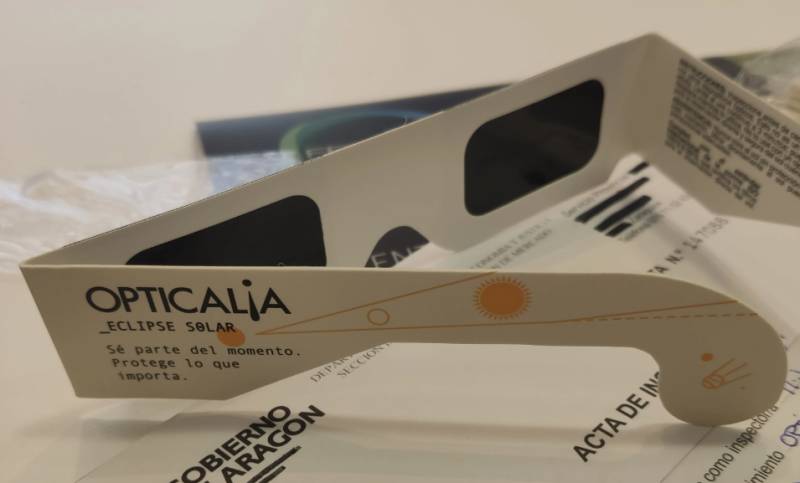
Open the package well before eclipse day and compare the delivered viewers with the listing and order confirmation. Check the manufacturer information, model, printed instructions, quantity, frame design, and filter appearance. Unexpected substitutions, missing provenance, loose film, poor assembly, or inconsistent labeling are reasons to stop and investigate.
Inspect every viewer under good room light. Discard one with a scratched, punctured, torn, creased, detached, or otherwise damaged filter. Small defects matter because the viewer is designed to cover both eyes and attenuate intense sunlight across the whole filter area.
An indoor check can reject an obviously unsafe viewer. When wearing legitimate eclipse glasses indoors, you normally should not see furniture, walls, or ordinary lamps. If the room remains visible or an ordinary bulb has a clear outline, do not use the viewer for the Sun.
But darkness is not certification. A filter can appear extremely dark in visible light while its performance at other wavelengths remains unknown. Color, apparent darkness, flame tests, phone-camera tests, and brief experimental glances at the Sun cannot establish conformity. The practical question how to tell if solar eclipse glasses are fake? therefore has two layers: inspect for obvious failure, then rely on trustworthy provenance for properties your eyes cannot measure.
Similarly, how do i know if my eclipse glasses are safe? cannot be settled by a logo alone. You need a credible source, an identifiable product, evidence supporting the conformity claim, and an undamaged viewer that matches what was represented.
If those elements do not line up, return or discard the glasses rather than trying to persuade yourself that they are probably fine. A pinhole projector provides an indirect way to follow the partial phases without looking through uncertain filters.
Age, storage, and damage are different problems
The question do solar eclipse glasses go bad? often bundles together three issues: the age of the filter, how it was stored, and whether it has suffered physical damage.
According to current AAS guidance, a viewer less than 10 years old may be reusable if its manufacturer had it tested by a properly accredited laboratory, it conforms to ISO 12312-2, and the filter remains in excellent condition. Older printed warnings about discarding compliant viewers after three years or limiting every look to three minutes do not generally apply to recently manufactured, conforming viewers in good condition.
Condition still comes first. Heat, moisture, rough handling, folding, punctures, scratches, and separation from the frame can make a previously credible viewer unusable. Keep cardboard viewers dry and store them flat in their original packaging or a protective envelope. Inspect each one again before use; do not assume the rest of a multipack is undamaged because one pair looks good.
For a family or school group, assign an adult to check viewers in advance and supervise children on eclipse day. That is more reliable than distributing an unopened box while everyone is already looking upward.
Safe glasses still have to be used correctly
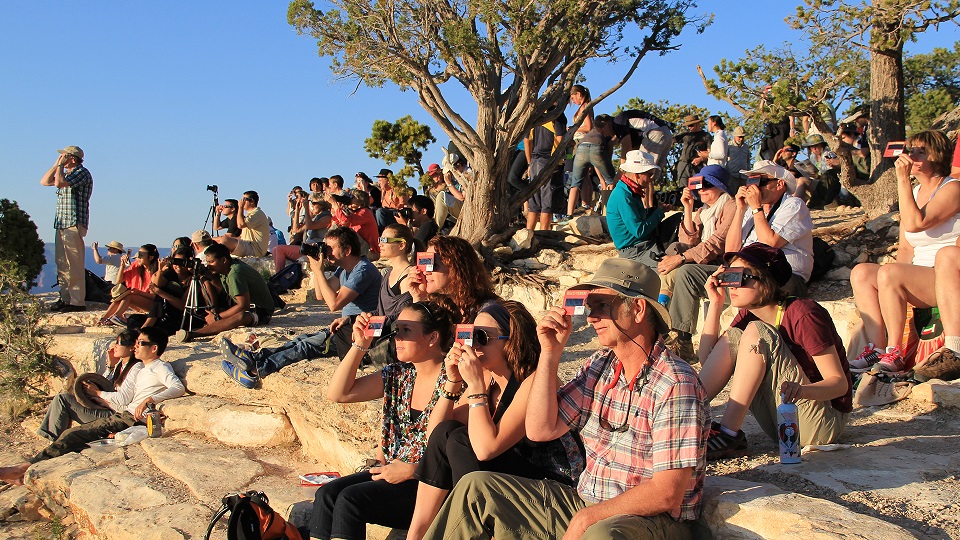
A trustworthy viewer protects only when it is used for the task it was designed to perform. Put the glasses on—or hold the viewer securely over your eyes—before turning toward the Sun. After looking, turn away before removing it. If you wear prescription glasses, keep them on and place eclipse glasses over them.
Never use handheld viewers or eclipse glasses in combination with an unfiltered camera, binoculars, or telescope. Magnifying optics concentrate sunlight and require a suitable solar filter secured over the front aperture. An eye-worn viewer does not make unfiltered optics safe, and concentrated rays can damage the viewer as well as your eyes.
During a partial or annular eclipse, certified viewers remain on whenever you look directly at the Sun. During a total solar eclipse, they may come off only during the brief interval when the Moon completely covers the Sun’s bright face—and only for observers actually inside the path of totality. They must go back on as soon as any bright photosphere reappears. Our phase-by-phase first-time viewer guide makes that transition easier to plan with children and groups.
For the total solar eclipse on August 12, 2026, tell your group early who is ordering the viewers, when they will arrive, and who will inspect them. You can use our Eclipse Explorer to verify whether your exact site is inside totality; outside that narrow path, there is no glasses-off phase.
A calmer buying strategy for 2026
Urgency is one of a questionable listing’s strongest sales tools. The practical defense is to buy early enough that you can inspect the delivery, question inconsistencies, and replace it without accepting the first available offer.
For a household, count viewers for adults and children, then add a few spares for damage or unexpected guests. For a school, club, workplace, or public event, keep the original order records and packaging, document the source, and inspect a sample before distribution—then ask participants to check each viewer for physical damage.
Avoid treating social proof as technical proof. Reviews can reveal fulfillment problems, substitutions, or torn filters, but a five-star average cannot measure spectral transmittance. Likewise, a refund guarantee can protect your purchase price; it cannot retroactively protect eyesight.
The most useful fraud habit is simple: stop asking whether the page feels official and start asking whether every important claim can be tied to the exact product and seller in front of you. If the chain breaks, choose a source with clearer provenance.
Justin Resells
Frequently asked questions
What warning signs should I look for when buying eclipse viewers through an online marketplace?
Look for a traceable manufacturer identity, a seller whose storefront and legal details make sense, and meaningful evidence behind any safety claim. Star ratings, ISO logos, laboratory-style graphics, and delivery promises do not prove that the item delivered matches the listing.
What does a free guide to marketplace red flags help buyers evaluate?
It helps buyers look beyond a deal’s price and assess whether there is a credible path from a known supplier to the product they receive. It also emphasizes ordering early enough to inspect the item and resolve a substitution or damaged shipment before the event.
Does an ISO 12312-2 label by itself prove eclipse glasses are safe?
No. Printing ISO 12312-2 on a product is not the same as demonstrating conformity through appropriate testing. The filter must reduce ultraviolet, visible, and infrared radiation appropriately and be uniform and free of dangerous defects—properties that cannot be confirmed from a listing photo.
How should I choose eclipse viewers instead of relying on price or appearance?
Treat price as context rather than proof, because both very low and high prices can be misleading. Check who made the viewer, who is selling it, what supports its safety claim, whether the pictured product is the one you will receive, and whether you can inspect and return it before the event.
Should I rely on an approval claim in a marketplace listing when selecting eclipse viewers?
No—an approval-style claim, logo, or badge in a listing is not enough on its own. Look for a manufacturer that can be independently traced and credible evidence supporting the stated safety standard, while recognizing that marketplace pages may combine offers from multiple sellers.
On-site next steps
- Shop Helioclipse eclipse glasses before event demand compresses delivery and inspection time.
- Read our detailed guide to spotting fake and low-quality solar eclipse glasses for a pre-use checklist.
- Use the Helioclipse blog and guides to plan safe viewing with your family, school, or eclipse group.
Sources & further reading
- American Astronomical Society: American Astronomical Society Warns of Counterfeit & Fake Eclipse Glasses
- Space.com: Fake solar eclipse glasses are everywhere ahead of the total solar eclipse. Here's how to check yours are safe
- The Conversation: How safe are your solar eclipse glasses? Cheap fakes from online marketplaces pose a threat, supply-chain experts say
- American Academy of Ophthalmology: How I Bought Fake Eclipse Glasses
- Sky & Telescope: AAS's Advice for Safe Solar-Eclipse Viewing
- American Astronomical Society: About the ISO 12312-2 Standard for Solar Viewers
- American Astronomical Society: Suppliers of Safe Solar Viewers & Filters
- American Astronomical Society: How to Get Onto Our List of Manufacturers of Safe Solar Viewers & Filters
- American Astronomical Society: How to View a Solar Eclipse Safely
- NASA Science: Eclipse Viewing Safety