Running out everywhere: eclipse-glasses stock ruptures in Spain and France—and why European B2B inventory still ships same day
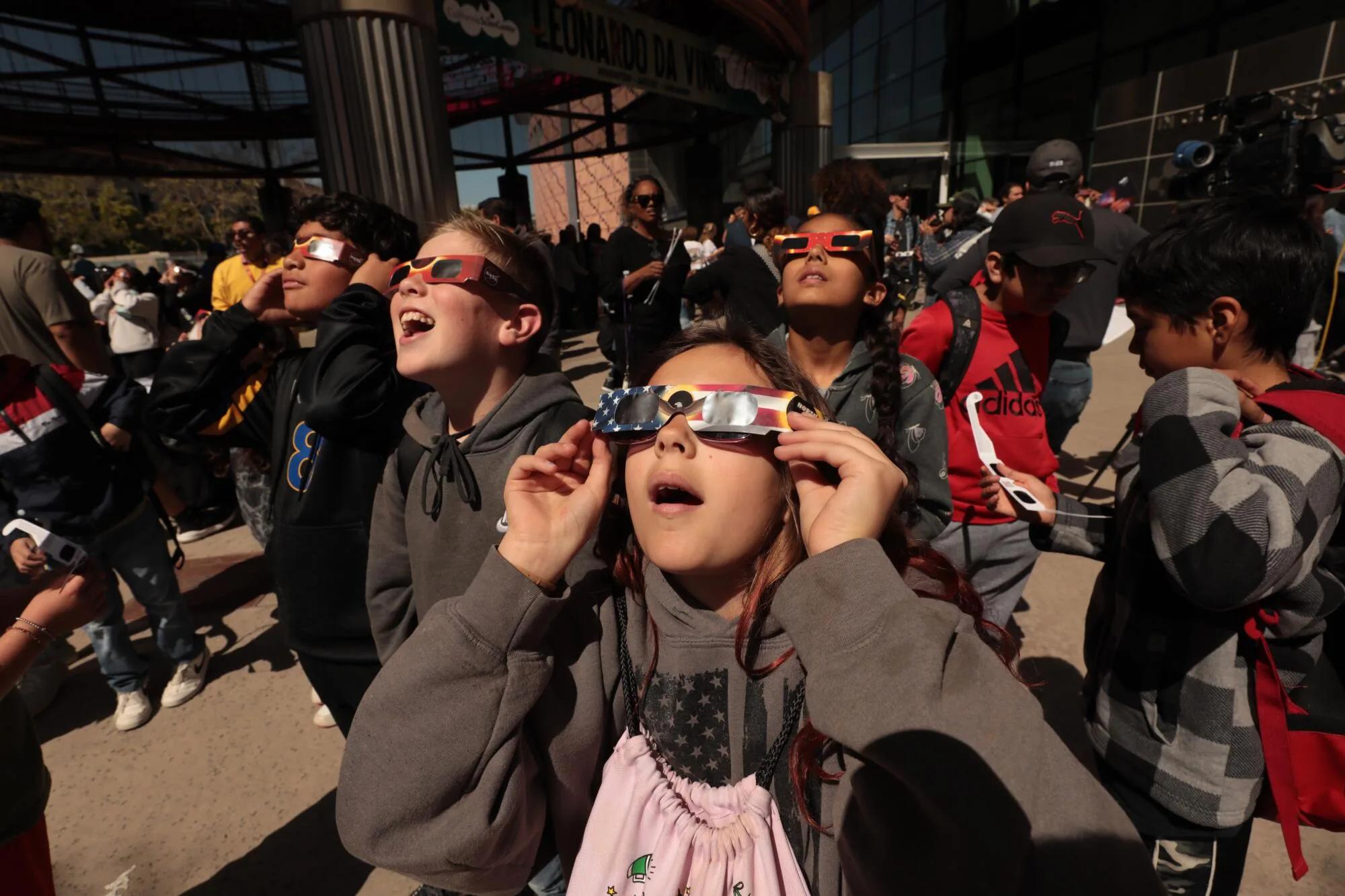
The final rush for safe solar viewers has arrived. In Spain and France, pharmacies, opticians and public distribution points are reporting depleted supplies as millions of people prepare for the solar eclipse on 12 August 2026. A free pair that seemed easy to collect last week may no longer be waiting at the counter today.
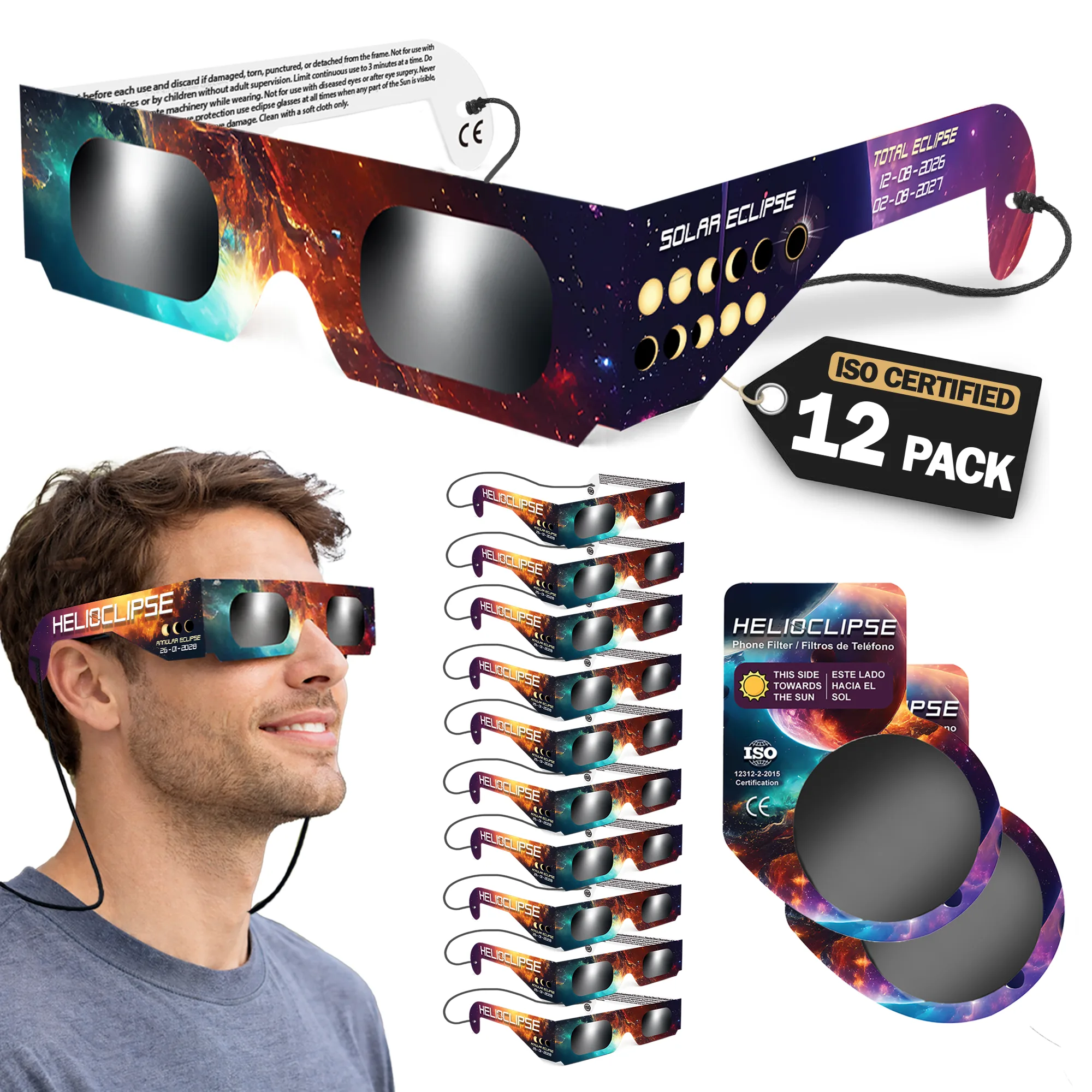
That does not mean Europe has run out of eclipse glasses. It means local retail stock is uneven, free campaigns are finite, and last-minute demand is landing much faster than many individual outlets can replenish. Helioclipse has millions of certified viewers in European inventory, with same-day B2B shipping available across Europe from now through eclipse day for retailers, schools, municipalities, event teams and other organizers.
Families can check current availability through our shop for ISO 12312-2 certified eclipse glasses. Organizations requiring larger quantities should use the same route to begin a wholesale enquiry immediately—include quantity, delivery country, deadline and event date.
This is a time-sensitive commercial and safety brief for the final days before the event. There is no reason to panic, but there is every reason to verify your supply now rather than improvise on 12 August.
What the reported shortages actually mean
“Running out everywhere” captures the mood, but it needs qualification. The shortage is not one uniform European condition. It is a series of local sell-outs across pharmacies, opticians, museum desks, municipal campaigns and web stores whose allocations were never unlimited.
In France, BFMTV reported that France’s Direction générale de la santé (DGS) warned pharmacies and ophthalmologists that ruptures de stock should be expected as last-minute demand peaks immediately before 12 August—echoing shortages seen at earlier eclipses when people waited too long. Reporting from Toulouse by *La Dépêche* described outlets being cleared out (“nous nous sommes fait dévaliser”) with some suppliers already unable to replenish. France is outside the path of totality, but that does not make demand surprising: NASA calculates about 92% solar coverage in Paris, with maximum eclipse around 8:17 p.m. local time.
Spanish reporting has described the same pattern with even greater geographical pressure. Infobae documented optics and pharmacy sell-through in places including Zaragoza (“agotadísimas”) and Burgos, plus pauses in online availability through Spain’s National Geographic Institute (CNIG) shop. Both Zaragoza and Burgos lie inside the path of totality. Zaragoza is expected to receive roughly 1 minute 23 seconds of totality at about 8:29 p.m. CEST, while Burgos receives about 1 minute 44 seconds near 8:28 p.m. CEST.
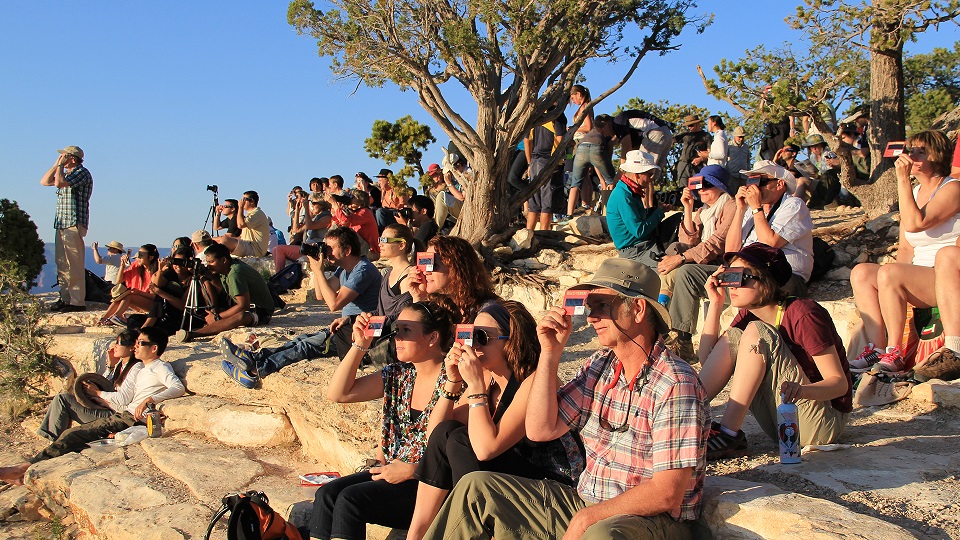
Free-distribution campaigns add useful capacity, but they cannot function as an unlimited national reserve. The ONCE and Spanish Ministry of Science campaign is distributing millions of certified pairs through vendor networks and science museums—explicitly hasta agotar existencias (while supplies last). Collaborative deal roundups such as the Chollometro compilation of free homologated glasses points across Spain show how widespread the effort is—and how often each listing ends with “until stock runs out.” Treat a free pickup point as first-come, first-served, not as guaranteed inventory for eclipse day.
That is the practical distinction: a pharmacy with an empty display in Toulouse or Zaragoza is real evidence of a local rupture; it is not evidence that properly documented European B2B stock has disappeared.
Why demand stretches far beyond totality in Spain
Is the eclipse visible in Europe in 2026? Yes—across most of the continent. Totality crosses Greenland, Iceland, northern Spain and a small part of Portugal, while a deep partial eclipse reaches France, the United Kingdom, Ireland, Germany, Italy and many other countries.
The path of totality is about 293 kilometres wide. Inside it, the Moon completely covers the Sun for a brief interval. León receives approximately two minutes of totality between about 8:28 and 8:30 p.m. local time, while Valladolid receives around 1 minute 29 seconds and Palencia about 1 minute 42 seconds. Bilbao lies near the path edge and receives only about 26 seconds—a vivid demonstration of how quickly duration changes with location.
Just outside the path, the difference is absolute rather than cosmetic. NASA lists Barcelona and Madrid at approximately 99% coverage, but neither city centre experiences totality. Even a hairline of exposed photosphere keeps the sky much brighter than totality and means solar viewers remain necessary throughout. Our guide to totality in Spain explains why 99% is not interchangeable with 100%.
France receives a partial eclipse only, yet it will be a major evening event. Paris reaches about 92% coverage. Corsica is closer to the totality track, with some locations approaching a 96% partial eclipse near sunset. Across Europe, NASA gives approximately 91% for London, 85% for Berlin and Vienna, and 92% for Milan. That broad footprint turns a Spanish total eclipse into a European supply event.
Use the Helioclipse Eclipse Explorer to check whether your exact site is inside or outside totality, the local contact times, maximum coverage and the Sun’s direction. A path map tells you where the eclipse is visible—not which nearby retailer still has stock. Geography explains demand; live supplier confirmation establishes availability.
Free giveaways and reliable commercial supply solve different problems
A public giveaway can be an excellent way to introduce a family to astronomy. Museums, science centres, councils and accessibility organizations can put safe viewers into thousands of hands, sometimes alongside expert demonstrations. We support that educational purpose.
But “free” does not mean continuously replenished. Campaigns normally receive a fixed allocation, set collection dates and stop when the last unit is distributed. A social post announcing availability may remain online after the physical stock is gone. Some programs also limit quantities per person or reserve viewers for attendees at a specific event. That is exactly the pattern visible across Spanish free-point roundups: dozens of cities and brands, almost all capped by remaining stock.
Commercial procurement solves a different problem: guaranteeing a known quantity for a known audience. A school cannot responsibly plan for 800 pupils on the assumption that families will each find a free pair. A retailer, hotel, festival, observatory or municipal viewing area likewise needs traceable stock, delivery planning and enough units for the expected attendance.
Helioclipse holds millions of certified viewers in European inventory. Our same-day B2B shipping is designed for organizations that still need bulk eclipse glasses in stock now. Same-day dispatch is not the same as same-day delivery: final arrival depends on destination, carrier service, order cutoff and local conditions. Tell us the deadline and delivery country at the start of your enquiry so we can address feasibility clearly.
When an organization needs stock today, the useful questions are operational:
- How many people must be equipped?
- Are spare viewers needed for damaged or forgotten units?
- What is the delivery postcode and hard deadline?
- Will the viewers be handed out in advance or at the entrance?
- Who will supervise children and explain correct use?
- Can the buyer document the product, manufacturer and supply chain?
That checklist is more reliable than driving from one depleted counter to another.
ISO 12312-2, CE marking and the difference between a label and evidence
Safe eclipse viewing depends on purpose-built filters—not ordinary sunglasses, smoked glass, exposed film or improvised dark plastic. The relevant international standard for direct, unmagnified solar viewing is ISO 12312-2. It addresses visible, ultraviolet and infrared transmission as well as filter quality, mounting and labeling.
The phrase “ISO 12312-2 eclipse glasses” should describe viewers whose conformity is supported by credible testing and traceable manufacturing. It must not be treated as magic wording. Anyone can print a standard number on cardboard or a marketplace listing; the American Astronomical Society warns that the printed claim alone cannot prove that the filter was tested by a properly accredited laboratory.
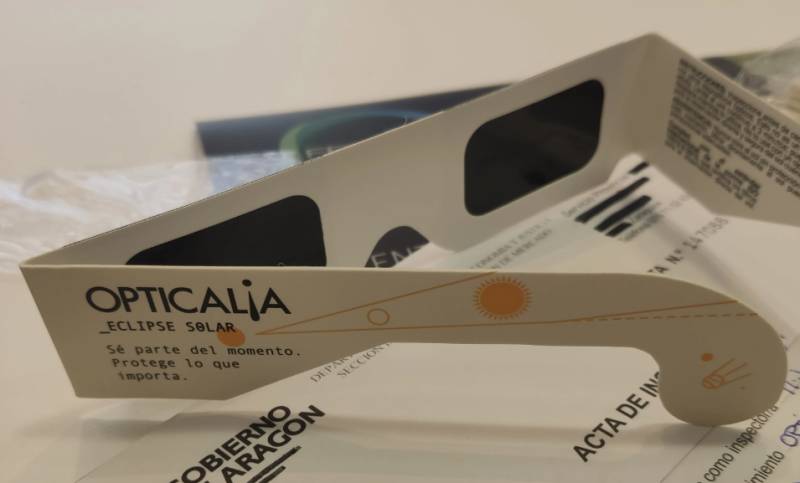
European buyers may also encounter CE information. Check that markings, manufacturer or responsible-operator details, instructions and conformity documentation form a coherent, traceable record. A CE logo by itself does not replace the need to establish what the product is, who supplied it and whether the solar filter genuinely conforms to ISO 12312-2.
Some product language deserves particular caution. There is no category of “NASA-approved eclipse glasses,” because NASA does not approve commercial viewer brands. Marketing phrases that lean on agency names should never substitute for the applicable standard, laboratory evidence and supply-chain traceability.
For our products, the meaningful description is solar eclipse glasses conforming to ISO 12312-2, backed by the documentation and product information presented through Helioclipse. Our deeper guide to ISO 12312-2 and eclipse viewers explains what the standard does and does not establish.
Before accepting eclipse viewing glasses for a family, school or public event, check:
- Traceability: Identify the manufacturer or responsible supplier and retain invoices or procurement records.
- Standard information: Look for ISO 12312-2 and supporting conformity evidence, not merely a marketplace claim.
- Instructions: Safe-use directions should be legible and appropriate for the market where the product is distributed.
- Physical condition: Reject filters with scratches, pinholes, tears, creases, loose edges or moisture damage.
- Fit and supervision: The filter must cover the eyes properly, and children should be supervised.
- Correct purpose: Wearable viewers are for direct, unmagnified viewing—not for looking through cameras, binoculars or telescopes.
Counterfeits become more tempting when shelves are empty
A stock rupture creates two risks. The obvious one is missing a direct view of the eclipse. The more serious one is accepting an unverified substitute because the date is close and the listing promises urgent delivery.
The AAS notes that you cannot confirm full spectral safety merely by looking at a filter. A basic indoor check can reveal an obviously unsafe viewer—ordinary room objects should not be visible through it—but passing that check is not laboratory proof. Traceability remains essential because ultraviolet and infrared performance cannot be assessed by eye.
Be especially cautious with loose viewers left from the 1999 European eclipse. Age alone does not automatically invalidate every properly manufactured solar viewer, but a decades-old filter may have unknown storage history, outdated documentation, scratches, delamination or no reliable provenance. French authorities and observatories have likewise warned against relying on old cardboard filters whose coatings may have degraded. If origin and condition are uncertain, discard it and use a current, traceable viewer or an indirect projection method.
Recently manufactured viewers can often be reused when their provenance is sound and their filters remain undamaged. Inspect every unit before distribution. If a viewer is torn, punctured, scratched or separating from its frame, remove it from use rather than trying to repair it with tape.
Scarcity never lowers the safety threshold. A fast delivery is useful only when the product is appropriate, documented and intact.
The viewing rule changes only during true totality
Everyone watching the partial phases must use a safe solar viewer whenever looking directly at the Sun. That includes observers inside Spain’s path before totality begins and immediately after it ends. Outside the path—including Paris, central Madrid, central Barcelona, London and Berlin—the glasses stay on for every direct look because the bright face of the Sun is never completely covered.
Only observers who are physically inside the path may remove their viewers during the brief interval when the Moon fully covers the Sun’s bright face. Remove them only when totality has unmistakably begun, and replace them as soon as the first bright point of photosphere returns. Near an edge location such as Bilbao, that unfiltered interval may last only a few tens of seconds.
Certified wearable viewers must never be used as filters for binoculars, telescopes or camera lenses. Magnifying optics concentrate sunlight and require a suitable solar filter secured over the front aperture of the instrument. Putting eclipse glasses between your eyes and unfiltered binoculars is dangerous.
If safe viewers are unavailable, use indirect projection during the partial phases. With the Sun behind you, a pinhole projector can cast an image onto a card or the ground. Gaps between crossed fingers, a colander or leaves on a tree can produce many small crescent Suns. Never look through the pinhole toward the Sun.
A practical last-days plan for families and organizations
For families, confirm how many usable viewers you already have tonight. Inspect each one under good light, check its provenance and keep it flat and dry. A household does not necessarily need one viewer per person for the entire partial phase because the eclipse develops slowly and viewers can be shared for brief looks, but every child should be supervised and nobody should be left tempted to look directly without protection.
For schools and events, work from attendance rather than registrations alone. Include staff, volunteers, accessibility assistants, speakers and a sensible reserve for damaged units. Decide who controls distribution and who gives the safety briefing. Open packages early enough to count them, but store the viewers so the filters cannot be scratched or bent.
Retailers should avoid unsupported claims on shelf cards and product pages. “Extra dark” is not a standard. State the intended use, applicable conformity information and handling instructions accurately.
Organizers should also check the sky geometry. In Spain, totality happens late in the evening with the Sun low in the west-northwest—around 10° high in León, roughly 6° in Zaragoza and only a few degrees above the horizon in parts of the Mediterranean and Balearic region. Buildings, trees and ridges can erase the view even under a clear sky. France sees a deep partial eclipse toward sunset, so a low western horizon matters there too.
That combination—peak holiday season, evening timing, a low Sun and more than 15 million people living inside the totality path—explains why demand is arriving in a wave. This is ultimately a logistics story driven by celestial geometry.
What Helioclipse can supply now
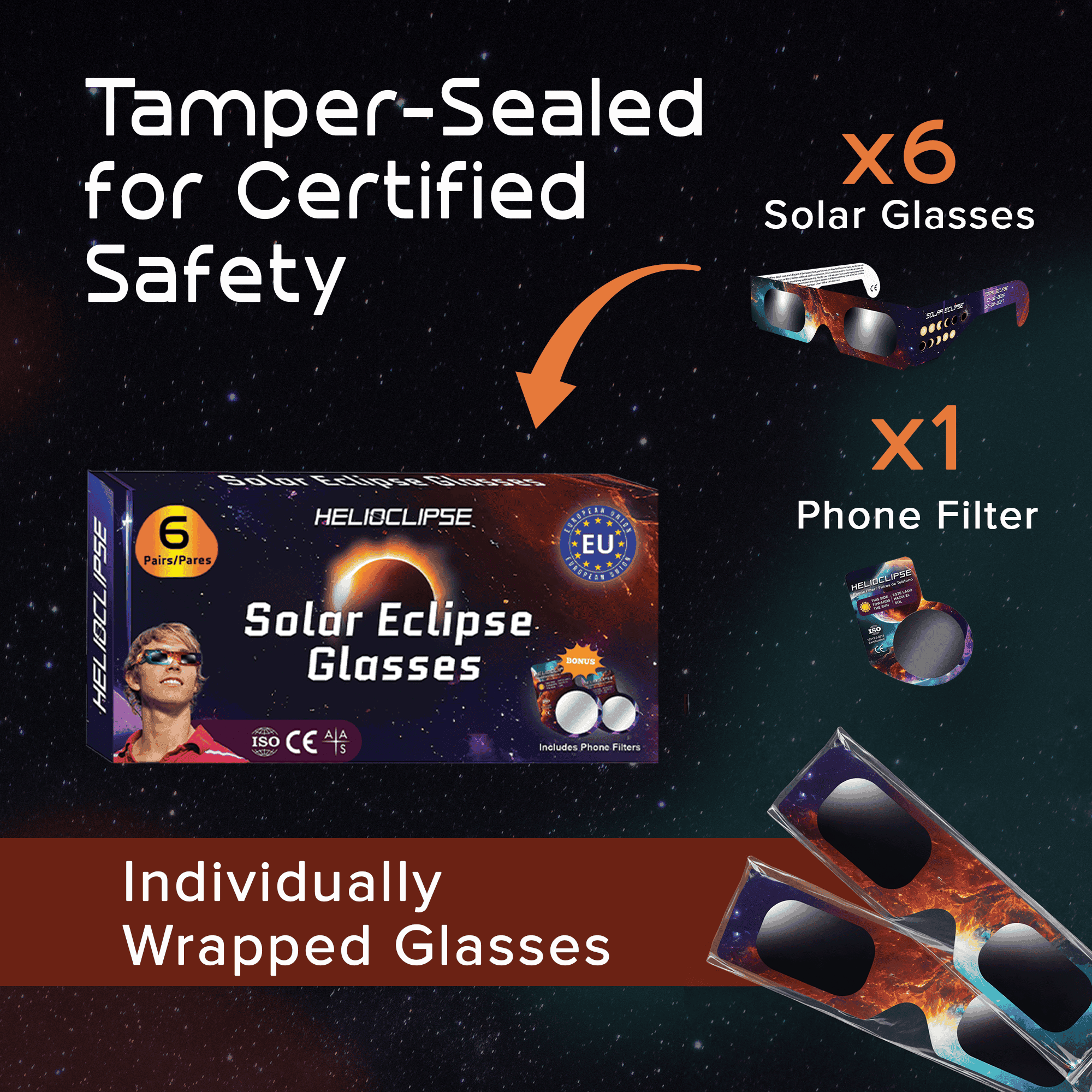
Helioclipse has millions of certified viewers on hand in European inventory. We are supporting same-day B2B shipping across Europe through eclipse day for organizers, retailers, schools and events, subject to order timing, destination and carrier feasibility.
For a fast assessment, send the essentials together:
- required quantity;
- destination country and postcode;
- latest acceptable delivery date;
- organization and event type;
- contact details for an immediate response;
- any packaging or distribution requirements.
We will not manufacture urgency by pretending every warehouse is empty. Local outlets really are selling out, while our European B2B inventory remains available. The responsible response is to convert uncertainty into a confirmed quantity, a documented product and a realistic delivery plan.
Frequently asked questions
How is the 2026 eclipse affecting demand for glasses in Spain?
Holiday travel into the path of totality is colliding with last-minute safety prep. Optics and pharmacies in cities such as Zaragoza and Burgos have reported sell-outs, while free public campaigns distribute fixed allocations until stock runs out. Treat local giveaways as a bonus, not as your only plan.
What should I do with leftover eclipse glasses after the event?
Inspect them. If the filters are undamaged, still opaque to room light, and you can document the manufacturer and ISO 12312-2 conformity, keep them flat and dry for a future partial or annular eclipse. Discard scratched, punctured, delaminated or untraceable pairs—especially decades-old cardboard from 1999.
How can I find eclipse glasses if local shops are sold out?
Check live availability through the Helioclipse shop. Families can order certified pairs; organizations needing larger quantities should submit a wholesale enquiry with quantity, delivery country, deadline and event date. Same-day B2B dispatch from European inventory remains available through eclipse day where carrier cutoffs allow.
Will the 2026 solar eclipse be visible from the United States?
On 12 August 2026 the deep show for European land observers is in Spain (totality) and a broad partial across much of Europe. Parts of North America see earlier phases depending on location—always check local circumstances on the Eclipse Explorer rather than assuming the Spanish path applies.
Can people see the 2026 eclipse from Europe?
Yes. Spain hosts the main land path of totality; France and much of the rest of Europe see a deep partial eclipse in the evening. Paris reaches about 92% coverage. Everywhere outside true totality, keep certified viewers on for every direct look at the Sun.
On-site next steps
- Check live product information and begin an order through the Helioclipse eclipse-glasses shop. For B2B requirements, provide quantity, destination and deadline immediately.
- Use our 3D Eclipse Explorer to confirm whether your location receives totality or a partial eclipse, then plan the correct safety briefing.
- Read our guide to spotting fake or low-quality eclipse glasses before accepting last-minute marketplace stock.
Use the map to establish what the sky will do, and documented inventory to establish what can actually be delivered. If you need eclipse glasses in stock today, act calmly, verify the product and give the people in your care enough time to learn how to use it.
Sources & further reading
- BFMTV: French health authorities warn of eclipse-glasses stock ruptures
- La Dépêche: Toulouse reportage on depleted homologated glasses stocks
- Infobae: Spanish optics and pharmacy stockouts ahead of 12 August
- Chollometro: collaborative roundup of free homologated glasses points in Spain
- ONCE: certified free eclipse glasses campaign overview
- El País: where to obtain free homologated glasses for the August total eclipse
- NASA Science: Total Solar Eclipse on August 12, 2026
- American Astronomical Society: How to View a Solar Eclipse Safely
- American Astronomical Society: How Can You Tell If Your Eclipse Glasses or Handheld Solar Viewers Are Safe?
- American Astronomical Society: About the ISO 12312-2 Standard for Solar Viewers