Vigo in 2026: one city, one eclipse—Rías Baixas haze, port cranes, and map-first viewing
On August 12, 2026, Vigo will face an eclipse-planning problem unlike the one confronting most Spanish cities: the decisive view will be low over the west-northwest horizon, across a landscape of estuary water, wooded slopes, apartment blocks, shipyard structures, and port cranes.
That combination could produce a magnificent scene. A narrowing solar crescent above the Ría de Vigo, followed—at a properly located point inside the Moon’s umbra—by the sudden darkness of totality would be unforgettable. But a city name is not a set of coordinates. Vigo is close enough to the southern side of the Spanish totality corridor that we want you to verify the geometry for the exact place where your feet will be.
Open the Helioclipse Eclipse Explorer before choosing a beach, park, hotel, or hillside. Drop separate pins on the actual viewing areas you are considering, not merely on “Vigo,” and record whether each pin is inside or outside totality, how long totality lasts, and where the Sun will stand above the horizon.
This is the practical meaning of a total solar eclipse 2026 Vigo Spain guide: map first, horizon second, weather third—and only then scenery.
Vigo is an edge-sensitive eclipse city
The August 12 event is the total solar eclipse 2026 Spain has been waiting for, but totality does not cover the whole country. The Moon’s dark central shadow crosses northern Spain during the evening; places outside that band see a partial eclipse, even when almost the entire solar surface is covered.
ESA’s map, based on calculations from Spain’s National Geographic Institute and Astronomical Observatory, shows the shadow moving across the Iberian Peninsula from approximately 20:27 to 20:32 CEST. NASA lists totality in selected Spanish cities between about 20:28 and 20:33 local time. In Galicia, a location-specific report cited by Space.com gives up to about 1 minute 50 seconds of totality at Playa de la Escaladina, with the Sun roughly 11° above the west-northwest horizon. ESA’s broader national graphic gives a maximum near 1 minute 40 seconds; small differences can arise from the chosen coordinate, solar-limb assumptions, and map methodology.
Those figures establish the scale, not the result for every Vigo viewing pin. The supplied institutional tables do not publish a validated circumstance line for central Vigo, Samil, O Vao, Monte do Castro, or Monte dos Pozos. We will not invent a second-level duration. In and around Vigo, plan for a brief total phase measured on the order of roughly a minute rather than several minutes, but obtain the actual classification and duration from a current coordinate-level map.
A total solar eclipse 2026 Vigo Spain map therefore needs more than a broad shaded band. It must distinguish the umbra from the surrounding partial-eclipse zone. Our broader guide to the total solar eclipse 2026 Spain path explains why the centerline, the edge, and a point just outside the path produce different experiences.
This distinction is absolute. There is no “99% totality.” At 99%, the remaining sliver of photosphere is still intensely bright, the corona does not emerge as it does during totality, and solar viewers stay on throughout.
What time will the eclipse happen in Vigo?
The event takes place on Wednesday, August 12, 2026, during the evening. In northwestern Spain, the total phase occurs near the beginning of the shadow’s 20:27–20:32 CEST passage across the peninsula. A reported Galician maximum occurs at approximately 20:26 CEST, while NASA gives 20:28–20:30 CEST for León farther east.
There is no single total solar eclipse 2026 Spain time that applies to every city. The shadow moves, local circumstances differ by longitude and position within the path, and in eastern Spain the low Sun approaches sunset even more closely. The same warning applies to the phrase total solar eclipse 2026 time Spain: useful planning requires a coordinate and an explicitly labeled time zone.
For the total solar eclipse 2026 Vigo Spain time, use the map pin’s local CEST contacts and confirm them again before eclipse day. Record at least:
- the beginning of the partial phase;
- the predicted start and end of totality, if the pin is inside the path;
- the Sun’s altitude and azimuth at maximum eclipse;
- local sunset time;
- whether the map classifies that precise coordinate as total or partial.
Do not build a family countdown from a rounded national time. Arrive well before the partial phase and have everyone settled at least 30 minutes before the predicted total phase. That margin matters in a city where parking, buses, pedestrian bottlenecks, or one unexpected crane can force a last-minute move.
Vigo’s real obstacle is the west-northwest horizon
In Galicia, totality occurs with the Sun only around 10°–12° above the west-northwest horizon. Ten degrees is approximately the width of a clenched fist held at arm’s length. That sounds comfortably high until you place a wooded ridge, a tower block, or shipyard machinery in front of it.
A clear view across the ría may be more valuable than an extra few metres of elevation. Conversely, a green hilltop can fail if trees or another ridge occupy the relevant bearing. Check the actual azimuth rather than assuming that “west-facing” is precise enough.
Vigo offers several types of municipal setting worth testing, but none should be accepted by reputation alone:
Waterfront and beach sightlines
Samil and O Vao can offer broad sky and a strong sense of the estuary’s scale. The trade-off is exposure to marine haze and the possibility that islands, headlands, temporary structures, or a busy foreground occupy the exact eclipse bearing. A beach also concentrates crowds into a limited set of access roads and parking areas.
Walk the intended section, pin it on the map, and use a compass or augmented-reality sky tool to identify west-northwest. A beautiful open sea view in another direction does not solve the eclipse geometry.
Urban and port silhouettes
From parts of Vigo’s waterfront, cranes, ships, gantries, and industrial structures could become dramatic silhouettes beneath the eclipsed Sun. They can also block it completely. This is composition with consequences: a crane boom crossing the solar position during the partial phase is inconvenient; crossing it during a total phase lasting around a minute could erase most of the event.
Port operations and restricted areas may also change between a scouting visit and eclipse day. Choose a lawful public viewing point and identify a second position reachable on foot without crossing controlled land or a congested road.
Green, elevated viewpoints
Monte do Castro, A Guía, Monte dos Pozos, and the western uplands may appear attractive because elevation can lift the line of sight above nearby buildings. Yet trees are especially deceptive in a low-Sun eclipse. A gap visible in winter may be filled by August foliage, while a summit lookout can face the wrong sector of the horizon.
Visit at approximately the eclipse’s clock time on a nearby date if possible. The Sun will not be in precisely the same position, but the visit will reveal fixed obstructions, summer foliage, lighting, closing times, and whether the site can safely accommodate your group.
Marine haze is not the same thing as cloud
Rías Baixas air can look clear overhead while the horizon remains milky. Near sunset, sunlight travels through a much longer atmospheric path than it does at midday. Water droplets, marine aerosol, dust, smoke, and humidity scatter and absorb more light along that slanted route.
Thin haze does not automatically ruin an eclipse. It may soften the solar crescent, redden the scene, or make distant landforms appear layered. But when the Sun is only about 11° high, a dense aerosol layer or a narrow cloud bank on the horizon can hide the photosphere even beneath otherwise blue sky.
That is why an overhead cloud percentage is insufficient. During the final 72 hours, examine satellite imagery, low-cloud forecasts, humidity, visibility, wind direction, and cloud layers specifically to the west and northwest. Our guide to cloud cover and eclipse-day mobility explains how to compare forecasts without treating any model as a promise.
Keep the decision proportional to your mobility. If you are staying in Vigo without a car, select two or three positions linked by dependable walking or public-transport routes. If you have a vehicle, decide in advance how far you are genuinely willing to move—and leave before congestion removes that choice. Do not improvise a long coastal drive at the last minute based on one phone screenshot.
One city, several pins: a map-first workflow
The solar eclipse Spain 2026 map you use should answer local questions rather than merely showing that Galicia intersects the national corridor. A useful plan can fit on one shared page:
- Pin the exact standing area. Test the beach access, park clearing, promenade, or lookout—not the nearest postcode marker.
- Verify total versus partial. If the result is close to a boundary, compare a second authoritative calculation and move farther inside the path where practical.
- Record duration. Near an edge, totality can shorten quickly. A central location may gain meaningful seconds, but only if its horizon remains open.
- Check altitude and azimuth. For Vigo, concentrate on a low west-northwest sightline around the evening maximum.
- Inspect terrain and structures. Include trees, ridges, apartment blocks, port equipment, fences, and temporary event infrastructure.
- Create a no-car fallback. Crowds and road closures can make a theoretically superior site unreachable.
- Share the plan. Give family or friends the coordinates, meeting time, backup point, and safety rules before mobile networks become overloaded.
The phrases totality 2026 Spain and totality Spain 2026 eclipse can hide a crucial geographic fact: totality belongs to coordinates inside the umbra, not to an entire country or region. Likewise, the Galicia eclipse 2026 includes both total and partial experiences depending on location. Verify each pin.
National comparisons require the same care. A list of total solar eclipse 2026 Spain cities may include León, Zaragoza, and Valencia as confirmed total-eclipse examples in NASA’s table, while Madrid and Barcelona receive approximately 99% partial coverage. The total solar eclipse 2026 Valencia Spain experience occurs at about 20:32–20:33 CEST with the Sun extremely low and sunset ending the later partial phase. Vigo’s earlier, higher Sun is an advantage, but only when the local horizon and path classification cooperate.
What totality would feel like—and what a deep partial cannot reproduce
During the long partial phase, the Moon takes an increasingly large bite from the Sun. Through a safe viewer, the disk becomes a narrow crescent. Shadows may sharpen or take on unusual forms, and light filtering through small gaps between leaves can project dozens of tiny crescents onto the ground.
If your verified Vigo pin is inside the umbra, the final seconds change the event qualitatively. The remaining photosphere disappears, the surrounding landscape darkens rapidly, and the solar corona becomes visible around the Moon’s black silhouette. Planets or bright stars may appear, although haze and twilight can limit them.
If the pin is outside totality, even by a small distance, the bright solar surface never disappears completely. You will still see a remarkable partial eclipse, but you must not remove your solar viewers. This is why the total solar eclipse 2026 Vigo Spain cannot be planned from a hotel’s city label or a broad tourism map.
Tell children and first-time observers what signal controls the glasses: not darkness, cheering, a timer alone, or what people nearby are doing. Solar viewers come off only after your verified location has entered totality and no bright part of the Sun remains. They go back on immediately when the first bright photosphere reappears. Our phase-by-phase safety guide is worth sharing with the whole group beforehand.
Solar viewers, phones, and cameras
Use purpose-made solar viewers that conform to ISO 12312-2 whenever any part of the bright Sun is visible. Inspect every viewer before use and discard it if the filter is scratched, torn, punctured, or separating from its frame. Ordinary sunglasses are not a substitute, regardless of tint.
Marketplace language can be misleading. Phrases such as eclipse glasses nasa approved or nasa certified solar eclipse glasses are not official product categories because NASA does not approve individual viewer brands. More meaningful product information includes a traceable manufacturer or supplier, clear instructions, intact filters, and credible evidence behind a claim such as solar eclipse glasses iso 12312-2 certified.
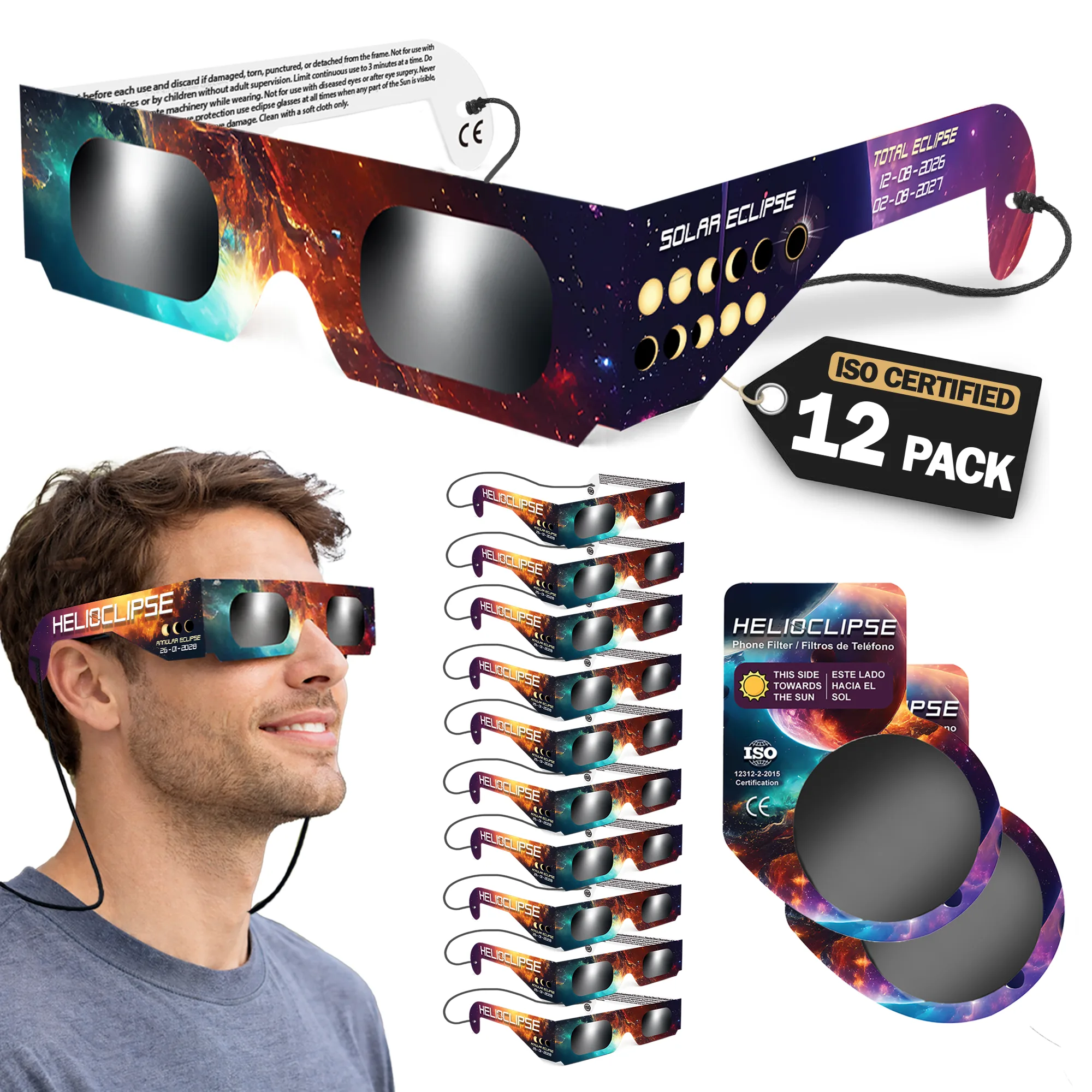
Order Helioclipse solar eclipse glasses early enough to inspect them and practise with children. For a group, bring spares rather than relying on a single pair of eclipse viewing glasses passed around during the fast final moments.
Eclipse glasses are for unmagnified viewing; they do not make it safe to look through binoculars, a telescope, or a camera lens. Concentrated sunlight can damage the filter and your eyes. Optical equipment needs an appropriate solar filter securely mounted over the front aperture, plus competent setup and testing.
A phone can capture the crowd, changing light, port silhouettes, and reactions without dominating the minute everyone came to see. If photography matters, rehearse the controls in advance. During totality, take a few frames and then look up.
Vigo versus the rest of the Spanish path
The total solar eclipse 2026 Spain path runs diagonally across the country, joining places with very different weather, terrain, and solar altitude. Galicia receives the shadow earlier, with the Sun around 11° high at favourable northwestern locations. By the time totality reaches eastern Spain and the Balearic Islands, the Sun can be only about 2°–5° above the horizon.
That gives Vigo more vertical clearance than Valencia or Mallorca, but not an unlimited one. A hill 10 kilometres away does not need to be tall to matter at a low angular altitude, and nearby city structures can be more important than distant terrain.
The Spain solar eclipse 2026 is therefore not a contest with one universally “best” city. Inland locations may offer better climatological odds, Galicia may offer a higher Sun and longer potential totality, and individual sites may reverse those advantages through cloud or obstruction. The winning location on August 12 will be one that is inside the path, reachable, legal, weather-aware, and open toward the correct horizon.
Frequently asked questions
Which location in Spain offers the best view of the 2026 total solar eclipse?
The excerpt does not identify one single best location in Spain. It advises choosing an exact point within the path of totality and checking both the local totality duration and the low west-northwest horizon before prioritizing scenery.
What time will the solar eclipse occur on February 17?
The excerpt provides no information about a solar eclipse on February 17. It discusses the August 12, 2026 eclipse, with the shadow crossing the Iberian Peninsula at approximately 20:27 to 20:32 CEST.
What are the key facts to know about Spain's total solar eclipse in 2026?
The total eclipse on August 12, 2026 will cross northern Spain during the evening, while locations outside the narrow totality band will see only a partial eclipse. Reported totality times for selected Spanish cities fall roughly between 20:28 and 20:33 local time, but exact circumstances depend on the viewing coordinates.
Will Vigo be inside the path of totality for the 2026 eclipse?
Possibly, but Vigo is close to the southern edge of Spain's totality corridor, so the city name alone is not enough to confirm totality. Check the exact beach, park, hotel, or hillside location on a coordinate-level eclipse map to determine whether it is inside the umbra and how long totality would last.
How should I plan an eclipse-viewing spot in Vigo for 2026?
Start with a map for the exact viewing point, then assess the west-northwest horizon, weather, and scenery in that order. The Sun will be low in that direction, and water, slopes, buildings, shipyard structures, and port cranes may obstruct the view.
On-site next steps
- Open the Helioclipse Eclipse Explorer and compare several exact Vigo pins. Save each pin’s total-or-partial classification, local timing, duration, altitude, and azimuth.
- Scout a primary site and a nearby backup with a genuinely clear west-northwest horizon. Recheck temporary restrictions and transport plans during eclipse week.
- Equip your group with ISO 12312-2 eclipse viewers in advance, inspect them, and agree on the glasses-on/glasses-off rule before August 12.
- Treat both total solar eclipse 2026 Vigo Spain map and total solar eclipse 2026 Vigo Spain time as coordinate-level planning tasks, not generic city facts.
Sources & further reading
- NASA Science: Total Solar Eclipse on August 12, 2026
- European Space Agency: Total solar eclipse 12 August 2026 — Map of totality in Spain
- Space.com: Spain’s total solar eclipse 2026 comes with a catch
- Space.com: The biggest skywatching day of 2026 is coming
- NASA Science: What’s Up — August 2026 skywatching tips
- American Astronomical Society: How to view a solar eclipse safely
- American Astronomical Society: About the ISO 12312-2 standard
- American Astronomical Society: Eclipse basics
- NASA Science: Eclipse viewing safety
- NASA Science: Eclipses and the Moon