Valencia in 2026: one city, one eclipse—timing, horizons, and planning without the fluff
On Wednesday, August 12, 2026, Valencia will spend roughly one minute inside the Moon’s darkest shadow. The partial eclipse begins at about 7:38 p.m. CEST, totality arrives around 8:32 p.m., and sunset interrupts the remaining partial phase at about 9:01 p.m. The city is genuinely inside the path—not on the wrong side of a boundary and not facing a merely 99% partial eclipse.
That is the thrilling part. The catch is that the totally eclipsed Sun will be only about 4° above the west-northwest horizon. A building, line of trees, rooftop structure, bridge, or distant ridge could erase the main event without taking Valencia out of totality on any map.
Our practical rule for the total solar eclipse 2026 Valencia Spain event is therefore simple: choose the horizon before you choose the atmosphere. Drop pins for your exact candidates in the Helioclipse Eclipse Explorer, compare beach, historic-center, and southern municipal locations, and then inspect each one on the ground at the same time of day.
Valencia is inside the path—but your sightline still decides what you see
A total eclipse happens only inside the Moon’s umbra, the narrow inner shadow in which the bright solar surface is completely covered. Valencia lies within the total solar eclipse 2026 path on August 12. NASA’s city table places totality between approximately 8:32 and 8:33 p.m. CEST, equivalent to roughly 18:32–18:33 UTC.
Those rounded city times are appropriate for an overview, not a personal countdown. Contact times and totality duration change slightly with your coordinates. A pin near La Malva-rosa, one in Ciutat Vella, and another in the southern part of Valencia municipality should not be assumed to produce identical circumstances. Use the map to retrieve the local partial-eclipse start, start and end of totality, Sun altitude, and azimuth for the exact place where you intend to stand.
The often-used phrase 2026 Valencia eclipse conceals an important distinction: being geometrically inside the path does not guarantee an unobstructed view of the umbra-covered Sun. At an altitude of 4.4°, an obstruction about 13 metres tall can hide the Sun from only 170 metres away on level ground. A 20-metre building can do the same from roughly 260 metres. These are simplified estimates, but they show why a seemingly broad street can still be a poor observing site.
Any solar eclipse Spain 2026 map can tell you whether a coordinate is inside totality. It cannot, by itself, tell you whether a hotel wing, palm canopy, temporary stage, or hazy cloud bank sits in the final few degrees above your horizon. Any total solar eclipse 2026 Valencia Spain 2026 guide map worth using must be paired with an actual sightline check.
The Valencia timetable: a slow build, then one very fast minute
The broad local sequence is:
- About 7:38 p.m. CEST (17:38 UTC): the partial eclipse begins.
- About 8:32 p.m. CEST (18:32 UTC): totality begins in the city-level NASA table.
- About 8:33 p.m. CEST (18:33 UTC): totality ends.
- About 9:01 p.m. CEST (19:01 UTC): sunset ends the visible event before the partial eclipse has formally finished above the astronomical horizon.
Space.com gives La Malva-rosa a more location-specific estimate of about 1 minute 3 seconds of totality, with the eclipsed Sun approximately 4.4° above the west-northwest horizon. Valencia’s official visitor information rounds the total phase to roughly one minute between 8:32 and 8:33 p.m. These figures agree at the level needed for early planning; your final operational timing should come from an exact map pin close to eclipse day.
The solar eclipse 2026 Valencia time is late enough that the city will already feel different before the Moon finishes covering the Sun. The light will become thinner and less familiar, shadows may sharpen into tiny crescents, and the western sky will darken rapidly as totality approaches. Yet the exposed sliver of photosphere remains dangerously bright right up to the moment it disappears.
Do not plan to arrive at 8:25 p.m. The partial phase lasts nearly an hour before totality, while finding a gap in a dense crowd or discovering that a tree blocks the Sun can consume the few minutes you thought you had. For families, agree on a meeting point and bathroom plan well before the sky begins to command everyone’s attention.
Three Valencia settings, three different horizon problems
This is a single-city guide, so the useful comparison is not Valencia versus somewhere hundreds of kilometres away. It is between places where visitors actually base themselves and move around within Valencia municipality.
La Malva-rosa and the maritime neighborhoods
La Malva-rosa is Valencia’s designated city viewing area, with the official information specifying a stretch between Carrer de la Séquia de la Cadena and the Cabanyal lifeguard post number 3. Space.com estimates about 63 seconds of totality there at 8:32 p.m. CEST.
The beach offers space, accessible approaches, and a familiar destination that can absorb an organized public event. But the sea lies east of Valencia, while the eclipse is low in the west-northwest. You will be looking inland, not out over the Mediterranean. Depending on your exact position, buildings, promenade structures, palms, and event infrastructure may occupy the critical horizon.
That does not make the official site a bad choice. It means you should pin the designated section rather than the generic center of “Malvarrosa Beach,” check the west-northwest bearing, and inspect the view during a previous sunset. Move tens of metres if necessary—but do that before the crowd fixes everyone in place.
Visitors staying in El Cabanyal, Canyamelar, or around the marina should not assume that a sea-view room is automatically an eclipse-view room. A balcony optimized for sunrise may face almost exactly the wrong direction. Ask for a west-northwest sightline and verify it rather than relying on “panoramic” in a room description.
Ciutat Vella and the central visitor base
Ciutat Vella is convenient for accommodation, food, and transit, but its urban fabric creates a difficult low-altitude horizon. Narrow streets that are magnificent for shade in August can frame only a small patch of sky. Rooftops can help, although parapets, lift housings, neighboring towers, antennas, and access limits still matter.
At 4° altitude, a picturesque plaza is not automatically open enough. Stand where you intend to observe and use a compass to identify west-northwest. If the view in that direction ends in a continuous roofline, totality may happen behind it even though the sky overhead is perfectly clear.
A private rooftop should be treated as a controlled venue, not an improvised last-minute solution. Confirm permission, capacity, guardrails, elevator arrangements, and whether children can attend. Never climb onto roofs, walls, construction areas, or restricted terraces to gain a few degrees of elevation.
For most central visitors, the sensible strategy is to keep Ciutat Vella as the base and travel to a pre-checked observing location several hours early. That separates the convenience of where you sleep from the geometry of where you watch.
Pinedo, El Saler, and Valencia’s Albufera-facing south
Valencia municipality stretches south through Pinedo and El Saler toward l’Albufera. The flatter terrain and openings around fields, dunes, and water can create longer sightlines than the historic center, but access and environmental protection impose real constraints.
Valencia’s official event guidance says the Devesa forest will remain closed throughout August 12 and that the CV-500 will close to general traffic from 6:00 p.m., with an exception indicated for residents carrying valid proof. Those restrictions make spontaneous driving toward the southern fringe a poor plan. They also protect a sensitive landscape that should not be treated as overflow parking or an informal festival site.
EMT line 25 serves Pinedo and El Saler, while line 24 reaches El Palmar; the city has said relevant services will be reinforced. Operational details can change, so confirm the 2026 timetable, stop closures, accessibility arrangements, and last return service shortly before the event. A beautiful pin is useless if you cannot legally reach it or leave it safely after dark.
Do not transplant the 25-second figure reported for La Muntanyeta dels Sants into a Valencia-city plan: that named site is outside the municipality and closer to the path edge. Within this article’s city boundary, obtain circumstances for your actual Valencia pin rather than borrowing a duration from another location with “Valencia” in its regional address.
Why four degrees is the number to remember
Hold your little finger at arm’s length: its width is roughly 1°. Four degrees is only about four finger-widths above a mathematically flat horizon. That is where the fully eclipsed Sun will sit from Valencia, give or take the pin-level variation.
At such a low elevation, you are looking through far more atmosphere than when the Sun is high. Thin cloud, sea haze, dust, and distant cloud banks become more consequential. A forecast icon showing sunshine over central Valencia does not guarantee a clear line of sight 50 or 100 kilometres toward the horizon.
This is why “beach versus rooftop” is not the real question. The real comparison is verified clear west-northwest horizon versus unverified horizon. Elevation can help, but only if it clears the obstructions in the correct direction. A low open field may beat a high terrace enclosed by taller buildings.
Run a rehearsal on August 11, ideally between about 8:20 and 8:40 p.m. The Sun will not occupy precisely the same position as the eclipsed Sun on the following day, but the visit will reveal the obstacles, access gates, lighting, crowd barriers, and transport assumptions that a digital model can miss. Use the Eclipse Explorer for the exact eclipse bearing rather than treating the ordinary sunset point as identical.
Weather planning without pretending a forecast can promise totality
August climatology is useful for broad expectations, not guarantees. Space.com cites a historical cloud figure near 31% for La Malva-rosa since 2000, but a single percentage cannot describe whether low cloud will sit specifically along the west-northwest horizon at 8:32 p.m.
Start following forecast trends several days ahead, then pay closer attention to satellite imagery, low-cloud forecasts, visibility, and the western horizon during the final 24–48 hours. Overhead blue sky is encouraging; the horizon itself remains the decisive strip.
Within Valencia, mobility will be constrained by crowds, road controls, protected areas, and public-transport capacity. Choose a primary location and one realistic backup reachable without gambling on a long cross-city transfer. Our guide to cloud cover and eclipse-day mobility explains how to distinguish a sensible move from a panicked one.
Set a decision deadline. If your group is still debating locations after 7:30 p.m., you risk trading a known, imperfect horizon for an unknown one while the partial phase is already underway. A family with children or an older relative usually benefits more from shade, water, toilets, and a stable viewing area than from chasing every update on a weather app.
Eye safety: viewers stay on throughout the partial phases
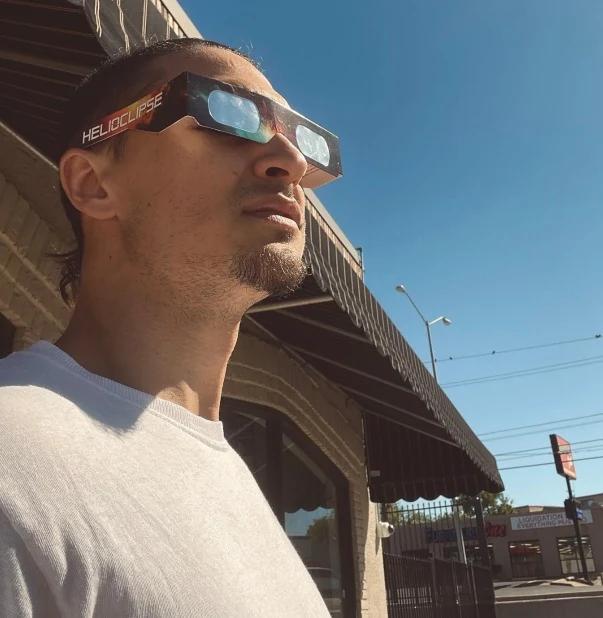
From approximately 7:38 p.m. until the bright solar surface is completely covered, look at the Sun only through safe solar viewers that conform to ISO 12312-2. Ordinary sunglasses—even several pairs stacked together—are not suitable. Check every viewer before use and discard it if the filter is scratched, punctured, torn, loose, or otherwise damaged.
Only when totality has actually begun and the Sun’s bright face is completely hidden may you remove viewers for unaided observation. In Valencia that interval lasts only about a minute. The instant a bright point of sunlight returns, put the viewers back on. Our first-timer guide explains when glasses stay on and when they may come off.
Build the handoff into your group plan. One adult can watch the final filtered crescent and call “glasses off” only after complete coverage; another can watch for the returning photosphere and call “glasses on.” Children should be supervised directly rather than expected to interpret the phase change themselves.
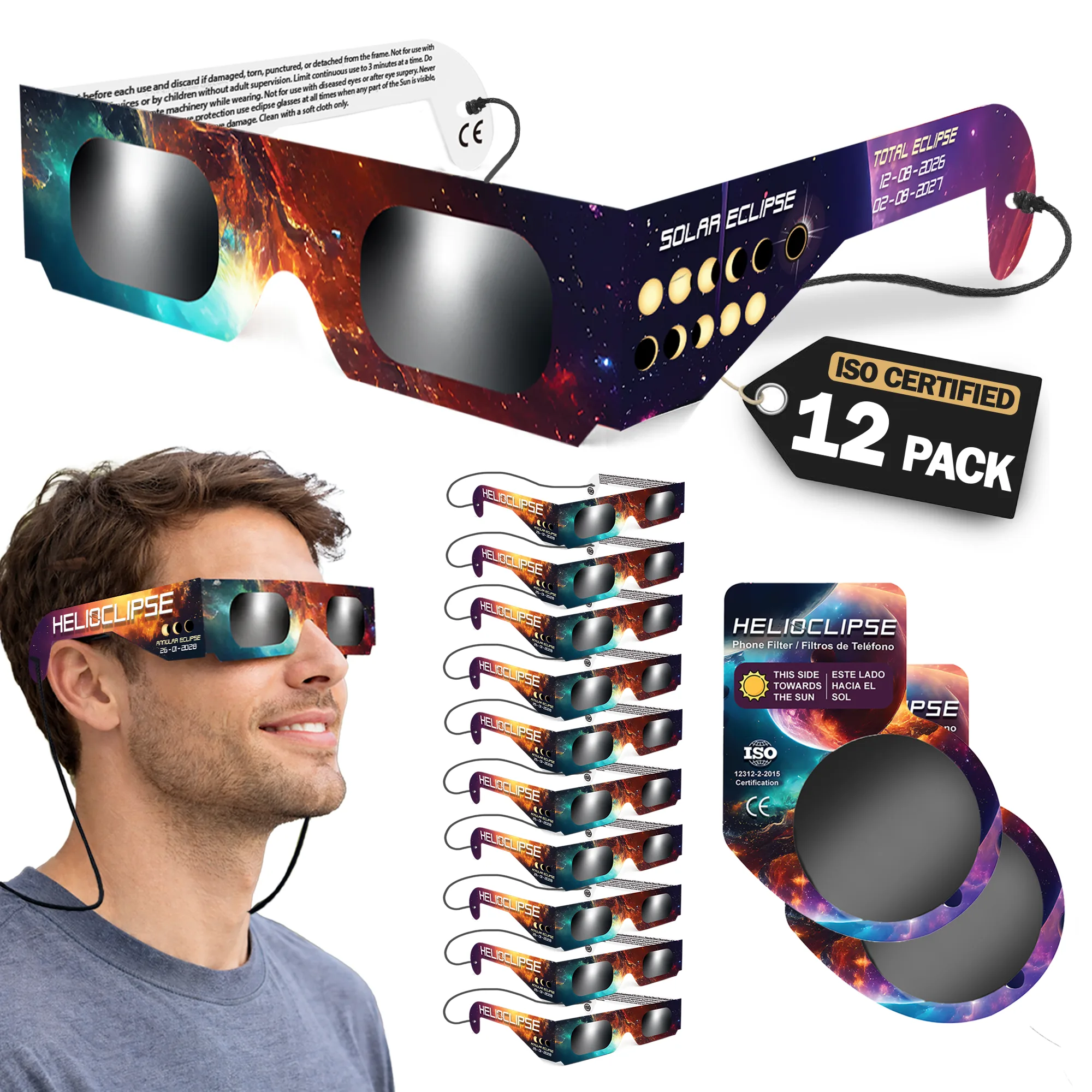
For product language, eclipse viewing glasses should identify the responsible manufacturer or supplier, carry instructions, fit securely, and have credible evidence of conformity. Labels such as solar eclipse glasses ISO 12312-2 certified or certified solar eclipse glasses are meaningful only when backed by appropriate testing and traceable product information—not merely printed as decoration. You can review the standard in our ISO 12312-2 guide and obtain Helioclipse eclipse glasses early enough to inspect and distribute them before eclipse day.
A camera, binoculars, or telescope needs a purpose-made solar filter securely attached over the front aperture during every partial phase. Wearing eclipse glasses while looking through unfiltered magnifying optics is not safe: the instrument concentrates sunlight before it reaches the viewer. If you are not already comfortable managing filtered optics through a one-minute totality transition, leave the telescope at home and experience the event with your eyes.
A realistic plan for August 12
Tell your group now that the date is Wednesday, August 12, 2026. The Valencia solar eclipse 2026 is an evening event, but your logistical day begins much earlier.
A workable city plan looks like this:
- Several weeks ahead: select two Valencia-proper candidates, record exact coordinates, and compare local circumstances in the map.
- Before eclipse week: acquire and inspect viewers for everyone who needs them; write names on family sets if that prevents confusion.
- August 11: rehearse the route and west-northwest sightline at approximately the eclipse time.
- Morning of August 12: check official municipal restrictions, EMT and Metrovalencia notices, heat guidance, and weather trends.
- Mid-afternoon: make the final location decision and send one pin—not a place name—to everyone in the group chat.
- Well before 7:38 p.m.: arrive, locate toilets and exits, distribute viewers, and settle children before first contact.
- Around 8:32 p.m.: follow the real phase of the eclipse rather than an unverified social-media countdown.
- After totality: keep viewers on for any final glimpse of the partially eclipsed Sun, then allow the crowd to thin before moving if conditions permit.
Pack water, sun protection for the long wait, any necessary medication, a charged phone, a power bank, and a small torch for the journey back. Keep loose belongings contained; a dark beach or crowded terrace is not the place to search for a dropped key.
The phrases 2026 eclipse Valencia Spain and Valencia Spain total eclipse 2026 both point to the same non-negotiable fact: Valencia crosses into totality, but only an exact coordinate and unobstructed horizon determine whether you personally see it. Likewise, solar eclipse Valencia 2026 planning should end with a pinned observing position, not a broad district name.
What this event is—and what it is not
The total solar eclipse 2026 Spain event crosses a much larger national path, but Valencia’s experience is unusually tied to sunset geometry. This guide deliberately stays inside the municipality because city visitors need decisions they can execute from Ciutat Vella, the maritime neighborhoods, and Valencia’s southern districts—not a catalogue of distant alternatives.
A total solar eclipse cruise 2026 may approach the event from a completely different location and set of coordinates. Its advertised duration, clock time, horizon, and safety arrangements do not transfer to a person standing in Valencia. Use Valencia-specific local circumstances.
The wording total solar eclipse 2026 Valencia Spain 2026 guide can also suggest more certainty than any guide should claim months in advance. We can establish the date, geometry, approximate city timing, and low Sun altitude. We cannot promise clear weather, unrestricted access to every site, or second-perfect circumstances for an unspecified hotel balcony.
That honest boundary makes the plan stronger. For the solar eclipse Valencia 2026, verify four things in order: that your pin is inside totality, that the west-northwest horizon is clear, that the site is legally accessible, and that everyone can observe safely.
Quick answers for Valencia observers
Is Valencia in the path of totality?
Yes. NASA and Spain’s Instituto Geográfico Nacional place Valencia inside the path for August 12, 2026. City-level tables put totality at roughly 8:32–8:33 p.m. CEST, while a La Malva-rosa estimate gives about 1 minute 3 seconds.
What is the most important feature of a viewing site?
An unobstructed west-northwest horizon. The eclipsed Sun will be only about 4.4° high near La Malva-rosa, so low obstacles matter much more than they would during a midday eclipse.
Is the beach automatically best?
No. La Malva-rosa is the designated public viewing area and has practical advantages, but the Mediterranean is east while the eclipse is west-northwest. Check the inland-facing sightline from the exact section you will use.
Can I watch from Ciutat Vella?
Potentially, if you have a verified open or elevated view toward west-northwest. Street-level locations surrounded by buildings are risky. Confirm rooftop access and safety rather than improvising.
When should I remove eclipse glasses?
Only after the bright solar surface is completely covered and totality has visibly begun at your location. Replace them as soon as the first bright sunlight reappears. If cloud or an obstruction prevents you from confirming the phase, keep the viewers on.
Frequently asked questions
Where in Spain can I watch the 2026 total solar eclipse from Valencia?
Valencia is inside the path of totality on August 12, 2026, so the Sun will be completely covered there for roughly one minute. Your exact viewing location still matters because the eclipsed Sun will be very low over the west-northwest horizon.
What time will the 2026 eclipse be visible in Valencia?
In Valencia, the partial eclipse begins at about 7:38 p.m. CEST, with totality occurring around 8:32 to 8:33 p.m. CEST. Sunset at about 9:01 p.m. CEST ends the remaining partial phase, and exact contact times vary slightly by location.
What is the most important thing to know before watching the 2026 total eclipse in Valencia?
A clear west-northwest horizon is essential because the totally eclipsed Sun will be only about 4° above the horizon. Buildings, trees, rooftops, bridges, ridges, or haze can block the view even when your location is inside the path of totality.
How should I choose a viewing spot for the 2026 eclipse in Valencia?
Choose the horizon before choosing the setting: compare exact locations and check their local eclipse timing, Sun altitude, and azimuth. Inspect candidate sites in person at the same time of day, since a map cannot reveal nearby structures or vegetation that may obstruct the low Sun.
Will every location within Valencia have the same eclipse circumstances?
No. Totality timing and duration change slightly with coordinates, so sites near the coast, in the historic center, and in southern parts of the municipality may not have identical circumstances. Use location-specific information rather than relying only on rounded citywide times.
On-site next steps
- Drop exact pins for La Malva-rosa, your accommodation area, and any permitted southern Valencia candidate in the Helioclipse Eclipse Explorer. Compare totality duration, contact times, altitude, and west-northwest direction.
- Revisit the winning pin at the same time of day and inspect the real horizon, entrances, shade, toilets, and return route.
- Order ISO 12312-2 certified Helioclipse viewers early, inspect them on arrival, and practice the glasses-on/glasses-off sequence with your group.
Sources & further reading
- Total Solar Eclipse in Valencia (August 12, 2026) — Visit Valencia
- Eclipse total de 12 de agosto de 2026 — Instituto Geográfico Nacional
- 10 easy places to see the total solar eclipse 2026 from Spain's major vacation destinations — Space.com
- Spain's total solar eclipse 2026 comes with a catch — Space.com
- Total Solar Eclipse on August 12, 2026 — NASA Science
- How to View a Solar Eclipse Safely — American Astronomical Society
- About the ISO 12312-2 Standard for Solar Viewers — American Astronomical Society
- Eclipse Basics — American Astronomical Society
- Why Do Eclipses Happen? — NASA Science
- Solar Filters for Optics: Telescopes, Binoculars & Cameras — American Astronomical Society