Gijón in 2026: one city, one eclipse—Asturian coast crowds, spray, and horizon games
Gijón will stand inside the Moon’s shadow on August 12, 2026. At approximately 8:26 p.m. CEST—18:26 UTC—the Sun should disappear for about 1 minute 45 seconds, transforming a bright Asturian evening into deep twilight. The corona will surround the black lunar silhouette, the western horizon will retain a band of sunset colour, and thousands of people along the waterfront may fall silent at almost the same instant.
That combination makes the total solar eclipse 2026 Gijon Spain event unusually compelling—and unusually dependent on preparation. Totality comes with the Sun only about 10° above the west-northwestern horizon. A headland, apartment block, tree, temporary stage or bank of Atlantic cloud can therefore matter more than an extra few seconds near the centreline.
Use our Eclipse Explorer and 3D map early, but do not stop at confirming that Gijón is inside the path. Drop a pin on the place where you expect to stand, check the local time and duration, and inspect the viewing direction. Then visit that location on an earlier evening if you can. In Gijón, the eclipse is not merely a question of being in the right city; it is a horizon problem measured block by block.
Gijón is genuinely inside the path of totality
The eclipse crosses Greenland, Iceland, the North Atlantic and northern Spain on August 12, 2026. Gijón lies well inside the path of totality and fairly close to its centreline. Published city-level calculations place the start of totality at about 8:26 p.m. CEST, with a duration of roughly 1 minute 44 seconds to 1 minute 46 seconds. The few-second variation between tables is normal: calculations may use different coordinates within the municipality and slightly different assumptions about elevation and the lunar limb.
For perspective, nearby inland Oviedo is expected to receive approximately 1 minute 48 seconds. That difference is only a few seconds. It is not a reason to abandon a clear Gijón horizon for an uncertain inland one, especially if traffic or cloud complicates a late move. Farther east, Bilbao sits near the edge of the path and gets only about 26–29 seconds in representative city-centre calculations. Gijón’s roughly 105 seconds of darkness is therefore a substantial totality, not a grazing encounter.
The distinction between total and almost total remains absolute. Madrid and Barcelona are expected to experience extremely deep partial eclipses, but the last visible sliver of the photosphere prevents the sky from becoming truly dark and keeps the corona hidden. In Gijón, weather permitting, the bright solar surface will be completely covered. Our broader guide to Spain’s 2026 path explains why 99.9% partial coverage is still not a substitute for crossing the path boundary.
The Gijon eclipse 2026, Gijon Spain eclipse 2026 and Gijon Spain 2026 eclipse all refer to this same August event—not to a February eclipse. The relevant date is Wednesday, August 12, 2026. February 17, 2026 brings an annular eclipse visible principally from Antarctica and is not the total eclipse over Asturias.
The number to remember is 10°, not just 1 minute 45 seconds
Totality over Gijón occurs late in the evening, with the eclipsed Sun approximately 10.3° above the west-northwestern horizon in one published calculation. Ten degrees is only about the width of your fist held at arm’s length. That simple hand measurement reveals why an otherwise attractive plaza can fail: a nearby building or the shoulder of Cerro de Santa Catalina can occupy much of the relevant sky.
The Sun’s low altitude also changes the visual character of the event. Before totality, the filtered solar crescent will hang over the city or sea rather than high overhead. As the Moon’s umbra arrives, clouds toward the Atlantic may darken first. During totality, the corona will appear against a sky already moving toward evening, while light from beyond the shadow creates a warm glow around parts of the horizon.
A national solar eclipse 2026 Spain map establishes the broad track, but it cannot tell you whether a kiosk blocks the Sun from one section of promenade. Likewise, a total solar eclipse 2026 map time label is incomplete unless it records coordinates and a time zone. For your chosen pin, the total solar eclipse 2026 Gijon Spain map should be checked alongside the total solar eclipse 2026 Gijon Spain time, including the Sun’s altitude and azimuth. A nationwide total solar eclipse 2026 time Spain table is useful for comparison, but the exact result belongs to a point, not merely a city name.
That point-specific discipline is the practical core of this total solar eclipse 2026 Gijon Spain 2026 guide. A useful total solar eclipse 2026 Gijon Spain 2026 guide map must answer four questions: Are you inside totality? How long does it last at the pin? Where is the Sun? What physically occupies that line of sight?
Santa Catalina, San Lorenzo or Poniente?
Gijón offers three obvious waterfront viewing zones: Cerro de Santa Catalina, Playa de San Lorenzo and Playa de Poniente. None is automatically “best.” Their geometry, crowd capacity and exposure to the Atlantic differ, and temporary eclipse-day controls could change access.
Cerro de Santa Catalina: elevation with a crowd cost
The hill above Cimavilla gives height and broad views, making it one of the city’s most intuitive gathering places. Elevation can lift the Sun above nearby roofs, and the open setting offers a dramatic view of the changing light over Gijón. It is also likely to be one of the first places visitors choose.
That popularity creates practical limits. Narrow approaches, uneven ground and packed sightlines can make a last-minute arrival miserable. Do not assume that being somewhere on the hill guarantees the correct west-northwestern view; walk the site with a compass or map and check what lies along the actual eclipse azimuth. If authorities create controlled entrances or capacity limits, follow the published municipal arrangements rather than trying to force access.
Playa de San Lorenzo: enormous visual appeal, complicated sightlines
San Lorenzo supplies space at low tide and an unmistakably Gijón setting, but its crescent curves east of the Cimavilla headland. From some sections, the line toward the low west-northwestern Sun may cross the headland, seawall, buildings or crowded promenade instead of open water. The answer can change as you move along the beach.
Tide and surf also matter. A broad patch of sand seen during a daytime inspection may be smaller on eclipse evening. Do not set equipment near an advancing waterline, climb onto wet rocks or turn the event into a contest for the most exposed position. Salt spray can coat lenses and viewers, while a rogue wave can endanger people who are staring skyward rather than watching the sea.
Playa de Poniente: potentially cleaner western geometry
Poniente lies west of the old centre and may offer a more direct relationship with the western sky from suitable sections. Its broad urban beach and promenade can accommodate many people, but harbour infrastructure, masts, cranes, railings and buildings still need to be tested against the exact azimuth.
Visit at approximately the same clock time on August 11—or another nearby date—and hold your fist above the horizon. If the visible Sun or its expected position is less than one fist above an obstruction, look for another spot. Make two plans within walking distance so a closed access point or unexpected structure does not force a cross-city drive.
Atlantic cloud is the main uncertainty
No map can promise a clear sky. One historical analysis cited for Gijón gives an August 12 cloud figure of about 54% based on records since 2000. That is not a forecast and should not be read as a precise 54% chance of failure. It is a reminder that the Asturian coast has a materially higher cloud risk than some inland sections of the Spanish path.
The Bay of Biscay supplies moisture, while the Cantabrian terrain can help create sharp local contrasts in cloud. Low marine layers may hug the coast; cloud can also build against higher ground. These are reasons for humility, not for declaring that the beach or the interior always wins. A coastal opening can appear while inland hills remain covered, and the reverse can happen on another evening.
Begin monitoring professional forecasts several days ahead, but place the most weight on short-range updates, satellite imagery and observations on eclipse day. Pay special attention to low cloud in the west-northwest—not merely the percentage shown by a generic weather icon. A mostly blue sky overhead is not enough if one persistent bank sits where the Sun will be at 8:26 p.m.
Mobility must remain realistic. A clear patch 60 kilometres away is useless if eclipse traffic makes it unreachable. Decide in advance how late you are willing to move, identify a route that does not depend on one congested junction, and never stop on a motorway shoulder or unsafe coastal road. Our eclipse weather and mobility guide can help your group set a decision time before emotion takes over.
What totality should feel like from the coast
The partial phase develops gradually for roughly an hour before totality. Through safe solar viewers, the Moon will take an ever-larger bite from the Sun. For much of that time, ordinary daylight may disguise how much of the solar disk has gone; your pupils and brain adapt surprisingly well.
The atmosphere becomes stranger in the final minutes. Shadows sharpen, colours lose warmth and the sea may take on a metallic appearance. A temperature change or shift in breeze is possible, although ordinary coastal weather can mask it. Look west for the approaching darkness, then look around rather than spending every second staring through a camera.
When the final bright portion of the Sun vanishes, Gijón enters totality. Only then may unaided observers remove their eclipse viewers. The corona—the Sun’s faint outer atmosphere—should become visible around the Moon. Bright planets or stars may emerge, and the horizon can glow beyond the Moon’s narrow shadow. With only about 105 seconds available, choose two or three priorities: look at the corona, glance at the horizon, and notice the people and city around you.
Then be ready for the ending. The first returning bead of direct sunlight is intensely bright. The moment it appears, viewers go back on. Do not let the beautiful low evening light persuade you that the returning partial phase is safe to watch directly.
Eye safety on a windy, crowded waterfront
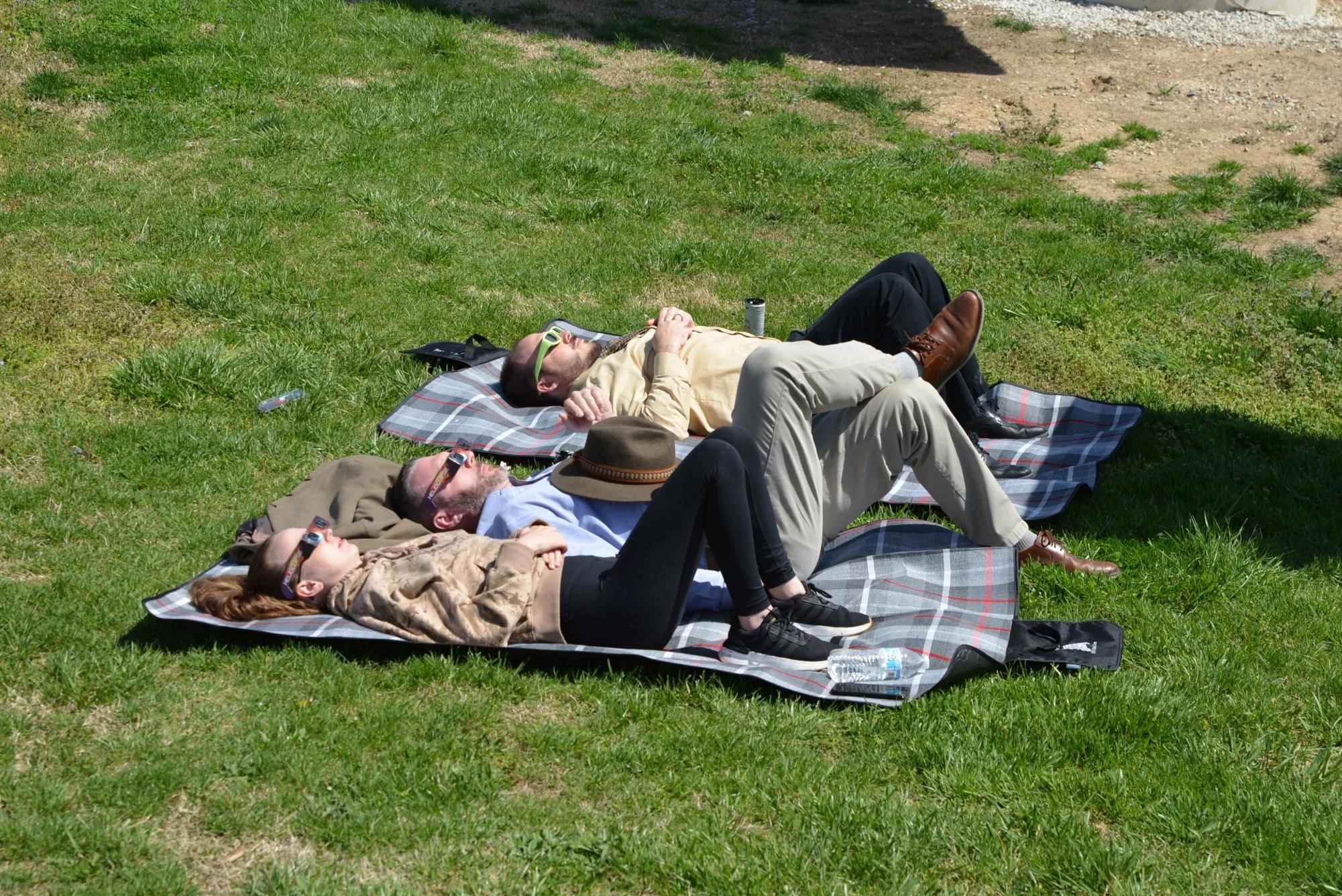
Certified solar viewers are required whenever any bright part of the Sun is visible. In Gijón, that means the entire partial phase before totality and the returning partial phase afterward. Remove them only after the photosphere is completely covered; replace them immediately when direct sunlight reappears. Our phase-by-phase safety guide is worth sharing with every adult supervising children.
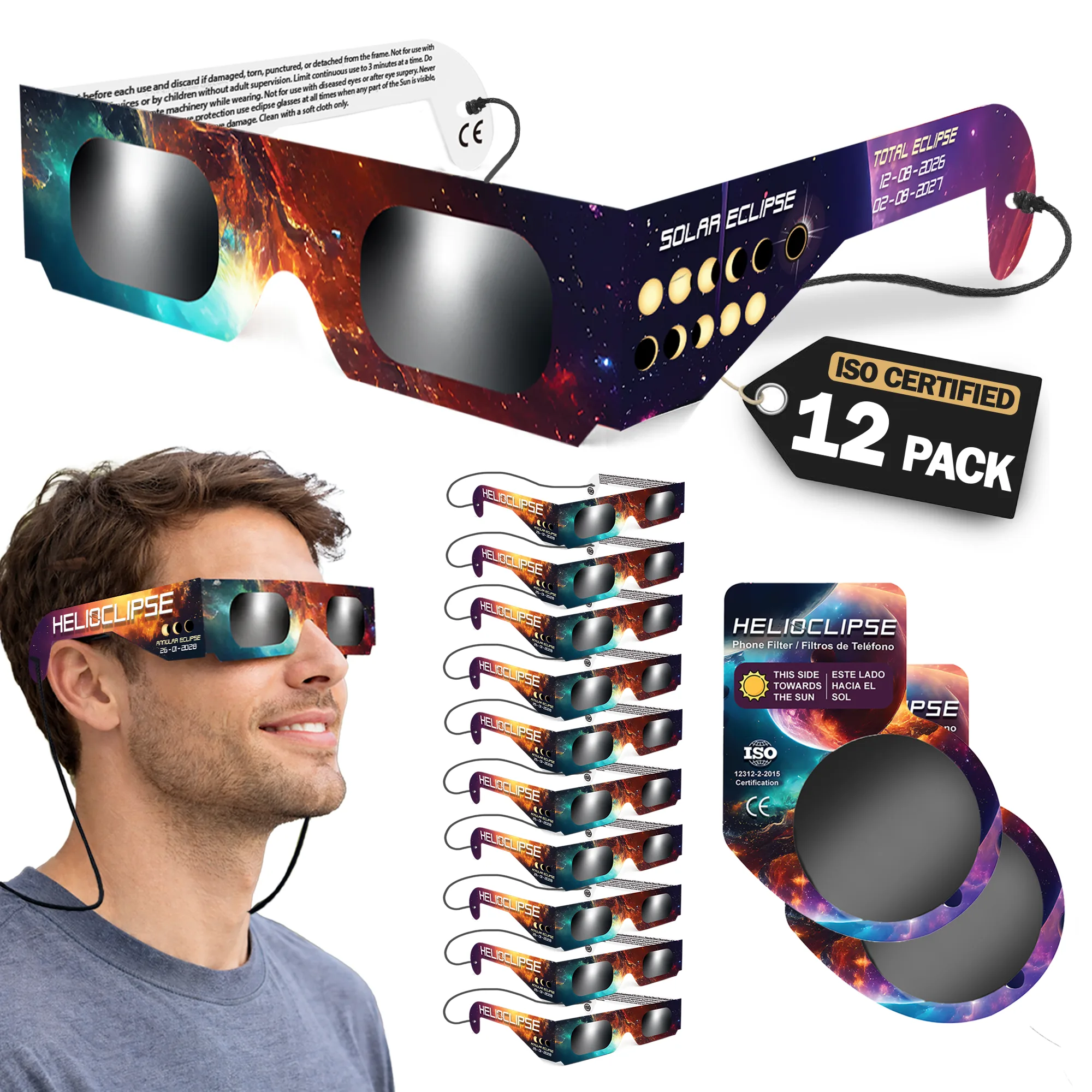
Use special-purpose viewers that conform to ISO 12312-2, inspect them for tears, punctures, scratches or loose filters, and follow their instructions. Ordinary sunglasses are not adequate, regardless of how dark they look. Marketplace wording can be confusing: NASA does not certify or approve particular viewer brands. Phrases such as solar eclipse glasses iso 12312-2 certified should lead you to verify the stated standard and product information, not assume that an agency endorsement exists.
Secure lightweight viewers before the wind catches them, but never modify the filter area. Children should practise the sequence in advance: look down, place the viewer securely over the eyes, look up briefly, then turn away before removing it. Good eclipse viewing glasses should fit the user well enough to maintain coverage during that routine. Bring spare certified solar eclipse glasses for damaged viewers and unexpected companions; you can find Helioclipse options on our solar eclipse glasses page.
Cameras, binoculars and telescopes need purpose-made solar filters secured over the front of the optics. Eclipse glasses worn over your eyes do not make it safe to look through an unfiltered optical instrument. If you are not already experienced with solar imaging, let the professionals handle close-ups and spend your 105 seconds looking up.
Crowds, transport and the myth of eclipse tickets
There are no tickets required for the Moon’s shadow. The phrase total solar eclipse 2026 Gijon Spain tickets may refer to a particular organised event, reserved venue, excursion, hotel package or transport service—not admission to totality itself. Public waterfront access, however, may still be managed for safety, and private or capacity-controlled sites can require booking.
Asturias has announced enhanced eclipse-day transport planning, including extended metropolitan services in the Oviedo–Gijón–Avilés area and associated coastal corridors. Treat those plans as encouraging but provisional until operators publish final timetables, stops and capacity information. Save official updates offline, because mobile networks may slow when crowds gather.
For families, choose a meeting point away from the densest viewing area and write a phone number on a child’s wristband or card. Bring water, sun protection for the long partial phase, a light layer for the evening, any essential medication and only equipment you can carry without blocking walkways. Arrange the journey home before arrival; thousands of people leaving immediately after totality can overwhelm parking exits even when the inbound trip felt easy.
Tell your group now, not the week before. Decide who brings viewers, who checks the map, who watches the weather and who keeps track of the children during the final minute. The total eclipse 2026 Spain experience will be shared by many cities, but your success in Gijón will depend on these small assignments.
A compact Gijón eclipse-day plan
- Confirm your exact pin. Check the total solar eclipse 2026 path, duration, local time, Sun altitude and west-northwestern direction in an interactive map.
- Inspect two local sites. Compare Santa Catalina, San Lorenzo and Poniente in person rather than trusting a city-level description.
- Recheck access and tide conditions. Do not assume a beach has the same usable area at every hour.
- Set a weather decision time. Use short-range forecasts and satellite observations, then stop moving early enough to avoid being trapped in traffic.
- Distribute viewers before the partial phase. Inspect every filter and rehearse the glasses-on, glasses-off sequence.
- Be settled well before 8:26 p.m. CEST. The published time is approximate for the city; your map pin should provide a more precise local prediction.
- Keep totality simple. Watch the corona with your own eyes, look at the horizon once, and put viewers back on at the first return of sunlight.
The total solar eclipse 2026 Gijon Spain 2026 guide time can be summarised in one line—about 8:26 p.m. CEST for roughly 1 minute 45 seconds—but the line is not the plan. Horizon, cloud, access and safe viewing determine whether those seconds become a clear view or merely darkness behind cloud.
Frequently asked questions
Where in Spain should I watch the 2026 total solar eclipse?
There is no single best location stated in the excerpt. Gijón is well inside the path of totality and close to the centreline, but a clear west-northwestern horizon is especially important because the Sun will be only about 10° above the horizon at totality.
What time will the February 17 eclipse occur?
The excerpt does not provide information about an eclipse on February 17. It covers the total solar eclipse visible from Gijón on August 12, 2026, with totality beginning at about 8:26 p.m. CEST (18:26 UTC).
What are the key viewing facts for the 2026 total solar eclipse in Gijón?
Gijón is inside the path of totality, with totality expected to last roughly 1 minute 44 seconds to 1 minute 46 seconds starting around 8:26 p.m. CEST. The low Sun and possible coastal cloud, buildings, trees, or other obstructions make choosing an unobstructed west-northwestern view essential.
How should I prepare for viewing the 2026 eclipse in Gijón?
Check your exact planned viewing location for its local totality time, duration, and viewing direction rather than relying only on the city’s position within the path. If possible, visit the site on an earlier evening to confirm that the low west-northwestern horizon is clear.
What coastal conditions could affect eclipse viewing in Gijón?
Crowds along the waterfront and Atlantic cloud may affect viewing, while the Sun’s low altitude means even a headland, apartment block, tree, stage, or bank of cloud can block it. A site with a clear horizon may be more valuable than moving for a few extra seconds of totality.
On-site next steps
- Open the Helioclipse Eclipse Explorer, zoom to your intended position in Gijón and record totality duration, local time, solar altitude and viewing direction.
- Compare at least two waterfront pins instead of treating the entire municipality as one viewpoint.
- Order and inspect ISO 12312-2 eclipse viewers early enough to replace any damaged units and equip your whole group.
- Share the pin, backup location and safety routine with family or friends before eclipse week.
Sources & further reading
- NASA Science: Total Solar Eclipse on August 12, 2026
- National Eclipse: 2026 Total Solar Eclipse Overview for Iceland and Spain
- Space.com: 10 best Spanish cities to see the total solar eclipse 2026
- Space.com: What time is the total solar eclipse on Aug. 12, 2026?
- Turismo Asturias: Asturias, one of the best places to watch the solar eclipse
- American Astronomical Society: How to View a Solar Eclipse Safely
- NASA Science: Eclipse Viewing Safety
- American Astronomical Society: The Total Solar Eclipse Experience
- American Astronomical Society: Phenomena You’ll Experience at a Total or Annular Eclipse
- NASA Science: Eclipses Frequently Asked Questions