Sfax in 2027: one city, one eclipse — 5 minutes 41 seconds on the Tunisian coast
The Sfax Tunisia solar eclipse 2027 story can be told with one extraordinary number: approximately 5 minutes 41 seconds of totality on the morning of August 2. For that long, the Moon will completely cover the Sun above Tunisia’s eastern coast, exposing the solar corona and turning a bright August morning into an unmistakable pocket of night.
This is not merely an especially deep partial eclipse. Sfax is inside the Moon’s central shadow—the umbra—while Tunis is outside it and will see a partial eclipse only. That geometric distinction changes everything. In Sfax, the Sun’s bright face disappears completely; in Tunis, a brilliant sliver remains visible, so the sky never enters true totality and solar viewers must stay on throughout.
Before choosing a hotel, beach, rooftop or open field, locate the exact site with our Eclipse Explorer and 3D map. A city name is a useful starting point, but eclipse circumstances vary with coordinates, especially near the edges of the path.

Why the Sfax Tunisia solar eclipse 2027 is so exceptional
On August 2, 2027, the Moon’s umbral shadow will travel from the Atlantic across southern Spain and North Africa, then continue through the Middle East and toward the Indian Ocean. The global path will be about 258 kilometres (160 miles) wide and roughly 15,227 kilometres (9,462 miles) long, according to the compiled circumstances reported by Space.com.
Sfax sits well inside that path. Published calculations for the city place totality at about 5 minutes 39 seconds to 5 minutes 41 seconds, depending on the precise coordinate and ephemeris calculation used. That two-second difference is normal for city-level summaries: “Sfax” can refer to a municipal coordinate, a district or a nearby observing site. For planning purposes, expect roughly five minutes and forty seconds, then calculate the circumstances for your actual location.
One detailed local calculation places the beginning of totality near 10:08:50 a.m., maximum eclipse around 10:11:39 a.m., and the end near 10:14:29 a.m., all in Tunisian local time, UTC+1. The partial phases extend for much longer, approximately from 8:56 a.m. to 11:31 a.m. These clock times should be rechecked before travel, but they establish the shape of the morning: arrive early, settle in before 9 a.m., and do not treat 10:08 as an arrival time.
At maximum eclipse, the Sun will stand about 56 degrees above the east-southeastern horizon. That is high enough to clear ordinary low obstructions, but not so high that every rooftop, wall or tree becomes irrelevant. Scout the site and check the Sun’s direction in advance.
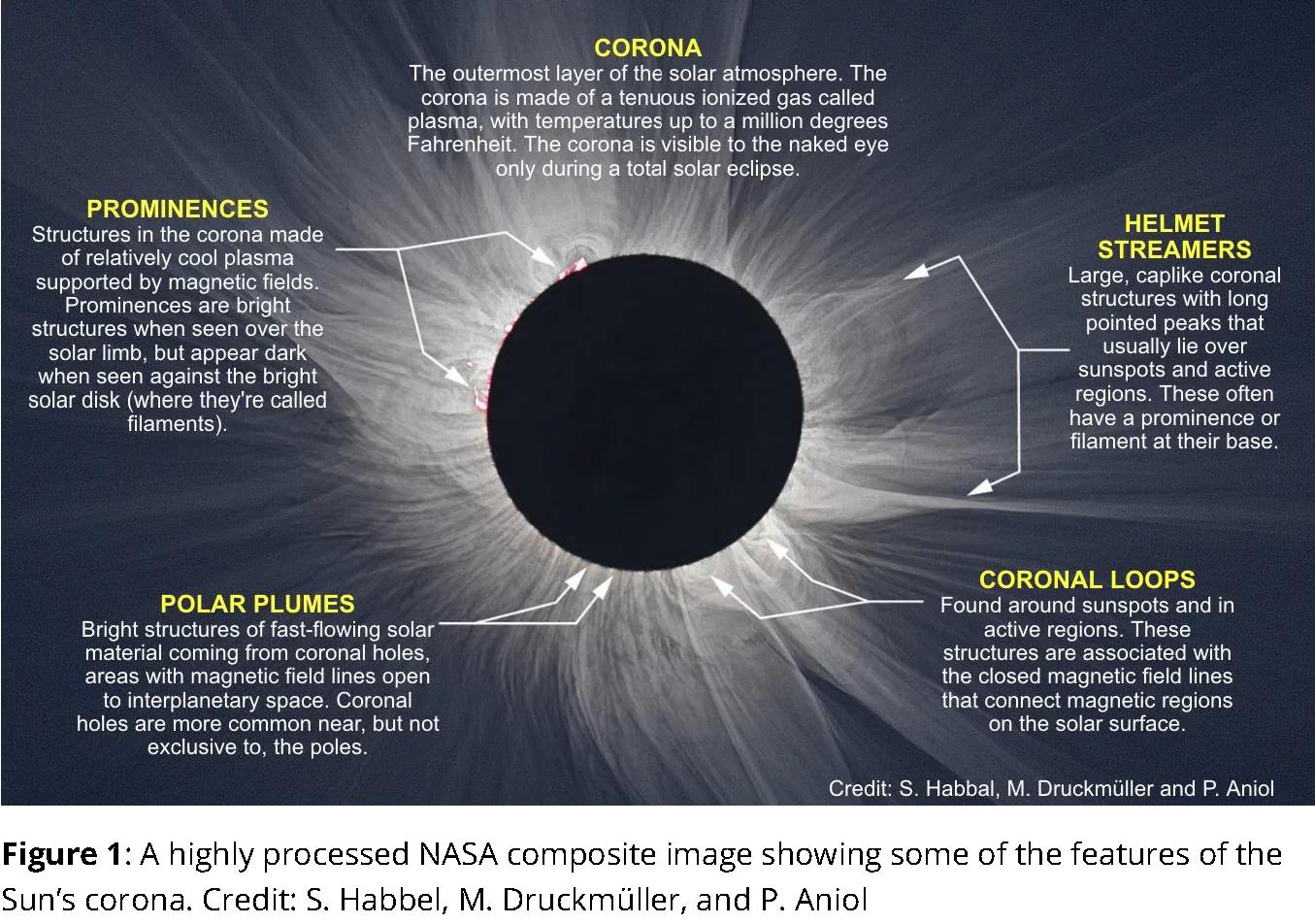
What five minutes and forty-one seconds will feel like
The first partial phase is gradual. Through proper solar viewers, you will see the Moon take an increasingly large bite from the Sun. To unaided eyes looking at the surroundings—not directly at the Sun—the morning may initially seem normal. Even a mostly covered Sun can keep the landscape surprisingly bright.
The final 10 to 15 minutes are different. The daylight becomes thinner and less familiar, shadows sharpen, and the heat may begin to ease. Under trees, gaps between leaves can project dozens of tiny solar crescents onto the ground. People who have been chatting and checking cameras tend to start watching the clock.
Immediately before totality, the remaining crescent breaks into bright points where sunlight passes through valleys along the Moon’s edge. These are Baily’s beads. The final bright point can create the diamond-ring effect—but your certified viewers remain on while any part of the Sun’s bright surface is visible.
Then the last direct sunlight vanishes. In Sfax, you may remove solar viewers only after totality has begun and the Sun’s bright face is completely covered. The black lunar disk will sit inside the pale, structured corona. The horizon may glow in several directions because places beyond the umbra remain in daylight. Bright planets or stars may become visible, while the city and coast take on a brief twilight character in the middle of the morning.
Five minutes 41 seconds is long enough to look, breathe and look again. You do not have to spend the whole interval fighting with a camera. Let someone in your group call out the remaining time, particularly the one-minute and 20-second warnings. The moment the first bright point of photosphere returns, solar viewers go back on immediately.
For a phase-by-phase rehearsal, read our guide to when glasses stay on and when they can come off during the 2027 eclipse.
Sfax, Kasserine and Tunis are not interchangeable
A Tunisia eclipse 2027 map must show more than the percentage of the Sun covered. It must show the two boundaries of the path of totality, because crossing one of those lines changes a partial eclipse into a total one.
Sfax is total, with approximately 5 minutes 41 seconds under the umbra. The nearby Kerkennah Islands receive a similarly long totality—published estimates are around 5 minutes 39 to 44 seconds—but island transport introduces a separate logistical question. If you choose Kerkennah, arriving the day before is far safer than depending on an eclipse-morning ferry connection.
Kasserine Governorate is also crossed by totality, but duration depends on the exact coordinate. An approximate 5 minutes 28 seconds is sometimes attached to Kasserine in broad planning summaries, but our available city-level sources do not securely establish the coordinate behind that figure. A published calculation for Sbeitla, within Kasserine Governorate, gives approximately 5 minutes 19 seconds, with totality beginning around 10:06 a.m. local time. Do not substitute the Sbeitla figure for every location in the governorate—or quote 5:28 as if it applied everywhere. Check the actual observing point on a path map.
Tunis is partial only. Published estimates differ slightly by selected coordinate, placing the maximum at about 96% to 97%. That is a dramatic partial eclipse, but it is not totality. A narrow part of the bright photosphere remains exposed; the corona does not appear as it does from inside the umbra, and there is no safe glasses-off interval.
This contrast can feel counterintuitive. Sousse and Monastir are even closer to the boundary, with estimates near 99.88% and 99.93%, yet they still remain partial in the cited calculations. Less than one percent of uncovered Sun is enough to prevent the total-eclipse experience. If your goal is totality, “almost 100%” is the wrong side of a hard boundary.
Other Tunisian locations illustrate how duration changes through the path: El Djem receives about 4 minutes 23 seconds, Djerba around 4 minutes 42 seconds, Gabès about 4 minutes 6 seconds, and Mahdia roughly 2 minutes 48 seconds. Sfax offers one of Tunisia’s longest city-based totalities without requiring an inland or island observing site.
Why Sfax works as an observing base
Sfax is a functioning port city rather than a purpose-built eclipse destination. That matters. Visitors can base themselves near accommodation, roads and everyday services while remaining deep inside the path. The coast also gives groups a choice between urban sites and more open surroundings, provided access is legal and the eastern to southeastern sky is unobstructed.
The Sun’s altitude of about 56 degrees means you do not need a perfectly flat sea horizon. You do need enough open sky in the correct direction. A courtyard enclosed by tall walls, a narrow street in the medina or a position beneath dense trees may be atmospheric but poorly aligned. Scout at approximately the same time of day before August 2 and note where the Sun stands.
Local access will matter more than squeezing out another second of totality. A secure site with toilets, water, shade and a clear sky is a better plan than an exposed roadside chosen only because a map predicts a marginally longer duration. Families should also consider how far children will have to walk in the August heat and whether the group can remain together if mobile networks become congested.
Tell friends, relatives or school groups early. A shared plan should identify the meeting point, arrival time, transport backup and the person responsible for the totality countdown. If several households are travelling together, do not assume everyone will find the same location independently on eclipse morning.
August weather: promising skies, serious heat
Long-term climate patterns make Tunisia one of the stronger prospects along the 2027 path. August is normally hot and dry, and expert planning commentary places Sfax among the practical long-totality bases with favourable cloud prospects. That is encouraging, not a guarantee. Coastal haze, local cloud, dust or an unusual weather system can still interfere.
Begin checking forecasts several days before the eclipse, then compare cloud layers, visibility, wind and dust—not just a single weather icon. Keep a realistic mobile plan within the totality zone, but avoid a last-minute drive that risks putting you in traffic when the partial phase begins. The smartest weather backup is usually one researched in advance, with its eclipse duration and access already saved offline.
Heat is the more predictable concern. The entire event lasts for hours, even though totality lasts minutes. Bring more drinking water than you expect to need, wear a hat and light protective clothing, use sunscreen, and create shade for waiting children and older relatives. Electronics and camera equipment also heat quickly in direct sunlight; keep spare batteries and devices shaded when possible.
Do not let the brief cooling near totality disguise the conditions before and after it. Once the Sun reappears, the temperature and solar exposure recover while roads may be at their busiest.
The date confusion: not 2024, not the 2026 eclipse
Tunisia’s headline total solar eclipse is on August 2, 2027. References to a “Tunisia solar eclipse 2024” usually concern a different event, general eclipse coverage or an incorrectly dated page. Likewise, the solar eclipse of 2026 is a separate event on August 12, 2026, with totality crossing Greenland, Iceland and northern Spain; Tunisia is not the destination for its total phase.
The eclipse 2027 Tunisia event is also distinct from the annular eclipse of February 6, 2027. During an annular eclipse, the Moon appears too small to cover the Sun completely, leaving a bright ring. On August 2, the geometry over Sfax produces a genuine total eclipse.
There will also be a penumbral lunar eclipse on February 20, 2027. Lunar eclipses involve Earth’s shadow falling on the Moon and can be viewed safely without solar filters. They should not be confused with the August solar event, when specialized eye protection is essential during every partial phase.

Safe viewing in Sfax—and the stricter rule in Tunis
Ordinary sunglasses are not solar viewers, regardless of how dark they look. During the partial phases in Sfax, use viewers designed for direct solar observation that conform to ISO 12312-2. Inspect every viewer beforehand and discard it if the filter is scratched, punctured, torn or separating from its frame. Children should be supervised whenever they look toward the Sun.
In Sfax, certified viewers remain on until the Sun’s bright face is completely hidden. Only during the roughly 5-minute-41-second total phase may you look directly without them. Put them back on as soon as the first brilliant point of Sun returns. In Tunis, Sousse, Monastir and every other location outside the path, there is no glasses-off moment at all.
Cameras, binoculars and telescopes need purpose-made solar filters secured over the front aperture. Do not look through unfiltered magnifying optics while wearing eclipse glasses; concentrated sunlight can damage the viewer and your eyes. Anyone planning telescopic or telephoto imaging should obtain expert equipment advice and practise the complete setup well before eclipse day.
When comparing eclipse viewing glasses, look for clear manufacturer identification, instructions, undamaged filters and credible conformity information rather than vague marketplace claims. Phrases such as solar eclipse glasses iso 12312-2 certified, certified solar eclipse glasses and approved solar eclipse glasses are often used in listings, but wording alone is not evidence—and NASA does not approve or certify commercial viewer brands. Our guide to ISO 12312-2 eclipse viewers explains what the standard actually covers.
Order enough viewers for your family or group before demand peaks, then keep them flat, clean and dry. You can browse Helioclipse ISO 12312-2 certified solar eclipse glasses when assembling the group kit.
A practical plan for eclipse morning
Arrive before the first partial phase, ideally with the site already inspected. The exact checklist will vary, but every group should cover the same essentials:
- Save your site coordinates, route and eclipse circumstances offline.
- Reach the location before approximately 8:56 a.m. local time, rather than aiming for totality after 10 a.m.
- Confirm a clear view toward the east-southeast and enough open sky for the Sun at roughly 56 degrees altitude.
- Bring certified solar viewers, spares and a simple pinhole projector for the partial phases.
- Pack water, shade, hats, sunscreen, food, essential medication and a basic first-aid kit.
- Assign one person to call totality and the return of direct sunlight.
- If photographing, practise filter removal and replacement without taking attention away from the sky.
- Plan to remain after totality instead of joining the first rush to leave.
A pinhole projector is especially useful for children and for sharing the slow partial phase. It projects an image of the Sun onto a surface; nobody should look through the hole at the Sun. A colander or the small gaps between crossed fingers can produce multiple crescent images on the ground.
Once totality ends, the eclipse is not over. The Moon takes more than an hour to uncover the Sun completely. Staying for the final partial phase gives you time to compare the returning light, let roads begin to clear and talk through what everyone just saw.
A 6-Minute Total Eclipse Is Coming to Egypt
Cosmos on Record
Frequently asked questions
Are organized trips to Egypt available for the 2027 solar eclipse?
The excerpt does not provide information about organized trips or viewing arrangements in Egypt. It states that the Moon’s shadow will continue across the Middle East toward the Indian Ocean after crossing North Africa.
When will the 2027 solar eclipse take place in Egypt?
The eclipse will occur on August 2, 2027. The excerpt does not give local timing or specific viewing circumstances for locations in Egypt.
Where in Tunisia should I go to see totality in 2027?
Sfax is inside the Moon’s umbra and is expected to experience roughly five minutes and forty seconds of totality. Check the exact coordinates of your intended hotel, beach, rooftop, or field, because eclipse circumstances can vary by location, especially near the path’s edges.
Will Tunisia experience a solar eclipse in 2027?
Yes. On August 2, 2027, Sfax on Tunisia’s eastern coast will experience a total solar eclipse, while Tunis will see only a partial eclipse because it lies outside the umbra.
What are the key details for watching the 2027 solar eclipse from Sfax?
Sfax is expected to have approximately 5 minutes 39 seconds to 5 minutes 41 seconds of totality, beginning near 10:08:50 a.m. and ending near 10:14:29 a.m. Tunisian local time. The partial phases may run from about 8:56 a.m. to 11:31 a.m.; arrive early, confirm timings for your exact site, and use proper solar viewers during the partial phases.
On-site next steps
- Open the Helioclipse Eclipse Explorer and place the marker on your actual hotel, viewing field or coastal site—not merely on the word “Sfax.” Check whether it is inside totality, the predicted duration, Sun direction and local contact times.
- Read our broader August 2, 2027 eclipse planning guide and build a weather and transport backup that stays inside the umbra.
- Once the group size is known, obtain enough Helioclipse solar eclipse glasses for the partial phases, plus a few spares for damaged or misplaced viewers.
Sources & further reading
- August 2, 2027 Total Solar Eclipse in Sfax, Gouvernorat de Sfax, Tunisia — coordinate-based eclipse circumstances for Sfax.
- Where will the “eclipse of the century” be visible on Aug. 2, 2027? — regional path, duration and city comparisons.
- Solar Eclipse 2027 in Tunisia: Sfax and Djerba get over five minutes of totality — Tunisia-focused calculations and local-time planning data.
- Eclipse experts’ best travel tips for the total solar eclipse 2027 — weather, heat and destination-planning context.
- The “eclipse of the century” will plunge these 8 wonders of the Roman Empire into darkness on Aug. 2, 2027 — circumstances for Sbeitla and El Djem.
- Eclipses and the Moon — NASA’s explanation of solar and lunar eclipse geometry.
- What to Expect: A Solar Eclipse Guide — NASA’s phase-by-phase guide to the total-eclipse experience.
- Eclipse Viewing Safety — NASA guidance for direct viewing, projection and optical equipment.
- How to View a Solar Eclipse Safely — American Astronomical Society viewing instructions.
- About the ISO 12312-2 Standard for Solar Viewers — detailed standards and labelling context from the AAS.