Jeddah and Mecca in 2027: totality on the Red Sea and what the map must confirm
The Jeddah–Mecca solar eclipse of 2027 will bring the Moon’s central shadow across western Saudi Arabia on 2 August. Jeddah can expect roughly six minutes of totality, while Mecca receives about five minutes. Those are extraordinary durations—but they are not interchangeable, and the difference becomes even sharper as the path climbs toward Taif.
For an initial city comparison, Jeddah is approximately 5 minutes 53 seconds at a representative coordinate, Mecca approximately 5 minutes 10 seconds, and a location near the path edge in Taif may receive only about 2 minutes 4 seconds. Published estimates vary because a city name is not a single observing point. Some tables put central Jeddah slightly above six minutes, while figures for the wider Taif region can approach four minutes.
That is why the first planning step is not choosing a hotel or saving a city name. It is placing your intended viewing coordinate on the Helioclipse Eclipse Explorer and confirming that it lies inside the path of totality. The map must also show how far the site is from the path boundary, the local duration and the event time for that exact point.

Jeddah Mecca solar eclipse 2027: the essential numbers
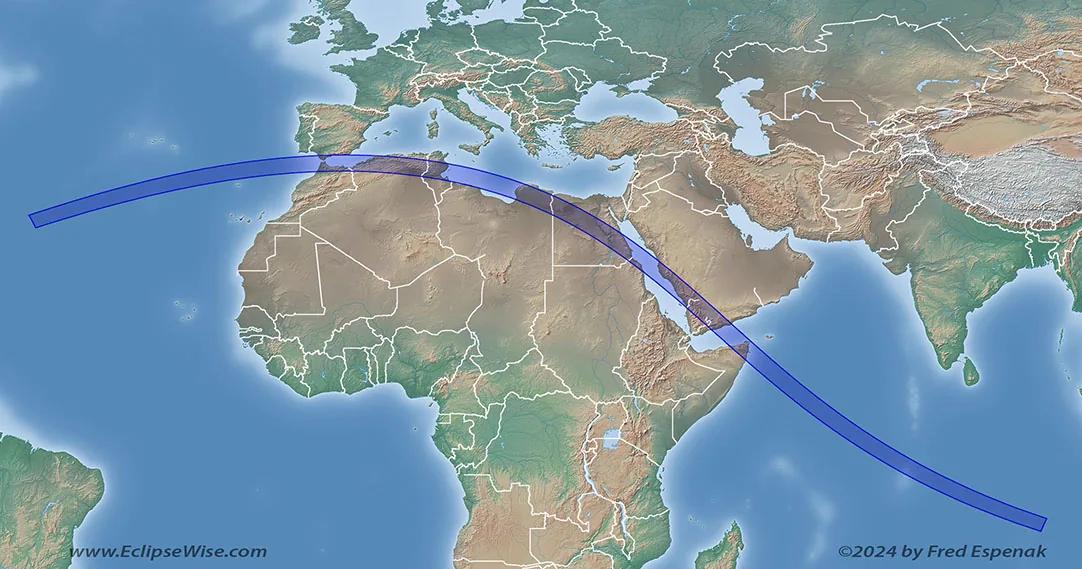
The eclipse is total on Monday, 2 August 2027. NASA identifies Saudi Arabia as one of the countries crossed by the path of totality, after the shadow travels through southern Spain and North Africa and crosses the Red Sea from Egypt.
Approximate city-level circumstances are:
| Location | Approximate totality | Approximate maximum time | Planning significance | |---|---:|---:|---| | Jeddah | About 5m 53s; some published coordinates give about 6m 01s–6m 02s | Around 1:22 p.m. AST | Long totality on the Red Sea side of the path | | Mecca | About 5m 10s | Around 1:23 p.m. AST | Clearly inside totality, but shorter than Jeddah | | Taif | About 2m 04s at an edgeward city coordinate; substantially longer elsewhere in the region | Around 1:26 p.m. AST | Exact coordinate is critical because the path boundary is nearby |
Arabia Standard Time is UTC+3, so the Jeddah maximum falls at roughly 10:22 UTC. Treat that as an orientation value rather than a second-by-second schedule. The precise start and end of totality depend on your coordinates, and future official tables should be checked before the event.
In Jeddah, the totally eclipsed Sun will be high in the afternoon sky—roughly 77° above the horizon, according to published city circumstances. Mecca’s Sun will be similarly high, around 76°. This is not a horizon-skimming eclipse: you will need an open view overhead and toward the western side of the sky, along with shade that does not obstruct that view.
These numbers answer the broad question, “What time is the solar eclipse in Jeddah?” Maximum eclipse is expected around 1:22 p.m. local time. They do not replace a coordinate-level schedule showing first contact, the start and end of totality, and final contact.

Why Jeddah gets longer totality than Mecca
A total solar eclipse is visible only inside the Moon’s umbra, the central shadow where the bright solar disk is completely covered. Outside that corridor, observers remain in the penumbra and see a partial eclipse—even if the Sun appears almost entirely covered.
Duration changes across the umbra. A site nearer the path’s center generally experiences a longer passage of the full shadow, while duration contracts toward either edge. The worldwide path on 2 August 2027 stretches approximately 15,227 kilometres (9,462 miles) and reaches about 258 kilometres (160 miles) wide, but those large dimensions do not make every point inside it equivalent.
Jeddah’s position is more favourable for duration than Mecca’s representative city coordinate. The difference between approximately 5m53s and 5m10s is about 43 seconds—long enough to matter during totality, when every stage seems to accelerate. Jeddah’s corona, darkened sky and visible horizon glow should persist noticeably longer before the first point of direct sunlight returns.
Mecca nevertheless receives a very long total eclipse. Five minutes is far beyond the brief totalities many observers have experienced elsewhere. The point is not that Mecca is a poor astronomical location; it is that “western Saudi Arabia” is too broad a label for deciding where a group should stand.
For the wider geometry and the journey of the shadow before it reaches Arabia, our 2 August 2027 total solar eclipse planning guide provides the continental context.
What the Jeddah–Mecca 2027 eclipse map must confirm
A useful Jeddah and Mecca solar eclipse 2027 map must do more than colour Saudi Arabia as total or partial. Zoom into the actual site and verify these details:
- The marker is inside the path of totality. Do not rely on a metropolitan label, accommodation address or regional description.
- The duration belongs to that marker. Moving across a large city or toward the mountains can alter totality by seconds or minutes.
- The path boundary is not uncomfortably close. An edge location offers a shorter total phase and less margin for a coordinate or routing mistake.
- Times use a clearly labelled zone. For Jeddah and Mecca, expect Arabia Standard Time, UTC+3, unless an authority explicitly states otherwise.
- The viewing direction is unobstructed. With the Sun very high, roofs, canopies and narrow courtyards can matter more than the distant horizon.
- The marker represents a lawful, accessible place. A geometrically excellent coordinate is useless if it is private, restricted, unsafe to stop at or inaccessible to your group.
The same method applies to any 2027 solar eclipse interactive map or path-of-totality map: inspect a coordinate, not merely the city name. Save screenshots or coordinates for a primary site and at least one backup, then recheck them as road controls and organised viewing arrangements become known.
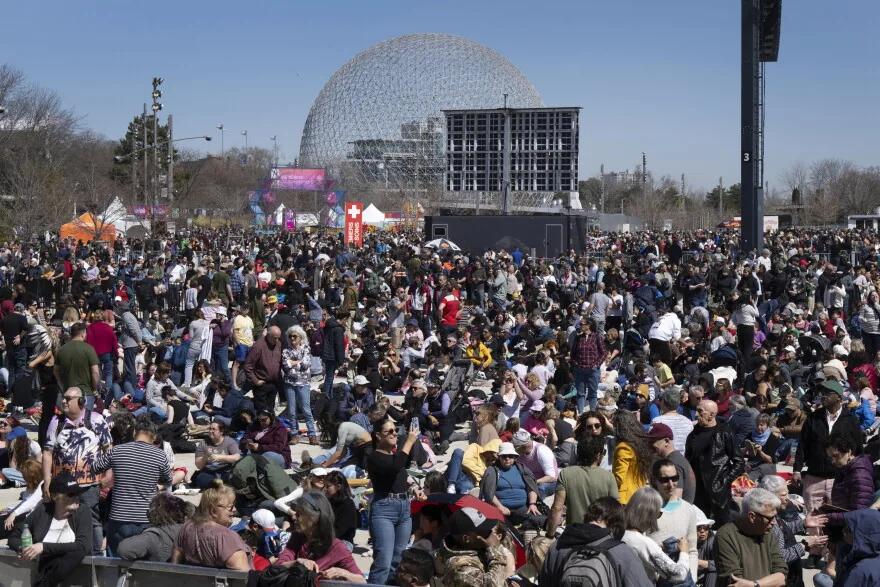
This distinction is especially important for families or school groups. Share the exact pin in advance, agree on where everyone will meet, and avoid a plan that depends on finding one another in mobile-phone congestion shortly before totality.
Taif shows how quickly duration can collapse near an edge
Taif is the clearest warning against treating a region-wide eclipse forecast as a city forecast. The city and surrounding highlands lie toward an edge of the path, where a modest change in latitude can produce a large change in duration.
A representative edgeward Taif coordinate may receive only about 2m04s of totality—less than half Mecca’s duration and roughly one-third of Jeddah’s. Yet published descriptions of the broader Taif region quote durations near 3m54s. Both values can describe real places if the coordinates are different.
That gap is not a technical footnote. It is the difference between a short totality and nearly four minutes in the lunar shadow. If Taif is your base, inspect the proposed viewing site on the solar eclipse 2027 path-of-totality map rather than assuming the city centre, airport, mountain overlook and surrounding plains share one prediction.
Highland elevation may offer a different local climate from the Red Sea plain, but elevation does not create totality. A cooler or clearer-looking site outside the umbra still gets only a partial eclipse. Astronomy sets the non-negotiable boundary; weather, comfort and access help you choose among sites that already satisfy it.
What totality will feel like over western Saudi Arabia
The partial phase develops slowly. Through a safe solar viewer, the Moon first takes a small bite from the Sun and then covers more of its bright face. The landscape remains surprisingly bright for much of that process because the exposed photosphere is intensely luminous.
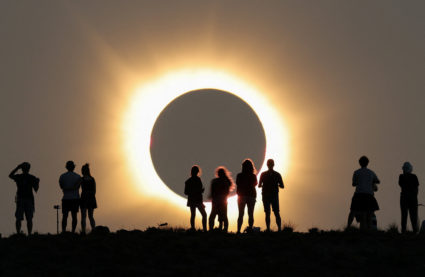
The final moments are different. Light drains rapidly, shadows sharpen and the surrounding horizon may retain a warm glow while the sky overhead darkens. When the last bright part of the photosphere disappears, the Sun’s corona becomes visible around the Moon’s black silhouette. Bright planets or stars may emerge, depending on sky transparency.
In Jeddah, that transformation can remain complete for nearly six minutes. Mecca loses roughly three-quarters of a minute by comparison, while an edgeward Taif site may have only about two minutes before sunlight returns. Those numbers turn an abstract map into a human schedule: enough time to look around, notice the horizon, listen to the crowd and still return your attention to the corona.
The global maximum reaches about 6m23s, with locations near Luxor in Egypt receiving around 6m19s to 6m20s. The Luxor solar eclipse of 2027 is therefore somewhat longer, but Jeddah is in the same exceptional duration class. You do not need to pretend every location is the centreline to appreciate how unusual nearly six minutes of totality will be.
Mecca access, Umrah and visa timing are logistics—not astronomy
The Moon’s shadow does not recognise municipal or religious boundaries, but travellers must. Only Muslims may enter Mecca, and visitors should follow current Saudi rules governing entry, visas, permits, transport and access to the holy city. An eclipse booking, tour or viewing plan does not create permission to enter a restricted area.
For Muslims considering Umrah around the eclipse, pilgrimage arrangements and eclipse geometry should be checked separately. Confirm the religious and administrative requirements through current official Saudi channels, then test any proposed accommodation or viewing coordinate against the path map. Do not assume that an Umrah itinerary automatically includes a suitable open viewing site at the required time.
Jeddah may be the more practical base for many eligible international visitors, but visa categories and entry conditions can change before August 2027. We cannot infer future access rules from the eclipse track. Flights, hotels, road closures, public events and heat plans belong on the logistics checklist; the umbra, duration and contact times belong on the astronomy checklist.
This separation prevents a common planning failure: choosing an itinerary first and discovering later that its eclipse location sits near an edge, has an obstructed overhead view or cannot be reached on the day.
Heat, haze and the value of a movable plan
The eclipse occurs in the early afternoon during August. Even with favourable regional cloud climatology, western Saudi Arabia can present serious heat, coastal humidity, haze or dust. Historical averages help compare regions, but they cannot promise a clear sky at 1:22 p.m. on one particular Monday.
Choose a site with safe vehicle access, drinking water, shade before and after totality, and an unobstructed solar view. Keep people out of parked vehicles, protect phones and cameras from overheating, and give children and older relatives somewhere cool to wait through the long partial phases.
A movable plan is useful only if the alternatives remain inside totality. Save two or three legal sites and record the duration at each one. On the morning of 2 August, compare reliable forecasts, dust observations and local instructions. Do not make a last-minute dash across unfamiliar roads merely to gain a few seconds.
Jeddah’s coastal conditions and Taif’s highland conditions may differ, but the map should come before the weather comparison. First establish which candidate points are safely inside the umbra; then choose the clearest and most practical of them.
Eye safety through every partial phase
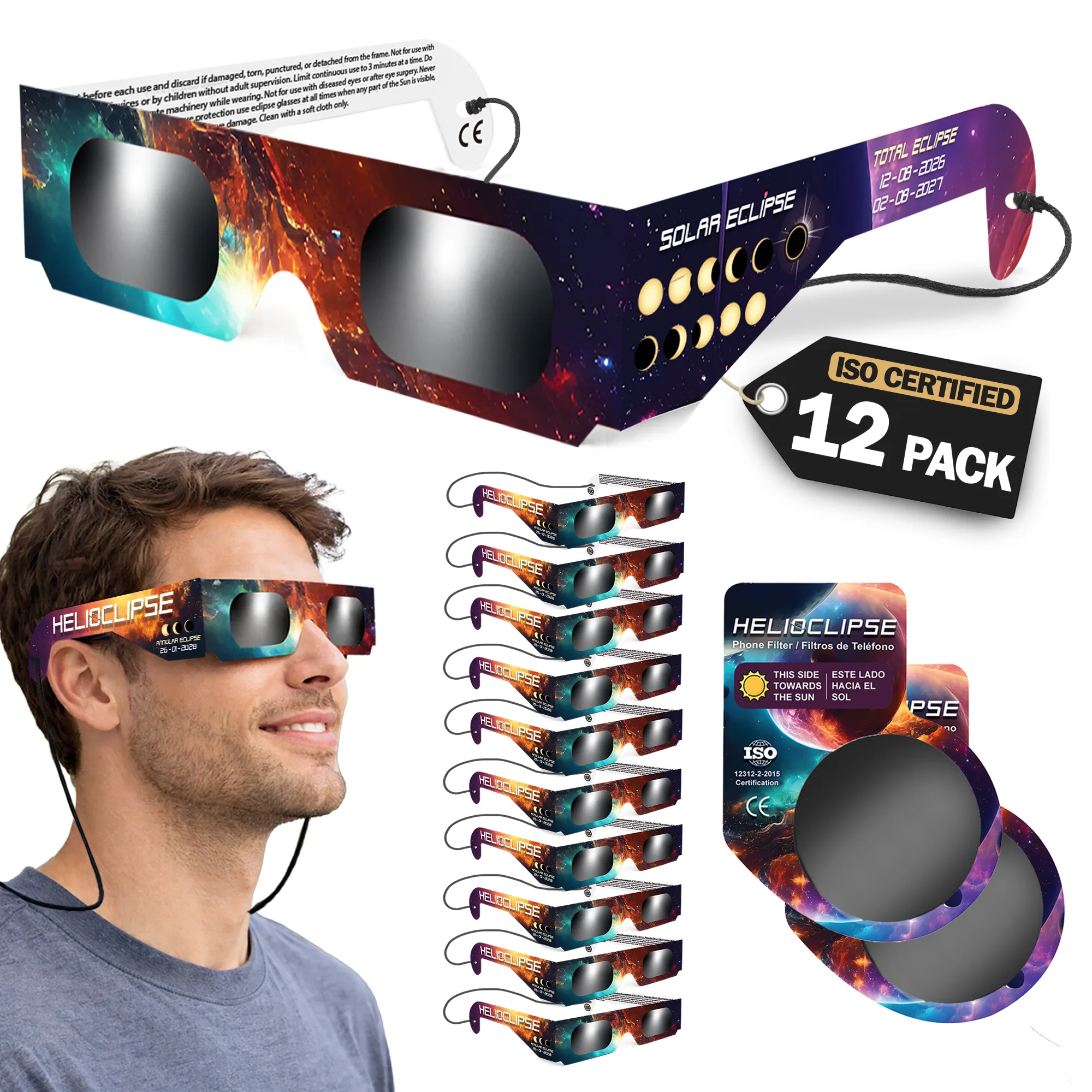
Certified solar viewers are required whenever any part of the Sun’s bright face remains visible. Ordinary sunglasses are not sufficient, no matter how dark they appear. Use special-purpose viewers conforming to ISO 12312-2, inspect each filter for tears, punctures or separation, and supervise children.
Inside the path of totality, you may remove your viewer only after the photosphere is completely covered and the scene has become dark. Replace it immediately when the first bright point of direct sunlight returns. If you are outside totality—even just beyond the path boundary—there is no glasses-off interval.
Our guide to when eclipse glasses stay on and when they come off walks through that sequence for first-time observers. Practise the routine with your family before eclipse day: viewer on before looking up, look away before taking it off, and never use eclipse glasses behind binoculars, a telescope or an unfiltered camera lens.
Marketplace wording can be confusing. Labels such as “approved solar eclipse glasses” or “solar eclipse glasses iso 12312-2 certified” are not, by themselves, proof that a product has been properly tested. There is also no general NASA product-approval programme for retail viewers. Verify the manufacturer, instructions, condition and credible conformity information rather than trusting a slogan.
If you are organising a large family, school or community group, arrange suitable ISO 12312-2 eclipse glasses early. Distribute and inspect them before 2 August instead of opening an unfamiliar shipment in the midday heat.
A practical plan for Jeddah, Mecca or Taif
Start with the people in your group. Decide who is travelling, whether anyone has mobility or heat-related needs, and whether access restrictions affect the proposed destination. Tell friends and relatives early: accommodation and transport are much easier to coordinate before eclipse interest peaks.
Next, build the plan around coordinates:
- Mark the exact primary viewing point in the Helioclipse map.
- Record totality duration and locally labelled times.
- Measure how comfortably the point sits inside the path boundary.
- Check that the Sun’s high western position will not be blocked.
- Save one or two lawful backup sites with their own predictions.
- Reconfirm visas, Mecca access rules, road arrangements and venue permission through official channels.
- Pack water, shade, charged devices and an ISO 12312-2 viewer for each observer.
Do a final astronomy check when authoritative local circumstances are published closer to the event. City-level estimates are excellent for comparing Jeddah, Mecca and Taif, but your day-of schedule should use the exact coordinate where you intend to stand.
Where to See the 2027 Total Solar Eclipse
Millions Books
Frequently asked questions
What upcoming solar eclipses are covered by this article?
The excerpt covers the total solar eclipse on Monday, 2 August 2027. It does not provide a list of the next five solar eclipses, so other events cannot be confirmed from this information.
Which location in Spain is best for viewing the 2027 total solar eclipse?
The excerpt states that the path of totality travels through southern Spain before crossing North Africa. It does not identify a specific Spanish city or viewing site as the best location.
Is there a solar eclipse on 21 September?
The excerpt does not mention an eclipse on 21 September. It only provides details for the total solar eclipse of 2 August 2027.
Can the article confirm a solar eclipse on 17 February 2026?
No. The excerpt contains no information about an eclipse on 17 February 2026, so it cannot confirm that date.
What route does the 2027 eclipse shadow follow before reaching western Saudi Arabia?
The path of totality travels through southern Spain and North Africa, then crosses the Red Sea from Egypt into Saudi Arabia. In western Saudi Arabia, it crosses the Jeddah–Mecca area, with the path boundary especially important to check near Taif.
On-site next steps
- Open the Helioclipse Eclipse Explorer, place a marker on your intended site and compare Jeddah, Mecca and Taif at coordinate level.
- Record the local start and end of totality—not only the time of maximum eclipse—and check the distance from the path edge.
- Once the site is confirmed, order Helioclipse solar eclipse glasses early enough to inspect and distribute them before 2 August 2027.
- Continue planning with our eclipse guides for safety, phases and the wider 2027 path.
Sources & further reading
- Where will the ‘eclipse of the century’ be visible on Aug. 2, 2027? — Space.com
- 10 incredible places to see the 2027 ‘eclipse of the century’ — beyond Luxor — Space.com
- Eclipse experts’ best travel tips for the total solar eclipse 2027 — Space.com
- Plan for Next Year’s Total Solar Eclipse: August 2, 2027 — Sky & Telescope
- Total Solar Eclipse of 2027 Aug 02 — EclipseWise
- Future Eclipses — NASA Science
- Eclipses and the Moon — NASA Science
- How to View a Solar Eclipse Safely — American Astronomical Society
- About the ISO 12312-2 Standard for Solar Viewers — American Astronomical Society
- Eclipse Basics — American Astronomical Society