2027 totality in Morocco: Tangier timing, Strait haze, and how to verify your pin
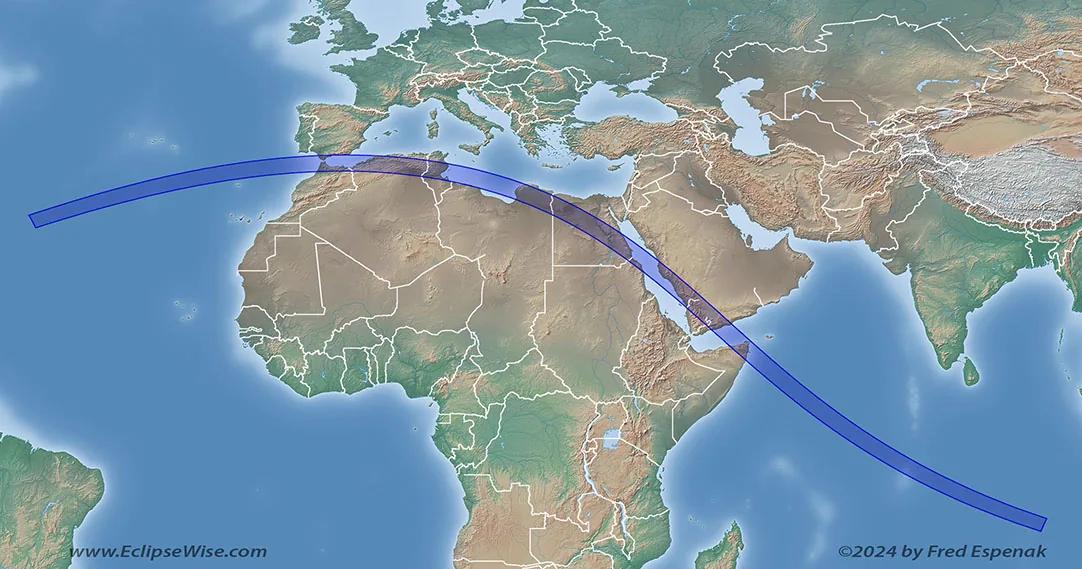
The 2027 total solar eclipse in Morocco puts Tangier in the Moon’s central shadow on the morning of 2 August 2027. At a representative city location, totality should begin around 09:44 WEST, or approximately 08:44 UTC, and last about 4 minutes 50 seconds. That is long enough for the Sun’s corona to emerge, the daylight to collapse and the horizon to take on the colours of a 360-degree sunset.
But “Tangier” is not a single observing point. A waterfront, hotel terrace, rural road and ferry terminal can have different coordinates, sight lines and local cloud exposure. Even the published duration varies by a second or two depending on the pin and calculation. Before booking around a headline figure, place your actual location on the Helioclipse Eclipse Explorer and confirm that it is inside the path of totality.
Tangier’s attraction is easy to understand: it combines nearly five minutes of darkness with a major city, ferry connections to Spain and a Sun roughly 37 degrees above the eastern horizon. Its principal uncertainty is also geographic. The Strait of Gibraltar can carry morning mist, marine haze or low stratus precisely when the eclipse is unfolding.

2027 total solar eclipse in Morocco: Tangier’s key numbers
For a representative pin in Tangier, current circumstances indicate:
- Date: Monday, 2 August 2027
- Approximate maximum totality: 09:44 WEST, subject to confirmation of the legal time zone in force in 2027
- Equivalent universal time: approximately 08:44 UTC
- Approximate duration: 4 minutes 49 seconds to 4 minutes 51 seconds, depending on the coordinates and ephemeris
- Sun altitude: about 37 degrees above the eastern sky
- Eclipse type: total inside the umbral path; partial outside it
Those figures make the Tangier solar eclipse of 2027 substantially more than a near miss. The Moon will completely cover the Sun’s bright photosphere, allowing the pearly corona to become visible without a solar viewer during totality alone. The partial phases on either side last much longer—roughly 80 minutes before and after totality—and require proper eye protection.
The distinction between a total and a 99-percent partial eclipse is not a technicality. Outside the path, even a very thin surviving arc of photosphere keeps the sky much brighter and makes unaided viewing unsafe. Inside the path, the final sliver disappears, the light drops sharply and totality begins. That is why the location of the 2027 total eclipse in Morocco matters down to the pin rather than merely the country or province.
Do not confuse this event with the solar eclipse of 12 August 2026. Morocco can see a partial phase in 2026, but the path of totality crosses elsewhere. Tangier’s opportunity for several minutes under the umbra is the 2 August 2027 eclipse.

Tangier versus Oujda: five minutes and one minute are different plans
The Morocco eclipse of 2027 does not give every city the same duration. Tangier lies well inside the path and slightly north of its central axis, producing almost 4 minutes 50 seconds of totality. Far to the east, Oujda sits much closer to the path’s southern edge. The research estimate for a representative Oujda location is only about 1 minute 7 seconds.
That is a difference of approximately 3 minutes 43 seconds. Tangier’s total phase is more than four times as long.
Oujda is still potentially inside totality, and one minute beneath the corona is a real total eclipse—not a lesser category of event. It is simply less forgiving. Near a path limit, a small coordinate error or move in the wrong direction can remove much of the duration and may eventually put an observer outside the umbra altogether. The Oujda estimate should therefore be treated as pin-dependent and verified against a location-specific ephemeris before travel.
This edge effect is useful for understanding the whole path. Totality lasts longest near the centre because the observer crosses a broader portion of the Moon’s umbral shadow. Near a limit, the observer clips only its outer part. Moving toward the central line can add tens of seconds or several minutes, while crossing the boundary converts the experience into a partial eclipse with no safe filter-free interval.
For families or school groups choosing between the two cities, duration is not the only consideration. Tangier has longer totality and extensive transport infrastructure, but it also faces the Strait’s coastal cloud risk. Oujda offers a more inland setting but much less time in totality. Check the weather and geometry separately; neither one can compensate for a failure in the other.
Why the Strait can look hazy on an August morning
Tangier sits between two bodies of water and two weather regimes. To the west, the cool Canary Current encourages moist air, fog and low marine cloud along Morocco’s Atlantic coast. Overnight cooling can also create shallow fog over low-lying land. Around sunrise, these layers may lift into stratus rather than vanish immediately.
Cape Spartel and the roughly 300-metre rise of the western Tangier Peninsula provide the city with some protection. Atlantic stratus often has more difficulty spreading into central and eastern Tangier than it does along the open coast near Asilah and Larache. The barrier is helpful, not absolute: low cloud can still curl around the peninsula or enter from the Strait.
Historical climate averages cannot tell us whether one beach will be clear at 09:44 on 2 August 2027. They identify the recurring hazard. Forecasts, satellite imagery and observations on the morning will decide whether the Sun is visible.
This is also why “haze” needs careful interpretation. A thin, milky layer may reduce contrast while leaving the Sun visible. Dense stratus can hide it completely. Dust can soften the sky without behaving like coastal fog. None of these conditions changes the eclipse geometry, but all can change what you see.
A practical Tangier plan therefore needs mobility. Central or eastern parts of the city, including areas around the Bay of Tangier, may fare better than the Atlantic-facing side of the peninsula. If a broad bank of coastal stratus is lingering, an inland alternative can be more valuable than a picturesque waterfront reservation. Roads, parking restrictions and eclipse traffic may limit last-minute movement, so choose the fallback before eclipse morning.
How to verify your Tangier eclipse pin
A 2027 total solar eclipse Morocco–Tangier map should answer more than “Is the city coloured in?” It should calculate the circumstances for the coordinates where you will actually stand. A hotel name, municipality label or dropped pin several kilometres away is not precise enough near a path boundary.
1. Drop the pin on the observing surface
Use the Helioclipse 3D eclipse map and zoom to the real location: the beach, terrace, field, school courtyard or public square. Confirm that the marker has not snapped to a road, city centre or similarly named property elsewhere.
Record the latitude and longitude separately. If you are joining an organised event, ask for its observing-site coordinates rather than relying on the hotel or meeting-point address.
2. Confirm that the result says total, not partial
The location must be inside the path of totality. Look for the calculated second and third contacts—the start and end of totality—and a non-zero totality duration. If the result gives only first contact, maximum eclipse and last contact, you may be outside the umbra.
For Tangier, a result near 4 minutes 50 seconds is plausible. A dramatically shorter result deserves investigation: the pin may be far from the intended site, close to a path limit or simply incorrect.
3. Separate UTC from local civil time
Tangier’s representative maximum is reported around 09:44 WEST, corresponding to roughly 08:44 UTC. Local clock rules can change, however, and Morocco’s civil-time arrangements deserve a fresh check close to the event.
Save the UTC contact times first. Then verify the official local conversion in 2027. This prevents a phone, calendar app or old webpage from silently applying the wrong daylight-saving rule.
4. Check the Sun’s direction and altitude
At about 37 degrees up in the east, the totally eclipsed Sun will not be grazing the horizon. It can still be blocked by a building, steep hillside, roof canopy or badly positioned balcony. A balcony described as having a “sea view” may face north or west rather than toward the morning Sun.
Visit the site at approximately the same clock time on an earlier morning, or use a reliable solar-position tool. From the exact standing point, identify whether the eastern sky is genuinely open.
5. Save an offline version
Take screenshots of the coordinates, contact sequence, UTC times and route to your backup site. Mobile networks can become congested when a large crowd gathers, and a saved plan is more useful than a map that will not load.
Ferry from Spain or stay in Morocco?
The Strait creates an unusual planning choice: Tarifa, Gibraltar and Tangier all experience totality, but not for the same length of time or under identical local conditions.
Representative figures put Tarifa near 4 minutes 39 seconds, Gibraltar around 4 minutes 25 seconds, and Tangier near 4 minutes 50 seconds. Tangier gains roughly 11 seconds over Tarifa and about 25 seconds over Gibraltar. Those are worthwhile differences, but not large enough to justify a risky same-morning border crossing if you are already securely positioned under clear skies.
Ferries connect Tarifa with Tangier and Algeciras with the Tanger Med port. Tanger Med is not central Tangier, so check the port pin rather than assuming the city’s circumstances apply exactly. Allow for transfers, immigration procedures, summer demand, schedule changes and possible wind-related disruption.
A ferry is a transport leg, not a weather escape plan unless you can move early. Totality reaches this region in midmorning—about 08:44–08:45 UTC—so attempting to inspect clouds on one shore and then cross the Strait is unlikely to be robust. If you base yourself in Spain but plan to observe in Morocco, cross at least a day ahead and confirm the return arrangements separately.
The comparison also shows how sharply duration changes farther from the central part of the path. Cádiz receives roughly 2 minutes 50 seconds, while Málaga is closer to 1 minute 50 seconds. Both are total, but Tangier offers around two to three additional minutes. Choose the shore using duration, forecast, transport resilience and the quality of your actual observing site—not the country name alone.
What totality will feel like in Tangier
The first partial phase is gradual. Through a proper viewer, you will see the Moon take a growing bite from the Sun. Shadows sharpen, gaps between leaves project tiny crescents and the daylight may acquire a strangely hard quality. For much of this period, an unprepared passer-by could fail to notice anything unusual.
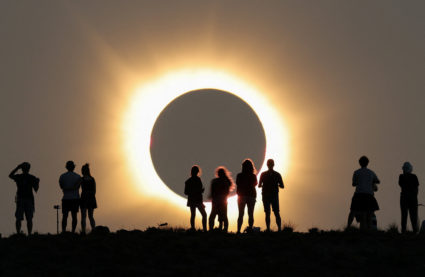
The final minutes are different. The remaining solar crescent narrows quickly, the surroundings dim and the temperature may fall. Bright points can appear briefly along the Moon’s rugged edge immediately before the photosphere disappears. Then totality arrives: the Sun becomes a black disc surrounded by the corona, bright planets or stars may emerge and the horizon can glow in every direction beyond the moving shadow.
Nearly five minutes is generous, but it will not feel long. Decide in advance whether you want photographs or simply the view. A first-time observer who spends totality troubleshooting a camera can miss the human scale of the event—the crowd’s reaction, the changing light and the corona’s shape.
Tell your family and friends early. Agree on the viewing site, backup location and safety cue before the morning becomes busy. Our broader 2 August 2027 planning guide can help you organise the phases, transport and shared responsibilities without turning the day into a military exercise.
Glasses on, glasses off—and back on immediately
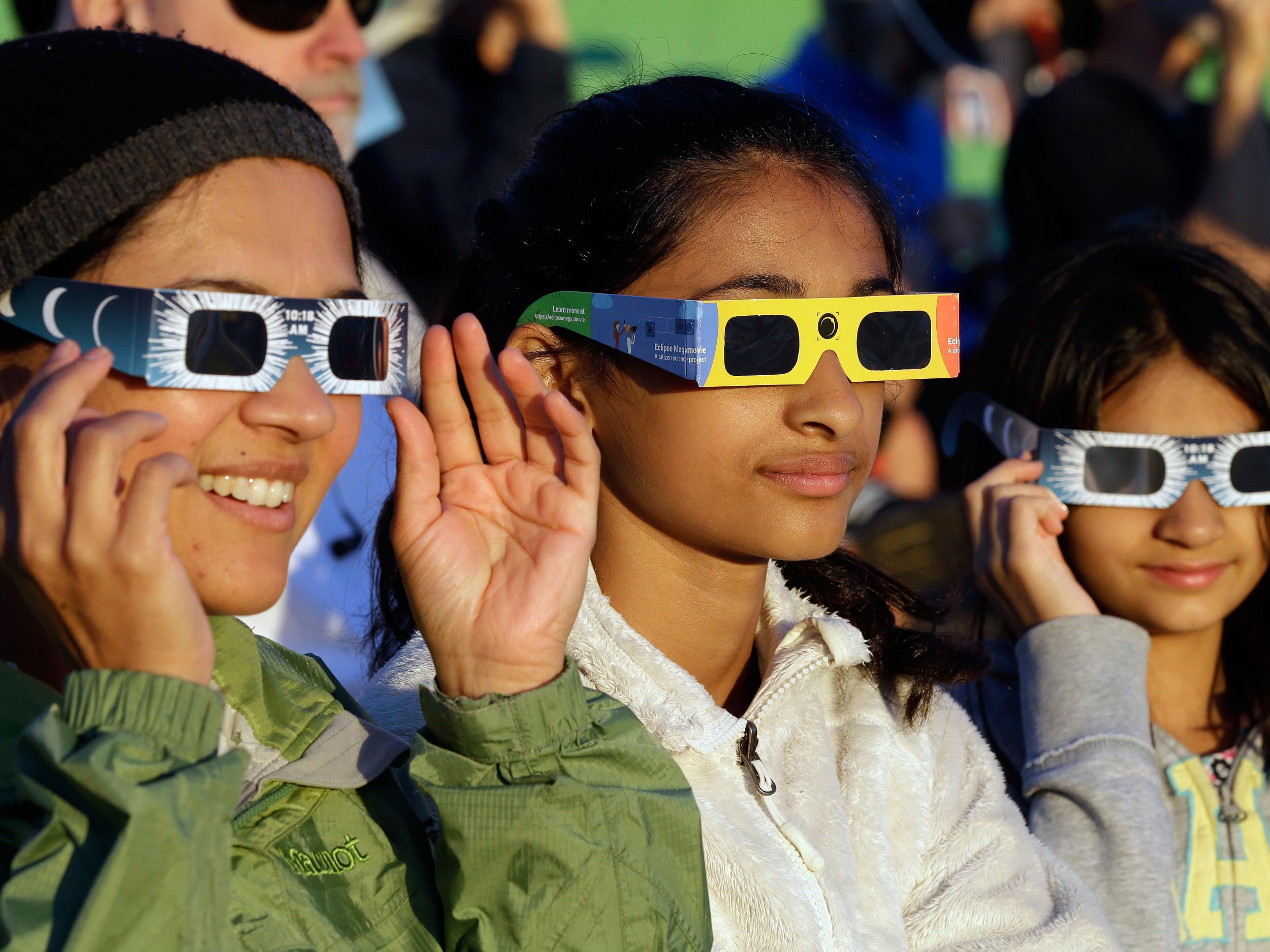
Use eclipse viewers throughout every partial phase. In Tangier, you may remove them only after the Moon has completely covered the Sun’s bright face and totality has begun. The moment any bright photosphere returns, put the viewers back on.
If your pin is outside the path—or if you are uncertain whether totality has begun—keep the viewers on. Partial eclipses never have a safe naked-eye interval, even at 99 percent coverage. Our phase-by-phase guide explains when eclipse glasses stay on and when they may come off.
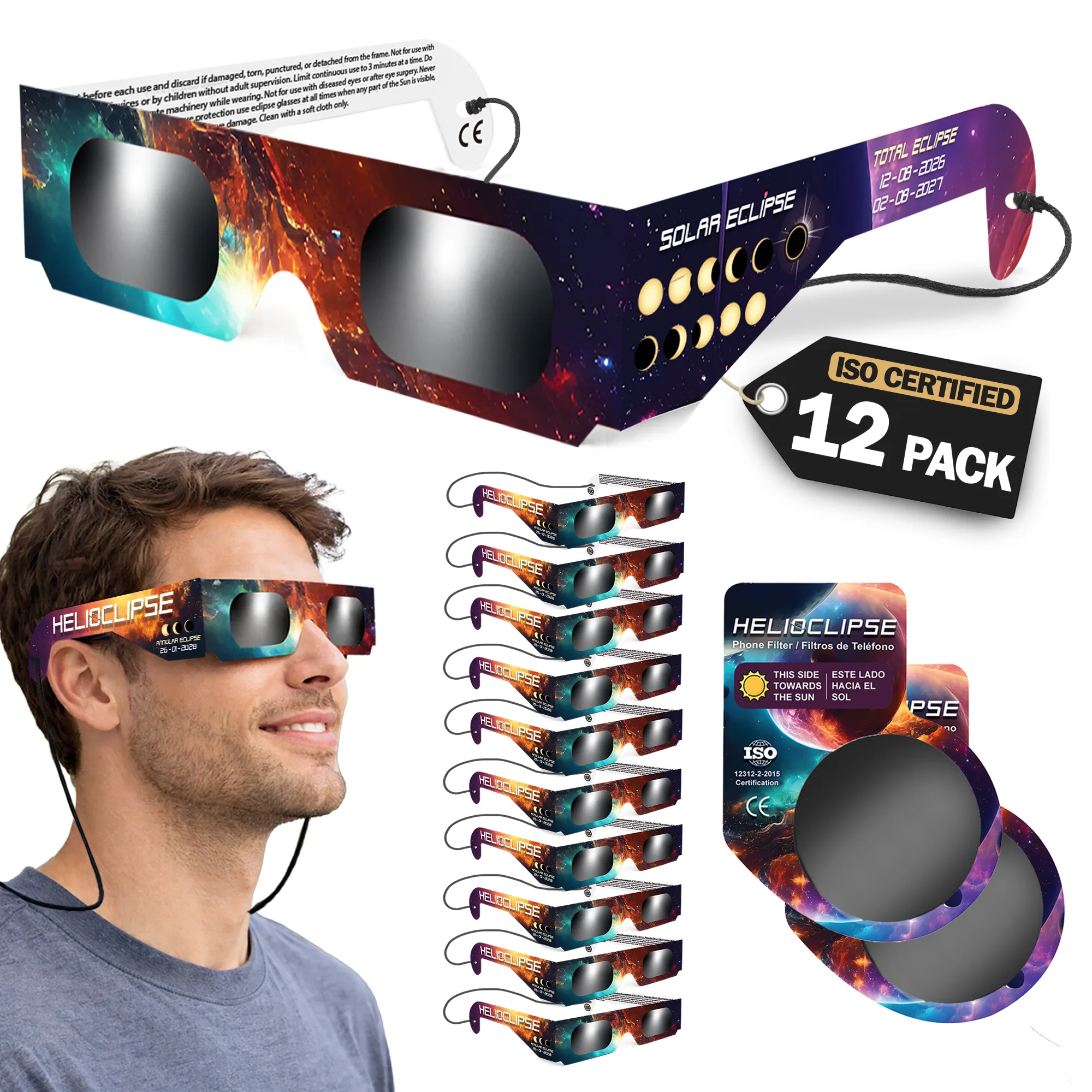
Ordinary sunglasses are not solar filters. Choose purpose-made viewers that conform to ISO 12312-2, inspect them for scratches, punctures, tears or loose filter material, and supervise children. Never look through binoculars, a telescope or a camera lens while wearing eclipse glasses; magnifying optics require a correctly fitted solar filter over the front aperture and expert setup.
Marketplace wording can be misleading. A listing may say eclipse glasses nasa approved, but NASA does not approve particular viewer brands. Phrases such as approved solar eclipse glasses or solar eclipse glasses iso 12312-2 certified do not replace traceable manufacturer information, correct instructions and credible conformity evidence. You can review our ISO 12312-2 eclipse glasses and order enough for your group well before August 2027.
A resilient plan for eclipse morning
Start with three locations: a preferred Tangier site, a nearby alternative with a clearer eastern view and an inland backup for marine cloud. Plot all three now. Check access hours, parking, toilets, shade and whether the space can safely hold your group.
In the final week, compare several reputable forecasts rather than reacting to one weather icon. In the final 24 hours, pay special attention to low-cloud forecasts, wind direction, coastal webcams and satellite imagery. A clear-sky percentage for an entire province cannot tell you whether a shallow bank of stratus is sitting over one bay.
Pack water, sun protection and a hat; the partial phases keep you outdoors well beyond totality. Bring your viewers in a rigid or protective envelope so they are not creased or punctured in transit. If children are attending, practise putting the viewers on while looking down, then looking up only after the filters cover both eyes.
Most importantly, set a decision deadline. An inland backup is useless if the group debates until traffic locks up. A slightly less scenic site beneath a clear sky beats a famous waterfront hidden by cloud.
The 2027 Solar Eclipse: 6 Minutes 23 Seconds of Darkness ...
Steppe to Stars
Frequently asked questions
Where should I watch the 2027 total solar eclipse in Morocco?
A location inside the path of totality is essential, and Tangier is within the Moon’s central shadow on 2 August 2027. Check your exact observing pin with an eclipse map before making plans, because duration and local sight lines can vary even within the city.
What should I look for in a guided trip for the 2027 eclipse in Tangier?
The excerpt does not evaluate or recommend guided trips. If you use one, confirm that its viewing location is inside the path of totality and consider whether it has a clear eastern view, since morning mist, marine haze, and low stratus can affect the Strait of Gibraltar.
Which 2027 Morocco eclipse travel packages are available?
The excerpt does not list travel packages or their availability. It advises verifying the exact location rather than relying on a city-level claim, because a waterfront, terrace, rural road, and ferry terminal may have different coordinates and cloud exposure.
Are organized eclipse-viewing trips confirmed in Morocco for 2027?
The excerpt does not confirm any organized trips in Morocco. It does confirm that Tangier is in the totality path on the morning of 2 August 2027, with representative totality lasting about 4 minutes 50 seconds.
Will Tangier see totality during the 2027 solar eclipse?
Yes. Tangier lies in the Moon’s central shadow on 2 August 2027, with totality beginning around 09:44 WEST at a representative city location, subject to confirmation of the legal time zone in force. Your precise pin still matters: outside the umbral path, the eclipse will be partial rather than total.
On-site next steps
- Open the Helioclipse Eclipse Explorer, place the marker on your exact Tangier or Oujda observing site, and save the coordinates, UTC contacts and duration.
- Compare your preferred pin with an eastern or inland backup, paying attention to the path boundary, Sun direction and road access.
- Read the 2027 eclipse phases and viewer guide with everyone in your group.
- Order ISO 12312-2 eclipse viewers from Helioclipse early enough to inspect and distribute them before travel.
Sources & further reading
- Total Solar Eclipse 2027 August 2 — Eclipsophile
- Total Solar Eclipse Map — August 2, 2027 — National Solar Observatory
- 16 best places to see the “eclipse of the century” total solar eclipse 2027 — Space.com
- Eclipse experts’ best travel tips for the total solar eclipse 2027 — Space.com
- Where will the “eclipse of the century” be visible on Aug. 2, 2027? — Space.com
- Eclipses and the Moon — NASA Science
- Future Eclipses — NASA Science
- Eclipse Viewing Safety — NASA Science
- How to View a Solar Eclipse Safely — American Astronomical Society
- About the ISO 12312-2 Standard for Solar Viewers — American Astronomical Society