Your first total solar eclipse: a calm primer for 2 August 2027
A total solar eclipse does not begin with sudden darkness. It begins quietly: a small black curve appears at the edge of the Sun, the light remains deceptively normal, and people wonder whether the main event has somehow been oversold. Then the final minutes arrive. Shadows sharpen, the landscape takes on an unfamiliar colour, and the Moon closes the last bright gap. Daylight falls away in seconds.
On 2 August 2027, that sequence will unfold across southern Spain, North Africa and parts of the Middle East. Near Luxor in Egypt, totality will last roughly 6 minutes 19 seconds, with the Sun about 82° above the horizon. Near Tarifa in southern Spain, the completely covered Sun will remain visible for about 4 minutes 39 seconds. Much of the rest of Europe will see a partial eclipse instead—not a weaker version of totality, but a fundamentally different experience.
This first total solar eclipse 2027 primer is designed to keep the planning calm. Start by checking your exact location in our Eclipse Explorer and 3D map. The boundary of totality is precise, so a region name, hotel advertisement or tour description is never enough on its own.
The date is simple; the shadow is not
Write down your first total solar eclipse date now: Monday, 2 August 2027. NASA lists it as a total solar eclipse visible from parts of southern Spain, Morocco, Algeria, Tunisia, Libya, Egypt, Saudi Arabia and Yemen, with the central shadow continuing across other parts of northeastern Africa and the Indian Ocean. A far larger surrounding area—including most of Europe and much of Africa—will receive only the Moon’s outer shadow and therefore see a partial eclipse.
Although people sometimes group all 2027 total solar eclipses together, there is only one total solar eclipse that year. The event on 6 February 2027 is annular: the Moon will appear too small to hide the whole solar disk, leaving a bright ring. In a family planning calendar headed future total solar eclipses 2027, that distinction belongs at the top: February is annular; August is total, but only inside its narrow central path.
The 2027 solar eclipse path stretches for roughly 15,227 kilometres (9,462 miles) across Earth, while the central shadow reaches about 258 kilometres (160 miles) wide at its broadest. That sounds generous until you compare it with the enormous partial-eclipse zone. Being in a country touched by the eclipse does not guarantee totality, and being in a city close to the path is not good enough.
This is the central rule of your solar eclipse plan: verify the coordinates of the place where you will actually stand.
Totality and 99% partial are different worlds
The geometry is straightforward. The Moon casts a dark inner shadow, the umbra, and a much larger, lighter outer shadow, the penumbra. Inside the umbra, the Moon completely covers the Sun’s bright face. Inside the penumbra, some part of that face remains visible.
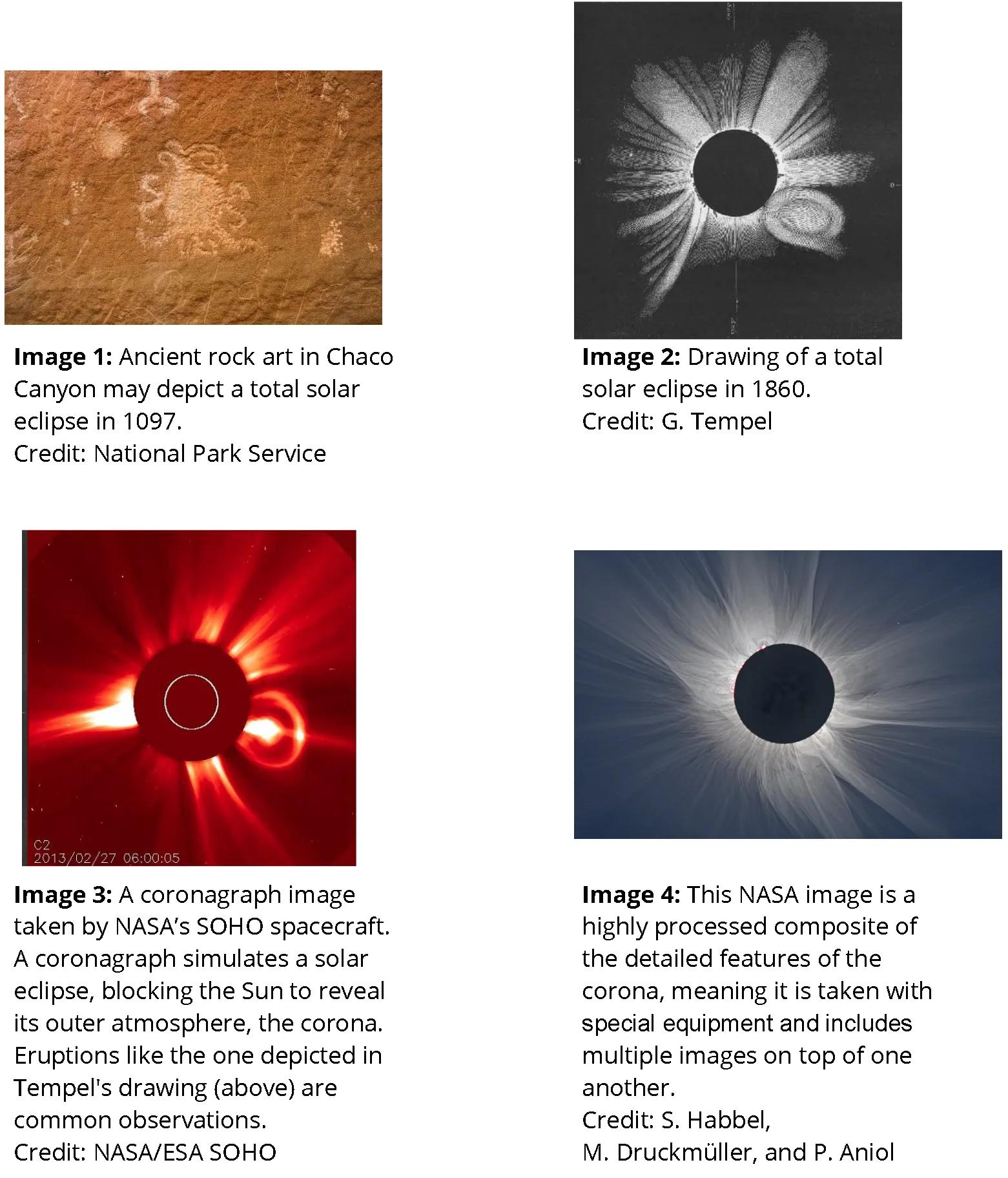
That final uncovered sliver matters enormously. Even at 99% partial coverage, direct sunlight remains intense, the corona stays hidden, and certified solar viewers must remain over your eyes whenever you look at the Sun. Only within the umbra does the bright solar surface disappear completely, revealing the pearly corona around a black lunar silhouette.
The dividing line is not gradual. A site just inside the path may receive a brief totality; a site just outside receives none. For a deeper walkthrough of that sequence, see our guide to when glasses stay on and when they may come off.
This distinction is especially important for European observers. Southern locations such as Tarifa, Gibraltar, Cádiz and Málaga are inside the path. Madrid, Paris, London, Berlin and most other European cities are outside it and will see a partial eclipse. Cairo is also outside the path despite its association with Egypt: the city will see roughly a 94–95% partial eclipse, while Luxor lies near the centre of the totality track.
A very deep partial eclipse can be beautiful. Tree leaves project hundreds of tiny crescents, the light may become strange, and the temperature can fall. But it does not produce the black Sun, naked-eye corona or abrupt onset of darkness that defines totality.

Where a first-timer can experience totality
You do not need to chase the absolute maximum duration. You need a confirmed site inside the path, a realistic prospect of clear sky and logistics that still work when roads, hotels and public spaces are busy.
Southern Spain and the Strait of Gibraltar
In southern Spain, totality occurs in the mid-morning, with the Sun approximately 37° to 39° above the eastern horizon. Published estimates put totality at about 1 minute 52 seconds in Málaga, 2 minutes 51 seconds in Cádiz, 4 minutes 25 seconds in Gibraltar and 4 minutes 39 seconds in Tarifa. Exact values vary slightly with the chosen coordinates and prediction source, so check the map for your actual beach, field or event venue.
Those numbers show why “Andalusia” is not a sufficiently precise plan. Seville, Córdoba and Granada sit outside the totality path, while the far south of Cádiz and Málaga provinces lies inside. Even within the path, driving west from Málaga toward Tarifa can add well over two minutes of totality.
Coastal weather is the trade-off. August is generally dry, but morning marine cloud, fog and Gibraltar’s local cap cloud can matter. An inland site with three clear minutes may be a better choice than a coastal site promising nearly five minutes beneath cloud.
Morocco, Algeria, Tunisia and Libya
Across the Strait, Tangier is expected to receive about 4 minutes 50 seconds of totality. Farther east, estimates rise to about 5 minutes 6 seconds in Oran and 5 minutes 41 seconds in Sfax. Benghazi lies close to the centreline and may receive just over six minutes.
These locations are not interchangeable. Coastal cloud and fog are a consideration around the Strait of Gibraltar, while heat, dust, transport capacity and current travel guidance become increasingly important along the North African track. Historical climate can help you compare regions, but it cannot promise clear sky on one particular Monday.
Egypt and the Arabian Peninsula
Egypt contains some of the longest land-based totality. Siwa Oasis is expected to receive roughly 5 minutes 32 seconds. Sohag approaches 6 minutes 22 seconds, while Luxor receives about 6 minutes 19 seconds shortly after 1 p.m. local summer time. Near the point of greatest eclipse southeast of Luxor, the maximum reaches approximately 6 minutes 23 seconds.
The 2027 total solar eclipse duration is exceptional, but the conditions demand respect. Around Luxor, the Sun will be nearly overhead and afternoon temperatures can be extreme. Shade, drinking water, sun protection and a site with suitable toilets and transport are not optional comforts. They are central parts of the observing plan.
The shadow then crosses the Red Sea. Jeddah is expected to receive about six minutes, while Mecca receives a little over five minutes. Access rules, local law, current travel advice and eligibility to enter particular places must be checked independently and well in advance.

What the sky will actually do
The partial phase starts without drama. Through a proper solar viewer, you will see the Moon take a small bite from the Sun. Over roughly the next hour, that bite grows. You do not need to stare continuously; look every few minutes and the motion becomes obvious.
As totality approaches, the experience accelerates. The remaining solar crescent becomes thin enough to cast unusually sharp shadows. Gaps between leaves act as pinhole projectors, scattering crescent Suns across walls and pavements. The air may cool, and animals may react to the fading light. In the last minute, the western sky can darken as the Moon’s shadow rushes toward you.
Keep your viewers on. Bright points may appear where sunlight passes through valleys along the Moon’s edge, followed by the concentrated gleam called the diamond-ring effect. These are still direct sunlight.
Only when the last bright part of the Sun disappears—and you can see nothing through your eclipse viewers—has totality begun. For unaided viewing, you may then remove the viewers. The corona appears as a pale, structured atmosphere around the Moon. Pink prominences may be visible at the edge, bright planets may emerge, and the horizon can glow in every direction because locations beyond the umbra remain sunlit.
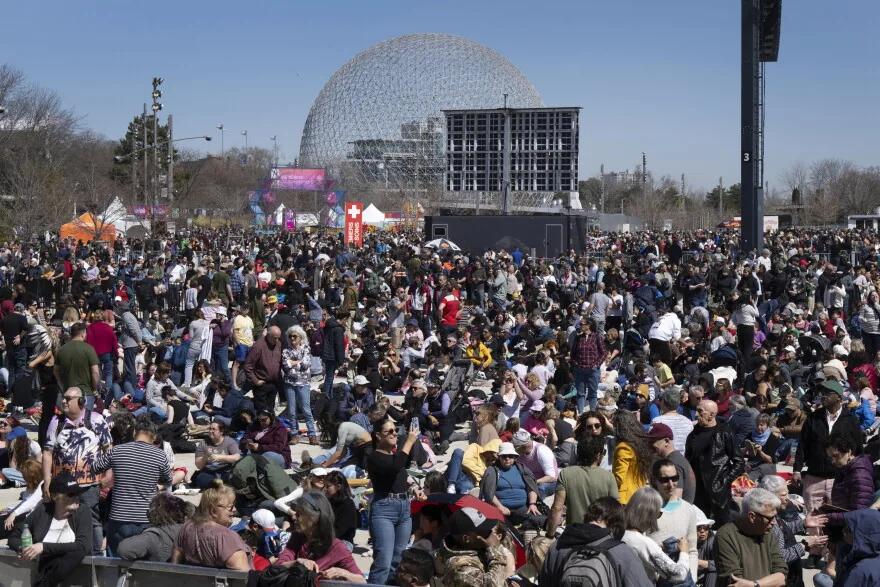
Totality can feel simultaneously spacious and very short. Even six minutes passes quickly when a group is reacting, children are asking questions and someone is trying to operate a camera. Decide beforehand what matters most. If this is your first eclipse, give yourself permission simply to look.
The instant a bright point of direct sunlight returns, put your viewers back on. The second partial phase then continues for roughly another hour.
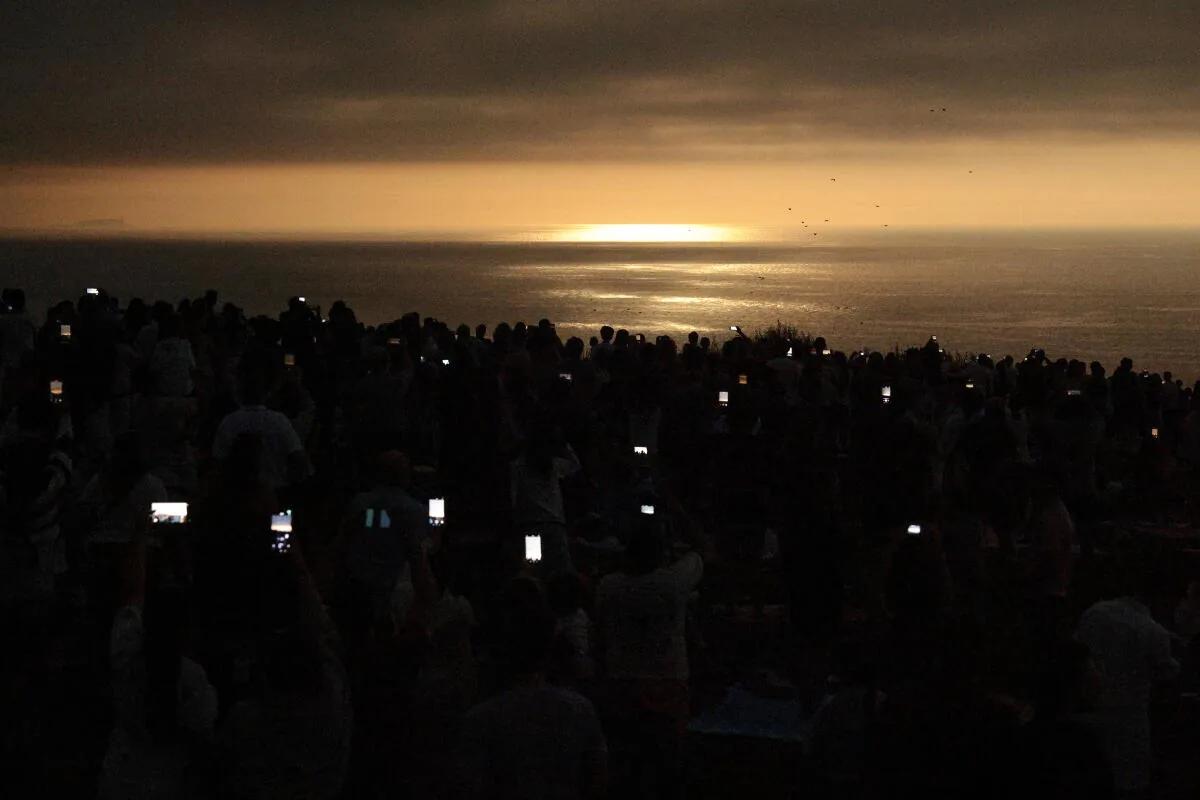
The calm safety rule: filters on, totality only off
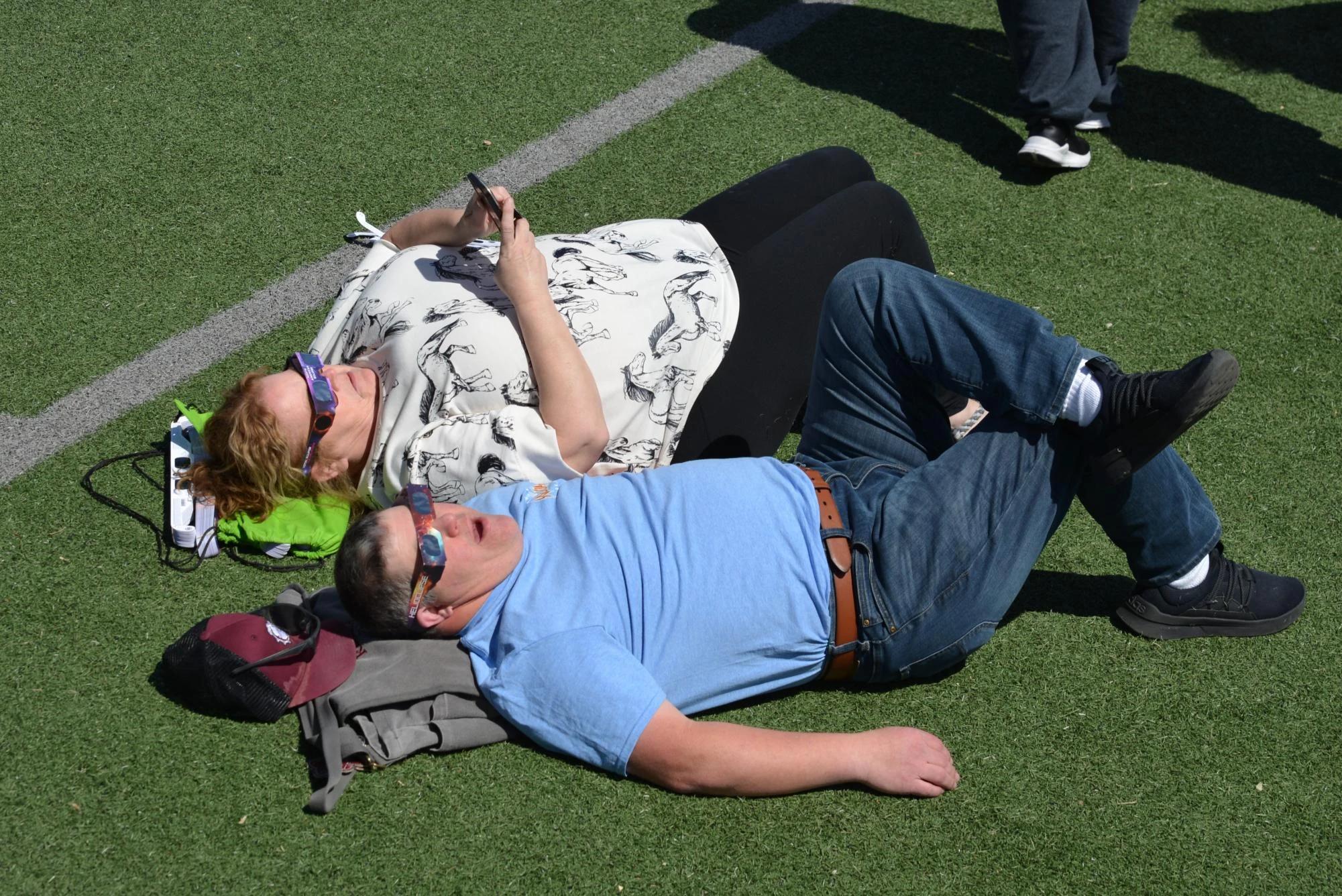
During every partial phase, use a purpose-made solar viewer that conforms to ISO 12312-2. Ordinary sunglasses are not safe, no matter how dark they appear. Inspect every viewer before the event and discard it if the filter is scratched, punctured, torn or separating from its frame. Supervise children, and have them put their viewers on before looking up.
The exception is narrow and easy to state: if—and only if—you are inside the path of totality, you may view the fully eclipsed Sun without a filter while the Sun’s bright face is completely covered. Outside the path, there is no glasses-off moment. Our detailed ISO 12312-2 guide explains what the standard covers and why a printed claim should be considered alongside the identity and trustworthiness of the supplier.
Never look through binoculars, a telescope or a camera lens while wearing eclipse glasses. Magnifying optics concentrate sunlight and require a suitable solar filter secured over the front aperture of the instrument. If you have not practised with correctly filtered equipment and obtained expert guidance, leave magnified viewing to an organised observatory or astronomy group.
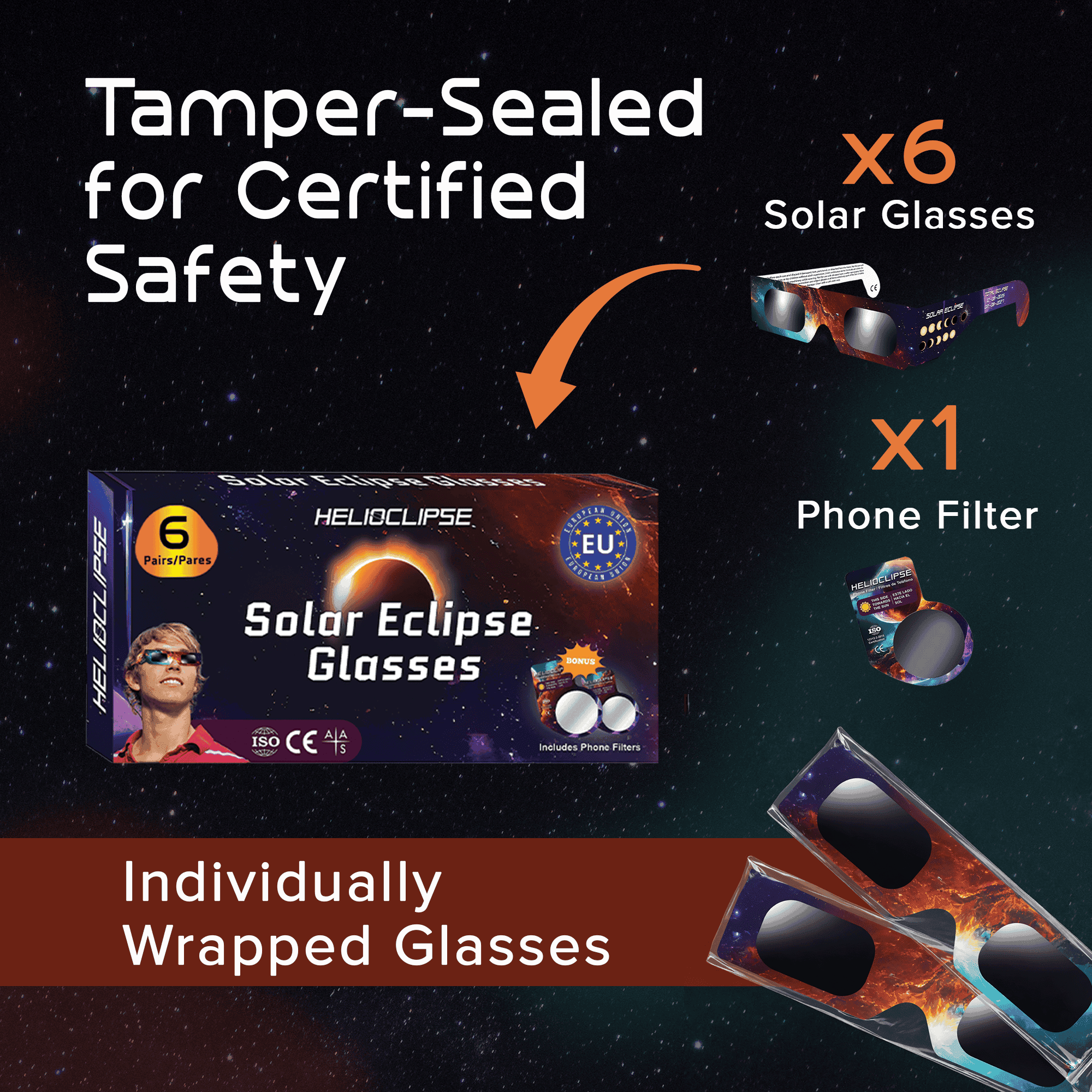
Product wording deserves similar care. Marketplace labels such as approved solar eclipse glasses or eclipse viewing glasses do not identify who supposedly granted approval, and NASA explicitly says that it does not approve particular viewer brands. Look instead for traceable sourcing, intact filters, clear instructions and a credible basis for a claim that the product is among certified solar eclipse glasses conforming to ISO 12312-2.
A first-eclipse checklist that leaves room to breathe
A shared note labelled first total solar eclipse 2027 primer 2027 guide may not be elegant, but keeping one plan visible to the whole group prevents assumptions from becoming expensive mistakes.
Several months before
- Confirm that the exact observing site is inside the path—not merely the destination city.
- Tell friends, relatives or your school group early. Agree on the budget, accessibility needs and tolerance for heat.
- Reserve flexible accommodation where possible, especially around southern Spain, Luxor and other heavily promoted destinations.
- Obtain enough ISO 12312-2 solar eclipse glasses for the group, plus spares for damaged or misplaced pairs.
- Check passports, entry rules, insurance, local law and official travel advice.
- Choose a location you would still value if cloud hides the eclipse.
In the final week
- Compare several reputable forecasts rather than trusting one weather icon.
- Identify one or two reachable alternatives, but do not plan a reckless long-distance chase on congested roads.
- Confirm the site’s opening time, parking, toilets, water, shade and accessibility.
- Download maps, tickets and contact details for offline use.
- Inspect every solar viewer in good light.
- Practise the spoken cue: “Glasses on until totality; glasses back on at the first returning sunlight.”
On eclipse morning
- Arrive before the partial phase begins.
- Bring more drinking water than you expect to need, especially in North Africa and the Middle East.
- Pack hats, sunscreen, light protective clothing, medication, snacks and a simple first-aid kit.
- Put phones on low-power mode; mobile networks may become congested.
- Keep the viewers in a rigid envelope or case until needed.
- Agree on a meeting point in case the group becomes separated.
- Spend less time troubleshooting cameras and more time noticing the changing light.
Tours, cruises and packages: verify the coordinates first
A solar eclipse 2027 cruise can offer mobility, open horizons and organised logistics, but the itinerary must state where the vessel intends to be during totality. Ask for the planned coordinates, expected duration, time-zone convention and contingency procedure. A cruise near the path is not necessarily a cruise inside it, and weather-related route changes may affect the plan.
Apply the same discipline to eclipse 2027 tours. Establish whether the price includes transport to a dedicated observing site, drinking water, shade, certified viewers, an experienced eclipse leader and a backup location. Check cancellation terms and ask who controls the final observing-site decision.
Do not choose a package solely by its advertised seconds of darkness. Four clear minutes at a well-run site can be far more rewarding than six theoretical minutes complicated by cloud, unsafe heat exposure or transport failure. If two options are both comfortably inside the path, weather prospects and practical resilience usually matter more than squeezing out one additional minute.
A little history helps—but local claims need context
Claims built around “first total solar eclipse since” are incomplete unless they name a location. Total eclipses occur somewhere on Earth every year or two on average, but any one city may wait centuries for the umbra to return. The event of 2 August 2027 is not humanity’s first total eclipse, nor the first of the century; it is remarkable because of its long duration, broad path and accessible landfall across several regions.
For many U.S. families, “first solar eclipse 2017” is shorthand in an old photo album for the total eclipse of 21 August 2017. That was a first personal experience, not the first solar eclipse in history. Likewise, there is no universally agreed first predicted total eclipse: ancient records contain eclipse observations and forecasts of varying precision, while reliable modern predictions emerged gradually from better astronomy and mathematical models.
Eclipses also do not occur “once every 300 years” as a universal rule. Similar alignments recur through cycles such as the Saros, but each event’s shadow falls on a different part of Earth. Long waits apply to particular places, not to the planet as a whole.
That is why your own location matters more than a headline. A first eclipse becomes memorable through a very specific combination of coordinates, weather, people and preparation.
You do not need a perfect eclipse to have a profound one
There will be pressure to optimise everything: the longest possible totality, the driest climate, the most famous setting, the sharpest photograph. Resist the idea that only one place can deliver the real experience.
Tarifa’s roughly four minutes and 39 seconds, Sfax’s five minutes and 41 seconds, and Luxor’s six minutes and 19 seconds all describe genuine totality. Even Málaga’s roughly two minutes contains the essential transformation: the last sunlight disappears, the corona emerges, and day briefly becomes something else.
Make the plan robust rather than perfect. Bring people you care about. Explain the glasses rule before the sky becomes distracting. Order viewers early instead of relying on whatever remains at the last moment. Then, during totality, look up rather than down at a timer.
The 6-Minute Solar Eclipse Is Coming in 2027
SciQuest
Frequently asked questions
Where can I experience totality during the 2 August 2027 solar eclipse?
Totality will be visible along a narrow path crossing southern Spain, North Africa and parts of the Middle East. NASA lists parts of southern Spain, Morocco, Algeria, Tunisia, Libya, Egypt, Saudi Arabia and Yemen; verify the exact coordinates of where you will stand, because being nearby is not enough.
Does this guide explain when the first solar eclipse in history occurred?
No. The excerpt does not provide a date or history of the first solar eclipse ever observed. It focuses on planning for the total solar eclipse on Monday, 2 August 2027.
Is there an eclipse in this article that occurs every 300 years?
No. The excerpt does not state that any eclipse repeats every 300 years. It describes one total solar eclipse in 2027, on 2 August, and an annular eclipse on 6 February 2027.
What is the most important planning advice for a first total eclipse in 2027?
Check the exact location where you will be standing against the path of totality. The central shadow is precise, and a country name, nearby city, hotel advertisement or tour description does not guarantee that you will be inside the umbra.
What should a beginner understand about the 2027 total-eclipse path?
Totality is only available inside the Moon's narrow inner shadow, while much of Europe and Africa will see a partial eclipse instead. The path extends roughly 15,227 kilometres, but reaches about 258 kilometres wide at its broadest, so confirm your coordinates rather than relying on a general regional description.
On-site next steps
- Open the Helioclipse Eclipse Explorer and check whether your exact coordinates fall inside or outside totality. Note the local partial-phase times, totality duration and Sun altitude shown for your site.
- Compare at least two possible observing locations, including weather flexibility, transport, heat, accessibility and distance from the path edge.
- Once the group size is settled, order Helioclipse solar eclipse glasses early enough to inspect them and practise the viewing routine together.
- Keep learning through our 2027 planning guide and broader eclipse blog.
Sources & further reading
- Future Eclipses — NASA Science
- Where will the “eclipse of the century” be visible on Aug. 2, 2027? — Space.com
- 8 things you need to know before booking the 2027 “eclipse of the century” — Space.com
- Eclipse experts’ best travel tips for the total solar eclipse 2027 — Space.com
- 10 best places to see the 2027 total solar eclipse in Spain — Space.com
- How to View a Solar Eclipse Safely — American Astronomical Society
- About the ISO 12312-2 Standard for Solar Viewers — American Astronomical Society
- Eclipse Viewing Safety — NASA Science
- What to Expect: A Solar Eclipse Guide — NASA Science
- Why Do Eclipses Happen? — NASA Science