Ordering viewers for a school or team: quantities, verification, and 2027 distribution
Ordering eclipse viewers for 30 colleagues is straightforward. Ordering for 600 pupils, several campuses, a sports club, or a public event is an operations project: the quantity must survive late registrations and damaged units, the product must be traceable, and every participant must receive clear instructions before anyone looks toward the Sun.
That is the real challenge behind buying bulk eclipse glasses for schools in 2027. The goal is not merely to have a box arrive. It is to place a verified viewer in each person’s hands, at the correct location, before the partial phase begins on 2 August 2027.
Start by checking every participating site in our Eclipse Explorer. The eclipse is total only inside a narrow path through southern Spain, North Africa and parts of the Middle East. Most of Europe and a much wider surrounding region will see a partial eclipse, where certified solar viewers remain necessary throughout the event.
Bulk eclipse glasses for schools in 2027: begin with the event plan
A quantity spreadsheet is useful only after you define who will actually attend. Separate the audience into groups: pupils or team members, teachers and supervisors, support staff, invited families, volunteers, photographers, and visitors. If several sites are involved, calculate each site independently rather than treating the order as one undifferentiated total.
Location changes the safety briefing too. On 2 August 2027, totality reaches only the path of the Moon’s central shadow. Published circumstances illustrate how sharply the experience varies even between places that appear close on a regional map: Málaga receives about 1 minute 52 seconds of totality, Cádiz about 2 minutes 51 seconds, and Tarifa roughly 4 minutes 39 seconds. Near Luxor, Egypt, totality lasts approximately 6 minutes 19 seconds, with the maximum eclipse occurring around 1:02 p.m. EEST and the Sun about 82 degrees above the horizon.
Outside that path there is no glasses-off interval. Cairo, for example, is outside totality with roughly a 94–95% partial eclipse, while Algiers is reported at about 99.7% partial. Those percentages may sound close to total, but even a thin uncovered portion of the Sun’s photosphere is intensely bright. Everyone looking directly at it still needs a suitable solar viewer.
Use the map to record the local phase type and event times for every campus or venue. Your run sheet should include first contact, maximum eclipse, the end of the partial phase, and—only for a site securely inside the path—second and third contact marking the beginning and end of totality. Do not copy the clock time from another city; eclipse circumstances change with location.
For a broader introduction to the event, share our 2 August 2027 eclipse planning guide with the organizing team.
Quantity math: count people, not enrolment places
Begin with the best available attendance estimate, then add viewers for people and problems that administrative headcounts often miss. A practical calculation is:
Order quantity = confirmed participants + expected guests and staff + accessibility or fit alternatives + contingency stock
For a closed school activity, a contingency allowance of around 10% is a reasonable planning baseline. Raise it toward 15% when attendance is fluid, families may join, distribution will occur across several buildings, or replacements cannot be moved quickly between sites. This is an operational recommendation rather than a requirement of ISO 12312-2.
Consider a school expecting:
- 540 pupils
- 48 teachers and classroom assistants
- 22 operational, catering, reception, and safeguarding staff
- 30 invited guests and volunteers
That produces a working attendance of 640. A 10% buffer adds 64 viewers, giving an order quantity of 704. If the product is supplied in fixed pack or case sizes, round upward—not downward—to the next complete pack.
Do not quietly assume that teachers will share one viewer between several young children unless that is an intentional, supervised activity design. The American Astronomical Society notes that viewers can be shared because the partial phases progress slowly, but one viewer per participant usually makes a large school event easier to control. It reduces queues, passing between classes, and the temptation to look up while waiting.
Sharing can make sense at a staffed observation station where participants take brief turns. It is less suitable for an entire playground responding to the same countdown. The best choice depends on supervision, age, mobility, and whether everyone is expected to observe simultaneously.
A multi-site calculation
For a trust, company, or club with several venues, assign stock by site and keep the buffer local. If Campus A needs 300 viewers and Campus B needs 200, sending 550 to a central office does not guarantee that the right quantities will reach both sites. A better plan might be 330 labelled for A and 220 labelled for B, with a named person signing for each allocation.
Keep a small central reserve only if transport between venues will remain practical on eclipse morning. A spare viewer locked 40 kilometres away is not contingency stock in any useful sense.

Verification: an ISO claim is the start, not the finish
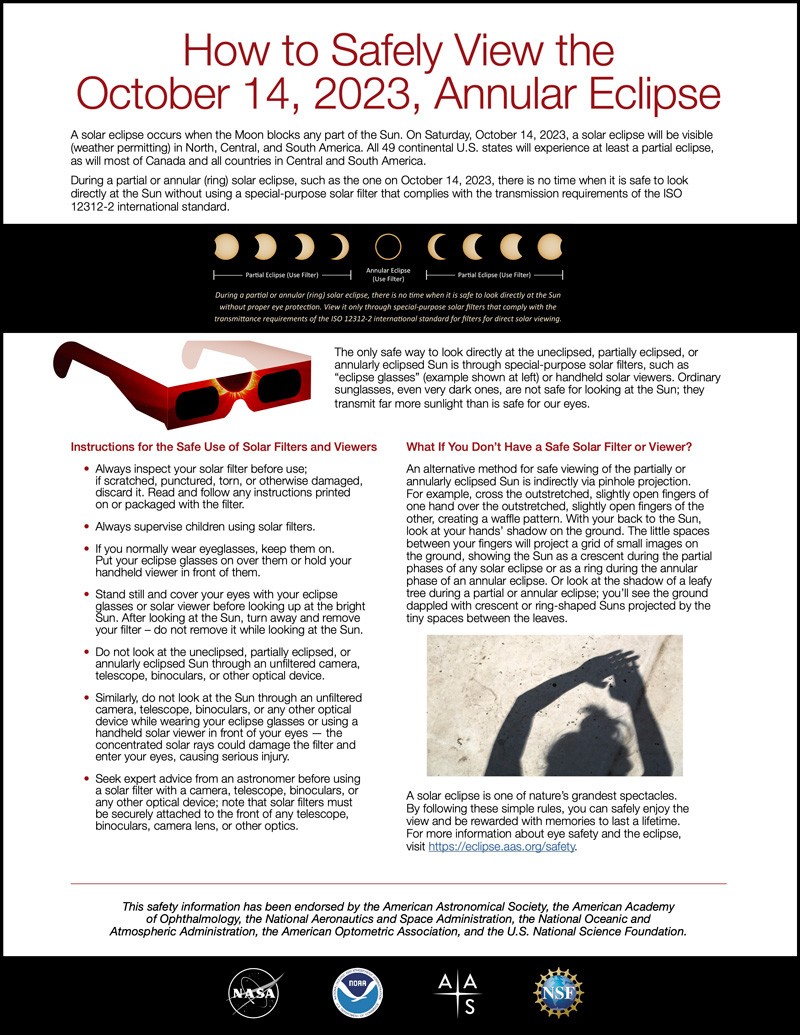
ISO 12312-2 is the international standard covering filters intended for direct, unmagnified observation of the Sun. It addresses matters including ultraviolet, visible, and infrared transmission, filter quality, mounting, and labelling. Ordinary sunglasses belong to a different product category and transmit far too much sunlight for direct solar viewing.
For institutional procurement, a printed standard number should not end the investigation. Anyone can print “ISO 12312-2” on cardboard or packaging. The American Astronomical Society advises purchasers to trace viewers to a credible manufacturer or to an authorized seller publicly identified by that manufacturer. Testing should have been performed by an appropriately accredited laboratory.
Before approving a purchase order, request and record:
- The finished product’s manufacturer and product identification
- Confirmation that the viewer is intended for direct, unmagnified solar observation
- Evidence supporting conformity with ISO 12312-2
- The identity and accreditation context of the testing laboratory
- Supplier contact details and the commercial chain between seller and manufacturer
- Instructions and warnings in the languages needed by participants
- Batch, lot, invoice, or other traceability information where available
- The proposed delivery date, quantity, pack configuration, and replacement process
This due diligence matters when listings advertise bulk eclipse glasses for sale through a general marketplace. A seller rating, dark-looking film, or product photograph cannot establish spectral performance. The “best bulk eclipse glasses” are not the ones with the loudest listing or lowest unit price; they are products whose origin, testing, condition, and instructions can be checked.
Marketplace language also needs scrutiny. Phrases such as “eclipse glasses nasa approved” and “nasa certified solar eclipse glasses” are misleading because NASA does not approve or certify individual brands of solar viewers. More meaningful product language includes “solar eclipse glasses iso 12312-2 certified,” but even that claim must be supported by traceability rather than accepted solely because it appears in a title.
Our detailed guide to ISO 12312-2 and eclipse viewers explains what the standard covers and why a number printed on a viewer is not, by itself, proof.
Inspect the delivered order, not just the paperwork
When the shipment arrives, check it while there is still time to resolve a shortage or discrepancy. Compare the delivered quantity with the purchase order and packing list, then inspect representative units from every case or lot. Keep the delivery record, invoice, correspondence, and verification documents together.
Check that the product identity and instructions match what procurement approved. Look for crushed boxes, moisture exposure, loose filters, torn frames, scratches, punctures, or other damage. A viewer with a damaged filter must be discarded; it should never be patched with tape or returned to circulation.
The AAS describes simple checks that can expose an obviously unsuitable viewer. Indoors, you should not be able to see furniture or ordinary surroundings through a genuine solar viewer. At most, an exceptionally bright light may appear very faint. That check can reveal a filter that is plainly too light, but passing it does not prove conformity with ISO 12312-2 or replace accredited laboratory testing.
Avoid turning student inspection into an experiment involving the Sun. Adult organizers should complete procurement checks, and every participant should receive a final visual inspection of their viewer before use. If there is unresolved doubt about an item’s origin or condition, quarantine it rather than improvising.
Distribution before first contact
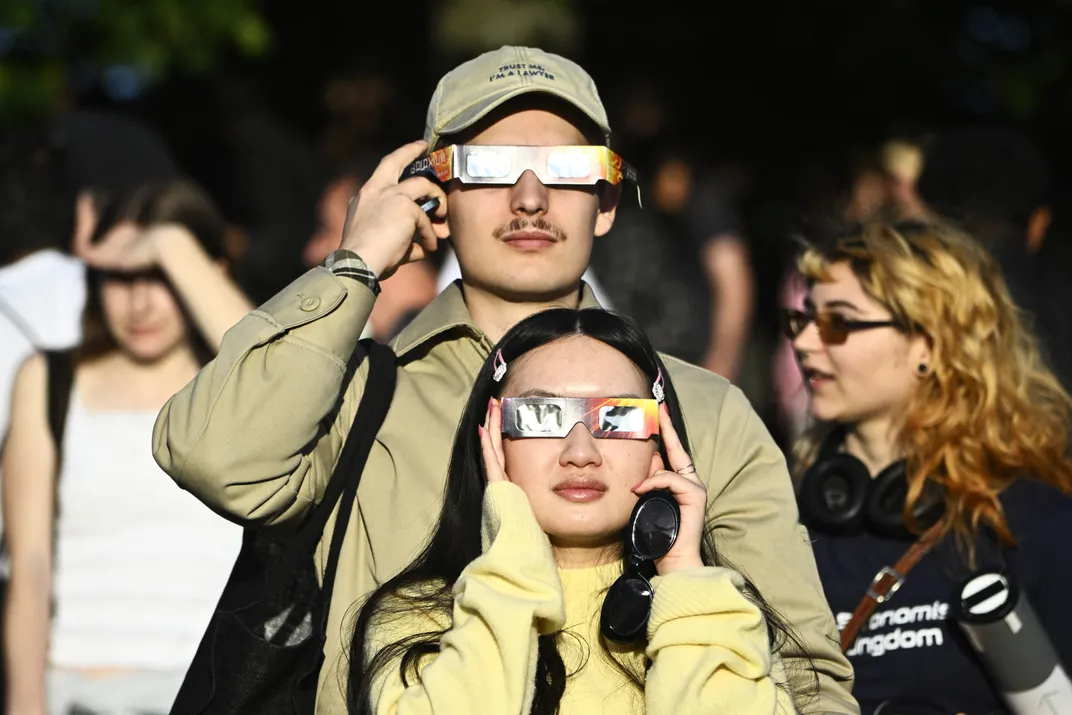
The safest distribution deadline is not maximum eclipse and certainly not the moment someone notices a crescent Sun. Viewers should be in participants’ hands before local first contact—the instant the Moon first begins to cover the Sun—and before the group moves into an observing area.
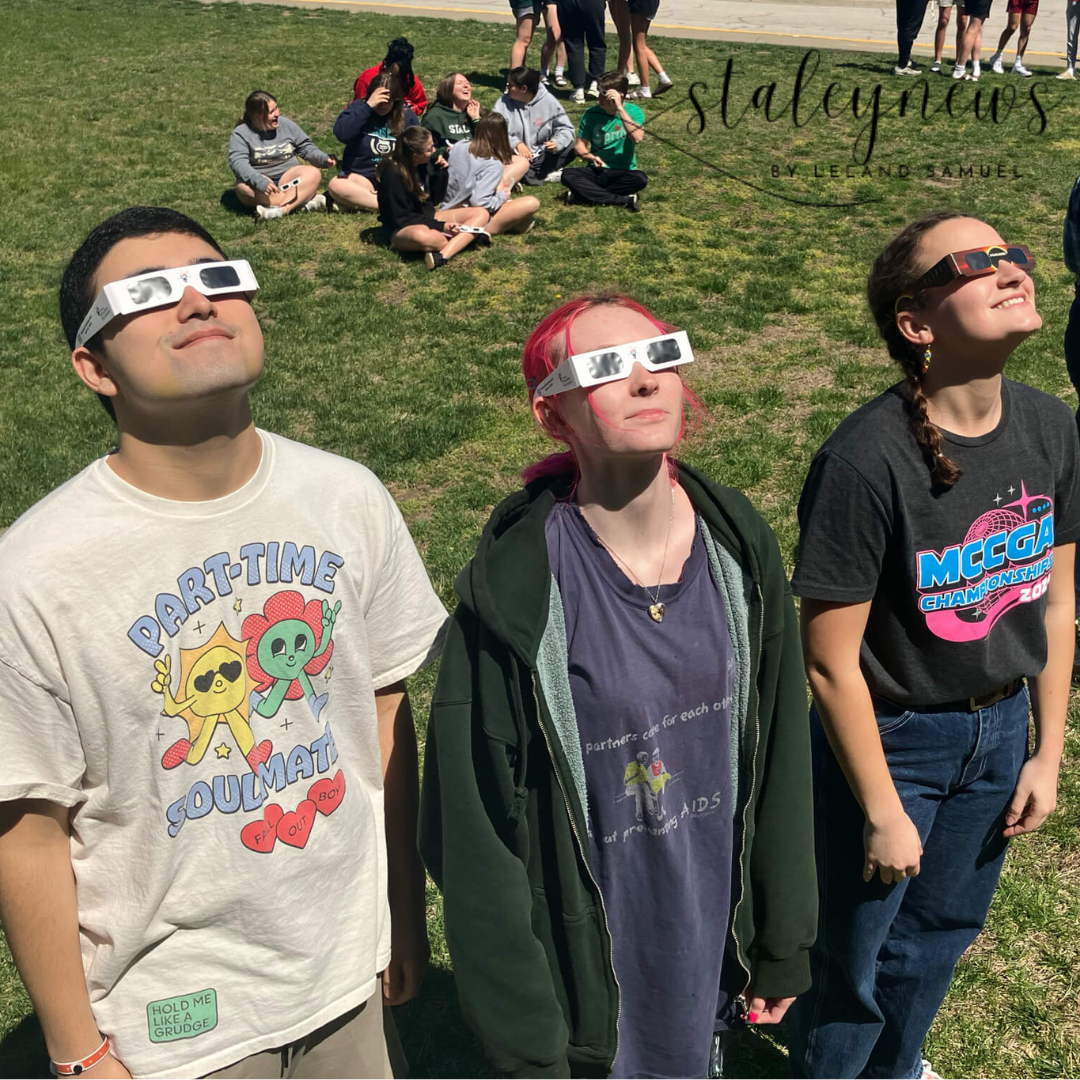
For a school, we recommend allocating viewers to classrooms or tutor groups in advance. Each bundle can carry the group name, exact quantity, supervisor’s name, and a short instruction card. Teachers can count the viewers, demonstrate the viewing sequence indoors, and report shortages while central stock is still accessible.
A practical schedule might look like this:
- Several weeks before the eclipse: confirm attendance assumptions, site locations, accessibility needs, and the person responsible for solar-viewing safety.
- At delivery: reconcile quantities, retain records, inspect stock, and quarantine damage.
- One week before: divide viewers into labelled class or team bundles and brief supervisors.
- One or two days before: send families the safety rules, event timing, clothing advice, and collection arrangements.
- At least 20–30 minutes before local first contact: distribute viewers, demonstrate their use, and complete a final condition check.
- Before anyone looks up: have participants put viewers on while facing away from the Sun, then turn toward it.
- After each look: turn away before removing the viewer.
That 20–30-minute margin is a logistical recommendation, not an astronomical contact time. Use the Helioclipse map to obtain the circumstances for the actual venue and build extra time around movement, registration, and explanations.
Ordering viewers for a school or team therefore combines quantity math, ISO verification, and distribution before first contact in one plan. If one part is left until eclipse morning, it tends to disrupt the others.
Build a briefing children and adults can follow
A long policy document is useful for the event lead; it is not the right script for a crowded playground. Participant instructions should be short, demonstrated aloud, and repeated by every supervisor.
The core sequence is:
- Inspect the viewer before use.
- If it is scratched, torn, punctured, wet, or coming apart, give it to a supervisor and request a replacement.
- Face away from the Sun before putting it over your eyes.
- Once your eyes are covered, turn toward the Sun for a brief look.
- Turn away again before removing the viewer.
- Never use ordinary sunglasses as a substitute.
- Never look through binoculars, a telescope, or a camera while wearing eclipse glasses.
Magnifying optics require a different solar filter secured over the front of the instrument. Eclipse glasses worn at the eyes do not protect against sunlight concentrated by binoculars or a telescope. Unless a suitably experienced person is managing filtered equipment, keep unfiltered optics out of the observing area.
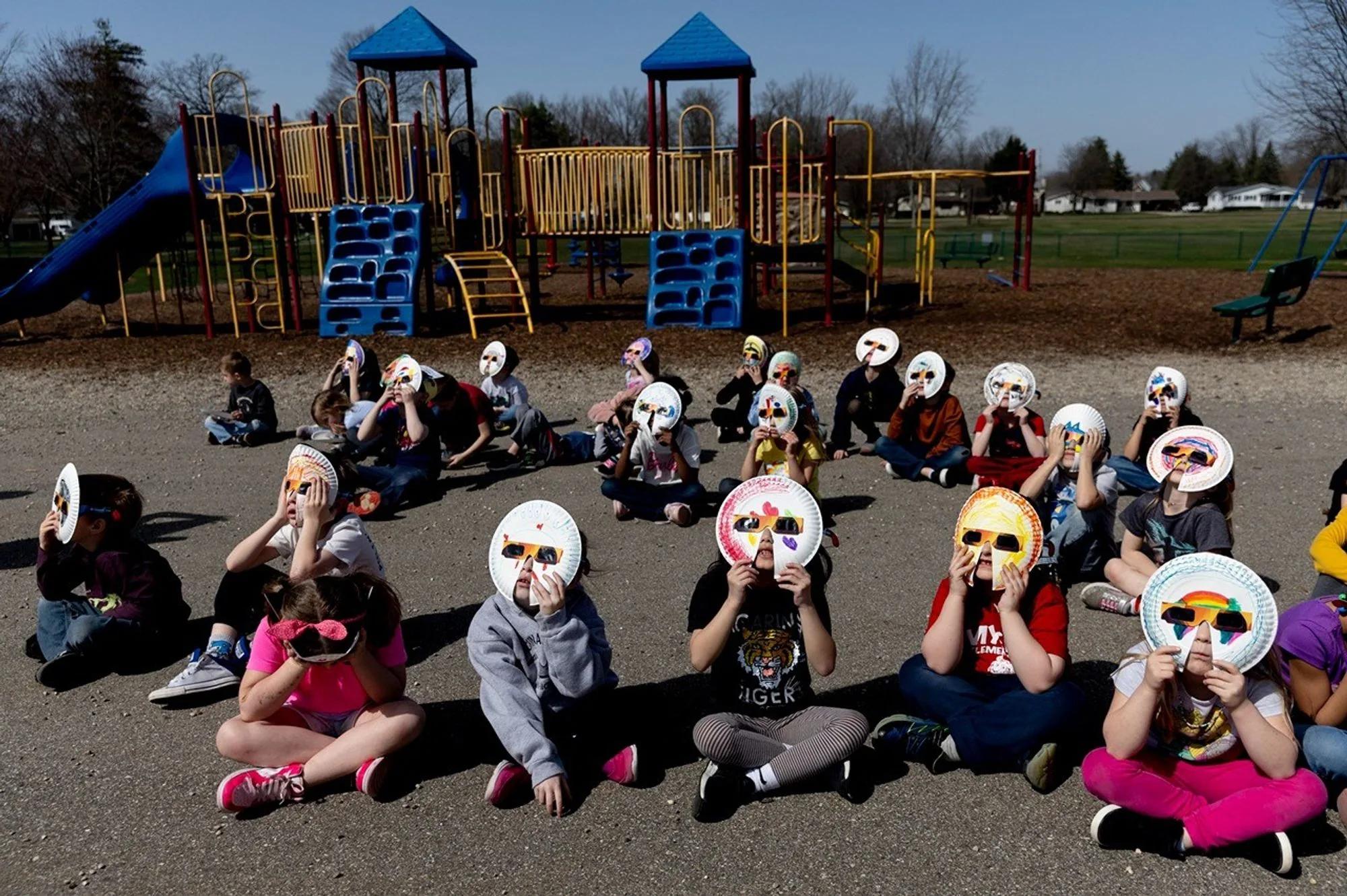
Children must be supervised. Consider a practice session indoors, particularly for younger pupils and participants who may need help holding a viewer securely. Corrective spectacles normally remain on, with eclipse glasses worn over them or a handheld viewer held in front.
If your location is outside the path of totality, the viewers stay on for every direct look. If your venue is inside the path, they may come off only after the Sun’s bright face is completely covered—and they must go back on as soon as the first bright point returns. Our guide to eclipse phases and when to use solar glasses can support the staff briefing.
Totality changes the script—but not the order quantity
A school in Tarifa or Luxor needs viewers just as much as one watching a partial eclipse in London, Paris, Cairo, or Algiers. Totality lasts only minutes; the partial phases before and after it require solar viewers.
The 2027 contrast is dramatic. Tarifa is expected to receive about 4 minutes 39 seconds of totality at approximately 10:45 a.m. CEST, while Luxor receives about 6 minutes 19 seconds around 1:02 p.m. EEST. Málaga, although also within the path, has less than two minutes. Those durations affect the event script, but not the need to equip the audience for the much longer partial phases.
Assign one knowledgeable caller at each totality site. That person should use verified local circumstances and announce when viewers remain on, when totality has genuinely begun, and when viewers must be replaced. Do not ask a crowd to infer the safe moment from how dark the surroundings feel. Deep partial eclipse can create unusual light while a dangerous portion of the photosphere is still visible.
Groups outside the path need an even simpler rule: there is no safe naked-eye phase. Viewers remain in use for every direct look from first contact through the end of the eclipse.
Free viewers, sponsorship, and low-cost procurement
Schools often look for the best free eclipse glasses for pupils because even a modest unit cost becomes significant across a district. Potential routes include local authority science programmes, libraries, museums, universities, astronomy organizations, parent associations, or a business willing to sponsor the order.
Free does not mean exempt from verification. Ask the same questions about the manufacturer, testing, supply chain, instructions, and product condition. A sponsor’s logo or a familiar institution’s name does not establish filter performance.
If a sponsor will fund only part of the audience, decide openly who receives the viewers and how the remaining participants will observe. Safe indirect methods, such as pinhole projection, can show the changing solar crescent without looking at the Sun. The observer keeps the Sun behind them and watches the projected image; nobody looks through the pinhole.
Projection is an excellent educational station, but it should not become a last-minute excuse for uncontrolled sharing. Plan the number of stations, adult supervision, group flow, and shade for viewing the projected image.
Choosing where and when to order
The best places to buy eclipse glasses are accountable sources that can explain who made the finished viewer, provide evidence supporting the relevant standard, and give a realistic delivery commitment. For European schools and teams, shipping origin, taxes, customs exposure, language requirements, and replacement lead time can matter as much as the advertised unit price.
Order early enough to inspect the stock and correct a problem. A same-day dispatch option within Europe may shorten warehouse handling when available, but it cannot remove carrier delays, school receiving procedures, holidays, or the time needed to divide thousands of units. Confirm current stock, dispatch cut-off, destination coverage, and arrival estimate before treating an urgent order as solved.
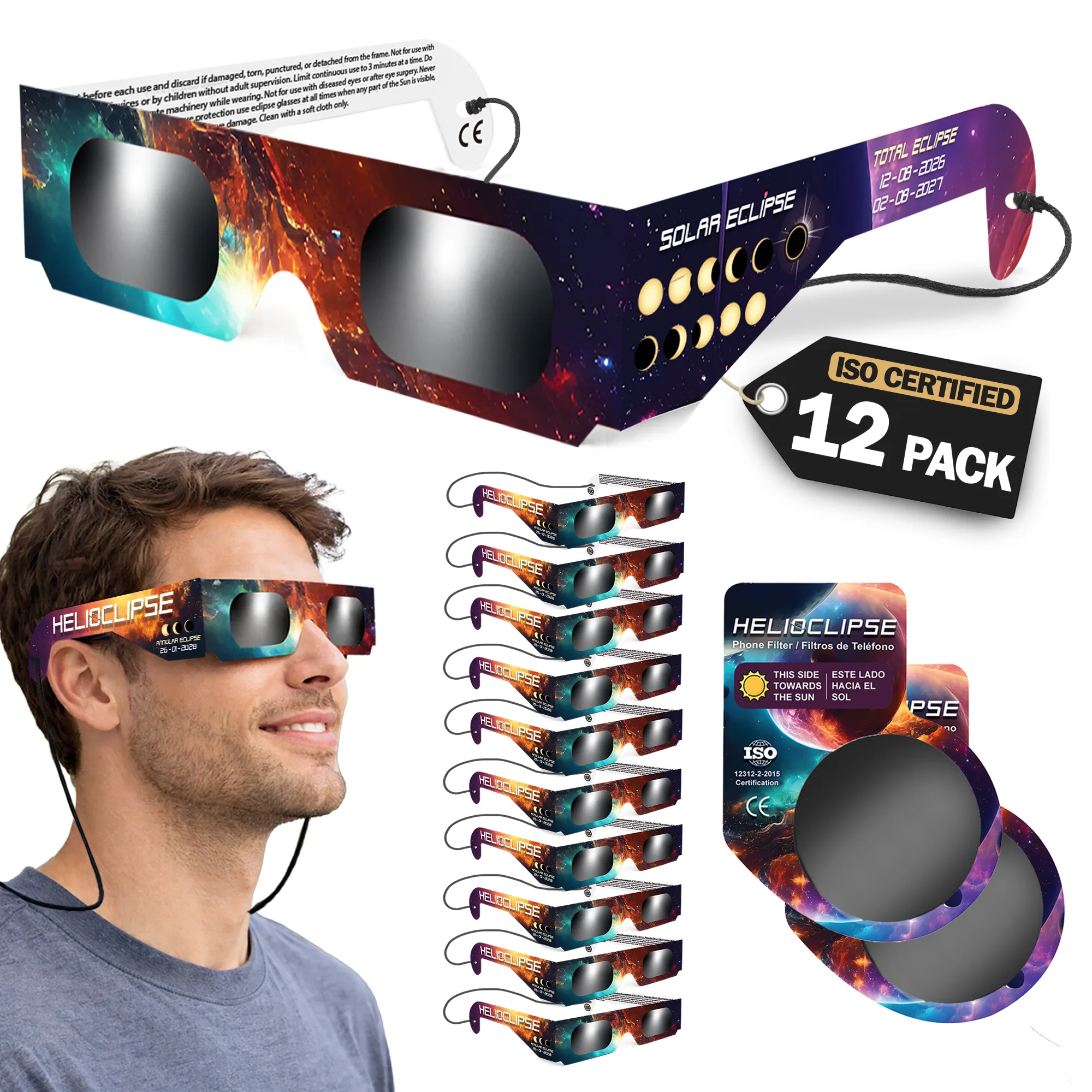
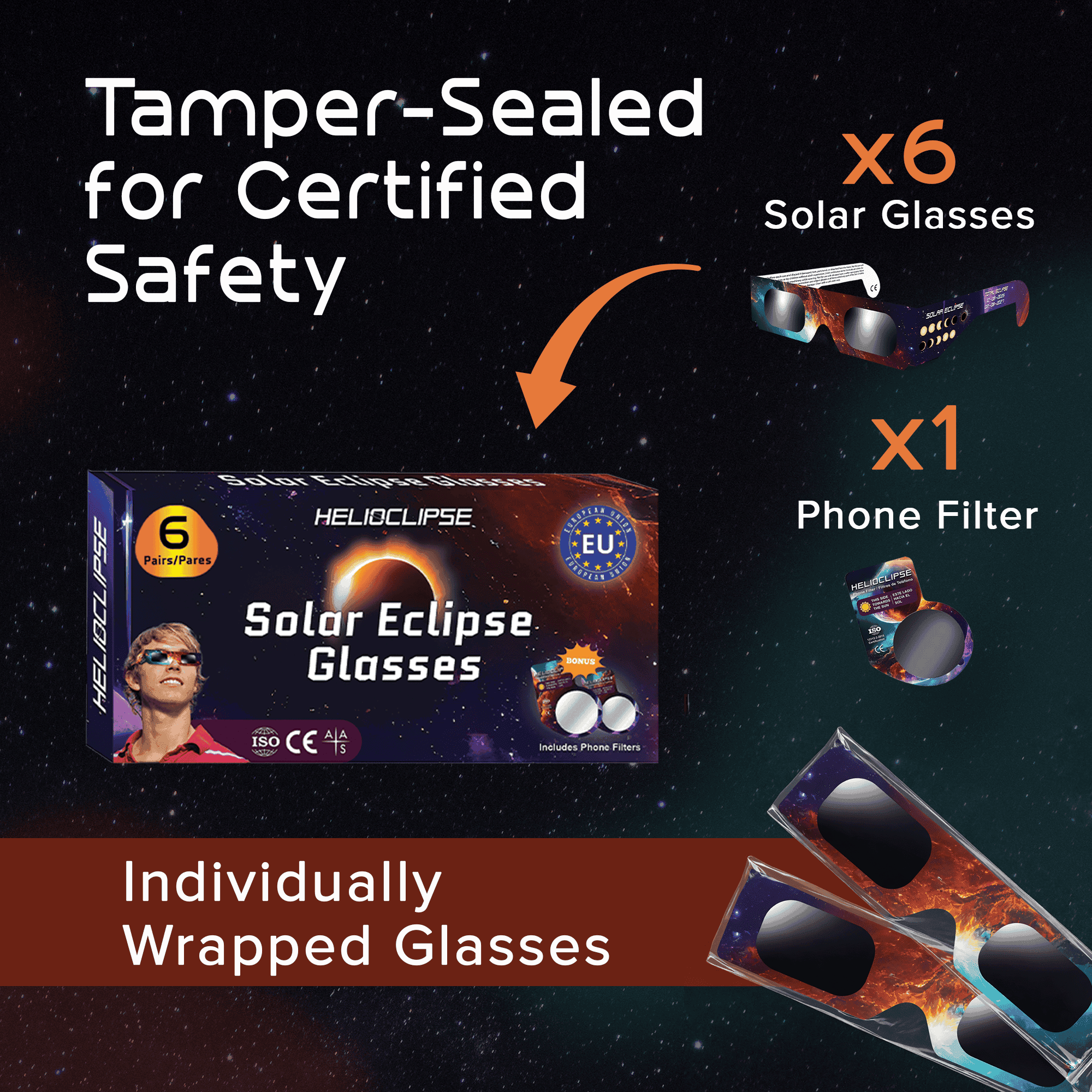
Helioclipse offers eclipse glasses for individual and group planning. If you need bulk solar eclipse glasses for several classes, campuses, or teams, contact us with the destination, required arrival date, expected attendance, preferred pack configuration, and invoicing needs. We can then discuss the appropriate order rather than forcing a large event into a household-sized calculation.
The timing decision should work backward from the event, not forward from the day someone remembers to order. Leave room for procurement approval, payment, production or picking, transport, receipt, inspection, replacements, internal distribution, and staff training. The closer August 2027 gets, the less resilience that chain has.
A one-page coordinator checklist
Before purchase
- Confirm the date: 2 August 2027.
- Check every venue for total versus partial eclipse and record local contact times.
- Count pupils, staff, guests, volunteers, and support personnel.
- Add an appropriate local contingency allowance.
- Confirm the pack or case size and round the order upward.
- Verify the manufacturer, seller relationship, ISO 12312-2 evidence, instructions, and traceability.
- Agree on delivery dates and a process for shortages or damaged stock.
When the order arrives
- Reconcile the shipment against the purchase order.
- Inspect every case and samples from each lot.
- Quarantine torn, scratched, punctured, wet, or loose filters.
- Store viewers flat, clean, dry, and protected from crushing or puncture.
- Retain invoices, product records, correspondence, and verification material.
Before eclipse day
- Divide stock into labelled class or team bundles.
- Give each supervisor a short safety script.
- Practise putting viewers on and removing them while facing away from the Sun.
- Establish a replacement point and keep reserve stock accessible.
- Remove uncontrolled binoculars and telescopes from the general viewing area.
- Confirm local weather procedures without cancelling the safety plan prematurely.
On 2 August 2027
- Distribute viewers before first contact.
- Inspect each viewer again before use.
- Supervise children and anyone needing assistance.
- Keep viewers on for every direct view of the partial Sun.
- Remove them only during confirmed totality at sites inside the path.
- Replace them immediately when the bright Sun begins to return.

Frequently asked questions
How should a school calculate how many eclipse viewers to order for 2027?
Start with an attendance plan for each campus or venue, separating pupils, supervisors, staff, families, volunteers, photographers, and visitors. Allow for late registrations and damaged units, and make sure each viewer is traceable before distribution.
What should be included in a school’s 2027 eclipse-viewing plan?
Create a site-specific run sheet with first contact, maximum eclipse, and the end of the partial phase. For locations securely inside the path of totality, also include second and third contact; do not use times copied from another city.
Why do location and timing matter when organizing group eclipse viewing?
The 2 August 2027 eclipse is total only within a narrow path through southern Spain, North Africa, and parts of the Middle East. Each participating site should be checked individually because the eclipse phase type and event times can differ substantially between locations.
What is the safest way for a school group to observe the eclipse?
Everyone looking directly at the Sun during a partial eclipse needs a suitable certified solar viewer. Outside the path of totality, there is no interval when viewers may be removed, even where the Sun is almost completely covered.
How should we plan for weather or limited visibility at our viewing site?
The excerpt does not provide weather forecasts or weather-specific procedures. It does recommend confirming the local eclipse phase and times for every campus or venue so the group has an accurate, location-specific schedule.
On-site next steps
- Calculate your final headcount and contingency stock, then visit the Helioclipse eclipse-glasses shop to review group-order options.
- Check each school or team venue in the Eclipse Explorer before writing the distribution timetable.
- For a larger order, prepare the destination, quantity, required arrival date, invoicing details, and number of separate site bundles before contacting us.
Sources & further reading
- American Astronomical Society, Solar Eclipses 2023–24 Educator’s Guide
- American Astronomical Society, Solar Eclipses of 2023 and 2024: A North American “Double-Header”
- American Astronomical Society, How Can You Tell If Your Eclipse Glasses or Handheld Solar Viewers Are Safe?
- American Astronomical Society, Suppliers of Safe Solar Viewers & Filters
- Space.com, Where will the ‘eclipse of the century’ be visible on Aug. 2, 2027?
- American Astronomical Society, How to View a Solar Eclipse Safely
- American Astronomical Society, About the ISO 12312-2 Standard for Solar Viewers
- NASA Science, Eclipse Viewing Safety
- NASA Science, Future Eclipses
- Sky & Telescope, How to Safely See a Solar Eclipse