León in 2026: one city, one eclipse—Camino crowds, plains horizons, and Castilian August heat
León will stand inside the Moon’s shadow on August 12, 2026. At about 8:28 p.m. CEST—18:28 UTC—the city is expected to receive roughly 1 minute 44 seconds of totality. That is long enough for the Sun’s corona to appear around the black lunar silhouette, the light to collapse into an eerie dusk, and a crowd to go from noisy anticipation to astonishment in seconds.
But León’s eclipse comes with a geographical catch. The totally eclipsed Sun will be only about 10° above the west-northwest horizon. Being in the right city is not enough: a wall, apartment block, line of trees, or modest rise in the landscape could hide the main event. Before committing to a viewing pin, inspect it with our Eclipse Explorer and 3D map, then check the same sightline in person at the relevant evening hour.
The shorthand 2026 eclipse Leon Spain conceals the decision that matters most. You are not merely choosing León; you are choosing one exact patch of ground within León from which the low western sky remains visible. This total solar eclipse 2026 Leon Spain 2026 guide is built around that distinction.

León’s eclipse in numbers
The calendar date is Wednesday, August 12, 2026. Published city circumstances place totality in León at approximately 8:28 p.m. CEST, or 18:28 UTC, with a duration near 1 minute 44 seconds. The Sun should be about 10° high in the west-northwest during totality.
These figures make León a compelling inland base. The city is comfortably within the total solar eclipse 2026 path, rather than sitting on an uncertain edge, and its predicted totality is comparable to Burgos. León also has a somewhat higher eclipsed Sun than Burgos, where published estimates put it near 8.3° high, and considerably higher than Zaragoza’s roughly 6°.
Still, city-wide figures are not a substitute for coordinates. A total solar eclipse 2026 Leon Spain map should answer at least four questions for your precise pin:
- Is the pin securely inside the path of totality?
- What are the local start and end times of totality?
- In which compass direction will the Sun appear?
- Does terrain or construction block the sky down to about 10° altitude?
The phrase total solar eclipse 2026 Leon Spain time can also be misleading when presented as one isolated clock reading. Totality is the climax, not the whole eclipse. The partial phase develops gradually before it, and you should be settled well ahead of the final minutes. Use a solar eclipse 2026 interactive map to retrieve updated contact times for your exact coordinates rather than copying a time assigned to a different side of the municipality.
For the same reason, treat any table labeled total solar eclipse 2026 Leon Spain date and time as the beginning of your planning, not the end. Recheck the calculation close to the event and confirm whether the displayed time is CEST, UTC, or another convention.
The cathedral is your landmark, not automatically your viewpoint
León’s historic core is designed for walking, meeting, eating, and looking at architecture. Those are strengths on an ordinary August visit. They are not necessarily strengths when the target is a Sun only 10° above the horizon.
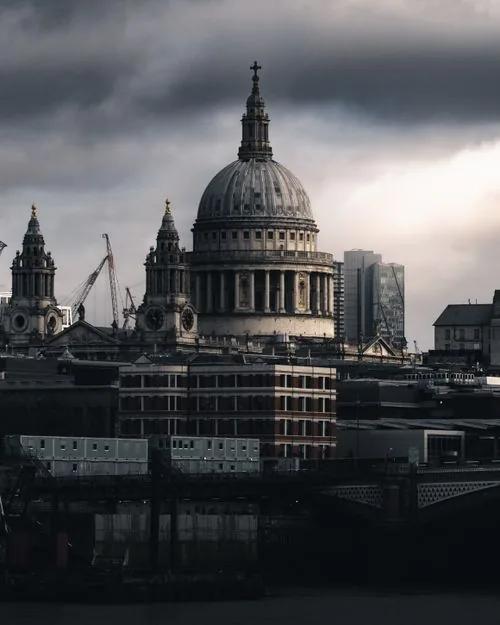
Near the cathedral and within the older street pattern, stone façades and narrow sightlines can turn the west-northwestern sky into a series of small windows. A square that feels spacious overhead may still have a blocked horizon. The medieval walls can provide atmosphere and orientation, but they should not be assumed to provide a usable eclipse view without an on-site check.
This is the central tension of león eclipse 2026 planning: the place where you want to spend the afternoon may not be the place where you should spend totality. Enjoy the cathedral quarter earlier, then leave enough time to reach a verified observing site. Do not plan a last-minute dash through unfamiliar streets while thousands of other people may be making the same calculation.
A candidate mentioned in published eclipse coverage is Mirador de Las Lomas Tres, east of the city, where the outlook toward León may provide a broad sunset-facing panorama. Treat it as a candidate, not a promise. Access rules, vegetation, construction, event controls, and crowd management can change. Verify the precise pin and west-northwest sightline, and identify a second site rather than betting everything on one popular overlook.
Think in two rings: the walls and the open urban edge
A practical León plan divides the city into two layers. The first is the historic and commercial core, where many visitors will stay, eat, and follow the familiar Camino de Santiago route through the city. The second is the more open urban ring and surrounding plain, where roads, parks, elevated ground, and less enclosed development may reveal more of the western sky.
The outer ring is not automatically better. A flat field can still have trees, warehouses, power infrastructure, or a distant ridge in exactly the wrong direction. Conversely, an elevated urban site can work beautifully if it has a clean west-northwest sector. The correct test is geometric, not aesthetic.
Stand at the proposed pin around the same clock time on August 11, if possible. Face west-northwest and hold your fist at arm’s length: a closed fist spans roughly 10° from top to bottom for many people. That gives you a useful visual sense of how low the eclipsed Sun will be. This is only a rough field check, not a replacement for a horizon tool, but it quickly reveals why a tree line or roof can matter.
The best site may therefore be an ordinary patch of open ground rather than the city’s most photogenic monument. For this eclipse, a clear horizon is part of the astronomical equipment.

Camino visitors, eclipse arrivals, and a city with two rhythms
León already has an August rhythm shaped by residents, summer visitors, and pilgrims moving along the Camino de Santiago. The eclipse adds another group whose daily schedule is unusually synchronized: everyone wants a west-northwest view at almost the same minute.
We do not have reliable grounds for inventing hotel occupancy figures or predicting the number of eclipse visitors. What we can say is that the concentration will be temporal as well as spatial. Restaurants, taxis, access roads, viewpoints, and open parks may all experience pressure late in the day, even if the city feels manageable in the morning.
Tell your group early where you intend to meet, and choose a location that can be described without relying on overloaded mobile data. Save coordinates and offline maps. Agree on a fallback pin and a decision deadline. If grandparents, children, or anyone with limited mobility is joining you, calculate the walking distance, shade availability, toilets, and return route before eclipse day.
Do not assume you can drive from the centre to an open suburban site shortly before totality. Arrive early enough to park legally without blocking farm access, emergency routes, or residential streets. Once you are settled, remaining through the later partial phase can be calmer than joining an immediate post-totality departure surge.
Our broader 2026 eclipse travel and backup-plan guide can help your group set decision times without turning eclipse day into a frantic road chase.
August heat changes how you wait
Totality arrives in the evening, but your waiting period may include hours of strong August sunlight. Inland Castile and León is often sunnier than Spain’s northern coast in summer, yet a favorable regional climate does not guarantee a clear eclipse day—and the same open ground that protects your horizon may provide very little shade.
Carry more drinking water than you expect to use, along with a hat, sunscreen, food, and lightweight clothing that covers exposed skin. A folding seat can make a long wait easier, while a small personal shade is useful if it can be lowered well before the critical phase and secured against wind. Never place canopies or umbrellas where they obstruct other observers’ low western view.
Heat also affects judgment. A tired group is more likely to postpone a move, lose track of equipment, or discover too late that a child’s viewer is damaged. Build in a shaded afternoon stop, inspect everyone’s solar viewers before leaving it, and reach the final site with time to settle.
Pack a light extra layer as well. The reduction in sunlight can make the air feel noticeably cooler near totality, especially if wind develops. The temperature change is part of the experience, but there is no defensible city-specific drop to promise in advance; it depends on the day’s atmosphere and local conditions.
Weather: watch the horizon, not only the sky overhead
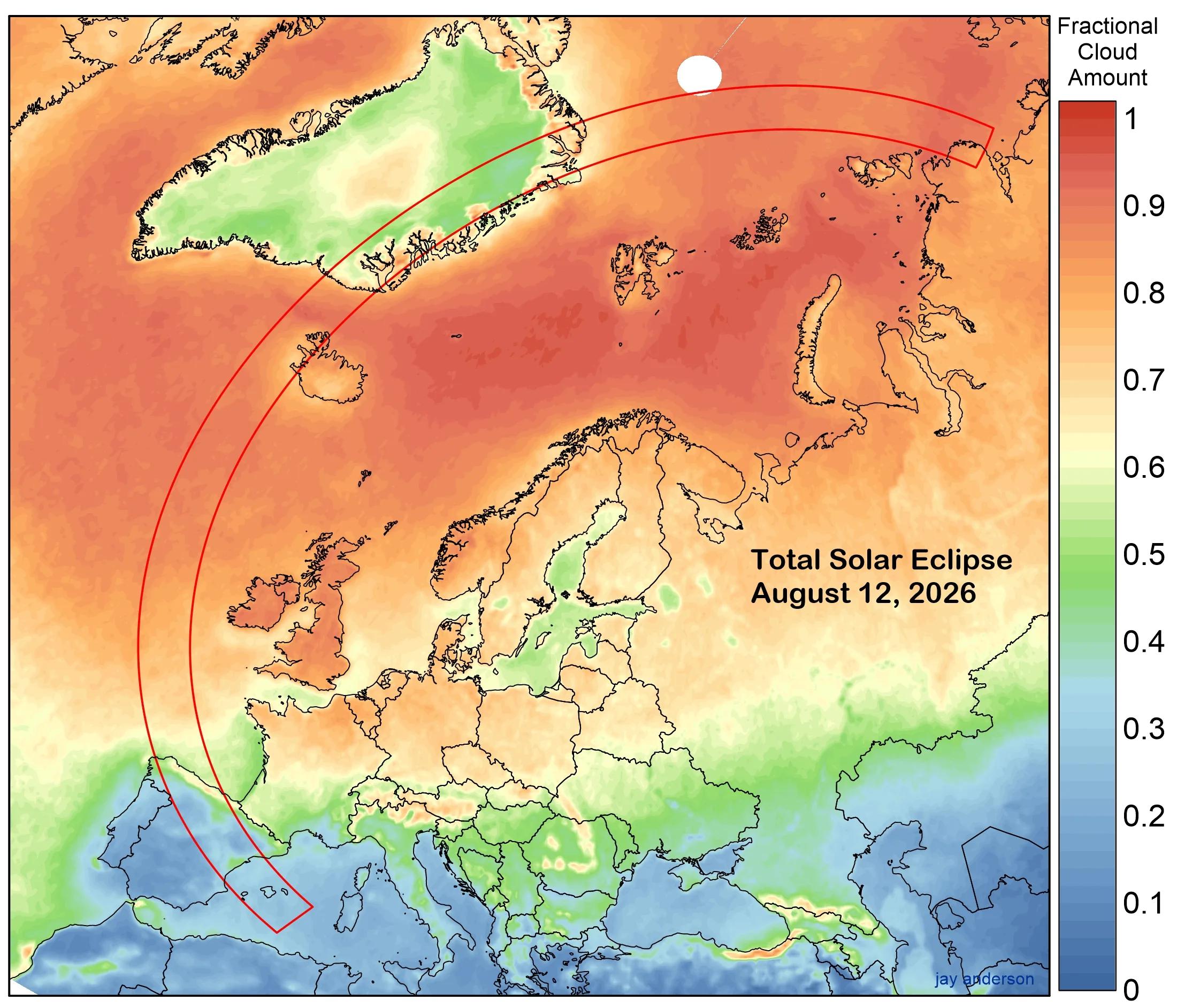
An overhead forecast can look encouraging while a bank of cloud sits along the west-northwestern horizon. Because León’s eclipsed Sun will be only about 10° high, distant cloud matters. Thin haze, smoke, or cloud tens of kilometres away can occupy the exact line of sight even when blue sky remains above you.
Long-term cloud statistics are useful for comparing broad regions, not predicting August 12, 2026. One published compilation estimates a historical cloud chance near 26% for León at totality, but that figure is not a personal 74% guarantee. Forecast skill improves as the event approaches, and the low-altitude geometry demands attention to cloud layers and their direction of movement.
Begin monitoring several forecast models a few days ahead. On eclipse morning, compare satellite imagery with local cloud forecasts. Establish in advance how far you are genuinely willing to move and when you will stop moving. A late attempt to outrun cloud can leave you in traffic with no verified horizon at all.
Our guide to eclipse-day weather and mobility explains how to separate climatology from the forecast that actually governs your day.
What totality will feel like in León
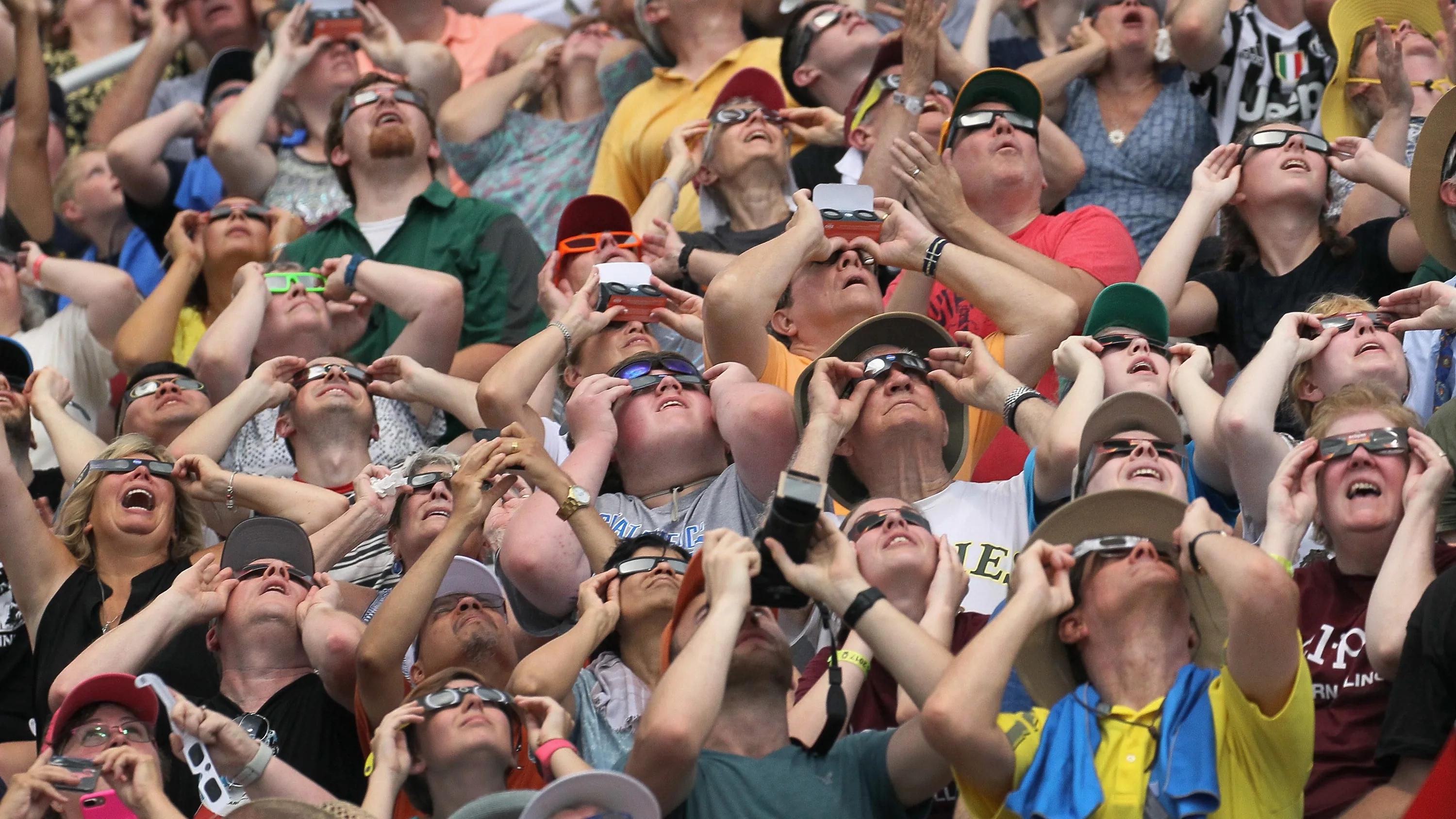
For much of the partial phase, the Sun will still look painfully bright to the unaided eye. Through a proper solar viewer, however, you will see the Moon gradually turn the solar disk into a narrowing crescent. Gaps between leaves may project dozens of tiny crescents onto walls or pavement.
The change accelerates perceptually in the last minutes. Shadows sharpen, the colour of the landscape becomes unfamiliar, and the western sky deepens. León’s broad horizon could make the approaching darkness especially striking if you are on elevated or open ground. Then the final bright portion of the photosphere disappears.
Only when the Sun’s bright face is completely covered may observers inside the path remove their eclipse viewers and look directly at totality without magnifying optics. The corona should surround the Moon’s silhouette while the horizon retains sunset-like colour. Approximately 1 minute 44 seconds later, the first returning point of direct sunlight ends the naked-eye interval. Put your viewers back on immediately.
This distinction is absolute: totality is not simply a darker version of a partial eclipse. Madrid’s centre, for example, is expected to experience an extraordinarily deep partial eclipse, but not the corona and full darkness of totality. Even a thin uncovered sliver of the Sun remains intensely bright.
Comparisons such as oviedo spain eclipse 2026 and burgos spain eclipse 2026 also require precise pins rather than city-name assumptions. Burgos is listed at roughly 1 minute 44 seconds of totality around 8:28 p.m. CEST, with the Sun only about 8.3° high. Oviedo’s local circumstances and horizon must be checked separately on an authoritative map. A solar eclipse Spain 2027 itinerary concerns a different eclipse and cannot be used to infer the 2026 path, timing, or viewing direction.
Eye safety and equipment for a low-Sun eclipse
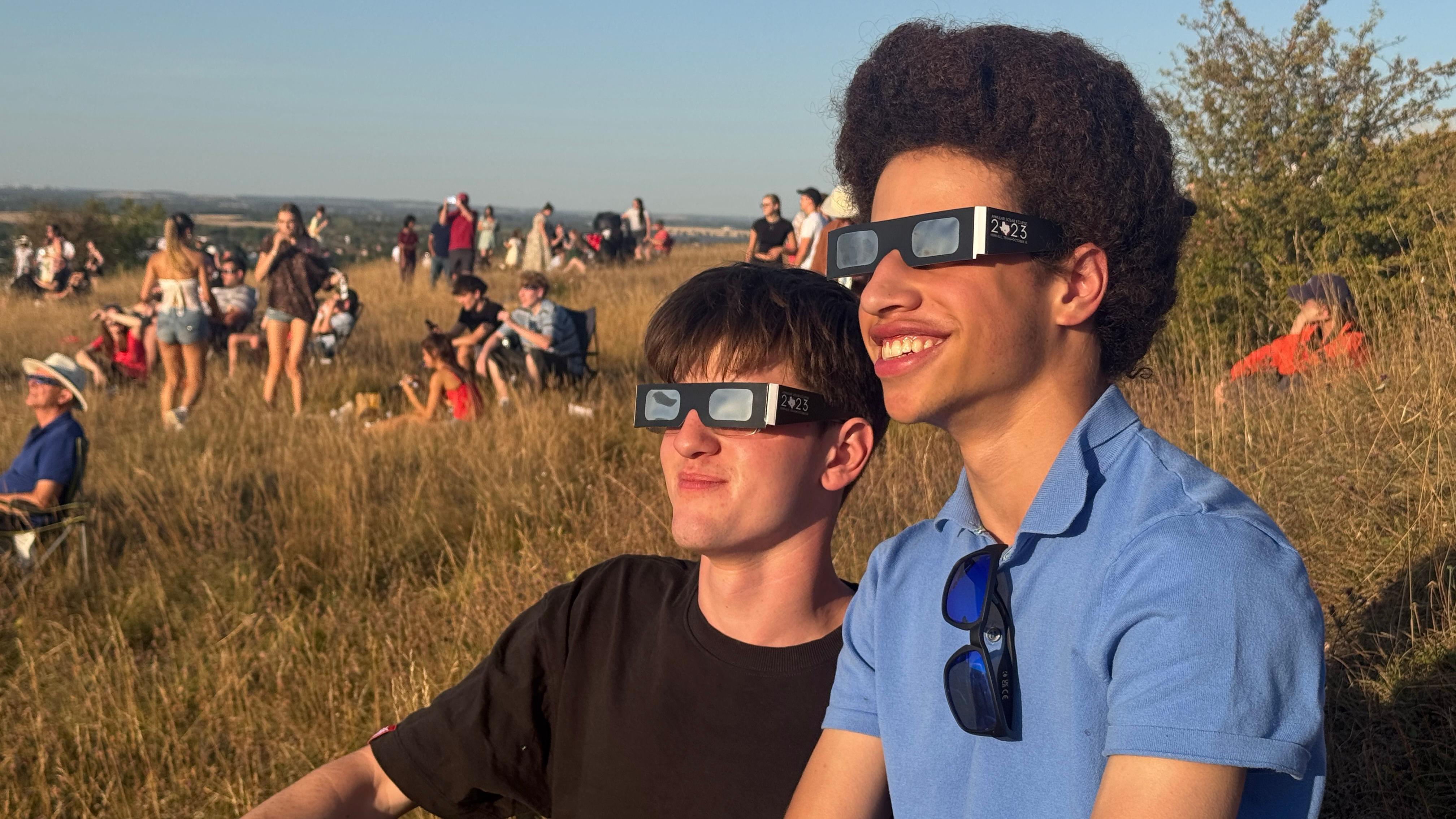
Use special-purpose solar viewers conforming to ISO 12312-2 whenever any part of the Sun’s bright face remains visible. Ordinary sunglasses are not solar filters, regardless of how dark they appear. Inspect every viewer before use and discard it if the filter is scratched, punctured, torn, loose, or otherwise damaged.
Marketplace wording can create confusion. The phrase approved solar eclipse glasses does not identify who performed the testing, and NASA does not approve particular brands of viewers. Labels such as eclipse glasses iso 12312-2 or certified solar eclipse glasses should lead you to verify the manufacturer, instructions, condition, and credible conformity information—not merely trust a printed phrase.
Bring enough ISO 12312-2 eclipse viewing glasses for your group and order early enough to inspect and store them properly. Adults should supervise children. Put viewers on before looking toward the Sun, then turn away before taking them off.
Do not look through binoculars, a telescope, or a camera lens while wearing eclipse glasses. Magnifying optics concentrate sunlight and require a correctly fitted solar filter over the front aperture of the instrument. If you have not prepared and tested a proper optical setup with expert guidance, leave the magnified observing to an organized astronomy event and enjoy the eclipse directly.
The low Sun creates one more temptation to avoid: haze does not make unfiltered viewing safe. A dim orange solar disk can still deliver dangerous radiation. Keep using certified viewers through every partial phase, including after totality as the Sun approaches the horizon.
A practical León checklist
Several months before
- Confirm that your accommodation and observing pin are inside the path.
- Share the date—August 12, 2026—with family and friends before diaries fill.
- Obtain ISO 12312-2 solar viewers from a trustworthy source.
- Identify one primary site and at least one realistic fallback.
- Check walking, public-transport, and legal parking options.
The day before
- Visit the primary pin around 8:28 p.m. local daylight time.
- Check the west-northwest horizon down to approximately 10°.
- Look specifically for trees, buildings, temporary structures, and terrain.
- Download offline maps and save exact coordinates.
- Confirm any municipal access restrictions or organized-event rules.
On August 12
- Review satellite imagery and several short-range forecasts.
- Make any relocation decision early, using a predetermined deadline.
- Pack water, food, hats, sunscreen, seats, a light layer, and viewers.
- Arrive before the partial phase becomes advanced.
- Keep solar viewers on until totality is unquestionably complete, then replace them the instant direct sunlight returns.
A total solar eclipse 2026 Leon Spain plan succeeds when geometry, safety, and human comfort all work together. A leon spain total eclipse 2026 itinerary that accounts only for the hotel and cathedral leaves the most important ten degrees of sky to chance.
Will you see the Full Solar Eclipse on your 2026 Camino?
Ivar
Frequently asked questions
Where should I watch the 2026 eclipse in Spain for the clearest view?
In León, the best viewing spot is an exact location with an unobstructed west-northwest horizon, not simply any place within the city. During totality, the Sun will be only about 10° above the horizon, so buildings, trees, walls, and small rises in the landscape can block it.
When will totality occur in León on August 12, 2026?
Totality in León is expected at about 8:28 p.m. CEST (18:28 UTC) on Wednesday, August 12, 2026. It is predicted to last roughly 1 minute 44 seconds, but viewers should check updated times for their precise coordinates and arrive well before the final minutes.
Which countries will be able to see the 2026 solar eclipse?
The excerpt provides details for León, Spain, but does not identify all countries from which the eclipse will be visible. It confirms that León is within the path of totality on August 12, 2026.
Will León experience a total solar eclipse in 2026?
Yes. León is expected to be inside the path of totality on August 12, 2026, with about 1 minute 44 seconds of totality around 8:28 p.m. CEST. The low west-northwest Sun makes a clear horizon essential.
What are the key planning considerations for viewing the 2026 total eclipse from León?
Choose a precise viewing location that is securely inside the path and has a clear sightline down to about 10° above the west-northwest horizon. Check local contact times, the Sun’s direction, and possible terrain or construction obstructions for your exact coordinates, then verify the sightline in person at a similar evening hour.
On-site next steps
- Open the Helioclipse Eclipse Explorer and place pins at your accommodation, preferred viewpoint, and fallback site. Compare path position, local timing, and the west-northwest horizon rather than relying on the city label alone.
- Read our August 12, 2026 planning guide with everyone responsible for transport, children, or equipment.
- Order Helioclipse solar eclipse glasses early, inspect each viewer, and keep them flat, clean, and dry until eclipse day.
Sources & further reading
- 10 best Spanish cities to see the total solar eclipse 2026 — Space.com
- Spain’s total solar eclipse 2026 comes with a catch — Space.com
- August 12, 2026 Solar Eclipse Map — National Solar Observatory
- Total Solar Eclipse 2026 August 12 — Eclipsophile
- Solar and Lunar Eclipses in 2026 — Sky & Telescope
- How to View a Solar Eclipse Safely — American Astronomical Society
- About the ISO 12312-2 Standard for Solar Viewers — American Astronomical Society
- Eclipse Basics — American Astronomical Society
- What to Expect: A Solar Eclipse Guide — NASA Science
- Types of Solar Eclipses — NASA Science