Eclipse glasses over prescription glasses: fit, comfort, and the mistakes people make
Wearing eclipse glasses over prescription glasses raises a very practical question before eclipse day gets dramatic: will your solar viewer actually fit, stay put, and feel comfortable enough that you will use it correctly? That is where a lot of people go wrong. They think only about darkness, not fit. But comfort is part of safety, because a viewer that pinches, slips, or leaves gaps is the one people keep lifting, fiddling with, or abandoning.
The advice here applies to any solar eclipse, not just 2026. If you want to get ready early, our shop for eclipse glasses is the simplest place to start, and our Eclipse Explorer / 3D map helps you confirm whether you will be in totality or seeing only a partial eclipse.
The short version is reassuring: yes. The American Astronomical Society explicitly says that if you normally wear eyeglasses, you should keep them on and put your solar viewer over them, or use a handheld viewer in front of them. The trick is choosing a viewer that is meant to be used that way and then using it without improvising.
The basic rule: keep your prescription glasses on
For most people, your everyday glasses should stay on. They help you see the eclipse more sharply, they keep your normal visual correction in place, and they reduce the temptation to squint or shift your head around trying to find a clear view.
That is the core of wearing eclipse glasses over prescription glasses: the eclipse viewer is the solar filter, while your prescription glasses are just your normal vision correction. Your regular lenses do not replace a solar filter, and the solar filter does not replace your prescription.
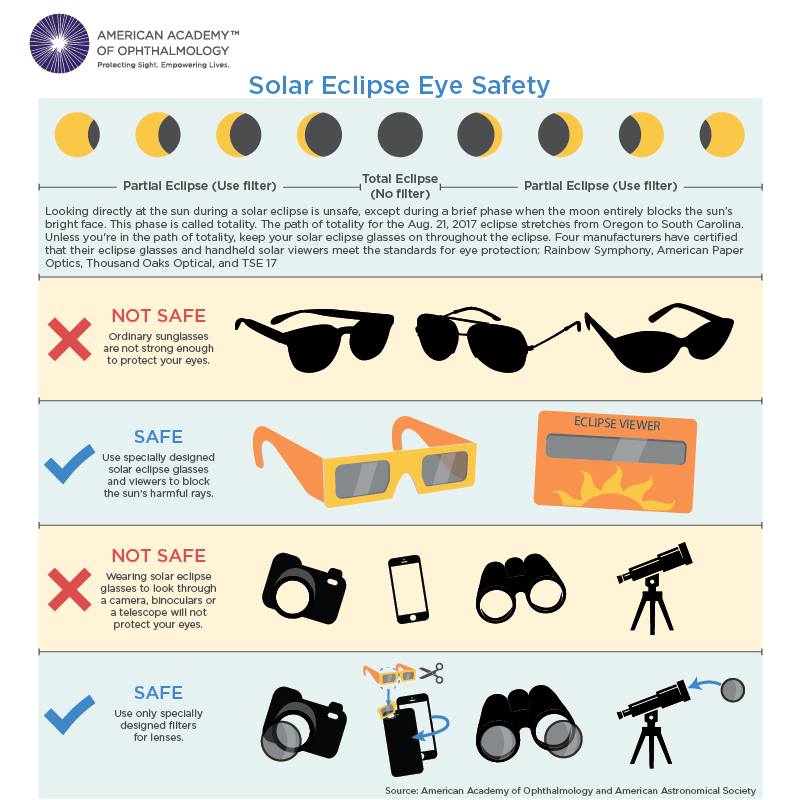
This is also why the answer to what glasses do you need to watch the eclipse? is not “whatever dark glasses you already own.” You need a special-purpose solar viewer that conforms to ISO 12312-2 for direct viewing of the Sun. Ordinary prescription lenses, blue-light glasses, transition lenses, polarized sunglasses, and fashion sunglasses are not solar viewers.
If you are new to eclipse safety, it also helps to read our guide to ISO 12312-2 and eclipse viewers: what the standard means for your family and our explainer on when glasses on, when glasses off: eclipse phases explained for first-time viewers.
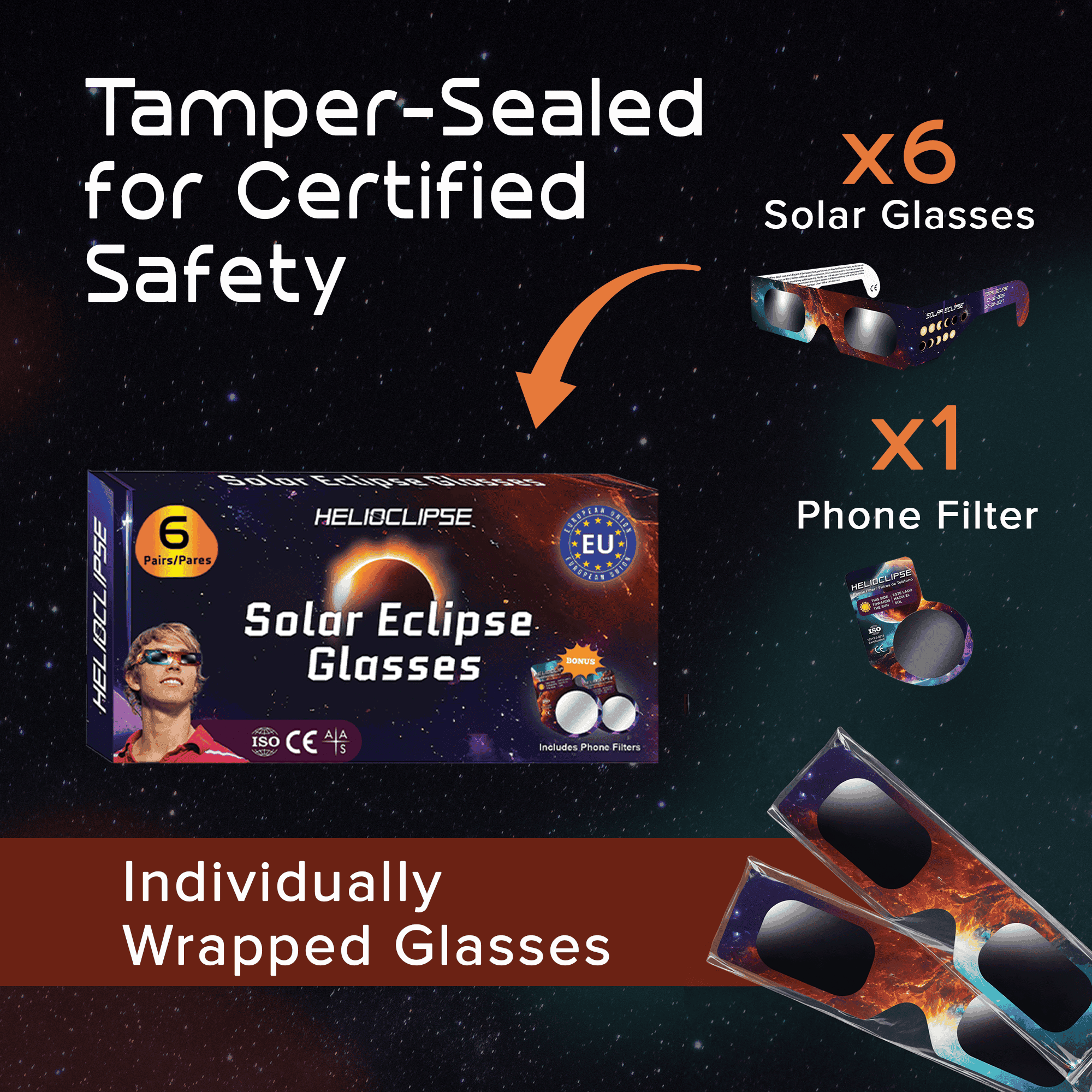
Fit-over design matters more than people expect
A lot of eclipse viewers are lightweight cardboard frames. That is normal. Lightweight does not mean unsafe by itself. But it does mean fit matters. If the arms are too short for your head, if the frame sits awkwardly on top of thick prescription frames, or if the viewer keeps riding upward, you are more likely to touch it while looking up.
That is why fit is so personal. The real issue is not gendered optics; it is face size, frame width, bridge shape, hairstyle, and whether your everyday glasses are slim metal frames or chunky acetate rectangles. A viewer that feels roomy on one person can feel cramped on another.
The best fit-over viewer is not the one with the most aggressive wraparound shape. In fact, some wrap styles can be harder to wear over prescription glasses. Astronomy Magazine noted this directly in a gear guide: wraparound designs may not fit small heads or fit comfortably over prescription eyewear. A little side coverage is useful, but not if the frame presses your prescription glasses into your nose or cheeks.
Think in simple ergonomic terms:
- It should go on over your regular glasses without forcing them out of position.
- It should cover your field of view well enough that you are not peeking around the edges.
- It should stay in place when you tilt your head up.
- It should be comfortable for repeated short looks over an hour or more.
Comfort sounds secondary until eclipse day. Then it becomes the difference between calm, correct use and constant adjustment.
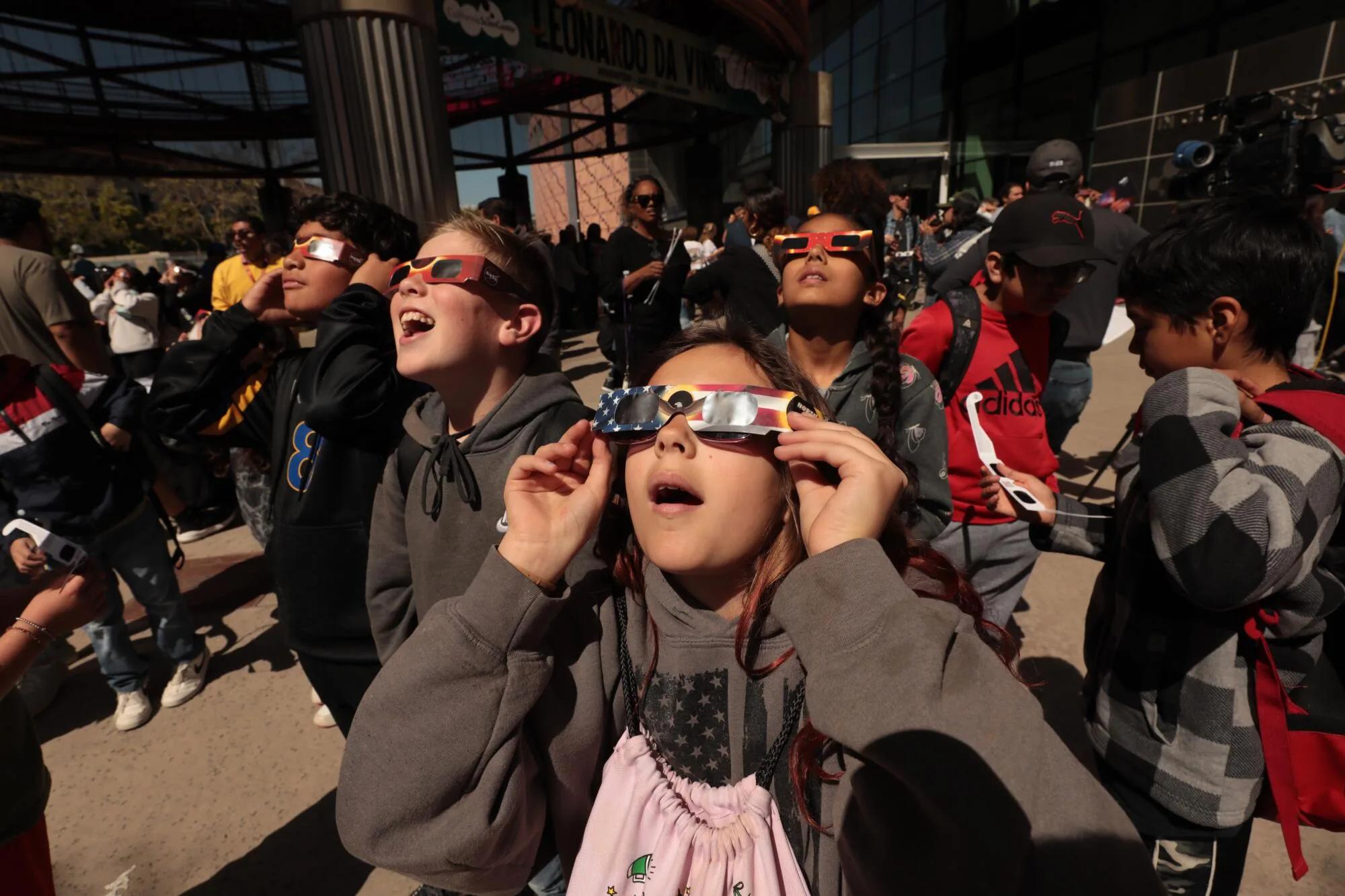
The most common mistakes people make
This is where prescription eyewear and eclipse viewers: fit, comfort, and the mistakes becomes more than a shopping question. Most problems are not exotic. They are ordinary human habits under bright-sky conditions.
Mistake 1: treating eclipse glasses like regular sunglasses
Space.com makes a useful point here: the thin arms on eclipse glasses can make them more prone to slipping than everyday eyewear. If you are looking up and they slide, that is not a minor annoyance. It is exactly the moment you do not want to be fumbling.
So stand still, put the viewer on before looking up, and look away before removing it. That sequence matters.
Mistake 2: stacking random dark lenses
People still try combinations like sunglasses plus prescription glasses, or sunglasses plus eclipse glasses, or smoked plastic over a camera viewfinder. None of that improves safety in a meaningful, standards-based way. The AAS is clear: ordinary sunglasses, even very dark ones, are not safe for looking at the Sun.
This is also why do fitover sunglasses work? is the wrong question for eclipse viewing. Fitover sunglasses may work for glare reduction while driving or walking outside. They are not automatically solar viewers. “Fit-over” describes shape and wearing style, not solar safety.
Mistake 3: using damaged viewers
Scratches, punctures, tears, loose filters, bent frames that expose gaps, or water-damaged cardboard are all reasons to stop and inspect. If the filter is damaged, discard it.
Mistake 4: buying from random listings because it is convenient
The AAS warns consumers not to buy whatever pops up from online marketplaces or shops that may know little about eclipse safety. That does not mean every local seller is bad. It means traceability matters. You want a product with clear manufacturer information, instructions, and standards labeling.
If you want a deeper counterfeit checklist, read our guide to fake and low-quality eclipse glasses: how to sanity-check what you are about to trust.
Mistake 5: trying to “improve” the fit with risky hacks
People search for tools to adjust glasses and optician glasses adjustment because they are used to tweaking normal eyewear. That instinct can backfire with eclipse viewers. You should not punch extra holes, tape dark plastic over the lenses, trim the frame until it exposes the filter edges, or bend the viewer so much that the filter loosens.
If your prescription glasses need an adjustment, have your optician adjust those. If the eclipse viewer itself fits badly, replace it with one that fits better. Eclipse day is not the time for improvised engineering.
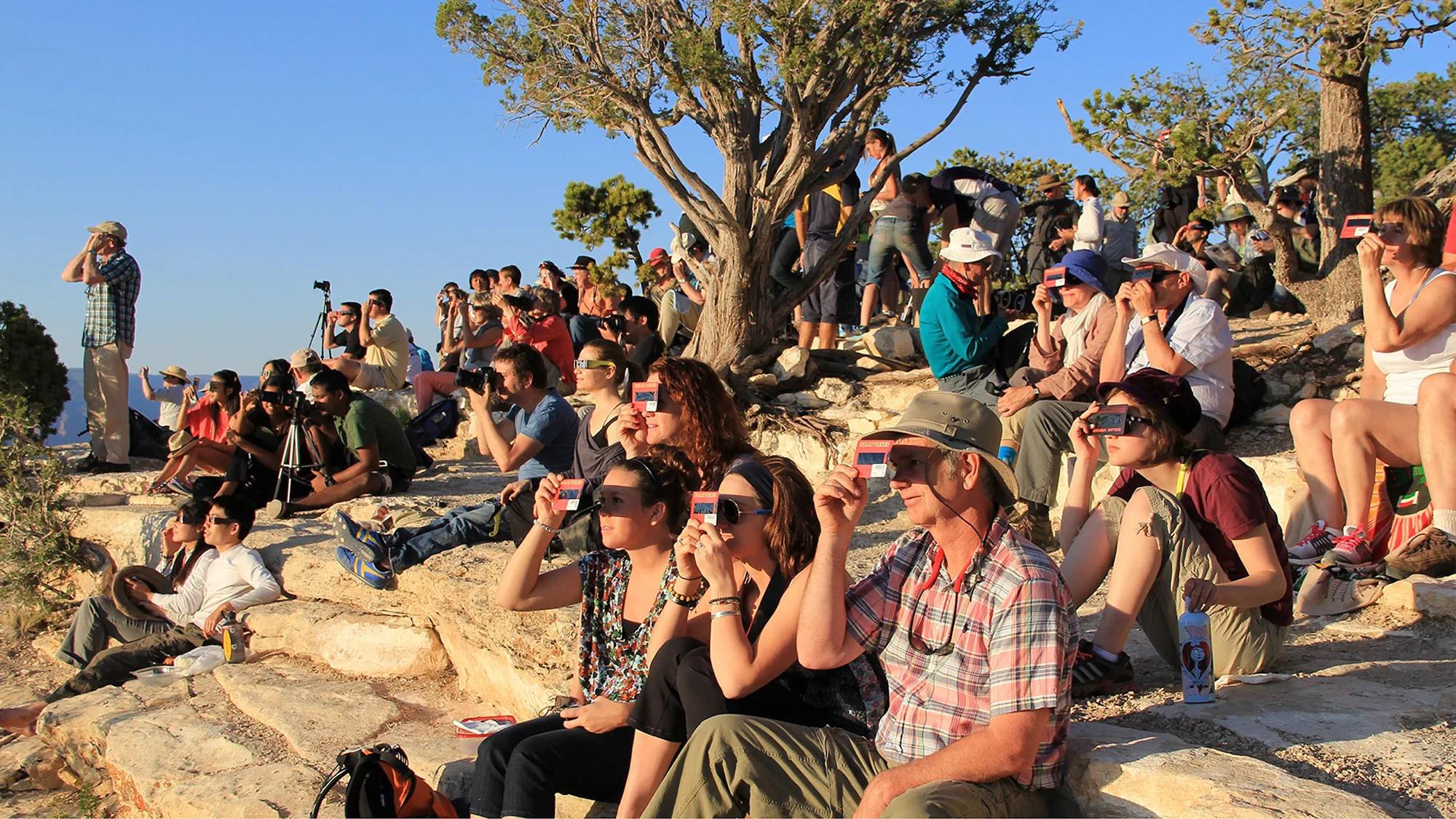
What safe fit actually looks like
A safe fit is boring in the best possible way. You put the viewer on over your prescription glasses, it covers your eyes fully, you look up, the Sun appears comfortably bright against a dark background, and you do not feel the urge to keep touching the frame.
That last part matters. The AAS notes that safe solar filters should show the Sun itself or something comparably bright, not a bright hazy scene full of ordinary surroundings. If you can see normal indoor lights and room detail easily through the viewer, something is wrong.
When testing fit at home, do not test by staring at the Sun. Test the mechanics indoors first:
- Put your prescription glasses on.
- Place the eclipse viewer over them.
- Turn your head left, right, up, and down.
- Check whether your regular glasses shift on your nose.
- Notice whether the viewer pinches at the temples or cheeks.
- Make sure children can keep it on without constant help.
Then inspect the filters in bright indoor light for scratches, punctures, tears, or loose mounting.
If you are buying for a family, this is where a calm, practical comparison beats hype. The most common frustrations for eclipse glasses for eyeglass wearers usually come down to one thing: people buy for price or speed, then discover on eclipse day that half the group hates wearing them.
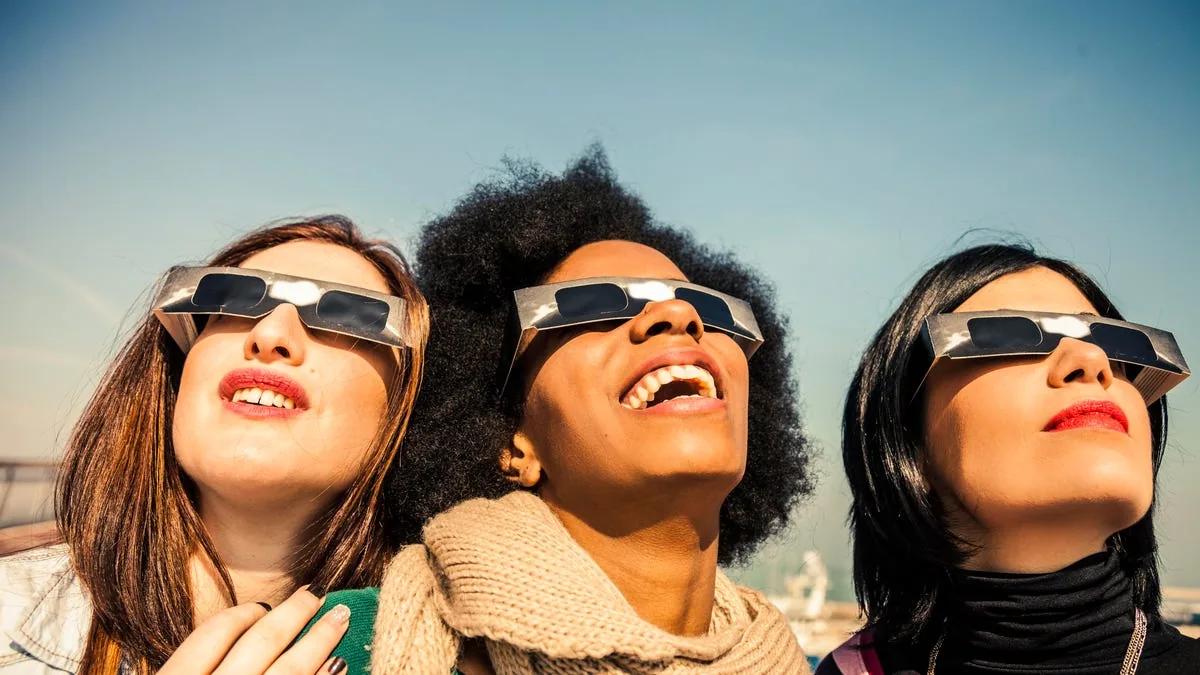
Price, freebies, and the temptation to cut corners
Let's talk honestly about price. For most families, the cost of safe eclipse viewers is not the expensive part of eclipse planning. Travel, time off, fuel, and lodging usually dwarf the price of viewers. That is exactly why it makes no sense to gamble on the one item protecting your eyes.
At the same time, cheap does not automatically mean bad, and expensive does not automatically mean better. What matters is standards compliance, condition, and fit.
The same goes for solar eclipse glasses free. Free viewers can be perfectly fine if they come through a reputable source such as a science museum, planetarium, astronomy club, school event, or organized public outreach tied to known manufacturers. The AAS specifically notes that viewers distributed through astronomers, astronomical organizations, science museums, and planetariums are often traceable to trusted sources.
But “free” from a random promotional pile with no manufacturer information is not a bargain. It is just uncertainty.
And no, solar eclipse glasses diy is not a safe substitute for direct viewing glasses. The AAS and Space both stress that homemade filters are not safe for looking directly at the Sun. DIY belongs on the projection side of eclipse viewing, not on your face.
If you do not have a good fit, use indirect viewing instead
This is the part many people skip, and they should not. If your viewer does not fit well over your prescription glasses, you still have safe options that do not involve forcing a bad setup.
Indirect viewing is excellent for kids, classrooms, and anyone who finds direct-view glasses awkward. A pinhole projector, a colander, crossed fingers, or the tiny gaps between leaves can project crescent Suns onto the ground during the partial phases. You do not look through the holes; you look at the projection.
That is the right answer when people start searching solar eclipse glasses diy and really mean, “I need another way to participate safely.” Make a projector, not a fake pair of eclipse glasses.
Indirect viewing is also useful for people with mobility or comfort issues. If holding your head at the right angle is tiring, or if your prescription frames and viewer never settle comfortably together, projection can make the event much more relaxed.
Special cases: cataracts, low vision, and eye concerns
We should be careful here. This article is not medical advice, and eclipse viewers are not medical devices.
People often ask what glasses are best for cataracts? For eclipse viewing, the answer is not a special cataract-specific eclipse product. The answer is still a safe solar viewer that meets the proper standard, used according to instructions, with your normal prescription eyewear on if you wear it. But if cataracts, recent eye surgery, severe glare sensitivity, or another eye condition changes how you see bright light, talk to your eye-care professional about comfort and expectations.
The same caution applies to questions like do self-adjusting eyeglasses really work? or whether some special adaptive lens will solve eclipse viewing. Those products are separate from solar safety. They do not replace a certified solar filter.
If you have a medical eye question, treat it as a medical question. If you have a solar viewing question, treat it as a standards-and-use question. Mixing the two is how confusion starts.
Direct viewing versus optics: a mistake that can seriously injure you
One of the biggest misunderstandings is thinking eclipse glasses can be combined with binoculars, a telescope, or a camera for “extra protection.” They cannot.
The AAS is explicit: do not look at the Sun through an unfiltered camera, telescope, binoculars, or any other optical device while using eclipse glasses or a handheld viewer in front of your eyes. Concentrated sunlight can damage the filter and your eyes.
If you want magnified views, the solar filter must go securely on the front of the optical instrument, not at the eyepiece and not in front of your face alone. That is a different setup, with different rules.
For most first-time viewers, especially families, simple direct viewing with certified eclipse glasses is the better plan. It is easier, safer, and less likely to turn a beautiful event into a gear-management problem.
Total eclipse versus partial eclipse: when fit matters all the way through
For a partial or annular eclipse, your viewer stays on whenever you look directly at the Sun. There is no safe “quick peek” phase.
For a total solar eclipse, the rule changes only if you are actually inside the path of totality and only during the brief interval when the Moon completely covers the Sun’s bright face. Then, and only then, you may remove your eclipse glasses to view totality with the naked eye. As soon as the bright Sun begins to reappear, the glasses go back on.
That is why planning matters. If you are traveling for 2026, do not assume a city near the path is 'close enough.' Use our Eclipse Explorer / 3D map to check whether your exact location is inside totality or outside it. If you are outside the path, you never get a glasses-off moment.
And if you want the full timing logic in plain English, our guide to when glasses on, when glasses off: eclipse phases explained for first-time viewers is worth reading before eclipse week, not during it.
Where to buy without making it complicated
People ask solar eclipse glasses where to buy and solar eclipse glasses near me because they want a simple answer. Ours is simple too: buy early, buy traceable products, and buy from a source that tells you what standard the viewer meets and how to use it.
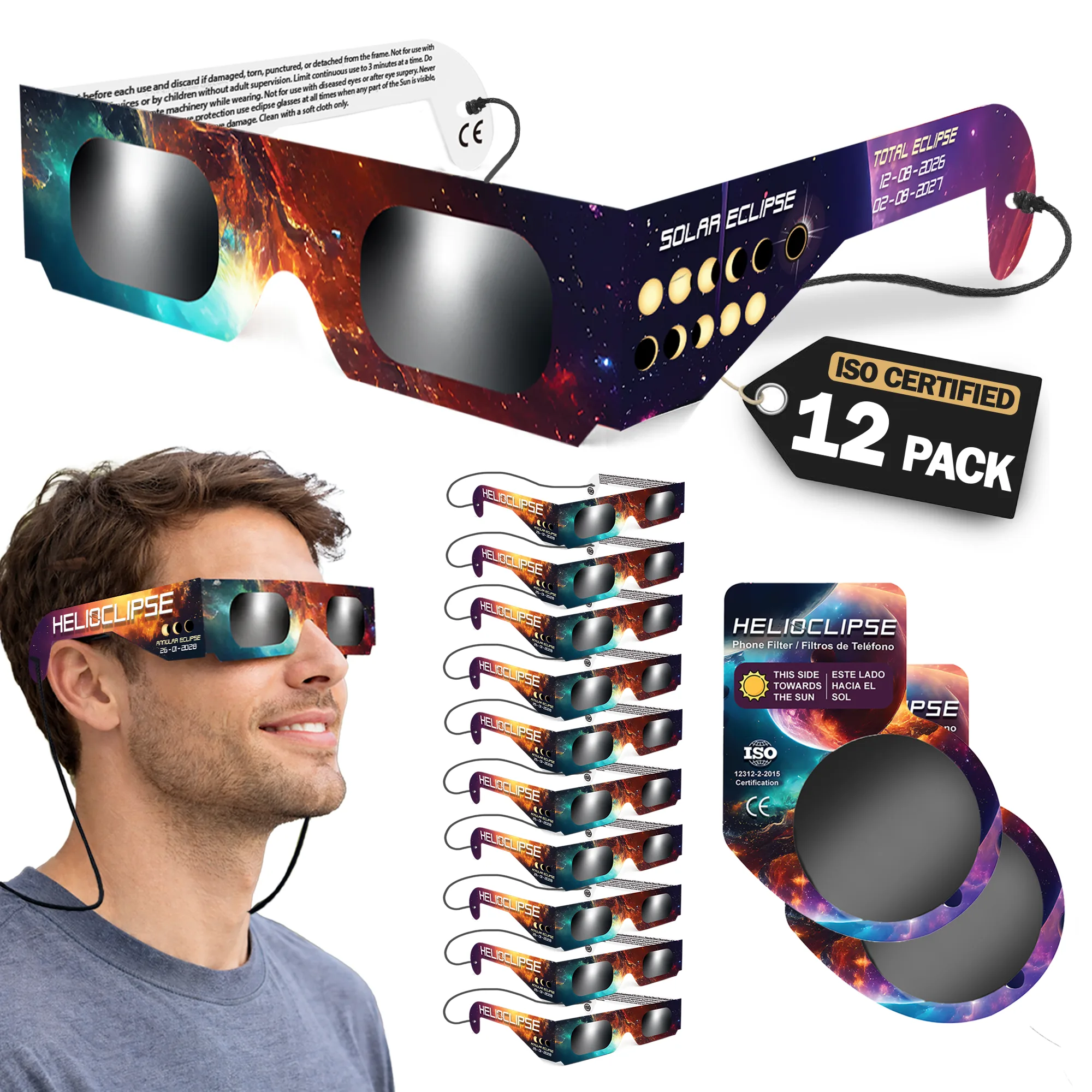
If you want a straightforward on-site option, start with the Helioclipse shop. That is the easiest way to avoid the last-minute scramble that leads people into random listings and questionable stock. When you are comparing listings anywhere, useful product language includes approved solar eclipse glasses, solar eclipse glasses iso 12312-2 certified, eclipse viewing glasses, and certified solar eclipse glasses—but do not stop at the phrase alone. Check the manufacturer information, instructions, and condition of the product you actually receive.
For groups, remember another AAS point that people often miss: you do not necessarily need one viewer per person for continuous use during the entire partial phase. The eclipse changes slowly. Families, classrooms, and friend groups can share brief looks if they are organized and careful. That can take pressure off the budget without pushing anyone toward unsafe shortcuts.
A practical checklist for eclipse glasses for eyeglass wearers
If you want the no-drama version of this article, here it is.
Before eclipse day
- Keep your normal prescription glasses.
- Buy a solar viewer that conforms to ISO 12312-2.
- Test the fit over your everyday frames.
- Inspect for scratches, punctures, tears, loose filters, or water damage.
- Make a backup indirect-viewing plan for kids or anyone who dislikes the fit.
- Tell your group the rules before the event starts.
On eclipse day
- Put the viewer on before looking up.
- Look away before removing it.
- Do not keep adjusting it while staring upward.
- Do not use it with unfiltered binoculars, telescopes, or cameras.
- Supervise children.
- If you are in totality, remove it only during totality itself, then put it back on the instant bright sunlight returns.
That is the real guide to eclipse glasses over prescription glasses in practice: not a miracle product, just correct gear used calmly.
How to know if solar eclipse glasses are safe
FOX 4 Dallas-Fort Worth
Frequently asked questions
How do you wear eclipse glasses with glasses?
Put your prescription glasses on first, then place the eclipse viewer over them — that is the standard approach endorsed by the American Astronomical Society. Your regular glasses help you see clearly but do not replace a solar filter. If the fit feels loose, test the mechanics indoors first: tilt your head up and check that the viewer stays put without leaving gaps at the sides.
What kind of glasses are actually safe for looking at the Sun during an eclipse?
You need a special-purpose solar viewer that conforms to ISO 12312-2 for direct viewing of the Sun. Ordinary prescription lenses, blue-light glasses, transition lenses, polarized sunglasses, and fashion sunglasses are not solar viewers.
If someone has cataracts, what should they use to view an eclipse safely?
The excerpt does not give cataract-specific advice. It does say that anyone viewing the Sun needs a proper solar viewer that conforms to ISO 12312-2, and that prescription glasses can be worn underneath if needed for normal vision correction.
What should people know before using a fit-over eclipse viewer in 2026?
The key point is that fit matters as much as darkness. A viewer that pinches, slips, or leaves gaps is more likely to be adjusted or removed, so it should be chosen to stay put comfortably over your regular glasses.
Is there anything different to consider for women using fit-over eclipse glasses?
The excerpt does not describe different safety rules by gender. The same guidance applies: keep your prescription glasses on if you wear them, and use a solar viewer that fits comfortably and stays in place without gaps or slipping.
On-site next steps
- Shop early for Helioclipse eclipse glasses so you can test fit over your prescription eyewear before eclipse day.
- Use our Eclipse Explorer / 3D map to confirm whether your location is in totality or only partial phases, because that changes when glasses stay on.
- Keep learning in the Helioclipse blog, especially our guides to ISO 12312-2, eclipse phases, and eye injury risk.
Sources & further reading
- Eyewear & Handheld Viewers | Solar Eclipse Across America
- How to observe the sun safely (and what to look for) | Space
- Solar eclipse glasses: How to check safety and use them correctly | Space
- Gear to safely see the 2024 eclipse | Astronomy
- How to Tell if Your Eclipse Glasses Are Unsafe (and What To Do About It) | Space
- How to View a Solar Eclipse Safely | Solar Eclipse Across America
- Suppliers of Safe Solar Viewers & Filters | Solar Eclipse Across America
- Telescopes & Binoculars | Solar Eclipse Across America
- Phenomena You'll Experience at a Total or Annular Eclipse | Solar Eclipse Across America
- AAS-Chou Tech Report: Solar Eclipse Eye Safety 2023