Annular, total, hybrid, partial: the taxonomy tourists confuse—and why your glasses rule does not change
If you have spent any time around eclipse chatter lately, you have probably seen people mix up ring of fire photos, totality videos, and travel plans for completely different events. That is normal. The internet has mashed together annular vs total solar eclipse 2023, 2024 reaction clips, old forum threads, and future-trip planning into one giant memory soup.
So let’s slow it down and make it useful. This is our annular vs total solar eclipse difference 2026 guide for people who want the vocabulary to finally click without being talked down to. If you are already planning your next event, our Eclipse Explorer / 3D map helps you check whether your location is in totality, annularity, or only a partial view.
The short version is simple: there are four main solar-eclipse labels you will hear most often—partial solar eclipse, annular solar eclipse, total solar eclipse, and hybrid solar eclipse. They describe geometry, not hype. And the safety rule is even simpler than the taxonomy: if any part of the bright Sun is still visible, you need certified solar viewing protection or an indirect method. The only direct-view exception is the brief total phase of a total solar eclipse, and only if you are actually inside the path of totality.
The four types, in plain English
A solar eclipse happens when the Moon passes between Earth and the Sun. But the alignment is not always the same, and the Moon does not always appear the same size in our sky. That is why the experience can range from “a bite taken out of the Sun” to “daylight collapses and the corona appears.”
Here is the clean taxonomy.
Partial solar eclipse
A partial solar eclipse is the most common experience for most people during most eclipse events. The Moon covers only part of the Sun as seen from your location. The Sun looks crescent-shaped or as if a chunk has been removed.
This can happen in two ways: either the eclipse is globally a partial event, or you are outside the central path of a total or annular eclipse and only see the partial phases from your spot. In both cases, the bright solar surface is still visible the entire time.
Total solar eclipse
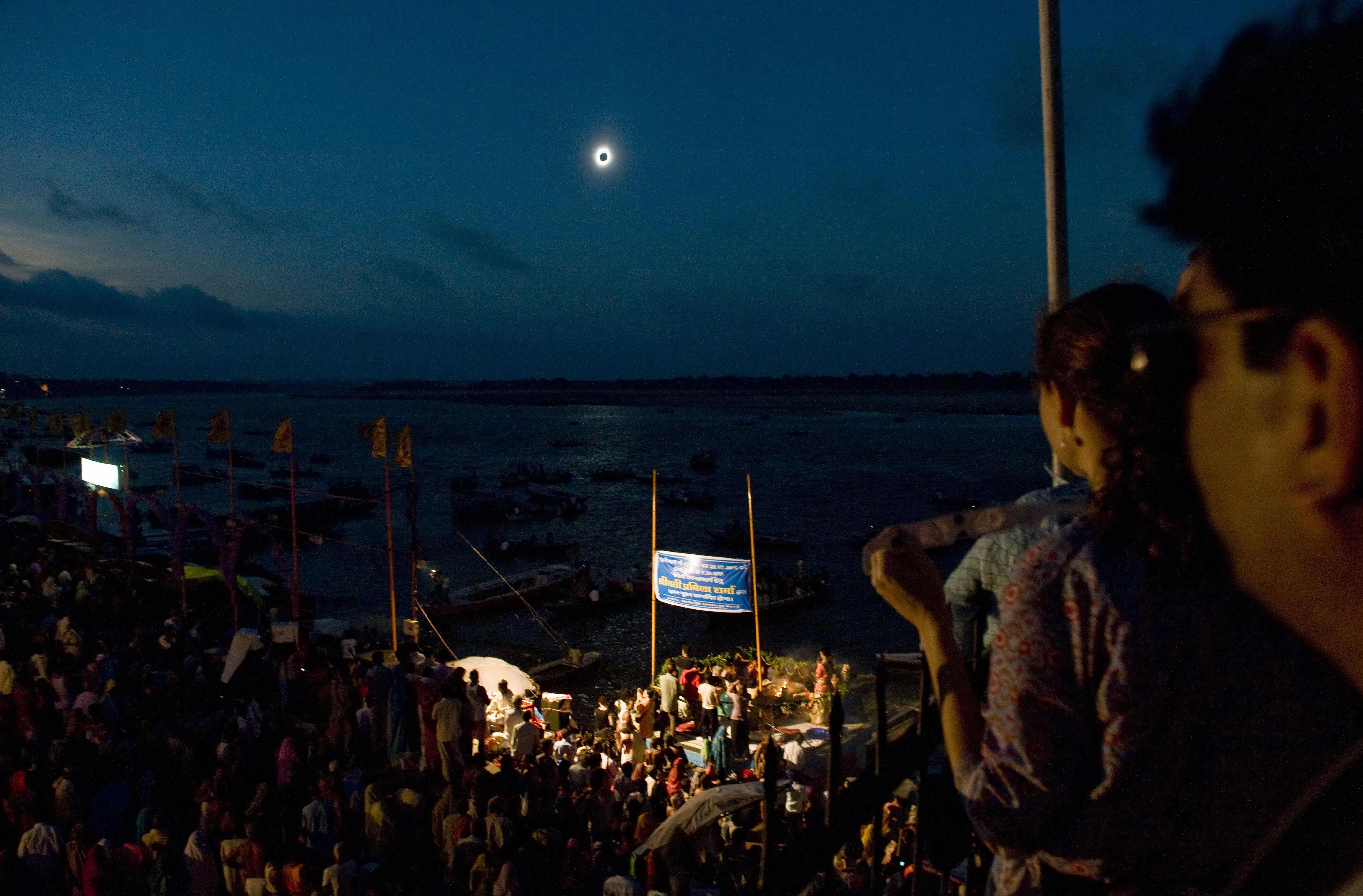
A total solar eclipse happens when the Moon completely covers the Sun’s bright face for observers inside a narrow path on Earth. That brief interval is totality. This is the only time you can see the corona with the unaided eye, and the only time direct viewing without eclipse glasses is allowed.
This is why total eclipses feel so different from everything else. The sky darkens toward twilight, bright planets may appear, the horizon can glow in a 360-degree sunset effect, and the Sun’s outer atmosphere becomes visible because the blinding photosphere is fully blocked.
Annular solar eclipse
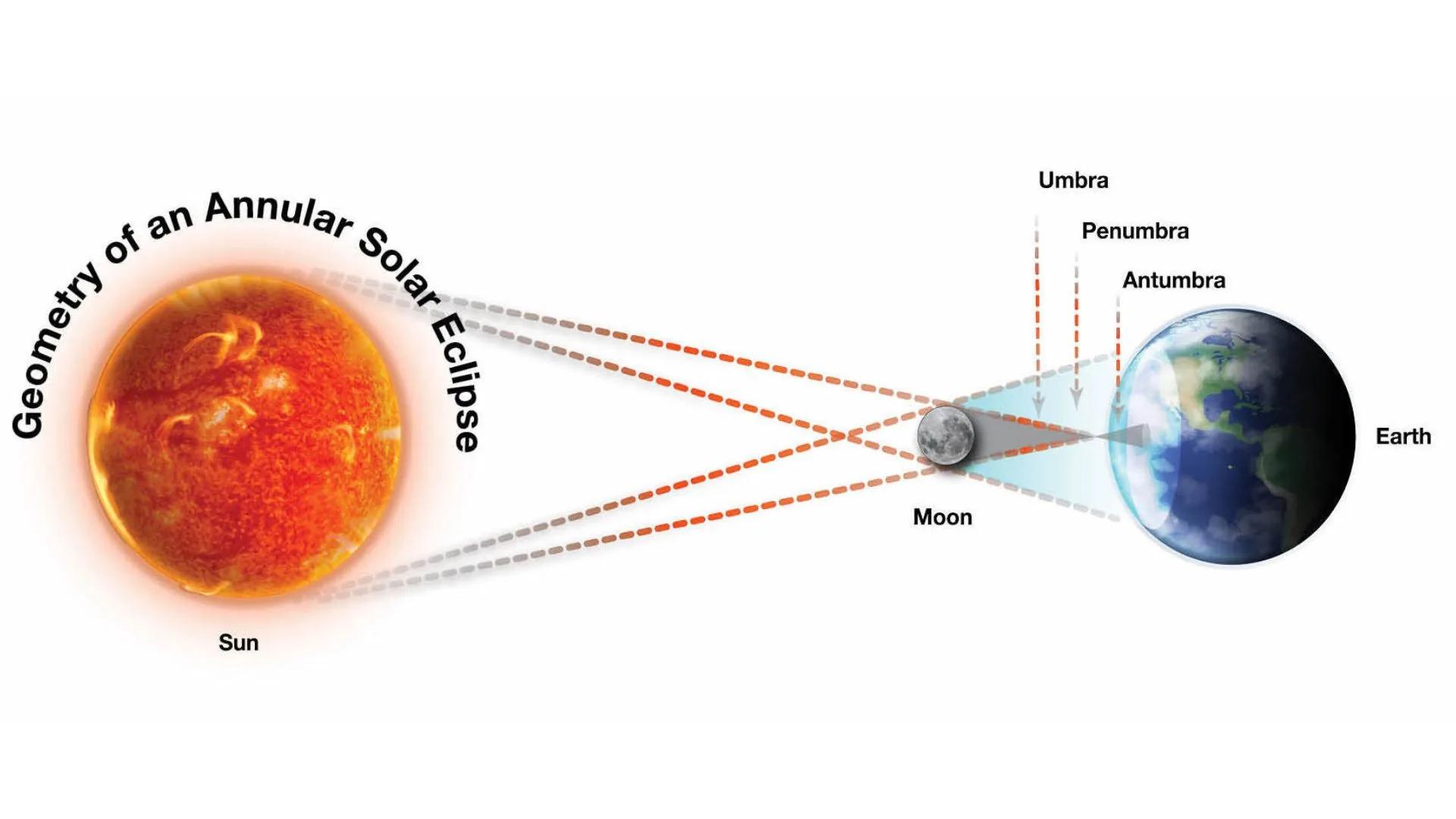
An annular solar eclipse happens when the Moon passes centrally in front of the Sun but appears slightly too small to cover it completely. The result is the famous ring of sunlight around the Moon’s silhouette: the “ring of fire.”
That ring is beautiful—but it is still direct, intense sunlight. So an annular eclipse never gives you a safe glasses-off interval. Not for a second.
Hybrid solar eclipse
A hybrid solar eclipse is the rare shape-shifter. Because of the curvature of Earth and the exact geometry of the shadow, the eclipse can appear annular along some parts of its track and total along others. In other words, the same event can be annular in one stretch and total in another.
This is where people get understandably confused. A hybrid is not a fifth vibe category. It is a specific geometric case in which the event changes character along the path.

The real annular vs total solar eclipse difference
If you remember only one distinction, make it this one: the annular vs total solar eclipse difference is whether the Moon completely covers the Sun’s bright face.
In a total eclipse, it does. In an annular eclipse, it does not.
That single fact changes almost everything you experience.
During totality, the corona appears, the sky darkens dramatically, and the world around you can feel briefly unstitched from ordinary daytime. During annularity, the ring of sunlight keeps the sky much brighter, the corona stays hidden, and the visual drama is more about precision and shape than darkness.
The American Astronomical Society puts this especially well in its eclipse-phenomena guidance: most of the buildup can feel similar, but the central moment is not interchangeable. A total eclipse is a full shutoff of the Sun’s bright disk. An annular eclipse is a bright ring that never stops shining.
That is why “which is better?” is not really a technical question. If you want the corona, deep twilight, and the famous emotional shock people talk about after totality, only a total eclipse delivers that. If you want a striking geometric ring and a fascinating demonstration of orbital mechanics, an annular eclipse is still absolutely worth seeing. But they are not substitutes.
Why the Moon sometimes makes a ring instead of full darkness
The Moon’s orbit around Earth is not a perfect circle. Sometimes the Moon is a bit closer to us and appears slightly larger in the sky; sometimes it is farther away and appears slightly smaller.
That size difference is the whole trick.
When the Moon is close enough in apparent size to cover the Sun completely, a total eclipse is possible. When it is farther away and looks too small, sunlight remains visible around the edge and you get an annular solar eclipse instead.
So if you have ever asked, “what is the difference between total eclipse and annular eclipse?” the answer is not that one is more “intense” in some vague way. It is angular size and alignment. The Moon either fully covers the Sun’s bright face from your location, or it does not.
That also explains why eclipse maps matter so much. The event type is not just about the date; it is about where you stand under the shadow geometry. Our Eclipse Explorer / 3D map is useful here because “close to the path” and “inside the path” are not the same thing.
Why your glasses rule does not change
This is the part we want every family, teacher, and first-time traveler to remember.
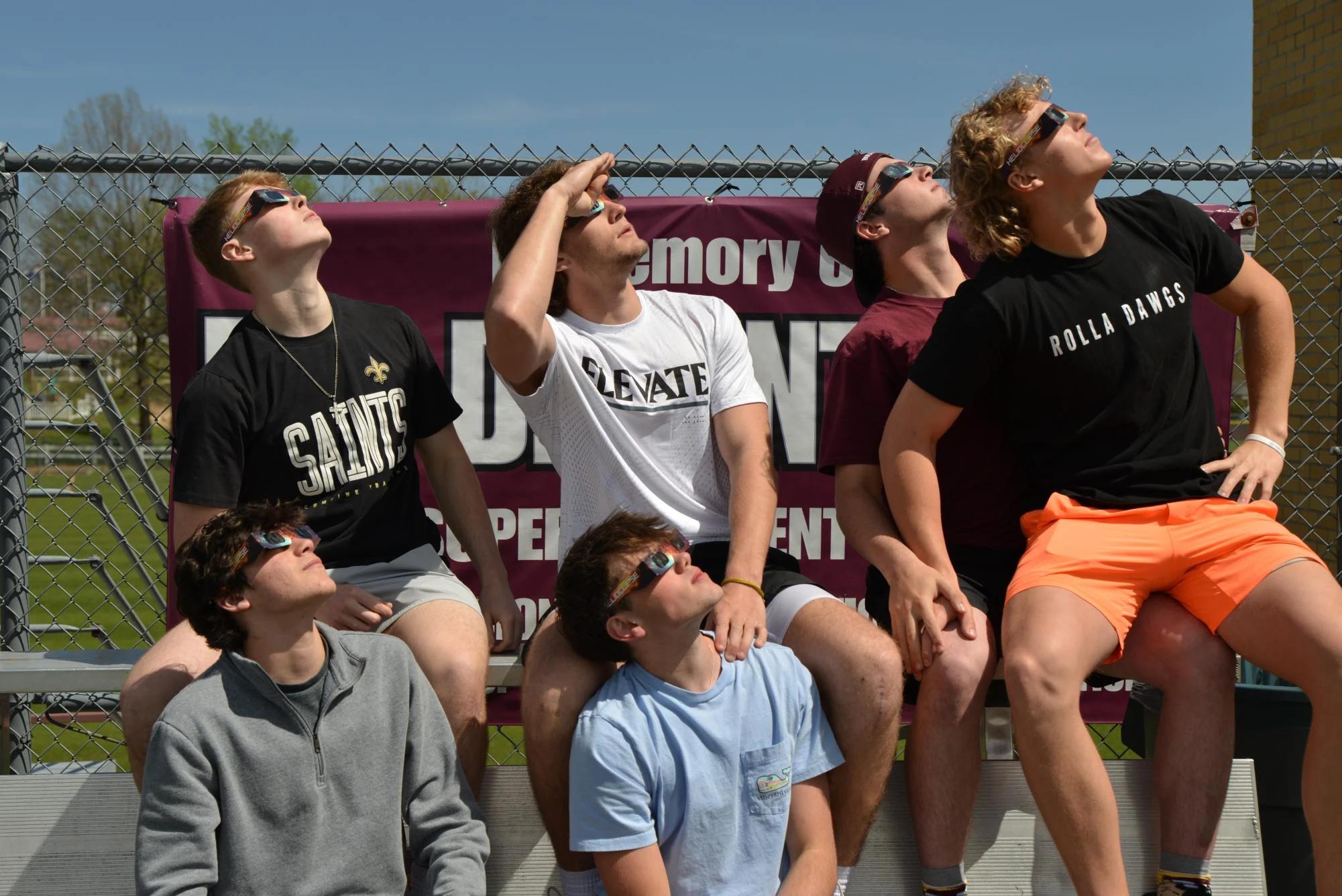
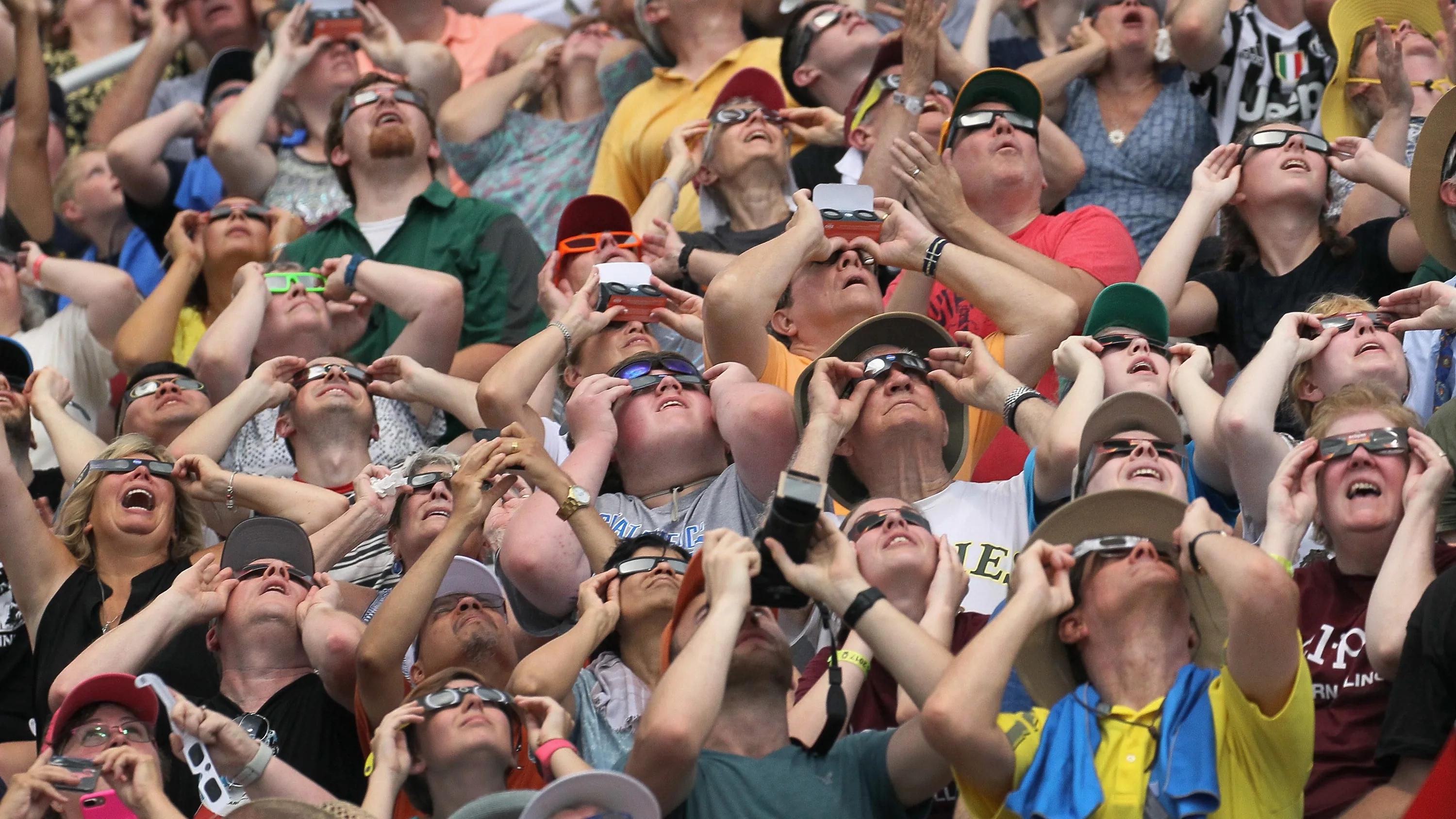
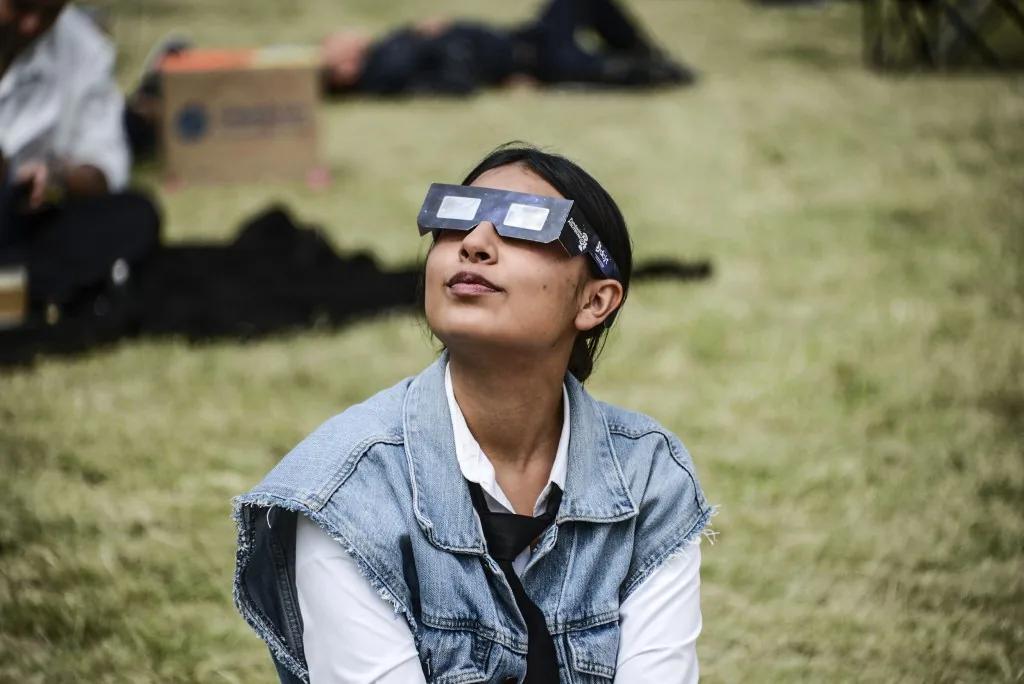
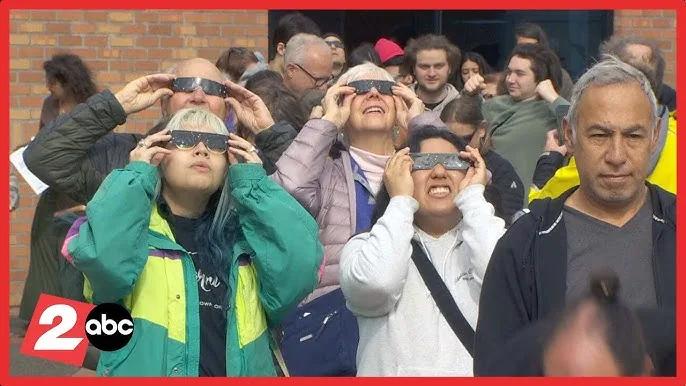
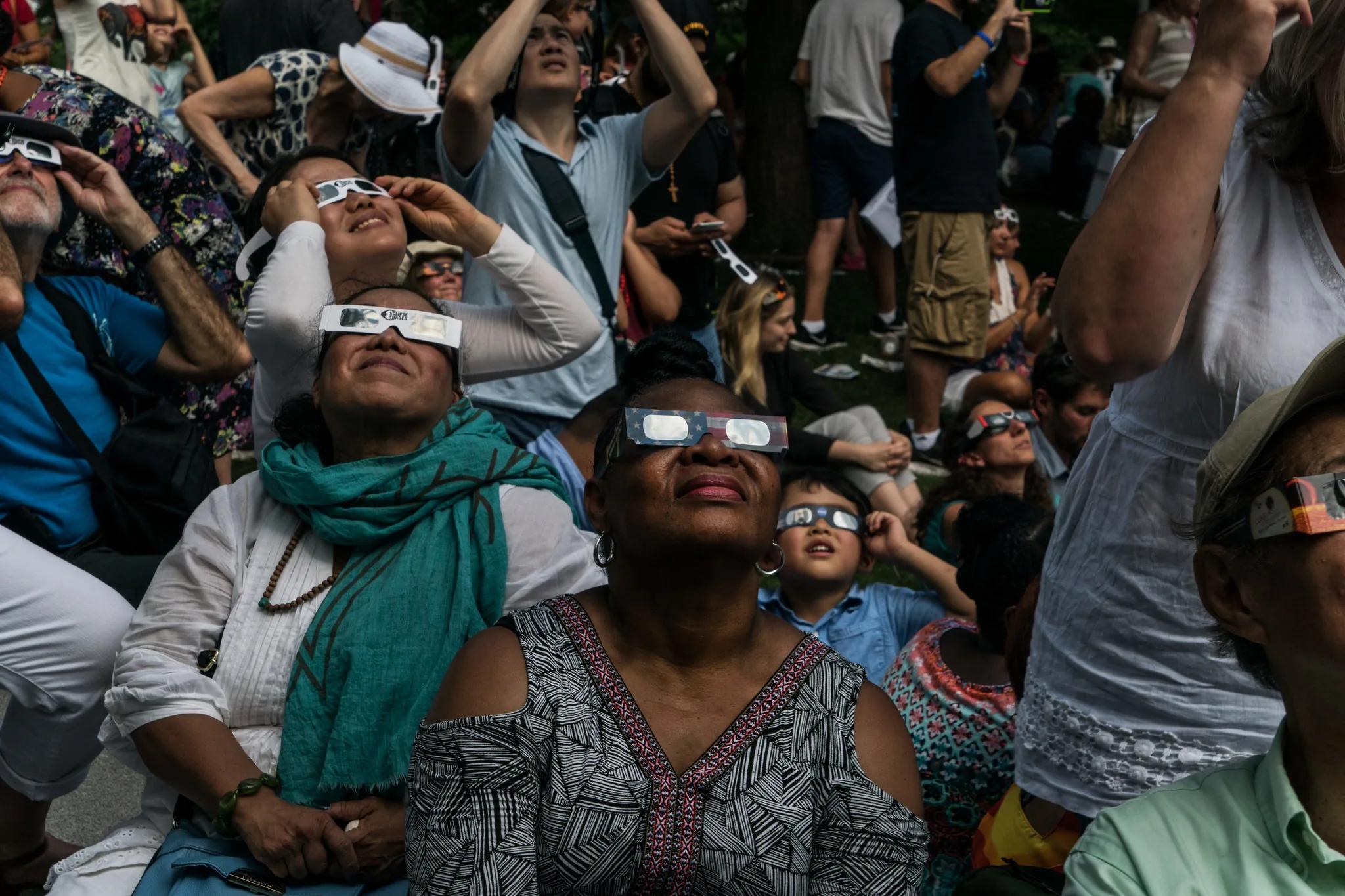
For eye safety, the rule is not “wear glasses for the boring eclipses and take them off for the exciting one.” The real rule is: if any bright Sun is visible, use proper solar protection or an indirect viewing method.
That means:
- during every partial solar eclipse, glasses on
- during every annular phase of an annular solar eclipse, glasses on
- during the partial phases before and after totality in a total eclipse, glasses on
- only during totality itself, and only if you are truly inside the path of totality, glasses may come off for direct viewing
NASA and the AAS are both explicit about this. Outside totality, direct solar viewing requires special-purpose solar filters that conform to ISO 12312-2, or an indirect method like pinhole projection.
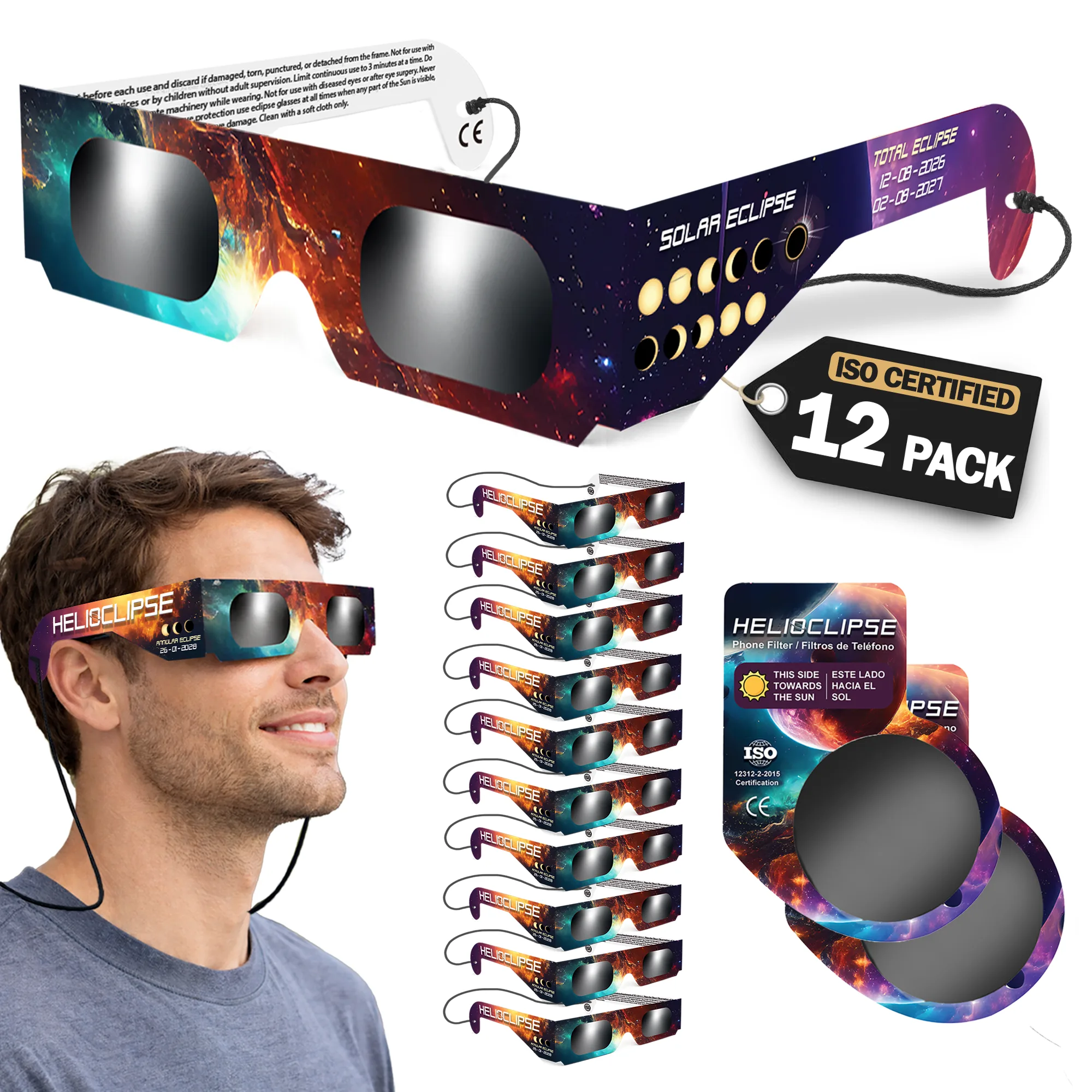
This is where a lot of shopping language online gets messy. People search for approved solar eclipse glasses, eclipse glasses nasa approved, or solar eclipse glasses iso 12312-2 certified. The important clarification is that NASA does not approve a particular brand of viewers. What matters is using properly made solar viewers that meet the relevant safety standard and are in good condition.
If you want a deeper breakdown of timing, our guide to when glasses on, when glasses off: eclipse phases explained for first-time viewers is the right companion piece. And if you are buying for a group, you can browse Helioclipse eclipse glasses early rather than scrambling the week before an event.
What you actually see in each type
Taxonomy gets easier when you attach it to lived experience instead of labels.
In a partial eclipse
The Sun slowly turns into a crescent. Light on the ground can look strange. Tree leaves can project dozens of tiny crescent Suns. But the world does not drop into true eclipse darkness, because a bright part of the photosphere remains visible the whole time.
If you were sketching a partial solar eclipse diagram, you would show the Moon offset from the Sun’s center as seen by the observer, with only part of the disk covered.
In an annular eclipse
The partial phases build in a familiar way, but near the center of the event it becomes obvious that the Moon is too small to finish the job. The horns of the shrinking crescent stretch around until they join into a bright ring.
In an annular solar eclipse diagram, the Moon sits centrally over the Sun but does not fully cover it, leaving a ring of sunlight around the edge. That ring is why the corona remains hidden and why your eye-safety rule does not relax.
In a total eclipse
The last sliver of direct sunlight vanishes. Baily’s beads and the diamond ring can appear right around the transition. Then totality begins: the corona comes out, the sky darkens sharply, and the landscape changes character in a way that photographs never fully capture.
This is also why people who compare clips online can get misled. A phone video of an annular ring and a phone video of totality are both dramatic, but they are documenting different physical situations.
In a hybrid eclipse
What you see depends on where you are along the track. One location may get annularity; another may get totality. So the label “hybrid” tells you something important about the event as a whole, but not enough by itself to tell you what you will experience. For that, you still need the path geometry.
Why old threads and memes keep confusing people
Search results are full of leftovers: annular vs total solar eclipse difference 2022, annular vs total solar eclipse 2023, annular vs total solar eclipse reddit, and annular vs total solar eclipse difference reddit all keep circulating because people revisit the same question before each new event.
That does not mean people are clueless. It means eclipse memory is weird. Most of us do not store “October annular in one region, April total in another, 2026 total in Europe and North Africa, 2027 longer totality elsewhere” as a clean mental filing system. We store the spectacular images and the social buzz.
So yes, we should disambiguate phenomena without dunking on readers who eclipse planning conversations have left understandably tangled. The fix is not snobbery. It is a better mental model:
- partial = only part of the Sun covered from your location
- annular = centered alignment, but the Moon looks too small, so a ring remains
- total = centered alignment, and the Moon fully covers the Sun’s bright face
- hybrid = the event changes between annular and total along different parts of its path
Once that clicks, the safety rule becomes almost boringly consistent—in a good way.
Does 2026 change any of this?
No. The geometry terms do not change because the travel year changes.
That is why the phrase annular vs total solar eclipse difference 2026 guide should lead you back to the same physics, not to a new rulebook. If you are planning for the August 12, 2026 total solar eclipse, what matters is whether your chosen location is inside totality or outside it. If you are outside the path, you are watching a partial eclipse from your site, even though the global event is a total eclipse.
That distinction matters a lot in real planning. Someone in the path may get a brief glasses-off totality interval; someone in a nearby city outside the path gets no such moment at all. If 2026 is your target, our August 12, 2026 total solar eclipse planning guide and 2026 totality in Spain: path basics, timing, and what “on the centerline” really means are the practical next reads.
And if you are wondering about the annular solar eclipse 2026 path, that is a separate planning question from the 2026 European total eclipse. Different date, different track, different experience. Always verify the specific event on a current map rather than assuming “2026 eclipse” means one thing worldwide.

The optics mistake that catches smart people
A lot of otherwise careful viewers think the rule changes if they use binoculars, a telescope, or a camera. It does not get looser. It gets stricter.
You should never look at the Sun through unfiltered optics. And you should not look through optics while wearing ordinary eclipse glasses and assume that solves it. For telescopes, binoculars, and camera lenses, the solar filter must be attached securely to the front of the instrument, as the AAS emphasizes.
That applies during partial phases and during annularity. During totality, different protocols can apply for properly planned observing or imaging, but only for the brief fully total phase and only if you know exactly what you are doing. For most first-time viewers, the safest plan is simple: use certified handheld viewers for direct viewing, and keep optics filtered unless you have learned the totality procedure in advance.
If you want the standards side explained in plain language, our ISO 12312-2 and eclipse viewers guide is built for exactly that question.
Which is rarer, total or annular? And is annular still worth it?
People often ask which is rarer, but rarity is not the best way to choose your trip. What matters more is what you want to experience and how far you are willing to travel.
Total eclipses are the ones that produce totality, corona viewing, and the most dramatic environmental change. That makes them the bigger bucket-list event for many people.
But an annular eclipse is not some consolation prize. A well-placed annular event gives you a precise, eerie ring of sunlight that is visually unforgettable. It also teaches the geometry beautifully: the Moon is centered, the alignment is excellent, and yet the Sun is still not fully covered because apparent size matters.
So if you are asking whether an annular solar eclipse is worth it, our answer is yes—absolutely. Just do not expect it to behave like totality, and do not borrow total-eclipse safety habits for an annular event.
The safest one-sentence rule to tell your group chat
If you need one line to send to friends, parents, or a school group, use this:
If any part of the bright Sun is visible, keep certified solar viewers on or use an indirect method; only people inside totality may look without them during the brief fully total phase.
That sentence covers partial eclipses, annular eclipses, the partial phases of total eclipses, and the location-specific reality of hybrid eclipses.
It also cuts through the noise around phrases like eclipse viewing glasses, “NASA approved,” or “close enough to totality.” Close enough is not totality. A thin sliver of Sun is still the Sun.
Annular and Total? A Hybrid Eclipse!
Caoimhin's Content
Frequently asked questions
How does a total solar eclipse differ from an annular one?
A total solar eclipse completely covers the Sun’s bright face for observers inside the path of totality, while an annular eclipse leaves a bright ring of Sun visible around the Moon. The key difference is whether the Moon appears large enough to block the Sun entirely or only most of it. Only during totality can you view the corona without eclipse glasses.
What are the four main kinds of solar eclipses people talk about?
The four main labels are partial, annular, total, and hybrid solar eclipses. They describe the geometry of the alignment and what you see from your location, not how dramatic the event sounds. In all cases except the brief total phase of a total eclipse, the bright Sun is still visible and protection is needed.
Is a total eclipse harder to see than an annular one?
Yes, a total eclipse is harder to experience because it is only visible from a narrow path on Earth during a brief total phase. An annular eclipse can be seen from a wider area, but it still does not allow direct viewing of the Sun without protection because the bright solar surface remains visible. The excerpt does not say which type is rarer overall.
How do partial, annular, and total eclipses compare in what you actually see?
A partial eclipse shows only part of the Sun covered, so the Sun looks crescent-shaped or bitten out. An annular eclipse leaves a ring of sunlight around the Moon, while a total eclipse fully covers the Sun’s bright face and briefly reveals the corona. The viewing rule changes only for totality inside the path of totality.
Why do some eclipses turn total while others stay annular?
It depends on the geometry of the alignment and the Moon’s apparent size in the sky. When the Moon appears large enough, it can completely cover the Sun and produce totality; when it appears a bit smaller, a ring of sunlight remains and the eclipse is annular. The excerpt frames this as a matter of geometry, not hype.
On-site next steps
- Check your exact eclipse geometry with our Eclipse Explorer / 3D map. It is the fastest way to confirm whether your location is in totality, annularity, or only a partial view.
- If your plan includes direct viewing, get your Helioclipse eclipse glasses early so your family or group is not improvising at the last minute.
- For more safety and planning help, browse the Helioclipse blog and our guide on why staring at the Sun without protection is never “just a quick look”.
Sources & further reading
- NASA Science — Types of Eclipses
- AAS Solar Eclipse Across America — Phenomena You'll Experience at a Total or Annular Eclipse
- Exploratorium — Total, Partial, & Annular Solar Eclipses
- NASA Science — What to Expect
- NASA Science — March 29, 2025, Partial Solar Eclipse
- AAS Solar Eclipse Across America — How to View a Solar Eclipse Safely
- NASA Science — Eclipse Viewing Safety
- AAS Solar Eclipse Across America — Solar Filters for Optics: Telescopes, Binoculars & Cameras
- NASA Science — Solar Eclipse Resources
- NASA Science — Eclipse Cereal Box Viewer