Saros families in one sitting: why eclipses arrive in recognizable ‘seasons’
Eclipses can feel wildly rare when you’re standing in one place on Earth, but from a sky-wide point of view they are anything but random. They come in rhythms. They come in families. And once you see that pattern, a lot of eclipse weirdness suddenly makes sense.
That is the emotional payoff of the saros cycle solar eclipse explained well: not memorizing a number for a quiz, but realizing the sky has structure. If you want to connect that structure to real events, our Eclipse Explorer / 3D map lets you see where a given eclipse falls on Earth, while our blog hub goes deeper on phases, safety, and planning.
The short version is this: after about 18 years, 11 days, and 8 hours, the Sun, Earth, and Moon return to nearly the same geometry. That repeat interval is called a Saros. It does not mean the next eclipse happens over your house. It means the next eclipse in the same family will look broadly similar in type and geometry, but it will usually be shifted to a different part of the world.
That is why eclipses arrive in recognizable “seasons” and lineages rather than as one-off accidents. Let’s unpack what repeats, what drifts, and why eclipse chasers keep talking about Saros numbers.
First, the simpler pattern: eclipse seasons
Before we get to the Saros, it helps to separate two ideas that often get mashed together.
An eclipse season is the shorter rhythm. Roughly every 173 days — about every six months — the geometry is favorable for eclipses because the new Moon or full Moon happens near one of the Moon’s orbital nodes, the places where the Moon’s tilted orbit crosses the plane of Earth’s orbit. The American Astronomical Society explains this basic geometry clearly in its eclipse primers.
That is why solar eclipses do not happen at every new Moon. Most months, the Moon passes a little above or below the Sun in our sky. But when new Moon lands near a node, a solar eclipse becomes possible. Sometimes one solar eclipse happens in that season; sometimes the timing allows another about a month later.
So if you have ever noticed that eclipses seem to cluster, you were noticing a real thing. The short clustering is eclipse season. The longer family resemblance across decades is the Saros.
What the Saros actually is
The saros eclipse cycle is about 6,585.3 days long, which works out to roughly 18 years, 11 days, and 8 hours. NASA’s classic reference page on the topic describes it as a near-match between several lunar cycles that matter for eclipses.
Why those cycles? Because an eclipse depends on more than one thing happening at once. You need a new Moon. You need that new Moon to occur near a node. And for the eclipse to be similar in character — total, annular, long, short, broad, narrow — it also matters how far the Moon is from Earth, because that changes the Moon’s apparent size in the sky.
The remarkable part is that these different lunar rhythms line up again after one Saros closely enough to produce a nearly identical eclipse. In NASA’s numbers, one Saros equals 223 synodic months, and it is also very close to 242 draconic months and 239 anomalistic months. You do not need to memorize those names to get the point. The point is that the Moon’s phase, node crossing, and distance all come back into near-agreement.
That is the core of saros cycle eclipse meaning in plain English: the geometry almost resets.
Why the next eclipse in the family is not over the same place
This is the part many first-time readers miss, and it is the part that matters most for planning.
A Saros is not a whole number of days. It includes that extra 8 hours. During those 8 hours, Earth keeps rotating. So when the next family member arrives one Saros later, Earth has turned about one-third of a rotation farther. That shifts the eclipse path by roughly 120 degrees in longitude, generally westward for solar eclipses.
So the saros cycle and solar eclipse story is not “same eclipse, same place.” It is “similar eclipse, different part of Earth.” Astronomy Magazine gives a nice practical version of this: if one long total eclipse peaks over one region, the next similar one 18 years later may peak over a very different continent or ocean basin.
This is also why the phrase best places and timing for saros cycle solar eclipse explained needs a reality check. The Saros helps you understand family resemblance. It does not by itself tell you the best place to stand for the next event. For that, you still need an actual path map, local timing, and weather context. That is exactly where our Eclipse Explorer / 3D map becomes more useful than a bare cycle number.
A family, not a clone
When people talk about Saros 145 or Saros 136, they are talking about eclipse families — long-running series in which each member is separated from the next by one Saros.
A family begins near one of Earth’s poles as a small partial eclipse. Over many centuries, the geometry shifts so that later members become central eclipses — total, annular, or hybrid — and the track migrates across the globe. Eventually the family weakens again into partial eclipses near the opposite pole and ends.
NASA says a solar Saros series may last roughly 1,226 to 1,550 years and contain about 69 to 87 eclipses, with around 40 to 60 of them central. So if you have wondered, how many eclipses are in a saros series? the honest answer is: not one fixed number, but typically several dozen, often around 70 or more.
That also answers what is the saros cycle of the eclipses? It is both a time interval and a way of organizing eclipse families. One Saros is the step between relatives. A Saros series is the whole family album.
Why each family member drifts north or south
If the Saros were a perfect reset, every family member would trace the same line forever. But it is only an approximate reset.
The Moon’s orbit and the node geometry do not return to exactly the same state each time. The mismatch is small, but over centuries it matters. NASA notes that the Moon’s node shifts a little from one Saros to the next, and the eclipse track moves accordingly. In some series the path drifts northward from event to event; in others it drifts southward, depending on whether the eclipse occurs near the ascending or descending node.
That is the answer to the common question what a saros cycle is in relation to eclipses? It is a repeat pattern with a built-in drift. Similar does not mean identical.
Or, put another way: the Saros gives you family resemblance, not photocopies.
Why one family can produce long totalities
Some Saros families become famous because they produce especially long total eclipses during the part of the series that passes near Earth’s equatorial regions and catches the Moon at a favorable apparent size.
NASA’s Saros 136 example is a good one. That family includes some of the longest total solar eclipses of the 20th and 21st centuries. The reason is not magic and not luck. It is geometry: the Moon is near the right distance, the shadow path crosses favorable parts of Earth, and the alignment is especially efficient at covering the Sun.
This is where saros cycle eclipses becomes more than a dry catalog term. Once you know a family’s place in its long life, you can understand why one era of that family produces brief partials near a pole while another era produces dramatic central eclipses with minutes of totality.
Still, do not overread the pattern. A Saros can hint that a later family member may also be total or annular, but it does not replace modern ephemerides, detailed path calculations, or local forecasts. It definitely does not predict cloud cover, travel ease, or whether your chosen hilltop will be clear at the crucial minute.
The 2026 and 2027 examples people keep noticing
If you are reading this because you are planning ahead, the upcoming eclipse years make the Saros feel less abstract.
NASA’s eclipse hub notes that the next total solar eclipse after the 2024 North American event is on August 12, 2026, with totality crossing Greenland, Iceland, northern Russia, the Atlantic, Spain, and a small corner of Portugal. Then on August 2, 2027, another major total eclipse crosses parts of North Africa and the Middle East.
A good saros cycle solar eclipse explained 2026 guide should be honest here: 2026 and 2027 are both exciting, but they are not “the same eclipse coming back.” They belong to different circumstances and different paths. The Saros is one organizing principle among several, not a shortcut that collapses all future eclipses into one repeating travel plan.
If you are specifically planning for Europe, our guide to August 12, 2026 total solar eclipse: what to expect and how to plan ahead is the better next read, and if Spain is your focus, 2026 totality in Spain: path basics, timing, and what “on the centerline” really means gets into the geography that a Saros article should not pretend to replace.

Why ancient astronomers cared so much
The Saros has a wonderful historical hook: people recognized eclipse repetition long before computers existed.
Babylonian skywatchers are often credited with identifying the pattern in antiquity, and later astronomers used it as a practical predictive tool. That does not mean ancient observers could generate the kind of second-by-second local predictions we expect now. It means they noticed that after about 18 years, similar eclipses tended to recur.
That is a big intellectual leap. It turns a terrifying surprise into a patterned sky event.
Sky & Telescope and Astronomy both make this point well: the Saros was powerful because it let observers connect records across generations. If you keep careful notes long enough, the heavens stop looking chaotic.
There is also a subtle historical point worth keeping. The Saros was especially useful as a pattern-recognition tool, but modern eclipse prediction relies on detailed orbital models and ephemerides, not on the Saros alone. So when readers look for saros cycle solar eclipse explained nasa, the best answer is not “NASA uses only Saros numbers.” The best answer is that NASA treats the Saros as a real and useful recurrence pattern inside a much richer predictive framework.
What the Saros does not tell you
This may be the most important section in the whole article.
The Saros does not tell you whether your city is in totality. It does not tell you whether clouds will ruin the view. It does not tell you whether one beach, plateau, or roadside pullout is better than another. And it absolutely does not tell you anything about astrology, luck, or personal fate.
You may see searches for saros cycle calculator, saros cycle dates, or even saros cycle astrology. The first two can be useful if they lead you toward real eclipse tables and family catalogs. The last one is not astronomy. The Saros is a geometric recurrence in the Earth-Moon-Sun system, not a forecast of human events.
Likewise, if you are trying to answer best places and timing for saros cycle solar eclipse explained, the practical answer is: use the Saros to understand pattern, then use a real map and local circumstances to make decisions. For actual observing, you need path position, contact times, altitude of the Sun, and weather odds.
The “same place again” idea: almost, but on a longer clock
People often ask whether the same eclipse ever comes back to the same region.
Sort of — but not after just one Saros.
Because each Saros adds that extra 8 hours, three Saroses add about 24 hours plus a little extra. After three Saroses — about 54 years and 34 days, a period called an exeligmos — a similar eclipse can return to roughly the same part of the world at a similar time of day. “Roughly” matters here. It is closer, not perfect.
So if you are asking why does each eclipse in a saros cycle series not occur in the same location each time? the answer is Earth’s rotation during the extra one-third day. And if you are asking how long it takes to come back near the same region, the rough answer is three Saroses, not one.
Why this matters for ordinary eclipse watchers
You do not need to become a catalog expert to get something valuable from this.
The Saros teaches you that eclipses are neither random nor routine. They are structured enough to be predictable, but dynamic enough to stay surprising. That is a lovely middle ground. It gives you pattern literacy without draining the wonder out of the event.
It also helps you talk about eclipses more clearly with friends, family, or students. Instead of saying “another eclipse happens in 18 years,” you can say: a related eclipse happens in about 18 years, with similar geometry, but probably over a different part of Earth. That is a much better mental model.
And if you are building your own eclipse habit — one event now, another years later, maybe a family trip in 2026 or 2027 — this perspective makes the sky feel connected across decades. One eclipse stops being a one-off spectacle and becomes part of a long-running story.
A quick note on viewing safely
Understanding the Saros does not change the safety rules.
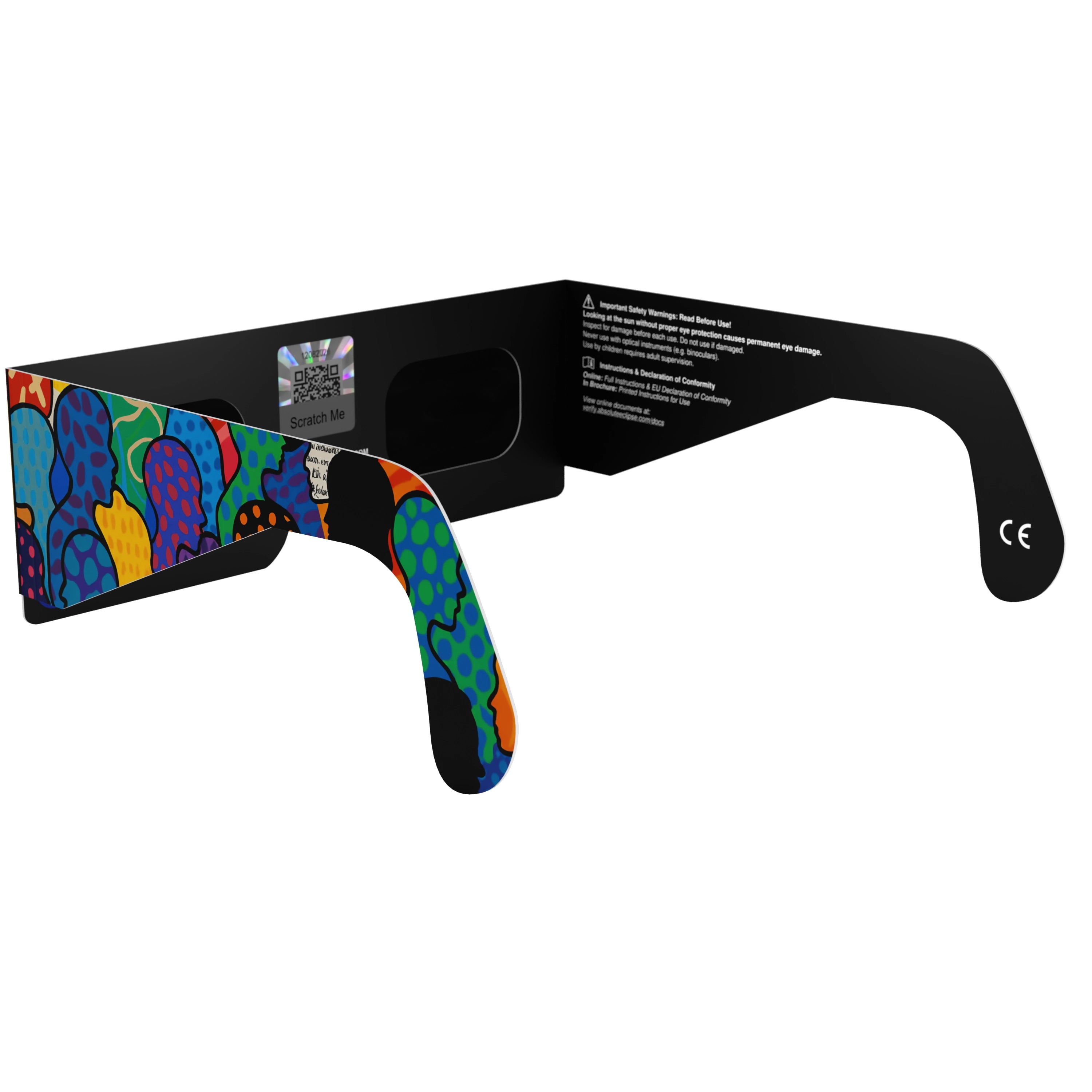
For any partial phase of a solar eclipse, and for annular eclipses at all times, you need proper solar viewing protection. Only during the brief period of totality in a total solar eclipse is it safe to look with the unaided eye — and only while the Sun’s bright surface is completely covered. If you want a clean walkthrough, read When glasses on, when glasses off: eclipse phases explained for first-time viewers and ISO 12312-2 and eclipse viewers: what the standard means for your family.
When you are getting ready for a real event, look for approved solar eclipse glasses and solar eclipse glasses iso 12312-2 certified products from a source you trust. On our shop page, we explain our eclipse viewing options and help you choose practical eclipse viewing glasses for families, classrooms, and group plans: Shop eclipse glasses.
So, in one sentence: what is the Saros?
If you want the shortest useful definition, here it is.
The saros cycle solar eclipse explained simply: it is a period of about 18 years, 11 days, and 8 hours after which the Sun, Earth, and Moon return to nearly the same eclipse geometry, producing a similar eclipse in the same family, but usually over a different part of the world.
That is the clean answer to what is the saros cycle of the eclipses?
And if someone asks, what a saros cycle is in relation to eclipses? you can answer without sounding like a textbook: it is the reason eclipse families repeat in a recognizable rhythm.
Solar Eclipse Maths and the Cosmic Coincidence of ...
Stand-up Maths
Frequently asked questions
How long does it take for an eclipse in the same family to line up over the same place on Earth again?
Not one Saros later. The excerpt says a Saros is about 18 years, 11 days, and 8 hours, and that the extra 8 hours shifts the next eclipse in the family to a different part of the world. So the eclipse can be similar in type and geometry, but it usually will not fall over the same location.
What should I understand from the idea of a solar eclipse cycle explained by NASA?
The key point is that an eclipse is not random: it depends on several lunar cycles lining up at once. A Saros is a near-match of those cycles, which is why a later eclipse can resemble an earlier one in broad geometry and type. The excerpt also notes that the next eclipse in the family is usually shifted geographically.
What is the Saros eclipse cycle, in practical terms?
It is a repeat interval of about 6,585.3 days, or roughly 18 years, 11 days, and 8 hours. In practical terms, it means the Sun, Earth, and Moon return to nearly the same geometry, so eclipses come in families with a recognizable pattern. It does not mean the same eclipse repeats in the same place.
What should I know if I am looking for a solar eclipse guide for 2026?
The excerpt does not give a 2026-specific forecast, but it does explain how to think about any upcoming eclipse. Eclipses cluster in seasons, and a Saros tells you that a later eclipse may resemble an earlier one while appearing in a different part of the world. For location-specific planning, the article points readers to an eclipse map and planning resources.
What is the safest way to watch a solar eclipse?
The excerpt says the blog hub covers safety, but it does not spell out the viewing method in detail. So the only supported answer here is that readers should use safety guidance from reliable eclipse resources before observing. Do not assume ordinary viewing is safe just because the event is brief.
On-site next steps
- Explore the pattern in real geography with our Eclipse Explorer / 3D map. It is the fastest way to turn “family resemblance” into actual path, timing, and location.
- Keep learning in the Helioclipse blog hub, especially if you want the next step after this article: phases, contact times, and planning guides.
- If you are already organizing a watch party, school event, or family trip, visit Shop eclipse glasses early so you are not scrambling for safe viewers at the last minute.
Sources & further reading
- Eclipses and the Saros — NASA
- How did ancient astronomers predict solar eclipses? — Astronomy
- How Did the Ancients Predict Eclipses? The Saros Cycle — Sky & Telescope
- Do the paths of totality during solar eclipses follow a repeating pattern? — Astronomy
- What is a solar eclipse? — Space.com
- How & Why Solar Eclipses Happen — AAS
- Phenomena You'll Experience at a Total or Annular Eclipse — AAS
- Eclipse basics — AAS
- NASA Science — Eclipses
- What is a Solar Eclipse? — AAS educational PDF