Partial phases before totality: what you’re looking at in the sky
A lot of first-time viewers think the real show starts only when totality arrives. That is understandable—and wrong in the most interesting way. The partial phase is when the eclipse first becomes physical to you: the Sun stops being a perfect disk, the light on the ground turns strange, shadows sharpen, and the whole landscape begins to feel slightly off before anyone can quite explain why.
If you are planning an eclipse day with family or friends, this is the part worth understanding in advance. Our Eclipse Explorer / 3D map helps you check whether your location is in totality or only in the partial zone, because that single fact changes both what you will see and when you must keep your eye protection on.
This is your partial solar eclipse what you see 2026 guide—but it is also useful for any event, whether you are remembering a partial solar eclipse 2024, comparing notes from partial solar eclipse 2023 or partial solar eclipse 2021, or wondering about a partial solar eclipse what you see today from your own backyard. The sky follows the same geometry every time. What changes is how much of the Sun the Moon covers, whether you are inside the path of totality, and how disciplined you are about safe viewing.
The basic picture: the Moon is taking a bite out of the Sun
So, what do you see during a partial solar eclipse? At first, not much—unless you are looking safely through a proper solar viewer or using projection. Then you notice the Moon has started to cover the Sun from one side, turning the round solar disk into a shape that looks as if a small bite has been taken out of it.
That “bite” grows slowly. This is one reason people underestimate the event: the motion is graceful, not fast. Over roughly an hour or more, the Sun changes from a circle to a deeper crescent, then—if you are in the path of totality—toward an impossibly thin sliver. If you are outside totality, the Moon never fully covers the Sun, and the sequence reverses after maximum eclipse.
If you have ever asked what can you see during a partial solar eclipse?, the honest answer is: more than you think, but less than totality. You do not see the corona during the partial phase. You do not get the full twilight plunge of a total eclipse. But you do get a visible, measurable transformation of the Sun’s shape and a growing set of effects in the world around you.
What is a partial phase, exactly?
People often ask, what is a partial phase? It is any part of a solar eclipse when the Moon covers only part of the Sun’s bright face. That includes a standalone partial eclipse, and it also includes the long lead-in and long exit around a total solar eclipse.
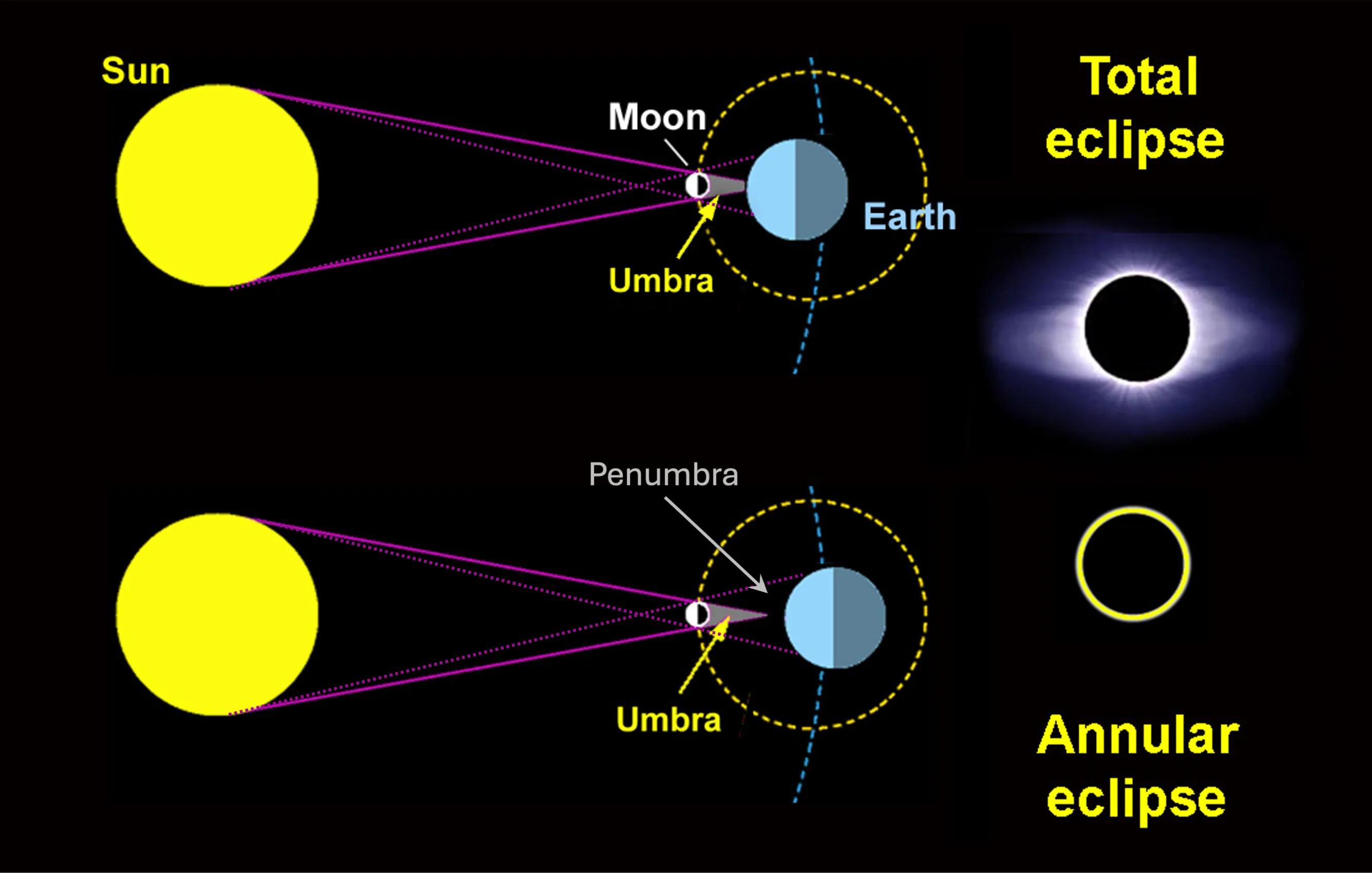
In other words, the partial phase is not a separate kind of sky event from a total eclipse. It is part of the total eclipse sequence unless you are outside the umbra, the darkest central shadow where totality happens. If you are outside that narrow corridor, you stay in partial eclipse the whole time.
This is where confusion starts. A search for what is total solar eclipse often brings up dramatic images of the black Sun, white corona, and darkened horizon. Those images are real—but only for observers inside the path of totality, and only for a brief interval. Everyone else sees partial phases only. That is why location matters so much more than many first-time viewers expect.
If you want the full safety timing explained step by step, our guide to when glasses on, when glasses off: eclipse phases explained for first-time viewers goes deeper on exactly when the rules change.
What are the phases of a partial solar eclipse?
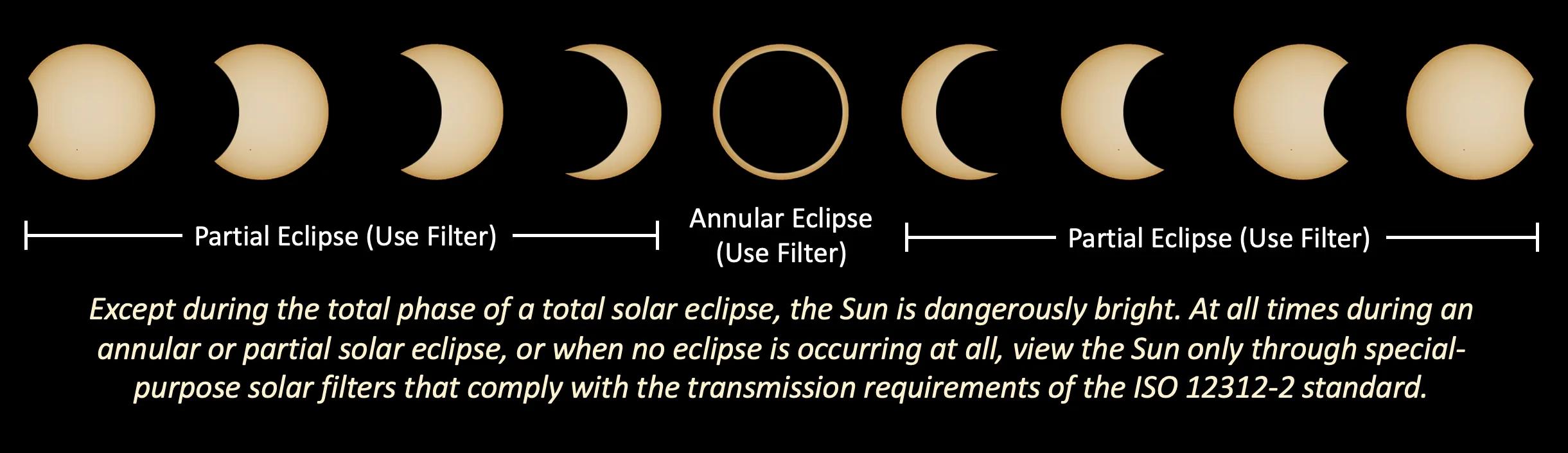
A common question is, what are the phases of a partial solar eclipse? In plain language, there are three visual beats.
First comes the beginning: the Moon first touches the Sun’s edge, and a tiny notch appears. This is easy to miss if you are chatting, setting up chairs, or still parking the car. It is worth being ready early because that first notch is the moment the event becomes real.
Second comes the deepening partial phase: the notch grows, the Sun becomes a thicker then thinner crescent, and the environment starts to change. This is the longest part, and it is where many of the subtle effects show up.
Third comes the turnaround. In a partial-only eclipse, maximum eclipse arrives with the Sun still partly visible, then the Moon slides away and the Sun returns toward a full circle. In a total eclipse, the deep partial phase continues right up to the last bright beads and the diamond ring, then totality begins. After totality, the same sequence runs in reverse.
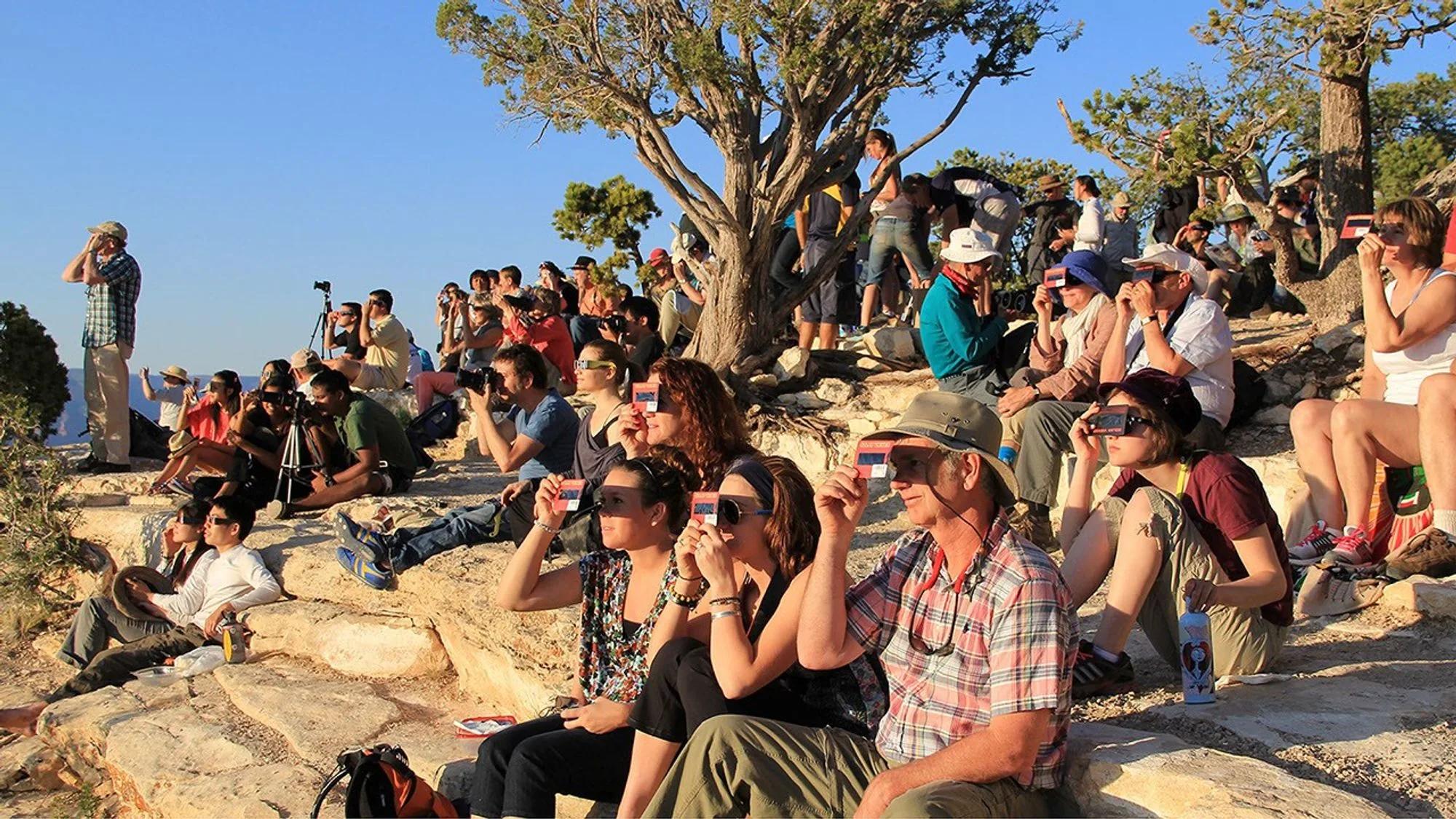
A good partial solar eclipse diagram would show this as a long, slow narrowing of the visible solar disk, not a sudden switch. That slow pace is why you do not need to stare continuously. In fact, the American Astronomical Society notes that brief glances every few minutes are enough to see the Moon’s motion clearly—as long as those glances are made with proper solar protection.
The biggest visual mistake: expecting the world to go dark too early
One reason people ask partial solar eclipse what you see is that the experience does not match intuition. You might think that if half the Sun is covered, the day should look half as bright. It does not.
The Sun is so bright that even a thin remaining crescent still throws a lot of light. That means the landscape can look surprisingly normal deep into the eclipse. You may know, intellectually, that the Moon has covered most of the Sun, yet the sky still seems bright enough to make you doubt your own eyes.
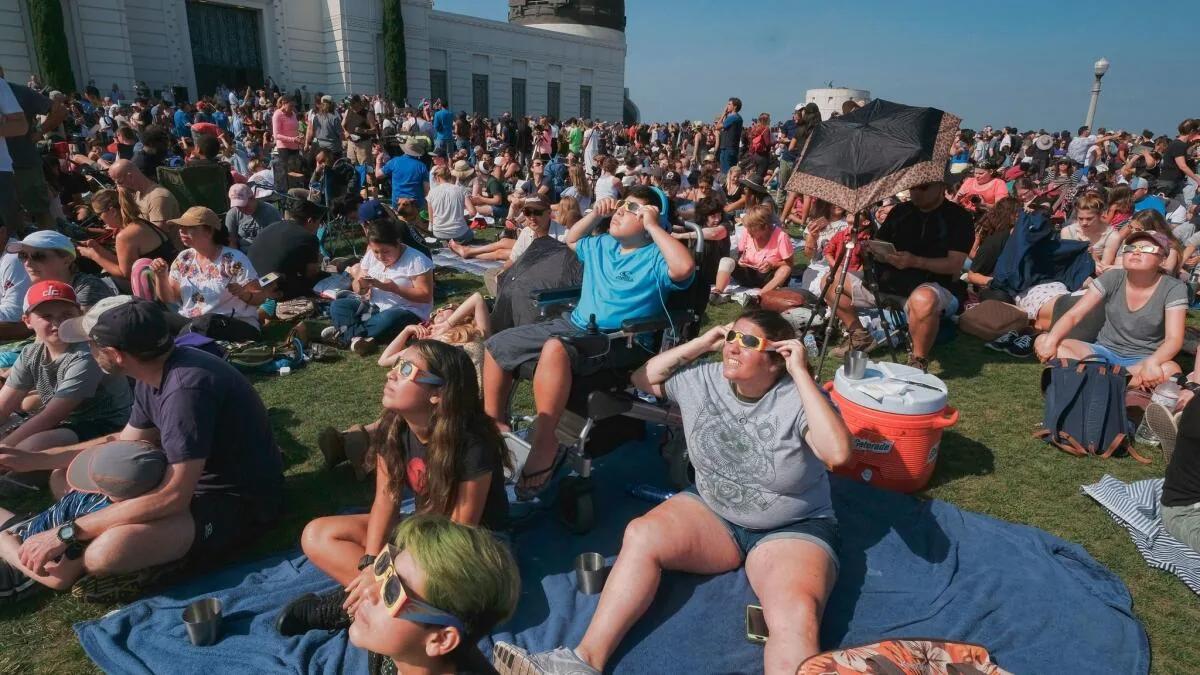
Then, late in the partial phase before totality, the changes begin to stack up. The light gets flatter and stranger. Colors can look slightly drained. The warmth on your skin may ease. The western sky may look darker than the east if you are in the path of totality. This is why “partial phases before totality: what you’re looking at in the” sky is really also about what you are looking at on the ground, on walls, in tree shade, and in the behavior of people around you.
The coolest things to watch for during the partial phase
Crescent Suns on the ground
This is one of the best family-friendly eclipse effects because it turns ordinary places into accidental projectors. During the partial phase, tiny gaps between leaves act like pinholes and cast many little images of the Sun onto the ground. Instead of round dapples of light, you get dozens or hundreds of crescents.
You can see the same effect through a colander, a straw hat, crossed fingers, or a homemade pinhole projector. NASA specifically highlights these indirect methods because they let you watch the changing shape of the Sun without looking at it directly.
If you are bringing kids, this is often the moment they remember most clearly: not the abstract idea of orbital geometry, but the shock of seeing the sidewalk covered in miniature eclipses.
Sharper, stranger shadows
As the Sun narrows toward a crescent, shadows can look unusually crisp. Edges that normally seem soft become more defined. This is subtle at first, then increasingly obvious as the visible part of the Sun shrinks.
It is a wonderful thing to test in real time. Look at your own shadow, the edge of a chair, or the shadow of a railing every 10 or 15 minutes. The change is not imaginary. The light source itself is changing shape.
A dimming that feels wrong rather than simply darker
The light before totality often feels eerie because it is not just weaker; it is qualitatively different. Many observers describe it as metallic, silvery, or stage-lit. Those words are imperfect, but they point to the same truth: the world stops looking like ordinary afternoon sunlight.
NASA’s eclipse guide notes that this becomes much more pronounced in roughly the last 15 minutes before totality. That timing matters. If you are in the path of totality, do not spend that whole interval fiddling with camera settings. Look around.
Changes in temperature and animal behavior
The air may cool by a few degrees as sunlight drops, especially near totality. Birds and insects can change their behavior. Some birds quiet down; some insects begin evening-like sounds. These effects are not guaranteed in the same way everywhere, but they are common enough to be worth noticing.
The key is to treat the eclipse as an environmental event, not just a thing happening on the Sun. The sky, the ground, the air, and the local soundscape all become part of the experience.
What you do not see until totality
This distinction is crucial, both for excitement and for safety. During the partial phases, you are still looking at the Sun’s bright face. That means eye protection remains necessary the entire time.
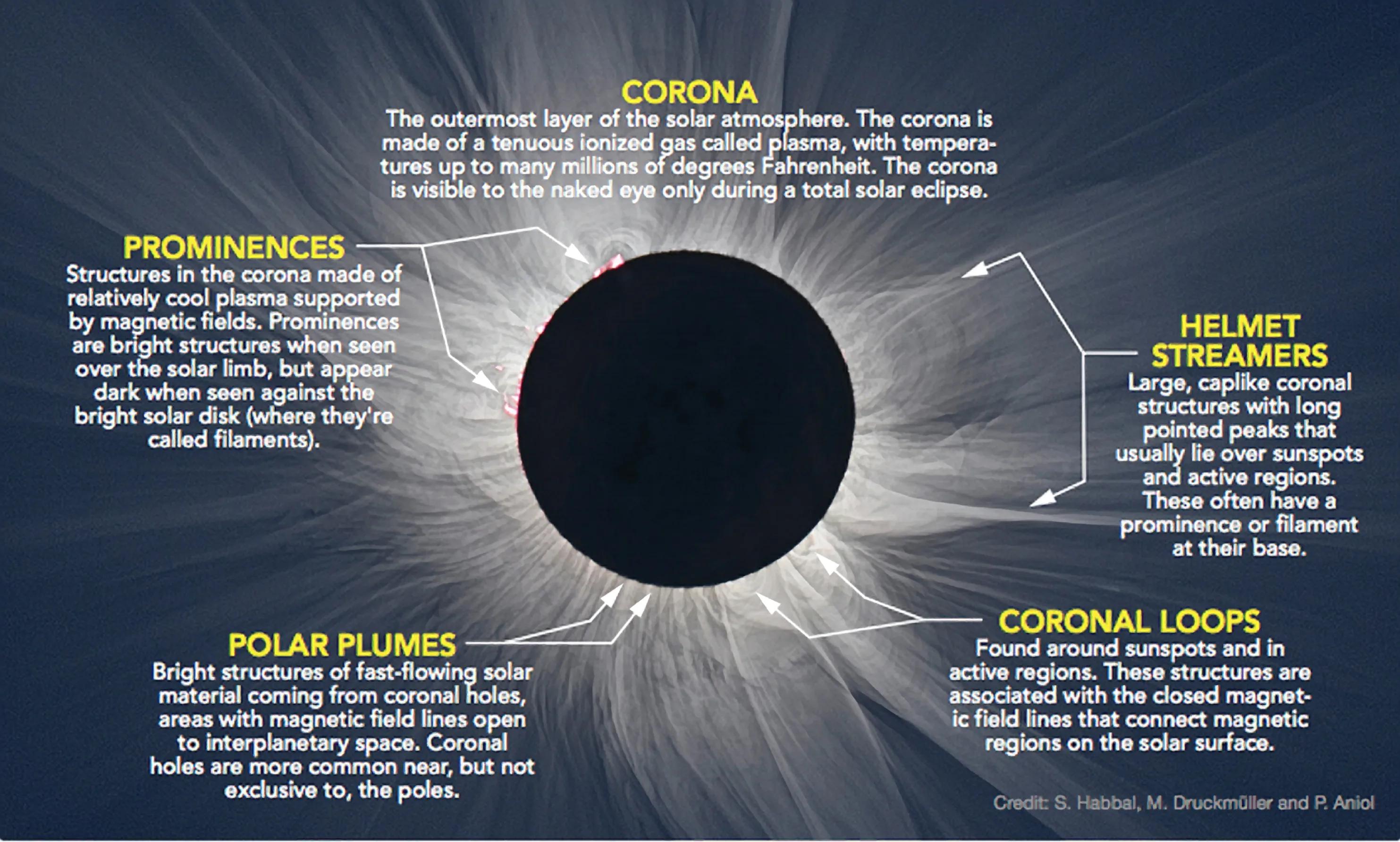
You do not see the corona during a partial phase. You do not safely remove eclipse glasses during a partial phase. You do not get the full black disk suspended in twilight during a partial phase.
Those famous features arrive only when the Moon completely covers the Sun’s bright face and only for observers inside the path of totality. Seconds before that, with filters still on, you may see Baily’s beads and then the diamond ring effect. Once even a tiny bit of bright Sun is visible again, the safe-viewing rule snaps back immediately: glasses on.
This is where many near-total observers get tripped up. A 90%-plus eclipse can look dramatic, but “almost total” is not total. Outside the path of totality, there is no safe glasses-off moment at all. If you want the medical why behind that rule, read our explainer on why staring at the Sun without protection is never “just a quick look”.
Why eye protection is required during every partial phase
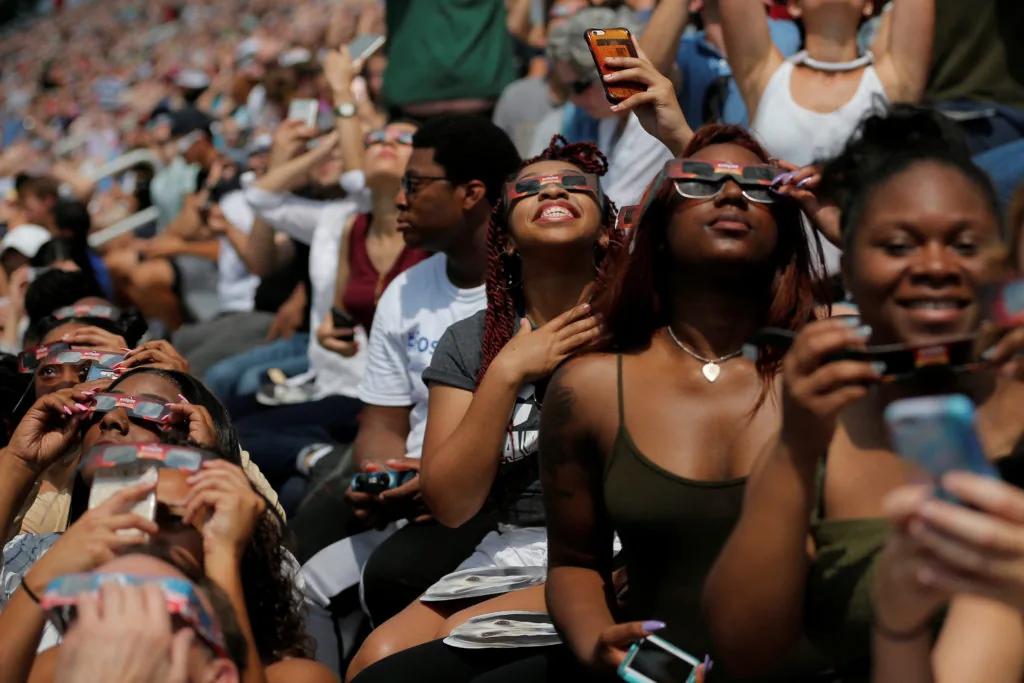
Here is the rule in one sentence: except during the brief total phase of a total solar eclipse, when the Sun’s bright face is completely covered, you must not look directly at the Sun without proper solar protection.
NASA, the AAS, and eye-health specialists all say the same thing. Partial phases are never safe for direct viewing with naked eyes. Regular sunglasses are not enough. Homemade dark materials are not enough. Looking through a camera, binoculars, or a telescope without the correct front-mounted solar filter is dangerous, and wearing eclipse glasses behind those optics does not make it safe.
This is also where search language can mislead people. Phrases like eclipse glasses nasa approved and nasa certified solar eclipse glasses sound reassuring, but NASA does not approve any particular brand. What matters is that your viewers are special-purpose solar filters that conform to ISO 12312-2 and are in good condition.
When shoppers look for approved solar eclipse glasses or solar eclipse glasses iso 12312-2 certified, they are really trying to solve the right problem: finding viewers built for direct solar viewing rather than ordinary sun glare. If you need a plain-English standards breakdown, our guide to ISO 12312-2 and eclipse viewers: what the standard means for your family is the next stop.
And if you already have eclipse viewers stored from a previous event, inspect them before use. Torn, scratched, punctured, or otherwise damaged filters should be discarded.
Direct viewing is optional; good eclipse watching is not
A useful mindset shift: you do not need to stare continuously at the Sun to have a great eclipse.
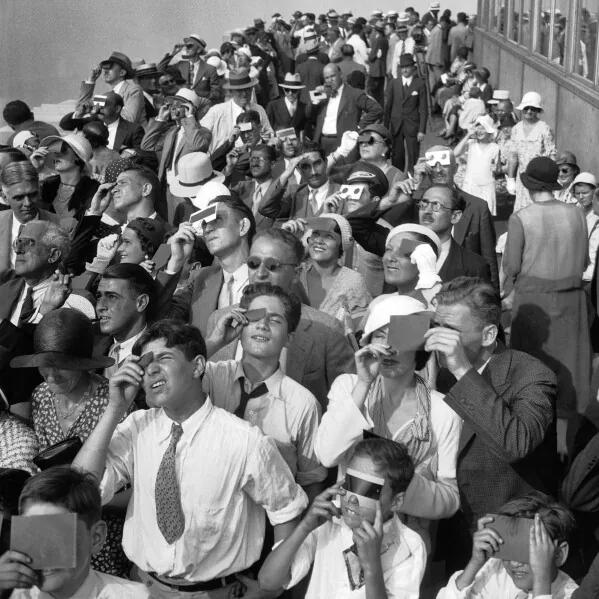
In fact, the partial phase rewards a mix of methods. Take a brief look through certified eclipse viewing glasses. Then look down at leaf shadows. Then check your pinhole projection. Then look across the landscape and notice the changing quality of light. Then glance again a few minutes later.
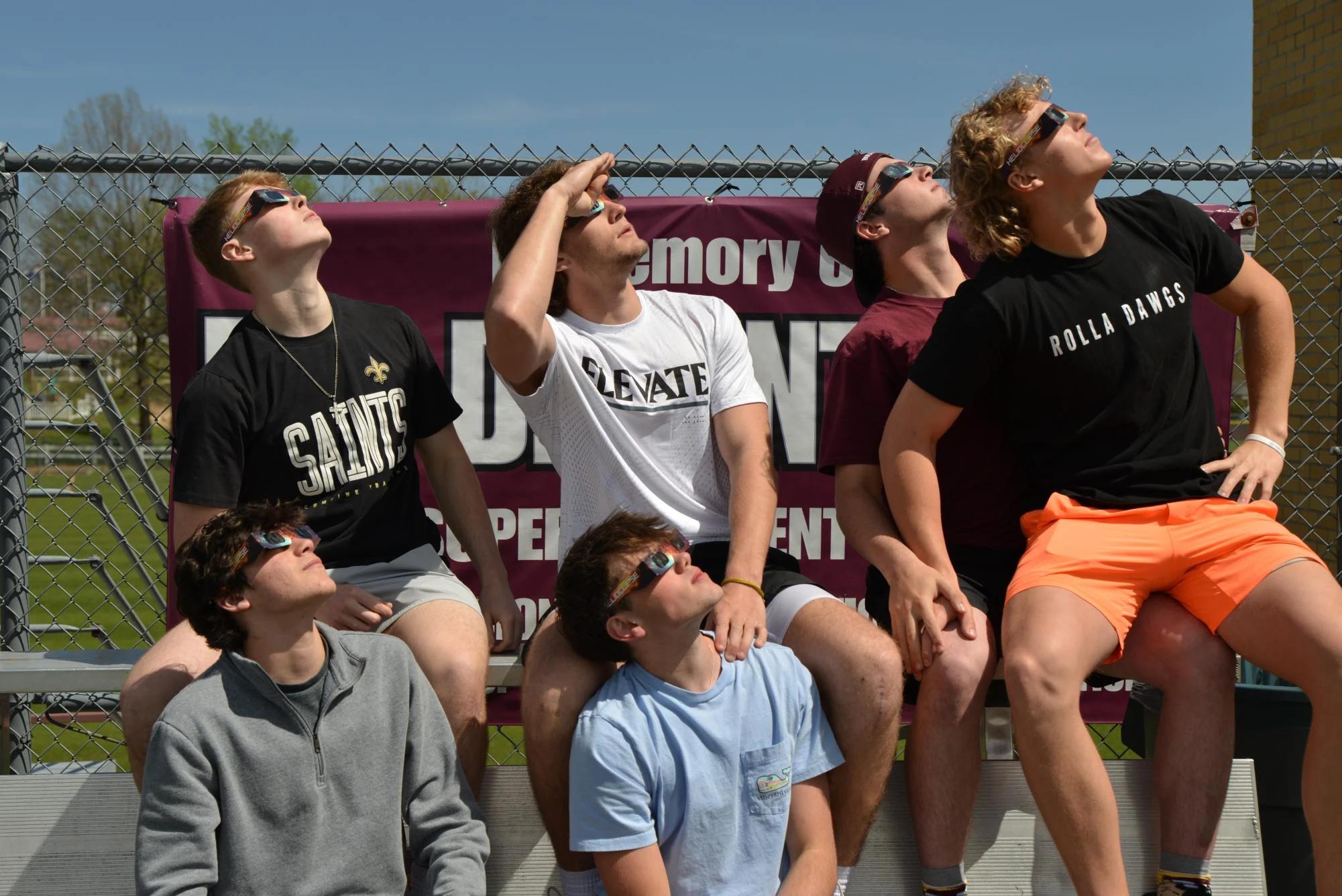
This rhythm is especially good for groups. Not everyone needs their own viewer every second. The partial phases move slowly enough that families, classrooms, and friend groups can share safely and still see the progression clearly.
If you are still buying gear, choose viewers early rather than in the last-minute scramble. On our shop eclipse glasses, we focus on Helioclipse eclipse viewing glasses designed for this exact use case, with labeling that helps you check what you are trusting before eclipse day.
Why the path matters even in an article about partial phases
You cannot fully answer what do you see during a partial solar eclipse? without talking about place. The same eclipse can be total in one narrow corridor and partial across a much larger region.
That is what the partial solar eclipse path tells you: not just where the event is visible, but what kind of event it is from your exact location. Inside the path of totality, the partial phases are a prelude and an aftermath. Outside it, the partial phase is the whole show.
This matters emotionally as much as technically. If you are traveling, a move of tens of kilometers can change your day from “deep partial with glasses on throughout” to “brief totality with a safe glasses-off window in the middle.” That is why we always recommend checking your exact site on the Helioclipse 3D eclipse map rather than relying on a city name alone.
For readers planning ahead for the next big European event, our August 12, 2026 total solar eclipse planning guide is the broader roadmap.
A quick reality check on past and future eclipses
Search interest often spikes around specific years, which is why people land on phrases like partial solar eclipse 2024, partial solar eclipse 2023, or partial solar eclipse 2021 and expect the visual answer to change dramatically from one event to another. The underlying sequence does not change much. The Moon still encroaches on the Sun, the visible solar disk becomes a crescent, and the environment shifts in proportion to how deep the eclipse gets.
What does change is the geometry for your location. One year you may get a modest bite from the Moon. Another year you may get a deep partial that feels almost unreal but never becomes total. Another year, if you are lucky or mobile, you may stand inside the umbra and watch the partial phase tip over into totality.
That is also the best answer to when was the last partial solar eclipse: there have been many, and there will be many more. The useful question is not just when the last one happened, but what kind of eclipse your location gets next—and whether you are willing to travel for a different experience.
If you are near totality, the last minutes are their own world
The deepest partial phase before totality is where anticipation turns physical. People start speaking more quietly, or more loudly. The light drops faster. The Sun becomes a razor-thin crescent through your filter. If you are on high ground, you may be able to see the Moon’s shadow approaching across the landscape from the west.
One to two minutes before totality, some observers see shadow bands—faint rippling lines of light and dark on pale surfaces caused by atmospheric turbulence and the thin crescent Sun. They are delicate, easy to miss, and absolutely worth trying for on a white sheet, pale pavement, or the roof of a light-colored car.
Then come the final bright beads of sunlight through lunar valleys and the diamond ring. Up to this point, your solar viewers stay on. Only when the bright face of the Sun is fully gone—completely gone—does totality begin.
That transition is why the partial phase deserves respect. It is not dead time. It is the runway.
How to watch the partial phase well with kids, friends, or a school group
Keep it simple and structured.
Arrive early enough to settle in before first contact. Bring certified viewers, plus one indirect method like a pinhole card or colander. Assign one person to keep time and call out milestones every 10 or 15 minutes. Ask everyone to compare shadows at the same spot during the event. If children are present, supervise every direct look.
And tell people ahead of time what they are about to notice. Once someone knows to look for crescent leaf shadows or sharper edges, they are much more likely to catch them. Eclipse day gets better when the group shares the hunt.
Phases of the moon and eclipses
SiouxScience
Frequently asked questions
What does the Sun look like during the partial stage of an eclipse?
You see the Moon gradually taking a bite out of the Sun, so the solar disk changes from a circle into a crescent-like shape. The change is slow, often unfolding over an hour or more, and it becomes more noticeable as the eclipse progresses.
Is it safe to view a partial eclipse with a phone camera?
The excerpt does not say that a phone camera is safe for direct viewing. It does say that you should keep your eye protection on during the partial phase and use proper solar viewing or projection methods instead.
How can I tell whether my location will see the August eclipse as total or only partial?
Check whether your location is inside the path of totality or in the partial zone. The article says that single fact determines both what you will see and when you must keep your eye protection on.
What unusual changes happen around you during an eclipse?
The light on the ground can turn strange, shadows sharpen, and the landscape may feel slightly off before you can explain why. Those effects are part of what makes the partial phase feel physical, even before totality arrives.
What do you actually get to see in a partial eclipse?
You can see the Moon covering part of the Sun’s bright face, and that visible change can be surprisingly dramatic. You do not see the corona during the partial phase, and you do not get the full twilight drop that comes with totality.
On-site next steps
- Check your exact location on our Eclipse Explorer / 3D map to see whether you are in totality or only in the partial zone. That one detail determines both the visuals and the safety rules.
- If you will be viewing any partial phase directly, get your Helioclipse solar eclipse glasses early and inspect them before eclipse day.
- Want the bigger picture? Browse the Helioclipse blog for planning, safety, weather, and first-timer guides.
Sources & further reading
- Eclipse Viewing Safety — NASA Science
- What to Expect: A Solar Eclipse Guide — NASA Science
- Eyewear & Handheld Viewers — American Astronomical Society
- Solar Eclipse Eye Safety — American Academy of Ophthalmology
- How to Protect Your Vision While Watching a Solar Eclipse — Houston Methodist
- NASA Science — Eclipses
- How to view a solar eclipse safely — American Astronomical Society
- Eclipse basics — American Astronomical Society
- Solar and Lunar Eclipses — NASA Science
- Solar Eclipse Eye Safety — National Eye Institute