Zaragoza in 2026: one city, one eclipse—inland heat, wide skies, and practical August truth
If you want one city-specific plan for the August 12, 2026 eclipse, Zaragoza is a serious one. The city sits inside the path of totality for the spain total solar eclipse 2026, with totality around 8:28 p.m. CEST and about 1 minute 23 seconds of darkness from the city itself. That makes zaragoza eclipse 2026 more than a box to tick on a map: it is a real urban viewing case study, with strong access, broad inland skies, and a few honest complications you should not ignore.
The short version is this: Zaragoza gives you a genuine total eclipse, not a near miss. It also gives you August heat, a low western Sun, and the possibility of haze or dust softening the horizon late in the day. If you are building your plan now, start with the Helioclipse Eclipse Explorer / 3D map so you can check your exact pin, horizon direction, and local circumstances instead of relying on a generic spain eclipse 2026 map.
This is our total solar eclipse 2026 zaragoza spain 2026 guide, and we are keeping it tightly focused on one municipality: Zaragoza, how the eclipse works there, what the city does well, and what practical August truth looks like when the Moon’s shadow arrives.
Why Zaragoza matters for the 2026 eclipse in Spain
For the wider 2026 eclipse spain story, Zaragoza stands out because it combines three things that do not always come together: it is in totality, it is a major city, and it sits in an inland landscape where broad sight lines are often easier to find than in hillier or more built-up places.
Space.com’s city-level roundup gives Zaragoza a totality time of 8:28 p.m. CEST and 1 minute 23 seconds of totality, with a relatively favorable cloud statistic compared with many other places along the path. That does not guarantee a clear sky, of course. Nothing does. But it does tell you Zaragoza belongs in the serious-planning tier, not the wishful-thinking tier.
It also matters because the eclipse arrives late in the day. Across Spain, the August 12 event is an evening eclipse, and in Zaragoza the Sun will be low in the west-northwest during totality. That changes everything about site choice. In some eclipse cities, you can get away with “any open park.” Here, you need to think more specifically: western horizon, trees, buildings, ridgelines, heat shimmer, and whether your chosen spot still works at the exact time the Sun is dropping toward the horizon.
If you want the national context first, our broader Spain guide on what “on the centerline” really means helps explain why one Spanish city can get a very different eclipse from another even on the same evening.
What Zaragoza will actually experience on August 12, 2026
The date is fixed: Wednesday, August 12, 2026. NASA lists this as a total solar eclipse visible from Spain, among other regions. For Zaragoza, the key local experience is not just that totality happens, but how it happens.
From the city, the eclipse builds through the partial phases for roughly an hour before totality and continues for roughly an hour after. During those partial phases, you must use proper solar viewing protection. Only during the brief total phase—when the Sun’s bright face is completely covered—is it safe to look with the naked eye. If you are new to that distinction, read our guide to when glasses are on and when glasses are off before eclipse week, not in the final five minutes.
For zaragoza spain eclipse 2026, the headline number is still the one people remember: about 1 minute 23 seconds of totality in the city. That is long enough to feel the event change from “interesting” to unforgettable. You can see the corona, the sudden drop in daylight, the horizon glow, and the emotional jolt that makes total eclipses different from every partial eclipse, no matter how deep the partial gets.
The other number that matters is the Sun’s altitude: low enough that your western view is part of the plan, not an afterthought. This is why a total solar eclipse 2026 zaragoza spain location is not just “Zaragoza” in the abstract. It is your exact place in Zaragoza, plus your exact line of sight.
Is Zaragoza a good place to see the eclipse?
Yes—if you plan for the city you actually have, not the city you imagine.
Zaragoza is good because it is large, accessible, and inside totality. It is good because the Ebro valley setting can offer wide skies. It is good because you do not need to invent a heroic rural expedition just to stand under the Moon’s shadow. For many families, friend groups, and first-time eclipse travelers, that matters. A city with transport, food, shade options, and multiple fallback spots can be more useful than a “perfect” remote viewpoint that becomes a logistical mess.
But Zaragoza is not magically easy. The Sun will be low. Urban trees can block exactly the part of the sky you need. Apartment blocks can do the same. Heat stored in pavement and rooftops can make the late-afternoon atmosphere look softer and shakier. And inland summer air is not always crystal clear; dust or haze can reduce contrast near the horizon even when the sky is technically cloud-free.
So when people ask whether zaragoza total eclipse 2026 is a good idea, our answer is: yes, with a site-specific plan. Not just a hotel booking. Not just “we’ll find a park.” A real pin on a map, checked in advance.
The Zaragoza advantage: inland skies and the Ebro plain
This is where Zaragoza earns its reputation. The city sits in the Ebro basin, and that inland geography can help eclipse observers in a very practical way: broad horizons and a feeling of sky that is harder to get in more enclosed terrain.
That does not mean every street corner works. It means Zaragoza gives you a better chance of finding open western sight lines without leaving the city’s planning frame. Large open spaces, river-adjacent areas, less obstructed edges of parks, and viewpoints with a clean west-to-west-northwest outlook are worth scouting early.
The phrase “wide skies” is not poetry here. It is logistics. For a late-evening eclipse, a wide western view buys you margin. If a row of trees or a nearby building clips the last few degrees above the horizon, your totality experience can go from spectacular to frustrating very quickly.
This is why a total solar eclipse 2026 zaragoza spain map matters more than a generic city guide. Use the Helioclipse 3D map to test specific Zaragoza pins and see whether your chosen spot is comfortably inside totality and how the event lines up for your location.
The Zaragoza disadvantage: low Sun, urban obstructions, and late-day atmosphere
Now for the practical August truth.
A low Sun is beautiful during an eclipse, but it is unforgiving. In Zaragoza, that means your biggest enemy may not be a dramatic storm front. It may be something much more ordinary: a line of plane trees, a residential block, a billboard, a construction crane, or a slightly raised western skyline that looked harmless at noon.
Then there is the atmosphere itself. Inland summer evenings can produce convection, shimmer, and a washed-out horizon. Even when the cloud picture looks decent on paper, the view near the Sun can be softened by suspended dust or haze. We are not turning this into a full calima explainer, because this article stays inside Zaragoza’s frame, but the honest planning point is simple: “clear” and “clean” are not always the same thing.
That matters less for the fact of totality than for the quality of what you see in the minutes around it. A hazier horizon can mute the crispness of the thin crescent phases and reduce contrast close to sunset. It does not erase the eclipse. It does mean you should avoid pretending every clear-sky forecast guarantees a perfect visual experience.
If eclipse week brings uncertain sky conditions, our guide to cloud cover, mobility, and when to move is the right companion piece.
What “time” means in Zaragoza: don’t trust one number and stop there
A lot of readers want one clean answer for total solar eclipse 2026 zaragoza spain time. The city-level answer is useful: around 8:28 p.m. CEST for totality, with roughly 1 minute 23 seconds of totality from Zaragoza.
But that is not the whole planning answer. A city is not a single point. Your exact circumstances shift slightly across the municipality, and your practical experience depends on more than the central timestamp. You need to know:
- whether your pin is fully inside totality
- how long totality lasts at that pin
- where the Sun sits relative to your local horizon
- when the partial phases begin and end for your exact spot
That is why we recommend checking total solar eclipse 2026 map time tools rather than copying a single city number into your notes and calling it done. The Helioclipse Eclipse Explorer is built for exactly this kind of local check.
If you are comparing tools online, you may also run into searches like solar eclipse 2026 interactive map, spain eclipse 2026 map, or total solar eclipse 2026 path. Those are useful starting ideas, but for actual planning in Zaragoza, you want a city-centered pin, not a national overview.
And yes, some readers will arrive here after looking up total solar eclipse 2026 zaragoza spain date and time or total solar eclipse 2026 zaragoza spain map. The practical answer is the same: use the city number as orientation, then verify your exact location.
Where to stand in Zaragoza without leaving Zaragoza’s planning frame
This article is intentionally not sending you off into a province-wide chase. We are staying with Zaragoza.
Within that frame, the best viewing logic is straightforward: prioritize places with a clean west or west-northwest view, enough room for people to gather without crowding, and some realistic way to handle August heat before the eclipse peaks. Open riverfront areas, broad park edges, large plazas with a genuine western opening, and less tree-choked urban spaces are all more promising than picturesque but enclosed courtyards.
The worst choices are also straightforward: places where you cannot verify the western sight line, places where mature trees dominate the horizon, and places where you are boxed in by tall buildings. Zaragoza has plenty of attractive urban spaces that are excellent for an evening walk and poor for a low-altitude eclipse.
If you are scouting in person, do it at roughly the same time of day well before August 12, 2026. Stand still. Face west-northwest. Ask the boring questions. Where does the skyline rise? Which trees leaf out heavily in summer? Is there a lamp post or roofline exactly where the Sun will drop? Eclipse success in cities often comes down to details that feel too small to matter—until they matter completely.
Heat is not a side note in Zaragoza
This is the part many eclipse guides underplay. We won’t.
Zaragoza in mid-August can be hot, dry, and tiring, especially if you are standing on exposed pavement for a long pre-totality wait. NASA’s eclipse planning guidance is blunt about all-day outdoor comfort: bring water, sun protection, and what you need to stay functional. In Zaragoza, that is not generic advice. It is part of the viewing plan.
A good city eclipse setup here includes shade before the crucial minutes, water for everyone in your group, and a route that does not require a last-minute sprint across sun-baked streets. If you are bringing children, older relatives, or anyone sensitive to heat, comfort planning is not optional. The eclipse itself lasts minutes; the waiting lasts much longer.
Think in layers:
- shade before the final approach to totality
- water you already have with you
- a hat and light clothing for the long partial phases
- a viewing spot that does not trap you in reflected heat from concrete and glass
- a calm exit plan after totality instead of an immediate scramble
That last point matters because Zaragoza may attract substantial eclipse interest without needing us to invent fake hotel panic or made-up room prices. A city this accessible, inside totality, will not be secret for long. If you are coordinating with friends or family, tell them early.
Safety in Zaragoza: totality is real, but only for a brief window
Because Zaragoza is in totality, this is one of those places where the safety rule changes briefly and only briefly.
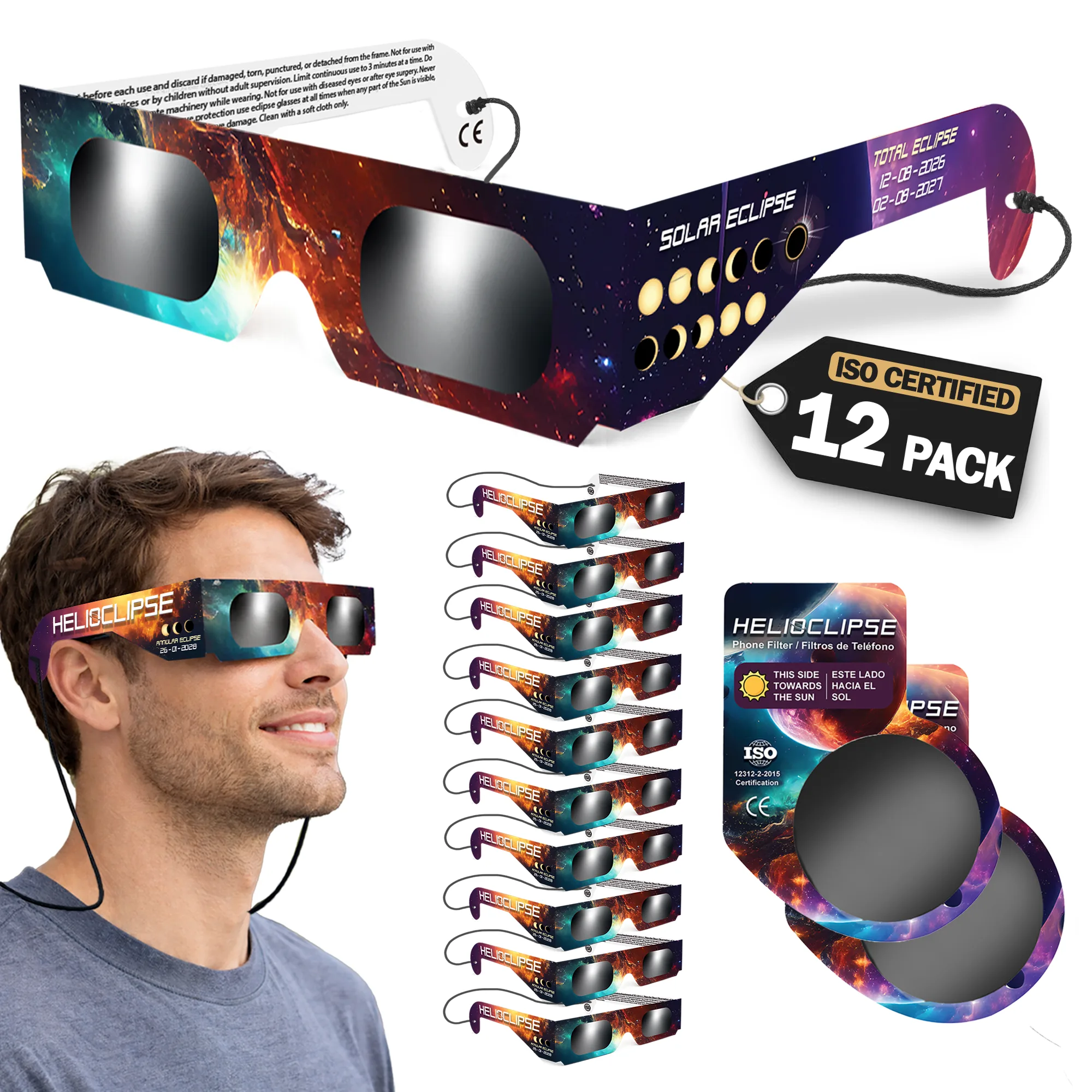
During the partial phases before and after totality, you need proper solar viewers that conform to ISO 12312-2. During totality itself—when the Sun’s bright face is fully covered—you may look without eclipse glasses. The instant bright sunlight reappears, the glasses go back on.
That distinction is the heart of safe viewing. It is also why near-total partial eclipses are not “basically the same.” They are not. Zaragoza gets the real thing.
If you are buying now, ignore sloppy marketplace language and focus on the standard and the seller. People often search phrases like approved solar eclipse glasses, eclipse viewing glasses, or solar eclipse glasses iso 12312-2 certified. The important reality is that NASA does not approve specific brands, and “NASA approved” is not the standard you should trust. The standard to verify is ISO 12312-2, plus a seller you are comfortable relying on.
We recommend ordering from our Helioclipse shop for eclipse glasses early enough that you are not making rushed decisions in the final days. If you want the deeper safety background, our guide to ISO 12312-2 and what it means for your family is the right next read.
What Zaragoza viewers may notice during totality
If your sky is clear enough and your horizon is open enough, Zaragoza should deliver the classic emotional sequence of a total eclipse in compressed form.
The light will thin and turn strange in the final minutes. Shadows sharpen. The western sky darkens faster than your instincts expect. Then, for roughly 83 seconds in the city, the Sun’s bright face is gone and the corona appears around the Moon’s black disk.
Because the eclipse happens late, the horizon effect may feel especially dramatic. NASA’s eclipse guide describes the 360-degree sunset glow that can ring the horizon during totality, and a low-Sun event can make that sensation feel even more theatrical. In Zaragoza, if the air is clean enough, that low-angle geometry could be one of the city’s most memorable strengths.
And then it ends fast. That is worth saying plainly. Totality in Zaragoza is long enough to be profound, but short enough that you should not spend it fiddling with gear, arguing about camera settings, or asking whether it is “really safe yet.” Know the sequence before the day arrives.
Zaragoza is a city plan, not just an eclipse plan
One reason total solar eclipse 2026 zaragoza spain is such a strong search is that people are not only asking about astronomy. They are asking whether a real city can make a real eclipse easier.
In Zaragoza, the answer is mostly yes. A city gives you transport links, food, backup meeting points, and the option to keep the day simple. It also gives you crowds, blocked sight lines, and the temptation to assume infrastructure solves everything. It does not.
The best Zaragoza plan is usually the one that feels slightly overprepared: you have checked your pin, checked your horizon, checked your viewers, checked your water, and told your group exactly when to arrive. That is how you turn zaragoza in 2026: one city, one eclipse—inland heat, wide skies, from a nice title into a good day.
It is also how you avoid the classic mistake of comparing this event to the wrong thing. You may see people bouncing between searches like total solar eclipse 2025 map, total solar eclipse 2027, or total solar eclipse 2030. Those future or past maps are fine for curiosity, but they do not replace a Zaragoza-specific plan for August 12, 2026.
A realistic Zaragoza checklist for eclipse day
If you want one practical summary, use this.
Arrive early enough that you are not choosing your spot under pressure. Bring certified viewers for every person who will want to look during the partial phases, or at least enough to share sensibly. Bring water. Bring shade strategy. Keep your western horizon clear. Do not assume a beautiful park is a good eclipse site until you test the actual sight line.
If you are using cameras, binoculars, or telescopes, remember that eclipse glasses are not a substitute for proper front-mounted solar filters on optics. NASA and the AAS are both explicit on this point: unfiltered optics can cause severe eye injury.
And if the sky looks uncertain on the day, do not freeze. Zaragoza is a city. Mobility within the municipality may help if one part of your planned view is more obstructed or hazier than another. Just do not leave that decision until the final minutes.
Frequently asked questions
Which Spanish city is a strong choice for seeing the 2026 total eclipse?
Zaragoza is a serious choice because it sits inside the path of totality for the August 12, 2026 eclipse. From the city itself, totality is expected around 8:28 p.m. CEST and lasts about 1 minute 23 seconds.
Is Zaragoza a good place to watch the eclipse?
Yes. It offers a genuine total eclipse, along with strong access and broad inland skies that can make viewing easier than in some other places. The main tradeoffs are August heat, a low western Sun, and the possibility of haze or dust near the horizon.
What should I know about seeing the 2026 eclipse from Zaragoza?
The eclipse in Zaragoza is an evening event, so the Sun will be low in the west-northwest during totality. That means site choice matters more than usual: you should check the western horizon for trees, buildings, ridgelines, and other obstructions.
What are the key facts about the total eclipse in Zaragoza, Spain?
The date is Wednesday, August 12, 2026, and Zaragoza is inside the path of totality. The city’s totality is listed at about 8:28 p.m. CEST, with roughly 1 minute 23 seconds of darkness from the city itself.
What does this Zaragoza eclipse guide focus on?
It focuses tightly on one municipality: Zaragoza, how the eclipse works there, what the city does well, and the practical realities of an August evening eclipse. The guide also recommends checking your exact location, horizon direction, and local circumstances rather than relying only on a generic map.
On-site next steps
- Check your exact Zaragoza pin in the Helioclipse Eclipse Explorer / 3D map to confirm your total solar eclipse 2026 zaragoza spain location, timing, and horizon logic.
- Order your Helioclipse eclipse glasses early so your group is covered for the long partial phases before and after totality.
- If you are still building your bigger plan, browse the Helioclipse blog for Spain path basics, weather mobility, and first-time totality safety.
Sources & further reading
- 16 best places to see the 2026 total solar eclipse
- 1 year until the total solar eclipse 2026 — Here's what you need to know
- Where can I see the total solar eclipse on Aug. 12, 2026?
- Spanish Total Eclipse Adventure 2026
- 2026 Spain 9-Night Total Solar Eclipse Tour
- NASA Science: Future Eclipses
- NASA Science: Eclipse Viewing Safety
- NASA Science: What to Expect: A Solar Eclipse Guide
- American Astronomical Society: Totality
- American Astronomical Society: How to view a solar eclipse safely