How people have observed eclipses across history—and what still matters today
The sky has always been bigger than our explanations for it. Long before cameras, spacecraft, or precise eclipse maps, people noticed that daylight could fail in the middle of the day, the Sun could turn into a bitten crescent, and the world could go strangely cold and quiet for a few minutes. That shock is ancient. So is the urge to record it.
The history of solar eclipse observation is not just a gallery of old stories. It is a record of how humans learned to move from fear, ritual, and interpretation toward measurement, prediction, and shared public experience. It is also a reminder that some basics have not changed at all: eclipses are still social events, still scientifically useful, and still something you need to view safely.
If you are planning to watch a future eclipse, our Eclipse Explorer / 3D map helps you see where totality falls and why location matters. And if you are getting a group ready—family, school, neighbors, or your group chat—our blog hub is where we keep the practical guides together.
From awe to evidence: what early records actually tell us
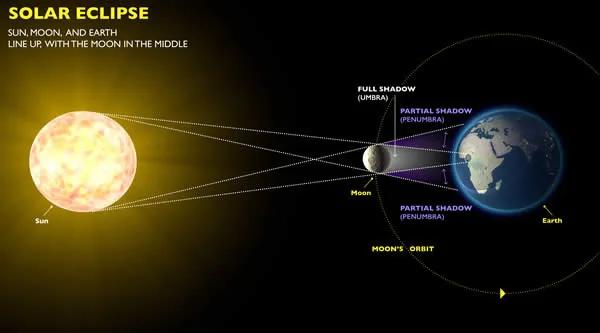
A lot of people searching for what is solar eclipse are really asking two questions at once: what physically happens in the sky, and what did people think was happening before modern astronomy? The physical answer is straightforward. A solar eclipse happens when the Moon passes between Earth and the Sun and blocks part or all of the Sun’s bright face for observers in the right place.
The historical answer is messier, and more interesting. Early societies did not all interpret eclipses the same way. Some treated them as omens, some folded them into religious or political meaning, and some recorded them with enough care that modern astronomers can still use those records.
That distinction matters. Our brief for this topic is historically attested observation and recording (academic or eclipse planning rather than folklore repeated as fact. So the strongest evidence comes from things like inscriptions, tablets, official court records, and later texts that preserve eyewitness details such as darkness, visible stars, or location.
NASA’s overview of eclipse history points to possible very early evidence from petroglyphs at Loughcrew in Ireland, associated with a likely eclipse on 30 November 3340 BCE. That claim is fascinating, but it also shows why historians rank evidence carefully: rock art can be suggestive without being as secure as a dated written record. By contrast, records from ancient China—especially eclipse references on oracle bones from around the late second millennium BCE—are much more useful for historians of astronomy because they tie observation to a place, a scribal tradition, and a durable archive.
In other words, the oldest eclipse material is not all equally solid. Some of it is probable, some of it is debated, and some of it is strong enough to test modern calculations against. That is the real starting point for any serious history of solar eclipse observation timeline.
The first big leap: writing eclipses down
Once eclipses entered written records, they became more than memorable sky events. They became data.
Chinese court astronomers are central here. Over many centuries, imperial records logged eclipses with impressive continuity. NASA notes that scribes in Anyang recorded eclipses on oracle bones and tortoise shells, including the phrase that “the Sun has been eaten.” That wording preserves cultural interpretation, but the record itself also preserves something more valuable to modern science: the fact that an eclipse was seen in a specific place.
Babylonian and later Mediterranean records matter for the same reason. Ancient observers often did not write in the format modern astronomers would prefer. They were not giving us neat spreadsheets of contact times, local weather, and calibrated brightness. But when a text says daytime turned dark enough for stars to appear, or when a city is named, that can be enough to narrow down which eclipse was seen.
This is where eclipse history stops being quaint and starts being powerful. Historical records let modern researchers compare where an eclipse should have been visible under a given model of Earth’s rotation with where it was actually reported. If those do not match, the model needs work.
That is one reason the history of solar eclipse observation in the world still matters to current science. Ancient and medieval observers were not just leaving us stories. They were accidentally helping future astronomers measure long-term changes in Earth’s spin.
Why old eclipse records still matter to modern science
One of the coolest things about eclipse history is that it is not finished. We still learn from old observations.
NASA highlights how records from Anyang helped researchers at the Jet Propulsion Laboratory study changes in Earth’s rotation over more than 3,000 years. The basic logic is elegant. If an eclipse was recorded in a place that should not have been in the path under a simple backward calculation, then Earth’s rotation rate over long timescales must be adjusted. NASA summarizes that this work showed Earth’s rotation has slowed by about 47-thousandths of a second per day over the past 3,200 years.
A more recent example comes from late antique and Byzantine sources. As reported by Space.com, researchers identified five total solar eclipses observed in the Eastern Mediterranean in A.D. 346, 418, 484, 601, and 693. One account from Constantinople in 418 described darkness deep enough that stars were visible. That detail matters because “stars appeared” is a strong clue for totality, not just a deep partial eclipse. Those records helped refine estimates of delta T, the difference between time based on Earth’s rotation and uniform time scales used in astronomy.
This is the part many readers do not expect from an eclipse history article. The eclipse history dates are not just trivia. They are part of the evidence chain for understanding how our planet behaves.
And that gives us a better answer to what is the history of eclipse observation? It is the history of people noticing something dramatic in the sky, then gradually learning to preserve enough detail that later generations could turn those observations into science.
A working timeline of eclipse observation
If you want a practical history of solar eclipse observation timeline, here is the broad arc.
Prehistoric and protohistoric evidence
Possible eclipse imagery appears in prehistoric monuments and petroglyphs, including the often-cited Loughcrew carvings in Ireland. These are intriguing but not always beyond dispute.
Bronze Age and early literate states
By the second millennium BCE, written eclipse records appear in stronger form, especially in China. These are among the earliest historically useful records because they connect observation to a scribal system and a known place.
Classical antiquity
Greek and Near Eastern texts preserve eclipse descriptions that blend interpretation with observation. Some accounts are literary, some administrative, and some later quoted by other writers.
Medieval and late antique records
Chronicles from the Mediterranean, Middle East, and East Asia become especially valuable because they sometimes mention location, darkness, and social effects in enough detail to identify specific eclipses.
Early modern prediction and calculation
As mathematical astronomy improved, eclipses became events that could be forecast rather than merely explained after the fact. This changed their cultural role. They were still awe-inspiring, but increasingly they were also tests of astronomical skill.
Nineteenth-century photography
A major turning point came on 28 July 1851, when Johann Julius Friedrich Berkowski made the first successful photographic record of a solar eclipse, capturing the corona during totality. That changed eclipse observation from text and sketch toward reproducible imaging.
Twentieth-century physics and mass public viewing
The 29 May 1919 total solar eclipse became famous because expeditions associated with Arthur Eddington measured the apparent deflection of starlight near the Sun, supporting Einstein’s general relativity. Later eclipses became increasingly public, media-rich, and scientifically coordinated.
Twenty-first-century networked eclipses
Now we combine satellite observations, aircraft, citizen science, livestreams, and millions of ordinary viewers using safe filters. NASA estimated that around 215 million Americans viewed the 2017 eclipse in some form, with 154 million stepping outside to see it directly. That scale makes recent U.S. events a major chapter in the history of solar eclipses in us and the history of total solar eclipses in us.
If you have ever landed on history of solar eclipse observation wikipedia and felt you wanted something more grounded than a quick summary, this is the missing point: the timeline is not just “ancient to modern.” It is a shift in what counts as evidence.
Eclipses as turning points in science
Not every eclipse changes science. Most are local experiences. But a few become landmarks.
The most famous example is 1919. Einstein had proposed general relativity in 1915–1916, arguing that gravity is not a force acting across empty space in the old Newtonian sense, but a curvature of spacetime. One testable consequence was that light passing near a massive body like the Sun should bend.
Normally the Sun’s glare hides the background stars needed for that test. During a total solar eclipse, the bright solar disk is blocked and stars near the Sun become visible. Expeditions to Sobral in Brazil and Príncipe off West Africa photographed stars during the 29 May 1919 eclipse and compared their apparent positions with reference images taken when the Sun was elsewhere in the sky. The result was interpreted as support for Einstein’s prediction.
That story is often simplified into a neat legend, but the deeper lesson is better: eclipses can create observing conditions that are impossible the rest of the time. Before space coronagraphs and modern instrumentation, totality was one of the only ways to study the corona directly. Even now, total eclipses still offer unique opportunities because the real sky is not a laboratory you can schedule at will.
This is why many lists of historical solar eclipses include 1919 near the top, and why it remains a contender for the most famous solar eclipse in history.
How people actually watched eclipses in the past
When readers ask, how did people view eclipses in the past?, the honest answer is: in many different ways, and not always safely.
For much of history, people observed with the naked eye, often at sunrise or sunset when the Sun was dimmed by haze, or through cloud, smoke, reflection, or improvised filters. Some of those methods reduced glare; none should be copied as modern advice. Historical practice is not the same thing as safe practice.
There were also indirect methods long before mass-produced eclipse viewers. Projection is simple and ancient in principle: let sunlight pass through a small opening and form an image on another surface. You do not need modern cardboard glasses to understand the crescent Sun. A gap between leaves can do it. So can a pinhole in a card or box. That is one of the beautiful continuities in eclipse watching: the geometry has not changed.
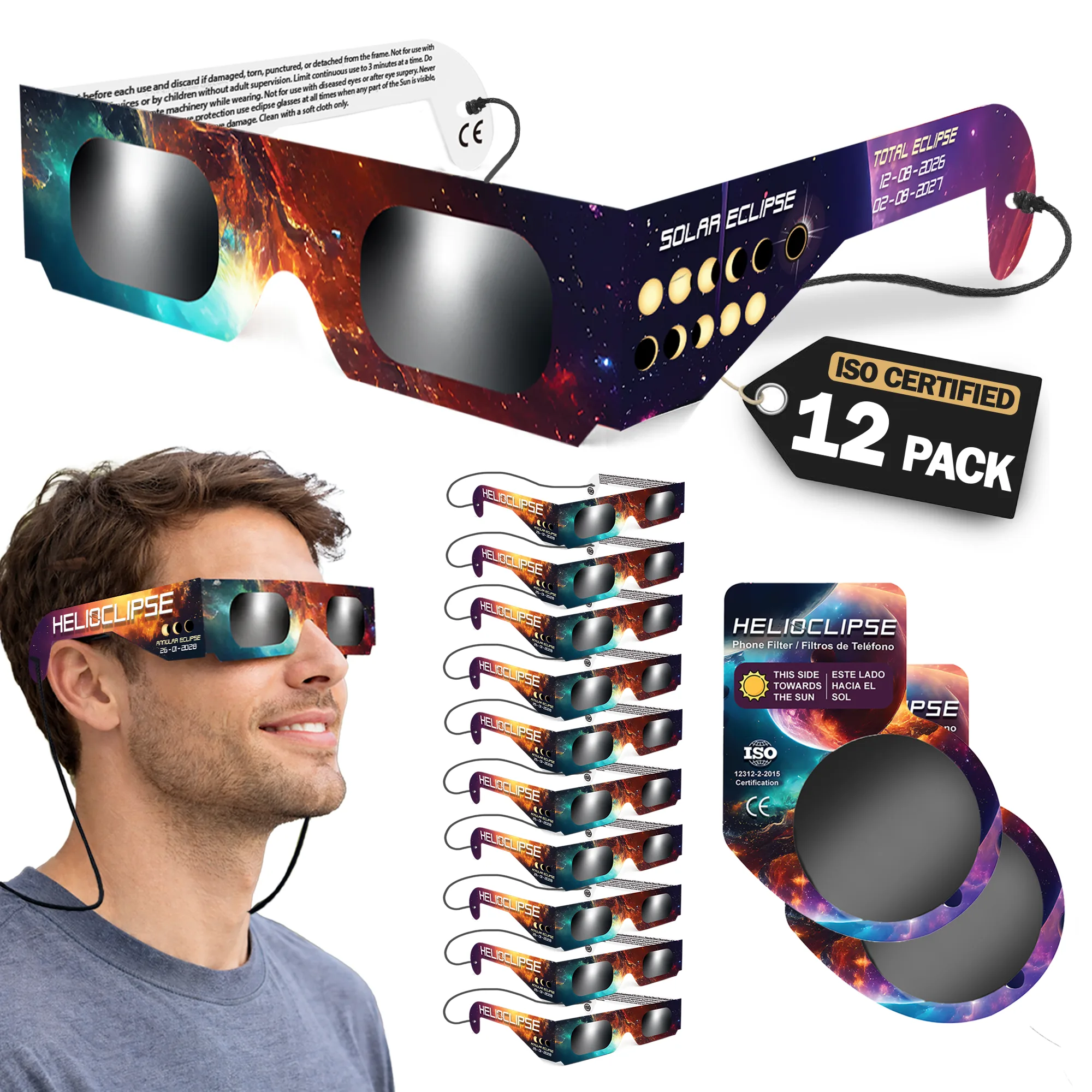
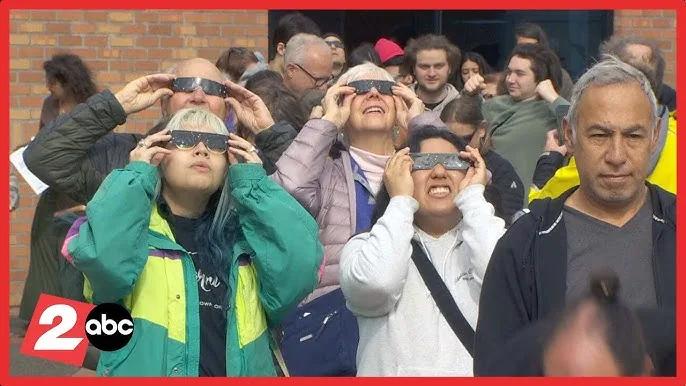
What has changed is our standard for direct viewing. Today, if you want to look at the partial phases, use proper solar viewers that meet the relevant standard. If you are helping a family or school prepare, this is where modern buying language can get confusing. People often look for approved solar eclipse glasses, eclipse viewing glasses, or solar eclipse glasses iso 12312-2 certified. The important thing is not a vague marketing phrase or a claim that a seller is “NASA approved”—NASA does not approve specific brands—but whether the viewer genuinely conforms to ISO 12312-2 and comes from a trustworthy source.
If you want a deeper breakdown of what that standard means, see our guide to ISO 12312-2 and eclipse viewers: what the standard means for your family. And if you are unsure about timing—especially the only moments when glasses can come off during a total eclipse—our explainer on when glasses on, when glasses off is worth reading before eclipse day.
What stayed the same from ancient observers to us
For all the changes in tools, some parts of eclipse observation are almost stubbornly constant.
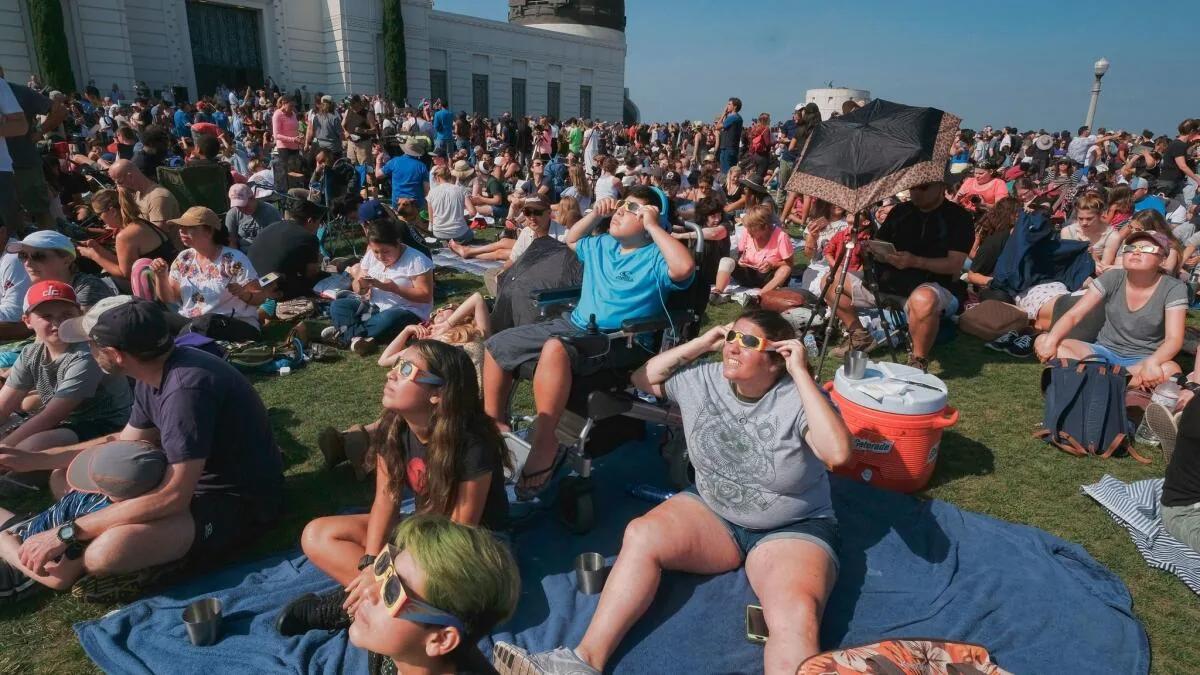
First, eclipses are communal. Ancient court astronomers recorded them for rulers and states; communities gathered under them; modern families still text each other, plan road trips, and step outside together. Even in an age of livestreams, people still want to be there.
Second, eclipses are emotional before they are analytical. A total eclipse is not just a diagram come to life. It is a sensory event: the light drains out, shadows sharpen, the horizon glows strangely in every direction, and the corona appears where your brain insists the Sun should be too bright to look at. Ancient observers did not need modern astrophysics to know something extraordinary was happening.
Third, location matters. This is true in every century. A person just outside the path of totality does not see the same event as a person on the centerline. That was true for scribes in ancient cities and it is true for us. If you are planning a future eclipse, the difference between partial and total is not subtle, and it is one reason we built the Helioclipse 3D eclipse map.
That is also the practical answer to the awkward keyword phrase best places and timing for history of solar eclipse observation. Historically, the “best place” has always meant the place where the geometry gives you the event you actually want to experience. Today we can know that in advance.
The modern era: from notebooks to mass participation
Recent eclipses have added something genuinely new to the long story: scale.
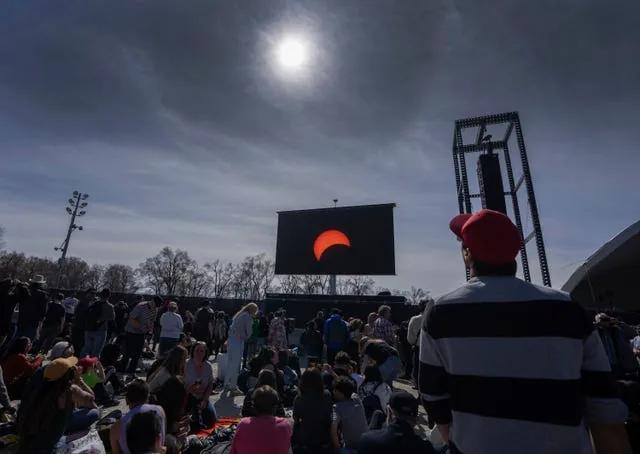
The 2017 total solar eclipse across the contiguous United States was the first in 38 years visible from the lower 48 and the first coast-to-coast U.S. total eclipse in 99 years. NASA says the path of totality crossed 14 states, and roughly two-thirds of the U.S. population lived within a day’s drive of totality. That is not just a scientific event. That is a national logistics event, a media event, and a memory event.
It also showed how modern eclipse observation now spans every level at once. Professional observatories, aircraft, spacecraft, and citizen scientists all observed the same eclipse. Some people measured the corona. Some tracked atmospheric effects. Some just stood in a parking lot with neighbors and looked up at the right moment. All of that belongs in the same story.
That is why a history of solar eclipse observation 2026 guide should not treat history as a museum wing detached from planning. The point of history is that it sharpens your sense of what matters when your own eclipse day arrives: where you stand, what you bring, who you tell, and whether you understand the difference between a partial eclipse and totality.
Solar eclipses, lunar eclipses, and the temptation to mix them up
Readers often bounce between solar and lunar topics, so it helps to separate them clearly.
The history of lunar eclipse overlaps with solar-eclipse history in one obvious way: both events were recorded early, both attracted interpretation, and both helped build long-term astronomical traditions. But they are not the same observational problem.
A lunar eclipse happens when Earth passes between the Sun and the Moon, darkening the Moon. It is safe to view with the naked eye at every stage. A solar eclipse happens when the Moon passes between Earth and the Sun, and direct viewing of the Sun requires proper protection except during the brief total phase of a total solar eclipse for observers actually inside the path of totality.
That difference is not a technical footnote. It is the biggest practical divide between the two histories. The history of lunar eclipse can be told without a safety section. The history of solar eclipse observation cannot.
NASA’s history page also notes that some Christian texts describing the Moon turning to blood after the crucifixion have been linked by scholars to a lunar eclipse on 3 April 33 C.E. Whether readers arrive through that question or through broader eclipse history dates, the important thing is to keep the categories straight: a “blood moon” is lunar, not solar.
What still matters today: prediction, place, and eye safety
If we strip away the centuries of changing interpretation, three lessons remain.
1) Prediction is only useful if you understand geometry
Modern astronomy can tell us far more than ancient observers could know in advance. But a predicted eclipse is not one experience for everyone. It is many different experiences spread across geography.
That is why we push readers toward maps, not just dates. A date tells you an eclipse exists. A map tells you whether you get totality, a deep partial, or something much less dramatic. If you are already thinking ahead to the next major event, our August 12, 2026 total solar eclipse planning guide is the right next read.
2) Totality and partial phases are different events for your eyes
This is the lesson history could not teach reliably on its own. We now know exactly why unsafe viewing can injure the retina, and we know that ordinary sunglasses are not enough. The AAS and NASA both emphasize the same rule: except during the brief total phase of a total solar eclipse, when the Sun’s bright face is completely covered for observers inside the path, you need proper solar protection for direct viewing.
If you are buying for a family, classroom, or watch party, do not rely on vague labels. People search for “eclipse glasses nasa approved” all the time, but that phrase is sloppy. NASA does not certify brands. What you want are viewers that genuinely meet ISO 12312-2, are undamaged, and come from a source you trust. Our shop eclipse glasses page is built around that practical need.
3) Eclipses are better when shared and planned early
Ancient observers did not have shipping deadlines, traffic models, or hotel sellouts. We do. That means modern eclipse culture includes logistics. Tell people early. Decide whether you are chasing totality or staying local for a partial. Check weather patterns closer to the date. Make sure the kids’ viewers are in hand before the week of the event, not after the good stock disappears.
History gives the event depth. Planning gives you a better chance of actually experiencing it well.
So what is the history of eclipse observation, really?
The shortest honest answer to what is the history of eclipse observation? is this: it is the story of humans learning to turn astonishment into record, record into prediction, and prediction into shared experience.
At first, eclipses were signs. Then they were entries in archives. Then they became tests of astronomical models, opportunities for photography, and evidence in twentieth-century physics. Today they are all of those things at once, plus a public event that millions can prepare for together.
That is why how people have observed eclipses across history—and what still matters is not just a cultural-history topic. It is a practical one. The same event that once startled scribes in Anyang can still stop a school playground, a family reunion, or a whole highway rest area in its tracks. The difference is that we now have better tools, better science, and better safety guidance.
Use them.
Good Morning America
Frequently asked questions
How did people first begin recording eclipses in history?
People first recorded eclipses as striking events that could be tied to fear, ritual, or interpretation, and later as observations that could be measured and compared. The article says the history of solar eclipse observation shows a shift from awe toward evidence, with early records preserved in inscriptions, tablets, court records, and later texts.
Was there a solar eclipse on June 14, 1946?
The excerpt does not mention June 14, 1946, so it does not provide enough information to confirm whether an eclipse happened on that date. It only explains that eclipse records must be checked carefully against dated historical evidence.
What is known about the earliest recorded lunar eclipse?
The excerpt does not give a specific earliest recorded lunar eclipse. It does say that some of the strongest early evidence for eclipse observation comes from ancient written records, especially oracle bones from China in the late second millennium BCE.
Did NASA record a lunar eclipse in 33 AD?
The excerpt does not mention a NASA record of a lunar eclipse in 33 AD. It only notes that some early eclipse claims are more secure than others and that historians prefer dated written records over suggestive evidence like rock art.
What should readers understand about the timeline of eclipse observation?
Readers should understand that the timeline is not a simple list of dates; it is a progression from early interpretation to careful recording and prediction. The article emphasizes that some early evidence is probable rather than certain, and that the most reliable historical records are tied to specific places, scribal traditions, and durable archives.
On-site next steps
- Explore the Helioclipse Eclipse Explorer / 3D map to see how eclipse geometry changes from one location to another.
- Browse our blog hub for more safety, planning, and eclipse-explainer guides.
- If you are preparing for a future event with family, friends, or a school group, see our solar eclipse glasses and order early enough to avoid last-minute stress.
Sources & further reading
- NASA Science — History of Eclipses
- NASA Science — Eclipses
- NASA Science — Eclipse Viewing Safety
- American Astronomical Society — How to View a Solar Eclipse Safely
- American Astronomical Society — About the ISO 12312-2 Standard for Solar Viewers
- American Astronomical Society — How Can You Tell If Your Eclipse Glasses or Handheld Solar Viewers Are Safe?
- Space.com — Ancient solar eclipse records reveal how Earth's rotation has changed
- Space.com — What Were the First Records of Solar Eclipses?
- Astronomy Magazine — A short history of eclipses
- Astronomy Magazine — The 10 most important eclipses in history, picked by an expert