Rental cars and eclipse weekend: insurance legibility, scratches, and the parking fantasy
A rental car can feel like the perfect eclipse tool: freedom to move for clearer skies, freedom to leave the city, freedom to chase that one gap in the clouds. Sometimes it really is. But the phrase rental car spain august 2026 eclipse traffic insurance only sounds tidy until you picture the actual weekend: crowded shoulders, improvised parking, dusty pull-offs, a tired driver trying to leave at the same time as everyone else, and a glovebox full of paperwork nobody read carefully enough.
That is why our rental car spain august 2026 eclipse traffic insurance 2026 guide starts with a boring truth that can save your trip: the most important part of the rental may be the least glamorous one. Read the exclusions. Photograph the car. Assume parking will be tighter than the brochure implies. And never let eclipse excitement tempt you into looking at a partial Sun while the vehicle is moving.
If you are still deciding where driving actually helps, start with the Helioclipse Eclipse Explorer / 3D map and compare your intended viewing spot with the path itself. For the broader event, our guide to August 12, 2026 total solar eclipse: what to expect and how to plan ahead is the right big-picture companion before you commit to roads, lodging, and a pickup time.
Why rental cars feel smart for an eclipse — and where the fantasy breaks
The fantasy is easy to understand. You land in Spain, collect a small hatchback, and tell yourself you now have options. If clouds threaten one town, you can pivot. If your lodging is outside the path, you can drive in. If trains are full, you are independent.
All of that can be true. But eclipse travel compresses a lot of people into the same useful roads and the same useful parking areas at roughly the same hours. A car gives you mobility, not immunity. NASA’s eclipse planning guidance has repeatedly warned travelers to expect heavy post-eclipse traffic, to fuel up early, and to avoid assuming a quick exit just because the map distance looks short. That advice was written for other eclipses, but the logic travels well: a narrow path, a fixed celestial schedule, and thousands of people leaving together create bottlenecks that ordinary weekend instincts underestimate.
The other fantasy is parking. Many drivers imagine a neat roadside turnout with a wide horizon, no restrictions, no gates, no agricultural traffic, no irritated landowner, and no one else arriving first. Sometimes that exists. Often it does not. The better mindset is not “we’ll find something.” It is “we will pre-select legal options, arrive early, and accept that the last kilometer may matter more than the last 100.”
Insurance legibility matters more than the marketing page
The title phrase rental cars and eclipse weekend: insurance legibility, scratches, and the missing last word is almost funny, but the point is serious: legibility matters. Not just whether the PDF is readable, but whether you actually understand what the coverage does, what it excludes, what counts as driver negligence, and what documentation the company expects if something goes wrong.
A lot of travelers ask, do i need to buy insurance when renting a car in spain? The honest answer is: you need to know what is already included, what your card or third-party policy really covers, and where the gaps are. “Included insurance” can still leave you with a deductible, exclusions for certain kinds of damage, or procedural requirements that matter just as much as the headline coverage.
This is where generic internet chatter can mislead. A search like rental car insurance spain reddit may surface useful anecdotes, but anecdotes are not contract language. If one traveler says a scratch was ignored and another says a nearly invisible scuff triggered a charge, both stories can be true under different companies, inspection standards, and return conditions.
Before you drive away, make sure you can answer these plain questions:
- What damage is covered, and what damage is excluded?
- What is your excess or deductible?
- Are tires, wheels, glass, mirrors, roof, underbody, and interior treated differently?
- What happens if the car is damaged while parked?
- What is the reporting deadline if you discover damage?
- Do you need a police report in any collision scenario?
- Are there restrictions on where the car may be driven or parked?
- What documents must you present at return if there is a claim?
If the desk agent explains any of this quickly and vaguely, slow the conversation down. Eclipse weekend is not the time to nod through a paragraph you did not understand.
Does rental car insurance cover scratches and dents? Usually: maybe, with conditions
People ask does rental car insurance cover scratches and dents? because scratches are the most plausible eclipse-weekend damage. Not dramatic crashes — just the ordinary stuff of crowded travel: a door edge in a cramped lot, brush against a wall in an old village street, a low post you did not see while reversing, grit or luggage scraping paint, someone else opening their door into yours.
And yes, are scratches covered in car rental insurance? Sometimes. But “covered” can mean several different things:
- Covered after you pay an excess.
- Covered only if the damage is documented correctly.
- Covered only for body panels, not mirrors, wheels, or glass.
- Covered unless the company argues the damage came from misuse, prohibited driving, or failure to report.
- Covered by one policy layer but not another.
That is why the practical question is not only whether scratches are theoretically covered. It is whether your paperwork makes the process predictable.
What to inspect before leaving the lot
Do this in daylight if you can, and do not rush because other customers are waiting.
- Walk around the entire car slowly.
- Photograph every side, the roofline if visible, wheels, bumpers, mirrors, windshield, and interior.
- Take a short video too; it helps show continuity.
- Capture the fuel level and odometer.
- Make sure any existing marks are recorded on the check-out form.
- If a mark is not listed, ask for it to be added before departure.
- Save the photos somewhere that will not vanish if your phone dies.
This is not paranoia. It is trip hygiene.
What counts as “minor” is not up to you
Another common question is do rental car companies care about minor scratches? Some may ignore tiny wear consistent with normal use; others may not. The key point is that your opinion of “minor” does not settle the matter. A mark that looks trivial to you may still trigger a charge, especially if it is on a panel edge, mirror cap, wheel, or trim piece.
So if you are wondering is it worth claiming on insurance for a scratch? that depends on the size of the charge, your excess, and the reporting rules in your contract. What you should not do is assume a scratch is too small to mention and hope it disappears into the general dust of eclipse weekend.
The eclipse-specific damage you can actually imagine
Most travel articles talk about rental cars as if the risk is abstract. Eclipse travel is more specific than that.
You may arrive at a rural viewpoint where the “parking area” is really a narrow shoulder with uneven ground. You may squeeze into a temporary space beside other visitors who are unloading chairs, coolers, camera bags, and children. You may return to the car after totality or after the maximum partial phase and find that everyone is trying to reverse out at once.
That is the environment where small damage happens.
The most plausible problems are not cinematic. They are:
- door dings in crowded lots
- bumper scrapes while inching through improvised parking
- wheel or tire damage from rough edges or curbs
- mirror contact on narrow roads
- underbody contact on uneven entrances
- interior mess or stains from food, sunscreen, dust, or wet gear
None of this means “don’t rent a car.” It means rent one with your eyes open. If you know you will be navigating old streets or tight parking, a smaller vehicle may be easier to live with than the SUV that looked comfortable on the booking page.
The driving safety rule that matters most: do not watch the eclipse from the driver’s seat
This should be obvious, but eclipse excitement makes people do foolishly casual things. During any partial phase, it is not safe to look directly at the Sun without proper solar viewing protection. The American Astronomical Society and NASA are both clear on this. Outside totality, and throughout a partial eclipse, there is no safe “quick glance” at the bright Sun with naked eyes.
That means no peeking through the windshield. No slowing down to stare. No lifting eclipse glasses for “just a second.” No trying to track the crescent Sun while rolling through traffic.
If you want to observe, pull over legally, park fully, switch off the driving task, and then observe safely. If you are new to the timing of safe viewing during a total eclipse, read When glasses on, when glasses off: eclipse phases explained for first-time viewers. If you are outside the path of totality, there is no glasses-off moment at all.
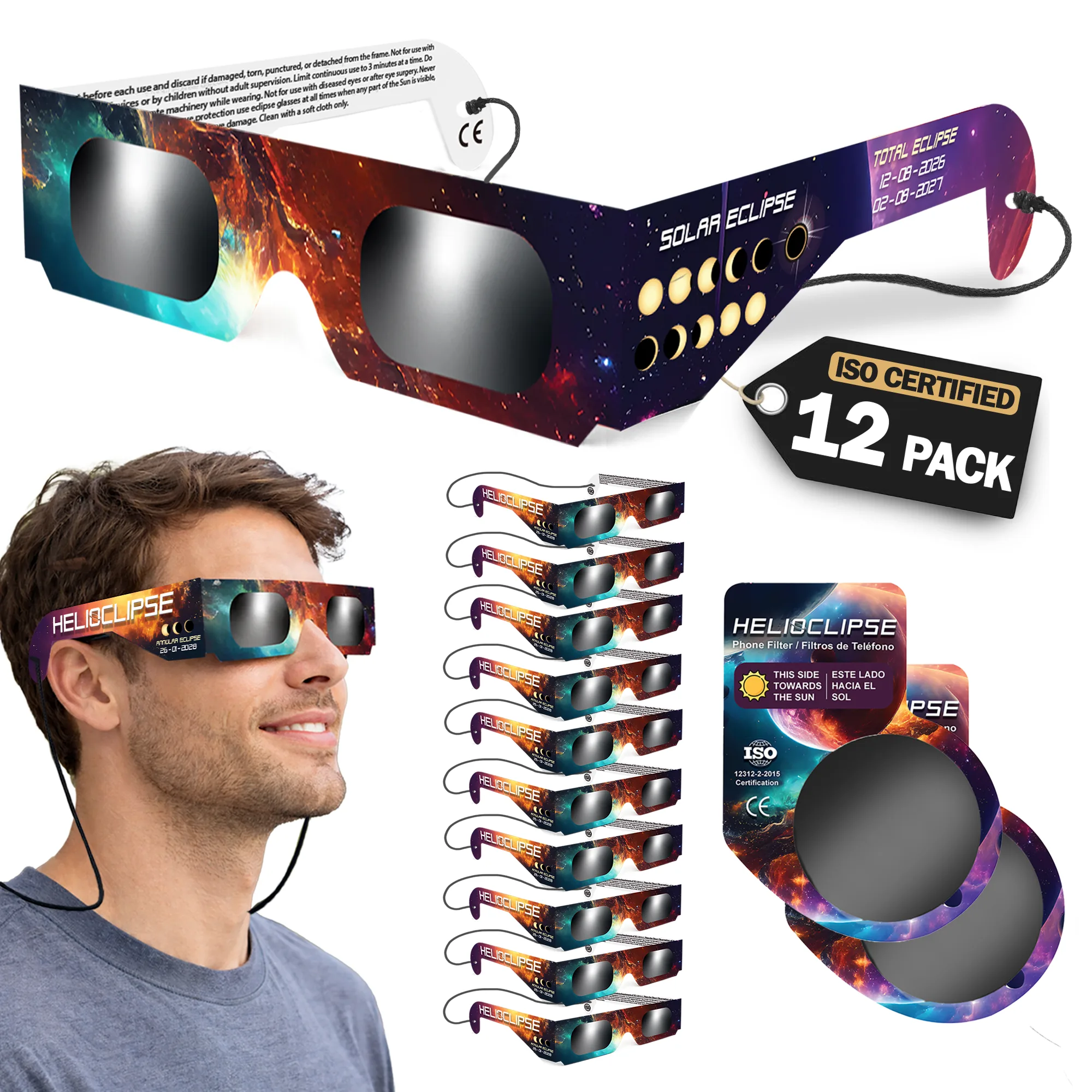
And if your viewers are bent, scratched, punctured, or otherwise suspect after bouncing around in a bag or hot car, do not trust them. The AAS guidance is blunt about damaged viewers: discard them. If you still need eye protection, use the Helioclipse shop for eclipse glasses and buy early enough that you are not improvising at the last minute with dubious stock.
In practical shopping language, what you want are approved solar eclipse glasses and solar eclipse glasses iso 12312-2 certified from a source you trust, not random marketplace listings with impressive-looking print. NASA also notes that it does not approve individual brands, so phrases like “eclipse glasses nasa approved” are common shopper shorthand, not an official NASA endorsement program.
Parking fantasy versus parking reality
The parking fantasy says you will drive until the view feels right, stop wherever the horizon opens, and enjoy a serene sky show.
Parking reality is more administrative.
You need to think about legality, access, turnaround space, and exit timing. A beautiful spot is not useful if it leaves you nose-in on a narrow shoulder with no room to reverse once a line forms behind you. A broad view is not useful if you are blocking a farm entrance, emergency access, or a lane that locals still need.
For eclipse weekend, the best parking plan is usually one of these:
- A pre-identified public site with known access.
- A town or venue where parking rules are clear and you can walk the last stretch.
- A backup site in the same weather zone.
- A decision to stay put after the event instead of joining the first wave out.
That last point matters. NASA’s planning advice for past eclipses has emphasized that leaving immediately after the main event can mean sitting in long backups with everyone else. If your schedule allows it, lingering through the final partial phases, eating, resting, and letting the first surge dissipate can be smarter than racing to your car the moment the sky brightens.
For more on that crowd logic, our eclipse travel without the chaos: routes, crowds, and backup plans for 2026 article goes deeper on the human side of egress and why “short drive” and “short trip home” are not the same thing on eclipse day.
Tolls, fuel, and the small logistics that become big when roads clog
Search interest around rental car spain tolls is not random. Tolls, fuel stops, and charging stops become more stressful when everyone is moving on the same schedule.
A few habits help:
- Start eclipse day with fuel or charge already handled.
- Carry water and simple food.
- Do not assume a tiny town can absorb a sudden wave of visitors without queues.
- Download maps offline in case mobile service is patchy.
- Keep the rental company’s emergency and roadside numbers easy to reach.
- Know whether toll payment is manual, automatic, or tied to the rental agreement.
This is also where broad questions like what do i need to drive in spain, rules for renting car in spain, and renting a car in spain with us license become practical rather than theoretical. Requirements can vary by traveler nationality, license type, rental company policy, and current regulation. We are not going to bluff a one-size-fits-all legal answer here. Check the rental company’s terms, your license validity, any permit requirements that apply to your country, and the current official driving rules before you fly.
The same caution applies to questions like what are the new rental laws in spain 2026? and what are the new driving rules in spain 2026? Laws and enforcement details can change, and this article is about eclipse-trip decision-making, not replacing official legal guidance. Use current government and rental-company documentation for the final word.
Should you buy extra insurance when renting abroad?
Another frequent question is do i need extra insurance when renting a car abroad? Sometimes yes, sometimes no, and sometimes the answer depends less on the car than on your tolerance for hassle.
If your existing coverage leaves a high excess, excludes common damage categories, or requires a claims process you do not want to navigate after an international trip, paying for simpler protection may be worth it. If your existing coverage is strong and clearly documented, extra coverage may be redundant.
What matters is not winning an internet argument about the cheapest strategy. What matters is whether you can explain your own protection in one calm paragraph before the trip starts.
A useful self-test:
- If the car gets a door ding in a crowded eclipse lot, who pays first?
- If a wheel is scraped on a curb, is that included?
- If the windshield chips, what happens?
- If the car is damaged while parked and the other driver is gone, what is your procedure?
- If you need to file a claim after returning home, what documents will you need?
If you cannot answer those questions, you do not yet understand your coverage.
A checklist for eclipse-morning drivers
This is the part to screenshot and send to the group chat.
Before pickup
- Read the rental terms, not just the booking summary.
- Confirm driver names, pickup hours, deposit, and fuel policy.
- Check what your coverage excludes.
- Save reservation and emergency numbers offline.
At pickup
- Inspect and photograph the car thoroughly.
- Confirm existing damage is logged.
- Check tires, mirrors, lights, and windshield.
- Ask how tolls are handled.
- Ask what to do if damage is discovered while parked.
The night before the eclipse
- Fuel or charge the car.
- Pack water, snacks, hats, sunscreen, and a phone cable.
- Put your eclipse viewers somewhere clean and protected.
- Review your primary site and one backup.
- Decide in advance whether you will leave immediately or wait out the first traffic wave.
On eclipse day
- Leave earlier than feels necessary.
- Park legally and with an exit plan.
- Do not observe while driving.
- Keep children away from traffic before and after the event.
- If you are sharing viewers, inspect them again before use.
If something goes wrong
- Photograph the damage immediately.
- Note time, place, and circumstances.
- Follow the rental company’s reporting instructions.
- Do not rely on memory after a long, hot day.
The car is a tool, not the experience
It is easy to let the rental become the center of the plan: which class, which policy, which route, which lot. But the car is only there to get you to the sky.
For the August 12, 2026 eclipse, the real planning question is still geographic: are you inside totality or outside it? A driver in the path may get a few minutes of true totality; a driver outside it may see only a partial eclipse, even if the road trip felt equally ambitious. That is a huge difference in experience. If you are comparing Spanish locations, use the Helioclipse Eclipse Explorer / 3D map and our path guide to 2026 totality in Spain: path basics, timing, and what “on the centerline” really means before you lock in a car-based plan.
A car can help you adapt to weather and reach a better horizon. It cannot turn a partial eclipse into totality, and it cannot rescue a trip built on vague assumptions.
That is the deeper lesson behind rental cars and eclipse weekend insurance legibility scratches and the reviews and best rental cars and eclipse weekend insurance legibility scratches and the kind of search language floating around online. Reviews can tell you how a company felt to other customers. They cannot replace your own reading of the contract, your own inspection of the vehicle, or your own discipline on eclipse day.
Frequently asked questions
What should I check in the rental agreement before driving to the eclipse area?
Read the exclusions carefully and make sure the paperwork is easy to understand before you leave. The article says the most important part of the rental may be the least glamorous one, and that legibility matters more than the marketing page. Photograph the car before you drive off so you have a record of its condition.
What is the main takeaway from the rental-car planning guide for eclipse weekend?
The guide’s main point is that a rental car gives you flexibility, but it does not remove the usual eclipse-weekend problems. Expect crowded roads, improvised parking, and a tired driver trying to leave at the same time as everyone else. The practical advice is to read the exclusions, photograph the car, and assume parking will be tighter than expected.
How should I think about scratches and damage when using a rental car for eclipse travel?
Treat the car’s condition as something to document before you start driving. The excerpt specifically recommends photographing the vehicle, which helps create a record if scratches or other issues are questioned later. It also warns against rushing through the paperwork when the weekend is already busy.
What is the safest way to handle parking and departure plans for an eclipse trip by car?
Do not rely on finding easy parking at the last minute. The article says to pre-select legal parking options, arrive early, and accept that the last kilometer may matter more than the last 100. It also notes that heavy post-eclipse traffic is likely, so a quick exit should not be assumed.
When is driving actually worth it for eclipse viewing, and how should I choose a spot?
Driving helps when it gives you a better chance of reaching clearer skies or a location that matches the eclipse path. The article recommends using the eclipse map to compare your intended viewing spot with the path before committing to roads, lodging, and pickup timing. That way you can decide whether the trip by car is truly useful rather than just convenient in theory.
On-site next steps
- Explore your actual viewing geometry with the Helioclipse Eclipse Explorer / 3D map. Check whether your planned stop is in totality, near the centerline, or only in the partial zone.
- If your group still needs viewers, order from our shop eclipse glasses early and inspect them before travel. For families, schools, or carpools, this is the moment to sort gear before stock gets tight.
- Keep learning in the Helioclipse blog, especially our guides on eclipse phases, crowd strategy, and weather mobility.
Sources & further reading
- How to View a Solar Eclipse Safely — American Astronomical Society guidance on safe direct viewing, totality, and damaged viewers.
- Eyewear & Handheld Viewers — AAS details on inspecting viewers and when to discard them.
- How Can You Tell If Your Eclipse Glasses or Handheld Solar Viewers Are Safe? — AAS explanation of what consumers can and cannot verify.
- Indirect Solar Viewing: Pinhole & Optical Projection — Safe indirect methods if you are parked and do not have direct-viewing gear.
- How to Safely See a Partial Solar Eclipse — accessible partial-eclipse safety explainer from Sky & Telescope.
- Eclipse Viewing Safety — NASA’s umbrella safety guidance, including ISO 12312-2 context.
- What to Expect: A Solar Eclipse Guide — NASA planning advice on fuel, crowds, timing, and staying flexible.
- Eclipses — NASA’s solar-eclipse hub for background and terminology.
- How to View a Solar Eclipse Without Damaging Your Eyes — consumer-friendly safety overview from Space.com.
- Solar eclipse glasses: How to check safety and use them correctly — practical gear-check guidance and ISO context.