Viewing from Greenland and the Arctic: logistics, daylight, and realism checks
On August 12, 2026, the Moon’s central shadow will cross one of the planet’s most arresting—and least forgiving—eclipse landscapes. Eastern Greenland lies inside the path of totality, with the eclipsed Sun roughly 25 degrees above the west-southwestern horizon in parts of Scoresby Sund. Near the center of the path, darkness can last approximately 2 minutes 16 or 17 seconds.
That sounds like a dream assignment. It is also an expedition, not a conventional city break. The practical story of the 2026 solar eclipse greenland arctic corridor involves ships, ice, limited access, persistent daylight and cloud that may—or may not—break at the right moment. Think of this as our 2026 solar eclipse greenland arctic 2026 guide to deciding whether the reward fits the cost and uncertainty.
Before comparing itineraries, open the Helioclipse Eclipse Explorer and check each proposed observation point. Greenland is enormous, and being “in Greenland” is not the same as being inside the umbra. The 2026 greenland eclipse is total only within the narrow central path; Nuuk, for example, remains outside it and receives a partial eclipse.
The path crosses eastern Greenland—not Greenland as a whole
The August 12 eclipse begins its global journey in the high Arctic, crosses northern Russia and tracks along Greenland’s eastern side before continuing over the North Atlantic, western Iceland and northern Spain. Published estimates place the path of totality at roughly 180 to 190 miles, or about 290 to 305 kilometres, wide. Within that band, the Moon completely covers the Sun’s bright face. Outside it, even where coverage is substantial, the eclipse remains partial.
This distinction immediately corrects a common misunderstanding about the 2026 solar eclipse greenland experience. Nuuk, Greenland’s capital on the southwest coast, is not a totality destination. NASA’s published city table gives Nuuk a partial eclipse beginning at about 3:30 p.m. local time, reaching maximum at about 4:35 p.m. with 79% coverage, and ending around 5:39 p.m. Those circumstances can still produce a striking crescent Sun, but the photosphere remains visible, the corona does not emerge as it does during totality, and eye protection stays on throughout.
The 2026 greenland eclipse path instead cuts through remote East and Northeast Greenland. Scoresby Sund, also known as Kangertittivaq, is the most frequently discussed operational zone. Nordvestfjord, deep within that fjord system, lies close enough to the centerline for approximately 2 minutes 16 seconds of totality at around 4:32 p.m. under the local time convention used by the cited location guide. The Sun should be about 24.8 degrees high. Ella Island in the King Oscar Fjord area is another cited expedition location, with roughly 1 minute 45 seconds of totality and a solar altitude near 23.7 degrees.
Those numbers show why the phrase 2026 greenland total solar eclipse needs a precise pin on a map. Moving from Nuuk to Nordvestfjord is not a short transfer between two viewing sites. It changes the event from 79% partial coverage to genuine totality—and involves travelling between widely separated coasts with no connecting road network.
What totality would actually feel like in an Arctic fjord
At Nordvestfjord, the Sun will not be grazing the horizon. A height of about 25 degrees is four times the width of an outstretched fist above a level horizon, giving observers more tolerance for nearby low terrain than eclipse viewers will have in parts of Spain. Mountains can still matter inside a fjord, so a vessel’s exact position and the western sightline remain important.
During the long partial phase, the Sun slowly narrows behind certified viewers. The surrounding fjord does not become dramatically dark when 80% or even 95% of the solar disk is covered; the remaining photosphere is intensely bright. Only when the last bright portion disappears does the scene change abruptly. The corona appears around a black lunar silhouette, the horizon can take on twilight colours, and the light across rock, water and ice becomes unlike ordinary sunset.
Near the Greenland centerline, that fully eclipsed interval lasts a little over two minutes. It is longer than the roughly one minute available in central Reykjavík and longer than many Spanish locations, but it is not long enough to troubleshoot unfamiliar equipment. A ship may be moving, people may be wearing gloves, and a gust can turn a loose filter or paper schedule into litter. Practise your sequence before leaving home: viewers on, look; turn away, viewers off; rehearse camera controls without pointing at the Sun; and decide whether your priority is photography or simply watching.
The 2026 greenland total eclipse is especially compelling because of that combination: a reasonably elevated Sun, close to the event’s maximum duration, above a landscape of steep fjords and drifting ice. Yet none of those features makes clear sky more likely. The celestial geometry is predictable; the atmosphere and sea route are not.
Expedition access: the itinerary is not the observation point
For most visitors, an expedition vessel is the realistic way to reach Scoresby Sund, Nordvestfjord or other remote points in eastern Greenland. A published cruise itinerary may name a fjord or broad region, but it cannot promise a particular anchorage months in advance. Sea ice, wind, swell, visibility, local restrictions and operational safety can all change where a vessel is able to go.
That means the best planning questions are unusually specific:
- Is the vessel scheduled to be inside the path well before first contact, rather than racing toward it on eclipse day?
- How much freedom does the captain have to change position for cloud, and what limits will ice or narrow fjords impose?
- Is the observation expected from an open deck, a landing site or either, depending on conditions?
- Does the ship have enough unobstructed deck space for passengers to see the west-southwestern sky?
- What happens if wind makes a landing unsafe or if wildlife protocols restrict movement ashore?
- Which time standard will the expedition use in briefings, and will all clocks be synchronised?
“Mobile” does not mean infinitely mobile. An expedition ship can sometimes reposition by kilometres, which may help beneath broken cloud. It cannot outrun every weather system, cross unsafe ice or teleport from a cloud-covered fjord to clear sky hundreds of kilometres away. If a broad low-pressure system blankets the region for days, there may be no workable escape.
A sound operating principle is arctic logistics, weather realism, and visibility—use institutional eclipse plan data alongside the operator’s navigation briefings. Similarly, a clipped planning field such as arctic logistics weather realism and visibility use institutional eclipse planni is not actionable by itself: your final documents should identify the forecast provider, eclipse circumstances, local authority and vessel decision-maker by name.
This is also the moment to read cancellation and itinerary-change terms carefully. Buy travel insurance appropriate to the trip, disclose relevant medical needs and understand the limits of evacuation and communications in a remote region. The eclipse should be treated as one extraordinary possibility within a broader Arctic voyage—not as a service the weather or ship can guarantee.
Cloud statistics are clues, not forecasts
Long-term cloud figures illustrate the challenge. One published location comparison gives Nordvestfjord an average cloud figure around 61% and Ella Island around 55%, based on historical datasets. Those values do not mean you have exactly a 39% or 45% chance of seeing totality. They describe past cloud occurrence at particular places, times or sampling scales; they do not capture every local opening or predict the sky on August 12, 2026.
Greenland’s ice cap and fjords create complicated local effects. Downslope air from the ice can sometimes dry and clear as it descends. On another day, moisture, low cloud or a large weather system can cover a vast area. Fog or a low deck can hide the Sun even when thinner high cloud elsewhere would still allow a view. Conditions may differ between the mouth and inner reaches of a fjord.
Any 2026 solar eclipse greenland arctic 2026 guide map should therefore be read as a geometry tool, not a weather promise. It can show whether a ship’s proposed position is inside totality, its distance from the centerline, the direction of the Sun and the expected duration. It cannot show the cloud that will occupy that point on eclipse afternoon.
Likewise, a 2026 solar eclipse greenland arctic 2026 guide time should be checked against the convention actually used aboard your vessel. Greenland’s time-zone arrangements and daylight-saving labels can make copied times confusing, while ships may maintain a designated onboard time. Put the local clock time, UTC equivalent and first-contact-to-last-contact sequence on one operator-issued schedule. Do not convert a third-party time in your head on deck.
In the final week, follow official meteorological products and the expedition team’s briefings. Satellite imagery becomes increasingly useful during the last day, but it still requires expert interpretation at high latitudes. Our guide to cloud cover and eclipse-day mobility explains why the useful question is not simply “Will it be cloudy?” but “What cloud type, moving in which direction, and what safe choices remain?”
August daylight: do not pack for polar night
“Greenland has six months of darkness” is an oversimplification caused by treating a huge north-south territory as one point. Polar night and midnight sun depend on latitude and season. The August 12 eclipse occurs after the summer solstice, when East Greenland still has very long days and lingering twilight.
One published estimate for the lower Scoresby Sund area places sunset around 10:15 p.m., several hours after totality, with the darkest part of the night around 12:50 a.m. Even then, the sky may remain in civil twilight rather than becoming fully dark. Exact daylight conditions vary with latitude, terrain and date, so check the coordinates for your voyage rather than relying on a generic table of greenland daylight hours by month.
This matters in two ways. First, totality can still create an abrupt, theatrical darkness even though ordinary night never becomes fully dark. The Moon is blocking the Sun directly; it does not need to be nighttime for the corona to appear.
Second, expectations for after-hours astronomy need restraint. The Perseid meteor shower peaks around the same period, but a bright twilight sky can wash out most meteors. Aurora is physically possible when solar activity and Earth’s magnetic field cooperate, yet the sky may not become dark enough to reveal it. Treat aurora and meteor sightings as bonuses, not promised extensions of an eclipse package.
Where are the best places—and what does “best” mean here?
The best places and timing for 2026 solar eclipse greenland arctic viewing depend on what risk you are willing to accept. Nordvestfjord offers centerline-adjacent geometry, about 2 minutes 16 seconds of totality and a Sun nearly 25 degrees high, but access is expedition-dependent and historical cloudiness is substantial. Ella Island offers about 1 minute 45 seconds and similarly elevated geometry, with the same basic realities of remote ship access and uncertain landing conditions.
A centerline position is not automatically worth sacrificing a clearer patch of sky. Moving toward the edge shortens totality, but two minutes behind opaque cloud is less useful than 90 seconds beneath a clear opening. The expedition team should balance path geometry against weather, ice and safe navigation. Ask whether an onboard eclipse specialist and the bridge team will make that decision together.
For many travellers, western Iceland provides a less remote compromise. The western Snæfellsnes Peninsula can receive roughly 2 minutes 8 to 10 seconds of totality with the Sun about 25 degrees high, although historical August cloud levels are also high. Spain generally offers easier road access and, according to long-term satellite comparisons, better broad cloud prospects—but totality occurs much lower in the evening sky. There is no universal answer to “Where is the best place to see the 2026 total solar eclipse?” Greenland maximises the expedition experience; it does not maximise certainty.
If your group includes children, anyone with limited mobility or a traveller who needs reliable medical access, discuss the practical burden honestly. A two-minute astronomical advantage is not automatically more valuable than simpler transport, a stable observing surface or the freedom to move by road. Our 2026 eclipse travel and backup-plan guide can help your group compare those trade-offs before deposits become non-refundable.
North America sees a partial eclipse, not totality
For readers asking will the 2026 solar eclipse be visible in the usa?, NASA’s answer is yes—but only as a partial eclipse, and not everywhere with equal depth. Parts of the northern United States, from Alaska into the Northeast and as far south as North Carolina within the visibility footprint, see at least some portion of the event. No part of the United States lies in the path of totality.
NASA lists about 37% solar coverage at maximum in Fairbanks, 28% in Anchorage, 24% in Bangor, 16% in Boston and 9% in New York City. Farther from the eclipse path, Detroit receives about 3% and Washington, D.C., about 4%. These percentages refer to the fraction of the Sun’s area covered in NASA’s table, not minutes of totality—there is no totality in those cities.
Canada also receives a partial eclipse, with circumstances generally becoming deeper toward the northeast. NASA lists 53% coverage for St. John’s and 31% for Halifax, while another published calculation places Iqaluit near 61%. Anyone staying in North America must keep certified viewers on whenever looking directly at the Sun. A 99% partial eclipse is still not totality; a 9% partial eclipse is still bright enough to require proper protection.
Safe viewing on a cold, windy or moving deck
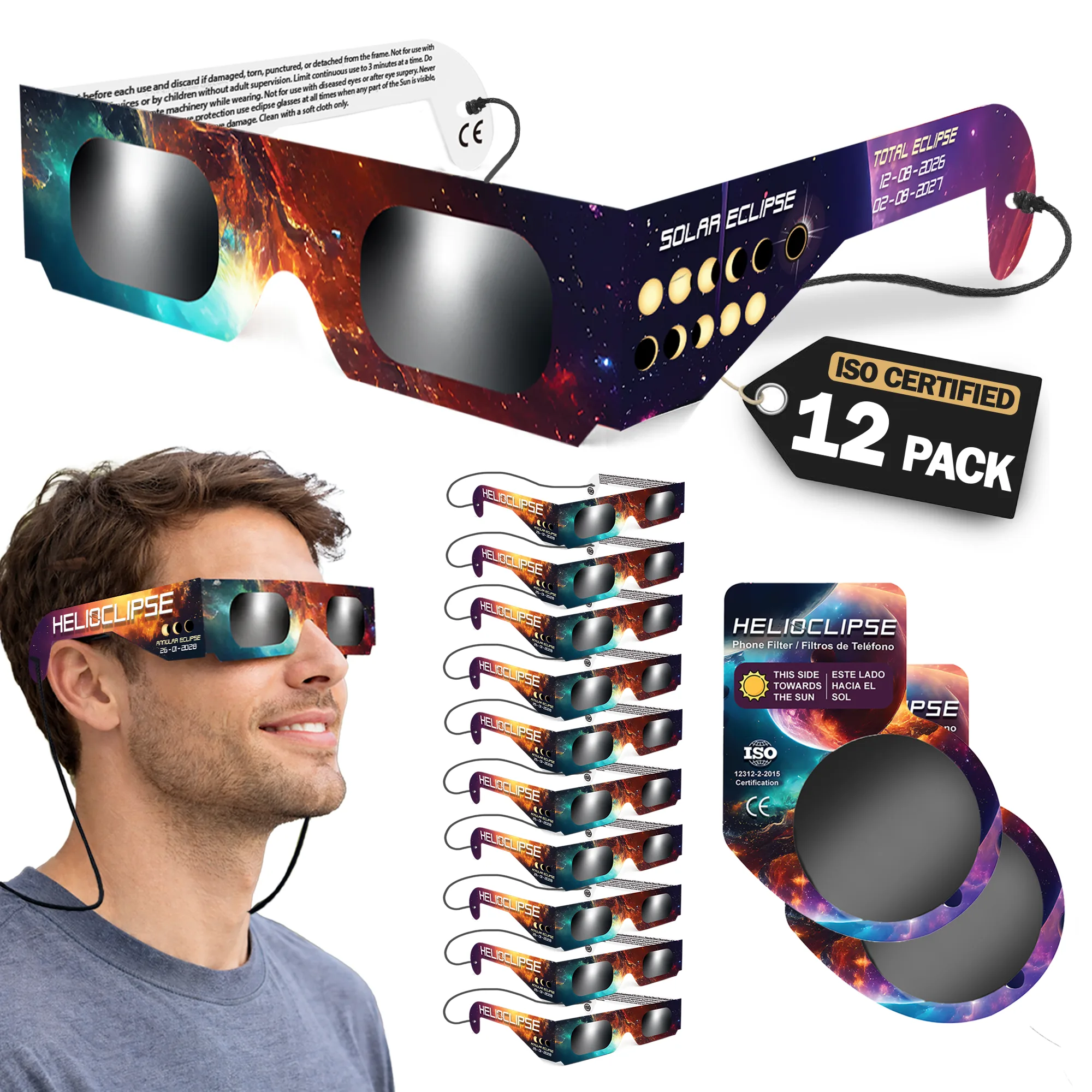
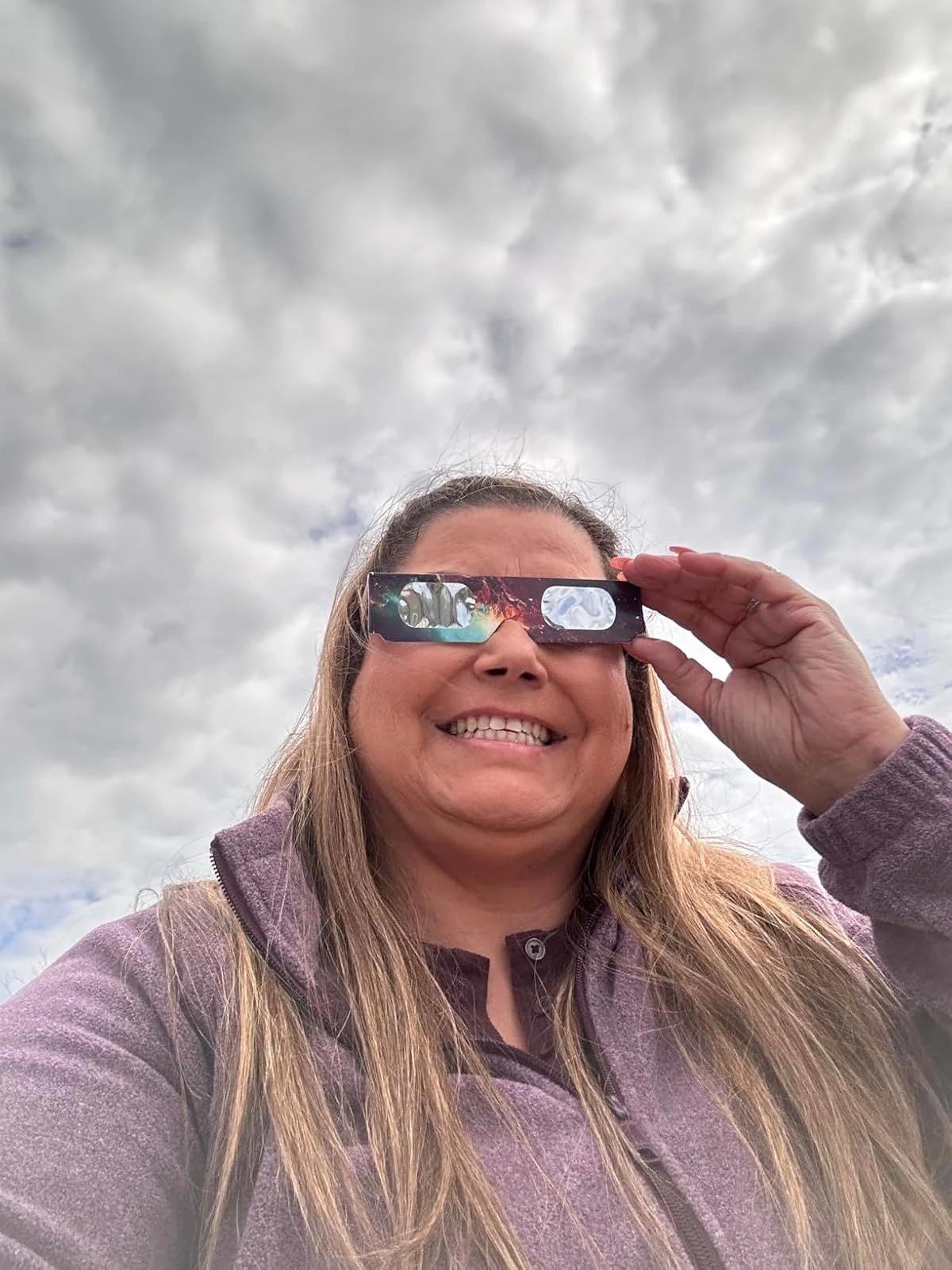
Arctic surroundings do not change solar safety. During every partial phase, look directly at the Sun only through a suitable solar viewer conforming to ISO 12312-2. Ordinary sunglasses are not sufficient. Inspect viewers in good light before the trip and again before use; discard any with torn frames, scratches, punctures, loose filter material or water damage.
Only observers confirmed to be inside the path may remove their viewers during the brief interval when the Moon completely covers the Sun’s bright face. Replace them as soon as even the smallest bright point reappears. In Nuuk and every other partial-only location, there is no glasses-off phase at all. Our first-timer guide explains when eclipse glasses stay on and when they may come off.
Wind adds a practical complication. Secure schedules, lens caps and other loose equipment, but never improvise by taping damaged eclipse viewers to your face. Help children fit their viewers before looking upward, and have them turn away from the Sun before removing them. If the deck is moving, stand or sit securely rather than walking while looking through a viewer.
Cameras, binoculars and telescopes need correctly fitted solar filters mounted over the front aperture during partial phases. Eclipse glasses worn over your eyes do not make it safe to look through unfiltered magnifying optics; concentrated sunlight can damage the viewer and your eyes. Ship movement and gusts make a secure filter attachment especially important. If you have not rehearsed the filter sequence with an experienced solar observer, watching totality without a telescope is the wiser choice.
Shopping language can be confusing. Phrases such as approved solar eclipse glasses or eclipse glasses nasa approved should not be treated as proof of safety because NASA does not approve particular viewer brands. Instead, check the manufacturer information, usage instructions, condition and credible evidence behind products described as solar eclipse glasses iso 12312-2 certified. Helioclipse’s solar eclipse glasses are the practical item to organise early for your family or expedition group, rather than hoping suitable viewers will be available in a remote departure port.
A realism checklist before you commit
The phrase viewing from greenland and the arctic: logistics, daylight, and realism should lead to concrete answers, not just dramatic photographs. Before paying a final balance, make sure your party can answer these questions:
- Where is the planned eclipse position? Record coordinates or a defined operational area, not merely “Greenland.”
- Is it inside totality? Check the position independently on a current map and note the expected duration.
- What is the Sun’s direction and altitude? Around Scoresby Sund, expect roughly 25 degrees above the west-southwest, but verify the exact site.
- What can force an itinerary change? Ask specifically about sea ice, wind, swell, fog, wildlife procedures and landing restrictions.
- Who makes the weather decision? Clarify how meteorological, eclipse and navigation expertise will be combined.
- Which time standard is official aboard ship? Put local time and UTC on the same final schedule.
- Can everyone tolerate the trip? Consider seasickness, cold, walking surfaces, medical needs and communications—not just the eclipse duration.
- Are your viewers and optical filters ready? Pack certified viewers in protective, dry storage and carry spares.
- Would the voyage still feel worthwhile under cloud? If the honest answer is no, Greenland may be the wrong risk profile.
Tell friends and family early if you plan to make the journey. Expedition capacity is limited, but urgency should never replace due diligence. Compare contracts, insist on specific operational answers and remember that no responsible operator can guarantee a clear Sun.
Quick answers to timing mix-ups
The relevant event is the total solar eclipse of August 12, 2026. It should not be confused with a February eclipse or with the 2024 North American total eclipse. A question such as “What time is the February 17 solar eclipse?” refers to a different event and cannot be answered with the Greenland circumstances in this guide.
For eastern Greenland, totality occurs in the late afternoon under the local time labels used in published guides. Nordvestfjord is commonly listed near 4:32 p.m., with nearby Scoresby Sund estimates around 4:36 p.m.; the exact instant changes with position. Because local time conventions and onboard clocks can differ, retrieve the circumstances for your actual coordinates and confirm the conversion with the operator.
This is why a location-specific map matters more than a generic countdown. The sky does not care what time zone a passenger’s phone selected after the last port call.
Frequently asked questions
Where in Greenland can observers experience totality most fully in 2026?
Nordvestfjord in the Scoresby Sund fjord system is cited as a location close to the centerline, with approximately 2 minutes 16 seconds of totality around 4:32 p.m. under the local time convention used by the location guide. It is in remote East Greenland, so it should be approached as an expedition destination rather than a conventional city visit.
What time will the February 17 solar eclipse occur?
The excerpt does not cover a solar eclipse on February 17, so it does not provide a time for that event. Its timing information applies only to the August 12, 2026 eclipse, including an approximately 4:32 p.m. totality time at Nordvestfjord.
Can people in North America see the August 12, 2026 eclipse?
The excerpt describes the totality path crossing eastern Greenland, after the high Arctic and northern Russia, before continuing over the North Atlantic, western Iceland, and northern Spain. It does not provide viewing circumstances for North America beyond Greenland, so local visibility elsewhere cannot be confirmed from this information.
Will the August 12, 2026 eclipse be visible from the United States?
The excerpt does not state whether the eclipse will be visible from the United States. It identifies eastern Greenland as being within the path of totality and notes that the path continues across the North Atlantic toward western Iceland and northern Spain.
What practical realities should travelers consider for viewing the 2026 eclipse in Greenland and the Arctic?
Totality is limited to a narrow path across remote East and Northeast Greenland, and being elsewhere in Greenland does not guarantee a total eclipse; Nuuk, for example, is outside the path and has a partial eclipse. Travel may involve ships, ice, limited access, persistent daylight, and cloud uncertainty, so each proposed observation point should be checked to confirm that it lies inside the central path.
On-site next steps
- Plot your proposed ship position, Nuuk or another Arctic location in the Helioclipse Eclipse Explorer. Confirm total versus partial visibility, duration, solar direction and the local timeline.
- Read our August 12, 2026 planning guide before comparing Greenland with Iceland or Spain.
- Order and inspect ISO 12312-2 eclipse viewers well before departure. Carry them in dry, rigid protection and pack spares for your group.
Sources & further reading
- NASA Science: Total Solar Eclipse on August 12, 2026
- NASA Earth Observatory: Stops Along the Path of Totality
- Space.com: 15 expert-checked places to see the 2026 total solar eclipse in Spain, Iceland and Greenland
- Space.com: Eclipse chasers share insider tips, travel advice and skywatching secrets for the 2026 total solar eclipse
- Space.com: The biggest skywatching day of 2026 is coming
- NASA Science: Eclipses
- NASA Science: Eclipse Viewing Safety
- American Astronomical Society: How to View a Solar Eclipse Safely
- American Astronomical Society: About the ISO 12312-2 Standard for Solar Viewers
- American Astronomical Society: Solar Filters for Optics—Telescopes, Binoculars & Cameras